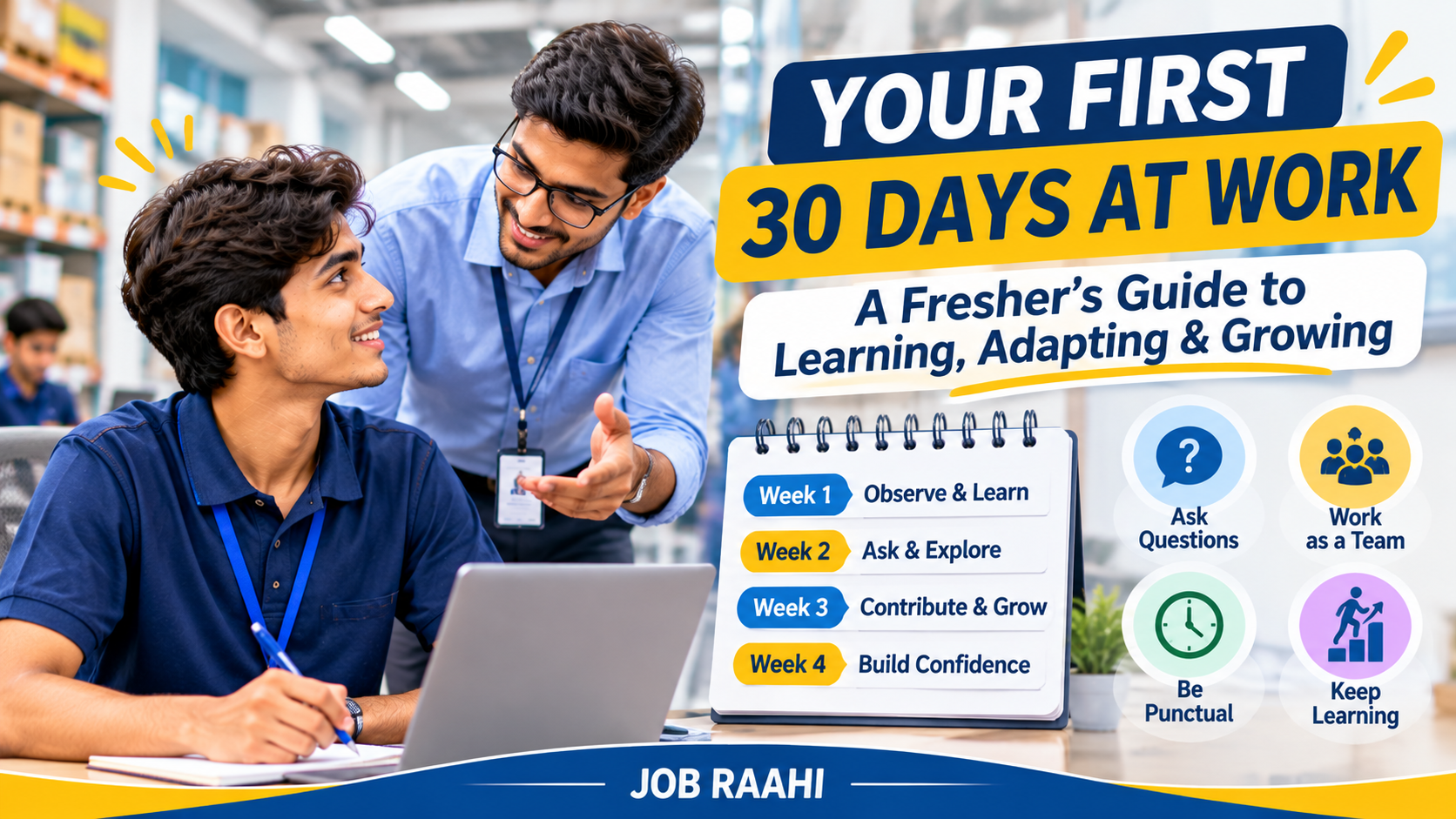
Getting your first job is a moment worth celebrating. After completing your education, vocational Training or job training, you finally have an opportunity to put your learning into practice.
But getting selected is only the beginning.
Your first few weeks at work can feel unfamiliar. You may need to understand new responsibilities, follow workplace rules, communicate with colleagues and learn processes that you have never experienced before. Even a job related to your course may involve practical situations that are different from what you studied.
The good news? You do not need to know everything on your first day.
What matters is how willing you are to learn, how responsibly you approach your tasks and how consistently you improve. Here is a practical guide to making your first 30 days at work count.
Your First Job Is Only the Beginning
Many freshers believe that once they get hired, they should immediately perform like experienced employees. This expectation can create unnecessary pressure.
A new workplace has its own systems, tools, working style and expectations. A retail employee needs to understand store operations and customer handling. A warehouse associate must learn inventory processes, safety instructions and order handling. A technical trainee may need time to become familiar with equipment and workplace procedures.
Your first month is an opportunity to understand these things.
Instead of trying to prove that you know everything, focus on becoming someone who is dependable, curious and willing to improve.
What Should You Focus on During Your First 30 Days?
Breaking your first month into four smaller stages can make the transition easier. The following is a practical guide, not a fixed company policy; your actual training and responsibilities will depend on your role and employer.
Week 1: Observe, Understand and Learn
Your first week should be about understanding the workplace.
Pay attention to how your team works, who assigns tasks, how instructions are communicated and what a normal working day looks like.
Start by understanding:
- Your job responsibilities and daily tasks.
- Reporting time, attendance rules and shift timings.
- Your reporting manager or supervisor.
- Workplace safety instructions and required protective equipment.
- The tools, machines, software or systems used in your role.
- The process to follow when you need assistance.
For example, if you have joined a warehouse, understand how goods are received, sorted, labelled and dispatched before trying to complete tasks independently.
Practical tip: Maintain a small notebook or digital note of important instructions. It can help you remember processes and avoid asking the same basic questions repeatedly.
Week 2: Ask Questions and Practise
Once you understand the basics, start participating more actively.
You may not understand every instruction immediately, and that is completely normal. Asking a relevant question is better than silently guessing and making an avoidable mistake.
Try to:
- Ask for clarification whenever an instruction is unclear.
- Practise tasks under appropriate supervision.
- Understand the quality standards expected in your role.
- Observe experienced team members and learn from their methods.
- Repeat important instructions in your own words to confirm understanding.
For instance, a fresher working in retail can observe how an experienced employee handles customer queries, checks product availability and completes billing.
Similarly, someone entering a technical role can learn how equipment is inspected and how safety procedures are followed before handling it independently.
Week 3: Take Responsibility for Small Tasks
By the third week, you may begin to feel more comfortable with routine responsibilities.
This is a good time to demonstrate that you can handle assigned work consistently.
Focus on:
- Completing familiar tasks with greater independence, where authorised.
- Following the correct process instead of taking shortcuts.
- Managing time and prioritising daily responsibilities.
- Informing your supervisor if you face a delay or difficulty.
- Checking your work before marking a task complete.
Remember, working quickly is useful only when the quality of work remains consistent.
A warehouse employee who completes orders accurately, a sales trainee who maintains proper customer records and a customer support executive who communicates clearly are all demonstrating workplace responsibility.
Week 4: Review Your Progress and Build Confidence
Your fourth week is an opportunity to understand how much you have learned.
Look back at your first day and compare it with your current performance. Are you more familiar with your responsibilities? Can you complete routine tasks more confidently? Do you understand whom to approach when you need help?
Ask your supervisor for feedback.
You could say:
“I have been learning the process over the last few weeks. Could you please share what I am doing well and what I should improve during the next month?”
Use the feedback to set two or three practical goals for the coming weeks.
Career readiness is not achieved in a single month. It develops through continued learning, communication, teamwork and the ability to apply feedback. The National Association of Colleges and Employers (NACE) identifies these as important career-readiness competencies. naceweb.org
Six Habits That Help Freshers Succeed at Work
Your technical knowledge is important, but your everyday work habits also influence how you grow in a new role.
1. Be punctual and dependable
Reach work on time, follow attendance procedures and complete assigned responsibilities. Reliability helps colleagues and supervisors plan their work.
2. Communicate clearly
You do not need perfect English to communicate effectively in every workplace. What matters is understanding instructions, sharing updates and asking questions clearly in a language suitable for the role and workplace.
3. Accept feedback positively
Feedback is not necessarily criticism. It can help you identify mistakes, improve your performance and understand what your workplace expects.
4. Work well with others
Every workplace involves teamwork. Respect colleagues, listen to instructions and offer support when appropriate.
5. Follow safety and quality procedures
Never compromise safety to finish a task faster. Follow the required instructions, use protective equipment where applicable and ask for guidance before operating unfamiliar equipment.
6. Keep learning
Be open to learning new tools, processes and technologies. Even after completing a vocational course, you will encounter workplace practices that require additional learning.
These habits also reflect widely recognised career-readiness areas such as professionalism, communication, teamwork, critical thinking and technology. naceweb.org
What If Your Workplace Is Different from Your Training Institute?
This is a common experience among freshers, particularly those completing ITI, Polytechnic, Diploma and other vocational courses.
Your institute may teach you the principles of electrical systems, machinery, computer applications or manufacturing processes. At work, however, you may need to use those skills while following production targets, customer requirements, company procedures and safety standards.
For example:
- A student who learns electrical wiring may need to follow site-specific safety procedures.
- A student trained in computer applications may need to use company-specific software.
- A student who studies retail operations may need to handle actual customer complaints and billing systems.
- A student trained in logistics may need to understand real-time inventory and dispatch processes.
Do not assume that the difference means your education was insufficient.
Your training gives you a foundation. Workplace exposure helps you understand how to apply it in real situations.
The World Economic Forum’s discussion of India’s school-to-work transition highlights the importance of practical exposure, internships, apprenticeships and experiential learning in preparing young people for employment. World Economic Forum
If you feel that you need additional guidance, the Government of India’s National Career Service also provides career guidance, vocational information and employability-related resources. Directorate General of Employment
Questions Every Fresher Should Feel Comfortable Asking
Asking questions shows that you want to understand your responsibilities. Here are some useful questions you can ask your supervisor:
| Situation | What you can ask |
|---|---|
| Understanding your role | What are my main responsibilities each day? |
| Learning a process | Could you demonstrate the correct way to complete this task? |
| Understanding quality | What should I check before marking this task complete? |
| Facing a problem | Whom should I contact if I face an issue? |
| Prioritising work | Which task should I complete first? |
| Seeking improvement | What is one area I should focus on improving? |
You do not have to ask all these questions at once. Ask them naturally when the situation calls for clarification.
Common Mistakes to Avoid During Your First Month
Even enthusiastic freshers can make mistakes while adjusting to a new workplace. Being aware of them can make your transition smoother.
- Pretending to understand everything: Ask for clarification instead of making assumptions.
- Ignoring instructions: Follow the correct process, especially for safety-related tasks.
- Hiding mistakes: Inform the appropriate person early so that the issue can be corrected.
- Comparing yourself with experienced employees: Focus on your own progress and learning.
- Avoiding communication: Share updates when a task is delayed or you need support.
- Expecting immediate growth: Build consistency and competence before worrying about rapid career progression.
Making a mistake does not automatically make you a poor employee. What matters is how responsibly you respond and what you learn from the experience.
Your First 30-Day Workplace Checklist
Use this simple checklist to review your progress at the end of your first month.
- I understand my main job responsibilities.
- I know my reporting manager or supervisor.
- I understand attendance, shift and workplace rules.
- I know the safety procedures relevant to my role.
- I can perform routine tasks with the required level of guidance.
- I know how to ask for help when something is unclear.
- I communicate important updates to my team.
- I have received feedback on my performance.
- I have identified areas where I need to improve.
- I have set goals for my next 30 days.
You do not need to master every responsibility within a month. Use this checklist to identify what you have learned and what still needs attention.
Turn Your First Opportunity into Long-Term Growth
Your first job is more than a source of income. It is an opportunity to understand how workplaces function, develop professional habits and discover your strengths.
Whether you begin as a retail associate, warehouse executive, field sales trainee, technician, customer support executive or in another entry-level position, every responsibility can teach you something valuable.
For freshers, the first 30 days are not about being perfect. They are about showing up, learning consistently, communicating honestly and becoming more confident with every passing week.
Your first job is the beginning. Make your first month count.