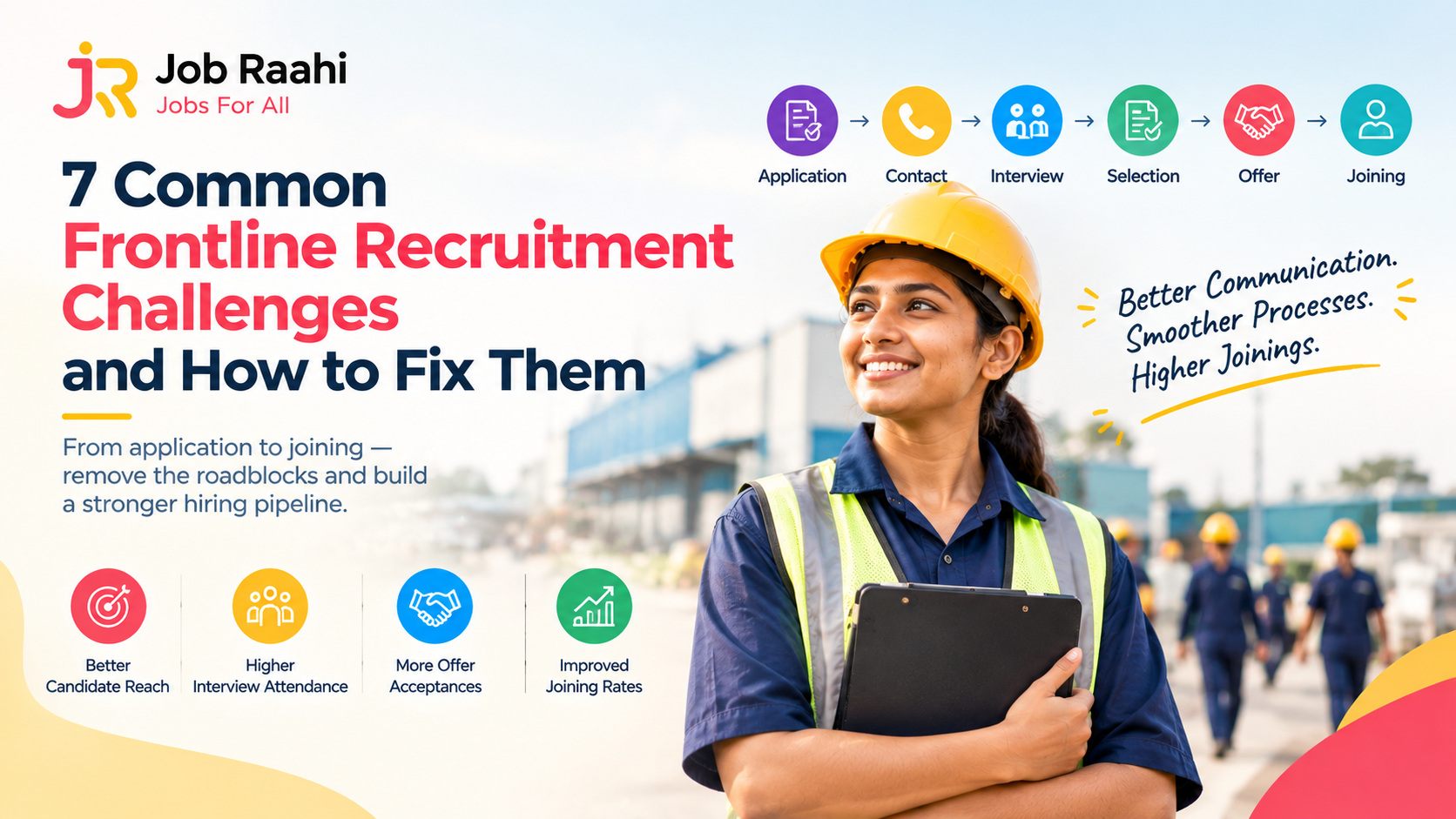
A candidate applies. A recruiter calls. An interview is scheduled. The candidate gets selected. And then… silence.
For employers hiring frontline employees at scale, this situation can feel frustratingly familiar.
The vacancy is live. Applications are coming in. Recruiters are making calls. Interviews are happening. Yet the final number of employees joining often falls short of the original target.
Where are the candidates getting lost?
The answer may not always be sourcing.
Sometimes, the bigger problem is the handoff between one stage of recruitment and the next.
At every step, a candidate has to move from interest to action. If that transition breaks down, even a strong sourcing campaign can struggle to deliver the required workforce.
For frontline, industrial, field and high-volume hiring, understanding these handoffs can help employers build a more reliable recruitment process.
Table of Contents
- What Is the Hiring Handoff Problem?
- Why Applications Don’t Automatically Become Hires
- The Five Handoffs Where Candidates Can Get Lost
- Why Frontline Hiring Needs a Different Approach
- Six Ways Employers Can Reduce Candidate Drop-Off
- Turn Recruitment Into a Connected Candidate Journey
- How Job Raahi Fits Into the Process
- Frequently Asked Questions
- Build a Stronger Frontline Hiring Pipeline
1. What Is the Hiring Handoff Problem?
Recruitment is often managed as a series of separate activities.
One team attracts candidates. Another screens applications. Recruiters schedule interviews. Hiring managers conduct assessments. HR handles offers and joining formalities.
Each activity may be working as intended, but the overall hiring process can still lose momentum.
Consider this example:
A company needs 200 production associates at a manufacturing facility.
The job campaign generates applications. Recruiters contact candidates and schedule interviews. A proportion of candidates attend, some are selected, and offers are issued.
However, several candidates may never attend interviews, some may decline offers, and others may accept but fail to join.
The original target remains 200, but the recruitment team has to source additional candidates to fill the gap.
This is the hiring handoff problem: the loss of candidate momentum as people move from discovery to application, screening, interview, selection and joining.
The solution isn’t necessarily to generate more applications. It is to understand where the process loses candidates and improve those transitions.
2. Why Applications Don’t Automatically Become Hires
Application volume is an important metric, but it is only one part of recruitment performance.
A high application count doesn’t automatically indicate that an employer has a strong hiring pipeline.
Candidates may apply without fully understanding the role. Some may not meet the requirements. Others may be unreachable, unavailable for interviews or unable to commute to the workplace.
Some may simply choose another opportunity.
For frontline recruitment, these factors can become especially important when employers are hiring across multiple locations or filling large numbers of similar positions.
A more useful way to view recruitment is:
Candidate Reach → Application → Contact → Qualification → Interview → Selection → Offer → Joining
Every stage has a conversion rate.
If a large proportion of candidates disappear at one particular stage, that is where the employer should investigate first.
3. The Five Handoffs Where Candidates Can Get Lost
Handoff 1: Job Visibility to Application
A candidate sees a vacancy but doesn’t apply.
Possible reasons include unclear salary information, a vague job location, confusing eligibility requirements or an application process that feels too complicated.
What employers can do: Communicate the role, location, salary range, shift requirements and application steps clearly wherever possible.
Handoff 2: Application to Recruiter Contact
A candidate applies, but the recruitment team cannot reach them.
The candidate may have entered incorrect contact details, become unavailable or received calls at inconvenient times.
What employers can do: Establish a consistent contact process, verify essential details and make it easy for candidates to respond or request a callback.
Handoff 3: Contact to Interview
The candidate is interested but doesn’t attend the interview.
The location may be inconvenient, the timing may conflict with existing work, or the candidate may not understand what to expect.
What employers can do: Share interview details early, confirm attendance, provide accurate directions and communicate the process in simple language.
Handoff 4: Selection to Offer Acceptance
A candidate is selected but declines the offer.
Compensation, shift timing, benefits, location or a competing opportunity may influence the decision.
What employers can do: Explain the complete employment proposition before selection whenever possible, and address important questions before issuing the offer.
Handoff 5: Offer Acceptance to Joining
The candidate accepts but doesn’t report on the joining date.
This can happen when the joining process is unclear, documentation is delayed, communication stops after the offer or the candidate accepts another role.
What employers can do: Maintain communication between offer acceptance and joining, provide a clear document checklist and confirm the reporting location, time and contact person.
These are potential causes, not universal explanations. Employers should use their own recruitment data and candidate feedback to identify the actual reasons for drop-off.
4. Why Frontline Hiring Needs a Different Approach
For certain frontline roles, candidates may be choosing between multiple nearby opportunities with similar salary ranges.
They may also need to consider practical factors such as:
- Daily travel and transport availability
- Shift schedules
- Take-home pay
- Joining timelines
- Family or personal responsibilities
- Documentation requirements
- Reliability of the employer and job information
A lengthy gap between application and recruiter contact can mean a candidate explores another opportunity. An unclear interview process can make attending feel less worthwhile. Uncertainty about the workplace can create hesitation before joining.
This is why frontline recruitment requires more than a steady supply of applications.
It requires clear communication, timely follow-up and a connected candidate journey.
5. Six Ways Employers Can Reduce Candidate Drop-Off
1. Treat Every Vacancy as a Complete Hiring Journey
Before launching recruitment, define what happens after a candidate applies.
Who contacts the candidate? How quickly should the first attempt happen? Who schedules interviews? Who follows up after selection?
Clear ownership reduces the chances of candidates getting stuck between teams.
2. Make Job Information Easy to Understand
Candidates should be able to understand the essential details without chasing the recruiter for basic information.
Include the job location, responsibilities, eligibility, compensation details, shift requirements and interview process wherever appropriate.
Clear information can help candidates make better-informed decisions and improve the relevance of applications.
3. Build a Consistent Follow-Up Process
A candidate who doesn’t answer one call isn’t necessarily uninterested.
Employers can establish reasonable follow-up procedures through appropriate channels, taking candidate consent and communication preferences into account.
The aim is to make it easy for interested candidates to reconnect without overwhelming them with messages.
4. Reduce Unnecessary Waiting
Long gaps between application, screening, interview and offer can create opportunities for candidates to disengage.
Review how long each stage takes and identify avoidable delays, such as repeated data entry, unclear approvals or limited interview scheduling options.
A faster process is not about rushing decisions. It is about removing unnecessary friction.
5. Keep Candidates Informed After Selection
Communication should not end when the offer is accepted.
Provide clear joining instructions, required documents, reporting details and a contact person who can resolve questions.
For large hiring drives, standardised joining communication can help recruiters manage multiple candidates consistently.
6. Measure Conversion at Every Stage
Don’t track only the number of applications or vacancies filled.
Measure the movement between stages:
- Applications to successful contact
- Contacted candidates to qualified candidates
- Qualified candidates to interviews attended
- Interviews to selections
- Offers to accepted offers
- Accepted offers to actual joinings
Review the figures by role, location and recruitment source.
This helps identify whether the main challenge is candidate reach, screening, interview attendance, offer acceptance or joining.
6. Turn Recruitment Into a Connected Candidate Journey
A recruitment process works best when each stage supports the next.
Imagine a company hiring field technicians across several districts.
Instead of running separate, disconnected activities, the employer creates one connected process:
Step 1: Attract relevant candidates through job listings and targeted promotion.
Step 2: Capture applications and essential candidate details.
Step 3: Engage candidates through timely, appropriate communication.
Step 4: Qualify candidates against the role and location requirements.
Step 5: Coordinate interviews and assessments.
Step 6: Convert selected candidates into accepted offers and confirmed joinings.
Step 7: Learn from candidate drop-off and improve the next hiring cycle.
The benefit is visibility. Recruitment teams can see not only how many candidates entered the pipeline but also where progress slowed down.
7. How Job Raahi Fits Into the Process
Job Raahi focuses on frontline, entry-level, blue-collar, grey-collar, industrial, contractual and high-volume hiring.
For employers, reaching candidates is an important starting point. But candidate reach becomes more useful when it is connected to a clear recruitment process.
Job Raahi’s approach combines job posting with job marketing and candidate outreach to help employers promote opportunities to relevant audiences.
Depending on the campaign and available capabilities, this can include:
- Job posting: Publish frontline and high-volume vacancies.
- Candidate reach: Promote opportunities beyond passive job discovery.
- Digital job marketing: Support vacancy visibility through relevant campaigns.
- Multi-channel outreach: Use channels such as WhatsApp, RCS, SMS and email where appropriate.
- Candidate pipeline development: Help employers work towards a more consistent supply of relevant applicants.
These activities support the earlier stages of the hiring journey. Employers should also establish clear processes for screening, interviews, offer management and joining so that candidate interest can progress through the funnel.
The underlying principle is simple:
Generating candidate interest is one part of recruitment. Converting that interest into actual joinings requires a connected process.
8. Frequently Asked Questions
What is candidate drop-off in recruitment?
Candidate drop-off occurs when candidates stop progressing through the recruitment process, such as abandoning an application, missing an interview, declining an offer or not joining after acceptance.
Why do candidates drop out of frontline hiring processes?
Potential reasons include unclear job details, inconvenient interview schedules, salary mismatches, transport challenges, competing offers and delayed communication. Employers should examine their own data and candidate feedback rather than assume one cause applies everywhere.
How can employers improve interview attendance?
Employers can communicate interview details clearly, confirm attendance, provide accurate directions, offer practical scheduling options where possible and make it easy for candidates to ask questions.
What recruitment metrics should employers track?
Useful metrics include successful contact rate, qualification rate, interview attendance, offer acceptance, joining rate and time taken at each recruitment stage.
How can employers improve joining rates during bulk hiring?
Start with clear job information, a structured recruitment process, timely follow-ups, transparent offer details and consistent pre-joining communication. Analyse results by role and location to identify the biggest sources of drop-off.
9. Build a Stronger Frontline Hiring Pipeline
A recruitment campaign can generate hundreds or thousands of applications and still fall short of its workforce target.
The difference often lies in what happens after the candidate enters the pipeline.
Employers need to understand where candidates disengage, reduce avoidable delays and connect sourcing, communication, interviews, offers and joining into one coherent process.
At Job Raahi, we believe frontline hiring should move beyond simply publishing vacancies. Employers need practical ways to reach relevant candidates and build stronger hiring pipelines.
We Don’t Just List Your Jobs. We Market Them.
And the next step is making sure the right candidates can move from discovering an opportunity to taking it.
External Resources
For further reading on employment, workforce development and India’s labour market:
- International Labour Organization (ILO) — International research on employment and labour-market issues.
- India Employment Report 2024 — Research on youth employment, education and skills in India.
- Ministry of Labour & Employment, Government of India — Official information on labour and employment initiatives.
- Periodic Labour Force Survey, MoSPI — Official labour-force and employment statistics.