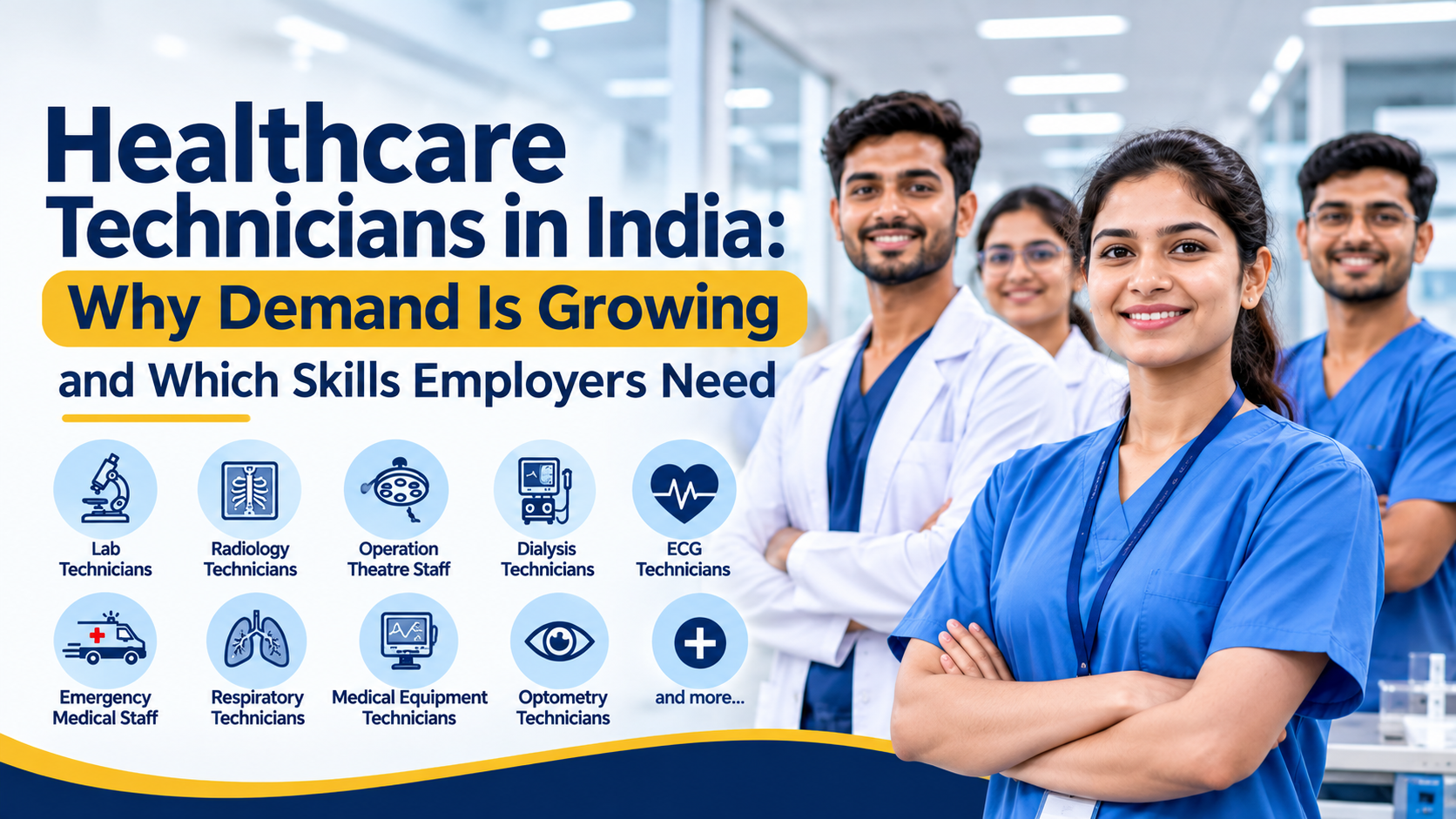
When people think about healthcare employment, doctors and nurses are usually the first professions that come to mind. However, behind every diagnostic test, medical scan, surgical procedure, dialysis session, and emergency response is a team of trained technical professionals.
Healthcare technicians play an essential role in keeping hospitals, diagnostic laboratories, imaging centres, and medical facilities operational. From analysing blood samples to operating specialised medical equipment, these professionals support the delivery of healthcare services across India.
As healthcare infrastructure expands and medical technology becomes more advanced, the need for trained healthcare technicians and allied health professionals is receiving increasing attention.
For hospitals, diagnostic chains, and healthcare employers, the challenge is no longer limited to recruiting doctors and nurses. Finding qualified technical and operational personnel is also becoming an important workforce planning priority.
So, which healthcare technician roles are in demand in India? What skills do employers need? And how can organisations prepare for the changing healthcare workforce?
Let’s explore.
Why Is Demand for Healthcare Technicians Increasing in India?
India’s healthcare sector is evolving. Hospitals are expanding, diagnostic services are becoming more accessible, and specialised medical procedures increasingly depend on trained technical personnel.
Several factors are contributing to the demand.
1. Expansion of Hospitals and Healthcare Infrastructure
The growth of hospitals, specialty clinics, nursing homes, and healthcare facilities creates demand for professionals who support daily medical operations.
Every additional diagnostic department, operation theatre, imaging facility, or critical care unit requires appropriately trained personnel.
This creates employment opportunities across technical and support functions, including laboratory operations, radiology, anaesthesia technology, patient care, and medical equipment management.
2. Increasing Dependence on Diagnostic Services
Healthcare decisions increasingly depend on accurate diagnostic information.
Blood tests, pathology investigations, imaging procedures, and specialised laboratory tests require trained professionals who can handle samples, operate equipment, follow testing protocols, and maintain quality standards.
As diagnostic networks expand beyond major metropolitan areas, the need for qualified medical laboratory and imaging professionals also becomes more important.
3. Growth in Chronic and Lifestyle-Related Conditions
Long-term health conditions often require repeated testing, monitoring, rehabilitation, and follow-up care.
This increases the importance of diagnostic laboratories, dialysis facilities, imaging centres, physiotherapy departments, and other specialised healthcare services.
The Ministry of Health and Family Welfare has also highlighted the growing demand for allied health professionals in areas such as diagnostics, imaging, physiotherapy, emergency care, and anaesthesia technology. <a href=”https://www.pib.gov.in/PressReleasePage.aspx?PRID=2236913&lang=2®=48“>Read the government’s discussion on scaling up allied health professionals.</a>
4. Adoption of Advanced Medical Technology
Modern healthcare facilities use specialised equipment for diagnosis, treatment, monitoring, and patient management.
Operating this equipment requires professionals with technical knowledge and practical training.
Examples include:
- MRI and CT imaging systems.
- Digital radiography equipment.
- Laboratory analysers.
- Dialysis machines.
- Ventilators and patient monitoring systems.
- Anaesthesia and operation theatre equipment.
Technology adoption is changing the skill requirements of healthcare employers. Technical knowledge, equipment handling, safety practices, and the ability to follow standard operating procedures are increasingly important.
5. Expansion Beyond Major Metropolitan Cities
Healthcare services are not limited to large cities such as Delhi, Mumbai, Bengaluru, or Hyderabad.
Hospitals, diagnostic centres, speciality clinics, and healthcare networks are expanding into smaller cities and emerging urban centres.
This creates opportunities for healthcare technicians across different regions while also presenting employers with a recruitment challenge: finding qualified professionals close to their facilities.
10 Healthcare Technician Roles in Demand
Healthcare technicians work across several departments. Their responsibilities and qualification requirements vary depending on the role and the type of medical facility.
Here are ten important technical and allied healthcare job categories employers should understand.
1. Medical Laboratory Technicians
Medical laboratory technicians support diagnostic services by collecting, preparing, processing, and analysing clinical samples under appropriate professional supervision.
Typical responsibilities:
- Handling blood, urine, and other clinical samples.
- Operating laboratory equipment.
- Performing assigned diagnostic procedures.
- Maintaining laboratory records.
- Following hygiene, safety, and quality protocols.
Common employers: Hospitals, pathology laboratories, diagnostic chains, and specialised testing facilities.
2. Radiology and Imaging Technicians
Radiology and imaging professionals support diagnostic procedures using medical imaging equipment.
Their work may involve X-ray, CT, MRI, mammography, and other imaging technologies, depending on their training and professional scope.
Typical responsibilities:
- Preparing patients for imaging procedures.
- Operating assigned imaging equipment.
- Following radiation safety protocols.
- Maintaining imaging records.
- Coordinating with radiologists and other medical professionals.
Common employers: Multispecialty hospitals, imaging centres, diagnostic chains, and specialty clinics.
3. Operation Theatre Technicians
Operation theatre technicians help prepare and maintain the environment required for surgical procedures.
Typical responsibilities:
- Preparing operation theatre equipment.
- Arranging instruments and supplies.
- Maintaining sterile conditions.
- Assisting the surgical team within their scope of practice.
- Following infection prevention protocols.
Common employers: Hospitals, surgical centres, and specialty healthcare facilities.
4. Dialysis Technicians
Dialysis technicians support the operation of dialysis equipment and assist with treatment-related procedures under appropriate clinical supervision.
Typical responsibilities:
- Preparing dialysis equipment.
- Checking equipment and supplies.
- Supporting patient preparation.
- Monitoring assigned parameters.
- Maintaining treatment records and hygiene standards.
Common employers: Hospitals, dialysis centres, and specialised kidney care facilities.
5. ECG and Cardiovascular Technicians
These professionals support cardiac diagnostic and monitoring services.
Depending on their qualifications, they may work with ECG, echocardiography, and other cardiovascular diagnostic technologies.
Typical responsibilities:
- Preparing patients for diagnostic procedures.
- Operating assigned diagnostic equipment.
- Recording test information.
- Maintaining equipment and patient records.
- Supporting clinical teams during investigations.
Common employers: Cardiology departments, hospitals, diagnostic centres, and cardiac care facilities.
6. Emergency Medical Technicians
Emergency medical technicians support pre-hospital emergency response and patient transportation.
Their responsibilities depend on their training, certification, and applicable clinical protocols.
Typical responsibilities:
- Providing emergency response support.
- Assessing patients within their permitted scope.
- Assisting with patient stabilisation.
- Supporting ambulance operations.
- Coordinating with emergency medical teams.
Common employers: Ambulance service providers, emergency response organisations, hospitals, and healthcare networks.
7. Anaesthesia Technicians
Anaesthesia technicians support anaesthesia-related equipment, supplies, and preparation in clinical settings.
Typical responsibilities:
- Preparing anaesthesia equipment.
- Checking assigned equipment and supplies.
- Supporting the anaesthesia team.
- Maintaining equipment readiness.
- Following infection control and safety procedures.
Common employers: Hospitals, operation theatres, and specialised surgical facilities.
8. Medical Equipment Technicians
Medical equipment technicians help maintain, inspect, troubleshoot, and support the safe operation of medical devices.
Some positions require biomedical engineering qualifications or specialised equipment training.
Typical responsibilities:
- Performing equipment inspections.
- Supporting preventive maintenance.
- Identifying technical issues.
- Coordinating equipment repairs.
- Maintaining maintenance records.
Common employers: Hospitals, medical equipment companies, healthcare technology providers, and equipment maintenance service organisations.
9. Respiratory Technicians
Respiratory technology professionals support respiratory care and related equipment in healthcare facilities.
Typical responsibilities:
- Supporting respiratory assessment and monitoring.
- Handling assigned respiratory care equipment.
- Assisting with ventilator-related procedures within their scope.
- Maintaining equipment and patient records.
- Following clinical safety protocols.
Common employers: Intensive care units, hospitals, pulmonary care centres, and specialised respiratory facilities.
10. Optometry and Ophthalmic Technicians
These professionals support eye care and vision-related services.
Depending on their qualifications and professional role, they may assist with vision testing, diagnostic equipment, and ophthalmic procedures.
Typical responsibilities:
- Conducting assigned vision-related tests.
- Preparing patients for examinations.
- Operating relevant diagnostic equipment.
- Maintaining patient records.
- Supporting ophthalmologists and optometrists.
Common employers: Eye hospitals, optical care networks, ophthalmology clinics, and diagnostic facilities.
What Does Government Recognition Mean for Healthcare Technician Careers?
An important development in India’s healthcare workforce is the formal recognition and regulation of allied and healthcare professions.
The National Commission for Allied and Healthcare Professions (NCAHP) Act, 2021 provides a statutory framework covering recognised allied and healthcare professions.
The official framework includes categories such as:
- Medical Laboratory and Life Sciences.
- Medical Radiology, Imaging and Therapeutic Technology.
- Anaesthesia and Operation Theatre Technology.
- Emergency Medical Technology.
- Dialysis Therapy Technology.
- Respiratory Technology.
- Medical Equipment Technology.
- Health Information Management.
The government has also been working on standardised education, registration, and professional competency requirements.
In July 2026, the Ministry of Health and Family Welfare announced that competency-based curricula had been finalised across multiple allied healthcare disciplines. It also highlighted the Budget 2026 announcement to add 100,000 allied health professionals over the next five years. <a href=”https://www.pib.gov.in/PressReleasePage.aspx?PRID=2292345&lang=2®=48“>Read the official announcement.</a>
This is an important signal for employers and training institutions: healthcare workforce development is receiving greater policy attention, and professional training standards are becoming increasingly important.
Employers should verify the applicable qualifications, registrations, and professional scope for each position before recruitment.
What Skills Do Healthcare Employers Look For?
A candidate’s qualification is important, but healthcare employers also need professionals who can work safely and reliably in clinical environments.
Some important skills include:
1. Technical proficiency: Ability to operate assigned equipment and follow relevant procedures.
2. Patient handling: Professional communication and appropriate interaction with patients.
3. Hygiene and infection control: Understanding of sanitisation, protective equipment, and safe handling practices.
4. Documentation: Maintaining accurate test records, equipment logs, and patient-related information.
5. Attention to detail: Following instructions and identifying inconsistencies in routine procedures.
6. Team coordination: Working effectively with doctors, nurses, technicians, and administrative teams.
7. Digital familiarity: Comfort with hospital information systems, laboratory information systems, and digital records where relevant.
8. Shift flexibility: Ability to work according to the operational requirements of the healthcare facility.
Technical qualifications and practical competency should always be assessed together.
Why Is Healthcare Technician Recruitment Challenging?
Even when healthcare employers have access to a large candidate market, recruiting suitable technical personnel can be difficult.
1. Qualification and Skill Mismatch
A candidate may hold a diploma or certificate but lack the practical experience required for a particular department or equipment.
Employers need to evaluate actual competencies instead of relying only on qualification titles.
2. Limited Availability in Certain Locations
Specialised technicians may be concentrated around large hospitals and metropolitan healthcare clusters.
Hospitals in smaller cities may need to widen their recruitment searches or develop relationships with training institutions.
3. Competition Between Healthcare Employers
Hospitals, diagnostic chains, specialty clinics, and other healthcare providers may compete for professionals with similar qualifications.
This can make it difficult to fill urgent or recurring technical vacancies.
4. Shift-Based Operations
Many healthcare facilities operate around the clock.
Employers need candidates who understand the role’s working hours, shift arrangements, and operational responsibilities before accepting an offer.
5. Training and Experience Requirements
Some roles require practical exposure to specialised equipment, clinical procedures, and safety protocols.
Employers may need to invest in structured induction and supervised training for candidates who meet the educational requirements but need additional workplace exposure.
How Can Hospitals Improve Healthcare Technician Hiring?
Healthcare recruitment requires more than posting vacancies and waiting for applications.
Employers can strengthen their recruitment process through a few practical steps.
1. Define role-specific qualifications: Clearly mention the required diploma, degree, registration, certifications, and experience.
2. Build relationships with training institutions: Connect with recognised colleges and skill development institutions to reach relevant graduating candidates.
3. Expand sourcing locations: Explore suitable candidates in nearby cities and healthcare education clusters.
4. Create a continuous candidate pipeline: Maintain visibility for recurring technical positions rather than beginning recruitment only when vacancies become urgent.
5. Assess practical skills: Use structured technical interviews and practical assessments appropriate to the role.
6. Communicate job conditions clearly: Explain salary, shift schedules, work location, department, and responsibilities before selection.
7. Track recruitment performance: Monitor applications, interview attendance, offer acceptance, joining rates, and early attrition.
A structured approach can help healthcare employers improve recruitment planning while maintaining the professional standards required in medical environments.
How Digital Recruitment Can Support Healthcare Technician Hiring
As healthcare organisations expand across locations, traditional recruitment channels alone may not always provide sufficient reach.
Digital recruitment platforms can help employers promote vacancies, connect with prospective candidates, and maintain visibility for recurring requirements.
Job Raahi is a digital job board designed for frontline and mass hiring. Its platform can support healthcare employers recruiting for suitable technical and operational positions.
Employers can use Job Raahi to:
- Promote vacancies across relevant candidate markets.
- Improve visibility for recurring healthcare job openings.
- Support location-focused recruitment campaigns.
- Reach candidates through digital outreach channels, including WhatsApp, RCS Business Messaging, SMS, email, and AI-powered calling.
- Manage multiple job postings and ongoing workforce requirements.
Job Raahi offers free onboarding and job posting, with no additional marketing charges for its stated outreach campaigns.
For specialised healthcare positions, employers must still verify qualifications, registration, practical competency, and suitability for the specific clinical role. Digital reach supports sourcing; it does not replace professional screening.
The Future of Healthcare Technician Employment in India
Healthcare employment is becoming more diverse as the sector adopts new technology, expands diagnostic services, and strengthens specialised care.
The demand for trained allied healthcare professionals is receiving policy attention, while competency-based education and professional standards are becoming important parts of workforce development.
For students and job seekers, healthcare technology offers career pathways beyond conventional medical and nursing professions.
For employers, the priority will be to find appropriately qualified professionals, strengthen practical training, and create recruitment pipelines that can support expanding healthcare operations.
The organisations that plan their technical workforce requirements early will be better positioned to respond to changing healthcare needs.
Frequently Asked Questions
1. Which healthcare technicians are in demand in India?
Important technical and allied healthcare roles include medical laboratory technicians, radiology and imaging technologists, dialysis technicians, operation theatre technicians, ECG technicians, emergency medical technicians, anaesthesia technicians, and respiratory technologists.
Actual demand varies by location, employer, speciality, and qualification requirements.
2. What qualifications are required to become a healthcare technician?
Qualifications vary by profession. Common pathways include recognised diploma and undergraduate programmes in medical laboratory technology, radiology and imaging technology, operation theatre technology, dialysis therapy, and other allied health disciplines. Candidates should check the applicable regulatory and institutional requirements for their chosen profession.
3. Are healthcare technician jobs available outside metropolitan cities?
Yes. Hospitals, diagnostic centres, clinics, and specialised healthcare facilities in smaller cities and regional centres also employ technical professionals. The availability of particular roles depends on the local healthcare infrastructure.
4. What is the difference between a healthcare technician and an allied health professional?
Healthcare technician is a broad employment term commonly used for technical roles supporting medical services. Allied health professional is a recognised professional category under India’s NCAHP framework. The two terms can overlap, but they are not interchangeable in every context.
5. Is healthcare technology a good career option?
It can offer a specialised career pathway for individuals interested in science, medical equipment, diagnostics, and patient-support services. Career opportunities depend on the candidate’s qualifications, practical skills, professional requirements, and chosen specialisation.
Conclusion
India’s healthcare system depends on a much wider workforce than doctors and nurses alone. Medical laboratory professionals, imaging technicians, dialysis personnel, operation theatre technicians, and other allied healthcare professionals contribute to the daily functioning of hospitals and diagnostic facilities.
As healthcare infrastructure and technology evolve, the importance of qualified technical personnel will continue to receive attention.
For healthcare employers, the challenge is to identify the right qualifications, reach suitable candidates, and build a dependable recruitment pipeline.
For aspiring professionals, healthcare technology offers opportunities to build specialised careers while contributing to an essential public service.
The future of healthcare is not only about better medical technology. It also depends on the skilled people who know how to operate, maintain, and support it.
External resources to include
These are particularly useful because they are official or government-backed sources:
- Ministry of Health and Family Welfare – Steps Taken for Strengthening Allied Healthcare Workforce — Government initiatives and workforce development.
- NCAHP – Competency-Based DMLT Curriculum — Medical laboratory technology education standards.
- NCAHP – Medical Radiology and Imaging Technology Curriculum — Recent professional training and registration developments.
- Allied and Healthcare Professionals Registry – FAQ — Recognised categories and professions.
- WHO India – Health Workforce — Broader healthcare workforce context.