Tag: workforce Planning

  • How to Reduce Frontline Employee Attrition: 9 Practical Strategies for Employers

    How to Reduce Frontline Employee Attrition: 9 Practical Strategies for Employers

    Frontline employee attrition is one of the most persistent challenges for employers managing manufacturing units, retail operations, warehouses, facility management teams, and other high-volume workforces. When employees leave frequently, organisations must repeatedly recruit, onboard, and train replacements, increasing operational costs and putting additional pressure on existing teams.

    For many employers, the challenge is not simply finding enough candidates. It is finding the right workforce, setting realistic job expectations, improving the joining experience, and creating conditions that encourage employees to stay.

    So, how can businesses reduce frontline employee attrition?

    This guide explores nine practical strategies employers can use to improve workforce retention, strengthen recruitment processes, and build a more stable workforce.

    What Is Frontline Employee Attrition?

    Frontline employee attrition refers to the gradual reduction in an organisation’s frontline workforce when employees leave and are not immediately replaced. These employees may work directly in production, operations, customer service, warehousing, retail, maintenance, or other essential business functions.

    Attrition can occur when employees resign voluntarily, leave for better opportunities, relocate, or find that the job does not meet their expectations.

    In high-volume hiring environments, even a seemingly small increase in attrition can create significant operational challenges. Employers may struggle to maintain production schedules, meet service commitments, or keep shifts adequately staffed.

    Why Does Frontline Employee Attrition Happen?

    Before implementing retention strategies, employers need to understand why workers leave.

    Some common reasons include:

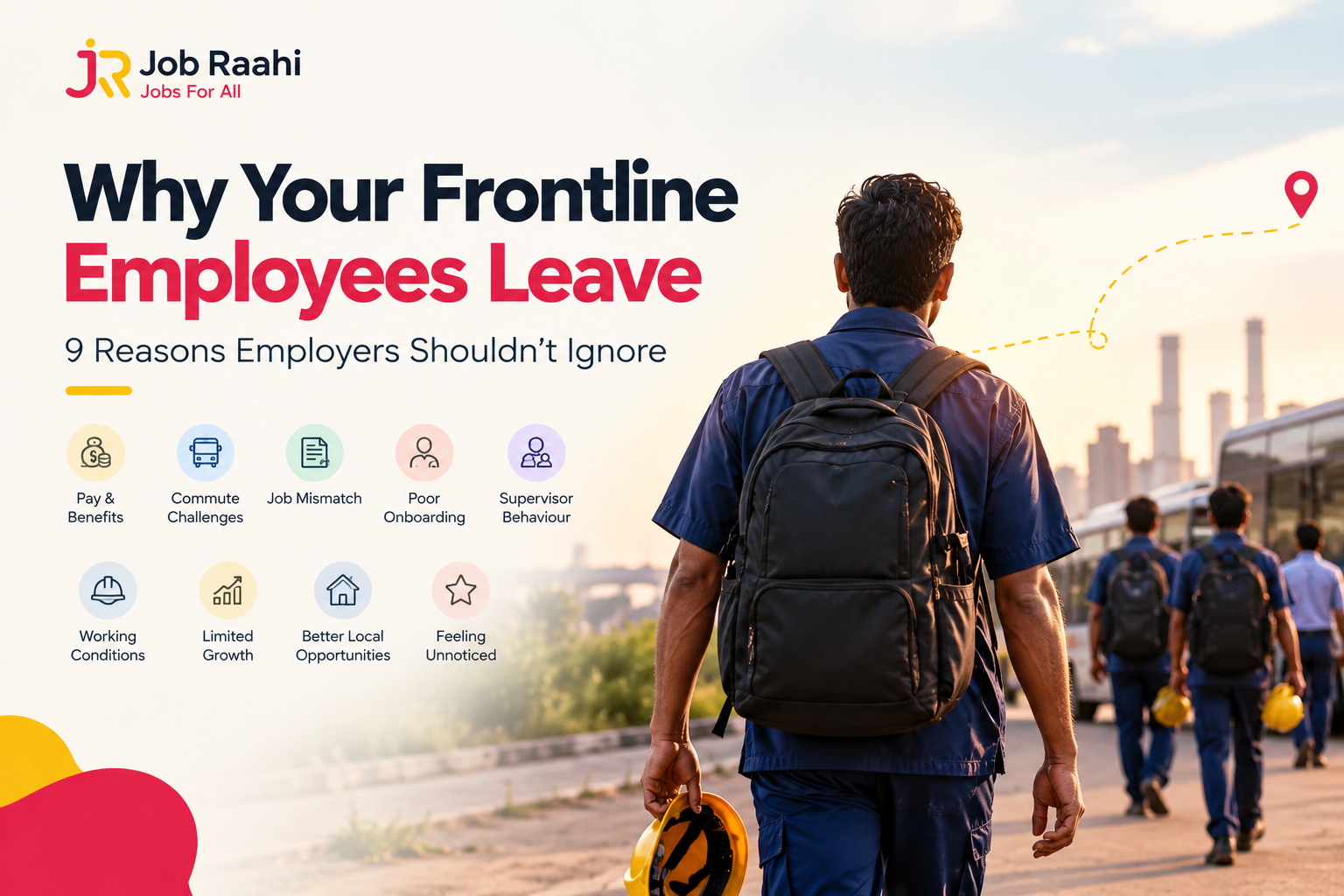
    • Better wage opportunities: Employees may move to another employer offering higher take-home pay or more predictable earnings.
    • Long commuting distances: Travel costs, unreliable transport, and lengthy commutes can make a job difficult to sustain.
    • Mismatch between job expectations and reality: Employees may discover that actual duties, working hours, targets, or compensation differ from what they were told during recruitment.
    • Unpredictable shifts and overtime: Difficult schedules can affect family responsibilities and personal well-being.
    • Workplace conditions: Poor supervision, unsafe environments, or a lack of basic facilities can encourage employees to leave.
    • Limited growth opportunities: Employees may move elsewhere when they cannot see a path to better responsibilities or earnings.
    • Delayed communication or salary payments: Uncertainty around wages, attendance, incentives, and payroll can undermine trust.
    • Social and location-based factors: Workers often make employment decisions based on family needs, local networks, transport access, and opportunities closer to home.

    These reasons may overlap. An employee might accept a slightly higher-paying job because it is closer to home, offers more predictable shifts, or allows them to work alongside people they already know.

    9 Practical Strategies to Reduce Frontline Employee Attrition

    1. Recruit From Locations Close to the Workplace

    Distance plays an important role in frontline employment decisions. A job that appears attractive on paper may become difficult to sustain if employees spend several hours commuting each day.

    Employers should evaluate where suitable workers live and identify recruitment catchment areas around their facilities.

    Practical steps include:

    • Targeting candidates from nearby towns and residential areas.
    • Considering transport availability before selecting recruitment locations.
    • Using location-based job promotion to reach relevant candidates.
    • Communicating shift timings and transport arrangements before joining.
    • Comparing retention across different sourcing locations.

    Hyperlocal recruitment can help employers reach workers for whom the workplace is more accessible. It does not guarantee lower attrition, but it gives employers another factor to consider when building a stable workforce.

    2. Set Clear Expectations Before Joining

    A mismatch between advertised conditions and the actual job can lead to early exits.

    During recruitment, candidates should receive clear information about:

    • Salary structure and expected take-home pay.
    • Shift timings, weekly offs, and overtime requirements.
    • Job responsibilities and physical demands.
    • Work location and reporting arrangements.
    • Contract terms, benefits, and eligibility requirements.
    • Joining dates and required documentation.

    Employers should also explain any variable incentives or attendance-linked payments rather than presenting them as guaranteed earnings.

    When candidates understand the job before accepting the offer, they can make better-informed decisions. This can reduce avoidable dropouts during onboarding and the first few weeks of employment.

    3. Review Wages and Benefits Against Local Market Conditions

    Compensation remains an important factor in workforce retention. Employers do not necessarily need to offer the highest salary in the market, but they should understand what comparable employers are offering in the same hiring location.

    Review the complete employment proposition, including:

    • Take-home salary.
    • Attendance and performance incentives.
    • Overtime payment practices.
    • Transport and meal facilities.
    • Leave and statutory benefits.
    • Salary payment timelines.

    A useful approach is to compare compensation across the locations from which the organisation recruits most frequently.

    If employees from one particular area consistently leave for nearby employers, local wage differences, transport expenses, and shift arrangements may deserve closer examination.

    4. Improve the First 30 Days of Employment

    The first few weeks can influence whether a new employee feels comfortable continuing in the job.

    A recruitment process should not end when the candidate accepts an offer or reports for duty. Employers should establish a structured joining and onboarding process.

    An effective first-month plan may include:

    Before joining: Confirm the joining date, documents, reporting location, salary terms, and contact person.

    First day: Explain workplace rules, safety procedures, attendance, payroll, and job responsibilities.

    First week: Assign a supervisor or experienced colleague who can answer questions and help the employee settle in.

    First 30 days: Check attendance, address concerns, and gather feedback about the work environment.

    Tracking early exits separately from overall attrition can help employers identify problems with recruitment, communication, onboarding, or supervision.

    5. Train Supervisors to Manage People Effectively

    Frontline employees often interact with their immediate supervisors more frequently than with the HR team. As a result, supervisor behaviour can influence the day-to-day employee experience.

    Employers should train supervisors to:

    • Communicate instructions clearly.
    • Treat employees consistently and respectfully.
    • Address grievances without unnecessary delays.
    • Explain performance expectations.
    • Recognise reliable attendance and good performance.
    • Escalate safety and workplace concerns promptly.

    Supervisors should also be encouraged to identify recurring problems instead of treating every resignation as an isolated incident.

    A pattern of employees leaving one shift, team, or reporting line may indicate an operational or management issue that needs attention.

    6. Understand Group Attrition and Worker Networks

    Frontline workers frequently learn about employment opportunities through friends, relatives, former colleagues, manpower vendors, and people from the same locality.

    These networks can support recruitment because workers may refer people they trust. However, they can also contribute to group attrition.

    For example, if several employees have joined through the same contractor or come from the same area, one worker moving to a different employer may influence others to explore that opportunity.

    Employers should not assume that shared backgrounds or union membership automatically lead to group resignations. Instead, they should examine actual exit patterns and the reasons employees provide.

    Useful actions include:

    • Tracking attrition by sourcing channel, contractor, location, and shift.
    • Conducting confidential exit interviews.
    • Identifying repeated concerns about wages, supervision, transport, or working conditions.
    • Maintaining regular communication with workers.
    • Developing multiple recruitment channels rather than depending on one source.

    The goal is not to discourage worker relationships. It is to understand workforce patterns and address common concerns before they lead to avoidable exits.

    7. Offer Visible Opportunities for Growth

    Frontline roles should not become dead ends for employees who want to improve their skills and earnings.

    Even when organisations cannot offer frequent promotions, they can provide clear progression opportunities.

    For example, an employee may progress from an entry-level production role to a skilled operator, team leader, machine operator, or supervisor after meeting defined training and performance requirements.

    Employers can support this progression through:

    • Practical skill development.
    • Cross-training for additional responsibilities.
    • Internal vacancy announcements.
    • Transparent promotion criteria.
    • Recognition for attendance, safety, and performance.
    • Training for employees interested in supervisory roles.

    When workers understand how they can improve their skills or earnings, they have a clearer reason to consider staying with the organisation.

    8. Use Workforce Data to Identify Attrition Patterns

    Many organisations monitor total headcount and monthly resignations but do not investigate where attrition is concentrated.

    A more useful approach is to segment the data and look for patterns.

    Track metrics such as:

    • Monthly and annual attrition rates.
    • First-30-day and first-90-day attrition.
    • Offer acceptance and joining rates.
    • Absenteeism and no-show rates.
    • Attrition by location, shift, department, and supervisor.
    • Attrition by recruitment channel or manpower vendor.
    • Average time taken to fill vacancies.
    • Recruitment cost per joining.

    For example, if a facility experiences frequent early exits among employees recruited from distant locations, transport and commuting conditions may require review. If resignations are concentrated in one department, the organisation may need to investigate supervision, workload, or working conditions.

    Data does not replace conversations with employees. It helps HR teams decide which questions to ask and where corrective action may have the greatest impact.

    9. Build a Continuous Recruitment Pipeline

    Even organisations with strong retention practices will experience some workforce movement. The objective is to reduce avoidable attrition while ensuring that essential operations do not suffer when vacancies arise.

    Instead of beginning recruitment only after several employees resign, employers can maintain a continuous pipeline of suitable candidates.

    This involves:

    • Keeping job descriptions and hiring requirements updated.
    • Building candidate pools for recurring roles.
    • Promoting vacancies in relevant hiring locations.
    • Maintaining communication with interested candidates.
    • Planning for seasonal demand and workforce expansion.
    • Tracking joining commitments and replacement requirements.
    • Using digital channels to improve vacancy visibility.

    A continuous pipeline helps HR teams respond more quickly when vacancies arise. It should complement retention initiatives, not replace them.

    How Job Raahi Can Support Frontline Recruitment

    Reducing attrition requires employers to address both sides of workforce management: retaining existing employees and sourcing suitable replacements when vacancies arise.

    Job Raahi is a digital job board designed for frontline and mass hiring. It helps employers promote vacancies and reach prospective candidates through a range of digital outreach channels.

    Its recruitment support includes:

    • Wider vacancy visibility: Promote job openings to expand the reach of recruitment campaigns.
    • Location-focused outreach: Support hiring campaigns aimed at relevant geographic areas.
    • Candidate communication: Use available channels such as WhatsApp, RCS Business Messaging, SMS, email, and AI-powered calling to support outreach.
    • High-volume job management: Manage multiple vacancies and recurring workforce requirements through the platform.
    • Recruitment pipeline development: Help employers maintain visibility for ongoing hiring needs rather than relying only on last-minute recruitment.

    Job Raahi offers free onboarding and job posting, with no additional marketing charges for the platform’s stated outreach campaigns.

    Employers should still assess candidate suitability, communicate job conditions accurately, and monitor joining and retention outcomes. A recruitment platform can support candidate reach, but long-term workforce stability also depends on compensation, management, working conditions, and employee experience.

    How to Measure Whether Attrition Is Improving

    A retention initiative should be evaluated against clear baseline metrics rather than assumptions.

    One important measure is the attrition rate:

    Attrition Rate (%) = (Number of employee exits during the period ÷ Average employee headcount during the period) × 100

    For example, if an organisation records 20 employee exits during a month and its average workforce during that month is 400, the monthly attrition rate is 5%.

    Employers should also measure early attrition, joining rates, absenteeism, and replacement hiring costs. Comparing these metrics before and after an intervention can help determine whether a change—such as improved transport, clearer job communication, or location-focused recruitment—is making a difference.

    Where possible, compare similar departments, locations, or hiring groups over the same period. This helps HR teams avoid attributing every change in attrition to a single initiative.

    Frequently Asked Questions

    1. What is the main cause of frontline employee attrition?

    There is no single cause across all organisations. Common factors include compensation, commuting distance, shift timings, workplace conditions, supervisor behaviour, and better local employment opportunities. Employers should analyse their own exit data and speak with employees to identify the most relevant factors.

    2. How can employers reduce early attrition?

    Employers can improve early retention by communicating job conditions accurately, confirming joining arrangements, providing structured onboarding, assigning supportive supervisors, and checking in with employees during their first 30 to 90 days.

    3. Does hyperlocal hiring reduce employee attrition?

    Hyperlocal hiring can improve access to jobs by reaching candidates closer to the workplace. It may reduce commuting-related barriers, but it does not guarantee lower attrition. Wages, working conditions, job expectations, and management practices remain important.

    4. How can HR teams identify group attrition?

    HR teams can review exit patterns by location, shift, department, recruitment channel, contractor, and supervisor. Exit interviews and confidential employee feedback can help explain whether workers are leaving for similar reasons or following opportunities through their professional and social networks.

    5. How can digital recruitment platforms help with frontline hiring?

    Digital recruitment platforms can improve vacancy visibility, expand candidate reach, support targeted outreach, and help employers manage recurring vacancies. Employers should evaluate platform performance using relevant metrics, including suitable applications, joining rates, time to fill, and cost per joining.

    Conclusion

    Frontline employee attrition is not simply a recruitment problem. It is a workforce management challenge influenced by compensation, location, job expectations, workplace relationships, supervision, and growth opportunities.

    Employers can make meaningful progress by understanding why workers leave, improving the first few weeks of employment, monitoring attrition patterns, and building a continuous recruitment pipeline.

    A more effective approach combines retention initiatives with smarter recruitment. By addressing the reasons employees leave while making vacancies easier for suitable candidates to discover, organisations can work toward a more reliable and sustainable frontline workforce.

    Looking to strengthen your frontline hiring process? Explore how Job Raahi can support vacancy promotion and workforce recruitment through its digital hiring platform.

    External Resources on Workforce Retention and Employment in India

    For further reading on employment trends, labour conditions, and worker welfare, explore these official resources:

    1. Periodic Labour Force Survey (PLFS) – Ministry of Statistics and Programme Implementation
      Explore official employment and labour force statistics that can help employers understand India’s changing employment landscape.
    2. Annual PLFS Reports – Directorate General of Employment
      Access annual reports on employment and labour force indicators to support workforce planning and recruitment research.
    3. Indian Labour Statistics – Labour Bureau
      Find government-published labour statistics relevant to understanding employment conditions and workforce trends.
    4. Code on Wages, 2019 – India Code
      Review the legal framework relating to wages and bonus provisions in India.
    5. Occupational Safety, Health and Working Conditions Code, 2020 – India Code
      Learn about the legal framework covering occupational safety, health, and working conditions.
    6. Safety and Health at Work – International Labour Organization (ILO)
      Explore international resources on workplace safety, prevention practices, and creating healthier working environments.

    These resources can help HR teams and employers strengthen their understanding of labour conditions, workplace standards, and workforce planning. While official labour statistics provide useful context, employers should also use internal exit interviews, employee feedback, and attrition data to identify the specific reasons workers leave their organisation.

  • Frontline Workforce Migration in India: Why Workers Move and What Employers Need to Know

    Frontline Workforce Migration in India: Why Workers Move and What Employers Need to Know

    India’s frontline workforce is constantly on the move. Workers relocate from villages to cities, travel between states for employment, move closer to industrial hubs and return to their hometowns when family or seasonal needs arise.

    For employers, this movement creates both an opportunity and a challenge. Migration expands the available talent pool, helping businesses find workers beyond their immediate location. At the same time, it can affect joining rates, workforce availability, employee retention and recruitment planning.

    From manufacturing plants and construction sites to facility management, retail and hospitality, understanding workforce migration is becoming increasingly important for employers that depend on frontline and high-volume hiring.

    But how much migration takes place in India, why do frontline workers move, and how can employers adapt their recruitment strategies?

    1. What Is Frontline Workforce Migration?

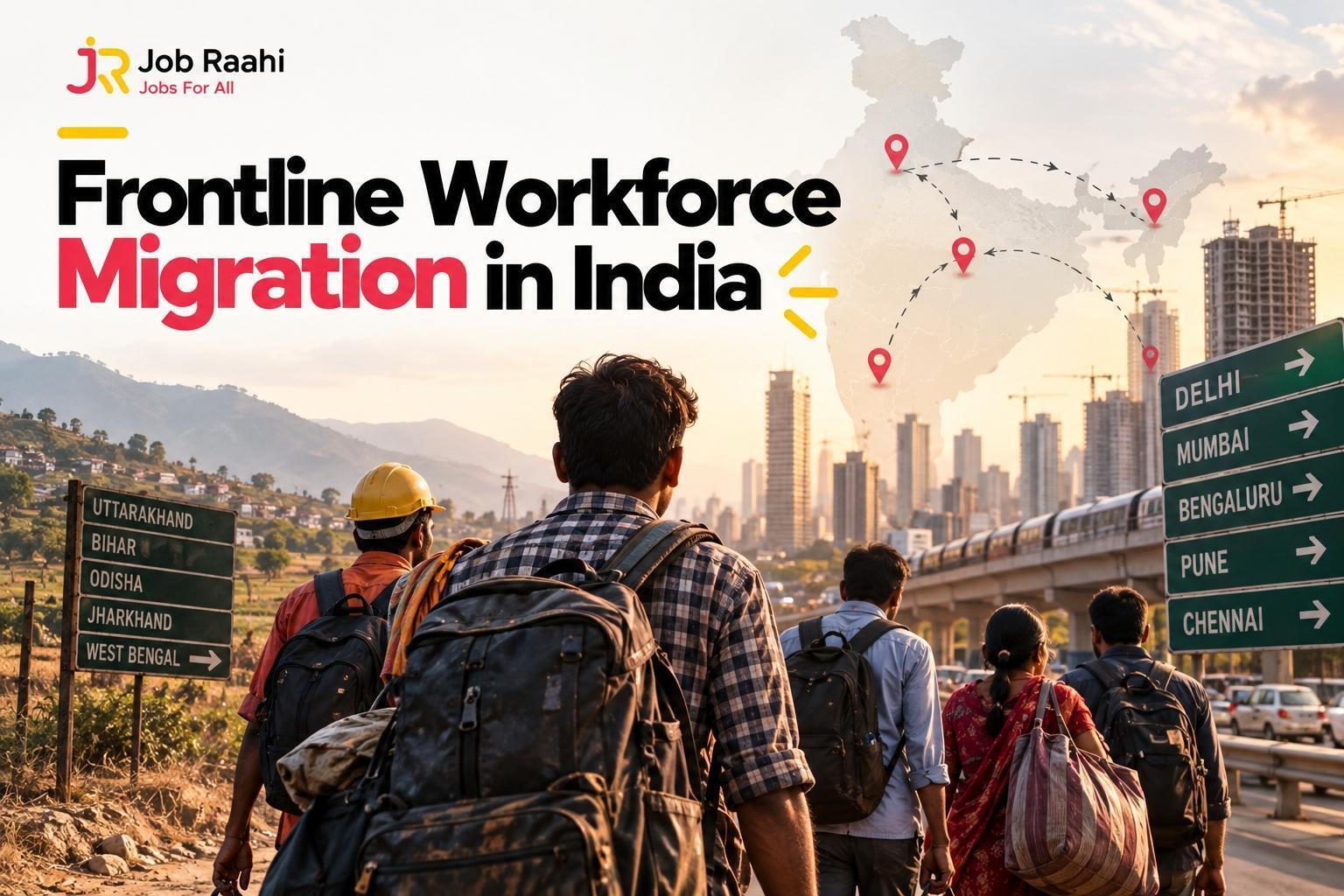
    Frontline workforce migration refers to workers moving from one location to another to find employment, improve their earnings or access better working opportunities.

    In India, this movement takes several forms.

    • Rural-to-urban migration: Workers move from villages or smaller towns to cities for better access to employment.
    • Inter-state migration: Workers move from one state to another to work in factories, construction, hospitality, services and other industries.
    • Seasonal migration: Workers relocate temporarily to take up work during particular periods of the year.
    • Circular migration: Workers move between their place of origin and their work location, often returning home periodically.
    • Local and regional migration: Workers shift between nearby districts, towns or industrial clusters to access more convenient or better-paying jobs.

    These categories can overlap. For example, a worker may migrate from Bihar to an industrial area in Haryana, work there for several months and return home before moving again for another opportunity.

    For employers, understanding these patterns is important because the workforce available at a particular location may change over time.

    2. How Much Workforce Migration Happens in India?

    India has a substantial history of internal migration, including migration for employment. However, there is no single current figure that accurately measures all frontline workers who migrate for jobs today.

    One important official reference is Census 2011. In a parliamentary response published in July 2023, the Ministry of Labour and Employment cited Census 2011 data reporting approximately 4.14 crore inter-state migrant workers in India. This is a historical census-based figure, not a current 2026 estimate and not a count exclusively of frontline workers. Source: Press Information Bureau, Government of India.

    The Census also provides detailed tables on migration by previous residence, duration of residence and reason for migration. These are useful for understanding movement patterns, but they should not be treated as a real-time count of workers available for hiring. Source: Census of India.

    What does this mean for employers?

    The key takeaway is not that every frontline vacancy can be filled through migrant labour. Rather, employers should recognise that their potential workforce may extend beyond the city or district where a facility is located.

    A manufacturing unit in an industrial cluster, for instance, may attract candidates from nearby districts as well as workers who have moved from other states. The mix will depend on the job, pay, accommodation, transport, local opportunities and individual circumstances.

    Employers should therefore evaluate migration patterns alongside local candidate availability, rather than assuming that recruitment must rely entirely on either local or migrant workers.

    3. Why Do Frontline Workers Migrate for Jobs?

    Workers rarely move for just one reason. Employment opportunities, family circumstances, living costs and the availability of suitable work can all influence their decisions.

    A. Better earning opportunities

    Workers may move to locations where they expect higher take-home earnings, more regular work or better opportunities to earn overtime and incentives.

    However, higher gross wages do not always translate into higher savings. Rent, food, commuting and travel home can reduce the financial benefit of relocating.

    B. Limited local employment options

    Some smaller towns and rural areas may offer fewer opportunities in particular occupations or industries. Workers with manufacturing, machine-operation, technical, security, housekeeping or hospitality skills may relocate to areas where employers need those capabilities.

    C. Industrial and infrastructure growth

    Factories, construction projects, industrial parks, commercial facilities and new business operations can attract workers to specific locations.

    When several employers recruit from the same catchment area, competition for candidates may increase, particularly for roles that require similar skills and offer comparable wages.

    D. Seasonal demand

    Certain businesses need additional staff during festive periods, tourism peaks, harvest-related activities or major production cycles.

    Workers may temporarily relocate to access these opportunities. Some return to their home locations when demand declines, while others continue working elsewhere.

    E. Family and personal circumstances

    Migration decisions are not always driven by wages. Workers may move to join family members, return home to provide care, respond to changes in household circumstances or seek employment closer to their families.

    Employers that understand these factors can design more realistic recruitment and retention practices.

    4. Which Industries Depend on Migrant Workers?

    The importance of migration differs by region, occupation and employer. Several frontline-intensive industries may recruit workers from outside their immediate hiring location.

    IndustryExamples of frontline rolesHow migration can affect hiring
    ManufacturingMachine operators, production workers, assemblers, packersPlants may need to recruit beyond the immediate industrial area
    ConstructionSite workers, helpers, skilled tradespeopleWorkforce availability may change with project locations and timelines
    Facility managementHousekeeping staff, security personnel, maintenance workersEmployers may need local or regional recruitment across multiple sites
    Warehousing and logisticsWarehouse associates, loaders, sortersDemand can rise around new facilities and peak business periods
    RetailStore associates, sales staff, stock handlersLocal availability and commuting distance can influence joining
    HospitalityHousekeeping, kitchen assistants, service staffTourism, events and seasonal demand may change staffing needs

    This table describes potential workforce patterns, not a ranking of industries by the number of migrant workers. Employers should validate the situation in their own locations before making staffing decisions.

    5. What Challenges Does Migration Create for Employers?

    Migration can expand the candidate pool, but it also introduces practical considerations that recruitment teams need to plan for.

    A. Uncertain joining rates

    A candidate may accept an offer but later reconsider because of relocation costs, accommodation concerns, family responsibilities or another opportunity closer to home.

    This makes it important to confirm joining intent and explain employment conditions before the candidate travels.

    B. Higher early-tenure attrition

    Workers who underestimate living expenses, travel time or the difficulty of living away from home may leave soon after joining.

    Employers should investigate whether early exits are linked to relocation challenges, job expectations, pay, supervision or working conditions rather than assuming migration itself is the cause.

    C. Accommodation and transportation

    For workers moving from another region, the availability and cost of safe accommodation and reliable transport can influence whether a job is practical.

    Where feasible, employers can provide accommodation, transport support or clear information about nearby housing and commuting options.

    D. Language and communication barriers

    Workers recruited from different regions may have different language preferences. Safety instructions, payroll explanations, workplace rules and grievance channels must be understandable to everyone.

    Using appropriate languages and visual instructions can improve communication and help new employees settle into the workplace.

    E. Recruitment competition

    Employers operating in the same industrial cluster may compete for similar workers. When candidates have several choices, unclear job information, slow hiring decisions or unreliable joining arrangements can make an employer less attractive.

    6. How Can Employers Adapt Their Hiring Strategies?

    The solution is not to avoid migrant hiring. It is to build recruitment processes that account for worker mobility and individual needs.

    1. Map the workforce catchment area

    Identify where successful employees currently live and where new hires have come from. Track commuting distances, transport options and the locations producing reliable joining and retention outcomes.

    This helps recruiters decide whether to prioritise nearby communities, neighbouring districts or a wider regional candidate pool.

    2. Be transparent about the job

    Before candidates accept an offer, explain the salary, take-home pay, shifts, weekly offs, overtime arrangements, job responsibilities, location and any deductions.

    For candidates relocating from another state, also explain accommodation availability, transport arrangements and the expected joining process.

    3. Reduce relocation friction

    Where business needs justify it, employers can explore transport support, temporary accommodation, joining assistance or partnerships with suitable accommodation providers.

    Even when financial support is not possible, providing accurate information before a candidate travels can prevent avoidable misunderstandings.

    4. Strengthen local recruitment

    Recruiting in nearby towns and communities may help employers reach workers who can commute without relocating.

    This can be particularly useful for roles where the required skills are locally available and the work schedule makes daily travel practical.

    5. Build regional talent pipelines

    For locations where local supply is insufficient, employers can establish repeatable recruitment channels in relevant districts or states.

    The process should include candidate screening, realistic job previews, joining confirmation and clear communication about travel and reporting arrangements.

    6. Improve the first 30 days

    Check in with new employees during their first week and throughout their first month. Ask about accommodation, commuting, shift schedules, workplace support and any mismatch between the job advertised and the job experienced.

    Early feedback allows HR teams to resolve practical issues before they become reasons for resignation.

    7. Track the right workforce metrics

    Review recruitment and retention data by hiring source, home location or district, role, site and length of service, while handling personal information responsibly.

    Useful measures include:

    • Offer-to-joining ratio.
    • Recruitment cost by hiring location.
    • Early-tenure attrition.
    • Retention at 30 and 90 days.
    • Absenteeism and vacancy fill time.
    • Reported reasons for declining offers or leaving.

    These metrics help employers identify which recruitment channels produce sustainable hiring outcomes, rather than focusing only on the number of candidates sourced.

    7. How Hyperlocal Hiring Can Help Build a More Stable Workforce

    Hyperlocal hiring focuses on reaching candidates who live in or near the area where a job is located.

    For some frontline roles, this approach can reduce the need for relocation and make daily commuting more manageable. It can also help employers connect with candidates who may not actively search on large national job portals.

    However, hyperlocal hiring is not a universal replacement for migrant recruitment. Some locations have limited local talent availability, and certain roles require skills that are more readily available elsewhere.

    A balanced strategy can combine:

    • Local recruitment for roles where nearby talent is available.
    • Regional recruitment for neighbouring districts and towns.
    • Inter-state recruitment when local supply is insufficient.
    • Clear joining support for candidates who need to relocate.
    • Consistent retention practices across all hiring sources.

    The goal is to match the recruitment approach to the actual needs of each location.

    8. How Job Raahi Supports Frontline Recruitment

    For employers managing high-volume frontline hiring, reaching relevant candidates in the right locations is an important part of workforce planning.

    Job Raahi is a digital job platform focused on frontline and mass hiring. Employers can publish vacancies and use recruitment marketing capabilities to improve job visibility among relevant candidate groups.

    Through location-focused recruitment and outreach channels such as WhatsApp, RCS, SMS, email and AI-powered calling, subject to applicable permissions and campaign requirements, employers can support candidate awareness and recruitment follow-up.

    For organisations hiring across multiple plants, facilities or service locations, a more structured digital recruitment process can complement local sourcing and regional hiring pipelines.

    The larger opportunity is to connect workforce mobility with smarter recruitment planning: understand where suitable candidates are located, communicate job details clearly and make the path from application to joining as straightforward as possible.

    9. Frequently Asked Questions

    What is frontline workforce migration?

    It is the movement of workers between villages, towns, cities or states to access employment. It can be temporary, seasonal, circular or long-term.

    How many inter-state migrant workers are there in India?

    The Ministry of Labour and Employment cited a Census 2011 figure of approximately 4.14 crore inter-state migrant workers in a parliamentary response published in 2023. This is a historical figure and should not be presented as a current estimate for 2026 or as a count exclusively of frontline workers.

    Why do frontline workers migrate for employment?

    Common reasons include better earning opportunities, limited local job availability, industrial growth, seasonal demand and personal or family circumstances. The reasons vary across workers and regions.

    Does hiring migrant workers lead to higher attrition?

    Not automatically. Retention depends on factors such as compensation, working conditions, accommodation, commuting, family circumstances, job expectations and management. Employers should use their own workforce data to identify the causes of turnover.

    Can hyperlocal hiring reduce dependence on migrant recruitment?

    It can help when suitable candidates are available near the workplace. Where local supply is insufficient or specialised skills are required, regional and inter-state recruitment may still be necessary.

    10. Conclusion: Build a Workforce Strategy Around Worker Mobility

    Migration is an important part of India’s employment landscape, but it should not be treated as a single, uniform trend. Frontline workers move for different reasons, follow different patterns and make employment decisions based on their individual circumstances.

    For employers, the most effective response is to understand local labour availability, recruit across appropriate catchment areas, communicate job conditions transparently and remove avoidable barriers to joining and retention.

    By combining hyperlocal recruitment with well-planned regional sourcing, employers can build a more resilient frontline hiring strategy—one that responds to workforce movement rather than being caught off guard by it.

    Looking to reach frontline candidates across relevant locations? Job Raahi helps employers improve job visibility and organise high-volume recruitment through a digital hiring platform built for frontline workforce needs.

    external links for further study

  • The Hidden Cost of Unfilled Frontline Positions: What Employers Often Overlook

    The Hidden Cost of Unfilled Frontline Positions: What Employers Often Overlook

    When a company has ten vacant positions, the immediate concern is usually straightforward: the recruitment team needs to find ten people.

    But what happens while those positions remain unfilled?

    A warehouse may need existing employees to handle additional work. A retail store may struggle to maintain its usual service levels. A hospitality team may have to manage busy shifts with fewer people than planned. A delivery operation may find it harder to meet daily requirements.

    The vacancy may appear as a number on an HR dashboard, but its effects can reach far beyond the recruitment department.

    The real cost of an unfilled position is not just the cost of hiring someone. It is also the operational impact of working without that person.

    For employers managing frontline teams, understanding this difference can lead to better workforce planning, smarter recruitment decisions and more effective use of hiring budgets.

    Hidden cost of Unfilled frontline position

    Why an Unfilled Position Costs More Than You Think ?

    A vacant role does not automatically create the same cost for every business. The impact depends on the job, the duration of the vacancy, the availability of existing staff and how essential the position is to daily operations.

    A vacancy in a warehouse during a peak order period may have a different effect from a vacancy in a department with flexible workloads. A missing store associate may create additional pressure during busy hours, while an unfilled support position may increase waiting times for customers.

    The important point is that vacancies have both visible costs and less obvious operational consequences.

    Visible costs include recruitment advertising, agency fees, screening and onboarding expenses. Less visible costs may include overtime, delayed work, lost sales opportunities, additional pressure on existing employees and the time managers spend covering gaps.

    These costs do not always appear together in a single report. That is why employers should evaluate vacancies from both an HR and an operational perspective.

    5 Hidden Costs of Frontline Vacancies

    1. Increased Workload for Existing Employees

    When a position remains vacant, the work rarely disappears. Other employees may need to cover additional shifts, complete extra tasks or take responsibility for activities outside their normal workload.

    Some flexibility is part of running a business. However, when understaffing continues for too long, it can make schedules harder to manage and leave employees with less time for their primary responsibilities.

    Managers should monitor overtime, workload distribution, absenteeism and employee feedback to understand whether vacancies are placing sustained pressure on existing teams.

    2. Disruption to Daily Operations

    Frontline roles are often directly connected to everyday business activities.

    A shortage of warehouse associates can affect picking, packing and dispatch schedules. A retail staffing gap may make stock replenishment and customer assistance more difficult. A shortage of hospitality staff can put pressure on service teams during busy periods.

    The impact depends on the business and should be measured rather than assumed.

    Employers can identify critical roles, map the tasks that depend on them and assess what happens when staffing falls below the required level.

    This helps HR teams prioritise vacancies according to operational importance rather than treating every open position as equally urgent.

    3. Additional Recruitment and Overtime Expenses

    When recruitment takes longer than planned, businesses may need temporary staffing support, overtime or additional sourcing efforts.

    These expenses can add to the original recruitment budget.

    For example, an employer might begin with a standard job advertisement but later engage a recruitment agency, organise an additional hiring drive and ask supervisors to cover unfilled shifts.

    Each decision may be reasonable in isolation. The combined expense, however, can become difficult to track unless the business measures it.

    A useful approach is to compare the cost of maintaining the vacancy with the cost of realistic alternatives, such as adding a suitable sourcing channel or improving the recruitment process.

    4. Customer Experience Can Suffer

    Customers may not know that a company has vacancies, but they can experience the consequences.

    Depending on the role, understaffing may contribute to longer queues, slower service, delayed deliveries or reduced availability of assistance.

    This does not mean every vacancy causes lost sales or dissatisfied customers. Other factors, such as demand fluctuations, processes and technology, also matter.

    However, if customer complaints or service delays repeatedly coincide with staffing gaps, the business should investigate whether workforce availability is contributing to the problem. Connecting operational data with recruitment data can help managers identify these patterns.

    5. Managers Lose Time Covering Staffing Gaps

    Supervisors and managers are often responsible for keeping operations running when teams are understaffed.

    They may spend time rearranging shifts, redistributing work, following up with recruiters or managing temporary solutions instead of focusing on planning, quality and team performance.

    This is an indirect cost that can be easy to overlook.

    Employers can track how frequently managers need to intervene because of staffing shortages and which roles create the most disruption. These insights can help prioritise recruitment and improve future workforce planning.

    How to Calculate the Cost of an Unfilled Position

    Employers do not need an elaborate analytics system to begin understanding vacancy costs. A simple calculation can provide a useful starting point.

    Consider a hypothetical warehouse associate position.

    Suppose the employer estimates the following additional costs while the position remains vacant:

    • Overtime or temporary coverage: ₹600 per day
    • Additional operational support: ₹200 per day
    • Vacancy duration: 20 working days

    The estimated additional cost would be:

    ₹800 per day × 20 working days = ₹16,000

    This is an illustrative example, not an industry benchmark. Actual costs may be higher, lower or negligible depending on the role and operating conditions.

    The estimate also excludes potential effects on productivity, service quality and missed business opportunities unless these can be reliably measured.

    A more complete assessment could use this framework:

    Estimated vacancy cost = Additional coverage costs + Additional recruitment costs + Measurable operational impact

    Avoid counting the same expense twice. For example, if temporary staffing costs already include overtime, these should not be added again as separate costs.

    Employers should also compare the vacancy cost against the cost of filling the role. The objective is not to hire at any price; it is to make a sound decision based on operational need, hiring quality and total cost.

    Why Frontline Positions Can Be Difficult to Fill

    Before trying to reduce vacancy costs, employers need to understand why positions remain open.

    Several issues can contribute to delays.

    Unclear job requirements: Candidates may apply without understanding the actual duties, work location, shifts or eligibility criteria.

    Limited sourcing channels: Depending on a narrow set of recruitment sources can restrict the candidates available to the employer.

    Mismatch between job expectations and offers: Compensation, working hours, commute requirements or other conditions may not align with candidate expectations.

    Slow decision-making: Delayed screening, interview scheduling or feedback can cause candidates to disengage.

    Joining-stage drop-offs: A candidate may be selected but fail to join because of changed circumstances, competing offers or unclear communication.

    These challenges require different solutions. More advertising will not necessarily solve a slow interview process, and faster screening will not fix a mismatch between the job and the compensation offered.

    The first step is to identify where the recruitment process is losing time or suitable candidates.

    6 Practical Ways to Reduce Vacancy Costs

    1. Prioritise Vacancies by Business Impact

    Not every open position needs the same level of urgency.

    Work with operations managers to identify roles that directly affect production, service delivery, safety or customer commitments.

    Use factors such as vacancy duration, workload, shift coverage and business criticality to decide which positions need immediate attention.

    This helps recruiters allocate their time and resources where they can make the greatest difference.

    2. Create a Clear and Realistic Job Description

    A job description should help candidates understand the opportunity before applying. Include the job title, responsibilities, workplace location, compensation or pay range where possible, shift details, eligibility requirements and selection process.

    Avoid adding unnecessary experience requirements if the role can be performed by a suitable fresher with appropriate training. Clear information can improve candidate-role alignment and reduce time spent on unsuitable applications.

    3. Diversify Your Recruitment Channels

    Do not rely entirely on one job portal, agency or referral network.
    Depending on the role and location, employers can explore local educational institutions, ITIs, skill centres, community networks, employee referrals and digital recruitment platforms.

    The objective is to reach relevant candidates through additional channels while retaining those that already work.

    Review each source based on qualified applicants, interviews, offers and successful joinings—not just the number of applications generated.

    4. Set Timelines for Every Hiring Stage

    Recruitment delays often occur between stages rather than during sourcing alone.

    Establish clear timelines for screening applications, scheduling interviews, collecting feedback, approving offers and communicating decisions.
    Assign responsibility for each step so that applications do not remain unattended.

    The appropriate timeline will vary by role, but regular reviews can help identify bottlenecks before they become major operational problems.

    5. Improve Candidate Communication

    Candidates need to know what happens after they apply.

    Communicate interview schedules, required documents, selection decisions and joining instructions clearly. Where a decision is delayed, provide an update rather than leaving candidates uncertain.

    For frontline recruitment, practical details matter. Candidates should understand the work location, shift arrangements, compensation and joining requirements before making a commitment.

    Clear communication helps candidates make informed decisions and gives employers a better opportunity to manage the process professionally.

    6. Build a Talent Pipeline Before Demand Peaks

    Recruitment is easier to plan when businesses anticipate their workforce needs.

    If a company regularly hires warehouse associates, retail staff or customer support employees, it can maintain relationships with relevant sourcing partners and develop a pipeline for recurring roles.

    Use previous hiring patterns, planned expansion and seasonal demand to estimate future requirements.

    A pipeline does not guarantee that every candidate will remain available, but it can reduce the need to start from scratch each time a vacancy opens.

    The Recruitment Metrics Every Employer Should Track

    To improve hiring, employers need more than a count of open positions.

    Start with a small set of practical metrics:

    • Time to fill: How long it takes to fill a vacancy, using a consistent definition.
    • Cost per hire: The recruitment costs attributable to each successful hire.
    • Application-to-interview rate: The proportion of applicants who progress to interviews.
    • Offer acceptance rate: The proportion of offers accepted by candidates.
    • Joining rate: The proportion of selected or offered candidates who actually join, with the denominator clearly defined.
    • Early attrition: The proportion of new employees who leave within a defined period.
    • Source of hire: Which channels generate successful hires.
    • Vacancy age: How long each position has remained open.

    Review these metrics by role, location and recruitment channel where the data is sufficient.

    For example, if a source generates many applications but few joiners, the issue may be candidate fit, job information or communication. If candidates regularly accept offers but do not join, employers may need to review the time between offer and joining.

    Speed alone is not the goal. A successful recruitment process balances timeliness, cost, suitability and retention.

    Build a Hiring Strategy Before the Vacancy Becomes Urgent

    Unfilled frontline positions can create a chain of operational challenges, but the answer is not simply to recruit faster at any cost.

    Employers need to understand which vacancies matter most, identify the reasons for delays, improve the candidate journey and measure the results.

    This requires coordination between HR teams and operational managers. Recruitment should be connected to workforce planning rather than treated as a separate activity that begins only when someone leaves.

    Businesses can also strengthen their sourcing strategy by exploring additional candidate pools and digital recruitment channels. Platforms such as Job Raahi can serve as an additional route for employers seeking frontline and entry-level talent, alongside their existing recruitment methods.

    The value of any channel should ultimately be assessed through relevant candidates, successful joinings, cost and hiring outcomes.

    An open position is more than an incomplete headcount. It is a business decision that deserves attention, measurement and a clear plan.

    The sooner employers understand the real impact of vacancies, the better equipped they are to build a hiring process that supports both their workforce and their business goals.

    Looking to expand your frontline candidate reach? Explore Job Raahi as an additional sourcing channel for entry-level and frontline hiring.

  • 7 Proven Seasonal Hiring Strategies to Handle Workforce Surges

    7 Proven Seasonal Hiring Strategies to Handle Workforce Surges

    Imagine your business is preparing for its busiest period of the year.

    Orders are increasing. Customer demand is rising. Stores need additional staff. Warehouses are processing more shipments. Production teams are working towards tighter deadlines.

    Your business is ready for the demand.

    But is your workforce?

    For many employers, seasonal demand brings a familiar challenge: the need to hire more people in less time, without compromising workforce quality or operational efficiency.

    Whether it is festive retail hiring, e-commerce fulfilment, manufacturing demand, agricultural operations, hospitality or telecom field activity, seasonal workforce requirements can place significant pressure on recruitment teams.

    The problem is not simply finding additional employees.

    It is finding the right people, in the right locations, at the right time.

    That is why employers need a structured seasonal hiring strategy rather than a last-minute recruitment drive.

    In this guide, we explore seven practical seasonal hiring strategies that can help employers prepare for demand peaks, build candidate pipelines and manage frontline workforce requirements more effectively.

    What Is Seasonal Hiring?

    Seasonal hiring is the process of recruiting employees to meet temporary or recurring increases in workforce demand during specific periods.

    These requirements may arise because of festivals, holidays, harvest cycles, promotional campaigns, weather conditions, production schedules or temporary business expansion.

    For example:

    • Retailers may need additional store associates during festive sales.
    • E-commerce companies may require more warehouse associates and delivery personnel during major shopping events.
    • Manufacturers may need additional production workers to meet increased orders.
    • Hospitality businesses may recruit service staff during holiday and tourism peaks.
    • Agricultural businesses may require workers during sowing and harvesting periods.
    • Telecom and field-service companies may need additional teams for installation, maintenance or rollout projects.

    Unlike regular recruitment, seasonal hiring often comes with a fixed deadline.

    A vacancy that remains unfilled for several weeks may have little value if the demand peak lasts only a month.

    The objective of seasonal hiring is not simply to recruit more people. It is to make the required workforce available before the business needs it.

    Why Seasonal Hiring Becomes a Challenge

    Seasonal recruitment creates a different set of pressures for employers.

    1. Everyone Starts Hiring at the Same Time

    During major demand periods, multiple employers may compete for similar candidates.

    A retail associate, warehouse worker, delivery executive or production operator may receive opportunities from several businesses simultaneously.

    This makes candidate reach, timely communication and clear job information particularly important.

    2. Hiring Deadlines Are Fixed

    A business cannot always postpone a festive sales campaign because recruitment is running behind schedule.

    If the workforce is unavailable when demand peaks, the operational consequences can include understaffing, increased pressure on existing employees and missed business opportunities.

    3. Candidate Requirements Vary by Location

    A company recruiting for several warehouses or stores cannot assume that one recruitment campaign will perform equally well everywhere.

    Candidate availability, commuting distances, salary expectations and local competition may vary from one location to another.

    4. Large Application Volumes Can Overwhelm Recruiters

    Seasonal campaigns can generate many applications within a short period.

    Without clear screening criteria, communication processes and interview coordination, recruiters may struggle to identify and convert suitable candidates quickly.

    5. Candidates May Drop Out Before Joining

    Some candidates may accept another opportunity, miss interviews or fail to report on their joining date.

    For seasonal hiring, these gaps are particularly costly because there may be limited time to find replacements.

    The answer is to plan recruitment around the complete hiring journey, from candidate discovery to joining.

    7 Proven Seasonal Hiring Strategies

    1. Forecast Workforce Demand Before the Peak

    The strongest seasonal hiring strategy begins before vacancies become urgent.

    Instead of waiting for managers to report shortages, employers should review previous seasonal requirements and upcoming business plans.

    Consider these questions:

    • Which locations will experience higher demand?
    • How many additional employees will each location need?
    • Which roles will require the most recruitment effort?
    • When must employees be ready to start?
    • How long will the additional workforce be required?
    • Which positions can be filled from existing candidate pipelines?

    For example, a retailer planning a festive expansion across 40 stores should estimate staffing requirements by store, role and joining date.

    This allows the recruitment team to work backwards from the operational deadline.

    The key principle: forecast the demand, then plan the hiring activity around it.

    2. Build a Candidate Pipeline Before Hiring Peaks

    One of the biggest mistakes employers make is beginning candidate sourcing only after seasonal vacancies open.

    By that point, recruitment teams may already be competing with other employers for the same workforce.

    A more proactive approach is to maintain candidate pools for frequently required roles.

    Examples include:

    • Retail sales associates
    • Warehouse associates
    • Packers and sorters
    • Delivery executives
    • Production operators
    • Customer service associates
    • Field executives

    When seasonal requirements arise, recruiters can begin with relevant candidates who have previously expressed interest, subject to appropriate consent and up-to-date availability.

    This does not eliminate the need for fresh sourcing. It gives recruiters an additional starting point.

    A candidate pipeline built before peak season can help reduce the pressure of starting every hiring drive from zero.

    3. Take Seasonal Job Opportunities to the Right Candidates

    Publishing vacancies is important, but employers should not rely exclusively on candidates discovering those vacancies themselves.

    Seasonal hiring often requires a more active approach to candidate reach.

    Employers can combine job listings with suitable outreach and promotional channels, including:

    • Digital job platforms
    • Location-specific job campaigns
    • Social media promotions
    • WhatsApp communication
    • SMS campaigns
    • Email outreach
    • Candidate databases
    • Employee referrals
    • Local recruitment partners

    The right combination depends on the role, candidate segment, location and available recruitment budget.

    For example, an employer hiring 150 warehouse associates for a facility outside a major city may need to reach candidates in nearby towns and surrounding communities rather than targeting only the city centre.

    The objective is to make the opportunity visible to relevant candidates where they are most likely to discover and consider it.

    4. Localise Your Seasonal Hiring Campaigns

    A seasonal hiring campaign should communicate the practical details candidates need to make a decision.

    A generic advertisement stating “Urgent Hiring — Apply Now” may not provide enough information.

    A more useful job communication would include:

    Role: Warehouse Associate

    Location: Greater Noida

    Hiring requirement: 100 positions

    Salary: Clearly stated compensation or salary range

    Work schedule: Applicable shift details

    Duration: Temporary, fixed-term or permanent, as applicable

    Joining date: Expected joining timeline

    Application process: Clear instructions for applying

    Employers should also specify relevant benefits, transport arrangements and eligibility requirements where applicable.

    This helps candidates understand the opportunity before investing time in the recruitment process.

    For employers recruiting across multiple cities, localised campaigns also make it easier to adjust messaging to individual hiring markets.

    5. Create a Time-Bound Recruitment Plan

    Seasonal hiring becomes difficult when every activity happens at the last minute.

    A recruitment calendar gives the team a clear sequence of activities and deadlines.

    For example, a seasonal hiring campaign planned six weeks before a demand peak could follow this structure:

    TimelineRecruitment activity
    Week 1Confirm workforce requirements and locations
    Week 2Finalise job details and activate sourcing channels
    Week 3Launch campaigns and contact relevant candidates
    Week 4Screen candidates and coordinate interviews
    Week 5Complete selection, offers and documentation
    Week 6Confirm joining and address remaining vacancies

    This is an illustrative timeline, not a universal hiring benchmark. High-volume or specialised recruitment may require more time, while some simpler requirements may be filled faster.

    The important point is to work backwards from the required joining date.

    Recruiters should also build contingency into the plan for candidate drop-offs, delayed approvals and unexpected changes in workforce demand.

    6. Reduce Candidate Drop-Off Between Selection and Joining

    A candidate who applies is not necessarily a candidate who will join.

    Seasonal recruitment teams must pay attention to every stage of the process.

    Track the movement from:

    Application → Contact → Qualification → Interview → Selection → Offer → Joining

    If interview attendance is low, examine scheduling, communication and location information.

    If candidates decline offers, review compensation, job expectations and competing opportunities.

    If selected candidates fail to join, investigate joining instructions, documentation delays and communication gaps.

    Employers should use actual recruitment data to identify the most important problem rather than assuming that every drop-off has the same cause.

    Consistent follow-up can also help candidates understand the next steps, ask questions and prepare for their joining date.

    The goal is to improve the conversion of suitable applicants into employees, not simply increase application volume.

    7. Use Technology to Coordinate Hiring at Scale

    Managing 20 vacancies across one location is different from managing 500 vacancies across multiple cities.

    As recruitment volume grows, manual coordination can become more difficult.

    Technology can help employers organise candidate information, distribute vacancies, coordinate outreach and monitor recruitment progress.

    Depending on the tools available, employers can use:

    • Applicant tracking systems to manage candidate stages
    • Recruitment platforms to publish jobs
    • Candidate databases to identify relevant talent
    • Digital campaigns to increase job visibility
    • Communication tools to coordinate follow-ups
    • Reporting dashboards to monitor recruitment performance

    For large seasonal hiring drives, the objective is to create a process that recruiters can repeat across locations without losing visibility of individual candidates.

    Technology should support the recruitment team, not replace the human judgement needed to assess candidates and make hiring decisions.

    Which Industries Need Seasonal Workforce Planning?

    Seasonal workforce requirements are not limited to festive retail hiring. Many industries experience temporary or recurring changes in demand.

    Retail and E-commerce

    Festive shopping, promotional sales and major online shopping events can increase demand for store staff, warehouse associates, packers and delivery personnel.

    Manufacturing

    Production schedules, customer orders and supply-chain requirements may create temporary increases in staffing needs.

    Logistics and Warehousing

    Higher shipment volumes can increase demand for sorters, warehouse workers, material handlers and delivery teams.

    Hospitality and Tourism

    Holiday periods, events and seasonal travel can create additional demand for service staff, housekeeping teams and operational employees.

    Agriculture and Food Processing

    Harvesting, procurement and processing cycles can generate time-bound workforce requirements.

    Telecom and Field Services

    Network rollouts, maintenance schedules, installation projects and regional expansion can create additional requirements for field employees and technicians.

    Each industry has different workforce requirements. Employers should plan around the specific duration, skills, location and operational needs of their seasonal demand.

    How to Measure Seasonal Hiring Performance

    A seasonal hiring drive should be evaluated by more than the number of applications received.

    Employers can monitor the following metrics:

    MetricWhat it tells you
    Time to fillHow long it takes to fill a vacancy
    Application-to-contact rateHow effectively applications become recruiter conversations
    Interview attendance rateHow many scheduled candidates attend
    Offer acceptance rateHow many offers candidates accept
    Joining rateHow many expected candidates actually join
    Cost per hireThe recruitment cost associated with each hire
    Location-wise conversionHow hiring performance differs across markets
    Time to productivityHow quickly new employees become operationally effective

    These metrics help employers identify where the recruitment process needs attention.

    For instance, high application volume alongside a low joining rate may indicate a conversion problem rather than a sourcing problem.

    Similarly, strong joining rates in one location and weak results in another may justify a closer review of local compensation, transport, candidate availability or recruitment channels.

    Over multiple hiring cycles, this information can improve future seasonal workforce planning.

    How Job Raahi Supports Seasonal Hiring

    At Job Raahi, we understand that employers hiring frontline workforces need more than a place to publish vacancies.

    They need practical ways to reach relevant candidates, promote opportunities and support recurring recruitment requirements.

    Job Raahi focuses on frontline, entry-level, blue-collar, grey-collar, industrial, contractual and high-volume hiring.

    Its employer proposition combines job posting with candidate reach and job marketing capabilities.

    Depending on the requirements and campaign, employers can use Job Raahi for:

    Job Posting: Publish frontline and high-volume vacancies.

    Candidate Database: Identify relevant candidates for current and recurring hiring needs.

    Job Marketing: Promote vacancies beyond passive job discovery.

    Multi-Channel Outreach: Use channels such as WhatsApp, RCS, SMS and email for candidate communication where appropriate.

    Digital Campaigns: Support vacancy promotion around relevant hiring markets.

    Candidate Engagement: Use available outreach capabilities, including AI-powered calling, to support communication at scale.

    For seasonal employers, these capabilities can form part of a broader recruitment plan that starts before peak demand and continues through candidate screening, selection and joining.

    Job Raahi does not replace the need for workforce forecasting or an effective joining process. Instead, its focus is to help employers improve the reach and visibility of their job opportunities.

    Because when demand rises, the challenge is not simply to open more vacancies.

    It is to connect those vacancies with the right candidates in time.

    Frequently Asked Questions About Seasonal Hiring

    What is seasonal hiring?

    Seasonal hiring is recruitment carried out to meet temporary or recurring increases in workforce demand, such as festive sales, harvest periods, tourism peaks or increased production.

    When should employers start seasonal recruitment?

    Employers should work backwards from the date employees need to be operational. The required lead time depends on hiring volume, role complexity, location, screening requirements and joining formalities.

    Which roles are commonly hired for seasonal demand?

    Common examples include retail associates, warehouse workers, packers, sorters, delivery executives, production operators, hospitality staff and temporary customer service employees.

    How can employers improve seasonal hiring results?

    Employers can forecast workforce demand early, build candidate pipelines, promote vacancies through relevant channels, localise job information, establish a recruitment calendar and monitor conversion through joining.

    How can technology help with seasonal hiring?

    Recruitment technology can support job publishing, candidate sourcing, communication, interview coordination and performance tracking across multiple roles and locations.

    Can seasonal hiring support long-term workforce planning?

    Yes. Employers can review previous hiring cycles, maintain relevant candidate pools and use recruitment data to prepare for recurring demand. Temporary requirements should still be clearly distinguished from permanent employment opportunities.

    Prepare for Your Next Hiring Peak

    Seasonal hiring should not begin when the business is already struggling with workforce shortages.

    It should begin with a plan.

    Forecast demand. Identify hiring locations. Build candidate pipelines. Promote vacancies. Coordinate interviews. Track joining rates. Learn from each recruitment cycle.

    For employers managing frontline and high-volume recruitment, these steps can create a more structured approach to temporary workforce demand.

    At Job Raahi, we believe the right time to prepare for your next hiring peak is before it arrives.

    We don’t just list your jobs. We market them.

    Planning a seasonal hiring drive? Connect with Job Raahi to explore how our employer platform and job marketing capabilities can support your frontline recruitment requirements.

    External Resources

  • How to Scale a GCC from 100 to 1,000 Employees

    How to Scale a GCC from 100 to 1,000 Employees

    Growing a Global Capability Centre from 100 employees to 1,000 is not simply a matter of hiring 900 more people.

    At 100 employees, many things can still work through individual relationships, informal communication and a relatively small leadership team. But as the organisation grows, those same approaches can quickly become bottlenecks.

    Hiring takes longer. Teams become difficult to coordinate. Managers get stretched. New employees take more time to become productive. And if the organisation grows too quickly without the right systems, quality can suffer.

    The real challenge is not just how to hire 1,000 people.

    It is how to build an organisation that can successfully operate with 1,000 people.

    Here are some practical steps GCC leaders can consider when planning that journey.

    Start With a Clear Workforce Plan

    Before increasing headcount, understand exactly why the organisation needs to grow.

    A GCC should have a clear view of:

    • Which functions are expanding?
    • Which roles will be needed in the next 12, 24 and 36 months?
    • Which skills are available internally?
    • Which skills need to be hired from outside?
    • Which roles can be developed through training?
    • Which positions are business-critical?

    For example, growing from 100 to 1,000 employees may involve expansion across technology, finance, analytics, HR, customer operations, engineering, cybersecurity or other functions.

    The workforce plan should connect hiring with the actual business mandate.

    Headcount should be an outcome of business growth, not the target itself.

    Build Hiring Capacity Before You Need It

    One of the biggest mistakes companies make during rapid expansion is starting recruitment only after the requirement becomes urgent.

    If a GCC suddenly needs 200 employees in six months, the recruitment team can quickly become overloaded.

    Instead, build a scalable hiring engine early.

    This can include:

    • Multiple sourcing channels
    • Strong employer branding
    • Recruitment partners
    • Employee referrals
    • Campus and fresher hiring
    • Specialist talent networks
    • Digital recruitment platforms
    • Internal talent pipelines

    The objective is simple: don’t start looking for talent when you need it. Build access to talent before you need it.

    Don’t Hire Everyone for the Same Location

    A 100-person GCC may initially operate from one major city. But scaling to 1,000 employees does not necessarily mean making the same office ten times bigger.

    India’s GCC ecosystem is increasingly looking beyond traditional metropolitan hubs, with Tier-II cities becoming part of the expansion conversation. This can help companies access additional talent pools and create distributed delivery models.

    A GCC can evaluate locations based on:

    • Talent availability
    • Skill concentration
    • Operating costs
    • Employee retention
    • Infrastructure
    • Connectivity
    • Educational ecosystem
    • Long-term hiring potential

    The right question is not “Which city is cheapest?”

    It is “Which location gives us sustainable access to the talent we need?”

    GCC in Mumbai

    Create a Multi-Level Talent Pipeline

    Scaling from 100 to 1,000 employees requires more than experienced professionals.

    A healthy GCC workforce can have a mix of:

    Experienced professionals
    For leadership, specialised and critical roles.

    Mid-level talent
    For building functional strength and managing growing teams.

    Freshers and early-career professionals
    For creating a long-term talent pipeline.

    Internal talent
    For promotions, mobility and leadership development.

    This creates a more balanced workforce instead of making the organisation completely dependent on lateral hiring.

    The GCC industry is also seeing increasing attention toward entry-level talent and fresher opportunities, making early-career hiring an important part of long-term workforce planning.

    Build a Strong Internal Training System

    You cannot always hire every skill you need.

    Some capabilities may be difficult to find in the market, while others may become important only as the GCC expands.

    This is where internal learning becomes important.

    A scalable GCC should invest in:

    • Technical training
    • Functional training
    • Leadership development
    • Communication skills
    • Domain knowledge
    • Digital skills
    • Manager training
    • Cross-functional exposure

    A person hired for one role today could potentially become a team lead, specialist or manager tomorrow.

    Hiring brings people into the organisation. Development helps the organisation grow with them.

    Standardise the Employee Experience

    When a company has 100 employees, a new employee can often get support directly from a manager or colleague.

    At 1,000 employees, this becomes much harder.

    That is why processes need to become more structured as the organisation scales.

    The GCC should standardise areas such as:

    • Recruitment
    • Background verification
    • Onboarding
    • Training
    • Performance management
    • Internal mobility
    • Employee communication
    • Exit processes

    The goal is not to make the organisation bureaucratic.

    The goal is to make the employee experience consistent and predictable, even as the workforce becomes larger.

    Strengthen Managers Before Rapid Hiring

    One manager cannot effectively manage an endlessly growing team.

    If the organisation adds hundreds of employees but does not build its management layer, problems eventually appear.

    Managers become overloaded.

    Employees receive less feedback.

    Performance issues take longer to identify.

    New employees struggle to understand expectations.

    Therefore, manager development should happen alongside workforce growth.

    Future managers can be identified internally and trained in:

    • People management
    • Communication
    • Performance coaching
    • Conflict resolution
    • Delegation
    • Decision-making
    • Team development

    Scaling a GCC means scaling its leadership capacity, not just its employee count.

    Use Technology to Make Recruitment and Operations Scalable

    When hiring 50 people, manual processes may still be manageable.

    When hiring hundreds, they become expensive and slow.

    Technology can help GCCs manage:

    • Candidate sourcing
    • Application tracking
    • Interview scheduling
    • Assessments
    • Onboarding
    • Employee records
    • Learning
    • Workforce analytics
    • Internal mobility

    Recruitment technology should not simply be used to increase the number of applications.

    It should help recruitment teams identify the right candidates faster.

    Similarly, workforce analytics can help leadership understand hiring velocity, time-to-hire, attrition, productivity and skill gaps.

    GCC's

    Protect Culture While You Scale

    This is one of the hardest parts of moving from 100 to 1,000 employees.

    A small organisation often has a strong sense of identity because employees know each other and leadership is accessible.

    Rapid hiring can change that.

    New employees may not understand the organisation’s values or the purpose behind the GCC.

    That is why culture needs to be deliberately built into:

    • Onboarding
    • Leadership communication
    • Recognition
    • Career development
    • Employee engagement
    • Internal communication

    The objective is to make new employees feel that they are joining a growing organisation, not simply filling a vacancy.

    Measure the Right Numbers

    Headcount alone does not tell you whether the GCC is scaling successfully.

    Leadership should track metrics such as:

    • Time to hire
    • Cost per hire
    • Offer acceptance rate
    • New-hire productivity
    • Attrition
    • Employee retention
    • Internal mobility
    • Training completion
    • Hiring by skill
    • Hiring by location
    • Diversity
    • Manager span of control

    These numbers can reveal where growth is working and where the organisation is developing a bottleneck.

    For example, hiring 100 employees in a quarter may look impressive. But if 30% leave within a short period, the organisation has a retention problem rather than a successful scaling model.

    The 100-to-1,000 Journey Needs a Different Mindset

    The biggest difference between a 100-person GCC and a 1,000-person GCC is not the number of employees.

    It is the operating model.

    At 100 employees, the organisation can depend heavily on people.

    At 1,000 employees, it needs people plus processes, technology, leadership, training and systems.

    A successful scaling journey can therefore be thought of in five stages:

    Plan → Build → Hire → Develop → Scale

    Plan the workforce requirements.

    Build the talent pipeline.

    Hire through multiple channels.

    Develop people internally.

    Then scale the functions, locations and leadership structure as the business grows.

    India’s GCC ecosystem is continuing to move toward higher-value work across technology, data, engineering, finance, AI and other specialised functions. That makes talent strategy increasingly important to the success of GCC expansion.

    The organisations that scale successfully will not necessarily be the ones that hire the fastest.

    They will be the ones that can hire the right people, develop them, retain them and build the systems required to support them.

    And when the goal is to move from 100 employees to 1,000, that difference can determine whether growth becomes a competitive advantage or an operational challenge.

    Final Thought

    Scaling a GCC is ultimately a people-and-process challenge.

    Technology can accelerate the journey. Recruitment platforms can expand access to talent. Training can close skill gaps. But sustainable growth comes from bringing all these pieces together.

    The goal isn’t simply to reach 1,000 employees.

    The goal is to build a 1,000-person GCC that is ready for its next 1,000.