Category: Market trends

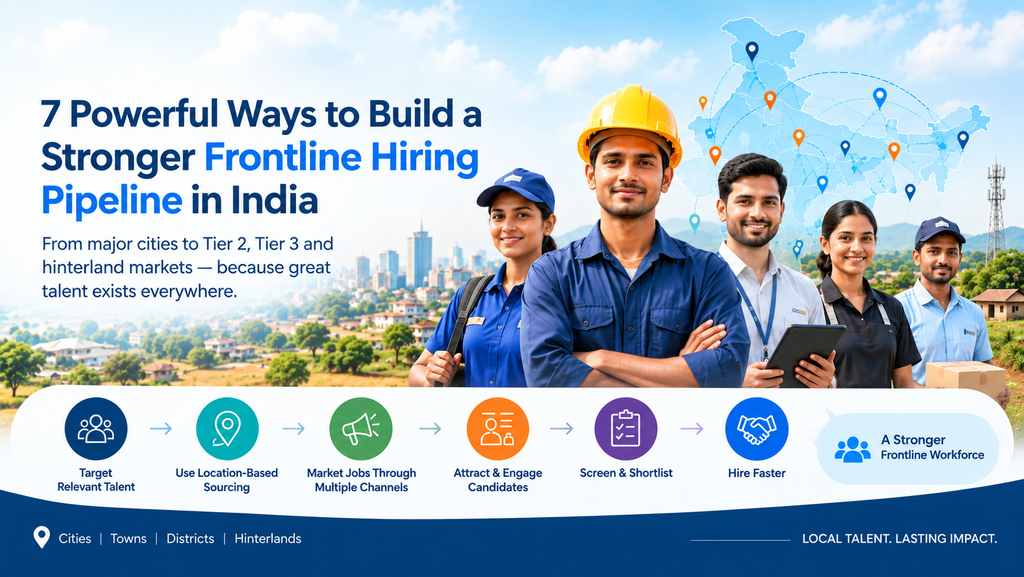
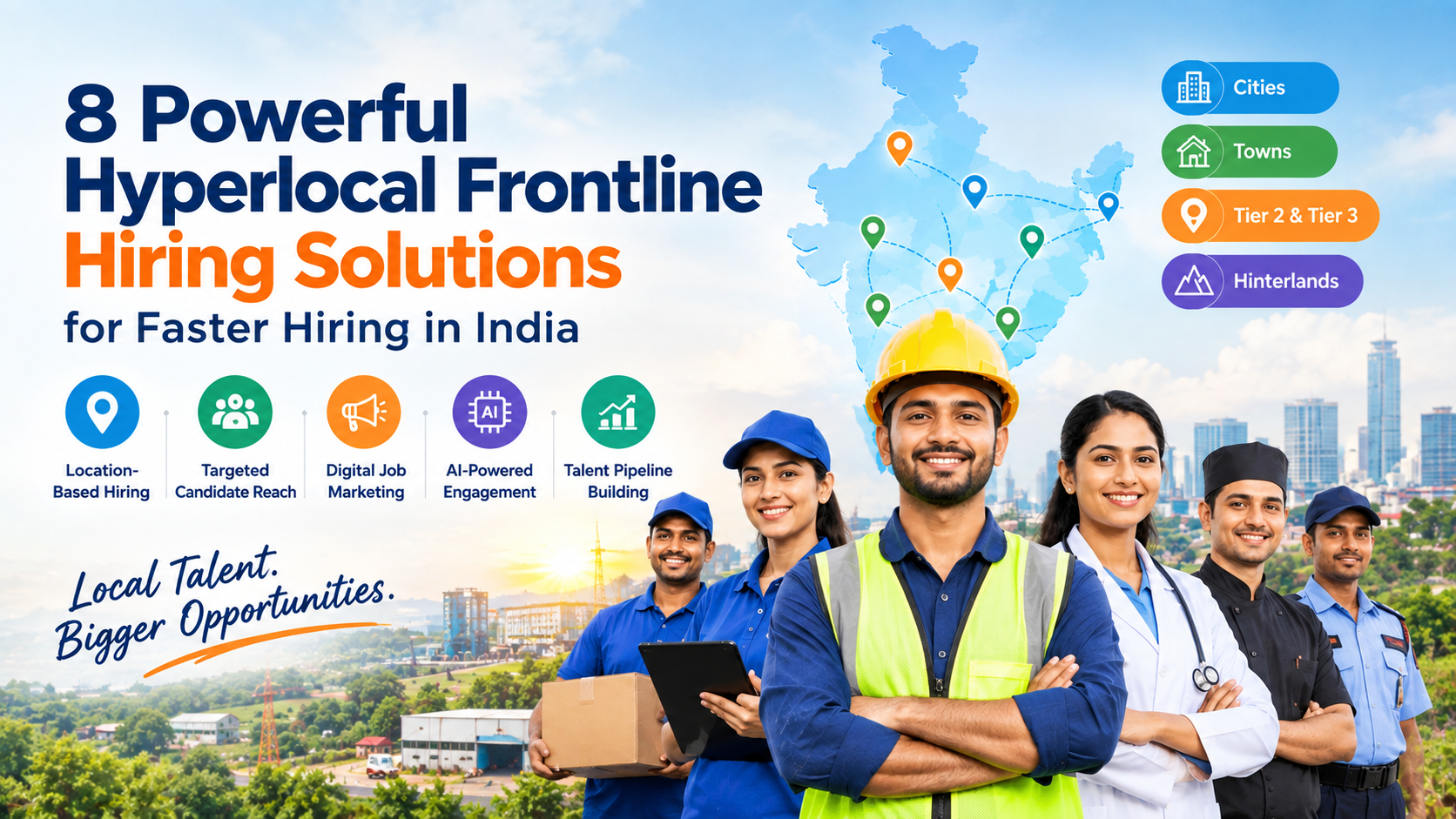
  • Why Hiring in Tier 2 & Tier 3 Cities Needs a Different Strategy

    Why Hiring in Tier 2 & Tier 3 Cities Needs a Different Strategy


    Why Tier 2 and Tier 3 Hiring Is Different

    For years, India’s recruitment ecosystem has been heavily concentrated around major metropolitan markets.

    Delhi NCR.

    Mumbai.

    Bengaluru.

    Hyderabad.

    Chennai.

    Pune.

    But India’s workforce doesn’t exist only in these cities.

    A significant and increasingly important talent market exists across:

    Tier 2 cities.

    Tier 3 cities.

    Industrial towns.

    District headquarters.

    Smaller cities.

    Hinterlands.

    For employers hiring frontline and operational workforces, these markets can represent a major opportunity.

    But there is one important catch:

    You cannot always use a metro hiring strategy in a non-metro market and expect the same results.

    The candidate behaviour can be different.

    The talent supply can be different.

    The communication channels can be different.

    The importance of location can be different.

    And the way employers need to build trust can be different.

    This is why companies expanding beyond India’s major cities need a different Tier 2 hiring strategy.


    India’s Talent Market Is Moving Beyond the Metros

    India’s economic growth is increasingly distributed across different regions.

    Manufacturing facilities are expanding into new industrial clusters.

    Retail brands are entering smaller cities.

    Telecom networks require field teams across districts.

    Logistics networks are expanding deeper into the country.

    Healthcare services are reaching new markets.

    Financial services are expanding their field workforce.

    GCC and technology ecosystems are also exploring locations beyond traditional metros.

    Every expansion creates a workforce requirement.

    And that creates an important question:

    How do you find and reach the right talent where your business is expanding?

    The answer cannot always be:

    “Post the job nationally.”

    For many frontline roles, recruitment needs to become much more local and market-specific.


    Why Traditional Hiring Strategies Struggle Outside Major Cities

    A company may have an excellent recruitment process.

    It may have a strong employer brand.

    It may use leading job platforms.

    It may have an experienced talent acquisition team.

    Yet hiring can still become difficult when entering a new location.

    Why?

    Because the challenge isn’t always a shortage of candidates.

    It can be a candidate reach problem.

    The right candidates may:

    • Not know about the company
    • Not see the vacancy
    • Prefer local employers
    • Be unaware of opportunities outside their immediate area
    • Have concerns about relocation
    • Have limited access to certain recruitment channels
    • Need more information before considering the opportunity

    For frontline positions, these factors can become even more important.


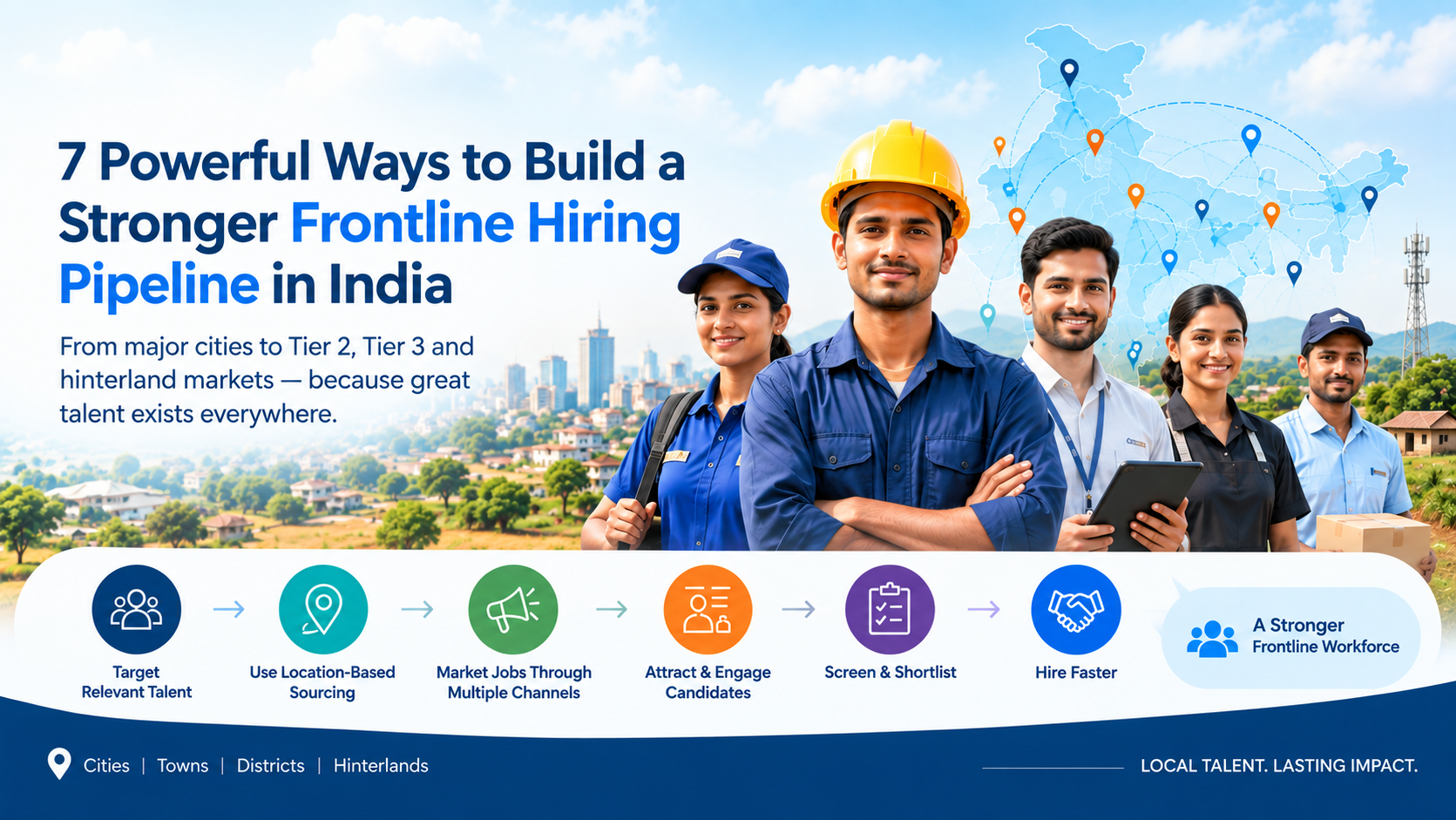
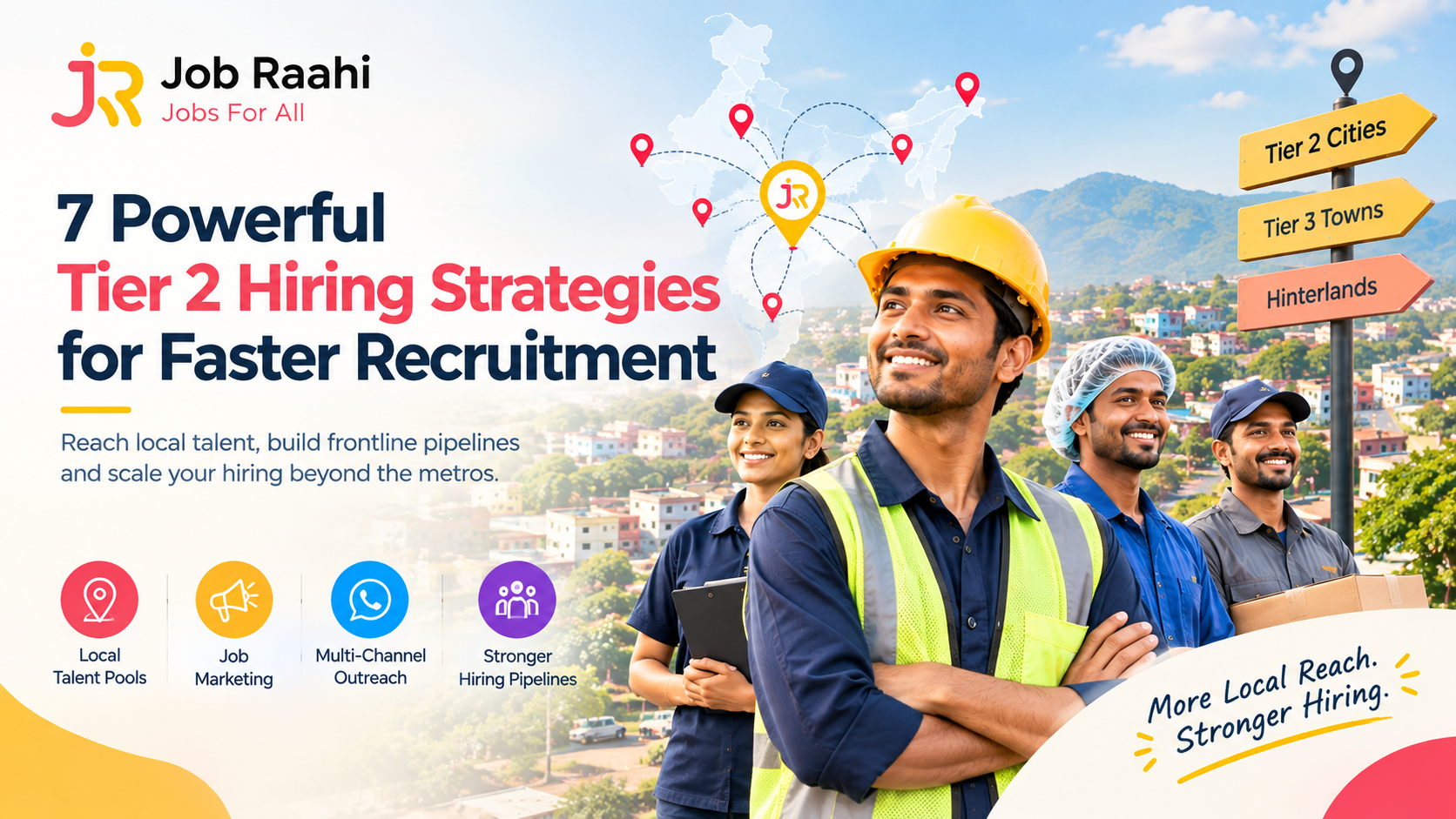
    7 Powerful Tier 2 Hiring Strategies

    1. Build Local Talent Pools

    The first step is to stop looking at Tier 2 cities simply as another location in a national recruitment campaign.

    Treat them as individual talent markets.

    For example:

    Instead of:

    “We need 500 technicians in North India.”

    break the requirement down into:

    Meerut — 50

    Lucknow — 75

    Dehradun — 40

    Jaipur — 80

    Rudrapur — 35

    Other markets — 220

    Now the recruitment team can start understanding each market separately.

    Who are the candidates?

    What skills are available?

    How far are they willing to travel?

    What salary expectations exist?

    Which roles are easiest to fill?

    Where are the hiring gaps?

    This is the foundation of a local talent pool.


    2. Think Beyond the City

    One of the biggest mistakes employers can make is defining their hiring market only by city boundaries.

    A candidate doesn’t necessarily need to live inside the city where the job is located.

    They may live:

    • In a nearby town
    • In a neighbouring district
    • Along a major transport route
    • In a surrounding industrial cluster
    • In a nearby semi-urban area

    This is particularly relevant for frontline jobs.

    Instead of thinking:

    City = Talent Market

    think:

    Workplace + Commute + Surrounding Communities = Talent Market

    This creates a more realistic hiring radius.


    3. Take Jobs to Candidates

    In metro markets, candidates may actively search for jobs across multiple platforms.

    In smaller markets, employers may need to be more proactive about creating awareness.

    This means recruitment can move from:

    “Post and wait.”

    to:

    “Reach and engage.”

    Employers can use:

    • Job platforms
    • WhatsApp
    • SMS
    • RCS
    • Email
    • Social media
    • Digital campaigns
    • Candidate databases
    • Recruiter outreach

    The objective is simple:

    Don’t wait for every candidate to discover the job. Take the opportunity to the candidate.


    4. Build Location-Specific Hiring Campaigns

    A job campaign for Delhi doesn’t necessarily need to look like a job campaign for a smaller industrial town.

    The recruitment message should answer the questions candidates actually care about.

    For example:

    Hiring in a Tier 2 market

    Machine Operators Required

    📍 Location: Rudrapur
    💰 Salary: ₹18,000–₹24,000
    🏭 Manufacturing Role
    🚌 Transport Available
    📅 Immediate / Short-Notice Joining

    This immediately provides context.

    A candidate can quickly determine:

    Is this job near me?

    Is the salary relevant?

    Can I commute?

    Can I join?

    Clear communication can reduce unnecessary applications while improving relevance.


    5. Create Always-On Talent Pipelines

    One of the biggest mistakes employers make is starting recruitment only when the requirement becomes urgent.

    Suppose a company regularly hires:

    • Technicians
    • Operators
    • Field executives
    • Sales staff
    • Customer service associates

    Why rebuild the candidate pool every time?

    Instead, employers can maintain always-on talent pipelines for important recurring roles.

    For example:

    Technician Talent Pool

    Location: Uttarakhand
    Qualification: ITI / Diploma
    Experience: 0–3 years
    Availability: Open to opportunities

    When a requirement appears, the company already has a relevant starting pool.

    This can be particularly useful for employers with recurring or high-volume hiring requirements.


    6. Make the Job Opportunity Clear

    Candidates in smaller markets are not necessarily less interested in opportunities.

    But the opportunity needs to be easy to understand.

    A strong job communication should clearly explain:

    Role

    Location

    Salary

    Working hours

    Qualification

    Experience

    Benefits

    Transport

    Joining timeline

    Interview process

    Contact / application process

    The more uncertainty a candidate has, the harder it may be to convert interest into an application or interview.


    7. Measure Every Hiring Market Separately

    One national hiring dashboard can hide important differences.

    Consider this:

    LocationApplicationsInterviewsSelectionsJoinings
    City A1,0002209062
    City B8001908571
    City C6001608065
    City D1,4001204025

    If you only look at applications, City D looks like the strongest market.

    But look at joinings.

    City C may actually be performing much better.

    This is why employers should track:

    Reach → Applications → Qualified Candidates → Interviews → Selections → Offers → Joinings

    by location.

    That creates genuine regional hiring intelligence.


    The Role of Technology in Regional Hiring

    Technology can help employers scale regional recruitment without treating every location as a completely manual exercise.

    A modern regional hiring strategy can combine:

    Candidate Databases

    Identify relevant talent pools.

    Location-Based Targeting

    Reach candidates around specific hiring markets.

    Digital Job Marketing

    Promote vacancies beyond passive job listings.

    Multi-Channel Communication

    Use WhatsApp, RCS, SMS and email to reach candidate segments.

    AI-Powered Calling

    Support large-scale candidate engagement.

    Recruitment Analytics

    Compare hiring performance across different markets.

    Technology doesn’t replace local recruitment knowledge.

    It helps employers scale it.


    How Job Raahi Helps Employers Hire Beyond the Metros

    Job Raahi is built around a simple employer problem:

    How do you reach frontline talent where traditional recruitment doesn’t always work efficiently?

    The platform focuses on:

    • Frontline hiring
    • Entry-level hiring
    • Blue-collar hiring
    • Grey-collar hiring
    • Industrial hiring
    • Contractual hiring
    • Bulk workforce hiring

    For employers expanding into Tier 2, Tier 3 and hinterland markets, Job Raahi can support a more localized recruitment approach.

    Hyperlocal Candidate Reach

    Reach candidates around specific hiring locations.

    Candidate Database

    Build and access relevant candidate pools.

    Job Marketing

    Don’t simply publish the vacancy.

    Promote it to relevant candidate segments.

    WhatsApp, RCS, SMS & Email

    Use multiple channels to increase candidate reach.

    Digital Campaigns

    Promote job opportunities around relevant hiring markets.

    AI-Powered Calling

    Support candidate engagement at scale.

    Continuous Pipeline Building

    Develop candidate pools that can support future requirements.


    Industries That Can Benefit From Tier 2 Hiring

    Manufacturing

    Tier 2 and Tier 3 cities are important hiring markets for:

    • Machine operators
    • Production workers
    • Technicians
    • Quality inspectors
    • Maintenance staff

    Telecom

    Regional hiring can support:

    • Field technicians
    • Installation teams
    • Sales employees
    • Service teams

    Retail

    Growing retail footprints create demand for:

    • Store associates
    • Sales executives
    • Customer service staff
    • Supervisors

    Logistics

    Expanding distribution networks require:

    • Warehouse workers
    • Sorters
    • Delivery executives
    • Operations staff

    Infrastructure

    Projects across smaller cities create demand for:

    • Technicians
    • Electricians
    • Site workers
    • Field teams

    BFSI

    Financial services expansion can create demand for:

    • Field officers
    • Sales executives
    • Customer-facing employees

    Healthcare

    Regional healthcare expansion can require:

    • Support staff
    • Field employees
    • Operations staff

    The industries may differ.

    The recruitment challenge is often similar:

    Find relevant candidates in the right location and move them through the hiring funnel efficiently.


    Tier 2 Hiring Is Not Tier 1 Hiring at a Smaller Scale

    This is perhaps the most important point.

    A Tier 2 or Tier 3 market shouldn’t simply be treated as:

    “A smaller version of a metro market.”

    The recruitment strategy should consider:

    Local talent availability

    Commuting patterns

    Candidate awareness

    Local employers

    Salary expectations

    Regional competition

    Communication preferences

    Skill availability

    Hiring radius

    Once employers start looking at these factors, regional recruitment becomes much more strategic.


    The Future of Hiring in India’s Hinterlands

    India’s next wave of workforce growth won’t come exclusively from the largest cities.

    As businesses expand their operations, distribution networks, manufacturing capacity and services across the country, access to talent outside major metros will become increasingly important.

    The employers that build an advantage may be those that start developing talent access before they urgently need it.

    That means:

    Map the market.

    Build local pools.

    Market the jobs.

    Engage candidates.

    Measure conversion.

    Keep the pipeline active.

    This turns regional recruitment from a one-time sourcing exercise into a repeatable hiring capability.


    Frequently Asked Questions

    What is a Tier 2 hiring strategy?

    A Tier 2 hiring strategy is a recruitment approach designed specifically for hiring talent in India’s growing non-metro cities, taking into account local talent availability, geography, candidate behaviour and regional workforce conditions.

    Why is Tier 2 hiring different from metro hiring?

    Candidate availability, commuting patterns, employer competition, salary expectations and awareness of opportunities can differ significantly between markets. Employers may therefore need a more localized recruitment strategy.

    What is Tier 3 hiring?

    Tier 3 hiring refers broadly to recruitment in smaller cities and towns beyond major metropolitan and larger Tier 2 markets. These locations can be particularly relevant for frontline and distributed workforce hiring.

    How can companies hire frontline workers in Tier 2 cities?

    Companies can combine local talent pools, hyperlocal candidate reach, digital job marketing, candidate databases and multi-channel outreach to reach relevant candidates.

    Can Job Raahi help with Tier 2 and Tier 3 hiring?

    Job Raahi is designed to help employers reach frontline, blue-collar, grey-collar, industrial and high-volume talent across diverse Indian hiring markets, including smaller cities and hinterlands.


    Build Your Tier 2 Hiring Strategy With Job Raahi

    India’s talent market is much bigger than its metros.

    The opportunity for employers is not simply to expand the geography of recruitment.

    It is to understand each hiring market differently.

    A successful Tier 2 hiring strategy can combine:

    Local talent pools

    Hyperlocal candidate reach

    Digital job marketing

    Multi-channel outreach

    Candidate engagement

    Continuous talent pipelines

    The future of regional hiring isn’t about waiting for candidates to come to the job.

    It’s about taking the right opportunities to the right talent markets.

    Job Raahi — We Don’t Just List Your Jobs. We Market Them.

    External Resources

  • How to Scale a GCC from 100 to 1,000 Employees

    How to Scale a GCC from 100 to 1,000 Employees

    Growing a Global Capability Centre from 100 employees to 1,000 is not simply a matter of hiring 900 more people.

    At 100 employees, many things can still work through individual relationships, informal communication and a relatively small leadership team. But as the organisation grows, those same approaches can quickly become bottlenecks.

    Hiring takes longer. Teams become difficult to coordinate. Managers get stretched. New employees take more time to become productive. And if the organisation grows too quickly without the right systems, quality can suffer.

    The real challenge is not just how to hire 1,000 people.

    It is how to build an organisation that can successfully operate with 1,000 people.

    Here are some practical steps GCC leaders can consider when planning that journey.

    Start With a Clear Workforce Plan

    Before increasing headcount, understand exactly why the organisation needs to grow.

    A GCC should have a clear view of:

    • Which functions are expanding?
    • Which roles will be needed in the next 12, 24 and 36 months?
    • Which skills are available internally?
    • Which skills need to be hired from outside?
    • Which roles can be developed through training?
    • Which positions are business-critical?

    For example, growing from 100 to 1,000 employees may involve expansion across technology, finance, analytics, HR, customer operations, engineering, cybersecurity or other functions.

    The workforce plan should connect hiring with the actual business mandate.

    Headcount should be an outcome of business growth, not the target itself.

    Build Hiring Capacity Before You Need It

    One of the biggest mistakes companies make during rapid expansion is starting recruitment only after the requirement becomes urgent.

    If a GCC suddenly needs 200 employees in six months, the recruitment team can quickly become overloaded.

    Instead, build a scalable hiring engine early.

    This can include:

    • Multiple sourcing channels
    • Strong employer branding
    • Recruitment partners
    • Employee referrals
    • Campus and fresher hiring
    • Specialist talent networks
    • Digital recruitment platforms
    • Internal talent pipelines

    The objective is simple: don’t start looking for talent when you need it. Build access to talent before you need it.

    Don’t Hire Everyone for the Same Location

    A 100-person GCC may initially operate from one major city. But scaling to 1,000 employees does not necessarily mean making the same office ten times bigger.

    India’s GCC ecosystem is increasingly looking beyond traditional metropolitan hubs, with Tier-II cities becoming part of the expansion conversation. This can help companies access additional talent pools and create distributed delivery models.

    A GCC can evaluate locations based on:

    • Talent availability
    • Skill concentration
    • Operating costs
    • Employee retention
    • Infrastructure
    • Connectivity
    • Educational ecosystem
    • Long-term hiring potential

    The right question is not “Which city is cheapest?”

    It is “Which location gives us sustainable access to the talent we need?”

    GCC in Mumbai

    Create a Multi-Level Talent Pipeline

    Scaling from 100 to 1,000 employees requires more than experienced professionals.

    A healthy GCC workforce can have a mix of:

    Experienced professionals
    For leadership, specialised and critical roles.

    Mid-level talent
    For building functional strength and managing growing teams.

    Freshers and early-career professionals
    For creating a long-term talent pipeline.

    Internal talent
    For promotions, mobility and leadership development.

    This creates a more balanced workforce instead of making the organisation completely dependent on lateral hiring.

    The GCC industry is also seeing increasing attention toward entry-level talent and fresher opportunities, making early-career hiring an important part of long-term workforce planning.

    Build a Strong Internal Training System

    You cannot always hire every skill you need.

    Some capabilities may be difficult to find in the market, while others may become important only as the GCC expands.

    This is where internal learning becomes important.

    A scalable GCC should invest in:

    • Technical training
    • Functional training
    • Leadership development
    • Communication skills
    • Domain knowledge
    • Digital skills
    • Manager training
    • Cross-functional exposure

    A person hired for one role today could potentially become a team lead, specialist or manager tomorrow.

    Hiring brings people into the organisation. Development helps the organisation grow with them.

    Standardise the Employee Experience

    When a company has 100 employees, a new employee can often get support directly from a manager or colleague.

    At 1,000 employees, this becomes much harder.

    That is why processes need to become more structured as the organisation scales.

    The GCC should standardise areas such as:

    • Recruitment
    • Background verification
    • Onboarding
    • Training
    • Performance management
    • Internal mobility
    • Employee communication
    • Exit processes

    The goal is not to make the organisation bureaucratic.

    The goal is to make the employee experience consistent and predictable, even as the workforce becomes larger.

    Strengthen Managers Before Rapid Hiring

    One manager cannot effectively manage an endlessly growing team.

    If the organisation adds hundreds of employees but does not build its management layer, problems eventually appear.

    Managers become overloaded.

    Employees receive less feedback.

    Performance issues take longer to identify.

    New employees struggle to understand expectations.

    Therefore, manager development should happen alongside workforce growth.

    Future managers can be identified internally and trained in:

    • People management
    • Communication
    • Performance coaching
    • Conflict resolution
    • Delegation
    • Decision-making
    • Team development

    Scaling a GCC means scaling its leadership capacity, not just its employee count.

    Use Technology to Make Recruitment and Operations Scalable

    When hiring 50 people, manual processes may still be manageable.

    When hiring hundreds, they become expensive and slow.

    Technology can help GCCs manage:

    • Candidate sourcing
    • Application tracking
    • Interview scheduling
    • Assessments
    • Onboarding
    • Employee records
    • Learning
    • Workforce analytics
    • Internal mobility

    Recruitment technology should not simply be used to increase the number of applications.

    It should help recruitment teams identify the right candidates faster.

    Similarly, workforce analytics can help leadership understand hiring velocity, time-to-hire, attrition, productivity and skill gaps.

    GCC's

    Protect Culture While You Scale

    This is one of the hardest parts of moving from 100 to 1,000 employees.

    A small organisation often has a strong sense of identity because employees know each other and leadership is accessible.

    Rapid hiring can change that.

    New employees may not understand the organisation’s values or the purpose behind the GCC.

    That is why culture needs to be deliberately built into:

    • Onboarding
    • Leadership communication
    • Recognition
    • Career development
    • Employee engagement
    • Internal communication

    The objective is to make new employees feel that they are joining a growing organisation, not simply filling a vacancy.

    Measure the Right Numbers

    Headcount alone does not tell you whether the GCC is scaling successfully.

    Leadership should track metrics such as:

    • Time to hire
    • Cost per hire
    • Offer acceptance rate
    • New-hire productivity
    • Attrition
    • Employee retention
    • Internal mobility
    • Training completion
    • Hiring by skill
    • Hiring by location
    • Diversity
    • Manager span of control

    These numbers can reveal where growth is working and where the organisation is developing a bottleneck.

    For example, hiring 100 employees in a quarter may look impressive. But if 30% leave within a short period, the organisation has a retention problem rather than a successful scaling model.

    The 100-to-1,000 Journey Needs a Different Mindset

    The biggest difference between a 100-person GCC and a 1,000-person GCC is not the number of employees.

    It is the operating model.

    At 100 employees, the organisation can depend heavily on people.

    At 1,000 employees, it needs people plus processes, technology, leadership, training and systems.

    A successful scaling journey can therefore be thought of in five stages:

    Plan → Build → Hire → Develop → Scale

    Plan the workforce requirements.

    Build the talent pipeline.

    Hire through multiple channels.

    Develop people internally.

    Then scale the functions, locations and leadership structure as the business grows.

    India’s GCC ecosystem is continuing to move toward higher-value work across technology, data, engineering, finance, AI and other specialised functions. That makes talent strategy increasingly important to the success of GCC expansion.

    The organisations that scale successfully will not necessarily be the ones that hire the fastest.

    They will be the ones that can hire the right people, develop them, retain them and build the systems required to support them.

    And when the goal is to move from 100 employees to 1,000, that difference can determine whether growth becomes a competitive advantage or an operational challenge.

    Final Thought

    Scaling a GCC is ultimately a people-and-process challenge.

    Technology can accelerate the journey. Recruitment platforms can expand access to talent. Training can close skill gaps. But sustainable growth comes from bringing all these pieces together.

    The goal isn’t simply to reach 1,000 employees.

    The goal is to build a 1,000-person GCC that is ready for its next 1,000.

  • Your Job Vacancy Is Competing for Attention: Why Employers Need Job Marketing, Not Just Job Posting

    Your Job Vacancy Is Competing for Attention: Why Employers Need Job Marketing, Not Just Job Posting

    A job vacancy can be perfectly written.

    The salary can be competitive.

    The company can be well known.

    The role can have an immediate joining requirement.

    And yet, the right candidates may never apply.

    Why?

    Because a vacancy cannot hire someone if the candidate never sees it.

    This is one of the biggest challenges employers face in today’s competitive hiring environment, particularly when recruiting for frontline, blue-collar, grey-collar, industrial, field and high-volume roles.

    For years, recruitment has largely followed a simple model:

    Create Job → Post Job → Wait for Applications

    But candidate behaviour has changed.

    Today, a job vacancy is competing for attention with:

    • Other job vacancies
    • Social media content
    • WhatsApp messages
    • Recruiter calls
    • Local employment opportunities
    • Gig work
    • Referrals
    • Offline hiring campaigns
    • Multiple employers hiring for similar roles

    The question is no longer simply:

    “Where should we post the job?”

    The better question is:

    “How do we make sure the right candidates actually see, understand and consider this opportunity?”

    That is where job vacancy marketing comes in.


    What Is Job Vacancy Marketing?

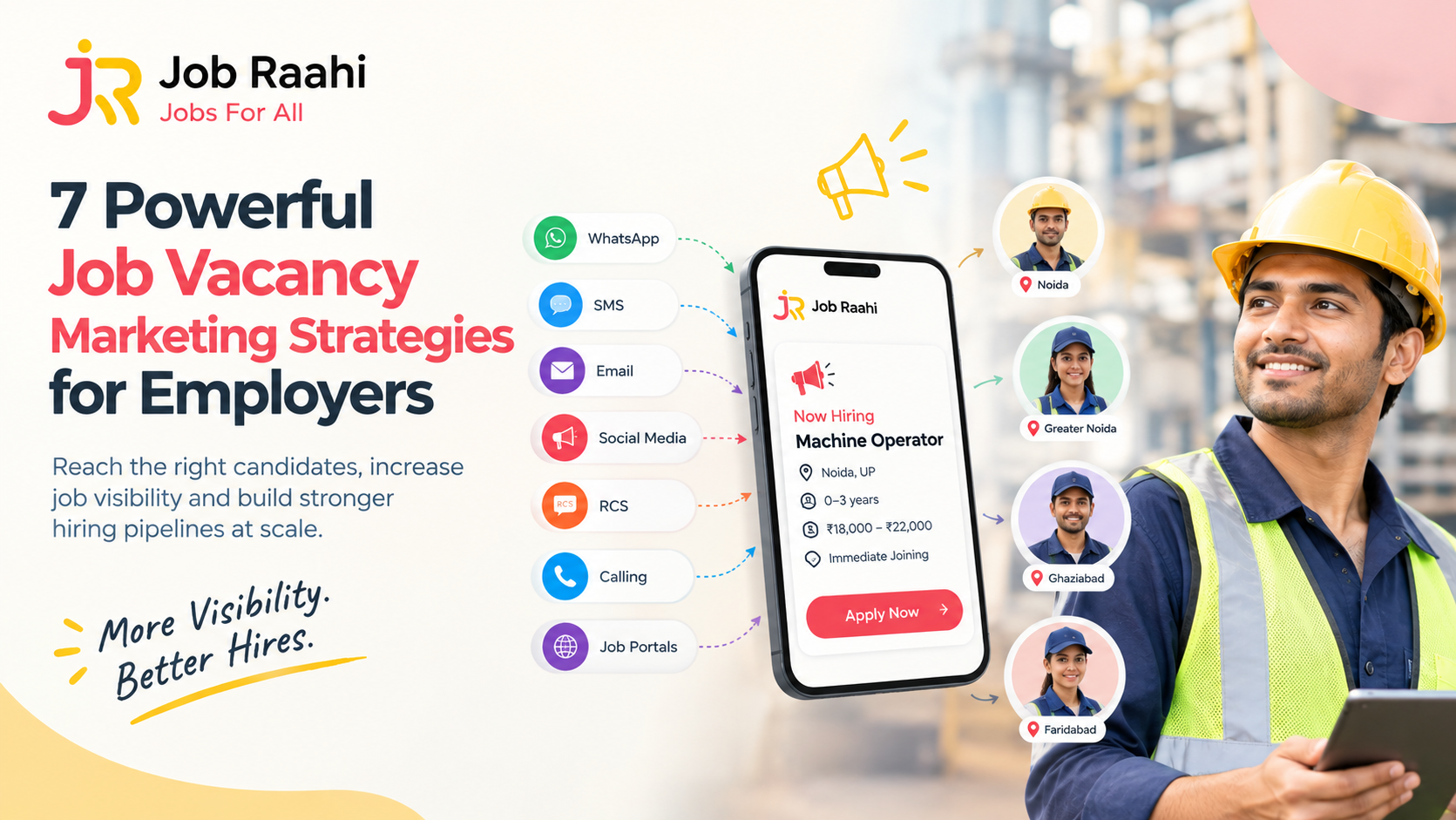
    Job vacancy marketing is the process of actively promoting a job opportunity to relevant candidates instead of relying only on candidates discovering the vacancy on a job portal.

    Think about the difference between:

    Job Posting

    “We have a vacancy. Here it is.”

    and:

    Job Marketing

    “We have a vacancy, and we’re going to actively take this opportunity to the candidates who are most likely to be interested.”

    The second approach treats a job vacancy more like a candidate acquisition campaign.

    The objective is not simply to publish.

    The objective is to create:

    Awareness → Interest → Application → Engagement → Hiring


    Why Job Posting Alone Is No Longer Enough

    Posting a vacancy is important.

    But posting doesn’t guarantee visibility.

    Imagine a company publishes a job for:

    Production Operator — Noida

    At the same time, hundreds of other jobs may be available for:

    • Machine Operators
    • Warehouse Associates
    • Technicians
    • Delivery Executives
    • Sales Executives
    • Field Staff
    • Production Workers

    The candidate now has choices.

    Your vacancy isn’t competing only with other companies.

    It is competing for candidate attention.

    This is particularly important for employers recruiting at scale.

    When you need:

    10 people, passive applications may sometimes be enough.

    When you need:

    100, 500 or 1,000 people across locations, relying only on organic job discovery can become limiting.


    A Vacancy Has a Distribution Problem

    Recruiters often focus heavily on the quality of the job description.

    That’s important.

    But another question deserves equal attention:

    How far did the vacancy travel?

    Consider two employers.

    Employer A

    Posts a job on a platform and waits.

    Employer B

    Posts the job and actively promotes it through:

    • Candidate databases
    • WhatsApp
    • RCS
    • SMS
    • Email
    • Social media
    • Digital campaigns
    • Calling
    • Location-based targeting

    Both employers have a vacancy.

    But their candidate distribution strategy is completely different.

    This is the difference between:

    Job Publishing

    and

    Job Distribution.


    The Difference Between Job Posting and Job Marketing

    Job PostingJob Marketing
    Publish vacancyPromote vacancy
    Wait for discoveryActively create reach
    One primary channelMultiple channels
    Candidate comes to jobJob goes to candidate
    Focus on applicationsFocus on candidate acquisition
    Often reactiveCan be proactive
    Vacancy-centricCandidate-centric
    Limited campaign thinkingContinuous campaign approach

    Neither approach eliminates the need for the other.

    A strong recruitment strategy can use both.

    Posting creates the opportunity.

    Marketing creates visibility.


    7 Ways Employers Can Market Their Job Vacancies

    1. Reach the Right Candidate Segment

    More reach doesn’t necessarily mean better hiring.

    If a company needs:

    ITI Electricians in Haridwar

    reaching thousands of unrelated candidates doesn’t solve the problem.

    The employer needs relevant candidates based on:

    • Location
    • Qualification
    • Experience
    • Role
    • Availability
    • Salary expectations
    • Industry experience

    This is why candidate segmentation is becoming increasingly important in high-volume recruitment.

    The goal isn’t:

    Reach everyone.

    It’s:

    Reach more of the right people.


    2. Make the Job Discoverable

    A candidate cannot apply for a vacancy they never discover.

    Employers should therefore think about the different ways candidates can encounter a job opportunity.

    For example:

    Job Platform

    ↓

    WhatsApp

    ↓

    RCS

    ↓

    SMS

    ↓

    Social Media

    ↓

    Digital Campaign

    ↓

    Recruiter Outreach

    ↓

    Candidate Referral

    A multi-channel approach can increase the number of opportunities for relevant candidates to discover the vacancy.


    3. Localise the Recruitment Message

    A generic job advertisement may say:

    “Hiring Field Executives.”

    A more targeted message could say:

    Hiring Field Executives in Meerut — Immediate Joining

    Or:

    10 Technician Jobs Near Rudrapur — Apply Now

    The second message immediately answers an important candidate question:

    Where is the job?

    For frontline hiring, location can be one of the strongest elements of a recruitment message.

    That makes localised job marketing particularly useful.


    4. Repeat the Opportunity

    One social post doesn’t create a recruitment campaign.

    One SMS doesn’t create a recruitment campaign.

    One WhatsApp message doesn’t create a recruitment campaign.

    Candidates may miss messages.

    They may not be looking for a job that day.

    They may see the vacancy but not apply immediately.

    They may become available later.

    This means recruitment campaigns can benefit from consistent candidate communication, while respecting appropriate consent, frequency and communication practices.

    The objective is not to spam candidates.

    It is to ensure that relevant opportunities remain discoverable.


    5. Build Campaigns Around Hiring Requirements

    Instead of thinking:

    “We have 100 vacancies.”

    think:

    “We have a 30-day hiring campaign.”

    For example:

    Campaign

    Requirement: 100 Production Operators

    Location: Greater Noida

    Duration: 30 Days

    Target: Relevant frontline candidates

    Channels:

    • Job platform
    • WhatsApp
    • SMS
    • Social media
    • Candidate database
    • Recruiter outreach

    Goal:
    Build sufficient qualified candidates to achieve the joining target.

    This changes the recruitment mindset from vacancy management to candidate acquisition.


    6. Use Job Marketing for Difficult Locations

    Some recruitment markets are naturally more challenging.

    Examples include:

    • Remote industrial locations
    • Smaller cities
    • Tier 2 markets
    • Tier 3 markets
    • Hinterlands
    • New facility locations
    • Locations with limited candidate awareness

    In these markets, simply posting the job may not be enough.

    Employers may need to actively introduce the opportunity to the local talent market.

    This can involve:

    Local targeting + digital reach + candidate databases + direct engagement.


    7. Turn Hiring Data Into Better Campaigns

    Job marketing can also create useful recruitment intelligence.

    Suppose a company runs campaigns in three locations.

    Location A

    High reach → High applications → High interview conversion

    Location B

    High reach → High applications → Low joining

    Location C

    Low reach → Low applications → High joining conversion

    The recruitment team now has something valuable:

    Data about how different hiring markets behave.

    Over time, employers can use this information to improve:

    • Candidate targeting
    • Messaging
    • Channels
    • Hiring radius
    • Campaign timing
    • Recruitment budgets
    • Candidate engagement

    Turn Every Hiring Requirement Into a Recruitment Campaign

    A vacancy shouldn’t always be treated as an isolated event.

    Consider a company that regularly hires:

    Technicians

    Sales Executives

    Production Operators

    Customer Service Associates

    Instead of restarting the recruitment process every time, the employer can build ongoing candidate communities around these requirements.

    For example:

    Technician Talent Pool

    Location: North India

    Experience: 0–3 years

    Qualification: ITI / Diploma

    Availability: Actively looking

    Then every new technician requirement can potentially activate an existing candidate pipeline.

    This creates a more sustainable approach to high-volume hiring.


    How Job Raahi Approaches Employer Hiring

    Job Raahi is built around a simple idea:

    We Don’t Just List Your Jobs. We Market Them.

    For employers hiring frontline and high-volume workforces, Job Raahi combines job publishing with candidate reach and digital amplification.

    This can include:

    Unlimited Job Posting

    Employers can publish multiple frontline opportunities.

    Candidate Database

    Access relevant candidate pools for hiring requirements.

    Hyperlocal Candidate Reach

    Reach candidates around specific hiring markets.

    Social Media Promotion

    Promote relevant vacancies through targeted digital campaigns.

    WhatsApp

    Use WhatsApp-based candidate communication and outreach.

    RCS Business Messaging

    Deliver richer recruitment communication where appropriate.

    SMS

    Reach candidates through direct messaging.

    Email Campaigns

    Use email as another candidate acquisition channel.

    AI-Powered Calling

    Support candidate engagement and outreach at scale.

    The objective is not to add more complexity to recruitment.

    It is to create more ways for the right candidate to discover the opportunity.


    The Job Marketing Funnel

    A recruitment campaign can be viewed as a funnel:

    1. Reach

    How many relevant candidates can we reach?

    ↓

    2. Awareness

    How many candidates notice the opportunity?

    ↓

    3. Interest

    How many candidates consider the job?

    ↓

    4. Application

    How many apply?

    ↓

    5. Engagement

    How many respond or engage with the recruiter?

    ↓

    6. Interview

    How many attend?

    ↓

    7. Selection

    How many are selected?

    ↓

    8. Joining

    How many actually join?

    This creates a much broader view of recruitment performance.


    Why This Matters for High-Volume Hiring

    Imagine an employer needs:

    500 frontline employees.

    The traditional approach may be:

    Post 500 jobs → Wait → Screen applications → Repeat

    A recruitment marketing approach can be:

    Define requirement

    ↓

    Identify target markets

    ↓

    Create job campaigns

    ↓

    Reach relevant candidates

    ↓

    Capture applications

    ↓

    Engage candidates

    ↓

    Build candidate pipeline

    ↓

    Convert candidates into hires

    ↓

    Retarget the remaining talent pool for future requirements

    The second approach is designed around continuous candidate acquisition rather than one-time vacancy publishing.


    From Vacancy Posting to Candidate Acquisition

    This is the larger shift happening in recruitment.

    Employers are moving from:

    “Where can I post this vacancy?”

    towards:

    “How can I acquire the right candidates for this requirement?”

    That shift is particularly important for:

    • Frontline hiring
    • Blue-collar recruitment
    • Grey-collar hiring
    • Industrial hiring
    • Field workforce hiring
    • Bulk recruitment
    • High-volume hiring
    • Multi-location recruitment

    Because in these hiring environments, the challenge isn’t always the absence of jobs.

    Sometimes, the challenge is connecting the job with the right candidate at the right time.


    The Future of Recruitment Is Distribution

    The companies that build strong recruitment engines will not necessarily be the companies that post the most jobs.

    They may be the companies that become better at:

    Finding candidates

    Reaching candidates

    Engaging candidates

    Building candidate pools

    Reactivating talent

    Converting candidates into hires

    In other words:

    Recruitment is increasingly becoming a distribution problem.

    And solving distribution requires more than a job board.

    It requires a candidate acquisition strategy.


    Frequently Asked Questions

    What is job vacancy marketing?

    Job vacancy marketing is the active promotion of job opportunities to relevant candidates through multiple channels instead of relying only on passive job posting.

    How is job marketing different from job posting?

    Job posting publishes a vacancy. Job marketing actively promotes the vacancy to increase relevant candidate awareness, reach and engagement.

    Why is job marketing important for frontline hiring?

    Frontline employers often recruit large numbers of candidates across multiple locations. Active job marketing can help increase visibility and reach relevant candidate segments.

    What channels can employers use for job marketing?

    Depending on the recruitment strategy, employers can use job platforms, social media, WhatsApp, RCS, SMS, email, digital campaigns, candidate databases and recruiter outreach.

    Can job marketing support bulk hiring?

    Yes. Job marketing can be structured into campaigns around specific roles, locations, candidate segments and hiring timelines.

    How does Job Raahi market jobs?

    Job Raahi combines job posting with candidate reach, digital promotion, hyperlocal targeting, candidate databases and multi-channel outreach to help employers promote their hiring requirements.


    Your Vacancy Deserves More Than a Listing

    Your hiring team spends time creating the JD.

    Your business has a genuine requirement.

    The position is open.

    The salary is approved.

    The hiring manager is ready.

    But none of that matters if the right candidate never sees the opportunity.

    That’s why employers need to think beyond:

    “Where should I post this job?”

    and start thinking:

    “How should I market this job?”

    At Job Raahi, that’s exactly where we want to make a difference.

    We Don’t Just List Your Jobs. We Market Them.

    External Resources

    For additional insights into recruitment, employment trends, digital skills and India’s changing workforce landscape:

    • International Labour Organization (ILO) — Research and reports on employment, labour markets and workforce trends: International Labour Organization
    • India Employment Report 2024 — Insights into India’s youth employment, education and skills landscape: India Employment Report 2024
    • Ministry of Labour & Employment, Government of India — Employment policies, labour-market initiatives and workforce information: Ministry of Labour & Employment
    • Ministry of Statistics and Programme Implementation (MoSPI) — Employment and labour-force data through the Periodic Labour Force Survey: MoSPI – PLFS Data
    • Skill India Digital — Government platform focused on skills, training and employment opportunities: Skill India Digital
  • Get Job-Ready, Get Ahead- Elevate your career

    Get Job-Ready, Get Ahead- Elevate your career

    Getting your first job can sometimes feel like a race where everyone else seems to be ahead of you. Someone already has an internship. Someone else has completed a course. Another person has six months of experience. And then there is you, wondering:

    “What can I do to get started?”

    If you are a fresher, this feeling is completely normal.

    But here is something worth remembering — you don’t need to know everything before you start your career.

    You need to become job-ready. Being job-ready does not mean having a perfect resume, knowing every software or having years of experience. It means having the basic skills, confidence and workplace understanding needed to take your first opportunity seriously. And the good thing is that these skills can be learned.

    What Does Being Job-Ready Actually Mean?

    Being job-ready is more than simply having a certificate. Imagine two candidates applying for the same entry-level position. Both have completed their education. Both are freshers. Neither has much work experience but one candidate has spent some time improving communication, understanding the job role, practising basic workplace skills and learning about the industry.

    That candidate may feel more comfortable when the interviewer asks questions.This is what job readiness is really about. It is about preparing yourself for what comes after getting selected. You should know what the job involves, how to communicate professionally, how to work with others and how to handle basic responsibilities. You don’t have to be perfect. You just need to be prepared enough to begin.

    A Certificate Is Useful, But Skills Matter Too

    Completing a course is an achievement. But employers also want to know what you can actually do with what you have learned.

    For example, if you have completed a course related to retail, understanding customer handling and store operations can be more useful than simply knowing the name of your course.

    If you are interested in logistics, knowing basic warehouse processes, inventory handling and workplace safety can give you a better understanding of the role. Similarly, someone looking at sales or customer service roles can work on communication, listening and problem-solving skills. The question to ask yourself is simple:

    “If I get this job tomorrow, what skills will help me perform it well?”

    Start there.

    Communication Is a Skill You Can Build

    You don’t need to speak perfect English to be a good employee. What you need is the ability to communicate clearly.
    Can you explain something properly?
    Can you listen to instructions?
    Can you ask a question when you don’t understand something?
    Can you speak respectfully with a customer, colleague or supervisor?

    These are everyday workplace skills, and they matter across industries. If you are not confident with communication today, don’t worry.

    Start small.

    Speak more often. Practise introducing yourself. Read aloud. Talk to people outside your usual circle. Record yourself answering common interview questions. Little improvements can make a noticeable difference over time.

    Be Job Ready, Build your future

    Learn to Work With People

    Most jobs involve working with other people.

    You may work with a team in a warehouse.

    You may deal with customers in a store.

    You may coordinate with colleagues in a hotel.

    You may report to a supervisor in a manufacturing unit.

    You may travel and meet customers in a field sales role.

    In all these situations, technical ability is only one part of the job.

    You also need to know how to work with people.

    That means being respectful, listening to others, taking responsibility and understanding that every person in a team has a role to play.

    Teamwork is not something you only learn in an office.

    You can develop it through college projects, sports, volunteering, training programmes and everyday experiences.

    Practical Skills Can Give You a Stronger Start

    For many entry-level and blue-collar roles, practical knowledge is extremely valuable.

    A person entering a warehouse job should understand basic warehouse processes.

    Someone entering hospitality should have some understanding of customer service and workplace etiquette.

    A retail candidate should be comfortable interacting with customers.

    A technical trainee should understand the basic tools and processes related to their trade.

    This is why vocational training and skill development can be useful pathways for young people who want to enter the workforce.

    The Skill India Digital Hub, for example, provides access to skill courses, job opportunities, apprenticeships and skill centres across different areas.

    The National Skill Development Corporation also focuses on connecting skills and training with employment opportunities, with industry-relevant courses and training centres available through its ecosystem.

    Don’t Wait Until You Get a Job to Start Learning

    This is one of the biggest mistakes a fresher can make.

    Some people think:

    “Once I get the job, then I will learn.”

    But why wait?

    If you know you want to work in logistics, start learning about logistics now.
    Interested in retail? Understand how stores operate.
    Want to work in sales? Practise communication and customer interaction.
    Interested in technical work? Look for relevant vocational training.

    The more you understand before your first job, the less unfamiliar the workplace may feel when you actually enter it.

    Learning doesn’t have to stop after you get hired either.
    In fact, that is when it becomes even more important.

    Screenshot 2026 10 06 163808

    Your First Job Is Also a Learning Opportunity

    Your first job may not be your dream job.

    And that’s perfectly fine.

    A first job can give you something that no classroom can completely provide — real work experience.

    You learn how a workplace functions.
    You learn how to deal with deadlines.
    You understand what it means to be responsible for a task.
    You learn how to communicate with customers and colleagues.
    You discover what you are good at.
    You also discover what you need to improve.

    That experience becomes part of your professional journey. A person who starts as a warehouse associate, for example, may eventually take on more responsibility and move towards team leadership or supervisory roles.

    A retail associate may gradually move into senior store operations.

    Someone starting in a field role can build customer-handling and sales experience that opens up further opportunities.

    Career growth rarely happens overnight. It is usually built one skill and one experience at a time.

    Learn, Apply, Improve

    Think of your career as a cycle.

    Learn → Apply → Gain Experience → Improve → Grow

    You learn a skill.
    You find an opportunity to use it.
    You gain practical experience.
    You understand where you need to improve.
    You develop another skill.
    And the cycle continues.

    This approach can be especially helpful for freshers because it takes away some of the pressure of finding the “perfect” career immediately.

    You don’t have to have your entire career planned at 18, 20 or 22.
    You can start somewhere, learn and adjust along the way.

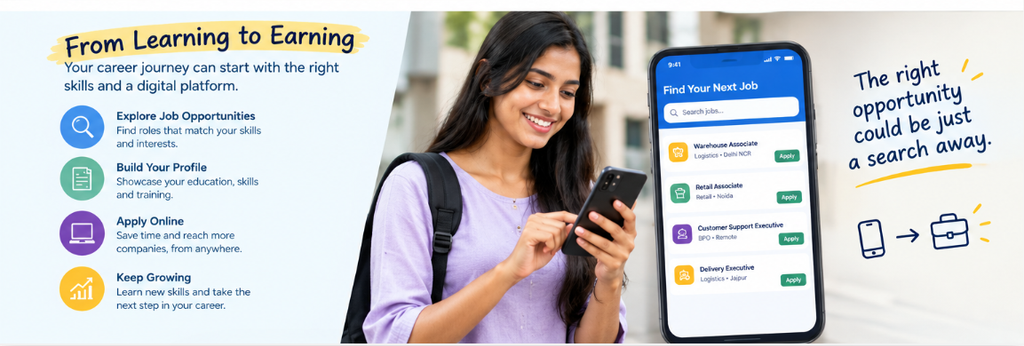
    Use Digital Platforms to Find Opportunities

    Being job-ready is only one part of the journey.
    You also need to know where to look for opportunities.

    The way people search for jobs has changed significantly. Digital platforms now allow job seekers to explore vacancies, compare roles and apply for opportunities without having to depend entirely on personal contacts or physically visit companies.

    The Government of India’s National Career Service (NCS) is one example. It provides job search and matching, career guidance, skill-related information and other employment services through a digital platform.

    For a fresher, using digital platforms alongside personal networks, training centres and referrals can give you more ways to discover opportunities.

    The important thing is to stay active.

    Don’t simply create a profile and wait.
    Search regularly.
    Read job descriptions.
    Apply for suitable roles.
    Keep improving your skills.

    A Simple Job-Readiness Checklist

    Before you start applying seriously, ask yourself:

    • Can I confidently introduce myself?
    • Do I understand the kind of job I want?
    • Do I know what skills the role requires?
    • Is my resume updated?
    • Can I communicate clearly?
    • Have I practised common interview questions?
    • Do I have any practical or vocational skills?
    • Am I comfortable working with a team?
    • Do I know how to search for jobs online?
    • Am I willing to learn after joining?

    You don’t need to answer “yes” to everything.

    The purpose of the checklist is to understand where you need to improve.

    You Don’t Need to Have It All Figured Out

    Starting a career is not about having the perfect qualification, perfect resume or perfect plan. It is about taking the next useful step.

    Maybe that step is completing a vocational course.
    Maybe it is improving your communication.
    Maybe it is creating your first resume.
    Maybe it is attending your first interview.

    Or maybe it is simply starting to search for jobs instead of waiting for someone to tell you about an opening.

    Whatever that step is, take it. Because every skill you learn makes you a little more prepared.

    Every interview teaches you something. Every job gives you experience.
    And every experience can help you move forward.

    Your Career Starts With Being Ready

    Your first opportunity may not come with a big title. It may not be the highest-paying job. It may simply be an entry-level role that gives you the chance to learn.

    But if you are prepared to make the most of it, that opportunity can become the starting point for something much bigger.

    So don’t wait until you feel completely ready.

    Learn a skill. Build confidence. Explore opportunities. Take the first step.

    Because sometimes, getting ahead doesn’t mean starting ahead of everyone else.

    It simply means being ready when your opportunity arrives.

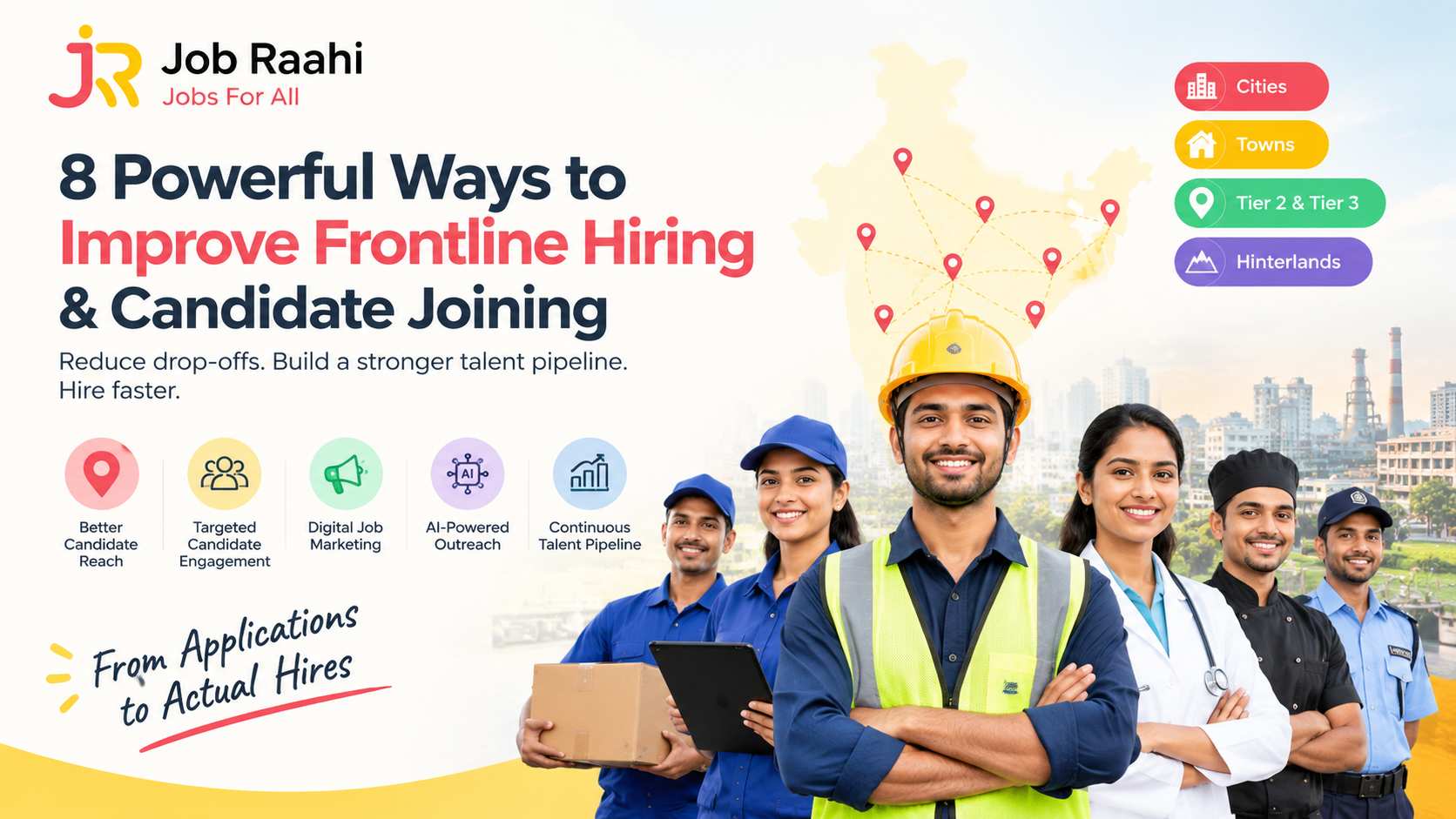
  • Why Frontline Hiring Fails After Applications: 8 Ways to Improve Candidate Joining

    Why Frontline Hiring Fails After Applications: 8 Ways to Improve Candidate Joining

    Getting applications is only the beginning of frontline hiring.

    For companies hiring frontline, blue-collar, grey-collar, industrial and high-volume employees, one of the biggest recruitment challenges often begins after a candidate clicks Apply.

    A candidate applies.

    The recruiter calls.

    The candidate shows interest.

    An interview is scheduled.

    The candidate is selected.

    And then the candidate doesn’t join.

    This creates a frustrating gap between:

    Applications → Interviews → Selection → Joining

    For frontline employers, this gap can become particularly expensive when dozens or hundreds of positions need to be filled across multiple locations.

    The answer is not always to generate more applications.

    Sometimes, the bigger opportunity is to build a better frontline hiring pipeline that focuses on candidate relevance, speed, engagement, location and joining readiness.

    This is where a modern frontline recruitment strategy needs to move beyond job posting.


    Why Applications Don’t Always Become Hires

    Recruiters often measure hiring activity through application numbers.

    For example:

    1,000 applications received

    may initially look like a successful recruitment campaign.

    But what if:

    • 400 candidates are unreachable?
    • 200 are not from the required location?
    • 150 are not interested in the salary?
    • 100 are unavailable?
    • 80 do not attend the interview?
    • 40 reject the offer?
    • Only 30 actually join?

    The original 1,000 applications suddenly look very different.

    This is why employers need to look beyond application volume.

    The real recruitment question is:

    How many relevant candidates can move through the entire hiring funnel?

    For frontline recruitment, this means improving every stage:

    Reach → Apply → Contact → Screen → Interview → Select → Offer → Join


    The Frontline Hiring Funnel

    A typical frontline hiring funnel looks like this:

    Stage 1 — Candidate Reach

    Can the employer reach enough relevant candidates?

    ↓

    Stage 2 — Application

    Does the candidate find the job relevant enough to apply?

    ↓

    Stage 3 — Contact

    Can the recruiter successfully connect with the candidate?

    ↓

    Stage 4 — Screening

    Does the candidate meet the basic requirements?

    ↓

    Stage 5 — Interview

    Does the candidate attend and complete the interview?

    ↓

    Stage 6 — Selection

    Is the candidate selected?

    ↓

    Stage 7 — Offer

    Does the candidate accept the offer?

    ↓

    Stage 8 — Joining

    Does the candidate actually join?

    A recruitment strategy that focuses only on the first two stages can leave significant value on the table.


    8 Reasons Frontline Candidates Drop Off

    1. Location Mismatch

    Location is one of the biggest factors in frontline hiring.

    A candidate may apply for a job because the role looks suitable, but later discover that the workplace is too far away.

    For frontline employees, commuting distance can have a direct impact on the candidate’s decision.

    This makes location-based hiring extremely important.

    Instead of simply asking:

    “Is this candidate qualified?”

    recruiters should also ask:

    “Can this candidate realistically work at this location?”

    This is one reason hyperlocal recruitment can improve candidate relevance.


    2. Slow Recruitment Processes

    Frontline candidates may have several employment options.

    If a company takes several days or weeks to move from:

    Application → Screening → Interview → Selection

    the candidate may accept another opportunity.

    For high-volume hiring, speed matters.

    A streamlined hiring process can reduce unnecessary delays between candidate application and recruiter engagement.

    The faster relevant candidates move through the funnel, the lower the opportunity for drop-off.


    3. Poor Candidate Communication

    A candidate who applies for a job may have questions.

    They may want to know:

    • Where is the workplace?
    • What is the salary?
    • What are the working hours?
    • Is transportation available?
    • When is the interview?
    • When can they join?
    • What documents are required?

    If these questions are not answered clearly, candidates can lose interest.

    Candidate communication therefore becomes an important part of frontline recruitment.

    Modern recruitment can combine human recruiter interaction with technology-assisted communication to improve the candidate experience.


    4. Low Job Visibility

    Posting a job does not automatically guarantee that the right candidates will see it.

    This is particularly important when employers are hiring in:

    • Tier 2 cities
    • Tier 3 cities
    • Industrial towns
    • Smaller cities
    • Districts
    • Hinterlands

    The candidate may be available.

    The vacancy may be suitable.

    But the candidate may never discover the opportunity.

    This is where job marketing becomes important.

    Instead of only listing a job, employers can actively promote the opportunity to relevant candidate segments.


    5. Salary and Job Expectation Gaps

    Another common reason for candidate drop-off is a mismatch between:

    Candidate expectations

    and

    Employer offering

    The candidate may apply before fully understanding the compensation, incentives, shift structure, location or job responsibilities.

    Clear job communication can help reduce this mismatch.

    A strong frontline job description should communicate:

    • Salary
    • Incentives
    • Location
    • Working hours
    • Job responsibilities
    • Qualification
    • Experience
    • Benefits
    • Joining timeline

    The clearer the opportunity, the more relevant the applications can become.


    6. Candidates Have Multiple Opportunities

    Frontline candidates often explore multiple opportunities simultaneously.

    A candidate may apply to:

    Company A

    Company B

    Company C

    and

    Company D

    If Company B responds first, the candidate may move forward with Company B.

    This means candidate response speed matters.

    Recruiters should not assume that an interested applicant will remain available indefinitely.

    The recruitment process needs to move quickly from:

    Application → Contact → Screening → Interview


    7. Lack of Continuous Candidate Engagement

    Candidate engagement shouldn’t necessarily stop after one application.

    A candidate who is not selected for one role may still be relevant for another.

    A candidate who is unavailable today may be available next month.

    A candidate who rejected one location may be interested in another nearby location.

    This is why maintaining a frontline talent pipeline can be valuable.

    Instead of treating every application as a one-time event, employers can build structured candidate pools around:

    Role + Location + Skill + Experience + Availability


    8. No Ready-to-Join Candidate Pipeline

    One of the biggest challenges in high-volume recruitment is starting the sourcing process only after the requirement becomes urgent.

    Imagine a company needs:

    200 technicians next month.

    If sourcing begins next month, the recruitment team is already working against the clock.

    A better approach can be to continuously build relevant candidate pipelines.

    For example:

    Technician Pipeline

    Location: North India

    Qualification: ITI / Diploma

    Experience: 0–3 years

    Role: Technician

    Availability: Actively looking / Open to opportunities

    When the requirement appears, the employer already has a starting point.


    Building a Ready-to-Join Talent Pipeline

    A strong frontline talent pipeline can be structured around multiple parameters.

    Geography

    Where does the candidate live?

    Role

    What type of job is the candidate interested in?

    Skills

    What skills or qualifications does the candidate have?

    Experience

    How much relevant experience does the candidate have?

    Availability

    How soon can the candidate join?

    Preferences

    What locations, shifts or job conditions are acceptable?

    This transforms a generic candidate database into a more useful recruitment resource.


    How Job Raahi Can Help Improve Frontline Hiring

    Job Raahi is built around the needs of employers hiring:

    • Frontline employees
    • Entry-level employees
    • Blue-collar workers
    • Grey-collar workers
    • Industrial workers
    • Field employees
    • High-volume workforces

    The objective is not simply to generate applications.

    It is to help employers create a more effective candidate acquisition and hiring pipeline.

    Job Raahi combines multiple approaches, including:

    Job Posting

    Publish frontline job opportunities on a dedicated hiring platform.

    Candidate Database

    Access relevant candidate pools for current and future hiring requirements.

    Hyperlocal Reach

    Reach candidates around specific hiring locations.

    Digital Job Marketing

    Promote job opportunities rather than relying entirely on passive job discovery.

    Multi-Channel Outreach

    Use channels such as:

    WhatsApp + RCS + SMS + Email

    to amplify relevant opportunities.

    AI-Powered Calling

    Support candidate outreach and engagement at scale.

    Talent Pipeline Building

    Continue building candidate pools for future hiring requirements.


    From Applications to Candidate Activation

    The recruitment mindset needs to shift from:

    “How many applications did we receive?”

    to:

    “How many relevant candidates did we activate?”

    Candidate activation can include:

    Application

    ↓

    Successful Contact

    ↓

    Interest Confirmed

    ↓

    Screening Completed

    ↓

    Interview Scheduled

    ↓

    Candidate Selected

    ↓

    Offer Accepted

    ↓

    Candidate Joined

    This gives employers a more complete view of the hiring funnel.


    The Role of Hyperlocal Recruitment

    Hyperlocal recruitment can play an important role in improving candidate relevance.

    Suppose an employer needs:

    100 field employees in Lucknow.

    A broad national campaign may generate thousands of applications.

    But a more targeted approach could focus specifically on:

    Lucknow + nearby areas + relevant job roles + relevant candidate profiles

    The objective is not necessarily to generate the maximum number of applications.

    It is to generate a higher proportion of relevant candidates.

    This is particularly useful for frontline roles where relocation may not always be practical.


    Industries That Can Benefit

    The need for stronger frontline hiring pipelines exists across industries.

    Telecom

    • Technicians
    • Field executives
    • Installation teams
    • Sales employees
    • Service staff

    Manufacturing

    • Machine operators
    • Production employees
    • Quality inspectors
    • Maintenance technicians
    • Assembly workers

    Retail

    • Store associates
    • Sales executives
    • Customer service employees
    • Supervisors

    Logistics

    • Warehouse employees
    • Delivery executives
    • Operations staff
    • Sorting employees

    Infrastructure

    • Technicians
    • Electricians
    • Field workers
    • Site employees

    Healthcare

    • Support staff
    • Field employees
    • Operations staff

    Hospitality

    • Housekeeping
    • Front-office employees
    • Service staff
    • Kitchen employees

    BFSI

    • Sales executives
    • Field officers
    • Customer-facing employees

    For all these industries, the hiring requirement may be different.

    But the underlying challenge remains:

    Find relevant talent and move them through the hiring funnel quickly.


    Why Frontline Hiring Needs More Than a Job Portal

    A job portal is an important part of recruitment.

    But employers increasingly need more than a place to publish vacancies.

    They need:

    Candidate reach

    Candidate discovery

    Candidate engagement

    Candidate segmentation

    Job marketing

    Hyperlocal recruitment

    Talent pipelines

    High-volume hiring support

    The recruitment platform of the future needs to help employers move from:

    Listing → Waiting

    to:

    Reach → Engage → Hire → Retain the Pipeline


    The Future of Frontline Recruitment

    Frontline recruitment is becoming increasingly digital and data-driven.

    The future hiring model can be:

    Location-aware

    Candidate-focused

    Technology-enabled

    Multi-channel

    Pipeline-driven

    Instead of rebuilding the candidate pool every time a vacancy opens, companies can continuously develop access to relevant frontline talent.

    This can be especially valuable for organizations with:

    • Recurring hiring
    • Multiple locations
    • High-volume requirements
    • Seasonal hiring
    • Expansion plans
    • Distributed operations

    Job Raahi’s Approach

    Job Raahi’s core philosophy is simple:

    We Don’t Just List Your Jobs. We Market Them.

    For employers, this means thinking beyond job posting.

    A frontline hiring campaign can combine:

    Job Posting

    Hyperlocal Candidate Reach

    Digital Job Marketing

    Candidate Database

    WhatsApp

    RCS

    SMS

    Email

    AI-Powered Calling

    Talent Pipeline Building

    The objective is to create a recruitment engine that can continuously connect employers with relevant frontline talent.


    From More Applications to Better Hiring

    More applications do not automatically mean better hiring.

    The real goal is:

    More Relevant Candidates

    →

    More Candidate Engagement

    →

    More Interviews

    →

    More Selections

    →

    More Joining

    That is the difference between measuring application volume and measuring hiring effectiveness.

    For frontline employers, the second metric is ultimately more important.


    Frequently Asked Questions

    Why do frontline candidates drop out of the hiring process?

    Candidates may drop out because of location mismatch, slow recruitment processes, unclear job information, compensation expectations, poor communication or competing job opportunities.

    How can companies reduce frontline candidate drop-offs?

    Companies can improve candidate communication, shorten hiring timelines, clearly communicate job conditions, target relevant locations and maintain continuous candidate pipelines.

    What is a frontline talent pipeline?

    A frontline talent pipeline is a structured pool of potential candidates organized according to role, location, skills, experience and availability.

    What is hyperlocal recruitment?

    Hyperlocal recruitment focuses on finding and engaging candidates within specific cities, towns, districts or geographic areas around the job location.

    How can Job Raahi help with frontline hiring?

    Job Raahi helps employers reach frontline candidates through job postings, candidate databases, hyperlocal recruitment, digital job marketing, WhatsApp, RCS, SMS, email and AI-powered candidate engagement.

    Is Job Raahi suitable for high-volume hiring?

    Yes. Job Raahi is designed around frontline, entry-level, blue-collar, grey-collar, industrial and high-volume hiring requirements.


    Build a Better Frontline Hiring Pipeline With Job Raahi

    If your company is receiving applications but struggling to convert them into interviews, offers and joining, the problem may not be the number of applications.

    It may be the quality, relevance, engagement and speed of the hiring pipeline.

    Job Raahi helps employers move beyond simple job posting by combining:

    Hyperlocal candidate reach

    Digital job marketing

    Candidate segmentation

    Multi-channel outreach

    AI-powered engagement

    Candidate database access

    Continuous talent pipeline building

    The goal is simple:

    Reach the right frontline candidates.

    Engage them faster.

    Build the pipeline before the next urgent requirement.

    Because frontline hiring shouldn’t begin when the vacancy becomes urgent.

    Job Raahi — We Don’t Just List Your Jobs. We Market Them.

    External Resources

    For additional insights into India’s employment landscape, workforce trends and skill development:

  • From Job Posting to Talent Pipeline: The New Way India Is Hiring Frontline Workers

    From Job Posting to Talent Pipeline: The New Way India Is Hiring Frontline Workers

    frontline hiring

    Discovering the frontline talent.

    For years, hiring frontline employees followed a familiar process.

    A vacancy opened.

    The recruiter created a job description.

    The job was posted on a portal.

    Applications came in.

    Candidates were screened.

    And once the position was filled, the process was considered complete.

    But for companies hiring frontline employees at scale, this model is becoming increasingly difficult to sustain.

    When a business needs technicians, operators, field executives, sales representatives, customer service associates, warehouse employees, or other frontline workers across multiple locations, hiring cannot always begin from zero every time a vacancy opens.

    The future of frontline hiring is moving towards something more continuous:

    Building a Talent Pipeline Instead of Filling a Vacancy

    A job vacancy is temporary.

    A talent pipeline is ongoing.

    This is an important distinction for companies with recurring or high-volume hiring requirements.

    Instead of asking:

    “Where can we find candidates for this vacancy?”

    companies can start asking:

    “Where are the candidates we may need for this role, location and skill set?”

    This shift can fundamentally change how frontline recruitment is managed.


    Why Frontline Hiring Is Different

    Frontline recruitment has characteristics that make it different from many corporate hiring processes.

    Frontline roles are often:

    • High volume
    • Location dependent
    • Frequently recurring
    • Time sensitive
    • Entry-level or skill-based
    • Distributed across multiple locations
    • Closely connected to day-to-day operations

    A company may need to hire 10 employees today, 30 next month, and another 50 across different locations a few months later.

    If the recruitment process starts from scratch every time, recruiters repeatedly spend time on the same activities:

    Searching → Reaching → Screening → Following up → Rebuilding the pipeline

    This creates unnecessary friction in the hiring process.

    A continuous talent pipeline changes the starting point.


    What Is a Frontline Talent Pipeline?

    A frontline talent pipeline is a structured pool of potential candidates who can be considered for current or future frontline hiring requirements.

    Instead of maintaining one large, generic candidate database, employers can think about candidates according to relevant attributes such as:

    Location + Role + Skill + Experience + Availability

    For example:

    Technician Pipeline

    Location: Meerut
    Qualification: ITI / Diploma
    Experience: 0–3 years
    Role: Field Technician
    Availability: Ready to join

    Sales Pipeline

    Location: Lucknow
    Qualification: Graduate
    Experience: 0–2 years
    Role: Sales Executive
    Availability: Actively looking

    Manufacturing Pipeline

    Location: Rudrapur
    Qualification: ITI / Diploma
    Experience: Manufacturing
    Role: Machine Operator
    Availability: Immediate / short notice

    These are not just candidate lists.

    They are potential hiring pipelines.


    The Problem With Starting From Zero

    Imagine a company has a recurring requirement for 100 field employees across 20 locations.

    The traditional approach might look like this:

    Vacancy opens

    ↓

    Recruiter publishes jobs

    ↓

    Applications are generated

    ↓

    Candidates are screened

    ↓

    Candidates are rejected or drop out

    ↓

    More candidates are sourced

    ↓

    Positions are eventually filled

    Then another requirement appears.

    The cycle starts again.

    The problem isn’t necessarily that the company cannot find candidates.

    The problem is that the candidate discovery process keeps restarting.

    A pipeline-first approach looks different.

    Build candidate pools

    ↓

    Segment by location and role

    ↓

    Maintain candidate engagement

    ↓

    New requirement opens

    ↓

    Activate relevant candidate pool

    ↓

    Generate applications

    ↓

    Screen and hire

    The recruitment team is no longer starting from a blank page.


    Why Location Matters So Much in Frontline Hiring

    For many frontline jobs, location is not a secondary detail.

    It can be one of the most important recruitment filters.

    A candidate may be perfectly qualified for a role but may not want to relocate 300 kilometres away.

    Another candidate with similar qualifications may already live 15 kilometres from the workplace.

    For frontline recruitment, the second candidate can represent a much more relevant talent opportunity.

    This is why location-based talent pools can become an important part of workforce planning.

    Instead of asking only:

    “Who can do this job?”

    employers also need to ask:

    “Who can do this job here?”


    The Opportunity Beyond Major Cities

    India’s frontline workforce is not concentrated only in major metropolitan cities.

    Talent exists across:

    • Tier 2 cities
    • Tier 3 cities
    • Industrial towns
    • District headquarters
    • Semi-urban markets
    • Small towns
    • Hinterland locations

    For employers, these markets represent a significant opportunity.

    However, reaching candidates outside traditional employment hubs requires a different recruitment approach.

    A vacancy posted in a large city may naturally attract applicants who are already familiar with that employment market.

    A vacancy in a smaller town or district may require active candidate outreach.

    This is where digital recruitment platforms can play a larger role.


    From Job Posting to Job Marketing

    A traditional job portal largely relies on candidate discovery.

    The candidate searches.

    The candidate finds the vacancy.

    The candidate applies.

    But what happens when the right candidate isn’t actively searching?

    The job can remain invisible to them.

    This is why Job Raahi’s approach goes beyond simply publishing jobs.

    We Don’t Just List Your Jobs. We Market Them.

    Depending on the requirement, job opportunities can be amplified through:

    • WhatsApp
    • RCS Business Messaging
    • SMS
    • Email campaigns
    • AI-powered calling
    • Candidate database outreach
    • Geographic targeting
    • Candidate-segment campaigns

    The objective is to actively take relevant opportunities to relevant candidates.

    For high-volume frontline hiring, this distinction can be significant.


    Building a Pipeline Before the Hiring Requirement Becomes Urgent

    The most useful candidate pipeline is one that exists before the vacancy becomes urgent.

    Suppose an organization frequently hires machine operators in a particular industrial cluster.

    Instead of beginning sourcing only after a vacancy opens, the organization can continuously build awareness and candidate pools around those roles.

    Similarly, a telecom organization can maintain candidate pools for technicians and field employees across specific markets.

    A retail company can build local pools of sales and store employees.

    A logistics company can build location-based pools for warehouse and delivery roles.

    The industry changes.

    The underlying recruitment model remains similar.


    One Pipeline Can Serve Multiple Hiring Cycles

    Another advantage of building a structured talent pipeline is that candidate relevance does not necessarily disappear when one vacancy closes.

    Consider a candidate who applies for a technician role but isn’t selected because the position has already been filled.

    That candidate may still be relevant for:

    • Another location
    • A future vacancy
    • A similar role
    • A different business unit
    • A subsequent hiring cycle

    With an organized talent pipeline, candidates can potentially remain discoverable for future opportunities, subject to their preferences and availability.

    This turns recruitment from a one-time transaction into an ongoing relationship.


    What This Means for Recruiters

    A pipeline-first recruitment model does not eliminate recruiters.

    It changes where recruiters spend their time.

    Instead of constantly searching for candidates from scratch, recruitment teams can spend more time on:

    • Candidate engagement
    • Screening
    • Assessment
    • Interview coordination
    • Offer management
    • Joining conversion
    • Workforce planning

    The technology handles more of the repetitive discovery and outreach process.

    The recruiter remains central to the decision-making and candidate experience.


    What This Means for Employers

    For employers, the goal is not simply to have a larger database.

    A large database is useful only when the relevant candidates can be identified and reached.

    A useful frontline talent pipeline should answer questions such as:

    Where are our candidates?

    What roles are they relevant for?

    What skills do they have?

    Which locations can they work in?

    Are they actively looking?

    How quickly can they join?

    The more structured the pipeline, the easier it becomes to activate it when demand appears.


    Job Raahi’s Role in the Frontline Hiring Ecosystem

    Job Raahi is building around this broader opportunity.

    The platform focuses on frontline, entry-level, blue-collar, grey-collar, industrial and high-volume hiring.

    The objective is to help employers move from:

    Posting jobs

    to:

    Building access to relevant candidate pools.

    And from:

    Searching only when a vacancy opens

    to:

    Creating continuous candidate pipelines.

    This approach becomes especially valuable when hiring is distributed across multiple locations.


    The Future of Frontline Recruitment in India

    The next evolution of frontline recruitment may not be about having another place to post a vacancy.

    It may be about creating a more connected hiring ecosystem.

    One where:

    Employers know where their talent pools are.

    Candidates know where relevant opportunities are.

    Recruiters can activate pipelines when requirements arise.

    Technology can take jobs to candidates instead of waiting for candidates to find jobs.

    And importantly:

    Hiring can become continuous rather than reactive.

    India has a massive frontline workforce.

    The challenge is connecting that workforce with the right opportunities efficiently.

    The opportunity for recruitment technology is to make that connection easier, faster, and more localized.

    From Vacancy Filling to Workforce Readiness

    The fundamental shift is simple.

    A vacancy is a requirement.

    A candidate pipeline is an asset.

    For companies with recurring frontline hiring requirements, building that asset can make recruitment more proactive and scalable.

    At Job Raahi, we believe the future of frontline hiring lies in making candidate access continuous — across industries, locations, cities, towns and India’s hinterlands.

    Because the best time to build your frontline talent pipeline isn’t when the vacancy becomes urgent.

    It’s before you need it.


    Frequently Asked Questions

    What is a frontline talent pipeline?

    A frontline talent pipeline is an ongoing pool of potential candidates organized around roles, skills, locations and availability for current and future hiring requirements.

    Why is a talent pipeline important for frontline hiring?

    Frontline hiring is often recurring, location-specific and high volume. A talent pipeline can help employers avoid starting the sourcing process from scratch for every new vacancy.

    How is a talent pipeline different from a job posting?

    A job posting communicates a specific vacancy. A talent pipeline provides ongoing access to potential candidates who may be relevant for current or future vacancies.

    What industries can benefit from frontline talent pipelines?

    Manufacturing, telecom, logistics, retail, infrastructure, healthcare, hospitality, BFSI and other industries with recurring frontline workforce requirements can benefit from structured candidate pipelines.

    How can Job Raahi help employers build frontline talent pipelines?

    Job Raahi combines job posting with candidate outreach and digital recruitment channels such as WhatsApp, RCS, SMS, email, AI-powered calling and geographic candidate targeting.

    Can frontline talent pipelines be built for smaller cities and towns?

    Yes. Location-specific candidate sourcing can help employers build talent pools across Tier 2 and Tier 3 cities, industrial towns, districts and hinterland markets.


    Build Your Frontline Hiring Pipeline With Job Raahi

    If your organization regularly hires frontline employees across multiple locations, Job Raahi can help you explore a more proactive approach to candidate sourcing.

    Don’t wait for the next vacancy to start searching. Build the pipeline before you need it.

    Job Raahi — We Don’t Just List Your Jobs. We Market Them.


    Further Reading

  • Blue Collar Job Openings

    Blue Collar Job Openings

    Blue Collar Jobs

    Blue Collar Jobs are in high demand, and various industries are looking for skilled labor to fill the gap. Furthermore, the growth of emerging sectors has led to an increase in Blue Collar Job Openings, providing opportunities for individuals to explore new career paths. Additionally, with the rise of e-commerce and logistics, the need for skilled workers in warehouses and factories has never been more pressing.

    Introduction to Blue Collar Jobs

    Blue Collar Jobs encompass a wide range of occupations, including factory jobs, warehouse jobs, and skilled labor positions. Moreover, these jobs often require specialized training and certifications, such as those obtained through ITI programs or vocational courses. Consequently, individuals with these skills are in high demand, and companies are willing to pay competitive salaries for their expertise.

    Blue Collar Jobs

    Types of Blue Collar Jobs

    Some examples of Blue Collar Jobs include electricians, fitters, welders, and machine operators. Additionally, drivers and logistics personnel are also in high demand, particularly in the e-commerce sector. Furthermore, companies are looking for skilled workers who can operate and maintain complex machinery, making it an exciting time for individuals with technical skills.

    Benefits of Blue Collar Jobs

    Blue Collar Jobs offer numerous benefits, including job security, competitive salaries, and opportunities for advancement. Moreover, many companies provide training and development programs to help workers enhance their skills and move up the career ladder. For instance, Job Raahi Blog provides valuable insights and tips for Blue Collar job seekers, helping them navigate the job market and find the best opportunities.

    Job Security and Stability

    One of the primary benefits of Blue Collar Jobs is job security and stability. Unlike white-collar jobs, which can be affected by economic downturns, Blue Collar Jobs are often less susceptible to layoffs and downsizing. Consequently, individuals with Blue Collar skills can enjoy a sense of security and stability in their careers.

    Emerging Sectors for Blue Collar Workers

    Emerging sectors, such as renewable energy and manufacturing, are creating new opportunities for Blue Collar workers. Moreover, the growth of e-commerce and logistics has led to an increase in demand for skilled workers in warehouses and distribution centers. Additionally, companies are looking for workers with specialized skills, such as robotics and automation, to help them stay competitive in the market.

    Skills in Demand

    Some of the skills in demand for Blue Collar Jobs include:
    * Mechanical skills
    * Electrical skills
    * Plumbing skills
    * Welding skills
    * Operating heavy machinery

    Skills Required for Blue Collar Jobs

    Blue Collar Jobs require a range of skills, from technical skills to soft skills. Furthermore, companies are looking for workers who can work well in teams, communicate effectively, and problem-solve. For example, Job Raahi provides a platform for Blue Collar job seekers to find jobs that match their skills and interests.

    Job Title Skills Required Salary Range
    Electrician Electrical skills, problem-solving 20,000 – 50,000
    Welder Welding skills, mechanical skills 15,000 – 30,000
    Machine Operator Operating heavy machinery, mechanical skills 18,000 – 35,000
    Driver Driving skills, logistics knowledge 12,000 – 25,000

    How to Apply for Blue Collar Jobs

    To apply for Blue Collar Jobs, individuals can search for job openings on platforms like download Job Raahi app or visit the websites of companies in their desired industry. Moreover, they can also reach out to recruitment agencies or attend job fairs to network with potential employers. Additionally, resources like National Career Service and Ministry of Skill Development can provide valuable information and guidance.

    Resume Building

    When applying for Blue Collar Jobs, it’s essential to have a well-crafted resume that highlights relevant skills and experience. Furthermore, individuals can also include certifications, training programs, and any other relevant qualifications to increase their chances of getting hired.

    Conclusion

    In conclusion, Blue Collar Jobs offer a range of opportunities for individuals with specialized skills and training. Moreover, with the growth of emerging sectors, the demand for Blue Collar workers is on the rise. Therefore, we encourage Blue Collar job seekers to explore the latest job listings on Job Raahi and take the first step towards a rewarding career. To get started, download Job Raahi app today.

    Sources and References

    For more information on Blue Collar Jobs and emerging sectors, please visit:
    * National Career Service
    * Ministry of Skill Development

  • Blue Collar Job Trends

    Blue Collar Job Trends

    Blue Collar Jobs

    Blue Collar Jobs are in high demand, and the market is witnessing a significant surge in the number of job openings. Furthermore, the Blue Collar Jobs sector is expected to grow exponentially in the coming years, creating numerous opportunities for job seekers. Consequently, it is essential for individuals to stay updated on the latest market trends and acquire the necessary skills to excel in their careers.

    Introduction to Blue Collar Jobs

    Blue Collar Jobs encompass a wide range of occupations, including factory workers, warehouse workers, drivers, electricians, fitters, welders, and machine operators. Additionally, these jobs require specialized skills and training, which can be acquired through vocational courses or on-the-job experience. Moreover, Blue Collar Jobs offer a sense of job satisfaction and stability, making them an attractive option for many job seekers.

    Blue Collar Jobs

    Blue Collar Jobs Market Trends

    The Blue Collar Jobs market is witnessing a significant shift, with an increasing demand for skilled workers. For instance, the National Career Service has reported a surge in the number of job openings in the Blue Collar sector. Furthermore, the Ministry of Skill Development has launched various initiatives to promote vocational training and skill development.
    Some of the key trends in the Blue Collar Jobs market include:
    * Increased demand for skilled workers
    * Growing importance of vocational training and skill development
    * Rising salaries and benefits for Blue Collar workers
    * Expanding job opportunities in emerging industries

    Blue Collar Jobs and Industry

    The Blue Collar Jobs sector encompasses a wide range of industries, including manufacturing, construction, and logistics. Moreover, these industries are experiencing rapid growth, creating new job opportunities for Blue Collar workers. Consequently, it is essential for job seekers to stay updated on the latest industry trends and acquire the necessary skills to excel in their careers.

    Benefits of Blue Collar Jobs

    Blue Collar Jobs offer numerous benefits, including job stability, sense of satisfaction, and opportunities for career advancement. Additionally, Blue Collar workers are in high demand, making it easier to find employment. Moreover, Blue Collar Jobs provide a sense of community and camaraderie, which can be lacking in other types of jobs.
    Some of the benefits of Blue Collar Jobs include:
    * Job stability and security
    * Sense of satisfaction and fulfillment
    * Opportunities for career advancement
    * Competitive salaries and benefits

    Blue Collar Jobs and Recruitment

    The recruitment process for Blue Collar Jobs typically involves a combination of online and offline methods. For instance, job seekers can search for job openings on the Job Raahi website or through the download Job Raahi app. Furthermore, employers often use social media and job fairs to recruit Blue Collar workers.

    Blue Collar Jobs and Salary

    Blue Collar Jobs offer competitive salaries and benefits, making them an attractive option for many job seekers. Moreover, the salaries for Blue Collar workers are increasing, with some jobs offering salaries upwards of Rs. 50,000 per month. Consequently, it is essential for job seekers to research the market rates and negotiate their salaries accordingly.
    The following table provides an overview of the average salaries for different Blue Collar Jobs:

    Job Title Average Salary
    Factory Worker Rs. 25,000 – Rs. 35,000 per month
    Warehouse Worker Rs. 20,000 – Rs. 30,000 per month
    Driver Rs. 25,000 – Rs. 40,000 per month
    Electrician Rs. 30,000 – Rs. 50,000 per month

    Blue Collar Jobs and Training

    Blue Collar Jobs require specialized skills and training, which can be acquired through vocational courses or on-the-job experience. Moreover, the Job Raahi Blog provides expert advice and tips on how to acquire the necessary skills and training for Blue Collar Jobs. Furthermore, job seekers can also enroll in vocational courses offered by the Ministry of Skill Development.

    Blue Collar Jobs and Skills

    Blue Collar Jobs require a range of skills, including technical, communication, and problem-solving skills. Additionally, Blue Collar workers need to be physically fit and able to work in a fast-paced environment. Moreover, the ability to work in a team and adapt to new situations is essential for success in Blue Collar Jobs.
    Some of the key skills required for Blue Collar Jobs include:
    * Technical skills and knowledge
    * Communication and teamwork skills
    * Problem-solving and adaptability skills
    * Physical fitness and stamina

    Conclusion

    Blue Collar Jobs are in high demand, and the market is witnessing a significant surge in the number of job openings. Consequently, it is essential for job seekers to stay updated on the latest market trends and acquire the necessary skills to excel in their careers. Therefore, we recommend that job seekers download Job Raahi app to stay updated on the latest job openings and market trends.

    Sources and References

    * National Career Service
    * Ministry of Skill Development

  • Fitter and Welder Jobs

    Fitter and Welder Jobs

    Fitter Jobs

    Fitter Jobs are in high demand in the Indian industry, particularly among ITI students and diploma holders. Consequently, many freshers and experienced workers are exploring new career opportunities in this field. Furthermore, the growth of the manufacturing sector has led to an increase in Fitter Jobs, making it an attractive option for blue collar job seekers.

    Introduction to Fitter and Welder Jobs

    Additionally, Fitter Jobs involve working with machines and equipment, requiring a strong foundation in mechanics and engineering principles. For instance, fitters and welders work together to assemble and repair machinery, making them an essential part of the manufacturing process. Moreover, the Job Raahi Blog provides valuable insights and information on Fitter Jobs and other blue collar job openings.

    Types of Fitter Jobs

    Fitter Jobs can be categorized into different types, including mechanical fitters, electrical fitters, and welding fitters. However, the most in-demand Fitter Jobs are those that require specialized skills and training, such as CNC machine operators and automotive fitters. Therefore, it is essential for job seekers to acquire the necessary skills and certifications to increase their chances of getting hired.

    Fitter Jobs

    Key Responsibilities of Fitters

    Some of the key responsibilities of fitters include:
    * Assembling and repairing machinery
    * Installing and maintaining equipment
    * Troubleshooting mechanical issues
    * Collaborating with other technicians and engineers
    * Following safety protocols and procedures

    Benefits of Fitter Jobs

    Fitter Jobs offer several benefits, including job security, competitive salaries, and opportunities for career advancement. Moreover, working as a fitter can be rewarding, as it involves working with hands and creating something from scratch. Additionally, Fitter Jobs are available in various industries, including manufacturing, construction, and automotive, making it a versatile career option. However, to get started, job seekers can visit Job Raahi to explore available Fitter Jobs and other blue collar job openings.

    Industry Trends and Outlook

    The demand for Fitter Jobs is expected to grow in the coming years, driven by the expansion of the manufacturing sector. Consequently, job seekers can expect to find more Fitter Jobs and other blue collar job openings in the future. Furthermore, the National Career Service provides valuable resources and information on career development and job search.

    Fitter Jobs and Welder Job Openings

    Fitter Jobs and welder job openings are often available in the same industries, including manufacturing, construction, and automotive. However, the skills and qualifications required for these jobs may differ. For instance, welders require specialized training and certification in welding techniques, while fitters require a strong foundation in mechanics and engineering principles. Therefore, job seekers should carefully review the job requirements and qualifications before applying. Moreover, Fitter Jobs can be found on various job portals, including download Job Raahi app to get started.

    Required Skills and Qualifications

    Some of the required skills and qualifications for Fitter Jobs include:
    * ITI or diploma in mechanics or engineering
    * Strong foundation in mathematics and science
    * Good communication and teamwork skills
    * Ability to work with hands and machines
    * Certification in specialized skills, such as welding or CNC operation

    Job Title Industry Salary Range Required Skills
    Fitter Manufacturing 20,000 – 40,000 ITI or diploma in mechanics
    Welder Construction 25,000 – 50,000 Certification in welding techniques
    CNC Operator Automotive 30,000 – 60,000 Certification in CNC operation
    Mechanic Automotive 20,000 – 40,000 ITI or diploma in mechanics

    Tips for Getting Fitter Jobs

    To get Fitter Jobs, job seekers should acquire the necessary skills and certifications, build a strong network of professionals in the industry, and create a compelling resume and cover letter. Furthermore, practicing interview skills and staying up-to-date with industry trends can also increase the chances of getting hired. Additionally, the Ministry of Skill Development provides valuable resources and information on skill development and career advancement.

    Conclusion

    In conclusion, Fitter Jobs are in high demand in the Indian industry, offering job security, competitive salaries, and opportunities for career advancement. Therefore, job seekers should explore available Fitter Jobs and other blue collar job openings on Job Raahi and download Job Raahi app to get started.

    Sources and References

    * National Career Service
    * Ministry of Skill Development

  • Blue Collar Jobs India 2026

    Blue Collar Jobs India 2026

    Blue Collar Jobs

    Blue Collar Jobs are in high demand in India, with numerous opportunities available for workers in various sectors. Furthermore, the job market is expected to grow significantly in the coming years, providing a wide range of Blue Collar Jobs for freshers and experienced workers alike. Additionally, many companies are looking to hire skilled and unskilled laborers to fill vacant positions, making it an ideal time to search for Blue Collar Jobs.

    Introduction to Blue Collar Jobs

    Blue Collar Jobs typically involve manual labor and are often found in industries such as manufacturing, construction, and transportation. Moreover, these jobs can be physically demanding and may require workers to be on their feet for long periods. Consequently, it is essential to be physically fit and have the necessary skills to perform the job requirements. For instance, workers can visit the Job Raahi Blog to learn more about the latest trends and opportunities in Blue Collar Jobs.

    Types of Blue Collar Jobs

    There are various types of Blue Collar Jobs available, including:

    • Construction workers
    • Manufacturing line workers
    • Delivery drivers
    • Warehouse workers
    • Customer service representatives

    Additionally, many companies are looking for skilled workers in areas such as electrical work, plumbing, and carpentry. Therefore, it is crucial to have the necessary training and certifications to be considered for these positions.

    Blue Collar Jobs

    Blue Collar Jobs in India

    Blue Collar Jobs in India are plentiful, with many companies looking to hire workers in various sectors. Furthermore, the Indian government has initiated several programs to promote Blue Collar Jobs and provide training and employment opportunities to workers. For example, the National Career Service provides a platform for workers to search and apply for Blue Collar Jobs. Moreover, the Ministry of Skill Development offers various training programs to help workers develop the necessary skills for Blue Collar Jobs.

    Benefits of Working in India

    Working in India can provide numerous benefits, including:

    • Cultural diversity
    • Opportunities for career growth
    • Competitive salaries
    • Access to training and development programs

    Consequently, many workers are looking to India as a prime destination for Blue Collar Jobs.

    How to Apply for Blue Collar Jobs

    Applying for Blue Collar Jobs can be a straightforward process, with many companies using online platforms to recruit workers. Moreover, workers can visit the Job Raahi website to search and apply for Blue Collar Jobs. Additionally, workers can download Job Raahi app to stay updated on the latest job openings and apply on the go.

    Company Job Title Location Salary
    ABC Corporation Construction Worker Mumbai 25000
    DEF Manufacturing Line Worker Delhi 20000
    GHI Logistics Delivery Driver Bangalore 30000
    JKL Warehouse Warehouse Worker Chennai 22000

    Preparing for Blue Collar Jobs

    To prepare for Blue Collar Jobs, workers should:

    • Develop the necessary skills and training
    • Build a strong physical foundation
    • Improve communication and teamwork skills
    • Stay updated on the latest industry trends

    Furthermore, workers should be prepared to work in a fast-paced environment and be adaptable to changing situations.

    Blue Collar Jobs and Career Growth

    Blue Collar Jobs can provide opportunities for career growth and advancement. Moreover, workers can move up the career ladder by acquiring new skills and taking on additional responsibilities. Consequently, it is essential to be proactive and seek out opportunities for growth and development.

    Benefits of Blue Collar Jobs

    Blue Collar Jobs can provide numerous benefits, including job security, competitive salaries, and opportunities for career growth. Furthermore, many companies offer additional benefits such as health insurance, retirement plans, and paid time off. Additionally, Blue Collar Jobs can provide a sense of satisfaction and fulfillment, as workers are able to see the direct impact of their work.

    Conclusion

    In conclusion, Blue Collar Jobs are in high demand in India, with numerous opportunities available for workers in various sectors. Therefore, workers should take advantage of these opportunities and apply for Blue Collar Jobs on Job Raahi. Moreover, workers can download Job Raahi app to stay updated on the latest job openings and apply on the go.

    Sources and References

    For more information on Blue Collar Jobs, please visit: