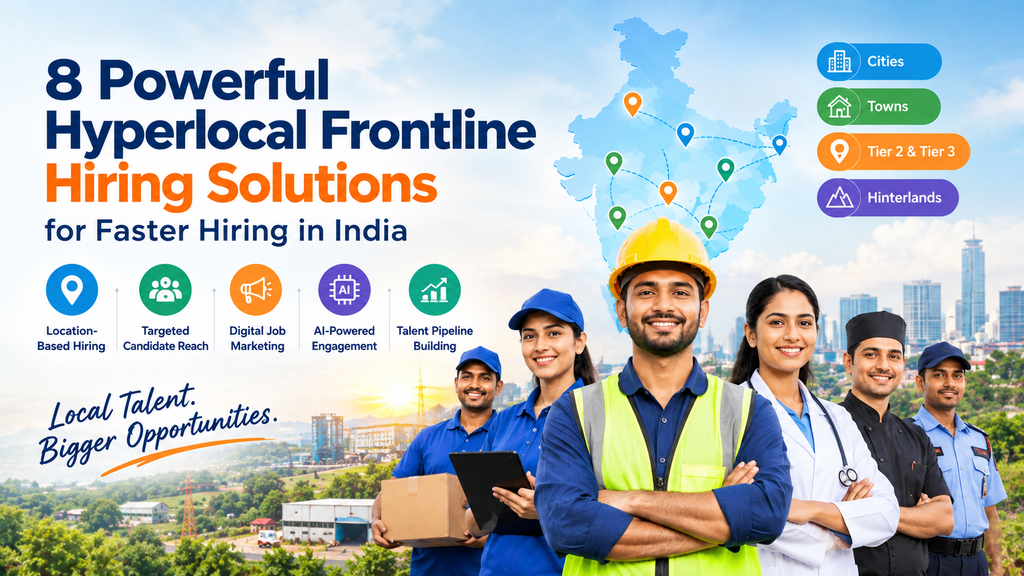
Hyperlocal frontline hiring is becoming increasingly important for companies that need to hire frontline employees across India’s cities, towns, industrial clusters, Tier 2 cities, Tier 3 cities and hinterland markets.
For employers, the challenge is no longer simply finding candidates.
The real challenge is finding the right frontline candidates in the right location at the right time and at the required scale.
A telecom company may need field technicians across multiple districts. A manufacturing company may need machine operators near an industrial cluster. A retail company may need customer service associates across several towns. A financial services company may need field executives in smaller cities.
These are not simply job-posting requirements.
They are hyperlocal frontline hiring requirements.
And solving them requires a recruitment approach that combines local candidate discovery, candidate segmentation, digital job marketing, multi-channel outreach and continuous frontline talent pipeline building.
That is where Job Raahi comes in.
What Is Hyperlocal Frontline Hiring?
Hyperlocal frontline hiring is the process of finding, reaching and engaging frontline candidates within specific geographic markets where the jobs are actually located.
Instead of treating India as one large candidate pool, hyperlocal recruitment looks at individual:
- Cities
- Towns
- Districts
- Pin codes
- Industrial clusters
- Commuting zones
- Tier 2 cities
- Tier 3 cities
- Semi-urban markets
- Hinterland locations
This approach is particularly relevant for frontline hiring in India because many frontline roles are closely connected to geography.
A candidate may have the right qualification and experience but may not want to relocate.
Another candidate with similar qualifications may already live close to the workplace.
For frontline recruitment, that proximity can be extremely valuable.
The basic principle of hyperlocal frontline hiring is therefore:
Right Role + Right Location + Right Candidate = Stronger Hiring Pipeline
Why India Needs Better Hyperlocal Hiring Solutions
India’s workforce is spread across a highly diverse geographic and economic landscape.
Employment opportunities are not concentrated only in India’s largest metropolitan cities.
Candidates live and work across:
- Tier 1 cities
- Tier 2 cities
- Tier 3 cities
- Industrial towns
- District headquarters
- Small towns
- Semi-urban markets
- Rural areas
- Hinterlands
This creates a significant opportunity for employers.
However, it also creates a recruitment challenge.
A company hiring in Delhi does not necessarily face the same talent-access challenge as a company hiring in a smaller industrial town.
Similarly, hiring 500 frontline employees across 50 locations is fundamentally different from hiring 500 employees in one city.
This is why hyperlocal recruitment needs to become part of the frontline hiring strategy.
The Government of India’s Periodic Labour Force Survey (PLFS) provides extensive labour-market information covering rural and urban India and is an important source for understanding India’s employment landscape.
Periodic Labour Force Survey — Ministry of Statistics & Programme Implementation
The scale and geographic diversity of India’s labour market makes localized talent access increasingly important for employers.
The Biggest Challenges in Frontline Hiring
Traditional frontline recruitment often follows a simple process:
Vacancy → Job Posting → Applications → Screening → Interviews → Hiring
This process can become difficult when hiring requirements are:
- High volume
- Recurring
- Location-specific
- Time-sensitive
- Distributed across multiple markets
Challenge 1: Limited local reach
A job posting may not reach enough candidates in a specific town or district.
Challenge 2: Candidate-location mismatch
Candidates may apply from locations that are too far from the workplace.
Challenge 3: Passive candidates
The right candidate may not be actively searching for a job when the vacancy is posted.
Challenge 4: Candidate drop-offs
Applications do not always translate into interviews or joining.
Challenge 5: Repeated sourcing
Recruiters often have to rebuild candidate pools whenever similar vacancies open.
Challenge 6: Multiple locations
Managing hundreds of frontline vacancies across multiple locations can create considerable operational complexity.
This is where a frontline talent pipeline becomes valuable.
How Job Raahi Solves Hyperlocal Frontline Hiring
Job Raahi approaches frontline recruitment as more than a job-posting exercise.
The objective is to help employers build access to relevant candidate markets.
The Job Raahi approach combines:
Location
Role
Skill
Candidate Segmentation
Digital Job Marketing
Multi-Channel Outreach
AI-Powered Engagement
Talent Pipeline Building
This creates a more structured hyperlocal frontline hiring solution.
Instead of waiting for candidates to discover every vacancy, employers can actively reach relevant candidate segments.
We Don’t Just List Your Jobs. We Market Them.
8 Powerful Hyperlocal Frontline Hiring Solutions
1. Location-Based Frontline Candidate Discovery
The first requirement of hyperlocal hiring is understanding where relevant candidates are located.
Job Raahi can help employers organize recruitment requirements around specific geographic markets.
For example:
Requirement: Field Technician
Markets:
- Delhi NCR
- Meerut
- Kanpur
- Lucknow
- Bareilly
- Agra
Instead of treating the requirement as one national vacancy, each location can become a specific recruitment market.
This creates a simple recruitment framework:
Job → Location → Candidate Pool
This is particularly useful for employers managing frontline hiring across multiple cities.
2. Role and Skill-Based Candidate Segmentation
Location alone does not solve frontline recruitment.
Employers also need to identify the right candidate profile.
Candidate pools can be segmented using:
- Job role
- Qualification
- Technical skills
- Experience
- Industry background
- Location
- Availability
- Salary expectations
- Joining timeline
For example:
Telecom Technician Pipeline
Location: Kanpur
Qualification: ITI / Diploma
Experience: 0–3 years
Role: Field Technician
Manufacturing Pipeline
Location: Rudrapur
Qualification: ITI
Experience: 1–5 years
Role: Machine Operator
Retail Pipeline
Location: Lucknow
Qualification: Graduate
Experience: 0–2 years
Role: Sales Associate
This makes the candidate pool more relevant than a generic database.
3. Multi-Channel Frontline Candidate Outreach
Publishing a job is only one part of recruitment.
The bigger question is:
How do you reach the candidate?
Job Raahi can help employers amplify job opportunities through multiple channels, including:
- RCS Business Messaging
- SMS
- Email campaigns
- Candidate database outreach
- Digital campaigns
- AI-powered calling
This creates multiple opportunities for candidates to discover relevant jobs.
Instead of relying entirely on passive job discovery, employers can actively take opportunities to candidate segments.
For hyperlocal frontline hiring, this can be particularly useful in markets where candidate reach is fragmented.
4. Digital Job Marketing for Frontline Hiring
Frontline recruitment increasingly needs to operate like marketing.
Think of it this way:
The job is the product.
The candidate is the audience.
The location is the market.
The recruitment campaign is the distribution system.
A successful digital hiring campaign therefore asks:
- Who is the target candidate?
- Where are they located?
- Which channels can reach them?
- What message will make the opportunity relevant?
- How quickly can they be engaged?
Job Raahi’s approach is designed around this idea.
We Don’t Just List Your Jobs. We Market Them.
Job opportunities can be amplified through multiple digital and direct-reach channels to help employers build awareness and candidate pipelines.
5. AI-Powered Candidate Engagement
Candidate engagement is one of the biggest operational challenges in high-volume recruitment.
A candidate may:
- Apply but not answer the phone
- Miss a recruiter call
- Forget about an interview
- Need additional information
- Become available later
- Apply for multiple jobs
AI-powered calling and technology-assisted communication can help recruitment teams manage repetitive candidate engagement at scale.
This can allow recruiters to spend more time on:
Screening → Interviewing → Selection → Offer → Joining
rather than repeatedly attempting initial candidate contact.
For high-volume frontline recruitment, this can make the overall hiring workflow more structured.
6. Continuous Frontline Talent Pipeline Building
This is one of the most important parts of the Job Raahi approach.
A company does not necessarily need to start building its candidate pool only after a vacancy becomes urgent.
It can build frontline talent pipelines continuously.
For example:
Technician Talent Pipeline
Markets: North India
Role: Field Technician
Qualification: ITI / Diploma
Experience: 0–3 years
Manufacturing Talent Pipeline
Markets: NCR + Haryana + Uttarakhand
Role: Machine Operator
Qualification: ITI
Experience: 0–5 years
When a new requirement opens, the relevant candidate segment can be activated.
This changes recruitment from:
Reactive Hiring
to:
Pipeline-Based Hiring
7. Bulk and High-Volume Hyperlocal Hiring
Hyperlocal hiring becomes especially important when the recruitment requirement involves volume.
Consider an employer that needs:
500 frontline employees across 50 locations.
This is not simply one recruitment campaign.
It can be viewed as:
50 local hiring markets.
Each location may have different:
- Candidate availability
- Skills
- Salary expectations
- Competition
- Joining timelines
- Commuting patterns
A scalable high-volume frontline hiring solution therefore needs to break large requirements into smaller, manageable local recruitment markets.
This makes the hiring process more targeted and measurable.
8. Hyperlocal Hiring Across Tier 2, Tier 3 and Hinterland Markets
One of the biggest opportunities in India’s frontline workforce lies beyond the largest metropolitan cities.
Companies increasingly need employees in:
- Tier 2 cities
- Tier 3 cities
- Industrial towns
- District headquarters
- Semi-urban markets
- Smaller towns
- Hinterlands
The challenge is not necessarily the absence of candidates.
The challenge can be candidate discoverability and access.
Hyperlocal recruitment provides a framework for approaching these markets more specifically.
Instead of asking:
“Where can we find candidates across India?”
employers can ask:
“Where are the relevant candidates around this particular job location?”
That is the foundation of hyperlocal frontline hiring.
How the Job Raahi Frontline Hiring Pipeline Works
A hyperlocal frontline hiring campaign can follow a structured process.
Step 1 — Understand the Requirement
Identify:
Role + Location + Qualification + Experience + Salary + Joining Requirement
↓
Step 2 — Define Candidate Segments
Create relevant candidate pools based on:
Location + Skill + Experience + Availability
↓
Step 3 — Launch Job Marketing
Promote the opportunity through relevant digital and direct-reach channels.
↓
Step 4 — Reach Candidates
Use:
WhatsApp + RCS + SMS + Email + Digital Outreach + AI-Powered Calling
↓
Step 5 — Generate Applications
Relevant candidates enter the hiring funnel.
↓
Step 6 — Screen Candidates
Candidates are evaluated against employer requirements.
↓
Step 7 — Interview and Select
The employer assesses suitable candidates.
↓
Step 8 — Maintain the Pipeline
Relevant candidates can potentially remain discoverable for future opportunities, subject to their preferences and availability.
This creates a continuous hiring loop.
Industries That Need Hyperlocal Frontline Recruitment
Hyperlocal frontline hiring is relevant across multiple industries.
Telecom
Telecom organizations can require:
- Field technicians
- Installation teams
- Sales executives
- Service representatives
- Field operations employees
Manufacturing
Manufacturing companies can require:
- Machine operators
- Production workers
- Maintenance technicians
- Quality inspectors
- Assembly workers
Retail
Retail organizations can require:
- Store associates
- Sales executives
- Customer service associates
- Store supervisors
Logistics
Logistics businesses can require:
- Warehouse workers
- Delivery executives
- Sorting staff
- Field operations employees
Infrastructure
Infrastructure companies can require:
- Technicians
- Electricians
- Site workers
- Field executives
Healthcare
Healthcare organizations can require:
- Support staff
- Field workers
- Operational employees
Hospitality
Hospitality businesses can require:
- Housekeeping staff
- Front-office employees
- Kitchen staff
- Service staff
BFSI
Financial services organizations can require:
- Field executives
- Sales officers
- Customer-facing employees
Across these industries, the underlying challenge remains similar:
Find the right people in the right locations.
Hyperlocal Hiring for India’s Hinterlands
India’s frontline workforce extends far beyond metropolitan employment hubs.
A company may need to recruit in:
Meerut → Kanpur → Lucknow → Bareilly → Agra → Rudrapur → Haridwar → Dehradun → Jaipur → Indore → Guwahati
Each market can have a different talent profile.
This is why a single national recruitment strategy may not always provide enough local relevance.
Hyperlocal hiring allows employers to think market-by-market.
The result can be:
Local Jobs + Local Candidate Reach + Structured Hiring Pipeline
For employers expanding into new locations, this approach can become particularly relevant.
Why Employers Need a Frontline Talent Pipeline
Applications are temporary.
Talent pipelines can become reusable recruitment assets.
A company may close a vacancy today, but similar requirements may appear tomorrow.
A candidate who wasn’t selected for one position may become relevant for another.
A candidate who wasn’t available last month may become available next month.
A candidate who applied in one location may later become interested in another nearby market.
A structured talent pipeline allows employers to organize candidate information around:
Location + Role + Skill + Experience + Availability
The objective is not simply to collect more applications.
It is to create better access to relevant frontline talent.
The Future of Hyperlocal Frontline Hiring in India
The future of frontline recruitment is likely to become increasingly:
Digital
Location-aware
Data-driven
Candidate-focused
Continuous
The traditional model is:
Vacancy → Post → Wait
The emerging model is:
Demand → Identify Market → Activate Pipeline → Reach Candidates → Screen → Hire → Maintain Pipeline
That is a fundamental change in how organizations can approach frontline recruitment.
The opportunity is not simply to build another place where jobs are listed.
The opportunity is to build a better connection between jobs and local talent.
Why Job Raahi?
Job Raahi is focused on helping employers connect with India’s frontline workforce.
The platform is designed around:
- Frontline hiring
- Entry-level hiring
- Blue-collar hiring
- Grey-collar hiring
- Industrial hiring
- Bulk hiring
- High-volume recruitment
- Hyperlocal recruitment
The broader objective is to help employers build access to talent across:
Cities
Towns
Industrial Clusters
Districts
Tier 2 Markets
Tier 3 Markets
Hinterlands
This is more than simply putting another job listing online.
It is about creating a repeatable candidate acquisition and frontline hiring pipeline.
The Complete Job Raahi Hyperlocal Hiring Solution
Job Raahi brings multiple recruitment capabilities together:
Hyperlocal Candidate Reach
Reach candidates around the locations where jobs exist.
Candidate Segmentation
Organize candidates according to role, skill, location and availability.
Multi-Channel Outreach
Use WhatsApp, RCS, SMS, email campaigns and other digital outreach channels.
Digital Job Marketing
Actively promote job opportunities instead of relying entirely on passive discovery.
AI-Powered Engagement
Support candidate communication and initial engagement at scale.
Frontline Talent Pipeline Building
Create candidate pools that can support recurring hiring requirements.
High-Volume Recruitment
Support employers managing multiple frontline vacancies across different markets.
Continuous Hiring
Move from one-time vacancy filling towards an ongoing talent acquisition engine.
Frequently Asked Questions About Hyperlocal Frontline Hiring
What is hyperlocal frontline hiring?
Hyperlocal frontline hiring is the process of finding and engaging frontline candidates within specific geographic markets where the jobs are located.
Why is hyperlocal hiring important for frontline jobs?
Many frontline jobs are location-dependent. Accessing candidates who live near the workplace can create a more relevant local candidate pool.
What is the difference between hyperlocal hiring and traditional recruitment?
Traditional recruitment may treat a large geographic area as one candidate market. Hyperlocal hiring breaks recruitment into specific cities, towns, districts, industrial clusters or other local markets.
Can Job Raahi support bulk frontline hiring?
Yes. Job Raahi is designed around frontline, entry-level, blue-collar, grey-collar, industrial and high-volume hiring requirements.
Which industries can use hyperlocal frontline hiring?
Telecom, manufacturing, retail, logistics, infrastructure, healthcare, hospitality, BFSI and other industries with distributed frontline workforces can use hyperlocal recruitment strategies.
How does Job Raahi reach frontline candidates?
Job Raahi can use job postings, WhatsApp, RCS Business Messaging, SMS, email campaigns, digital outreach, candidate databases and AI-powered calling to amplify job opportunities.
Can hyperlocal hiring work in Tier 2 and Tier 3 cities?
Yes. Hyperlocal recruitment is particularly relevant for employers looking to build candidate pipelines beyond India’s major metropolitan employment hubs.
What is a frontline talent pipeline?
A frontline talent pipeline is an organized pool of potential candidates segmented by factors such as location, role, skills, experience and availability for current and future hiring requirements.
Build Your Hyperlocal Frontline Hiring Pipeline With Job Raahi
Your next frontline hiring requirement shouldn’t have to start from zero.
Whether you need:
Technicians in a district
Machine operators in an industrial cluster
Sales employees across multiple cities
Customer service associates in Tier 2 markets
Field executives across North India
or frontline employees across hundreds of locations, the recruitment challenge is often the same:
Find the right candidate.
In the right location.
At the right time.
At the required scale.
Job Raahi brings together hyperlocal candidate reach, digital job marketing, candidate segmentation, multi-channel outreach, AI-powered engagement and continuous frontline talent pipeline building to help employers create a more scalable frontline recruitment process.
Don’t just post your frontline jobs.
Build the pipeline behind them.
Job Raahi — We Don’t Just List Your Jobs. We Market Them.
Further Reading
For additional context on India’s labour market, employment and workforce development: