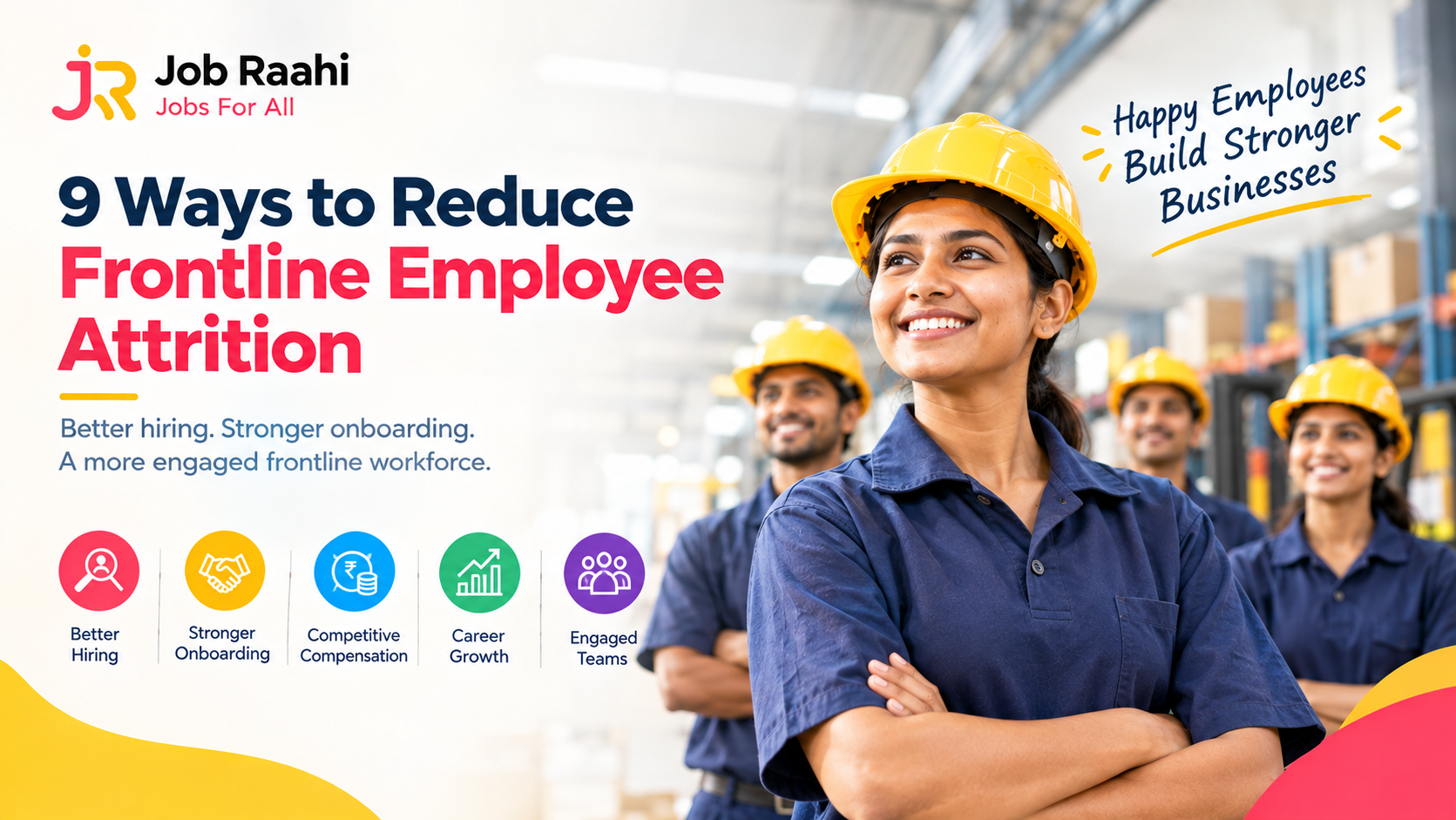
Frontline employee attrition is one of the most persistent challenges for employers managing manufacturing units, retail operations, warehouses, facility management teams, and other high-volume workforces. When employees leave frequently, organisations must repeatedly recruit, onboard, and train replacements, increasing operational costs and putting additional pressure on existing teams.
For many employers, the challenge is not simply finding enough candidates. It is finding the right workforce, setting realistic job expectations, improving the joining experience, and creating conditions that encourage employees to stay.
So, how can businesses reduce frontline employee attrition?
This guide explores nine practical strategies employers can use to improve workforce retention, strengthen recruitment processes, and build a more stable workforce.
What Is Frontline Employee Attrition?
Frontline employee attrition refers to the gradual reduction in an organisation’s frontline workforce when employees leave and are not immediately replaced. These employees may work directly in production, operations, customer service, warehousing, retail, maintenance, or other essential business functions.
Attrition can occur when employees resign voluntarily, leave for better opportunities, relocate, or find that the job does not meet their expectations.
In high-volume hiring environments, even a seemingly small increase in attrition can create significant operational challenges. Employers may struggle to maintain production schedules, meet service commitments, or keep shifts adequately staffed.
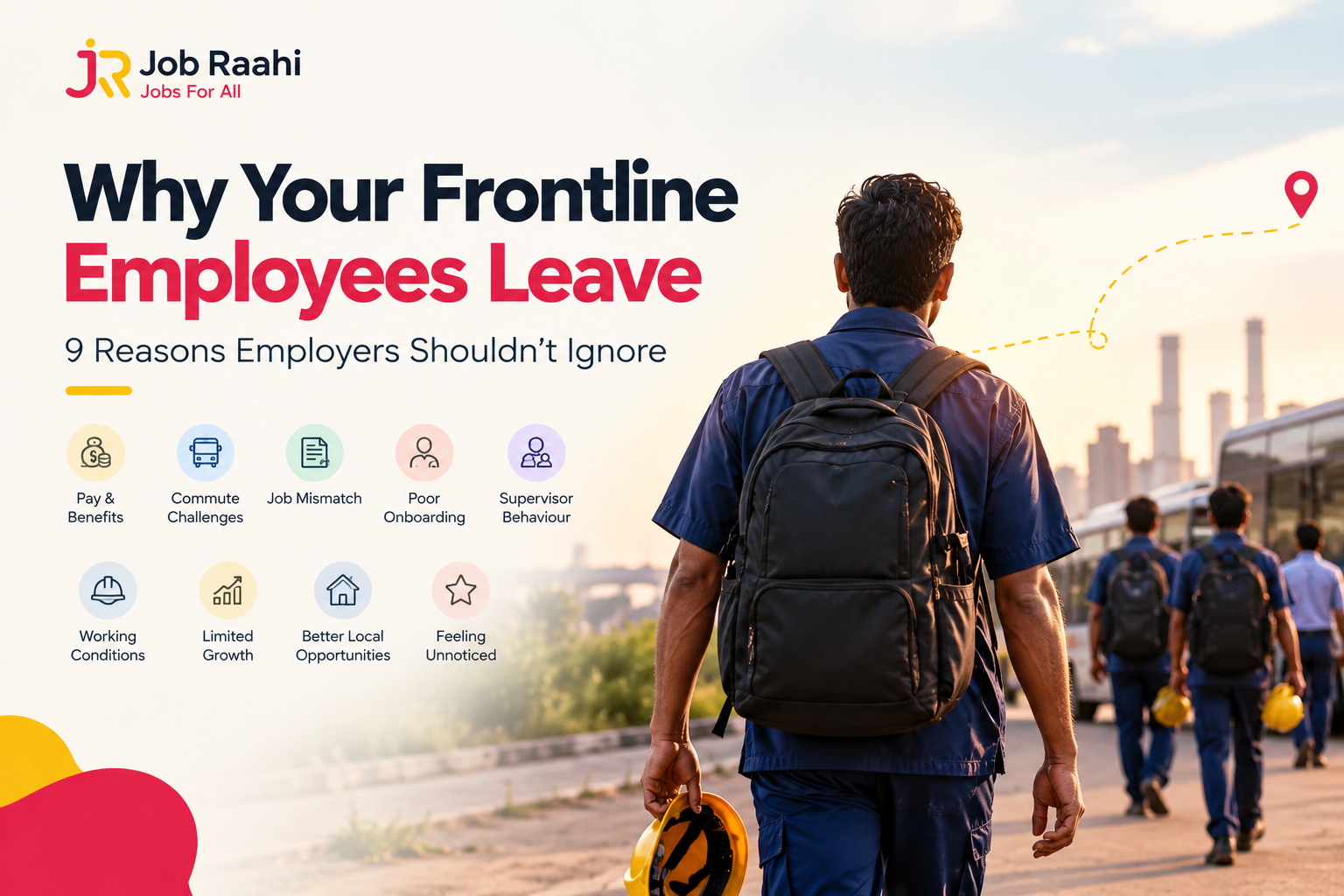
Why Does Frontline Employee Attrition Happen?
Before implementing retention strategies, employers need to understand why workers leave.
Some common reasons include:
- Better wage opportunities: Employees may move to another employer offering higher take-home pay or more predictable earnings.
- Long commuting distances: Travel costs, unreliable transport, and lengthy commutes can make a job difficult to sustain.
- Mismatch between job expectations and reality: Employees may discover that actual duties, working hours, targets, or compensation differ from what they were told during recruitment.
- Unpredictable shifts and overtime: Difficult schedules can affect family responsibilities and personal well-being.
- Workplace conditions: Poor supervision, unsafe environments, or a lack of basic facilities can encourage employees to leave.
- Limited growth opportunities: Employees may move elsewhere when they cannot see a path to better responsibilities or earnings.
- Delayed communication or salary payments: Uncertainty around wages, attendance, incentives, and payroll can undermine trust.
- Social and location-based factors: Workers often make employment decisions based on family needs, local networks, transport access, and opportunities closer to home.
These reasons may overlap. An employee might accept a slightly higher-paying job because it is closer to home, offers more predictable shifts, or allows them to work alongside people they already know.
9 Practical Strategies to Reduce Frontline Employee Attrition
1. Recruit From Locations Close to the Workplace
Distance plays an important role in frontline employment decisions. A job that appears attractive on paper may become difficult to sustain if employees spend several hours commuting each day.
Employers should evaluate where suitable workers live and identify recruitment catchment areas around their facilities.
Practical steps include:
- Targeting candidates from nearby towns and residential areas.
- Considering transport availability before selecting recruitment locations.
- Using location-based job promotion to reach relevant candidates.
- Communicating shift timings and transport arrangements before joining.
- Comparing retention across different sourcing locations.
Hyperlocal recruitment can help employers reach workers for whom the workplace is more accessible. It does not guarantee lower attrition, but it gives employers another factor to consider when building a stable workforce.
2. Set Clear Expectations Before Joining
A mismatch between advertised conditions and the actual job can lead to early exits.
During recruitment, candidates should receive clear information about:
- Salary structure and expected take-home pay.
- Shift timings, weekly offs, and overtime requirements.
- Job responsibilities and physical demands.
- Work location and reporting arrangements.
- Contract terms, benefits, and eligibility requirements.
- Joining dates and required documentation.
Employers should also explain any variable incentives or attendance-linked payments rather than presenting them as guaranteed earnings.
When candidates understand the job before accepting the offer, they can make better-informed decisions. This can reduce avoidable dropouts during onboarding and the first few weeks of employment.
3. Review Wages and Benefits Against Local Market Conditions
Compensation remains an important factor in workforce retention. Employers do not necessarily need to offer the highest salary in the market, but they should understand what comparable employers are offering in the same hiring location.
Review the complete employment proposition, including:
- Take-home salary.
- Attendance and performance incentives.
- Overtime payment practices.
- Transport and meal facilities.
- Leave and statutory benefits.
- Salary payment timelines.
A useful approach is to compare compensation across the locations from which the organisation recruits most frequently.
If employees from one particular area consistently leave for nearby employers, local wage differences, transport expenses, and shift arrangements may deserve closer examination.
4. Improve the First 30 Days of Employment
The first few weeks can influence whether a new employee feels comfortable continuing in the job.
A recruitment process should not end when the candidate accepts an offer or reports for duty. Employers should establish a structured joining and onboarding process.
An effective first-month plan may include:
Before joining: Confirm the joining date, documents, reporting location, salary terms, and contact person.
First day: Explain workplace rules, safety procedures, attendance, payroll, and job responsibilities.
First week: Assign a supervisor or experienced colleague who can answer questions and help the employee settle in.
First 30 days: Check attendance, address concerns, and gather feedback about the work environment.
Tracking early exits separately from overall attrition can help employers identify problems with recruitment, communication, onboarding, or supervision.
5. Train Supervisors to Manage People Effectively
Frontline employees often interact with their immediate supervisors more frequently than with the HR team. As a result, supervisor behaviour can influence the day-to-day employee experience.
Employers should train supervisors to:
- Communicate instructions clearly.
- Treat employees consistently and respectfully.
- Address grievances without unnecessary delays.
- Explain performance expectations.
- Recognise reliable attendance and good performance.
- Escalate safety and workplace concerns promptly.
Supervisors should also be encouraged to identify recurring problems instead of treating every resignation as an isolated incident.
A pattern of employees leaving one shift, team, or reporting line may indicate an operational or management issue that needs attention.
6. Understand Group Attrition and Worker Networks
Frontline workers frequently learn about employment opportunities through friends, relatives, former colleagues, manpower vendors, and people from the same locality.
These networks can support recruitment because workers may refer people they trust. However, they can also contribute to group attrition.
For example, if several employees have joined through the same contractor or come from the same area, one worker moving to a different employer may influence others to explore that opportunity.
Employers should not assume that shared backgrounds or union membership automatically lead to group resignations. Instead, they should examine actual exit patterns and the reasons employees provide.
Useful actions include:
- Tracking attrition by sourcing channel, contractor, location, and shift.
- Conducting confidential exit interviews.
- Identifying repeated concerns about wages, supervision, transport, or working conditions.
- Maintaining regular communication with workers.
- Developing multiple recruitment channels rather than depending on one source.
The goal is not to discourage worker relationships. It is to understand workforce patterns and address common concerns before they lead to avoidable exits.
7. Offer Visible Opportunities for Growth
Frontline roles should not become dead ends for employees who want to improve their skills and earnings.
Even when organisations cannot offer frequent promotions, they can provide clear progression opportunities.
For example, an employee may progress from an entry-level production role to a skilled operator, team leader, machine operator, or supervisor after meeting defined training and performance requirements.
Employers can support this progression through:
- Practical skill development.
- Cross-training for additional responsibilities.
- Internal vacancy announcements.
- Transparent promotion criteria.
- Recognition for attendance, safety, and performance.
- Training for employees interested in supervisory roles.
When workers understand how they can improve their skills or earnings, they have a clearer reason to consider staying with the organisation.
8. Use Workforce Data to Identify Attrition Patterns
Many organisations monitor total headcount and monthly resignations but do not investigate where attrition is concentrated.
A more useful approach is to segment the data and look for patterns.
Track metrics such as:
- Monthly and annual attrition rates.
- First-30-day and first-90-day attrition.
- Offer acceptance and joining rates.
- Absenteeism and no-show rates.
- Attrition by location, shift, department, and supervisor.
- Attrition by recruitment channel or manpower vendor.
- Average time taken to fill vacancies.
- Recruitment cost per joining.
For example, if a facility experiences frequent early exits among employees recruited from distant locations, transport and commuting conditions may require review. If resignations are concentrated in one department, the organisation may need to investigate supervision, workload, or working conditions.
Data does not replace conversations with employees. It helps HR teams decide which questions to ask and where corrective action may have the greatest impact.
9. Build a Continuous Recruitment Pipeline
Even organisations with strong retention practices will experience some workforce movement. The objective is to reduce avoidable attrition while ensuring that essential operations do not suffer when vacancies arise.
Instead of beginning recruitment only after several employees resign, employers can maintain a continuous pipeline of suitable candidates.
This involves:
- Keeping job descriptions and hiring requirements updated.
- Building candidate pools for recurring roles.
- Promoting vacancies in relevant hiring locations.
- Maintaining communication with interested candidates.
- Planning for seasonal demand and workforce expansion.
- Tracking joining commitments and replacement requirements.
- Using digital channels to improve vacancy visibility.
A continuous pipeline helps HR teams respond more quickly when vacancies arise. It should complement retention initiatives, not replace them.
How Job Raahi Can Support Frontline Recruitment
Reducing attrition requires employers to address both sides of workforce management: retaining existing employees and sourcing suitable replacements when vacancies arise.
Job Raahi is a digital job board designed for frontline and mass hiring. It helps employers promote vacancies and reach prospective candidates through a range of digital outreach channels.
Its recruitment support includes:
- Wider vacancy visibility: Promote job openings to expand the reach of recruitment campaigns.
- Location-focused outreach: Support hiring campaigns aimed at relevant geographic areas.
- Candidate communication: Use available channels such as WhatsApp, RCS Business Messaging, SMS, email, and AI-powered calling to support outreach.
- High-volume job management: Manage multiple vacancies and recurring workforce requirements through the platform.
- Recruitment pipeline development: Help employers maintain visibility for ongoing hiring needs rather than relying only on last-minute recruitment.
Job Raahi offers free onboarding and job posting, with no additional marketing charges for the platform’s stated outreach campaigns.
Employers should still assess candidate suitability, communicate job conditions accurately, and monitor joining and retention outcomes. A recruitment platform can support candidate reach, but long-term workforce stability also depends on compensation, management, working conditions, and employee experience.
How to Measure Whether Attrition Is Improving
A retention initiative should be evaluated against clear baseline metrics rather than assumptions.
One important measure is the attrition rate:
Attrition Rate (%) = (Number of employee exits during the period ÷ Average employee headcount during the period) × 100
For example, if an organisation records 20 employee exits during a month and its average workforce during that month is 400, the monthly attrition rate is 5%.
Employers should also measure early attrition, joining rates, absenteeism, and replacement hiring costs. Comparing these metrics before and after an intervention can help determine whether a change—such as improved transport, clearer job communication, or location-focused recruitment—is making a difference.
Where possible, compare similar departments, locations, or hiring groups over the same period. This helps HR teams avoid attributing every change in attrition to a single initiative.
Frequently Asked Questions
1. What is the main cause of frontline employee attrition?
There is no single cause across all organisations. Common factors include compensation, commuting distance, shift timings, workplace conditions, supervisor behaviour, and better local employment opportunities. Employers should analyse their own exit data and speak with employees to identify the most relevant factors.
2. How can employers reduce early attrition?
Employers can improve early retention by communicating job conditions accurately, confirming joining arrangements, providing structured onboarding, assigning supportive supervisors, and checking in with employees during their first 30 to 90 days.
3. Does hyperlocal hiring reduce employee attrition?
Hyperlocal hiring can improve access to jobs by reaching candidates closer to the workplace. It may reduce commuting-related barriers, but it does not guarantee lower attrition. Wages, working conditions, job expectations, and management practices remain important.
4. How can HR teams identify group attrition?
HR teams can review exit patterns by location, shift, department, recruitment channel, contractor, and supervisor. Exit interviews and confidential employee feedback can help explain whether workers are leaving for similar reasons or following opportunities through their professional and social networks.
5. How can digital recruitment platforms help with frontline hiring?
Digital recruitment platforms can improve vacancy visibility, expand candidate reach, support targeted outreach, and help employers manage recurring vacancies. Employers should evaluate platform performance using relevant metrics, including suitable applications, joining rates, time to fill, and cost per joining.
Conclusion
Frontline employee attrition is not simply a recruitment problem. It is a workforce management challenge influenced by compensation, location, job expectations, workplace relationships, supervision, and growth opportunities.
Employers can make meaningful progress by understanding why workers leave, improving the first few weeks of employment, monitoring attrition patterns, and building a continuous recruitment pipeline.
A more effective approach combines retention initiatives with smarter recruitment. By addressing the reasons employees leave while making vacancies easier for suitable candidates to discover, organisations can work toward a more reliable and sustainable frontline workforce.
Looking to strengthen your frontline hiring process? Explore how Job Raahi can support vacancy promotion and workforce recruitment through its digital hiring platform.
External Resources on Workforce Retention and Employment in India
For further reading on employment trends, labour conditions, and worker welfare, explore these official resources:
- Periodic Labour Force Survey (PLFS) – Ministry of Statistics and Programme Implementation
Explore official employment and labour force statistics that can help employers understand India’s changing employment landscape. - Annual PLFS Reports – Directorate General of Employment
Access annual reports on employment and labour force indicators to support workforce planning and recruitment research. - Indian Labour Statistics – Labour Bureau
Find government-published labour statistics relevant to understanding employment conditions and workforce trends. - Code on Wages, 2019 – India Code
Review the legal framework relating to wages and bonus provisions in India. - Occupational Safety, Health and Working Conditions Code, 2020 – India Code
Learn about the legal framework covering occupational safety, health, and working conditions. - Safety and Health at Work – International Labour Organization (ILO)
Explore international resources on workplace safety, prevention practices, and creating healthier working environments.
These resources can help HR teams and employers strengthen their understanding of labour conditions, workplace standards, and workforce planning. While official labour statistics provide useful context, employers should also use internal exit interviews, employee feedback, and attrition data to identify the specific reasons workers leave their organisation.