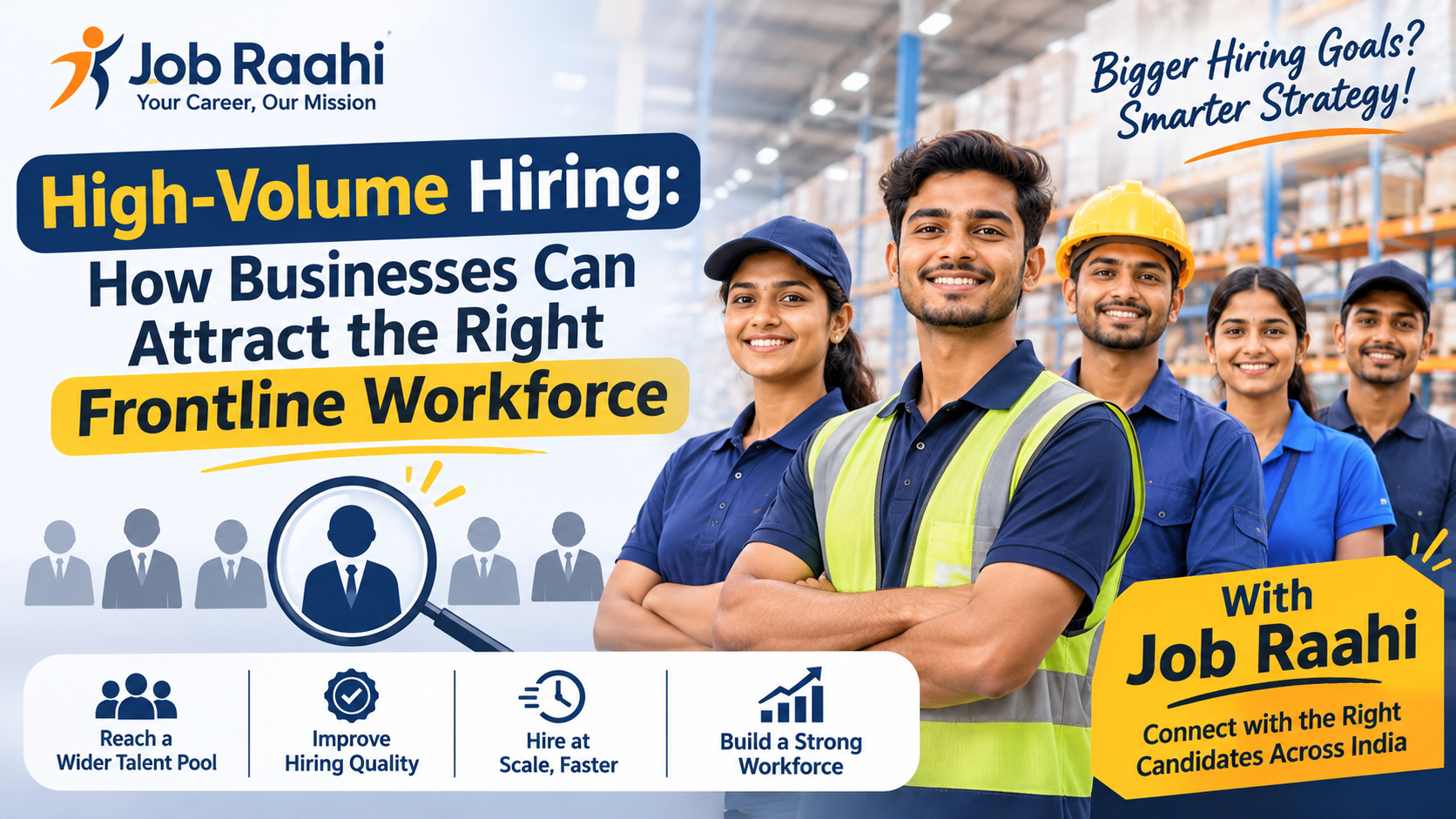
For businesses operating across logistics, warehousing, manufacturing, retail, hospitality and delivery, having the right workforce is essential to maintaining daily operations.
A warehouse needs associates to manage inventory and dispatch. A retail chain needs employees across multiple stores. A manufacturing unit requires production workers to maintain its operations. A delivery business needs people to support its growing service network.
When these requirements arise across several locations or within a short period, companies face the challenge of high-volume hiring.
However, bulk recruitment is not simply about attracting a large number of applicants. Employers must find candidates who meet the job requirements, are genuinely interested in the opportunity and are willing to join.
The real challenge is therefore not just hiring at scale. It is attracting the right workforce at scale.
What Is High-Volume Hiring?
It is commonly required when businesses:
- Open new warehouses, stores, factories or operational facilities.
- Expand into new cities or geographical markets.
- Experience seasonal increases in business demand.
- Launch new projects or operational units.
- Need to replace employees who have left the organisation.
- Expand delivery, sales or customer support operations.
Unlike specialised recruitment, where companies may focus on filling a few positions, high-volume hiring involves attracting and evaluating multiple candidates for similar or different roles.
Common examples include:
| Industry | Common High-Volume Roles |
|---|---|
| Logistics and Warehousing | Warehouse Associates, Pickers, Packers, Helpers |
| Retail | Store Associates, Cashiers, Sales Executives |
| Manufacturing | Production Associates, Machine Operators, Packaging Staff |
| Delivery | Delivery Executives, Field Associates |
| Hospitality | Housekeeping Staff, Kitchen Helpers, Service Associates |
| BPO and Customer Support | Customer Support Executives, Telecallers |
Each role has different eligibility requirements, but all require employers to communicate vacancies effectively and reach relevant candidates.
Why High-Volume Frontline Hiring Is Challenging
Recruiting a large number of employees comes with challenges that are different from hiring for a small number of specialised positions.
Limited Candidate Reach
Companies may depend on familiar job portals, referrals or local recruitment drives. While these channels can be useful, relying on a limited number of sources may restrict access to candidates from other locations.
High Competition for Frontline Talent
Several employers may be looking for similar candidates in the same geographical area. This makes it important to communicate job opportunities clearly and attract candidates who are genuinely interested.
Candidate Drop-Offs
Not every candidate who applies will attend an interview or complete the joining process. Some may accept another offer, change their plans or find that the job does not match their expectations.
Unclear Job Information
Incomplete information about salary, location, working hours, responsibilities or eligibility can lead to unsuitable applications and confusion during recruitment.
Urgent Hiring Requirements
Operational businesses often work with strict timelines. Delays in hiring can affect productivity, service delivery and business expansion.
These challenges make it necessary for employers to develop a structured approach rather than depending only on application volume.
Why Receiving More Applications Does Not Always Mean Better Hiring
One common mistake in mass recruitment is treating the number of applications as the main measure of success.
A campaign may generate hundreds of applications but still fail to meet the actual hiring requirement.
For example, imagine a warehouse hiring 100 associates. It receives 500 applications, but many candidates do not meet the eligibility criteria, some are unwilling to work at the given location, and others do not attend interviews.
The employer may have generated considerable interest without achieving the required number of joinings.
This highlights an important difference:
- Application volume: How many candidates apply.
- Candidate relevance: How many applicants meet the job requirements.
- Candidate engagement: How many remain interested throughout the process.
- Hiring conversion: How many selected candidates actually join.
A successful high-volume hiring strategy must consider all four.
Strategies to Attract the Right Frontline Workforce
Attracting suitable candidates requires employers to understand their target workforce and select recruitment channels accordingly.
A. Define Job Requirements Clearly
Before starting a hiring campaign, employers should establish the exact requirements for each position.
Important details include:
- Job title and responsibilities.
- Educational qualifications.
- Required experience, if any.
- Salary and payment structure.
- Work location.
- Shift timings and weekly offs.
- Physical or technical requirements, where relevant.
- Joining timeline.
Clear job descriptions help candidates understand the opportunity before applying and allow employers to attract more relevant applicants.
B. Expand Beyond Traditional Hiring Locations
Employers should not restrict their recruitment efforts to major metropolitan cities.
Smaller cities, nearby towns and hinterland regions can offer access to freshers and candidates with different educational and vocational backgrounds.
For example, a manufacturing company may explore ITI and diploma candidates from nearby districts, while a logistics business may reach candidates interested in warehouse operations from surrounding towns.
Expanding geographical reach can help businesses explore additional talent markets.
C. Use Multiple Recruitment Channels
A strong high-volume hiring strategy should not depend on just one source.
Companies can combine:
- Digital job portals.
- Employee referrals.
- Campus and ITI placements.
- Local job fairs and recruitment drives.
- Community-level outreach.
- Social media campaigns.
- Regional recruitment networks.
Different channels may perform differently depending on the role, location and candidate profile. Employers should identify which sources bring suitable applicants and actual joinings.
D. Make Job Opportunities Easy to Understand
Frontline candidates may not be familiar with complex job descriptions or corporate recruitment language.
Use simple and direct communication.
Instead of writing a lengthy description, explain what the candidate will do, where the job is located, what qualifications are needed and what the employment conditions are.
Where appropriate, communicating in regional languages can make vacancies easier to understand.
E. Highlight Opportunities for Freshers
Not every frontline position requires extensive work experience.
Many roles offer opportunities for candidates entering the workforce for the first time.
Employers can expand their potential candidate pool by considering freshers and candidates with limited experience where the role permits.
This can also help young people gain practical exposure and begin their professional journeys.
How to Improve Candidate Quality During Bulk Hiring
Attracting more candidates is only the beginning. Employers must also make sure the recruitment process identifies people who are suitable for the role.
Here are some practical ways to improve candidate quality.
Use Role-Based Screening: Evaluate candidates according to the actual responsibilities and eligibility criteria rather than relying only on general qualifications.
Communicate Expectations Early: Explain working conditions, shifts, salary, location and responsibilities before the interview stage.
Keep the Application Process Simple: Avoid unnecessary complexity that may discourage suitable candidates from applying.
Conduct Relevant Assessments: Depending on the position, use basic practical tests, communication assessments or role-specific questions.
Maintain Regular Communication: Keep candidates informed about interview schedules, selection updates and joining requirements.
Provide a Realistic Job Preview: Help candidates understand what the job involves so they can make informed decisions.
A transparent recruitment process can reduce mismatches between candidate expectations and employer requirements.
The Role of Technology and Digital Job Platforms
Technology has changed how employers approach recruitment, particularly when vacancies need to reach candidates across multiple locations.
Digital job platforms allow companies to publish vacancies and make them accessible to job seekers beyond their immediate geographical networks.
For high-volume hiring, this creates additional opportunities to:
- Promote multiple job openings.
- Reach candidates across different locations.
- Attract freshers and candidates with limited experience.
- Communicate job requirements more widely.
- Create another channel for candidate applications.
However, technology alone cannot guarantee suitable hiring outcomes. Employers still need clear job descriptions, appropriate screening, candidate communication and a structured selection process.
The most effective approach is to combine digital recruitment with local engagement and human interaction.
How Job Raahi Can Support High-Volume Hiring
For companies hiring frontline employees in bulk, expanding candidate reach is an important part of the recruitment strategy.
It provides employers with an additional channel to communicate vacancies and explore a wider candidate pool.
Reach Beyond Traditional Employment Markets
Job Raahi focuses on connecting employers with candidates across different parts of India, including smaller cities and hinterland regions.
This can help businesses explore talent beyond the locations and recruitment channels they already depend on.
Access to Freshers and Candidates with Limited Experience
Many frontline roles are suitable for candidates who are beginning their careers.
Job Raahi helps employers reach freshers and candidates with limited professional experience, depending on the eligibility requirements of the vacancy.
This gives companies an opportunity to consider candidates who may have the right basic qualifications, practical knowledge and willingness to learn.
Support Across Multiple Frontline Sectors
Job Raahi focuses on opportunities across sectors such as:
- Logistics and warehousing.
- Retail and sales.
- Delivery operations.
- Hospitality.
- BPO and customer support.
- Field operations.
- Other frontline and operational roles.
This makes the platform relevant to employers with different types of frontline recruitment requirements.
An Additional Sourcing Channel for Employers
Companies do not need to replace their existing recruitment methods to explore Job Raahi.
They can continue using referrals, job portals, campus placements and recruitment drives while using Job Raahi as another channel to promote vacancies and reach potential candidates.
The objective is to make it easier for companies to connect with a broader candidate market while helping freshers and other job seekers discover relevant employment opportunities.
Recruitment Metrics Every Employer Should Track
High-volume hiring should be measured through meaningful recruitment outcomes rather than application numbers alone.
Some important metrics include:
| Recruitment Metric | What It Measures |
|---|---|
| Number of Applications | Total candidates applying for vacancies |
| Relevant Application Rate | Percentage of applicants meeting basic requirements |
| Interview Attendance Rate | Candidates attending scheduled interviews |
| Selection Rate | Percentage of interviewed candidates selected |
| Offer Acceptance Rate | Candidates accepting employment offers |
| Joining Rate | Selected candidates who actually join |
| Time to Fill | Time taken to close a vacancy |
| Source-Wise Hiring | Applications, selections and joinings from each recruitment channel |
| Early Attrition | Employees leaving within an initial period of employment |
Tracking these metrics helps employers understand which recruitment channels are performing well and where improvements are needed.
For example, if one sourcing channel generates many applications but very few joinings, the company may need to review candidate relevance, job communication or the location being targeted.
The purpose of measurement is to improve hiring decisions continuously.
Conclusion: Successful Bulk Hiring Starts with Reaching the Right People
High-volume hiring is not just about filling multiple vacancies quickly. It is about building a recruitment strategy that consistently attracts suitable candidates and converts genuine interest into successful joinings.
Employers need to look beyond application numbers and focus on candidate relevance, clear communication, geographical reach and effective recruitment channels.
Exploring smaller cities, connecting with educational institutions, considering freshers and using digital job platforms can help businesses broaden their sourcing approach.
Platforms like Job Raahi can contribute by giving employers an additional channel to reach frontline candidates, including freshers and individuals from hinterland regions.
As businesses continue to expand their operations, the ability to attract the right workforce will remain an important part of sustainable growth.
Because successful high-volume hiring is not about collecting the maximum number of applications. It is about connecting the right opportunities with the right people, at the right time.