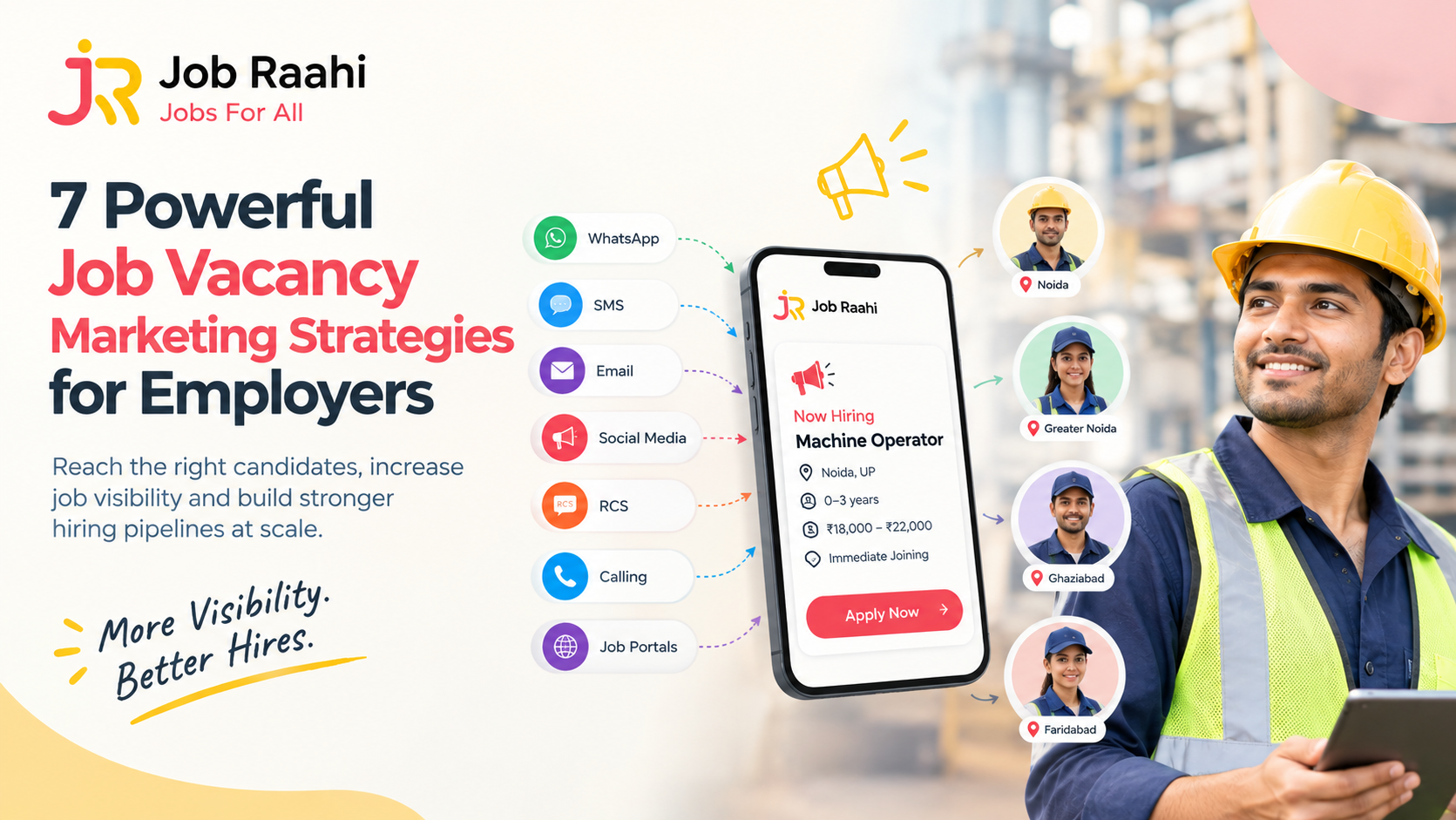
A job vacancy can be perfectly written.
The salary can be competitive.
The company can be well known.
The role can have an immediate joining requirement.
And yet, the right candidates may never apply.
Why?
Because a vacancy cannot hire someone if the candidate never sees it.
This is one of the biggest challenges employers face in today’s competitive hiring environment, particularly when recruiting for frontline, blue-collar, grey-collar, industrial, field and high-volume roles.
For years, recruitment has largely followed a simple model:
Create Job → Post Job → Wait for Applications
But candidate behaviour has changed.
Today, a job vacancy is competing for attention with:
- Other job vacancies
- Social media content
- WhatsApp messages
- Recruiter calls
- Local employment opportunities
- Gig work
- Referrals
- Offline hiring campaigns
- Multiple employers hiring for similar roles
The question is no longer simply:
“Where should we post the job?”
The better question is:
“How do we make sure the right candidates actually see, understand and consider this opportunity?”
That is where job vacancy marketing comes in.
What Is Job Vacancy Marketing?
Job vacancy marketing is the process of actively promoting a job opportunity to relevant candidates instead of relying only on candidates discovering the vacancy on a job portal.
Think about the difference between:
Job Posting
“We have a vacancy. Here it is.”
and:
Job Marketing
“We have a vacancy, and we’re going to actively take this opportunity to the candidates who are most likely to be interested.”
The second approach treats a job vacancy more like a candidate acquisition campaign.
The objective is not simply to publish.
The objective is to create:
Awareness → Interest → Application → Engagement → Hiring
Why Job Posting Alone Is No Longer Enough
Posting a vacancy is important.
But posting doesn’t guarantee visibility.
Imagine a company publishes a job for:
Production Operator — Noida
At the same time, hundreds of other jobs may be available for:
- Machine Operators
- Warehouse Associates
- Technicians
- Delivery Executives
- Sales Executives
- Field Staff
- Production Workers
The candidate now has choices.
Your vacancy isn’t competing only with other companies.
It is competing for candidate attention.
This is particularly important for employers recruiting at scale.
When you need:
10 people, passive applications may sometimes be enough.
When you need:
100, 500 or 1,000 people across locations, relying only on organic job discovery can become limiting.
A Vacancy Has a Distribution Problem
Recruiters often focus heavily on the quality of the job description.
That’s important.
But another question deserves equal attention:
How far did the vacancy travel?
Consider two employers.
Employer A
Posts a job on a platform and waits.
Employer B
Posts the job and actively promotes it through:
- Candidate databases
- RCS
- SMS
- Social media
- Digital campaigns
- Calling
- Location-based targeting
Both employers have a vacancy.
But their candidate distribution strategy is completely different.
This is the difference between:
Job Publishing
and
Job Distribution.
The Difference Between Job Posting and Job Marketing
| Job Posting | Job Marketing |
|---|---|
| Publish vacancy | Promote vacancy |
| Wait for discovery | Actively create reach |
| One primary channel | Multiple channels |
| Candidate comes to job | Job goes to candidate |
| Focus on applications | Focus on candidate acquisition |
| Often reactive | Can be proactive |
| Vacancy-centric | Candidate-centric |
| Limited campaign thinking | Continuous campaign approach |
Neither approach eliminates the need for the other.
A strong recruitment strategy can use both.
Posting creates the opportunity.
Marketing creates visibility.
7 Ways Employers Can Market Their Job Vacancies
1. Reach the Right Candidate Segment
More reach doesn’t necessarily mean better hiring.
If a company needs:
ITI Electricians in Haridwar
reaching thousands of unrelated candidates doesn’t solve the problem.
The employer needs relevant candidates based on:
- Location
- Qualification
- Experience
- Role
- Availability
- Salary expectations
- Industry experience
This is why candidate segmentation is becoming increasingly important in high-volume recruitment.
The goal isn’t:
Reach everyone.
It’s:
Reach more of the right people.
2. Make the Job Discoverable
A candidate cannot apply for a vacancy they never discover.
Employers should therefore think about the different ways candidates can encounter a job opportunity.
For example:
Job Platform
↓
↓
RCS
↓
SMS
↓
Social Media
↓
Digital Campaign
↓
Recruiter Outreach
↓
Candidate Referral
A multi-channel approach can increase the number of opportunities for relevant candidates to discover the vacancy.
3. Localise the Recruitment Message
A generic job advertisement may say:
“Hiring Field Executives.”
A more targeted message could say:
Hiring Field Executives in Meerut — Immediate Joining
Or:
10 Technician Jobs Near Rudrapur — Apply Now
The second message immediately answers an important candidate question:
Where is the job?
For frontline hiring, location can be one of the strongest elements of a recruitment message.
That makes localised job marketing particularly useful.
4. Repeat the Opportunity
One social post doesn’t create a recruitment campaign.
One SMS doesn’t create a recruitment campaign.
One WhatsApp message doesn’t create a recruitment campaign.
Candidates may miss messages.
They may not be looking for a job that day.
They may see the vacancy but not apply immediately.
They may become available later.
This means recruitment campaigns can benefit from consistent candidate communication, while respecting appropriate consent, frequency and communication practices.
The objective is not to spam candidates.
It is to ensure that relevant opportunities remain discoverable.
5. Build Campaigns Around Hiring Requirements
Instead of thinking:
“We have 100 vacancies.”
think:
“We have a 30-day hiring campaign.”
For example:
Campaign
Requirement: 100 Production Operators
Location: Greater Noida
Duration: 30 Days
Target: Relevant frontline candidates
Channels:
- Job platform
- SMS
- Social media
- Candidate database
- Recruiter outreach
Goal:
Build sufficient qualified candidates to achieve the joining target.
This changes the recruitment mindset from vacancy management to candidate acquisition.
6. Use Job Marketing for Difficult Locations
Some recruitment markets are naturally more challenging.
Examples include:
- Remote industrial locations
- Smaller cities
- Tier 2 markets
- Tier 3 markets
- Hinterlands
- New facility locations
- Locations with limited candidate awareness
In these markets, simply posting the job may not be enough.
Employers may need to actively introduce the opportunity to the local talent market.
This can involve:
Local targeting + digital reach + candidate databases + direct engagement.
7. Turn Hiring Data Into Better Campaigns
Job marketing can also create useful recruitment intelligence.
Suppose a company runs campaigns in three locations.
Location A
High reach → High applications → High interview conversion
Location B
High reach → High applications → Low joining
Location C
Low reach → Low applications → High joining conversion
The recruitment team now has something valuable:
Data about how different hiring markets behave.
Over time, employers can use this information to improve:
- Candidate targeting
- Messaging
- Channels
- Hiring radius
- Campaign timing
- Recruitment budgets
- Candidate engagement
Turn Every Hiring Requirement Into a Recruitment Campaign
A vacancy shouldn’t always be treated as an isolated event.
Consider a company that regularly hires:
Technicians
Sales Executives
Production Operators
Customer Service Associates
Instead of restarting the recruitment process every time, the employer can build ongoing candidate communities around these requirements.
For example:
Technician Talent Pool
Location: North India
Experience: 0–3 years
Qualification: ITI / Diploma
Availability: Actively looking
Then every new technician requirement can potentially activate an existing candidate pipeline.
This creates a more sustainable approach to high-volume hiring.
How Job Raahi Approaches Employer Hiring
Job Raahi is built around a simple idea:
We Don’t Just List Your Jobs. We Market Them.
For employers hiring frontline and high-volume workforces, Job Raahi combines job publishing with candidate reach and digital amplification.
This can include:
Unlimited Job Posting
Employers can publish multiple frontline opportunities.
Candidate Database
Access relevant candidate pools for hiring requirements.
Hyperlocal Candidate Reach
Reach candidates around specific hiring markets.
Social Media Promotion
Promote relevant vacancies through targeted digital campaigns.
Use WhatsApp-based candidate communication and outreach.
RCS Business Messaging
Deliver richer recruitment communication where appropriate.
SMS
Reach candidates through direct messaging.
Email Campaigns
Use email as another candidate acquisition channel.
AI-Powered Calling
Support candidate engagement and outreach at scale.
The objective is not to add more complexity to recruitment.
It is to create more ways for the right candidate to discover the opportunity.
The Job Marketing Funnel
A recruitment campaign can be viewed as a funnel:
1. Reach
How many relevant candidates can we reach?
↓
2. Awareness
How many candidates notice the opportunity?
↓
3. Interest
How many candidates consider the job?
↓
4. Application
How many apply?
↓
5. Engagement
How many respond or engage with the recruiter?
↓
6. Interview
How many attend?
↓
7. Selection
How many are selected?
↓
8. Joining
How many actually join?
This creates a much broader view of recruitment performance.
Why This Matters for High-Volume Hiring
Imagine an employer needs:
500 frontline employees.
The traditional approach may be:
Post 500 jobs → Wait → Screen applications → Repeat
A recruitment marketing approach can be:
Define requirement
↓
Identify target markets
↓
Create job campaigns
↓
Reach relevant candidates
↓
Capture applications
↓
Engage candidates
↓
Build candidate pipeline
↓
Convert candidates into hires
↓
Retarget the remaining talent pool for future requirements
The second approach is designed around continuous candidate acquisition rather than one-time vacancy publishing.
From Vacancy Posting to Candidate Acquisition
This is the larger shift happening in recruitment.
Employers are moving from:
“Where can I post this vacancy?”
towards:
“How can I acquire the right candidates for this requirement?”
That shift is particularly important for:
- Frontline hiring
- Blue-collar recruitment
- Grey-collar hiring
- Industrial hiring
- Field workforce hiring
- Bulk recruitment
- High-volume hiring
- Multi-location recruitment
Because in these hiring environments, the challenge isn’t always the absence of jobs.
Sometimes, the challenge is connecting the job with the right candidate at the right time.
The Future of Recruitment Is Distribution
The companies that build strong recruitment engines will not necessarily be the companies that post the most jobs.
They may be the companies that become better at:
Finding candidates
Reaching candidates
Engaging candidates
Building candidate pools
Reactivating talent
Converting candidates into hires
In other words:
Recruitment is increasingly becoming a distribution problem.
And solving distribution requires more than a job board.
It requires a candidate acquisition strategy.
Frequently Asked Questions
What is job vacancy marketing?
Job vacancy marketing is the active promotion of job opportunities to relevant candidates through multiple channels instead of relying only on passive job posting.
How is job marketing different from job posting?
Job posting publishes a vacancy. Job marketing actively promotes the vacancy to increase relevant candidate awareness, reach and engagement.
Why is job marketing important for frontline hiring?
Frontline employers often recruit large numbers of candidates across multiple locations. Active job marketing can help increase visibility and reach relevant candidate segments.
What channels can employers use for job marketing?
Depending on the recruitment strategy, employers can use job platforms, social media, WhatsApp, RCS, SMS, email, digital campaigns, candidate databases and recruiter outreach.
Can job marketing support bulk hiring?
Yes. Job marketing can be structured into campaigns around specific roles, locations, candidate segments and hiring timelines.
How does Job Raahi market jobs?
Job Raahi combines job posting with candidate reach, digital promotion, hyperlocal targeting, candidate databases and multi-channel outreach to help employers promote their hiring requirements.
Your Vacancy Deserves More Than a Listing
Your hiring team spends time creating the JD.
Your business has a genuine requirement.
The position is open.
The salary is approved.
The hiring manager is ready.
But none of that matters if the right candidate never sees the opportunity.
That’s why employers need to think beyond:
“Where should I post this job?”
and start thinking:
“How should I market this job?”
At Job Raahi, that’s exactly where we want to make a difference.
We Don’t Just List Your Jobs. We Market Them.
External Resources
For additional insights into recruitment, employment trends, digital skills and India’s changing workforce landscape:
- International Labour Organization (ILO) — Research and reports on employment, labour markets and workforce trends: International Labour Organization
- India Employment Report 2024 — Insights into India’s youth employment, education and skills landscape: India Employment Report 2024
- Ministry of Labour & Employment, Government of India — Employment policies, labour-market initiatives and workforce information: Ministry of Labour & Employment
- Ministry of Statistics and Programme Implementation (MoSPI) — Employment and labour-force data through the Periodic Labour Force Survey: MoSPI – PLFS Data
- Skill India Digital — Government platform focused on skills, training and employment opportunities: Skill India Digital