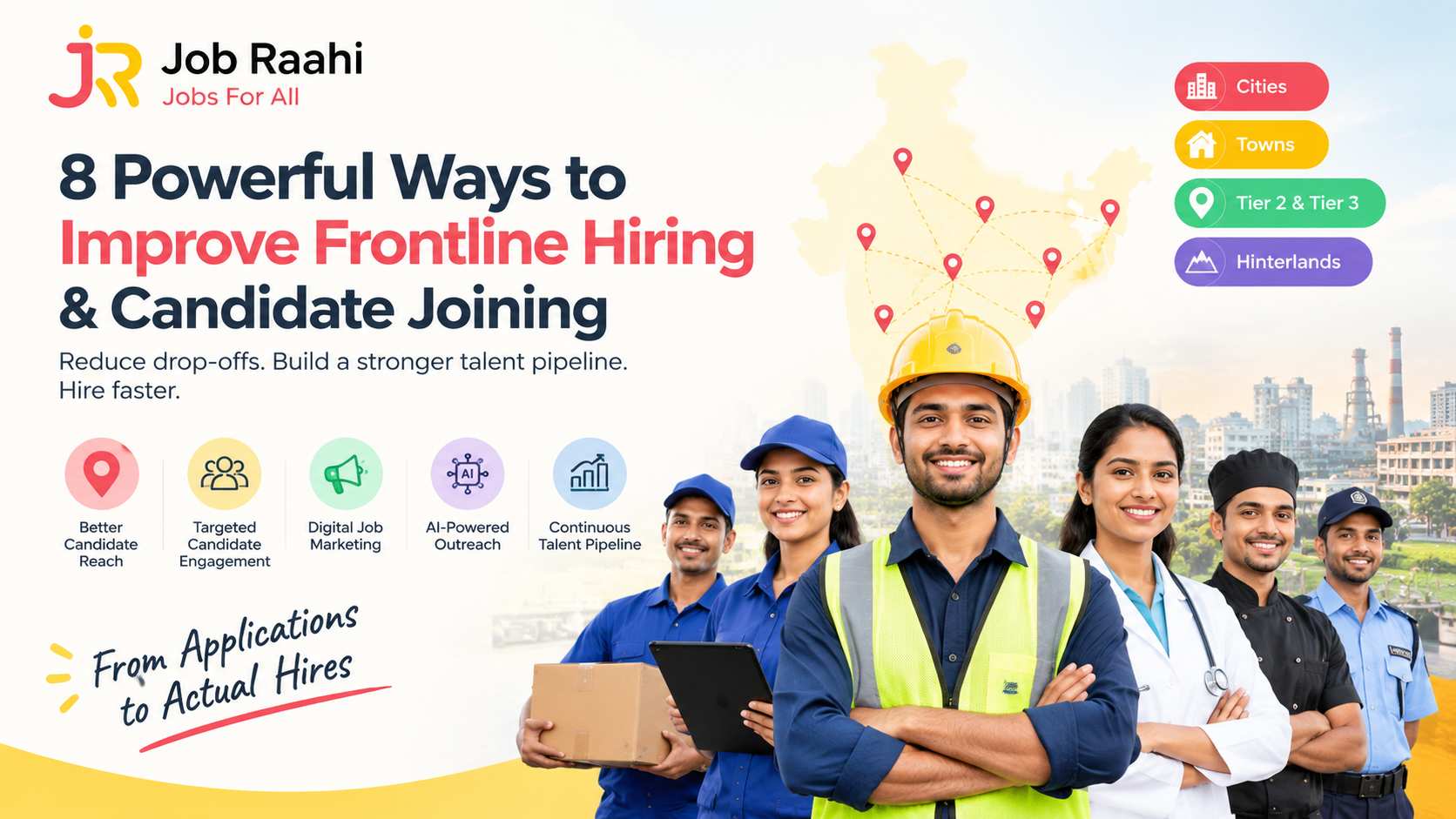
Getting applications is only the beginning of frontline hiring.
For companies hiring frontline, blue-collar, grey-collar, industrial and high-volume employees, one of the biggest recruitment challenges often begins after a candidate clicks Apply.
A candidate applies.
The recruiter calls.
The candidate shows interest.
An interview is scheduled.
The candidate is selected.
And then the candidate doesn’t join.
This creates a frustrating gap between:
Applications → Interviews → Selection → Joining
For frontline employers, this gap can become particularly expensive when dozens or hundreds of positions need to be filled across multiple locations.
The answer is not always to generate more applications.
Sometimes, the bigger opportunity is to build a better frontline hiring pipeline that focuses on candidate relevance, speed, engagement, location and joining readiness.
This is where a modern frontline recruitment strategy needs to move beyond job posting.
Why Applications Don’t Always Become Hires
Recruiters often measure hiring activity through application numbers.
For example:
1,000 applications received
may initially look like a successful recruitment campaign.
But what if:
- 400 candidates are unreachable?
- 200 are not from the required location?
- 150 are not interested in the salary?
- 100 are unavailable?
- 80 do not attend the interview?
- 40 reject the offer?
- Only 30 actually join?
The original 1,000 applications suddenly look very different.
This is why employers need to look beyond application volume.
The real recruitment question is:
How many relevant candidates can move through the entire hiring funnel?
For frontline recruitment, this means improving every stage:
Reach → Apply → Contact → Screen → Interview → Select → Offer → Join
The Frontline Hiring Funnel
A typical frontline hiring funnel looks like this:
Stage 1 — Candidate Reach
Can the employer reach enough relevant candidates?
↓
Stage 2 — Application
Does the candidate find the job relevant enough to apply?
↓
Stage 3 — Contact
Can the recruiter successfully connect with the candidate?
↓
Stage 4 — Screening
Does the candidate meet the basic requirements?
↓
Stage 5 — Interview
Does the candidate attend and complete the interview?
↓
Stage 6 — Selection
Is the candidate selected?
↓
Stage 7 — Offer
Does the candidate accept the offer?
↓
Stage 8 — Joining
Does the candidate actually join?
A recruitment strategy that focuses only on the first two stages can leave significant value on the table.
8 Reasons Frontline Candidates Drop Off
1. Location Mismatch
Location is one of the biggest factors in frontline hiring.
A candidate may apply for a job because the role looks suitable, but later discover that the workplace is too far away.
For frontline employees, commuting distance can have a direct impact on the candidate’s decision.
This makes location-based hiring extremely important.
Instead of simply asking:
“Is this candidate qualified?”
recruiters should also ask:
“Can this candidate realistically work at this location?”
This is one reason hyperlocal recruitment can improve candidate relevance.
2. Slow Recruitment Processes
Frontline candidates may have several employment options.
If a company takes several days or weeks to move from:
Application → Screening → Interview → Selection
the candidate may accept another opportunity.
For high-volume hiring, speed matters.
A streamlined hiring process can reduce unnecessary delays between candidate application and recruiter engagement.
The faster relevant candidates move through the funnel, the lower the opportunity for drop-off.
3. Poor Candidate Communication
A candidate who applies for a job may have questions.
They may want to know:
- Where is the workplace?
- What is the salary?
- What are the working hours?
- Is transportation available?
- When is the interview?
- When can they join?
- What documents are required?
If these questions are not answered clearly, candidates can lose interest.
Candidate communication therefore becomes an important part of frontline recruitment.
Modern recruitment can combine human recruiter interaction with technology-assisted communication to improve the candidate experience.
4. Low Job Visibility
Posting a job does not automatically guarantee that the right candidates will see it.
This is particularly important when employers are hiring in:
- Tier 2 cities
- Tier 3 cities
- Industrial towns
- Smaller cities
- Districts
- Hinterlands
The candidate may be available.
The vacancy may be suitable.
But the candidate may never discover the opportunity.
This is where job marketing becomes important.
Instead of only listing a job, employers can actively promote the opportunity to relevant candidate segments.
5. Salary and Job Expectation Gaps
Another common reason for candidate drop-off is a mismatch between:
Candidate expectations
and
Employer offering
The candidate may apply before fully understanding the compensation, incentives, shift structure, location or job responsibilities.
Clear job communication can help reduce this mismatch.
A strong frontline job description should communicate:
- Salary
- Incentives
- Location
- Working hours
- Job responsibilities
- Qualification
- Experience
- Benefits
- Joining timeline
The clearer the opportunity, the more relevant the applications can become.
6. Candidates Have Multiple Opportunities
Frontline candidates often explore multiple opportunities simultaneously.
A candidate may apply to:
Company A
Company B
Company C
and
Company D
If Company B responds first, the candidate may move forward with Company B.
This means candidate response speed matters.
Recruiters should not assume that an interested applicant will remain available indefinitely.
The recruitment process needs to move quickly from:
Application → Contact → Screening → Interview
7. Lack of Continuous Candidate Engagement
Candidate engagement shouldn’t necessarily stop after one application.
A candidate who is not selected for one role may still be relevant for another.
A candidate who is unavailable today may be available next month.
A candidate who rejected one location may be interested in another nearby location.
This is why maintaining a frontline talent pipeline can be valuable.
Instead of treating every application as a one-time event, employers can build structured candidate pools around:
Role + Location + Skill + Experience + Availability
8. No Ready-to-Join Candidate Pipeline
One of the biggest challenges in high-volume recruitment is starting the sourcing process only after the requirement becomes urgent.
Imagine a company needs:
200 technicians next month.
If sourcing begins next month, the recruitment team is already working against the clock.
A better approach can be to continuously build relevant candidate pipelines.
For example:
Technician Pipeline
Location: North India
Qualification: ITI / Diploma
Experience: 0–3 years
Role: Technician
Availability: Actively looking / Open to opportunities
When the requirement appears, the employer already has a starting point.
Building a Ready-to-Join Talent Pipeline
A strong frontline talent pipeline can be structured around multiple parameters.
Geography
Where does the candidate live?
Role
What type of job is the candidate interested in?
Skills
What skills or qualifications does the candidate have?
Experience
How much relevant experience does the candidate have?
Availability
How soon can the candidate join?
Preferences
What locations, shifts or job conditions are acceptable?
This transforms a generic candidate database into a more useful recruitment resource.
How Job Raahi Can Help Improve Frontline Hiring
Job Raahi is built around the needs of employers hiring:
- Frontline employees
- Entry-level employees
- Blue-collar workers
- Grey-collar workers
- Industrial workers
- Field employees
- High-volume workforces
The objective is not simply to generate applications.
It is to help employers create a more effective candidate acquisition and hiring pipeline.
Job Raahi combines multiple approaches, including:
Job Posting
Publish frontline job opportunities on a dedicated hiring platform.
Candidate Database
Access relevant candidate pools for current and future hiring requirements.
Hyperlocal Reach
Reach candidates around specific hiring locations.
Digital Job Marketing
Promote job opportunities rather than relying entirely on passive job discovery.
Multi-Channel Outreach
Use channels such as:
WhatsApp + RCS + SMS + Email
to amplify relevant opportunities.
AI-Powered Calling
Support candidate outreach and engagement at scale.
Talent Pipeline Building
Continue building candidate pools for future hiring requirements.
From Applications to Candidate Activation
The recruitment mindset needs to shift from:
“How many applications did we receive?”
to:
“How many relevant candidates did we activate?”
Candidate activation can include:
Application
↓
Successful Contact
↓
Interest Confirmed
↓
Screening Completed
↓
Interview Scheduled
↓
Candidate Selected
↓
Offer Accepted
↓
Candidate Joined
This gives employers a more complete view of the hiring funnel.
The Role of Hyperlocal Recruitment
Hyperlocal recruitment can play an important role in improving candidate relevance.
Suppose an employer needs:
100 field employees in Lucknow.
A broad national campaign may generate thousands of applications.
But a more targeted approach could focus specifically on:
Lucknow + nearby areas + relevant job roles + relevant candidate profiles
The objective is not necessarily to generate the maximum number of applications.
It is to generate a higher proportion of relevant candidates.
This is particularly useful for frontline roles where relocation may not always be practical.
Industries That Can Benefit
The need for stronger frontline hiring pipelines exists across industries.
Telecom
- Technicians
- Field executives
- Installation teams
- Sales employees
- Service staff
Manufacturing
- Machine operators
- Production employees
- Quality inspectors
- Maintenance technicians
- Assembly workers
Retail
- Store associates
- Sales executives
- Customer service employees
- Supervisors
Logistics
- Warehouse employees
- Delivery executives
- Operations staff
- Sorting employees
Infrastructure
- Technicians
- Electricians
- Field workers
- Site employees
Healthcare
- Support staff
- Field employees
- Operations staff
Hospitality
- Housekeeping
- Front-office employees
- Service staff
- Kitchen employees
BFSI
- Sales executives
- Field officers
- Customer-facing employees
For all these industries, the hiring requirement may be different.
But the underlying challenge remains:
Find relevant talent and move them through the hiring funnel quickly.
Why Frontline Hiring Needs More Than a Job Portal
A job portal is an important part of recruitment.
But employers increasingly need more than a place to publish vacancies.
They need:
Candidate reach
Candidate discovery
Candidate engagement
Candidate segmentation
Job marketing
Hyperlocal recruitment
Talent pipelines
High-volume hiring support
The recruitment platform of the future needs to help employers move from:
Listing → Waiting
to:
Reach → Engage → Hire → Retain the Pipeline
The Future of Frontline Recruitment
Frontline recruitment is becoming increasingly digital and data-driven.
The future hiring model can be:
Location-aware
Candidate-focused
Technology-enabled
Multi-channel
Pipeline-driven
Instead of rebuilding the candidate pool every time a vacancy opens, companies can continuously develop access to relevant frontline talent.
This can be especially valuable for organizations with:
- Recurring hiring
- Multiple locations
- High-volume requirements
- Seasonal hiring
- Expansion plans
- Distributed operations
Job Raahi’s Approach
Job Raahi’s core philosophy is simple:
We Don’t Just List Your Jobs. We Market Them.
For employers, this means thinking beyond job posting.
A frontline hiring campaign can combine:
Job Posting
Hyperlocal Candidate Reach
Digital Job Marketing
Candidate Database
RCS
SMS
AI-Powered Calling
Talent Pipeline Building
The objective is to create a recruitment engine that can continuously connect employers with relevant frontline talent.
From More Applications to Better Hiring
More applications do not automatically mean better hiring.
The real goal is:
More Relevant Candidates
→
More Candidate Engagement
→
More Interviews
→
More Selections
→
More Joining
That is the difference between measuring application volume and measuring hiring effectiveness.
For frontline employers, the second metric is ultimately more important.
Frequently Asked Questions
Why do frontline candidates drop out of the hiring process?
Candidates may drop out because of location mismatch, slow recruitment processes, unclear job information, compensation expectations, poor communication or competing job opportunities.
How can companies reduce frontline candidate drop-offs?
Companies can improve candidate communication, shorten hiring timelines, clearly communicate job conditions, target relevant locations and maintain continuous candidate pipelines.
What is a frontline talent pipeline?
A frontline talent pipeline is a structured pool of potential candidates organized according to role, location, skills, experience and availability.
What is hyperlocal recruitment?
Hyperlocal recruitment focuses on finding and engaging candidates within specific cities, towns, districts or geographic areas around the job location.
How can Job Raahi help with frontline hiring?
Job Raahi helps employers reach frontline candidates through job postings, candidate databases, hyperlocal recruitment, digital job marketing, WhatsApp, RCS, SMS, email and AI-powered candidate engagement.
Is Job Raahi suitable for high-volume hiring?
Yes. Job Raahi is designed around frontline, entry-level, blue-collar, grey-collar, industrial and high-volume hiring requirements.
Build a Better Frontline Hiring Pipeline With Job Raahi
If your company is receiving applications but struggling to convert them into interviews, offers and joining, the problem may not be the number of applications.
It may be the quality, relevance, engagement and speed of the hiring pipeline.
Job Raahi helps employers move beyond simple job posting by combining:
Hyperlocal candidate reach
Digital job marketing
Candidate segmentation
Multi-channel outreach
AI-powered engagement
Candidate database access
Continuous talent pipeline building
The goal is simple:
Reach the right frontline candidates.
Engage them faster.
Build the pipeline before the next urgent requirement.
Because frontline hiring shouldn’t begin when the vacancy becomes urgent.
Job Raahi — We Don’t Just List Your Jobs. We Market Them.
External Resources
For additional insights into India’s employment landscape, workforce trends and skill development:
- Periodic Labour Force Survey (PLFS) — Ministry of Statistics and Programme Implementation: Explore PLFS reports and employment data
- India Employment Report 2024 — International Labour Organization: Read the India Employment Report 2024
- Skill India Digital — Ministry of Skill Development and Entrepreneurship: Explore Skill India Digital
- NITI Aayog — Research and policy insights on employment, skills and workforce development: Explore NITI Aayog resources