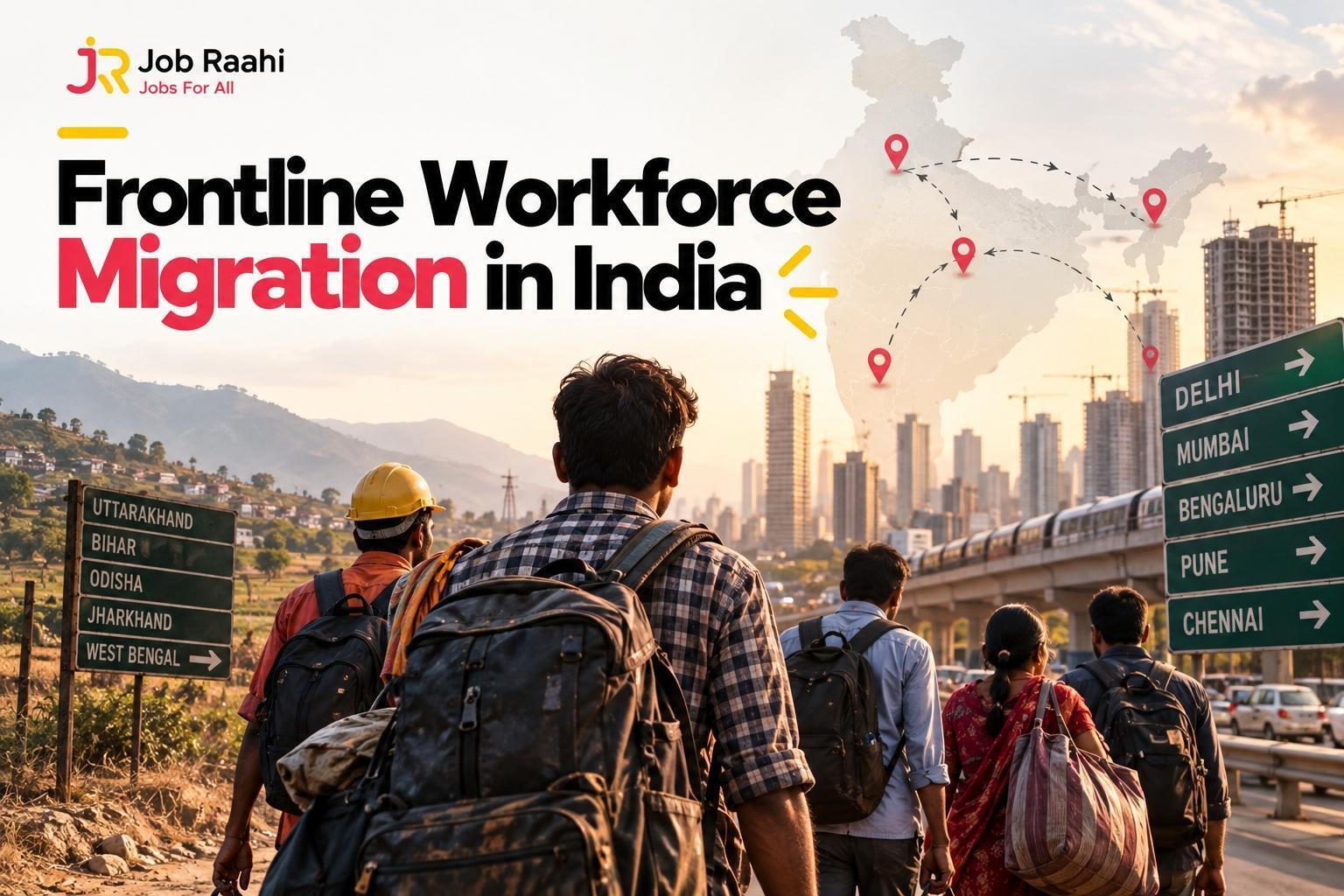
India’s frontline workforce is constantly on the move. Workers relocate from villages to cities, travel between states for employment, move closer to industrial hubs and return to their hometowns when family or seasonal needs arise.
For employers, this movement creates both an opportunity and a challenge. Migration expands the available talent pool, helping businesses find workers beyond their immediate location. At the same time, it can affect joining rates, workforce availability, employee retention and recruitment planning.
From manufacturing plants and construction sites to facility management, retail and hospitality, understanding workforce migration is becoming increasingly important for employers that depend on frontline and high-volume hiring.
But how much migration takes place in India, why do frontline workers move, and how can employers adapt their recruitment strategies?
1. What Is Frontline Workforce Migration?
Frontline workforce migration refers to workers moving from one location to another to find employment, improve their earnings or access better working opportunities.
In India, this movement takes several forms.
- Rural-to-urban migration: Workers move from villages or smaller towns to cities for better access to employment.
- Inter-state migration: Workers move from one state to another to work in factories, construction, hospitality, services and other industries.
- Seasonal migration: Workers relocate temporarily to take up work during particular periods of the year.
- Circular migration: Workers move between their place of origin and their work location, often returning home periodically.
- Local and regional migration: Workers shift between nearby districts, towns or industrial clusters to access more convenient or better-paying jobs.
These categories can overlap. For example, a worker may migrate from Bihar to an industrial area in Haryana, work there for several months and return home before moving again for another opportunity.
For employers, understanding these patterns is important because the workforce available at a particular location may change over time.
2. How Much Workforce Migration Happens in India?
India has a substantial history of internal migration, including migration for employment. However, there is no single current figure that accurately measures all frontline workers who migrate for jobs today.
One important official reference is Census 2011. In a parliamentary response published in July 2023, the Ministry of Labour and Employment cited Census 2011 data reporting approximately 4.14 crore inter-state migrant workers in India. This is a historical census-based figure, not a current 2026 estimate and not a count exclusively of frontline workers. Source: Press Information Bureau, Government of India.
The Census also provides detailed tables on migration by previous residence, duration of residence and reason for migration. These are useful for understanding movement patterns, but they should not be treated as a real-time count of workers available for hiring. Source: Census of India.
What does this mean for employers?
The key takeaway is not that every frontline vacancy can be filled through migrant labour. Rather, employers should recognise that their potential workforce may extend beyond the city or district where a facility is located.
A manufacturing unit in an industrial cluster, for instance, may attract candidates from nearby districts as well as workers who have moved from other states. The mix will depend on the job, pay, accommodation, transport, local opportunities and individual circumstances.
Employers should therefore evaluate migration patterns alongside local candidate availability, rather than assuming that recruitment must rely entirely on either local or migrant workers.
3. Why Do Frontline Workers Migrate for Jobs?
Workers rarely move for just one reason. Employment opportunities, family circumstances, living costs and the availability of suitable work can all influence their decisions.
A. Better earning opportunities
Workers may move to locations where they expect higher take-home earnings, more regular work or better opportunities to earn overtime and incentives.
However, higher gross wages do not always translate into higher savings. Rent, food, commuting and travel home can reduce the financial benefit of relocating.
B. Limited local employment options
Some smaller towns and rural areas may offer fewer opportunities in particular occupations or industries. Workers with manufacturing, machine-operation, technical, security, housekeeping or hospitality skills may relocate to areas where employers need those capabilities.
C. Industrial and infrastructure growth
Factories, construction projects, industrial parks, commercial facilities and new business operations can attract workers to specific locations.
When several employers recruit from the same catchment area, competition for candidates may increase, particularly for roles that require similar skills and offer comparable wages.
D. Seasonal demand
Certain businesses need additional staff during festive periods, tourism peaks, harvest-related activities or major production cycles.
Workers may temporarily relocate to access these opportunities. Some return to their home locations when demand declines, while others continue working elsewhere.
E. Family and personal circumstances
Migration decisions are not always driven by wages. Workers may move to join family members, return home to provide care, respond to changes in household circumstances or seek employment closer to their families.
Employers that understand these factors can design more realistic recruitment and retention practices.
4. Which Industries Depend on Migrant Workers?
The importance of migration differs by region, occupation and employer. Several frontline-intensive industries may recruit workers from outside their immediate hiring location.
| Industry | Examples of frontline roles | How migration can affect hiring |
|---|---|---|
| Manufacturing | Machine operators, production workers, assemblers, packers | Plants may need to recruit beyond the immediate industrial area |
| Construction | Site workers, helpers, skilled tradespeople | Workforce availability may change with project locations and timelines |
| Facility management | Housekeeping staff, security personnel, maintenance workers | Employers may need local or regional recruitment across multiple sites |
| Warehousing and logistics | Warehouse associates, loaders, sorters | Demand can rise around new facilities and peak business periods |
| Retail | Store associates, sales staff, stock handlers | Local availability and commuting distance can influence joining |
| Hospitality | Housekeeping, kitchen assistants, service staff | Tourism, events and seasonal demand may change staffing needs |
This table describes potential workforce patterns, not a ranking of industries by the number of migrant workers. Employers should validate the situation in their own locations before making staffing decisions.
5. What Challenges Does Migration Create for Employers?
Migration can expand the candidate pool, but it also introduces practical considerations that recruitment teams need to plan for.
A. Uncertain joining rates
A candidate may accept an offer but later reconsider because of relocation costs, accommodation concerns, family responsibilities or another opportunity closer to home.
This makes it important to confirm joining intent and explain employment conditions before the candidate travels.
B. Higher early-tenure attrition
Workers who underestimate living expenses, travel time or the difficulty of living away from home may leave soon after joining.
Employers should investigate whether early exits are linked to relocation challenges, job expectations, pay, supervision or working conditions rather than assuming migration itself is the cause.
C. Accommodation and transportation
For workers moving from another region, the availability and cost of safe accommodation and reliable transport can influence whether a job is practical.
Where feasible, employers can provide accommodation, transport support or clear information about nearby housing and commuting options.
D. Language and communication barriers
Workers recruited from different regions may have different language preferences. Safety instructions, payroll explanations, workplace rules and grievance channels must be understandable to everyone.
Using appropriate languages and visual instructions can improve communication and help new employees settle into the workplace.
E. Recruitment competition
Employers operating in the same industrial cluster may compete for similar workers. When candidates have several choices, unclear job information, slow hiring decisions or unreliable joining arrangements can make an employer less attractive.
6. How Can Employers Adapt Their Hiring Strategies?
The solution is not to avoid migrant hiring. It is to build recruitment processes that account for worker mobility and individual needs.
1. Map the workforce catchment area
Identify where successful employees currently live and where new hires have come from. Track commuting distances, transport options and the locations producing reliable joining and retention outcomes.
This helps recruiters decide whether to prioritise nearby communities, neighbouring districts or a wider regional candidate pool.
2. Be transparent about the job
Before candidates accept an offer, explain the salary, take-home pay, shifts, weekly offs, overtime arrangements, job responsibilities, location and any deductions.
For candidates relocating from another state, also explain accommodation availability, transport arrangements and the expected joining process.
3. Reduce relocation friction
Where business needs justify it, employers can explore transport support, temporary accommodation, joining assistance or partnerships with suitable accommodation providers.
Even when financial support is not possible, providing accurate information before a candidate travels can prevent avoidable misunderstandings.
4. Strengthen local recruitment
Recruiting in nearby towns and communities may help employers reach workers who can commute without relocating.
This can be particularly useful for roles where the required skills are locally available and the work schedule makes daily travel practical.
5. Build regional talent pipelines
For locations where local supply is insufficient, employers can establish repeatable recruitment channels in relevant districts or states.
The process should include candidate screening, realistic job previews, joining confirmation and clear communication about travel and reporting arrangements.
6. Improve the first 30 days
Check in with new employees during their first week and throughout their first month. Ask about accommodation, commuting, shift schedules, workplace support and any mismatch between the job advertised and the job experienced.
Early feedback allows HR teams to resolve practical issues before they become reasons for resignation.
7. Track the right workforce metrics
Review recruitment and retention data by hiring source, home location or district, role, site and length of service, while handling personal information responsibly.
Useful measures include:
- Offer-to-joining ratio.
- Recruitment cost by hiring location.
- Early-tenure attrition.
- Retention at 30 and 90 days.
- Absenteeism and vacancy fill time.
- Reported reasons for declining offers or leaving.
These metrics help employers identify which recruitment channels produce sustainable hiring outcomes, rather than focusing only on the number of candidates sourced.
7. How Hyperlocal Hiring Can Help Build a More Stable Workforce
Hyperlocal hiring focuses on reaching candidates who live in or near the area where a job is located.
For some frontline roles, this approach can reduce the need for relocation and make daily commuting more manageable. It can also help employers connect with candidates who may not actively search on large national job portals.
However, hyperlocal hiring is not a universal replacement for migrant recruitment. Some locations have limited local talent availability, and certain roles require skills that are more readily available elsewhere.
A balanced strategy can combine:
- Local recruitment for roles where nearby talent is available.
- Regional recruitment for neighbouring districts and towns.
- Inter-state recruitment when local supply is insufficient.
- Clear joining support for candidates who need to relocate.
- Consistent retention practices across all hiring sources.
The goal is to match the recruitment approach to the actual needs of each location.
8. How Job Raahi Supports Frontline Recruitment
For employers managing high-volume frontline hiring, reaching relevant candidates in the right locations is an important part of workforce planning.
Job Raahi is a digital job platform focused on frontline and mass hiring. Employers can publish vacancies and use recruitment marketing capabilities to improve job visibility among relevant candidate groups.
Through location-focused recruitment and outreach channels such as WhatsApp, RCS, SMS, email and AI-powered calling, subject to applicable permissions and campaign requirements, employers can support candidate awareness and recruitment follow-up.
For organisations hiring across multiple plants, facilities or service locations, a more structured digital recruitment process can complement local sourcing and regional hiring pipelines.
The larger opportunity is to connect workforce mobility with smarter recruitment planning: understand where suitable candidates are located, communicate job details clearly and make the path from application to joining as straightforward as possible.
9. Frequently Asked Questions
What is frontline workforce migration?
It is the movement of workers between villages, towns, cities or states to access employment. It can be temporary, seasonal, circular or long-term.
How many inter-state migrant workers are there in India?
The Ministry of Labour and Employment cited a Census 2011 figure of approximately 4.14 crore inter-state migrant workers in a parliamentary response published in 2023. This is a historical figure and should not be presented as a current estimate for 2026 or as a count exclusively of frontline workers.
Why do frontline workers migrate for employment?
Common reasons include better earning opportunities, limited local job availability, industrial growth, seasonal demand and personal or family circumstances. The reasons vary across workers and regions.
Does hiring migrant workers lead to higher attrition?
Not automatically. Retention depends on factors such as compensation, working conditions, accommodation, commuting, family circumstances, job expectations and management. Employers should use their own workforce data to identify the causes of turnover.
Can hyperlocal hiring reduce dependence on migrant recruitment?
It can help when suitable candidates are available near the workplace. Where local supply is insufficient or specialised skills are required, regional and inter-state recruitment may still be necessary.
10. Conclusion: Build a Workforce Strategy Around Worker Mobility
Migration is an important part of India’s employment landscape, but it should not be treated as a single, uniform trend. Frontline workers move for different reasons, follow different patterns and make employment decisions based on their individual circumstances.
For employers, the most effective response is to understand local labour availability, recruit across appropriate catchment areas, communicate job conditions transparently and remove avoidable barriers to joining and retention.
By combining hyperlocal recruitment with well-planned regional sourcing, employers can build a more resilient frontline hiring strategy—one that responds to workforce movement rather than being caught off guard by it.
Looking to reach frontline candidates across relevant locations? Job Raahi helps employers improve job visibility and organise high-volume recruitment through a digital hiring platform built for frontline workforce needs.
external links for further study
- Ministry of Labour & Employment – Migration of Labour in the Country — for the official Census-based inter-state migration figure.
Press Information Bureau
- Census of India – Migration by Reason and Duration — for official migration tables.
2011
- Labour Bureau – All India Survey on Migrant Workers — for the government survey’s objectives and scope.
Labour Bureau