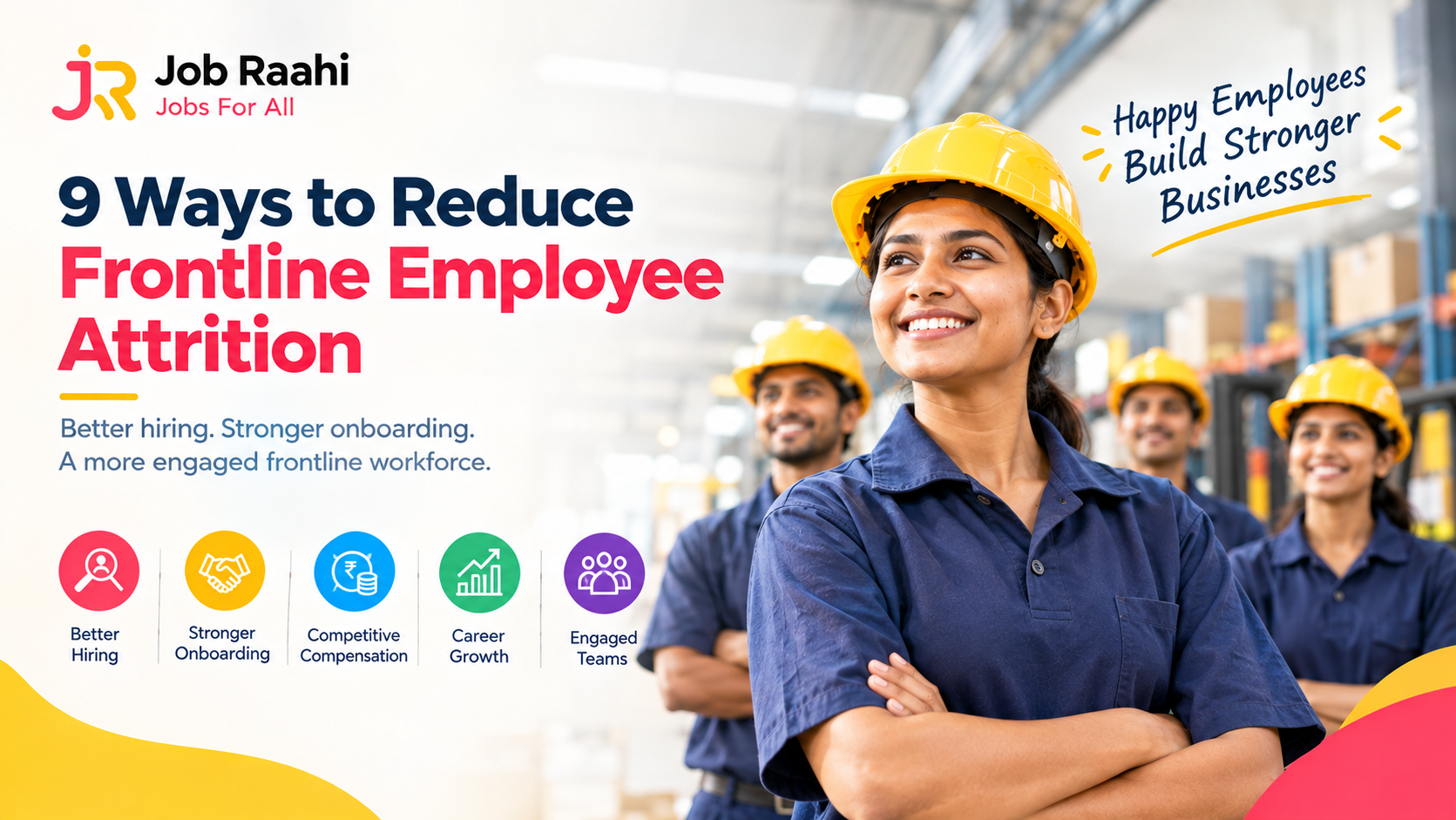
Frontline employees keep businesses running. From manufacturing operators and warehouse associates to retail staff, delivery teams, security personnel and facility management workers, these employees play a critical role in daily operations.
Yet, many employers face a persistent challenge: high attrition rates in frontline roles.
Frequent resignations, absenteeism, early exits and constant replacement hiring can disrupt operations, increase recruitment costs and put additional pressure on existing teams. Hiring more people may appear to be the obvious solution, but sustainable workforce management requires employers to look beyond recruitment numbers.
The real question is: How can employers attract the right frontline candidates, retain them longer and reduce repeated hiring cycles?
What Causes High Attrition in Frontline Jobs?
Before implementing retention measures, employers need to understand why employees leave. Common reasons include:
- Salary and benefits: Employees may leave for slightly better pay, more reliable incentives or improved benefits elsewhere.
- Long commutes: Travel time and transportation costs can make a job financially or physically difficult to sustain.
- Unclear job expectations: Candidates may discover after joining that the actual work, shift timings or responsibilities differ from what they were told.
- Difficult working conditions: Physically demanding work, inadequate facilities, safety concerns and excessive workloads can affect retention.
- Limited growth opportunities: Employees may leave when they cannot see a path toward higher pay, supervisory roles or skill development.
- Poor supervisor relationships: Disrespectful communication, inconsistent instructions or unfair treatment can contribute to resignations.
- Weak onboarding: Employees who receive little guidance during their first few days may feel overwhelmed and leave early.
These causes vary across industries and locations. Employers should use exit interviews, attendance records, employee feedback and early-tenure data to identify their specific attrition drivers.
9 Strategies to Reduce Attrition in Frontline Roles
1. Hire for Job Fit, Not Just Immediate Availability
When a large number of vacancies need to be filled quickly, employers may focus primarily on how soon a candidate can join. However, availability alone does not guarantee suitability.
Recruiters should clearly explain the job responsibilities, salary structure, shift timings, weekly offs, work location, physical requirements and employment conditions before candidates accept an offer.
This helps candidates make informed decisions and reduces the risk of early exits caused by mismatched expectations.
Practical tip: Use a standard job briefing checklist so every candidate receives consistent and accurate information before joining.
2. Recruit Closer to the Workplace
For many frontline workers, the distance between home and the workplace can influence whether they accept a job and how long they stay.
Long commutes may increase travel expenses, make shift changes difficult and reduce the attractiveness of an otherwise suitable opportunity.
Employers can improve workforce stability by building candidate pipelines in nearby communities, industrial areas and residential clusters. For locations with limited public transport, company transport or travel support may also help.
Hyperlocal recruitment can make it easier to reach candidates who are realistically able to commute to the workplace.
3. Review Compensation and Incentives
Employers should periodically compare their compensation with similar jobs in the surrounding area. Even when salaries are competitive, unclear incentives, delayed payments or unexpected deductions can damage employee trust.
Consider reviewing:
- Take-home pay after deductions.
- Attendance and performance incentives.
- Overtime calculations and payment timelines.
- Transport, meal and accommodation support where relevant.
- Pay progression for experienced employees.
The objective is not necessarily to offer the highest salary in the market. It is to provide a transparent and dependable compensation structure that employees understand and value.
4. Improve the First 30 Days of Employment
The initial weeks can strongly influence whether a new frontline employee continues in the role. A worker who feels unsupported, confused or disconnected may leave before becoming comfortable with the job.
A structured onboarding process should include:
- A clear explanation of workplace rules and responsibilities.
- Safety training and role-specific instructions.
- Introduction to supervisors and team members.
- Help with attendance systems, payroll processes and shift schedules.
- Regular check-ins during the first week and first month.
Assigning a buddy or experienced colleague can also help new employees settle in faster.
Key metric to track: Early-tenure attrition, especially exits within the first 7, 30 and 90 days.
5. Train Supervisors to Manage People Better
Frontline employees often interact with their immediate supervisors more frequently than with HR. As a result, day-to-day management practices can have a major influence on the employee experience.
Employers should train supervisors to communicate respectfully, explain expectations, resolve concerns fairly and recognise good performance. They should also provide employees with a clear channel to raise grievances without fear of retaliation.
Regular employee feedback can help HR identify teams or shifts where management practices may be contributing to unusually high attrition.
6. Make Work Schedules More Predictable
Unpredictable shifts, last-minute schedule changes and excessive overtime can make it difficult for employees to manage their personal responsibilities.
Where operationally possible, employers should publish schedules in advance, communicate changes promptly and distribute overtime fairly. They should also monitor excessive workloads and recurring absenteeism rather than treating every absence as an isolated incident.
For round-the-clock operations, better workforce planning can help maintain staffing levels without placing disproportionate pressure on the same employees.
7. Create Visible Career Progression
Frontline jobs should not automatically be treated as short-term positions. Many employees are willing to build long-term careers when they can see a realistic opportunity to progress.
Employers can create pathways from entry-level roles to senior operator, team leader, technician, quality checker or supervisor positions, depending on the industry.
Short training programmes, skill certifications, internal promotions and pay increases linked to demonstrated skills can encourage employees to stay and develop within the organisation.
8. Use Attrition Data to Identify Patterns
A company-wide attrition percentage may not reveal the real problem. One plant, contractor, shift or job category may account for a disproportionate share of employee exits.
HR teams should analyse attrition by:
- Location and business unit.
- Role and department.
- Supervisor and shift.
- Employment type or contractor.
- Length of service.
- Recruitment source.
- Reason for leaving.
For example, if most exits occur within the first two weeks at one location, the issue may relate to job expectations, onboarding or working conditions rather than the overall recruitment pipeline.
Use the findings to test targeted improvements and measure whether they reduce exits over time.
9. Build a More Reliable Recruitment Pipeline
Retention should be the priority, but employers also need a dependable way to manage unavoidable vacancies. Resignations, seasonal demand and business expansion can still create urgent workforce requirements.
Instead of restarting recruitment from scratch every time a vacancy opens, employers can maintain a pipeline of screened candidates, build relationships with local talent communities and use recruitment channels suited to frontline workers.
A more organised pipeline can help employers fill vacancies faster while allowing recruiters to focus on candidate suitability instead of relying entirely on last-minute hiring.
Digital hiring platforms can support this process by improving vacancy visibility and helping employers reach candidates across relevant locations and job categories.
Which Attrition Metrics Should Employers Track?
A practical frontline workforce dashboard should go beyond the total number of resignations.
| Metric | What it helps employers understand |
|---|---|
| Overall attrition rate | The proportion of the workforce leaving during a defined period |
| Early-tenure attrition | Whether new hires are leaving soon after joining |
| Offer-to-joining ratio | Whether candidates who accept offers actually join |
| Absenteeism rate | Patterns that may signal disengagement or operational difficulties |
| Vacancy fill time | How long it takes to replace employees |
| 30-day and 90-day retention | Whether new employees are staying beyond their initial period |
| Exit reasons | The most common reported reasons employees leave |
A common way to calculate attrition is:
Attrition rate = (Employees who left during the period ÷ Average number of employees during the period) × 100
For meaningful comparisons, employers should use a consistent reporting period and clearly define which exits are included. Voluntary resignations, contract completions, layoffs and other separations may need to be tracked separately.
How Job Raahi Can Support Frontline Hiring
Reducing attrition requires more than increasing the number of candidates available. Employers need to reach relevant jobseekers, communicate opportunities clearly and maintain a reliable recruitment pipeline.
Job Raahi supports employers looking to connect with frontline and mass-hiring talent through a digital job platform designed for roles across relevant locations and candidate segments.
Employers can use the platform to publish vacancies, improve job visibility through recruitment marketing campaigns and reach potential candidates through channels such as WhatsApp, RCS, SMS, email and AI-powered calling, subject to applicable permissions and campaign requirements.
By combining targeted candidate reach with better job communication and a more organised hiring process, employers can work toward reducing avoidable hiring friction and filling frontline vacancies more efficiently.
The important distinction: recruitment platforms can help employers reach and hire candidates, but long-term retention also depends on fair compensation, realistic job expectations, good supervision, safe working conditions and opportunities for growth.
Frequently Asked Questions
1. What is the main reason for high attrition in frontline jobs?
There is no single reason across all industries. Compensation, long commutes, difficult working conditions, unpredictable shifts, supervisor relationships and mismatched job expectations can all contribute. Employers should analyse their own workforce data before choosing a solution.
2. How can employers reduce attrition among new hires?
Provide accurate job information before joining, simplify onboarding, explain workplace expectations clearly and check in with employees during their first 7, 30 and 90 days.
3. Does increasing salary always reduce attrition?
Not necessarily. Competitive and reliable pay matters, but employees may also leave because of commuting difficulties, poor management, unsafe conditions or limited career progression. Employers should address the reasons most relevant to their workforce.
4. How does hyperlocal hiring help with frontline retention?
Recruiting candidates who live closer to the workplace may reduce commuting time and travel costs. However, proximity alone does not guarantee retention; job fit, compensation and working conditions remain important.
5. How can employers manage attrition without constantly increasing recruitment budgets?
Focus on preventing avoidable exits, improving early-tenure retention, analysing why employees leave and building a reusable candidate pipeline. Reducing repeated replacement hiring can help control recruitment costs over time.
Conclusion: Retention Starts Before the First Working Day
High attrition in frontline roles is not simply a recruitment problem. It is a workforce management challenge that spans candidate expectations, compensation, commuting, onboarding, supervision and career development.
Employers that measure attrition carefully and address its root causes can make better decisions about both retention and recruitment. The goal is not just to fill today’s vacancies, but to build a workforce that is more likely to join, perform and stay.
Looking to strengthen your frontline hiring pipeline? Explore how Job Raahi can help your organisation reach relevant candidates and manage high-volume recruitment more effectively.
Recommended External Links
- Employee Onboarding Best Practices – SHRM
Link: https://www.shrm.org/en/topics-tools/topics/onboarding
Anchor text: employee onboarding best practices
Place in: Section 4 – Improve the First 30 Days of Employment. - Employee Turnover and Retention Strategies – SHRM
Link: https://www.shrm.org/topics-tools/news/talent-acquisition/how-to-reduce-employee-turnover-robust-retention-strategies
Anchor text: strategies to reduce employee turnover
Place in: Section 8 – Use Attrition Data to Identify Patterns, or the introduction to retention strategies. - Decent Work Country Programme for India 2023–2027 – International Labour Organization (ILO)
Link: https://www.ilo.org/publications/decent-work-country-programme-india-2023-2027
Anchor text: improving working conditions and employment quality
Place in: Section 5 – Train Supervisors to Manage People Better, or Section 6 – Make Work Schedules More Predictable. - Indian Labour Statistics – Labour Bureau, Government of India
Link: https://labourbureau.gov.in/indian-labour-statistics
Anchor text: Indian labour-market statistics
Place in: Section 8 – Use Attrition Data to Identify Patterns. - Decent Work – International Labour Organization (ILO)
Link: https://www.ilo.org/public/english/decent.htm
Anchor text: decent work and fair employment practices
Place in: Section 3 – Review Compensation and Incentives.