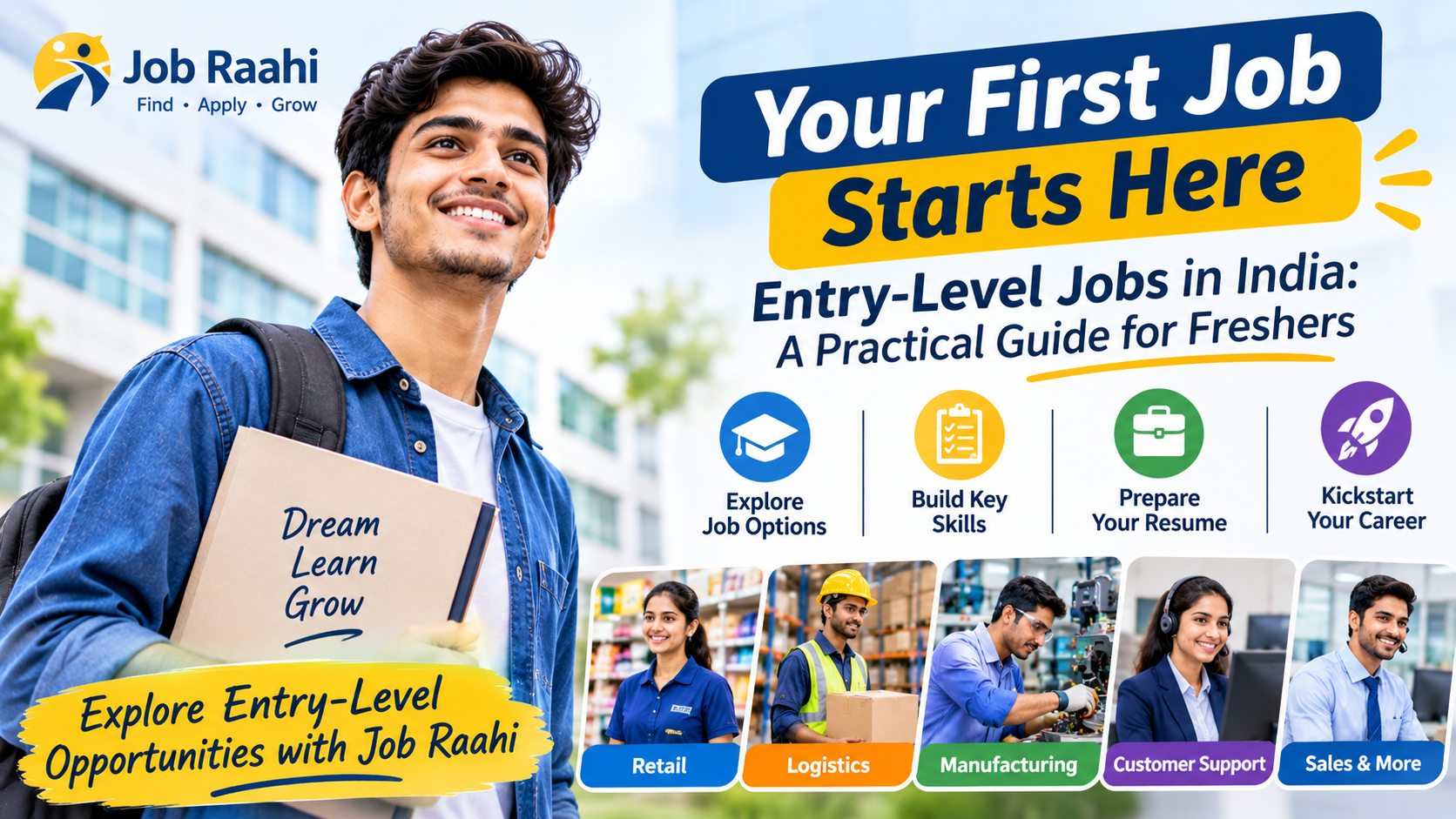
Tag: Entry Level Jobs

  • Entry-Level Jobs in India: A Practical Guide for Freshers to Start Their Careers

    Entry-Level Jobs in India: A Practical Guide for Freshers to Start Their Careers

    Table of Contents

    1. What Are Entry-Level Jobs?
    2. Why Are Entry-Level Jobs Important for Freshers?
    3. Types of Entry-Level Jobs You Can Explore
      a. Retail and customer service
      b. Logistics and warehouse
      c. Manufacturing and Technical Operations
      d. Sales and field Operations
      e. BPO and Customer Support
    4. What Do Employers Expect from Freshers?
    5. How to Find Entry-Level Jobs in India
    6. How to Prepare for Your First Job
    7. Common Mistakes to Avoid While Applying
    8. Build Your Career with Job Raahi

    Getting your first job is an important milestone. It brings the opportunity to earn, become independent, gain practical experience and understand how the professional world works. However, for many freshers, finding that first opportunity can feel challenging.

    One common question job seekers face is: How can I get a job when most employers ask for experience?

    The good news is that not every job requires years of experience. Many companies hire candidates for entry-level positions and provide the initial training needed to perform the role. These opportunities are designed for people who are beginning their careers, including candidates who have completed their 10th, 12th, ITI, Polytechnic, Diploma or graduation.

    With the right approach, preparation and willingness to learn, your first job can become the foundation of a long-term career.

    1. What Are Entry-Level Jobs?

    Entry-level jobs are positions designed for candidates who have little or no previous work experience. These roles help individuals enter the workforce, understand workplace responsibilities and develop professional skills.

    Unlike experienced positions, entry-level roles generally focus on basic qualifications, communication, practical ability and the candidate’s willingness to learn.

    Depending on the industry and employer, candidates may be eligible with:

    • 10th or 12th standard education
    • ITI or vocational training
    • Polytechnic or Diploma qualifications
    • Graduation or other relevant qualifications
    • Basic computer or technical knowledge

    For example, a candidate who has completed an ITI course may start as a technician trainee or production associate. Similarly, a 12th-pass candidate may explore opportunities in retail, customer support, field sales or warehouse operations.

    The eligibility criteria vary from one employer to another, so always check the job description before applying.

    2. Why Are Entry-Level Jobs Important for Freshers?

    Your first job is more than a source of income. It is an opportunity to understand how workplaces operate and develop the habits that support career growth.

    Practical experience: Training gives you knowledge, but working in a real environment helps you understand how to apply it. You learn to handle responsibilities, follow processes and solve everyday problems.

    Financial independence: Earning your first salary can help you manage personal expenses and become more financially independent.

    Professional confidence: Communicating with colleagues, interacting with customers and completing assigned tasks gradually build confidence.

    Career development: Your first role can help you identify your strengths, understand your interests and prepare for better opportunities in the future.

    Learning workplace discipline: Punctuality, teamwork, accountability and professional behaviour are important habits that develop through practical experience.

    You do not need to find your dream job in your first attempt. Focus on finding a suitable opportunity where you can learn, contribute and grow.

    3. Types of Entry-Level Jobs You Can Explore

    Entry-level opportunities are available across several industries. Your options will depend on your educational background, location, interests and the requirements of employers.

    A. Retail and Customer Service

    Retail companies hire freshers for positions that involve assisting customers, managing products and supporting daily store operations.

    Common roles include:

    • Retail Sales Associate
    • Store Assistant
    • Customer Service Executive
    • Cashier
    • Store Operations Assistant

    These roles can help candidates develop communication, customer-handling and problem-solving skills.

    B. Logistics and Warehouse

    The growing movement of goods across e-commerce, retail and supply-chain businesses creates opportunities in warehouse and logistics operations.

    Common roles include:

    • Picker and Packer
    • Warehouse Associate
    • Inventory Assistant
    • Dispatch Assistant
    • Loading and Unloading Associate

    These positions may suit candidates who are comfortable with operational responsibilities and following process-based work.

    C. Manufacturing and Technical Operations

    Candidates with ITI, Polytechnic or Diploma qualifications can explore opportunities in manufacturing, production and technical operations.

    Common roles include:

    • Production Trainee
    • Machine Operator Trainee
    • Technician Trainee
    • Quality Assistant
    • Maintenance Assistant

    Some employers provide on-the-job training, while others require specific technical knowledge or trade qualifications.

    D. Sales and Field Operations

    Sales roles offer opportunities to interact with customers, understand products and develop communication skills.

    Common positions include:

    • Field Sales Executive
    • Sales Promoter
    • Business Development Associate
    • Field Relationship Executive
    • Customer Acquisition Executive

    Candidates who enjoy interacting with people and are comfortable working in the field may find these roles suitable.

    E. BPO and Customer Support

    Many businesses hire freshers to manage customer queries, provide product information and support daily communication.

    Common positions include:

    • Customer Support Executive
    • Voice Process Associate
    • Non-Voice Process Associate
    • Back Office Executive
    • Data Entry Operator

    Basic communication, computer knowledge and attention to detail can be useful for these roles. Language requirements depend on the employer and process.
    First Job for fresher

    4. What Do Employers Expect from Freshers?

    Employers do not always expect freshers to know everything from day one. However, they do look for certain qualities that indicate whether a candidate can learn and perform the job.

    Communication: The ability to understand instructions, ask questions and communicate clearly with customers or team members.

    Willingness to learn: Employers value candidates who are open to feedback and interested in improving their skills.

    Punctuality and discipline: Reporting on time, following workplace rules and completing assigned responsibilities demonstrate professionalism.

    Basic digital knowledge: Familiarity with smartphones, email, online forms and basic computer applications can be useful in many roles.

    Teamwork: Most workplaces require employees to coordinate with colleagues and contribute towards shared goals.

    Problem-solving: Even in an entry-level position, the ability to identify an issue and seek the right solution is valuable.

    Remember, your attitude and willingness to learn can make a positive impression, even when you have limited experience.

    5. How to Find Entry-Level Jobs in India

    Finding a suitable first job requires more than applying randomly to every opening. A focused approach can help you identify opportunities that match your qualifications and expectations.

    Step 1: Identify Your Suitable Job Category

    Start by understanding what type of work you want to explore. Consider your education, skills, location and interests.

    For example:

    • ITI candidates can explore technical and production roles.
    • 12th-pass candidates can consider retail, sales and customer support.
    • Diploma holders can explore technical, operational and trainee positions.
    • Graduates can consider entry-level opportunities across sales, operations and support functions.

    Step 2: Use Reliable Job Platforms

    Search for openings through established employment platforms and check whether the job details are genuine.

    You can explore resources such as:

    • National Career Service (NCS)
    • Job Raahi
    • Apprenticeship India
    • National Apprenticeship Training Scheme (NATS), where applicable

    Step 3: Read Job Descriptions Carefully

    Before applying, check the eligibility criteria, job location, responsibilities, working hours, salary details and experience requirements.

    Do not apply only because the job title sounds attractive. Make sure the actual responsibilities suit your expectations.

    Step 4: Keep Your Documents Ready

    Prepare an updated resume and keep important documents accessible. These may include educational certificates, identity proof, photographs and relevant training certificates.

    Share personal documents only through legitimate and appropriate hiring processes.

    Step 5: Apply Consistently and Follow Up

    Make job searching a regular activity. Apply to relevant openings, attend scheduled interviews and follow up professionally when required.

    Consistency and preparation can improve your chances of finding a suitable opportunity.

    6. How to Prepare for Your First Job

    Once you start receiving interview calls, preparation becomes important.

    Create a simple resume: Mention your educational qualifications, technical training, projects, internships, practical skills and contact details. If you have no work experience, highlight what you have learned and practised.

    Prepare your introduction: Practise explaining who you are, what you have studied and what kind of opportunity you are looking for.

    Understand the job role: Research the company and read the job description. Be prepared to explain why you are interested in that position.

    Practise common interview questions: Questions such as “Tell me about yourself”, “Why should we hire you?” and “Are you willing to learn?” are useful to practise.

    Be honest: Do not exaggerate your skills or claim experience you do not have. Employers appreciate candidates who communicate honestly about their abilities.

    Most importantly, do not let nervousness stop you from attending interviews. Every interview is also an opportunity to learn.

    7. Common Mistakes to Avoid While Applying

    Freshers sometimes miss good opportunities because they overlook a few important details.

    • Applying without checking eligibility: Always read the requirements before submitting an application.
    • Using the same incomplete resume everywhere: Keep your resume accurate and relevant to the role.
    • Ignoring job location: Check whether the workplace is accessible and whether relocation is required.
    • Accepting unclear job offers: Understand the salary, working hours, responsibilities and employment terms before joining.
    • Paying money to secure a job: Be cautious of recruiters or individuals demanding registration fees, deposits or payments in exchange for guaranteed employment.
    • Giving up after rejection: Rejections are part of the job-search process. Use feedback to improve your preparation.

    A careful approach can help you avoid unnecessary problems and make better career decisions.

    8. Build Your Career with Job Raahi

    Your first job is an opportunity to turn your education, training and potential into practical experience. Whether you have completed your 10th, 12th, ITI, Polytechnic, Diploma or graduation, there are entry-level opportunities across industries that can help you begin your professional journey.

    Job Raahi aims to connect job seekers with employers hiring across frontline and entry-level roles in sectors such as retail, logistics, warehousing, sales, customer support and hospitality.

    The platform helps candidates discover relevant job opportunities and take the next step towards employment.

    You do not need to have your entire career figured out before getting started. Focus on finding the right first opportunity, developing useful skills and learning with every experience.

    Your first job is not the end goal. It is where your career begins. Explore opportunities and take your next career step with Job Raahi.
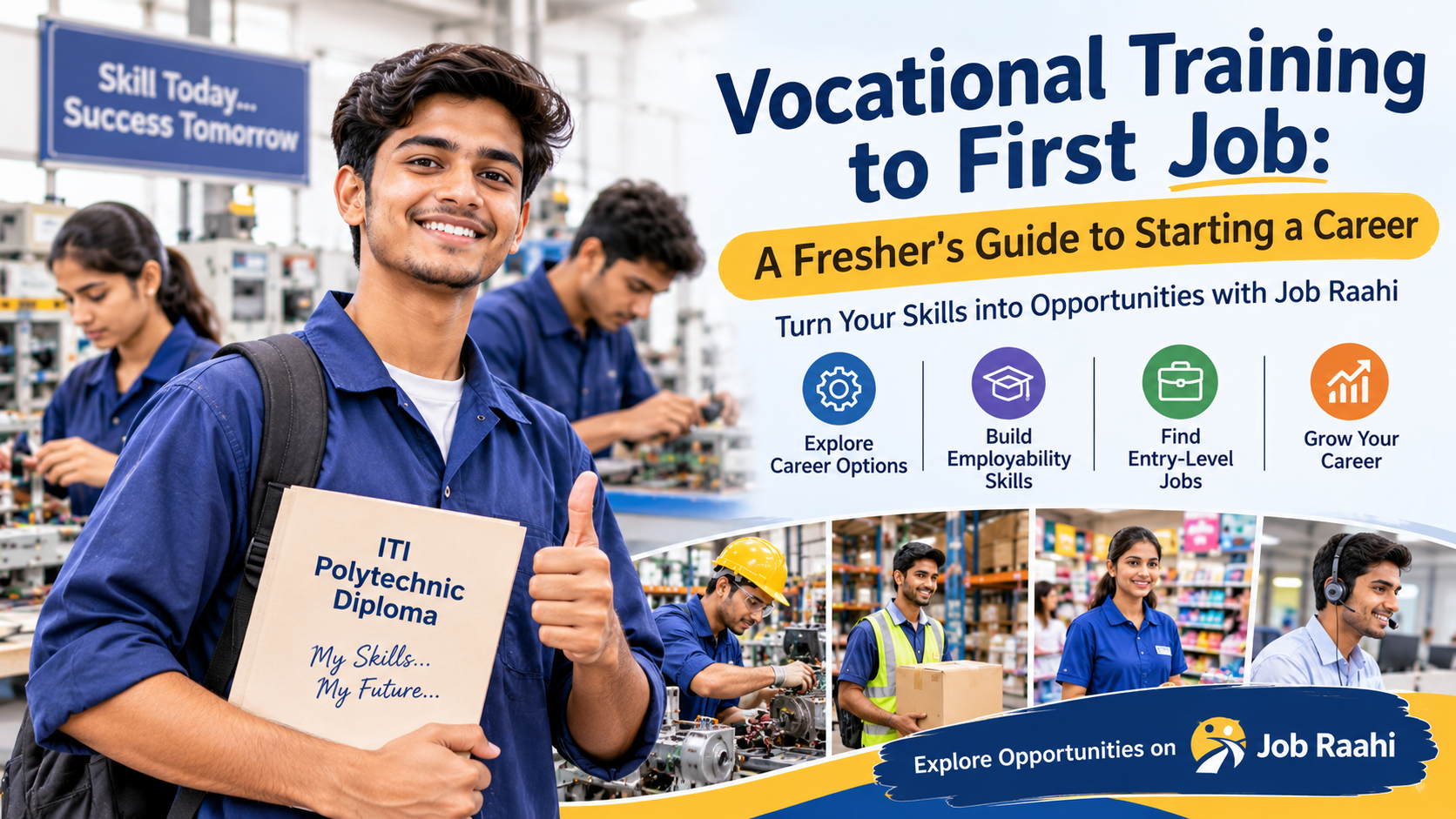
  • Vocational Training to First Job: A Fresher’s Guide to Starting a Career

    Vocational Training to First Job: A Fresher’s Guide to Starting a Career

    Completing a vocational course is an important milestone. Whether you have completed ITI, Polytechnic, Diploma or another skill-based programme, you have already taken a step towards preparing yourself for the professional world.

    You may have spent months learning technical concepts, practising with tools, working on projects and understanding how things operate in real situations. But once your training is complete, another question begins to take priority:

    How do I turn what I have learned into my first job?

    For many freshers, the transition from a classroom or training institute to an actual workplace can be confusing. You may have the qualification but limited work experience. You may understand your trade but feel unsure about interviews, job applications or the expectations of employers.

    The good news is that your career does not need to begin with years of experience. It can begin with the skills you already have, your willingness to learn and the right opportunity.

    Let’s explore how you can make that transition.

    What Does Vocational Training Really Prepare You For?

    Vocational training focuses on developing practical knowledge and skills that can be applied in specific occupations or industries.

    Unlike learning that is primarily theoretical, skill-based education often includes practical sessions, workshop activities, equipment handling and task-based learning.

    For example:

    • An ITI Electrician student learns about electrical systems, wiring and safety practices.
    • An ITI Fitter student develops an understanding of fitting, tools and mechanical components.
    • A Diploma in Mechanical Engineering introduces students to manufacturing, production and maintenance concepts.
    • A Diploma in Civil Engineering provides a foundation in construction, surveying and site-related activities.
    • A Diploma in Electronics helps students understand electronic components, circuits and testing.
    • A vocational course in computer applications can introduce learners to digital tools and basic technical support.

    These skills can provide a starting point for exploring relevant employment opportunities.

    However, completing a course is only one part of the journey. The next step is learning how to apply your knowledge in a professional environment.

    Why Practical Skills Matter in Today’s Job Market

    Employers do not only look at what candidates have studied. They also want to understand whether candidates can apply their knowledge to actual work.

    Imagine two freshers applying for an entry-level technical position. Both have completed the same qualification. However, one can explain the practical projects completed during training, understands basic safety procedures and can confidently describe the tools used.

    That candidate may be better prepared to demonstrate their abilities during the selection process.

    Practical skills help you:

    • Understand workplace tasks more easily.
    • Follow instructions and standard operating procedures.
    • Work with tools, machines and equipment relevant to your trade.
    • Identify basic problems and seek appropriate solutions.
    • Adapt to workplace expectations.

    This does not mean you must know everything before joining your first job. Employers hiring freshers may provide role-specific training. What matters is having a foundation and being ready to build on it.

    From Training Institute to Workplace: Understanding the Gap

    One of the biggest challenges for freshers is adapting to the difference between classroom learning and workplace responsibilities.

    During your course, you may have worked on assignments with the guidance of instructors. At work, you may need to complete tasks within a schedule, coordinate with colleagues and follow company procedures.

    Here are a few ways to prepare:

    Understand workplace discipline: Learn the importance of punctuality, attendance, responsibility and following instructions.

    Improve communication: Practise explaining your work, asking questions and sharing updates with supervisors.

    Learn safety practices: Understand the safety requirements associated with your trade or workplace.

    Develop teamwork: Most jobs involve working with other people. Learn to coordinate, cooperate and respect different responsibilities.

    Stay open to feedback: Your first job will introduce new processes and challenges. Treat feedback as an opportunity to improve.

    The transition may take time, but every new experience can help you become more confident and capable.

    Career Opportunities Freshers Can Explore

    Vocational training can open doors to opportunities across different industries. The roles available will depend on your qualification, specialisation, skills, location and employer requirements.

    Here are some career areas worth exploring:

    Technical and maintenance roles

    Students from relevant ITI and Diploma trades can explore opportunities such as technician assistants, electricians, fitters, maintenance assistants and equipment operators.

    Manufacturing and production

    Manufacturing companies require people to support production activities, operate equipment, follow processes and maintain quality standards. Entry-level opportunities may include production assistants, machine operators and quality-checking assistants.

    Logistics and warehouse operations

    Warehouses and logistics businesses offer roles such as warehouse associates, inventory assistants, dispatch assistants and operations associates. These opportunities can help freshers understand inventory management, order processing and supply-chain operations.

    Retail and field operations

    Retail associates, field executives, sales assistants and customer-facing roles can provide exposure to customer interactions, product knowledge and daily business operations.

    Customer support and technical assistance

    Candidates with suitable communication and basic computer skills can explore customer support, service assistance, helpdesk and other entry-level operational roles.

    Remember, your first job does not have to define your entire career. It should give you a reasonable opportunity to learn, gain experience and move towards your future goals.

    Vocational Training to first job

    How Apprenticeships Can Help You Gain Industry Experience

    If you have completed your course but are struggling to gain practical industry exposure, consider exploring apprenticeship opportunities.

    An apprenticeship provides structured learning in a workplace, allowing eligible candidates to gain hands-on experience under an employer’s training arrangement.

    For eligible Diploma holders, the National Apprenticeship Training Scheme (NATS) is one route to explore. ITI pass-outs and other eligible candidates can also explore opportunities under the National Apprenticeship Promotion Scheme (NAPS).

    An apprenticeship can help you:

    • Understand actual workplace processes.
    • Apply your classroom knowledge to practical tasks.
    • Learn from experienced professionals.
    • Develop professional discipline and confidence.
    • Build experience that may support future job applications.

    Remember to check the eligibility, trade, duration, stipend and conditions of each opportunity. Apprenticeship training does not automatically guarantee permanent employment.

    Five Skills That Can Make You More Employable

    Your technical qualification gives you a foundation, but developing additional skills can make your transition into employment smoother.

    Here are five areas worth working on:

    1. Technical understanding: Revise the important concepts and practical tasks related to your trade. Be prepared to explain what you know.

    2. Basic digital literacy: Learn to use email, online forms, spreadsheets and other basic digital tools.

    3. Communication: Practise speaking clearly, listening carefully and asking relevant questions. You do not need perfect English for every role; communication requirements depend on the job.

    4. Problem-solving: Develop the habit of understanding a problem, identifying possible causes and seeking guidance when necessary.

    5. Adaptability: Be willing to learn new tools, processes and responsibilities as you enter the workplace.

    You can improve these skills through regular practice, short courses, practical projects and workplace exposure.

    How to Prepare for Your First Job

    You do not need an impressive employment history to apply for your first job. You need a clear profile that tells employers about your education, practical knowledge and interest in the role.

    Follow these steps:

    • Create a simple resume: Mention your qualification, specialisation, institute, year of completion and relevant skills.
    • Include practical projects: Add workshop activities, final-year projects, lab work or hands-on assignments.
    • Keep documents ready: Organise your resume, certificates and other documents requested by the employer.
    • Practise interview questions: Prepare to explain what you studied, what you learned and why you are interested in the position.
    • Read job descriptions carefully: Check the responsibilities, eligibility, location, salary details and working conditions.
    • Apply consistently: Explore relevant openings instead of waiting for one perfect opportunity.

    Most importantly, be honest about your experience. As a fresher, you are not expected to know everything. Show employers that you have a foundation and are willing to learn.

    How Job Raahi Helps Freshers Discover Opportunities

    Getting the right information at the right time can make the job search easier.

    Freshers often miss opportunities because they are unsure where to search, which roles to apply for or how to connect with employers.

    This is where Job Raahi can help.

    Job Raahi is a digital job platform that connects candidates with employment opportunities across different sectors. Candidates can explore openings in areas such as retail, logistics, warehouse operations, sales, delivery, customer support and other frontline roles.

    Whether you have recently completed your vocational course or are looking for an entry-level opportunity, you can create your profile, explore relevant vacancies and apply for suitable openings.

    The goal is simple: help candidates discover opportunities and take practical steps towards employment.

    Your training has given you a starting point. Now take the next step towards your career with Job Raahi.

    Final Thoughts

    Vocational training is not just about earning a certificate. It is about developing abilities that can be used in the workplace.

    Your first job may come with new challenges, unfamiliar responsibilities and plenty of learning opportunities. Do not let limited experience stop you from exploring suitable roles.

    Revise your skills, prepare your resume, stay open to learning and apply for opportunities that match your qualifications.

    You do not have to build your entire career in one day. You just have to take the first step.

    Learn a skill. Find an opportunity. Build your future with confidence.

  • Your First Job, Your Next Opportunity: How Freshers and Frontline Workers Can Build a Strong Career

    Your First Job, Your Next Opportunity: How Freshers and Frontline Workers Can Build a Strong Career

    For many young Indians, getting a first job is a major milestone. It can mean earning independently, supporting family members, gaining confidence and taking the first step towards a more secure future.

    But starting a career also brings questions. What if you have no experience? How do you improve your skills once you start working? Can a frontline job lead to greater responsibilities? And if you work in sales, how can you achieve your targets without losing confidence?

    These questions matter to freshers, retail employees, warehouse workers, customer support staff, delivery personnel and frontline sales professionals alike.

    The answer begins with a simple shift in perspective: your first job is not just about earning a salary. It is also an opportunity to build skills, understand the workplace and prepare for what comes next.

    Your First Job Is Only the Beginning

    Many people feel that their first job must be perfect. They look for the ideal salary, a well-known company or a role that matches every career expectation.

    In reality, the first opportunity is often a starting point rather than a final destination.

    A fresher joining a retail store can learn customer service, billing, product knowledge and store operations. A warehouse associate can develop skills in inventory handling, order processing and workplace safety. A field sales executive can learn communication, customer relationships, negotiation and market understanding.

    These experiences can become valuable foundations for future roles.

    This does not mean accepting any job without considering salary, safety, working hours or employment conditions. It means evaluating an opportunity on more than its title alone.

    Ask yourself: Will this role help me earn, learn something useful and gain experience that I can build on?

    Why Frontline Jobs Deserve More Recognition

    Frontline employees help businesses function every day. They serve customers, deliver products, maintain operations, manage stock and represent brands in the market.

    Yet these jobs are sometimes viewed as temporary work rather than careers worth developing.

    That perception can discourage capable candidates from exploring frontline opportunities. It can also cause employees to overlook the skills they are developing through everyday responsibilities.

    Frontline roles can involve much more than completing repetitive tasks. Depending on the job, employees may learn to use digital systems, solve customer problems, manage stock, coordinate with teams, understand sales performance or handle operational challenges.

    For employers, these capabilities matter because frontline employees directly influence service quality, customer experience and daily operations.

    For job seekers, recognising the value of these skills can change how they approach their work and future opportunities.

    Career growth is not automatic, and progression differs between employers. However, understanding your role, learning consistently and seeking greater responsibility can help you prepare for the next step.

    Skills That Can Help You Move Forward

    You do not need to master every skill before starting your career. Focus on developing the abilities that matter in your current role and can transfer to future opportunities.

    Communication: Learn to explain information clearly, listen to instructions and ask questions when something is unclear. Good communication matters in customer-facing, operational and team-based roles.

    Reliability: Being punctual, following procedures and completing assigned work responsibly helps build trust with supervisors and colleagues.

    Digital confidence: Many frontline jobs involve mobile applications, digital payments, inventory systems, barcode scanners or online reporting. Becoming comfortable with relevant tools can make daily work easier.

    Problem-solving: Learn to identify routine problems, follow the correct process and ask for help when necessary. Taking responsibility does not mean ignoring safety rules or working beyond your authority.

    Adaptability: Workplaces change. New products, systems, customer expectations and procedures may require you to learn continuously.

    Try to identify one skill you can improve each month. Small improvements, practised consistently, can make a meaningful difference over time.

    A Special Focus on Frontline Sales Professionals

    Frontline workers

    Frontline sales is often described as a target-driven job. But successful selling involves more than persuading someone to purchase a product.

    A field sales representative may visit retailers, explain products, maintain relationships, understand local demand and report market feedback. A sales promoter may demonstrate products and answer customer questions. A salesperson working in a store may need to understand customer preferences and recommend suitable options.

    These responsibilities build skills that can be valuable in future sales, account management, team coordination and other customer-facing roles, depending on performance and available opportunities.

    If you are starting in sales, focus on four habits.

    First, understand the product you are selling. Customers are more likely to trust information that is clear and accurate.

    Second, listen before recommending. Understanding a customer’s needs is more useful than delivering the same pitch to everyone.

    Third, learn from your performance. Review which conversations led to successful sales, where customers had concerns and what you could improve next time.

    Finally, communicate honestly. Do not make promises about products, discounts or services that you cannot fulfil simply to meet a target.

    Sales targets can be demanding, and performance is affected by factors beyond an individual employee’s control. Ask your manager for clear expectations, product training and constructive feedback.

    The goal is to become better at serving customers and delivering results—not merely to chase numbers.

    How Freshers Can Prepare for Their First Job

    If you have never worked before, it is natural to feel unsure about how employers will evaluate you.

    Start by understanding the responsibilities of the role you want. Read the job description carefully and identify the skills, qualifications and working conditions involved.

    Prepare a simple, honest CV that includes your education, relevant training, practical projects and any genuine work experience. You do not need to invent experience to make your application stronger.

    Practise introducing yourself and explaining why you are interested in the position. Think of examples that show responsibility, teamwork or willingness to learn, even if they come from school, college, training or other genuine experiences.

    During an interview, ask sensible questions about the work, salary, location, shifts and training. Before accepting an offer, ensure that the important terms are clear.

    You can also explore official career guidance and job-search resources through the National Career Service portal.

    Remember that a lack of formal work experience does not mean you lack potential. Your task is to show employers what you already know and how you are prepared to learn.

    What Employers Can Do to Help Frontline Teams Grow

    Career development is not only an individual responsibility. Employers influence whether frontline workers have a genuine opportunity to improve their skills and performance.

    A new employee who receives unclear instructions and little training may struggle even when they are willing to learn. Similarly, a salesperson who receives targets without product knowledge or coaching may find it difficult to improve.

    Employers can help by providing structured onboarding, practical training, clear performance expectations and regular feedback.

    They can also explain how employees may qualify for additional responsibilities, specialised tasks or supervisory opportunities. These pathways should be realistic and linked to actual business requirements.

    Recruitment practices matter too. When a role is suitable for a fresher, employers should consider whether relevant aptitude, foundational skills and willingness to learn can be assessed instead of requiring previous experience by default.

    Hiring the right candidate is only the beginning. Supporting that person after joining can help them become more capable and contribute effectively.

    For employers, investing in frontline employees is not simply about offering career advice. It is about building a workforce that understands the job, receives the support it needs and has clear expectations.

    Turn Your Next Job into Your Next Opportunity

    Whether you are applying for your first job or already working on the frontline, you can take practical steps towards your future.

    Identify the skills your current or desired role requires. Learn from experienced colleagues, seek feedback and keep a record of the responsibilities you have handled.

    When exploring a new opportunity, look beyond the job title. Consider the salary, working conditions, location, training and whether the role suits your present needs and longer-term goals.

    Do not assume that every job will lead to promotion. Instead, focus on building experience and making informed choices about your next move.

    Employers also have a part to play by offering clear job information, realistic expectations and fair opportunities for suitable candidates.

    A strong career is rarely built through one decision alone. It develops through a series of opportunities, lessons and improvements.

    Find Your Next Opportunity with Job Raahi

    Your career can begin in different ways. You might be entering the workforce after school, completing vocational training, looking for your first sales job or searching for a new frontline opportunity.

    Job Raahi helps job seekers explore opportunities across frontline and entry-level roles. Look for vacancies that match your qualifications, skills and interests, and take the next step towards your career.

    For employers, giving suitable freshers and frontline candidates an opportunity to demonstrate their abilities can help expand the talent pool for relevant roles.

    Your first job is where the journey begins. What you learn, how you grow and the opportunities you pursue can help shape what comes next.