Table of Contents
- What Are Entry-Level Jobs?
- Why Are Entry-Level Jobs Important for Freshers?
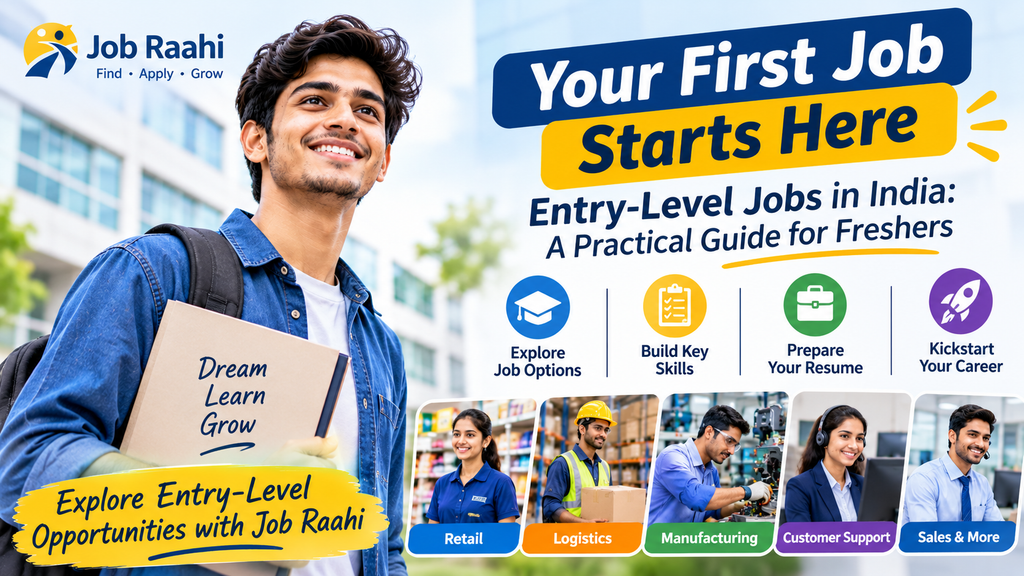
- Types of Entry-Level Jobs You Can Explore
a. Retail and customer service
b. Logistics and warehouse
c. Manufacturing and Technical Operations
d. Sales and field Operations
e. BPO and Customer Support - What Do Employers Expect from Freshers?
- How to Find Entry-Level Jobs in India
- How to Prepare for Your First Job
- Common Mistakes to Avoid While Applying
- Build Your Career with Job Raahi
Getting your first job is an important milestone. It brings the opportunity to earn, become independent, gain practical experience and understand how the professional world works. However, for many freshers, finding that first opportunity can feel challenging.
One common question job seekers face is: How can I get a job when most employers ask for experience?
The good news is that not every job requires years of experience. Many companies hire candidates for entry-level positions and provide the initial training needed to perform the role. These opportunities are designed for people who are beginning their careers, including candidates who have completed their 10th, 12th, ITI, Polytechnic, Diploma or graduation.
With the right approach, preparation and willingness to learn, your first job can become the foundation of a long-term career.
1. What Are Entry-Level Jobs?
Entry-level jobs are positions designed for candidates who have little or no previous work experience. These roles help individuals enter the workforce, understand workplace responsibilities and develop professional skills.
Unlike experienced positions, entry-level roles generally focus on basic qualifications, communication, practical ability and the candidate’s willingness to learn.
Depending on the industry and employer, candidates may be eligible with:
- 10th or 12th standard education
- ITI or vocational training
- Polytechnic or Diploma qualifications
- Graduation or other relevant qualifications
- Basic computer or technical knowledge
For example, a candidate who has completed an ITI course may start as a technician trainee or production associate. Similarly, a 12th-pass candidate may explore opportunities in retail, customer support, field sales or warehouse operations.
The eligibility criteria vary from one employer to another, so always check the job description before applying.
2. Why Are Entry-Level Jobs Important for Freshers?
Your first job is more than a source of income. It is an opportunity to understand how workplaces operate and develop the habits that support career growth.
Practical experience: Training gives you knowledge, but working in a real environment helps you understand how to apply it. You learn to handle responsibilities, follow processes and solve everyday problems.
Financial independence: Earning your first salary can help you manage personal expenses and become more financially independent.
Professional confidence: Communicating with colleagues, interacting with customers and completing assigned tasks gradually build confidence.
Career development: Your first role can help you identify your strengths, understand your interests and prepare for better opportunities in the future.
Learning workplace discipline: Punctuality, teamwork, accountability and professional behaviour are important habits that develop through practical experience.
You do not need to find your dream job in your first attempt. Focus on finding a suitable opportunity where you can learn, contribute and grow.
3. Types of Entry-Level Jobs You Can Explore
Entry-level opportunities are available across several industries. Your options will depend on your educational background, location, interests and the requirements of employers.
A. Retail and Customer Service
Retail companies hire freshers for positions that involve assisting customers, managing products and supporting daily store operations.
Common roles include:
- Retail Sales Associate
- Store Assistant
- Customer Service Executive
- Cashier
- Store Operations Assistant
These roles can help candidates develop communication, customer-handling and problem-solving skills.
B. Logistics and Warehouse
The growing movement of goods across e-commerce, retail and supply-chain businesses creates opportunities in warehouse and logistics operations.
Common roles include:
- Picker and Packer
- Warehouse Associate
- Inventory Assistant
- Dispatch Assistant
- Loading and Unloading Associate
These positions may suit candidates who are comfortable with operational responsibilities and following process-based work.
C. Manufacturing and Technical Operations
Candidates with ITI, Polytechnic or Diploma qualifications can explore opportunities in manufacturing, production and technical operations.
Common roles include:
- Production Trainee
- Machine Operator Trainee
- Technician Trainee
- Quality Assistant
- Maintenance Assistant
Some employers provide on-the-job training, while others require specific technical knowledge or trade qualifications.
D. Sales and Field Operations
Sales roles offer opportunities to interact with customers, understand products and develop communication skills.
Common positions include:
- Field Sales Executive
- Sales Promoter
- Business Development Associate
- Field Relationship Executive
- Customer Acquisition Executive
Candidates who enjoy interacting with people and are comfortable working in the field may find these roles suitable.
E. BPO and Customer Support
Many businesses hire freshers to manage customer queries, provide product information and support daily communication.
Common positions include:
- Customer Support Executive
- Voice Process Associate
- Non-Voice Process Associate
- Back Office Executive
- Data Entry Operator
Basic communication, computer knowledge and attention to detail can be useful for these roles. Language requirements depend on the employer and process.
4. What Do Employers Expect from Freshers?
Employers do not always expect freshers to know everything from day one. However, they do look for certain qualities that indicate whether a candidate can learn and perform the job.
Communication: The ability to understand instructions, ask questions and communicate clearly with customers or team members.
Willingness to learn: Employers value candidates who are open to feedback and interested in improving their skills.
Punctuality and discipline: Reporting on time, following workplace rules and completing assigned responsibilities demonstrate professionalism.
Basic digital knowledge: Familiarity with smartphones, email, online forms and basic computer applications can be useful in many roles.
Teamwork: Most workplaces require employees to coordinate with colleagues and contribute towards shared goals.
Problem-solving: Even in an entry-level position, the ability to identify an issue and seek the right solution is valuable.
Remember, your attitude and willingness to learn can make a positive impression, even when you have limited experience.
5. How to Find Entry-Level Jobs in India
Finding a suitable first job requires more than applying randomly to every opening. A focused approach can help you identify opportunities that match your qualifications and expectations.
Step 1: Identify Your Suitable Job Category
Start by understanding what type of work you want to explore. Consider your education, skills, location and interests.
For example:
- ITI candidates can explore technical and production roles.
- 12th-pass candidates can consider retail, sales and customer support.
- Diploma holders can explore technical, operational and trainee positions.
- Graduates can consider entry-level opportunities across sales, operations and support functions.
Step 2: Use Reliable Job Platforms
Search for openings through established employment platforms and check whether the job details are genuine.
You can explore resources such as:
- National Career Service (NCS)
- Job Raahi
- Apprenticeship India
- National Apprenticeship Training Scheme (NATS), where applicable
Step 3: Read Job Descriptions Carefully
Before applying, check the eligibility criteria, job location, responsibilities, working hours, salary details and experience requirements.
Do not apply only because the job title sounds attractive. Make sure the actual responsibilities suit your expectations.
Step 4: Keep Your Documents Ready
Prepare an updated resume and keep important documents accessible. These may include educational certificates, identity proof, photographs and relevant training certificates.
Share personal documents only through legitimate and appropriate hiring processes.
Step 5: Apply Consistently and Follow Up
Make job searching a regular activity. Apply to relevant openings, attend scheduled interviews and follow up professionally when required.
Consistency and preparation can improve your chances of finding a suitable opportunity.
6. How to Prepare for Your First Job
Once you start receiving interview calls, preparation becomes important.
Create a simple resume: Mention your educational qualifications, technical training, projects, internships, practical skills and contact details. If you have no work experience, highlight what you have learned and practised.
Prepare your introduction: Practise explaining who you are, what you have studied and what kind of opportunity you are looking for.
Understand the job role: Research the company and read the job description. Be prepared to explain why you are interested in that position.
Practise common interview questions: Questions such as “Tell me about yourself”, “Why should we hire you?” and “Are you willing to learn?” are useful to practise.
Be honest: Do not exaggerate your skills or claim experience you do not have. Employers appreciate candidates who communicate honestly about their abilities.
Most importantly, do not let nervousness stop you from attending interviews. Every interview is also an opportunity to learn.
7. Common Mistakes to Avoid While Applying
Freshers sometimes miss good opportunities because they overlook a few important details.
- Applying without checking eligibility: Always read the requirements before submitting an application.
- Using the same incomplete resume everywhere: Keep your resume accurate and relevant to the role.
- Ignoring job location: Check whether the workplace is accessible and whether relocation is required.
- Accepting unclear job offers: Understand the salary, working hours, responsibilities and employment terms before joining.
- Paying money to secure a job: Be cautious of recruiters or individuals demanding registration fees, deposits or payments in exchange for guaranteed employment.
- Giving up after rejection: Rejections are part of the job-search process. Use feedback to improve your preparation.
A careful approach can help you avoid unnecessary problems and make better career decisions.
8. Build Your Career with Job Raahi
Your first job is an opportunity to turn your education, training and potential into practical experience. Whether you have completed your 10th, 12th, ITI, Polytechnic, Diploma or graduation, there are entry-level opportunities across industries that can help you begin your professional journey.
Job Raahi aims to connect job seekers with employers hiring across frontline and entry-level roles in sectors such as retail, logistics, warehousing, sales, customer support and hospitality.
The platform helps candidates discover relevant job opportunities and take the next step towards employment.
You do not need to have your entire career figured out before getting started. Focus on finding the right first opportunity, developing useful skills and learning with every experience.
Your first job is not the end goal. It is where your career begins. Explore opportunities and take your next career step with Job Raahi.