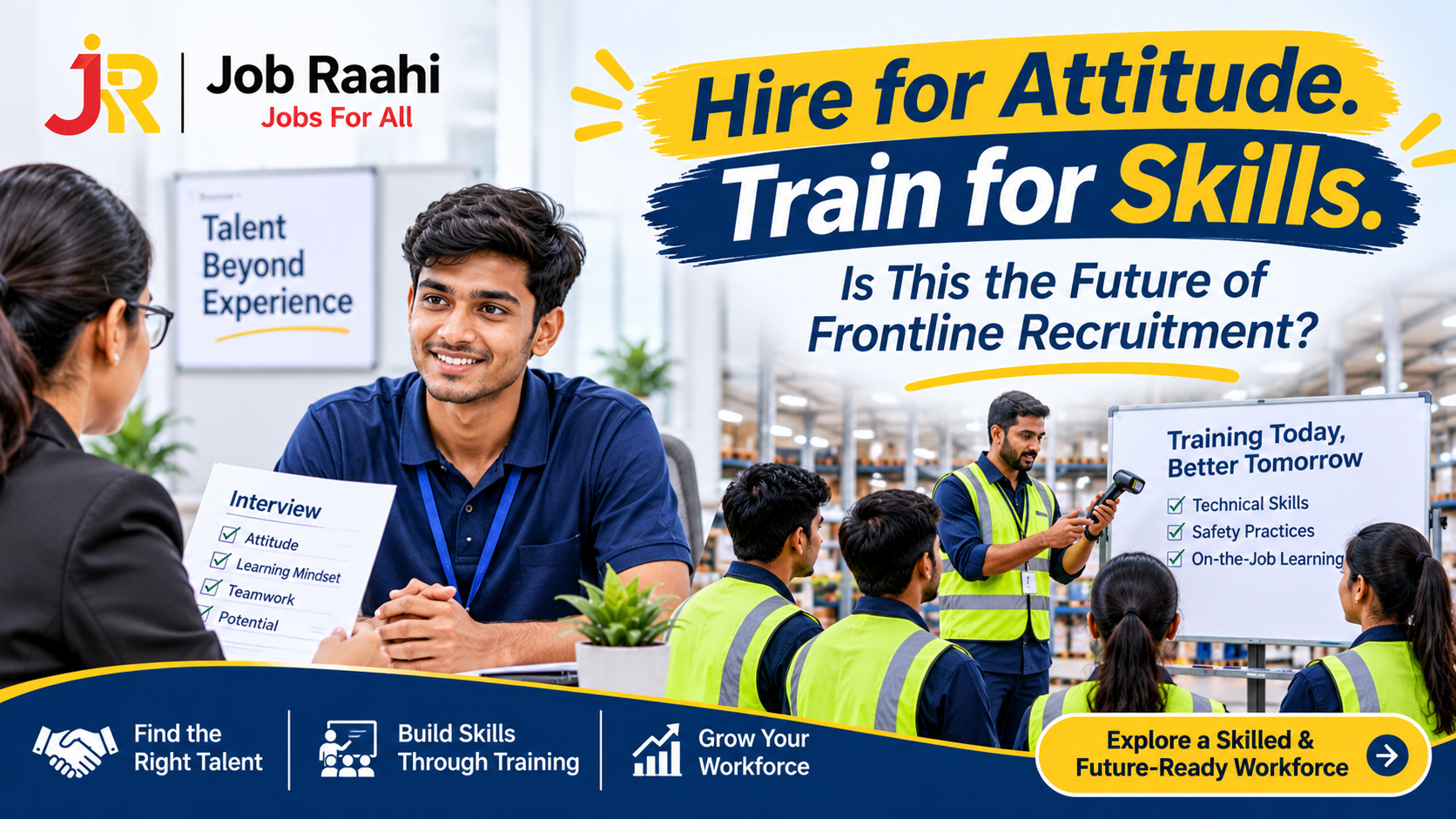
Imagine a company looking to hire 50 warehouse associates. During recruitment, it comes across two types of candidates.
The first group has previous work experience but may require additional support to adapt to the company’s processes. The second group consists of freshers with little or no experience, but they are punctual, motivated, willing to learn and interested in building a career.
Which group should the company choose?
Traditionally, employers might prefer candidates with previous experience because they are expected to understand the job more quickly. However, as hiring requirements evolve, businesses are beginning to recognise the value of another approach: hiring candidates for their attitude and potential, then developing their skills through training.
This approach is particularly relevant in frontline industries such as retail, logistics, warehousing, hospitality, manufacturing and customer support, where businesses frequently need to recruit people in large numbers.
But is hiring for attitude and training for skills really a better approach? Let’s understand.
1. Why Traditional Hiring Approaches Are Changing
For years, previous work experience has been one of the most important factors in recruitment. Employers often prefer candidates who have already performed similar roles because they believe experienced employees require less training and can become productive sooner.
However, this approach can create challenges, especially in frontline recruitment.
The shortage of job-ready candidates
Many employers need candidates who can join quickly, understand basic workplace responsibilities and perform specific operational tasks. Finding enough candidates who meet every requirement can become difficult, particularly when companies are hiring in bulk.
Experience requirements limit fresher opportunities
A candidate may have completed an ITI, Polytechnic, Diploma or other vocational course but still struggle to find employment because most vacancies ask for previous experience.
This creates a gap: employers are looking for experienced workers, while freshers are looking for their first opportunity to gain experience.
Experienced candidates may have different expectations
Experienced workers may have specific salary expectations, preferred locations, shift requirements or established working habits. These expectations do not always align with the requirements of an employer.
None of this means experienced candidates are less valuable. It simply shows that experience alone may not be the right measure for every frontline role.
Businesses need to consider whether a candidate has the potential to perform well after receiving the right training.
2. What Does Hiring for Attitude, Training for Skills Mean?
The concept is straightforward.
Instead of selecting candidates only on the basis of their previous experience or existing technical abilities, employers assess their attitude, basic aptitude, reliability and willingness to learn.
Once selected, employees receive structured training to develop the specific skills required for their roles.
For example, a retail company hiring store associates may not necessarily need candidates who already know how to operate its billing software. It can select candidates who demonstrate communication skills, customer-friendly behaviour, responsibility and a willingness to learn.
The company can then train them on:
- Point-of-sale (POS) systems
- Product knowledge
- Billing procedures
- Inventory management
- Customer handling
- Store operations
Similarly, a warehouse employer can recruit candidates with basic physical and operational readiness, a safety-conscious attitude and the ability to follow instructions. Job-specific training can then cover scanning devices, inventory processes, picking, packing and dispatch procedures.
The objective is not to ignore skills or qualifications. It is to distinguish between skills that candidates must already possess and skills that employers can realistically teach.
3. Why Attitude Matters in Frontline Jobs
Frontline employees interact directly with customers, handle daily operations and represent a company’s service standards. Their behaviour can influence productivity, customer satisfaction and teamwork.
Here are some qualities employers can look for during recruitment.
A. Willingness to Learn
A candidate who is open to feedback and interested in learning new processes can adapt more effectively to changing workplace requirements.
B. Reliability and Responsibility
Punctuality, attendance, accountability and completing assigned tasks are important across frontline roles.
C. Communication and Teamwork
Retail associates, delivery staff, customer support executives and warehouse employees often coordinate with supervisors, colleagues and customers. Basic communication and teamwork help daily operations run smoothly.
D. Problem-Solving Ability
Frontline employees regularly encounter situations that require practical thinking. A delivery associate may need to handle an address-related issue, while a retail employee may have to respond to a customer query.
E. Adaptability
Work processes, technologies and customer expectations change. Employees who are willing to adapt can learn new systems and responsibilities more easily.
These qualities do not replace technical qualifications or role-specific requirements. They complement them.
4. The Benefits of Training Employees After Hiring
Hiring candidates with potential and developing their skills can create advantages for employers when the training programme is properly designed.
1. Access to a Wider Talent Pool
Employers can consider freshers, vocationally trained candidates and people with limited experience instead of restricting recruitment to candidates who have previously performed the exact same job.
This is particularly useful when hiring for entry-level and high-volume positions.
2. Training According to Company Requirements
Every organisation has its own operating procedures, technology, safety rules and performance expectations.
Even experienced employees need to understand these processes.
Training new employees from the beginning allows companies to introduce their own standards and working methods.
3. Better Preparation for Job Responsibilities
A structured onboarding and training programme helps employees understand what is expected from them before they begin handling responsibilities independently.
This can reduce confusion and improve their readiness for the role.
4. More Opportunities for Freshers
This approach can create employment opportunities for candidates who have the basic educational background and motivation but lack professional experience.
For many young people, especially those entering the workforce after ITI, Polytechnic, Diploma or Class 12, the first job is an important step towards building a career.
5. Building a Workforce for Long-Term Requirements
Employers can develop employees according to future operational requirements instead of depending entirely on the existing experienced talent pool.
However, training requires time, resources and consistent supervision. It should be treated as an investment, not an informal activity.
5. How Employers Can Implement This Hiring Approach
Hiring for attitude does not mean selecting candidates randomly or ignoring job requirements. Employers need a structured recruitment and training process.
Here are five practical steps.
Step 1: Separate Essential Skills from Trainable Skills
Before publishing a vacancy, employers should identify which skills are absolutely necessary on the first day and which can be developed after joining.
For example:
| Role | Essential at Hiring | Can Be Taught Through Training |
|---|---|---|
| Retail Associate | Basic communication, customer-friendly attitude | POS operation, billing, product knowledge |
| Warehouse Associate | Ability to follow instructions, safety awareness | Scanning, picking, packing, inventory processes |
| Customer Support Executive | Basic communication, patience | CRM tools, product knowledge, call-handling processes |
| Delivery Associate | Route awareness, responsibility, basic digital confidence | Company delivery application, delivery procedures |
| Production Assistant | Safety awareness, discipline | Machine-specific processes, quality checks |
The exact requirements will vary by employer, location and job responsibilities.
Step 2: Assess Attitude During Interviews
Employers can use simple situational questions to understand a candidate’s approach to work.
For example:
- How would you respond if your supervisor corrected a mistake?
- What would you do if you did not understand a task?
- How would you handle a customer who was unhappy?
- Are you comfortable learning a new system or process?
Practical assessments and realistic job previews can also help employers evaluate candidates more fairly.
Step 3: Design a Structured Training Programme
Training should be specific to the job role.
It can include workplace orientation, safety instructions, practical demonstrations, supervised tasks and basic technology training.
The duration will depend on the complexity and risk associated with the role. Some responsibilities may require only a short induction, while technical or safety-sensitive work requires formal instruction and supervised practice.
Step 4: Provide Support During the Initial Period
The first few weeks are important for new employees.
Supervisors should explain responsibilities, monitor progress, provide feedback and address difficulties.
A buddy or mentor system can also help freshers become comfortable with the workplace.
Step 5: Measure Results
Employers should evaluate whether the approach is delivering results.
Useful indicators include:
- Training completion rates
- Time taken to become job-ready
- Attendance and punctuality
- Performance after training
- Employee retention during the first 90 days
- Supervisor feedback
- Quality and productivity measures
These metrics help companies understand whether their recruitment and training processes need improvement.
6. What Role Do Training Institutes and Job Platforms Play?
Employers cannot build a skilled workforce alone. Training institutes, educational organisations and employment platforms can contribute to connecting candidates with suitable opportunities.
Training institutes can help students develop practical knowledge, workplace discipline and basic employability skills. Industry interaction and exposure to actual job requirements can make training more relevant.
Employability programmes can prepare candidates in communication, interview readiness, digital literacy and professional behaviour.
Digital job platforms can help employers reach candidates from different educational backgrounds, locations and experience levels. They can also make it easier for freshers to discover opportunities that match their qualifications and interests.
For example, a candidate completing an ITI course may not have previous employment experience, but could still be suitable for an entry-level technical or operational role after receiving the required training.
At Job Raahi, we believe that employment opportunities should be accessible to candidates based on their potential and relevant capabilities, not just their previous work history. Connecting employers with freshers and candidates from diverse backgrounds can help create more pathways into the workforce.
7. Is This the Future of Frontline Recruitment?
Hiring for attitude and training for skills is not a replacement for experience-based recruitment. Certain jobs require specialised technical knowledge, professional certifications or proven experience that cannot be substituted with basic training.
However, for many entry-level and frontline positions, employers can benefit from looking beyond previous experience.
As businesses expand across retail, logistics, warehousing, hospitality, manufacturing and customer support, they will continue to need employees who can learn, adapt and perform according to operational requirements.
The companies that build effective recruitment and training systems may be better positioned to develop their own talent pipelines.
The future of frontline recruitment may therefore depend not only on finding people who can do the job today, but also on identifying people who can learn to do it well tomorrow.
Conclusion
Experience will always have value, but it should not become the only gateway to employment.
A candidate who is responsible, motivated, adaptable and willing to learn may have considerable potential, even without an extensive work history.
For employers, the opportunity lies in identifying that potential and supporting it with structured training, supervision and clear career pathways.
Hire for potential. Train for performance. Create opportunities for growth.