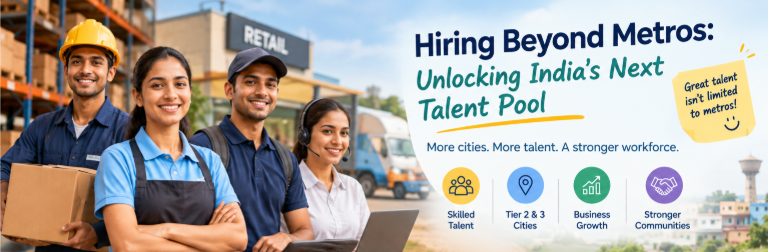
For years, when companies thought about hiring at scale, the first names that came to mind were Bengaluru, Delhi NCR, Mumbai, Hyderabad, Chennai and Pune.
These cities have strong talent pools, established businesses, universities and mature hiring ecosystems. They will continue to be important.
But there is another side to India’s talent story.
Across Tier 2 and Tier 3 cities, thousands of candidates are building skills, completing vocational courses, graduating from colleges and looking for opportunities closer to home.
For employers, this creates an important question:
Are you looking at the entire talent pool, or only the talent that is easiest to find?
The Talent Market Is Moving Beyond Traditional Hubs
Hiring is no longer restricted to a handful of large cities. Recent hiring data has shown continued momentum in emerging cities. In FY26, cities such as Coimbatore, Gandhinagar and Surat recorded strong hiring activity, while more recent data has highlighted cities including Jaipur, Coimbatore and Ahmedabad as growing hiring markets.
The change is particularly interesting because companies are not only looking for highly specialised professionals. There is growing demand across sectors such as retail, logistics, hospitality, BPO, sales, customer support, manufacturing and e-commerce.
These sectors require people who can perform practical, customer-facing and operational roles — and that talent can be found far beyond the major metros.
Why Should Companies Look Beyond Metros?
1. A Larger Talent Pool
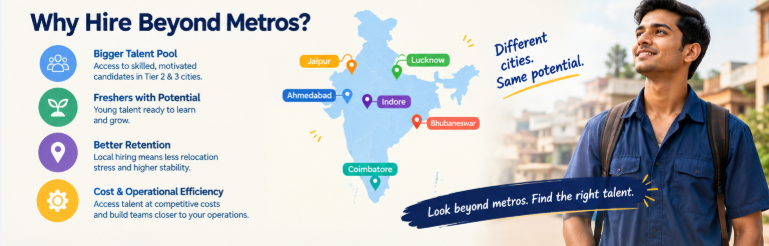
The biggest advantage is simple: more people to hire from.
When companies repeatedly recruit from the same few cities, they are competing for the same candidates.
Expanding into smaller cities can open access to candidates who may have the right education, skills or potential but are not actively visible in traditional hiring channels.
For frontline and entry-level roles, this becomes even more important.
A warehouse associate, retail executive, field sales representative, customer support executive or delivery professional does not necessarily need to come from a major metropolitan city.
They need the right skills, willingness to work and an opportunity.
2. Freshers Can Become Long-Term Talent
One of the biggest opportunities outside metros is the availability of young, early-career talent.
Many candidates in smaller cities are entering the workforce for the first time.
They may not have years of experience, but they can bring:
- Willingness to learn
- Local market understanding
- Basic digital skills
- Communication abilities
- Educational qualifications
- Practical training
- Strong motivation to build a career
Instead of treating lack of experience as an automatic rejection, companies can look at potential and trainability.
Recent hiring data has also shown positive momentum in fresher hiring, including strong growth in several emerging cities.
3. Local Talent Can Improve Workforce Stability
Hiring locally can also have an important advantage: employees may not need to relocate to another city to find work.
For many frontline employees, relocation can be a major challenge.
Moving to a metro can mean higher rent, longer commutes, unfamiliar surroundings and greater living expenses.
A suitable job closer to home can sometimes make employment more sustainable.
This can matter for employers too.
A workforce that lives closer to its workplace may be easier to build and retain, particularly for roles where attendance, punctuality and regular availability are critical.
Of course, retention depends on many factors — compensation, management, work environment and career growth all matter. But location can be an important part of the equation.
4. Smaller Cities Are Becoming More Connected
The old perception of smaller cities is changing.
Digital connectivity, smartphones, online education, digital payments and job platforms have made it easier for candidates to discover opportunities without physically visiting an employer’s office.
At the same time, better infrastructure and expanding business ecosystems are making regional hiring more practical.
Team Lease notes that Tier 2 and Tier 3 cities are increasingly becoming strategic hiring locations because of their talent availability, workforce stability and improving infrastructure.
This means companies don’t necessarily have to choose between talent quality and geographic expansion.
With the right hiring and training systems, they can build both.
5. Frontline Hiring Especially Benefits From a Regional Approach
Consider a company expanding its operations across multiple states.
It may need hundreds of:
- Retail associates
- Sales executives
- Warehouse associates
- Pickers and packers
- Delivery executives
- Customer support executives
- Field representatives
- Hospitality staff
- Store operations employees
Hiring all of them from major cities would make little sense.
These roles are often needed where the business operates.
If a company opens stores in smaller cities, expands its warehouse network or enters new regional markets, the hiring strategy should move with the business.
The closer your talent search is to your actual operations, the more relevant your talent pool can become.
The Challenge: Finding This Talent
Of course, hiring beyond metros is not as simple as posting a job and waiting for applications.
Companies may face challenges such as:
- Limited visibility into local talent
- Fragmented recruitment channels
- Difficulty reaching candidates at scale
- Candidate verification
- Skill mismatches
- Communication gaps
- Joining drop-offs
- Lack of structured local recruitment networks
This is where technology and local talent ecosystems can make a difference.
A digital hiring platform can help companies reach candidates across different locations without depending entirely on traditional recruitment methods.
Training institutions, colleges, skill centres and local employment networks can also become valuable sources of candidates.
Build a Regional Talent Pipeline, Not Just a Regional Hiring Campaign
There is an important difference between hiring from smaller cities and building a talent pipeline in smaller cities.
A hiring campaign begins when a vacancy opens.
A talent pipeline starts much earlier.
Companies can work with local colleges, vocational institutes, training centres and digital platforms to identify potential candidates before urgent hiring requirements arise.
For example:
Identify → Train → Assess → Connect → Hire → Develop
This creates a repeatable model instead of starting recruitment from zero every time a new requirement comes in.
Technology Can Make Regional Hiring Easier
Technology is changing how employers connect with candidates.
Candidates no longer have to depend entirely on newspaper advertisements, local references or physically visiting recruitment offices.
They can discover jobs, create profiles, apply digitally and track opportunities through their phones.
For employers, digital platforms can make it easier to:
- Reach candidates across locations
- Filter candidates by skills and experience
- Manage high-volume applications
- Promote vacancies
- Build candidate pipelines
- Connect with fresher talent
- Track recruitment activity
The combination of digital reach + local talent can make regional hiring significantly more scalable.
Don’t Ignore the Candidate’s Potential
Perhaps the biggest mindset shift required is moving away from the idea that the best candidate is always the candidate with the longest resume.
For many frontline and entry-level positions, employers need people who can learn, adapt and perform consistently.
A candidate with six months of experience from a smaller city may be a better fit than an experienced candidate who is unwilling to relocate.
A fresher with the right attitude and practical training may develop into a strong employee.
The question should therefore move from:
“Where does this candidate come from?”
to:
“Can this candidate perform, learn and grow in this role?”
India’s Next Talent Pool May Already Be There
India’s workforce is becoming increasingly distributed. Talent is not concentrated in a few large cities anymore.
From Jaipur and Indore to Bhubaneswar, Coimbatore, Surat, Lucknow, Patna and many other emerging markets, companies have an opportunity to discover talent closer to where people actually live.
For frontline hiring, this shift can be particularly powerful.
The future of recruitment may not be about choosing between metros or smaller cities.
It may be about building a hiring strategy that combines both.
Use metros when specialised talent is needed.
Look beyond metros when you need scale, local talent and broader workforce access.
Build partnerships with institutions and local ecosystems.
Use digital platforms to expand your reach.
And most importantly, evaluate candidates based on skills, potential and role fit — not simply their pin code.
Final Thought
India’s next talent pool isn’t necessarily waiting in another large corporate office.
It could be in a college classroom, a vocational training centre, a small city, a district headquarters or a candidate’s home town.
The opportunity for employers is to look beyond the traditional hiring map.
Because sometimes, the talent you’re looking for isn’t unavailable.
You’re simply not looking far enough.