Getting your first job can sometimes feel like a race where everyone else seems to be ahead of you. Someone already has an internship. Someone else has completed a course. Another person has six months of experience. And then there is you, wondering:
“What can I do to get started?”
If you are a fresher, this feeling is completely normal.
But here is something worth remembering — you don’t need to know everything before you start your career.
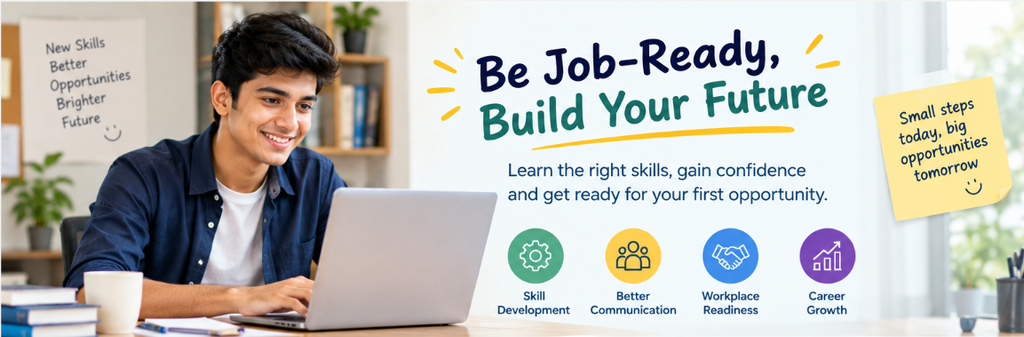
You need to become job-ready. Being job-ready does not mean having a perfect resume, knowing every software or having years of experience. It means having the basic skills, confidence and workplace understanding needed to take your first opportunity seriously. And the good thing is that these skills can be learned.
What Does Being Job-Ready Actually Mean?
Being job-ready is more than simply having a certificate. Imagine two candidates applying for the same entry-level position. Both have completed their education. Both are freshers. Neither has much work experience but one candidate has spent some time improving communication, understanding the job role, practising basic workplace skills and learning about the industry.
That candidate may feel more comfortable when the interviewer asks questions.This is what job readiness is really about. It is about preparing yourself for what comes after getting selected. You should know what the job involves, how to communicate professionally, how to work with others and how to handle basic responsibilities. You don’t have to be perfect. You just need to be prepared enough to begin.
A Certificate Is Useful, But Skills Matter Too
Completing a course is an achievement. But employers also want to know what you can actually do with what you have learned.
For example, if you have completed a course related to retail, understanding customer handling and store operations can be more useful than simply knowing the name of your course.
If you are interested in logistics, knowing basic warehouse processes, inventory handling and workplace safety can give you a better understanding of the role. Similarly, someone looking at sales or customer service roles can work on communication, listening and problem-solving skills. The question to ask yourself is simple:
“If I get this job tomorrow, what skills will help me perform it well?”
Start there.
Communication Is a Skill You Can Build
You don’t need to speak perfect English to be a good employee. What you need is the ability to communicate clearly.
Can you explain something properly?
Can you listen to instructions?
Can you ask a question when you don’t understand something?
Can you speak respectfully with a customer, colleague or supervisor?
These are everyday workplace skills, and they matter across industries. If you are not confident with communication today, don’t worry.
Start small.
Speak more often. Practise introducing yourself. Read aloud. Talk to people outside your usual circle. Record yourself answering common interview questions. Little improvements can make a noticeable difference over time.
Learn to Work With People
Most jobs involve working with other people.
You may work with a team in a warehouse.
You may deal with customers in a store.
You may coordinate with colleagues in a hotel.
You may report to a supervisor in a manufacturing unit.
You may travel and meet customers in a field sales role.
In all these situations, technical ability is only one part of the job.
You also need to know how to work with people.
That means being respectful, listening to others, taking responsibility and understanding that every person in a team has a role to play.
Teamwork is not something you only learn in an office.
You can develop it through college projects, sports, volunteering, training programmes and everyday experiences.
Practical Skills Can Give You a Stronger Start
For many entry-level and blue-collar roles, practical knowledge is extremely valuable.
A person entering a warehouse job should understand basic warehouse processes.
Someone entering hospitality should have some understanding of customer service and workplace etiquette.
A retail candidate should be comfortable interacting with customers.
A technical trainee should understand the basic tools and processes related to their trade.
This is why vocational training and skill development can be useful pathways for young people who want to enter the workforce.
The Skill India Digital Hub, for example, provides access to skill courses, job opportunities, apprenticeships and skill centres across different areas.
The National Skill Development Corporation also focuses on connecting skills and training with employment opportunities, with industry-relevant courses and training centres available through its ecosystem.
Don’t Wait Until You Get a Job to Start Learning
This is one of the biggest mistakes a fresher can make.
Some people think:
“Once I get the job, then I will learn.”
But why wait?
If you know you want to work in logistics, start learning about logistics now.
Interested in retail? Understand how stores operate.
Want to work in sales? Practise communication and customer interaction.
Interested in technical work? Look for relevant vocational training.
The more you understand before your first job, the less unfamiliar the workplace may feel when you actually enter it.
Learning doesn’t have to stop after you get hired either.
In fact, that is when it becomes even more important.
Your First Job Is Also a Learning Opportunity
Your first job may not be your dream job.
And that’s perfectly fine.
A first job can give you something that no classroom can completely provide — real work experience.
You learn how a workplace functions.
You learn how to deal with deadlines.
You understand what it means to be responsible for a task.
You learn how to communicate with customers and colleagues.
You discover what you are good at.
You also discover what you need to improve.
That experience becomes part of your professional journey. A person who starts as a warehouse associate, for example, may eventually take on more responsibility and move towards team leadership or supervisory roles.
A retail associate may gradually move into senior store operations.
Someone starting in a field role can build customer-handling and sales experience that opens up further opportunities.
Career growth rarely happens overnight. It is usually built one skill and one experience at a time.
Learn, Apply, Improve
Think of your career as a cycle.
Learn → Apply → Gain Experience → Improve → Grow
You learn a skill.
You find an opportunity to use it.
You gain practical experience.
You understand where you need to improve.
You develop another skill.
And the cycle continues.
This approach can be especially helpful for freshers because it takes away some of the pressure of finding the “perfect” career immediately.
You don’t have to have your entire career planned at 18, 20 or 22.
You can start somewhere, learn and adjust along the way.
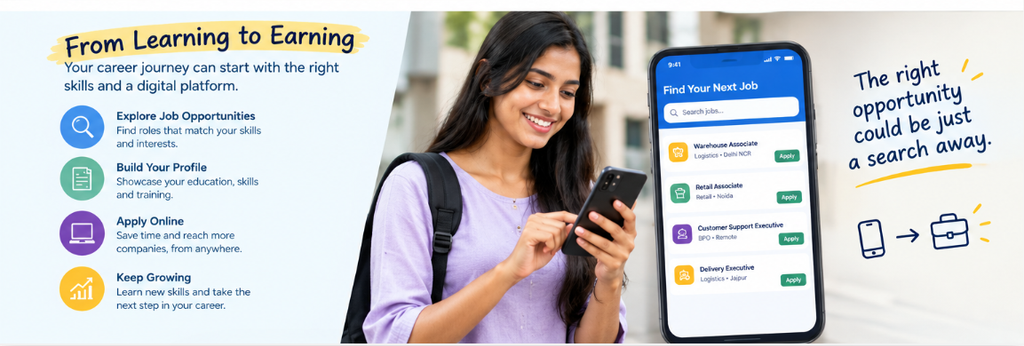
Use Digital Platforms to Find Opportunities
Being job-ready is only one part of the journey.
You also need to know where to look for opportunities.
The way people search for jobs has changed significantly. Digital platforms now allow job seekers to explore vacancies, compare roles and apply for opportunities without having to depend entirely on personal contacts or physically visit companies.
The Government of India’s National Career Service (NCS) is one example. It provides job search and matching, career guidance, skill-related information and other employment services through a digital platform.
For a fresher, using digital platforms alongside personal networks, training centres and referrals can give you more ways to discover opportunities.
The important thing is to stay active.
Don’t simply create a profile and wait.
Search regularly.
Read job descriptions.
Apply for suitable roles.
Keep improving your skills.
A Simple Job-Readiness Checklist
Before you start applying seriously, ask yourself:
- Can I confidently introduce myself?
- Do I understand the kind of job I want?
- Do I know what skills the role requires?
- Is my resume updated?
- Can I communicate clearly?
- Have I practised common interview questions?
- Do I have any practical or vocational skills?
- Am I comfortable working with a team?
- Do I know how to search for jobs online?
- Am I willing to learn after joining?
You don’t need to answer “yes” to everything.
The purpose of the checklist is to understand where you need to improve.
You Don’t Need to Have It All Figured Out
Starting a career is not about having the perfect qualification, perfect resume or perfect plan. It is about taking the next useful step.
Maybe that step is completing a vocational course.
Maybe it is improving your communication.
Maybe it is creating your first resume.
Maybe it is attending your first interview.
Or maybe it is simply starting to search for jobs instead of waiting for someone to tell you about an opening.
Whatever that step is, take it. Because every skill you learn makes you a little more prepared.
Every interview teaches you something. Every job gives you experience.
And every experience can help you move forward.
Your Career Starts With Being Ready
Your first opportunity may not come with a big title. It may not be the highest-paying job. It may simply be an entry-level role that gives you the chance to learn.
But if you are prepared to make the most of it, that opportunity can become the starting point for something much bigger.
So don’t wait until you feel completely ready.
Learn a skill. Build confidence. Explore opportunities. Take the first step.
Because sometimes, getting ahead doesn’t mean starting ahead of everyone else.
It simply means being ready when your opportunity arrives.