Getting your first interview call can be exciting.
It can also make you nervous.
You might start wondering: What will they ask me? What if I don’t know the answer? What should I wear? What if they ask about my experience when I don’t have any?
If you have ever had these thoughts before an interview, you are not alone.
For a fresher, the first job interview can feel like a big moment. You may not have years of work experience to talk about, but that does not mean you have nothing to offer. Your education, projects, internships, vocational training, part-time work, college activities and even everyday experiences can tell an interviewer a lot about how you learn, communicate and handle responsibility.
The key is knowing how to present yourself. Your First Interview Is Not About Being Perfect. One of the biggest mistakes freshers make is thinking they need to have the perfect answer to every question.
You don’t.
An interview is a conversation where the employer is trying to understand whether you are suitable for the role and whether you are willing to learn.
For entry-level positions, interviewers may look at things such as communication, attitude, basic knowledge, reliability and your interest in the role.
So instead of thinking, “I don’t have enough experience,” try asking yourself:
“What have I learned, and how can I show that I am ready to learn more?”
That small change in mindset can make a big difference.
1. Understand the Job Before You Walk In
Before preparing answers, read the job description carefully. What exactly will you be doing?
What skills are mentioned?
Is the job related to sales, customer service, logistics, retail, warehouse operations, hospitality or something else?
For example, if you are interviewing for a warehouse associate role, understand the basic responsibilities of the position. If it is a retail job, think about customer interaction, product handling and store operations.
You don’t need to become an expert overnight. But you should know what you are applying for. It shows that you are genuinely interested in the opportunity rather than simply attending every interview you receive.
2. Research the Company
Spend some time learning about the company before your interview. Start with the company’s website. Understand what it does, what products or services it offers and the kind of customers it serves.
You can also look at its recent updates or social media pages. Why does this matter?
Because you may be asked:
“What do you know about our company?”
A candidate who has done even basic research can answer this question much more naturally than someone who knows nothing about the organisation.
You don’t need to memorise the company’s entire history. Just know the basics and understand why the job interests you.
3. Prepare Your Answer to “Tell Me About Yourself”
This is one of the most common questions in a first interview. And many freshers make it unnecessarily complicated. You don’t need to tell your entire life story.
Keep your answer simple:
Who you are → What you have studied → What skills or experience you have → What kind of opportunity you are looking for
For example:
“I recently completed my 12th and have been interested in customer-facing roles. During my studies, I participated in activities where I had to interact with people and work as part of a team. I am now looking for an entry-level opportunity where I can develop my communication skills and gain practical work experience.”
Don’t memorise this word by word. Understand the structure and speak naturally.
4. Be Ready for Common Fresher Interview Questions
You will probably face some familiar questions during your interview. Prepare for questions such as:
- Tell me about yourself.
- Why do you want this job?
- Why do you want to work with our company?
- What are your strengths?
- What is one area you want to improve?
- Why should we hire you?
- What do you know about this role?
- Where do you see yourself in the future?
- Are you comfortable working in shifts?
- Are you comfortable working with a team?
- Do you have any questions for us?
Don’t prepare by memorising long answers. Instead, think about your own experiences and prepare a few points for each question. That way, your answers will sound like you, rather than something copied from the internet.
5. You Don’t Need Work Experience to Show Your Skills
This is particularly important for freshers. Suppose the interviewer asks:
“Can you give me an example of working in a team?”
You don’t necessarily need to have worked in a company.
You can talk about a college project, school activity, sports team, volunteer activity or any other situation where you worked with other people.
Similarly, if you are asked about responsibility, think about a real situation where you were responsible for completing something.
The interviewer is often interested in how you handled the situation, not just where it happened.
Your experiences count. You just need to learn how to talk about them.
6. Don’t Be Afraid to Say “I Don’t Know”
This is something many freshers struggle with. They think saying “I don’t know” will automatically ruin their chances. But pretending to know something you don’t can be worse.
If you genuinely don’t know the answer, you can say:
“I’m not familiar with that yet, but I would be interested in learning it.”
Or:
“I haven’t worked with that before, but I understand the basics and would be happy to learn.”
Being honest while showing a willingness to learn is much better than making up an answer.
7. Practice Before the Interview
You can read interview tips all day, but speaking your answers out loud is different.
Take your phone and record yourself answering a few questions.
Start with:
“Tell me about yourself.”
Then try:
“Why should we hire you?”
And:
“Why do you want this job?”
Listen to your recording.
Are you speaking too quickly?
Are your answers too long?
Are you using “umm” and “actually” too often?
Are you sounding confident?
You will notice things that you may not realise while simply thinking about your answers. If possible, ask a friend, teacher or family member to conduct a mock interview with you.
8. Dress Neatly and Reach on Time
You don’t need expensive clothes for an interview. You need to look clean, neat and appropriate for the workplace.
Choose comfortable and professional clothing, keep your appearance tidy and avoid anything that makes you uncomfortable during the interview.
And don’t underestimate punctuality. Plan your route beforehand and try to reach a little early. Arriving in a hurry can make you nervous before the interview even begins.
9. Communication Is More Than Speaking English
Many freshers worry that their English is not perfect. But good communication is not about using complicated English. It is about expressing your thoughts clearly.
Listen carefully to the question. Take a moment if you need to think. Speak at a comfortable pace.
And if you don’t understand something, simply ask the interviewer to repeat or explain the question.
You don’t need to sound like someone else. You need to be clear, respectful and confident enough to express yourself.
10. Ask a Question When the Interview Ends
At the end of an interview, you may hear:
“Do you have any questions for us?”
Don’t automatically say no.
You can ask something simple and relevant, such as:
- “What would my responsibilities be in this role?”
- “What skills are most important for this position?”
- “What would the next step in the hiring process be?”
- “Is there any training provided for someone joining this role?”
It shows that you are paying attention and genuinely interested in understanding the opportunity.
What If You Don’t Get Selected? This is probably the most important thing to remember. Your first interview may not lead to your first job.
And that’s okay.
You may attend one interview, then another, and another before receiving an offer. Each interview teaches you something. Maybe you realised you need to improve your communication. Maybe you struggled with a particular question. Maybe you discovered that you need to learn more about the industry.
Take that learning with you to the next interview. Over time, the process becomes less unfamiliar, and your confidence starts to grow.
A Simple Interview Checklist for Freshers
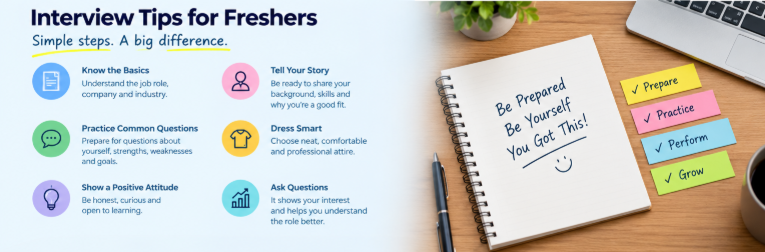
Before leaving for your interview, take a minute to check:
- Have I read the job description?
- Do I know what the company does?
- Is my resume updated?
- Can I introduce myself confidently?
- Have I practised common interview questions?
- Do I know how to explain my skills and education?
- Have I planned my route?
- Am I carrying the required documents?
- Have I prepared one or two questions to ask?
- Most importantly, am I ready to be honest and learn?
Your First Interview Is a Learning Experience Getting your first job is not about having everything figured out. You are a fresher. Employers know that. What matters is showing that you are prepared, willing to learn and serious about the opportunity.
So take a breath.
Read the job description. Do your research. Practise your answers. Be honest about what you know. And walk into the interview with the confidence that you have something valuable to offer.
Your first interview may be the beginning of your professional journey. You don’t need to be perfect. You just need to be prepared enough to take the first step.