Tag: Local Talent Acquisition

  • Why Hiring in Tier 2 & Tier 3 Cities Needs a Different Strategy

    Why Hiring in Tier 2 & Tier 3 Cities Needs a Different Strategy


    Why Tier 2 and Tier 3 Hiring Is Different

    For years, India’s recruitment ecosystem has been heavily concentrated around major metropolitan markets.

    Delhi NCR.

    Mumbai.

    Bengaluru.

    Hyderabad.

    Chennai.

    Pune.

    But India’s workforce doesn’t exist only in these cities.

    A significant and increasingly important talent market exists across:

    Tier 2 cities.

    Tier 3 cities.

    Industrial towns.

    District headquarters.

    Smaller cities.

    Hinterlands.

    For employers hiring frontline and operational workforces, these markets can represent a major opportunity.

    But there is one important catch:

    You cannot always use a metro hiring strategy in a non-metro market and expect the same results.

    The candidate behaviour can be different.

    The talent supply can be different.

    The communication channels can be different.

    The importance of location can be different.

    And the way employers need to build trust can be different.

    This is why companies expanding beyond India’s major cities need a different Tier 2 hiring strategy.


    India’s Talent Market Is Moving Beyond the Metros

    India’s economic growth is increasingly distributed across different regions.

    Manufacturing facilities are expanding into new industrial clusters.

    Retail brands are entering smaller cities.

    Telecom networks require field teams across districts.

    Logistics networks are expanding deeper into the country.

    Healthcare services are reaching new markets.

    Financial services are expanding their field workforce.

    GCC and technology ecosystems are also exploring locations beyond traditional metros.

    Every expansion creates a workforce requirement.

    And that creates an important question:

    How do you find and reach the right talent where your business is expanding?

    The answer cannot always be:

    “Post the job nationally.”

    For many frontline roles, recruitment needs to become much more local and market-specific.


    Why Traditional Hiring Strategies Struggle Outside Major Cities

    A company may have an excellent recruitment process.

    It may have a strong employer brand.

    It may use leading job platforms.

    It may have an experienced talent acquisition team.

    Yet hiring can still become difficult when entering a new location.

    Why?

    Because the challenge isn’t always a shortage of candidates.

    It can be a candidate reach problem.

    The right candidates may:

    • Not know about the company
    • Not see the vacancy
    • Prefer local employers
    • Be unaware of opportunities outside their immediate area
    • Have concerns about relocation
    • Have limited access to certain recruitment channels
    • Need more information before considering the opportunity

    For frontline positions, these factors can become even more important.


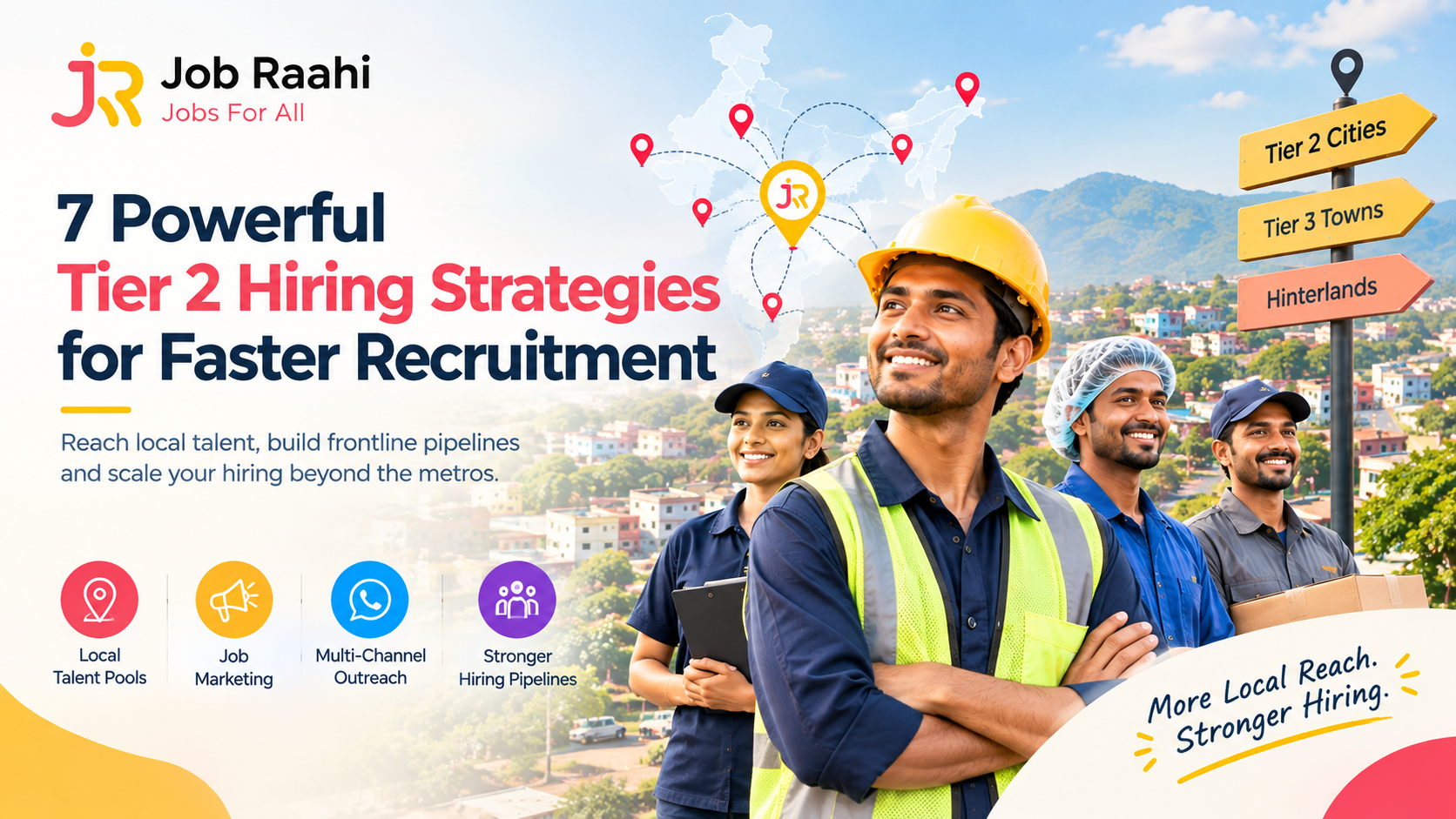
    7 Powerful Tier 2 Hiring Strategies

    1. Build Local Talent Pools

    The first step is to stop looking at Tier 2 cities simply as another location in a national recruitment campaign.

    Treat them as individual talent markets.

    For example:

    Instead of:

    “We need 500 technicians in North India.”

    break the requirement down into:

    Meerut — 50

    Lucknow — 75

    Dehradun — 40

    Jaipur — 80

    Rudrapur — 35

    Other markets — 220

    Now the recruitment team can start understanding each market separately.

    Who are the candidates?

    What skills are available?

    How far are they willing to travel?

    What salary expectations exist?

    Which roles are easiest to fill?

    Where are the hiring gaps?

    This is the foundation of a local talent pool.


    2. Think Beyond the City

    One of the biggest mistakes employers can make is defining their hiring market only by city boundaries.

    A candidate doesn’t necessarily need to live inside the city where the job is located.

    They may live:

    • In a nearby town
    • In a neighbouring district
    • Along a major transport route
    • In a surrounding industrial cluster
    • In a nearby semi-urban area

    This is particularly relevant for frontline jobs.

    Instead of thinking:

    City = Talent Market

    think:

    Workplace + Commute + Surrounding Communities = Talent Market

    This creates a more realistic hiring radius.


    3. Take Jobs to Candidates

    In metro markets, candidates may actively search for jobs across multiple platforms.

    In smaller markets, employers may need to be more proactive about creating awareness.

    This means recruitment can move from:

    “Post and wait.”

    to:

    “Reach and engage.”

    Employers can use:

    • Job platforms
    • WhatsApp
    • SMS
    • RCS
    • Email
    • Social media
    • Digital campaigns
    • Candidate databases
    • Recruiter outreach

    The objective is simple:

    Don’t wait for every candidate to discover the job. Take the opportunity to the candidate.


    4. Build Location-Specific Hiring Campaigns

    A job campaign for Delhi doesn’t necessarily need to look like a job campaign for a smaller industrial town.

    The recruitment message should answer the questions candidates actually care about.

    For example:

    Hiring in a Tier 2 market

    Machine Operators Required

    📍 Location: Rudrapur
    💰 Salary: ₹18,000–₹24,000
    🏭 Manufacturing Role
    🚌 Transport Available
    📅 Immediate / Short-Notice Joining

    This immediately provides context.

    A candidate can quickly determine:

    Is this job near me?

    Is the salary relevant?

    Can I commute?

    Can I join?

    Clear communication can reduce unnecessary applications while improving relevance.


    5. Create Always-On Talent Pipelines

    One of the biggest mistakes employers make is starting recruitment only when the requirement becomes urgent.

    Suppose a company regularly hires:

    • Technicians
    • Operators
    • Field executives
    • Sales staff
    • Customer service associates

    Why rebuild the candidate pool every time?

    Instead, employers can maintain always-on talent pipelines for important recurring roles.

    For example:

    Technician Talent Pool

    Location: Uttarakhand
    Qualification: ITI / Diploma
    Experience: 0–3 years
    Availability: Open to opportunities

    When a requirement appears, the company already has a relevant starting pool.

    This can be particularly useful for employers with recurring or high-volume hiring requirements.


    6. Make the Job Opportunity Clear

    Candidates in smaller markets are not necessarily less interested in opportunities.

    But the opportunity needs to be easy to understand.

    A strong job communication should clearly explain:

    Role

    Location

    Salary

    Working hours

    Qualification

    Experience

    Benefits

    Transport

    Joining timeline

    Interview process

    Contact / application process

    The more uncertainty a candidate has, the harder it may be to convert interest into an application or interview.


    7. Measure Every Hiring Market Separately

    One national hiring dashboard can hide important differences.

    Consider this:

    LocationApplicationsInterviewsSelectionsJoinings
    City A1,0002209062
    City B8001908571
    City C6001608065
    City D1,4001204025

    If you only look at applications, City D looks like the strongest market.

    But look at joinings.

    City C may actually be performing much better.

    This is why employers should track:

    Reach → Applications → Qualified Candidates → Interviews → Selections → Offers → Joinings

    by location.

    That creates genuine regional hiring intelligence.


    The Role of Technology in Regional Hiring

    Technology can help employers scale regional recruitment without treating every location as a completely manual exercise.

    A modern regional hiring strategy can combine:

    Candidate Databases

    Identify relevant talent pools.

    Location-Based Targeting

    Reach candidates around specific hiring markets.

    Digital Job Marketing

    Promote vacancies beyond passive job listings.

    Multi-Channel Communication

    Use WhatsApp, RCS, SMS and email to reach candidate segments.

    AI-Powered Calling

    Support large-scale candidate engagement.

    Recruitment Analytics

    Compare hiring performance across different markets.

    Technology doesn’t replace local recruitment knowledge.

    It helps employers scale it.


    How Job Raahi Helps Employers Hire Beyond the Metros

    Job Raahi is built around a simple employer problem:

    How do you reach frontline talent where traditional recruitment doesn’t always work efficiently?

    The platform focuses on:

    • Frontline hiring
    • Entry-level hiring
    • Blue-collar hiring
    • Grey-collar hiring
    • Industrial hiring
    • Contractual hiring
    • Bulk workforce hiring

    For employers expanding into Tier 2, Tier 3 and hinterland markets, Job Raahi can support a more localized recruitment approach.

    Hyperlocal Candidate Reach

    Reach candidates around specific hiring locations.

    Candidate Database

    Build and access relevant candidate pools.

    Job Marketing

    Don’t simply publish the vacancy.

    Promote it to relevant candidate segments.

    WhatsApp, RCS, SMS & Email

    Use multiple channels to increase candidate reach.

    Digital Campaigns

    Promote job opportunities around relevant hiring markets.

    AI-Powered Calling

    Support candidate engagement at scale.

    Continuous Pipeline Building

    Develop candidate pools that can support future requirements.


    Industries That Can Benefit From Tier 2 Hiring

    Manufacturing

    Tier 2 and Tier 3 cities are important hiring markets for:

    • Machine operators
    • Production workers
    • Technicians
    • Quality inspectors
    • Maintenance staff

    Telecom

    Regional hiring can support:

    • Field technicians
    • Installation teams
    • Sales employees
    • Service teams

    Retail

    Growing retail footprints create demand for:

    • Store associates
    • Sales executives
    • Customer service staff
    • Supervisors

    Logistics

    Expanding distribution networks require:

    • Warehouse workers
    • Sorters
    • Delivery executives
    • Operations staff

    Infrastructure

    Projects across smaller cities create demand for:

    • Technicians
    • Electricians
    • Site workers
    • Field teams

    BFSI

    Financial services expansion can create demand for:

    • Field officers
    • Sales executives
    • Customer-facing employees

    Healthcare

    Regional healthcare expansion can require:

    • Support staff
    • Field employees
    • Operations staff

    The industries may differ.

    The recruitment challenge is often similar:

    Find relevant candidates in the right location and move them through the hiring funnel efficiently.


    Tier 2 Hiring Is Not Tier 1 Hiring at a Smaller Scale

    This is perhaps the most important point.

    A Tier 2 or Tier 3 market shouldn’t simply be treated as:

    “A smaller version of a metro market.”

    The recruitment strategy should consider:

    Local talent availability

    Commuting patterns

    Candidate awareness

    Local employers

    Salary expectations

    Regional competition

    Communication preferences

    Skill availability

    Hiring radius

    Once employers start looking at these factors, regional recruitment becomes much more strategic.


    The Future of Hiring in India’s Hinterlands

    India’s next wave of workforce growth won’t come exclusively from the largest cities.

    As businesses expand their operations, distribution networks, manufacturing capacity and services across the country, access to talent outside major metros will become increasingly important.

    The employers that build an advantage may be those that start developing talent access before they urgently need it.

    That means:

    Map the market.

    Build local pools.

    Market the jobs.

    Engage candidates.

    Measure conversion.

    Keep the pipeline active.

    This turns regional recruitment from a one-time sourcing exercise into a repeatable hiring capability.


    Frequently Asked Questions

    What is a Tier 2 hiring strategy?

    A Tier 2 hiring strategy is a recruitment approach designed specifically for hiring talent in India’s growing non-metro cities, taking into account local talent availability, geography, candidate behaviour and regional workforce conditions.

    Why is Tier 2 hiring different from metro hiring?

    Candidate availability, commuting patterns, employer competition, salary expectations and awareness of opportunities can differ significantly between markets. Employers may therefore need a more localized recruitment strategy.

    What is Tier 3 hiring?

    Tier 3 hiring refers broadly to recruitment in smaller cities and towns beyond major metropolitan and larger Tier 2 markets. These locations can be particularly relevant for frontline and distributed workforce hiring.

    How can companies hire frontline workers in Tier 2 cities?

    Companies can combine local talent pools, hyperlocal candidate reach, digital job marketing, candidate databases and multi-channel outreach to reach relevant candidates.

    Can Job Raahi help with Tier 2 and Tier 3 hiring?

    Job Raahi is designed to help employers reach frontline, blue-collar, grey-collar, industrial and high-volume talent across diverse Indian hiring markets, including smaller cities and hinterlands.


    Build Your Tier 2 Hiring Strategy With Job Raahi

    India’s talent market is much bigger than its metros.

    The opportunity for employers is not simply to expand the geography of recruitment.

    It is to understand each hiring market differently.

    A successful Tier 2 hiring strategy can combine:

    Local talent pools

    Hyperlocal candidate reach

    Digital job marketing

    Multi-channel outreach

    Candidate engagement

    Continuous talent pipelines

    The future of regional hiring isn’t about waiting for candidates to come to the job.

    It’s about taking the right opportunities to the right talent markets.

    Job Raahi — We Don’t Just List Your Jobs. We Market Them.

    External Resources

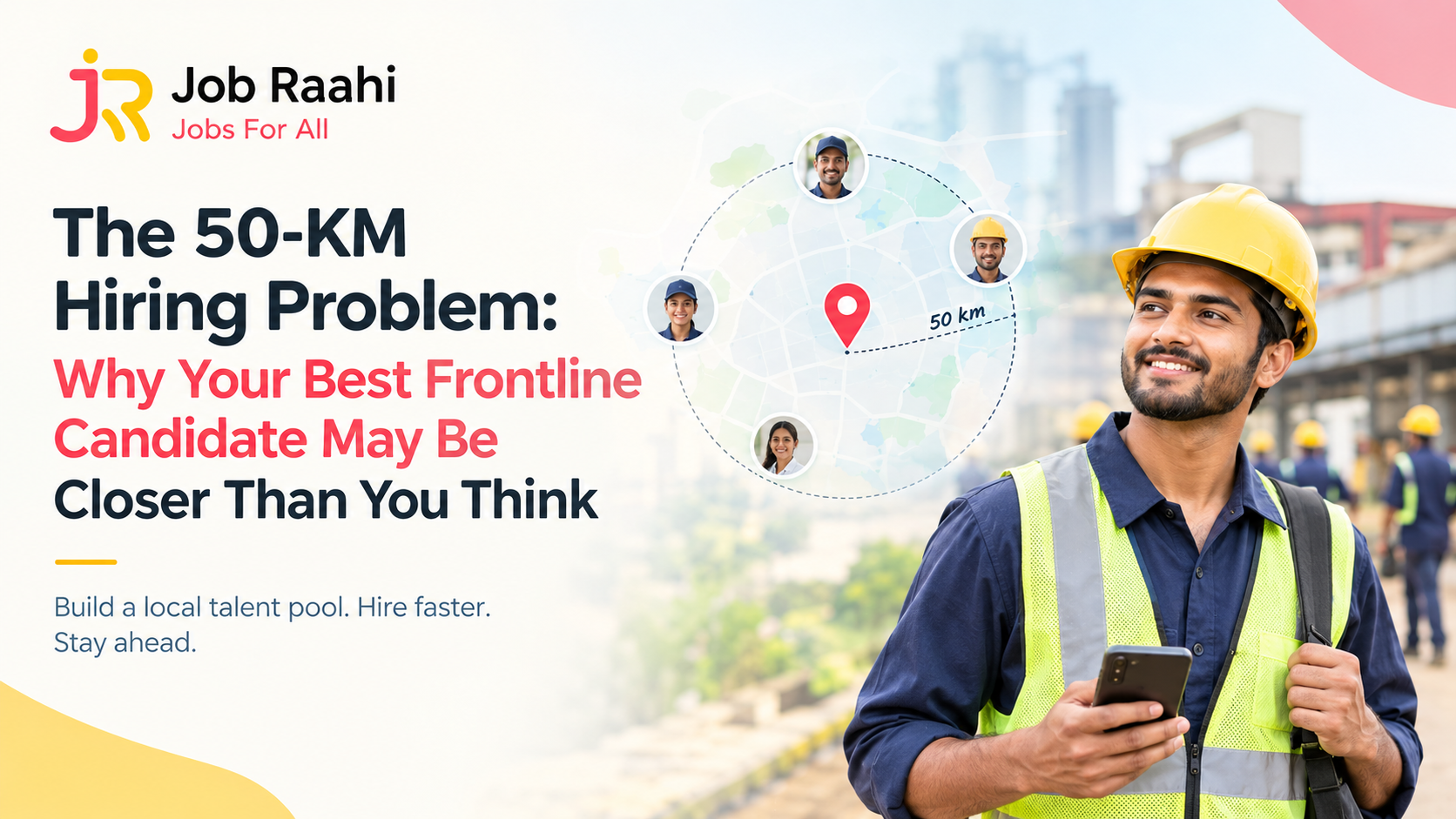
  • The 50-KM Hiring Problem: Why Your Best Frontline Candidate May Be Closer Than You Think

    The 50-KM Hiring Problem: Why Your Best Frontline Candidate May Be Closer Than You Think

    What if the problem with your frontline hiring isn’t a shortage of candidates?

    What if the problem is that you’re looking in the wrong places?

    A manufacturing company may have 100 open positions.

    A telecom company may need technicians across multiple districts.

    A retail chain may be opening stores in smaller cities.

    A logistics company may need warehouse workers around a new hub.

    The conventional response is often:

    Post the jobs. Increase the sourcing. Get more applications.

    But there is another question employers should be asking:

    Where are the candidates who can actually work at this location?

    For many frontline roles, geography isn’t just a recruitment parameter.

    Geography is part of the candidate profile.

    A candidate who lives 8 km from the workplace can sometimes be more relevant than a candidate with identical qualifications who lives 80 km away.

    This is the local talent pool problem.

    And solving it can change the way companies approach frontline hiring.


    What Is a Local Talent Pool?

    A local talent pool is a group of potential candidates who live within a practical geographic area around a job location and match the employer’s requirements.

    Instead of thinking:

    “We need 500 candidates for this role.”

    an employer can think:

    “We need 50 relevant candidates within the hiring radius of this location.”

    Then repeat the process across every location.

    For example:

    Requirement

    500 Field Technicians

    Instead of treating this as one national vacancy:

    500 Candidates → India

    the employer could structure it as:

    50 Candidates → Location A

    75 Candidates → Location B

    40 Candidates → Location C

    60 Candidates → Location D

    and so on.

    This creates a much more granular local hiring strategy.


    Why Distance Matters in Frontline Hiring

    For many corporate roles, relocation is relatively common.

    For frontline roles, it can be a completely different story.

    A candidate may consider:

    • Daily commute
    • Transportation costs
    • Shift timings
    • Family responsibilities
    • Local transportation availability
    • Workplace accessibility
    • Working hours
    • Take-home salary

    This means two candidates with identical qualifications may not have identical hiring relevance.

    Consider:

    Candidate A

    Lives 6 km from the workplace.

    Candidate B

    Lives 65 km from the workplace.

    Both have the same qualification.

    Both have similar experience.

    Both accept the salary.

    But Candidate A may have a significantly easier commute.

    This is why location-based recruitment deserves more attention in frontline hiring.


    The Hidden Cost of Hiring From Too Far Away

    Distance can create friction throughout the recruitment lifecycle.

    During sourcing

    The candidate may apply but later reject the location.

    During interviews

    The candidate may be less willing to travel for an interview.

    During joining

    The candidate may accept another nearby opportunity.

    After joining

    Long commutes can affect employee satisfaction and attendance.

    During replacement hiring

    The employer may have to restart the sourcing process.

    This doesn’t mean local candidates will always have better retention or joining rates.

    But it does mean location deserves to be considered much earlier in the recruitment funnel.


    The 50-KM Hiring Problem

    Let’s imagine a company opens a manufacturing facility.

    The HR team needs:

    100 machine operators.

    The company posts the jobs across a major job portal.

    Applications start coming in from:

    • Delhi
    • Noida
    • Ghaziabad
    • Meerut
    • Jaipur
    • Lucknow
    • Other states

    The application count looks impressive.

    But the plant is located in a specific industrial area.

    The real hiring market may be much smaller:

    People who are qualified + available + willing to commute to the plant.

    This is where the concept of a hiring radius becomes powerful.

    Instead of asking:

    “How many people applied?”

    ask:

    “How many relevant candidates are available within our practical hiring market?”

    That is a much more useful employer question.


    8 Smart Ways to Build a Local Talent Pool

    1. Map the Hiring Radius Before You Start Recruiting

    Before launching a high-volume recruitment campaign, define the geographic market.

    Consider:

    • Workplace location
    • Nearby towns
    • Nearby districts
    • Public transport
    • Employee transportation
    • Typical commuting patterns
    • Shift timings
    • Candidate availability

    A hiring radius doesn’t necessarily have to be a fixed number such as 50 km.

    For one role, 10 km may be appropriate.

    For another, 30 km may be practical.

    For specialized technicians, the radius could be much larger.

    The important thing is to make location part of the recruitment strategy from day one.


    2. Divide Large Requirements Into Local Markets

    Large recruitment requirements can become easier to manage when divided geographically.

    Imagine:

    1,000 frontline vacancies

    across

    20 locations.

    Instead of running one giant campaign, employers can create:

    20 local hiring campaigns.

    Each campaign can have its own:

    • Candidate pool
    • Hiring target
    • Recruitment message
    • Candidate outreach
    • Progress tracking
    • Joining target

    This provides greater visibility into where hiring is actually working.


    3. Segment Candidates Beyond Job Titles

    A candidate database shouldn’t only say:

    “Machine Operator.”

    The employer needs more context.

    A useful frontline candidate profile can include:

    Role

    Location

    Skill

    Experience

    Availability

    Salary expectation

    Preferred work location

    For example:

    ITI Machine Operator | 2 Years Experience | Rudrapur | Available in 15 Days | ₹18–22K

    This is significantly more actionable than:

    Machine Operator | 2 Years

    The more useful the segmentation, the easier it becomes to activate the right candidate pool.


    4. Market Jobs Where Candidates Actually Are

    A job vacancy has little value if the relevant candidates never see it.

    This is especially important in:

    • Tier 2 cities
    • Tier 3 cities
    • Industrial clusters
    • Smaller towns
    • District markets
    • Hinterlands

    Employers should think about candidate distribution, not just job distribution.

    That can include:

    • Job portals
    • WhatsApp
    • RCS
    • SMS
    • Email
    • Digital campaigns
    • Candidate databases
    • AI-powered calling

    The objective is simple:

    Put the opportunity in front of the right candidate segment.


    5. Build Talent Pools Before Vacancies Become Urgent

    This is where recruitment can shift from reactive to proactive.

    Suppose a telecom company knows it will regularly require field technicians across North India.

    It doesn’t need to start from zero every time.

    It can continuously build pools of:

    Technicians

    Installers

    Field Executives

    Sales Employees

    Customer Service Associates

    across relevant locations.

    Then, when a new requirement opens, the employer already has a starting point.

    This is the difference between:

    Sourcing after demand

    and

    Building supply before demand.


    6. Create a Reusable Local Candidate Pipeline

    A candidate who wasn’t selected today doesn’t necessarily become irrelevant forever.

    Maybe:

    • The candidate was unavailable.
    • The salary wasn’t suitable.
    • The role was filled.
    • The location wasn’t suitable.
    • The candidate was not selected for that particular position.

    Six months later, circumstances may change.

    A reusable local talent pool allows employers to maintain access to previously engaged candidates, subject to candidate preferences and applicable data practices.

    This can reduce the need to rebuild the entire pipeline every time a similar vacancy opens.


    7. Use Multiple Candidate-Reach Channels

    Different candidate segments respond differently to different channels.

    One candidate may discover a job through a job portal.

    Another may respond to WhatsApp.

    Another may notice a digital campaign.

    Another may respond to an SMS.

    Another may engage after a phone call.

    This is why multi-channel candidate outreach can be particularly valuable for high-volume frontline hiring.

    Job Raahi can help employers amplify opportunities through channels such as:

    WhatsApp

    RCS Business Messaging

    SMS

    Email

    Digital Campaigns

    AI-Powered Calling

    The objective isn’t simply to communicate more.

    It’s to reach relevant candidates through the channels where they are more likely to engage.


    8. Measure Your Hiring Market by Market

    One of the biggest advantages of a localized recruitment strategy is better visibility.

    Instead of looking at:

    Total Applications: 10,000

    employers can look at:

    LocationApplicationsInterviewsSelectionsJoining
    Location A1,2001807052
    Location B9001405541
    Location C6001104839
    Location D1,5001304021

    Suddenly, the recruitment problem becomes clearer.

    Location D may be generating lots of applications but fewer joiners.

    Location C may be generating fewer applications but better conversion.

    This is local talent intelligence.

    And it can help recruiters decide where to increase sourcing effort.


    How Job Raahi Can Help Employers

    Job Raahi is designed around the challenges of frontline, entry-level, blue-collar, grey-collar, industrial and high-volume hiring.

    The platform can support employers looking to build local talent pools across India’s diverse hiring markets.

    The approach combines:

    Hyperlocal Candidate Reach

    Reach relevant candidates around specific hiring locations.

    Candidate Segmentation

    Organize candidate pools based on role, skill, location and other relevant parameters.

    Job Marketing

    Don’t simply list the vacancy.

    Actively promote it to relevant candidate segments.

    Multi-Channel Outreach

    Use WhatsApp, RCS, SMS, email and other digital channels to amplify opportunities.

    AI-Powered Candidate Engagement

    Support candidate outreach and initial engagement at scale.

    Talent Pipeline Building

    Build candidate pools that can support both current and future requirements.


    The Local Talent Flywheel

    The real opportunity isn’t just building one candidate pool.

    It’s creating a local talent flywheel.

    Here’s how it works:

    Step 1

    Identify the hiring market.

    ↓

    Step 2

    Understand the local candidate profile.

    ↓

    Step 3

    Reach relevant candidates.

    ↓

    Step 4

    Build the candidate pool.

    ↓

    Step 5

    Hire from the pool.

    ↓

    Step 6

    Continue engaging the market.

    ↓

    Step 7

    Reuse and expand the pipeline for future hiring.

    ↓

    Step 8

    Build deeper talent access in that location.

    Over time, the employer becomes better positioned to hire in that market.

    The recruitment process gets smarter with every hiring cycle.


    Industries That Can Benefit From Local Talent Pools

    A local talent strategy can be useful across industries.

    Manufacturing

    • Machine operators
    • Production workers
    • Quality inspectors
    • Maintenance technicians
    • Assembly workers

    Telecom

    • Field technicians
    • Installation teams
    • Field executives
    • Sales representatives

    Retail

    • Store associates
    • Sales employees
    • Customer service associates

    Logistics

    • Warehouse workers
    • Delivery executives
    • Operations employees

    Infrastructure

    • Electricians
    • Technicians
    • Site employees
    • Field workers

    Healthcare

    • Support staff
    • Field workers
    • Operations employees

    Hospitality

    • Housekeeping
    • Service staff
    • Front office
    • Kitchen staff

    BFSI

    • Field executives
    • Sales officers
    • Customer-facing employees

    The roles vary.

    The recruitment principle remains the same:

    Build access to the right talent where the work happens.


    From National Hiring to Local Talent Intelligence

    India has a huge workforce.

    But employers don’t hire India.

    They hire people for:

    A location

    A role

    A shift

    A salary

    A skill requirement

    A joining timeline

    That means the real recruitment market is often much smaller than the national candidate pool.

    The future of frontline recruitment may therefore not be about having access to the largest possible database.

    It may be about having access to the most relevant candidate pool for each requirement.

    That’s a very different proposition.


    Why This Matters for Employers

    Imagine your recruitment team receives:

    5,000 applications.

    It sounds impressive.

    But imagine instead having:

    500 relevant candidates

    who match:

    • Location
    • Role
    • Skills
    • Experience
    • Availability

    The second number may actually be more valuable.

    Because recruitment isn’t a competition to collect applications.

    It’s a process of finding people who can actually join.


    The Job Raahi Approach

    At Job Raahi, we believe frontline hiring needs to move beyond:

    Post → Wait → Screen

    towards:

    Identify → Reach → Engage → Build → Hire → Reuse

    That’s why Job Raahi focuses on building a stronger connection between employers and frontline talent across India’s cities, towns, industrial clusters and hinterlands.

    We Don’t Just List Your Jobs. We Market Them.

    And increasingly, the question we’re helping employers solve is not:

    “Where can I post this job?”

    It’s:

    “Where is my next candidate likely to come from?”


    Frequently Asked Questions

    What is a local talent pool?

    A local talent pool is a group of potential candidates located within a practical geographic area around a job location and relevant to the employer’s hiring requirements.

    Why is a local talent pool important for frontline hiring?

    Many frontline jobs are location-dependent. Building a local candidate pool can help employers reach people who may be better positioned to commute and join the workplace.

    What is hyperlocal recruitment?

    Hyperlocal recruitment focuses on sourcing and engaging candidates within specific cities, towns, districts or geographic markets around a job location.

    How can companies build a local talent pool?

    Companies can map their hiring radius, segment candidates by location and skill, market jobs locally, use multiple outreach channels and continuously maintain candidate pipelines.

    Can local talent pools support bulk hiring?

    Yes. Large requirements can be divided into individual local hiring markets, allowing recruiters to build and activate candidate pools for each location.

    Can Job Raahi help companies build local talent pools?

    Job Raahi is designed to support frontline, blue-collar, grey-collar, industrial and high-volume hiring through job postings, candidate reach, digital job marketing, multi-channel outreach and talent pipeline building.


    Build Your Local Talent Pool With Job Raahi

    Your next great frontline candidate may not be thousands of kilometres away.

    They may be:

    15 km away.

    20 km away.

    In the next town.

    In the next district.

    The challenge is finding them, reaching them and building a relationship with that talent market before the next urgent vacancy arrives.

    That’s where local talent pools become powerful.

    Job Raahi helps employers move towards a more localized, scalable approach to frontline recruitment by combining:

    Hyperlocal candidate reach

    Candidate segmentation

    Digital job marketing

    Multi-channel outreach

    AI-powered engagement

    Talent pipeline building

    Because the future of frontline hiring isn’t necessarily about finding candidates everywhere.

    It’s about finding the right candidates where the work happens.

    Job Raahi — We Don’t Just List Your Jobs. We Market Them.

    External Resources