Tag: Vocational Training

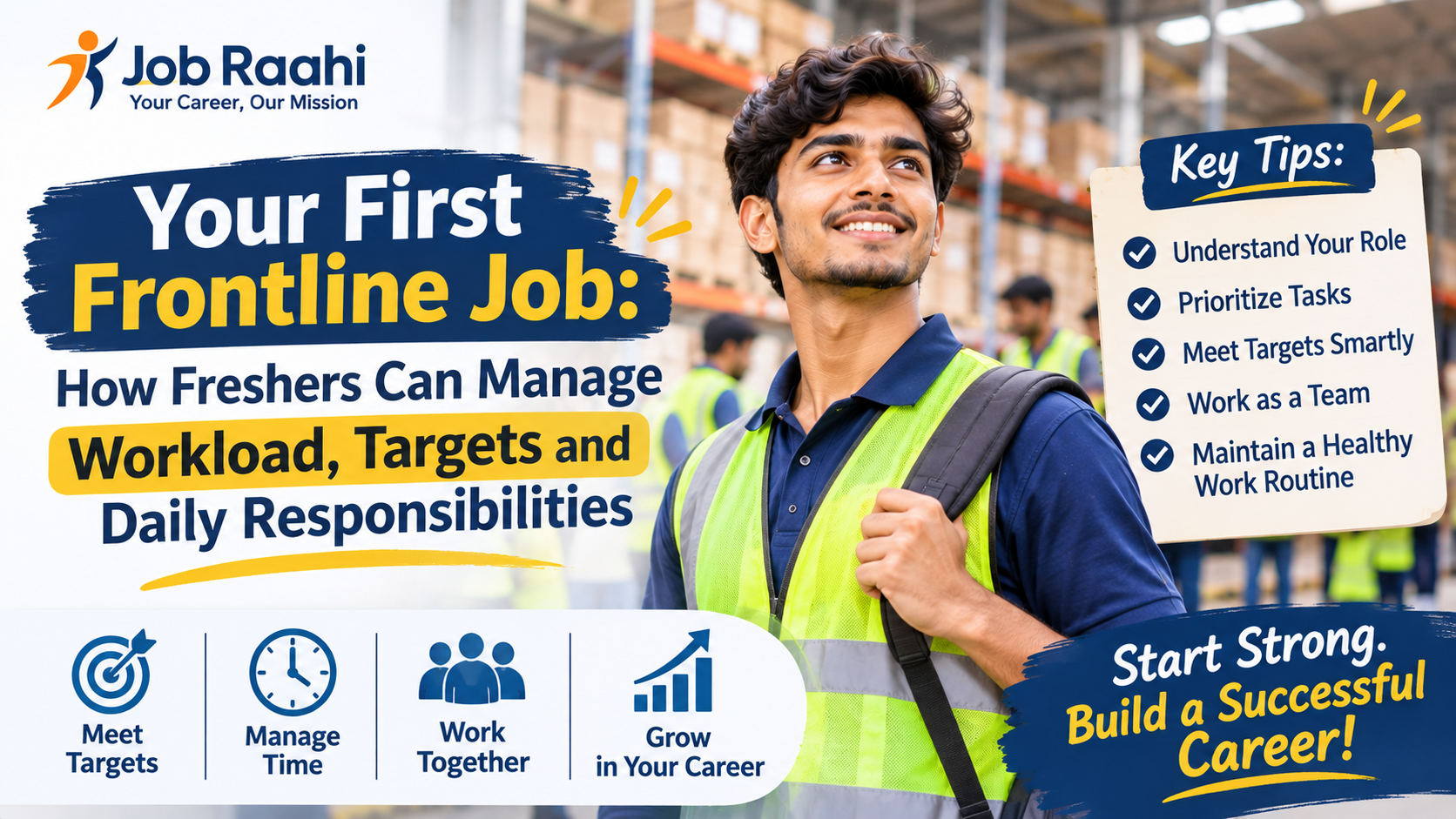
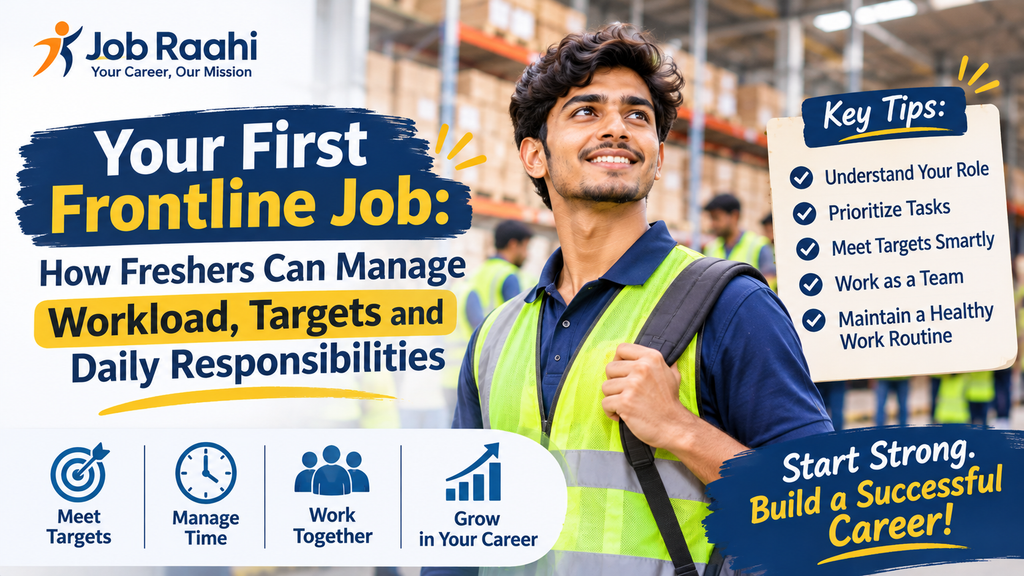
  • Your First Frontline Job: How Freshers Can Manage Workload, Targets and Daily Responsibilities

    Your First Frontline Job: How Freshers Can Manage Workload, Targets and Daily Responsibilities

    Getting your first job is an important milestone. After completing your education or vocational training, entering the professional world gives you an opportunity to earn, learn practical skills and become more independent.

    For many freshers, frontline jobs are an important starting point. Opportunities in retail, warehousing, logistics, manufacturing, delivery, hospitality and customer support allow candidates to gain real workplace experience.

    However, the transition from education to employment also brings new responsibilities.

    You may need to follow a shift schedule, complete assigned tasks within a specific time, coordinate with colleagues, meet daily targets and adapt to an entirely new working environment.

    At first, managing all these responsibilities can feel overwhelming.

    The good news is that workload management is a skill that develops with experience, practice and the right guidance. Understanding your responsibilities and building a few effective work habits can make your first job more manageable.

    Understanding Workload in Frontline Jobs

    Workload refers to the tasks, responsibilities and activities an employee is expected to complete during a particular working period.

    In frontline jobs, workload can vary depending on the industry, role, location and business demand.

    For example:

    • Warehouse Associate: Receiving, sorting, scanning, picking, packing and dispatching products.
    • Retail Associate: Assisting customers, arranging products, managing billing and maintaining store operations.
    • Production Associate: Supporting production activities, operating equipment as instructed and following quality procedures.
    • Delivery Executive: Managing assigned deliveries, following routes and coordinating with customers.
    • Customer Support Executive: Handling customer queries, maintaining records and resolving issues according to company guidelines.
    • Hospitality Associate: Supporting guest services, maintaining cleanliness and coordinating daily service activities.

    Some roles involve physical activities, while others require continuous customer interaction, attention to detail or meeting productivity targets.

    Understanding what your job involves is the first step towards managing your workload effectively.

    Why the First Frontline Job Can Feel Challenging

    For a fresher, the workplace can be very different from a classroom or training environment.

    During education, tasks are often organised around lessons, assignments and examinations. At work, responsibilities may follow operational schedules and business requirements.

    Some common reasons the first job can feel challenging include:

    A New Working Environment: Learning workplace rules, processes, equipment and reporting structures takes time.

    Unfamiliar Tasks: Even if you have studied a subject, performing the actual job may require practical experience.

    Time-Based Responsibilities: Some roles require employees to complete tasks within specific time limits.

    Shift Schedules: Adjusting to fixed shifts, rotating shifts or early reporting times may require changes to daily routines.

    Performance Expectations: Employees may be expected to maintain accuracy, productivity and quality while completing assigned responsibilities.

    These challenges are a normal part of entering the workforce. Freshers should focus on learning the process rather than expecting themselves to perform perfectly from the beginning.

    Common Workload Challenges Freshers May Face

    Different frontline roles have different demands, but some challenges are common across industries.

    Managing Multiple Tasks

    An employee may need to complete several activities during a shift. Without understanding which tasks are most important, it can become difficult to organise the work.

    Meeting Daily Targets

    Some jobs involve daily productivity targets, such as processing orders, completing production tasks or handling customer queries.

    Freshers may initially need time to understand how these targets are measured.

    Maintaining Accuracy

    Working quickly is important in many operational roles, but speed should not come at the cost of accuracy.

    For example, incorrect inventory entries, packaging mistakes or billing errors can affect business operations.

    Adjusting to Physical Work

    Certain frontline positions involve standing for extended periods, walking, lifting approved loads or performing repetitive tasks. Employees need proper training and must follow workplace safety procedures.

    Understanding Instructions

    New employees may receive instructions from supervisors or different team members. Understanding priorities and asking questions when something is unclear can prevent mistakes.

    Practical Ways to Manage Daily Responsibilities

    Good workload management does not require complicated techniques. A few consistent habits can help freshers become more organised.

    A. Understand Your Daily Tasks

    At the beginning of your shift, understand what responsibilities have been assigned to you.

    If the instructions are unclear, ask your supervisor for clarification.

    Knowing what is expected helps you organise your time and avoid unnecessary confusion.

    B. Prioritise Important Activities

    Not every task has the same level of urgency.

    Understand which responsibilities need immediate attention and which can be completed later.

    For example, a warehouse employee may need to prioritise an assigned dispatch activity according to the supervisor’s instructions rather than independently choosing tasks.

    C. Focus on One Task at a Time

    Trying to handle too many activities simultaneously can increase the chances of mistakes.

    Complete tasks in the required sequence, follow standard operating procedures and maintain accuracy.

    D. Learn the Correct Process

    Do not focus only on completing tasks quickly. First understand the correct way to perform them.

    Once you become familiar with the process, your speed and confidence can improve naturally.

    E. Track Your Progress

    Pay attention to the tasks you have completed and those that are still pending.

    Where appropriate, use a checklist or follow the tracking system provided by your organisation.

    This can help you stay organised throughout the shift.
    Frontline jobs for freshers

    How to Handle Targets and Work Pressure

    Targets are common in several frontline roles. They help organisations monitor productivity and plan daily operations.

    However, freshers may find it difficult to meet targets while they are still learning.

    Here are some ways to approach them:

    Understand How Targets Work: Ask your supervisor how performance is measured and what is expected from your role.

    Focus on Consistency: Rather than rushing to complete everything, develop a steady and accurate working pace.

    Learn from Feedback: If your performance needs improvement, understand which part of the process requires attention.

    Communicate Difficulties Early: If you are facing an operational challenge or cannot complete an assigned task, inform your supervisor instead of waiting until the end of the shift.

    Avoid Unnecessary Comparisons: Experienced employees may work faster because they are familiar with the process. Give yourself time to learn and improve.

    It is also important to remember that targets should be realistic, communicated clearly and supported by appropriate training, equipment and working conditions.

    The Importance of Teamwork and Asking for Help

    Frontline operations rarely depend on one employee working independently. Most activities require coordination between different people and teams.

    In a warehouse, employees may work together across receiving, inventory, picking, packing and dispatch. In retail, store associates coordinate with billing teams and supervisors. In hospitality, service staff work together to maintain daily operations.

    Freshers should understand that asking for help is not a sign of weakness.

    If you are unsure about a task, seek guidance from an experienced colleague or supervisor.

    Good teamwork involves:

    • Listening carefully to instructions.
    • Sharing relevant information with colleagues.
    • Respecting assigned responsibilities.
    • Informing the team about delays or difficulties.
    • Supporting others when your own responsibilities allow it.
    • Following established reporting procedures.

    Learning to work as part of a team can make daily responsibilities easier to manage and improve your professional confidence.

    Maintaining a Healthy Work Routine

    Managing workload also involves preparing yourself for the demands of your job outside working hours.

    A consistent routine can help employees adjust to their responsibilities.

    Consider the following habits:

    Get Adequate Rest: Maintain a suitable sleep routine, particularly if your role involves early morning, late-night or rotating shifts.

    Plan Your Commute: Allow enough time to reach the workplace without unnecessary last-minute stress.

    Follow Break Schedules: Use designated breaks appropriately and follow workplace policies.

    Stay Hydrated: Drink water regularly, especially in roles involving physical activity or warm working environments.

    Follow Safety Instructions: Use required protective equipment and follow the training provided for handling tools, machinery or materials.

    Make Time for Personal Life: Maintain a routine that gives you time to rest, spend time with family and pursue personal interests.

    A sustainable work routine can help freshers adjust to their responsibilities over time.

    What Employers Can Do to Support Freshers

    Workload management is not only an employee responsibility. Employers also play an important role in helping new employees adjust to their jobs.

    Companies can support freshers through:

    • Clear explanations of job responsibilities.
    • Structured onboarding and role-specific training.
    • Realistic productivity expectations during the learning period.
    • Accessible supervisors and reporting channels.
    • Proper equipment and workplace safety instructions.
    • Clear shift schedules and break policies.
    • Regular feedback and performance guidance.

    When employees understand their responsibilities and receive the right support, they have a better opportunity to develop confidence and perform their work effectively.

    For frontline businesses, investing in employee readiness can also help create a more organised and productive workforce.

    How Job Raahi Helps Freshers Discover Frontline Opportunities

    Finding a suitable first job is an important part of beginning a professional journey.

    Freshers need opportunities that match their educational background, practical skills and experience level. They also need clear information about job responsibilities and eligibility before applying.

    Job Raahi is a digital job platform focused on connecting companies with candidates exploring frontline, entry-level and mass hiring opportunities.

    It provides candidates with an additional channel to discover openings across sectors such as logistics, warehousing, retail, delivery, sales, hospitality and customer support.

    For freshers and candidates with limited experience, this can help make relevant employment opportunities more accessible.

    Job Raahi also works with skill centres across India, where candidates can be trained and developed in line with industry requirements.

    The objective is to connect candidates with suitable employment opportunities while helping employers reach a wider pool of potential frontline talent.

    For someone beginning their career, discovering the right opportunity is the first step. Learning to manage responsibilities and developing workplace skills comes next.

    Conclusion: Your First Job Is Also Your First Learning Experience

    Starting a frontline job brings new responsibilities, expectations and challenges. Managing daily tasks, understanding targets, adjusting to shifts and working with a team may take time, particularly for someone entering the workforce for the first time.

    The key is to remain organised, understand your responsibilities, follow instructions and stay open to learning.

    Do not measure your progress only by how quickly you complete a task. Focus on improving accuracy, building confidence and developing good professional habits.

    Employers also have a responsibility to provide clear instructions, proper training and a supportive working environment.

    Platforms like Job Raahi can help freshers discover relevant frontline opportunities and take their first step towards employment.

    Your first job is not just about completing daily tasks. It is about learning how the workplace operates, developing responsibility and building the foundation for your future career.


  • The Rise of Jobs You Didn’t Know Existed: Exploring New-Age Frontline Careers

    The Rise of Jobs You Didn’t Know Existed: Exploring New-Age Frontline Careers

    Table of Contents

    1. Why Are New-Age Frontline Careers Emerging?
    2. 10 New-Age Frontline Jobs You Should Know About
    3. Skills That Can Help You Enter These Careers
    4. How Freshers Can Prepare for Emerging Job Opportunities
    5. Where to Discover Your Next Career Opportunity

    When people think about frontline jobs, they often imagine retail sales, delivery executives, warehouse workers or customer support staff. These are important career options, but the employment landscape is expanding far beyond these familiar roles.

    Think about who installs solar panels, maintains electric vehicle charging stations, operates drones, supports smart manufacturing or helps organise digital information for businesses. These are real job functions, and many are creating new opportunities for people with practical skills and a willingness to learn.

    India’s changing industries are opening doors to careers that were not widely discussed a few years ago. The interesting part? Not every emerging opportunity requires an advanced degree or years of experience. Some roles can be explored through vocational training, technical courses, ITI qualifications and entry-level learning pathways.

    Let’s explore some new-age frontline careers that deserve more attention.

    1. Why Are New-Age Frontline Careers Emerging?

    Industries are changing the way they operate. Electric vehicles are creating demand for specialised maintenance. Renewable energy projects need trained installation professionals. E-commerce and digital businesses require people who can manage technology-supported operations.

    At the same time, businesses are adopting automation, connected devices and digital tools. This does not mean every job is becoming a software job. It means many hands-on roles now involve a combination of practical knowledge and basic technology skills.

    The Government of India’s skill development initiatives also reflect this shift, with training pathways covering areas such as electric vehicles, drones, renewable energy, industrial robotics, semiconductors and data-related work.

    For job seekers, this creates an important opportunity: learning about emerging roles before they become familiar career choices.

    2. 10 New-Age Frontline Jobs You Should Know About

    Here are ten career options worth exploring.

    1. Electric Vehicle Service Technician

    As electric vehicles become more common, trained professionals are needed to inspect, service and maintain them.

    What you may do:

    • Assist with EV servicing and routine maintenance.
    • Identify basic electrical or mechanical faults.
    • Support battery and component inspections.
    • Follow workshop safety procedures.

    Who can explore it: ITI students, automobile trainees and candidates with electrical or mechanical knowledge.

    2. Solar Panel Installation Technician

    Solar energy projects require people who can install, inspect and maintain solar systems at homes, commercial buildings and project sites.

    What you may do:

    • Assist in installing solar panels.
    • Check electrical connections and equipment.
    • Support system testing and maintenance.
    • Follow site safety practices.

    Who can explore it: Candidates with electrical training, ITI qualifications or relevant technical skills.

    3. Drone Pilot or Drone Technician

    Drones are being used in agriculture, surveying, mapping, inspections and other specialised operations.

    These applications create opportunities for trained operators and technicians.

    What you may do:

    • Operate drones for approved activities.
    • Conduct basic pre-flight checks.
    • Assist with equipment maintenance.
    • Support data collection and field operations.

    Who can explore it: Candidates interested in technology, electronics, aviation-related activities and fieldwork. Pilot roles require appropriate training and regulatory compliance.

    4. Data Annotation Assistant

    Artificial intelligence systems need organised and labelled data to learn and perform tasks. Data annotation assistants help prepare this information.

    What you may do:

    • Label images, text or other datasets.
    • Categorise information according to instructions.
    • Review entries for accuracy.
    • Follow quality and confidentiality guidelines.

    Who can explore it: Freshers with basic computer knowledge, attention to detail and the ability to follow instructions.

    5. Fibre-to-the-Home (FTTH) Technician

    Internet connectivity depends on professionals who install and maintain fibre-optic connections.

    What you may do:

    • Assist with fibre cable installation.
    • Support customer connection setup.
    • Identify basic connectivity issues.
    • Coordinate field visits and repairs.

    Who can explore it: ITI electronics, telecom and electrical candidates, along with people interested in technical fieldwork.

    6. Industrial Robotics and Automation Technician

    Factories increasingly use automated machines and robotic systems to support production. These systems also require people who can monitor operations and assist with maintenance.

    What you may do:

    • Monitor automated equipment.
    • Assist with routine machine checks.
    • Report operational issues.
    • Support maintenance and production teams.

    Who can explore it: Candidates with mechanical, electrical, electronics or mechatronics knowledge.

    7. Semiconductor Production Technician

    Semiconductor manufacturing involves specialised processes, equipment and quality checks. Production technicians support operations in controlled manufacturing environments.

    What you may do:

    • Assist with production activities.
    • Follow process and safety instructions.
    • Support equipment monitoring.
    • Maintain production and quality records.

    Who can explore it: Candidates with technical education and an interest in electronics and manufacturing. Specialised training may be required.

    8. Smart Agriculture Field Technician

    Technology is changing agricultural operations through sensors, connected devices and automated irrigation systems.

    Field technicians help install, monitor and maintain these solutions.

    What you may do:

    • Assist with sensor installation.
    • Support irrigation monitoring systems.
    • Collect field information.
    • Help farmers understand basic equipment operations.

    Who can explore it: Candidates interested in agriculture, electronics, fieldwork and practical technology.

    9. E-commerce Operations Associate

    Online shopping requires much more than a website and a delivery partner. Behind every order are people managing inventory, returns, packaging, quality checks and dispatch operations.

    What you may do:

    • Monitor incoming and outgoing orders.
    • Manage inventory records.
    • Coordinate packing and dispatch.
    • Support returns and quality checks.

    Who can explore it: Freshers, 10th/12th-pass candidates and people with basic computer and operational skills, depending on employer requirements.

    10. Smart Facility Operations Technician

    Modern offices, hospitals, malls and commercial buildings use connected systems for security, access control, lighting, energy management and maintenance.

    Technicians help keep these systems running smoothly.

    What you may do:

    • Monitor building equipment.
    • Assist with basic system maintenance.
    • Report faults and coordinate repairs.
    • Support daily facility operations.

    Who can explore it: Candidates with electrical, electronics, HVAC or maintenance-related knowledge.

    Frontline new age jobs

    3. Skills That Can Help You Enter These Careers

    You do not need to master every new technology before applying for a job. Start by understanding the requirements of the role you want to pursue.

    Some useful skills include:

    Basic digital literacy: Be comfortable using smartphones, computers, applications and digital records.

    Technical understanding: Learn the basic tools, equipment and processes used in your chosen industry.

    Problem-solving: Develop the ability to identify an issue, understand instructions and seek the right solution.

    Communication: Learn to coordinate with supervisors, colleagues and customers.

    Safety awareness: Technical and field-based jobs often require strict attention to workplace safety.

    Willingness to learn: New-age industries change quickly. Being open to training and learning new tools can help you grow.

    4. How Freshers Can Prepare for Emerging Job Opportunities

    If you are a fresher, you may wonder how to enter an industry when you have little or no experience. A practical approach can make the journey easier.

    1. Choose an area of interest: Start with EVs, renewable energy, electronics, logistics, digital operations or another field that matches your interests.
    2. Understand eligibility: Check the educational qualifications, technical knowledge and physical or field requirements of the role.
    3. Explore relevant training: Look for recognised courses, ITI trades, practical workshops and apprenticeship opportunities.
    4. Build hands-on experience: Practical assignments, supervised training and apprenticeships can help you understand workplace expectations.
    5. Prepare a relevant resume: Mention your qualification, projects, practical training, tools you know and willingness to learn.
    6. Apply consistently: Explore suitable entry-level openings and follow up on applications.

    Remember, not every new-age job is suitable for every candidate. Some positions require specialised certification, technical training or experience. Always check the employer’s actual eligibility requirements before applying.

    5. Where to Discover Your Next Career Opportunity

    Emerging careers can be difficult to discover because their job titles may be unfamiliar. A good starting point is to explore government skill-development resources, vocational training programmes and employment platforms.

    You can explore the Skill India Digital Hub for training and certification options, Bharat Skills for ITI learning resources, and the National Career Service for employment and career-related information.

    Job seekers can also explore Job Raahi to discover relevant entry-level and frontline opportunities across industries. Whether you are beginning your career or looking for a role that matches your practical skills, staying aware of new openings can help you take the next step.

    Final Thoughts: Your Next Career May Be in an Industry You Haven’t Explored Yet

    The future of frontline employment is not limited to traditional job titles. From maintaining electric vehicles and installing solar systems to supporting automated factories and digital operations, new opportunities are taking shape across India’s industries.

    You do not have to know everything today. Start by identifying what interests you, understanding the skills required and taking one practical step towards learning.

    Your first career opportunity might not be in the industry you originally imagined. Sometimes, the best opportunity is the one you haven’t discovered yet.

    Explore opportunities, build your skills and take your next career step with Job Raahi.

  • How to Choose the Right Vocational Course: 7 Things Every Student Should Check Before Enrolling

    How to Choose the Right Vocational Course: 7 Things Every Student Should Check Before Enrolling

    Choosing what to study after Class 10 or 12 can be confusing. Some students prefer traditional degrees, while others want to learn practical skills and enter the workforce sooner.

    Vocational education offers an alternative by helping students develop skills related to specific occupations and industries. From electrical work and automobile servicing to retail operations, healthcare support, logistics and computer applications, there are several career paths to explore.

    However, there is one important question students often overlook:

    Will the course I am choosing actually help me build a career?

    A course may have an attractive name, affordable fees or a certificate at the end. But these things alone do not guarantee that you will acquire useful skills or find relevant employment.

    Before enrolling, it is important to understand what the course teaches, how it is delivered and whether employers value the skills it develops.

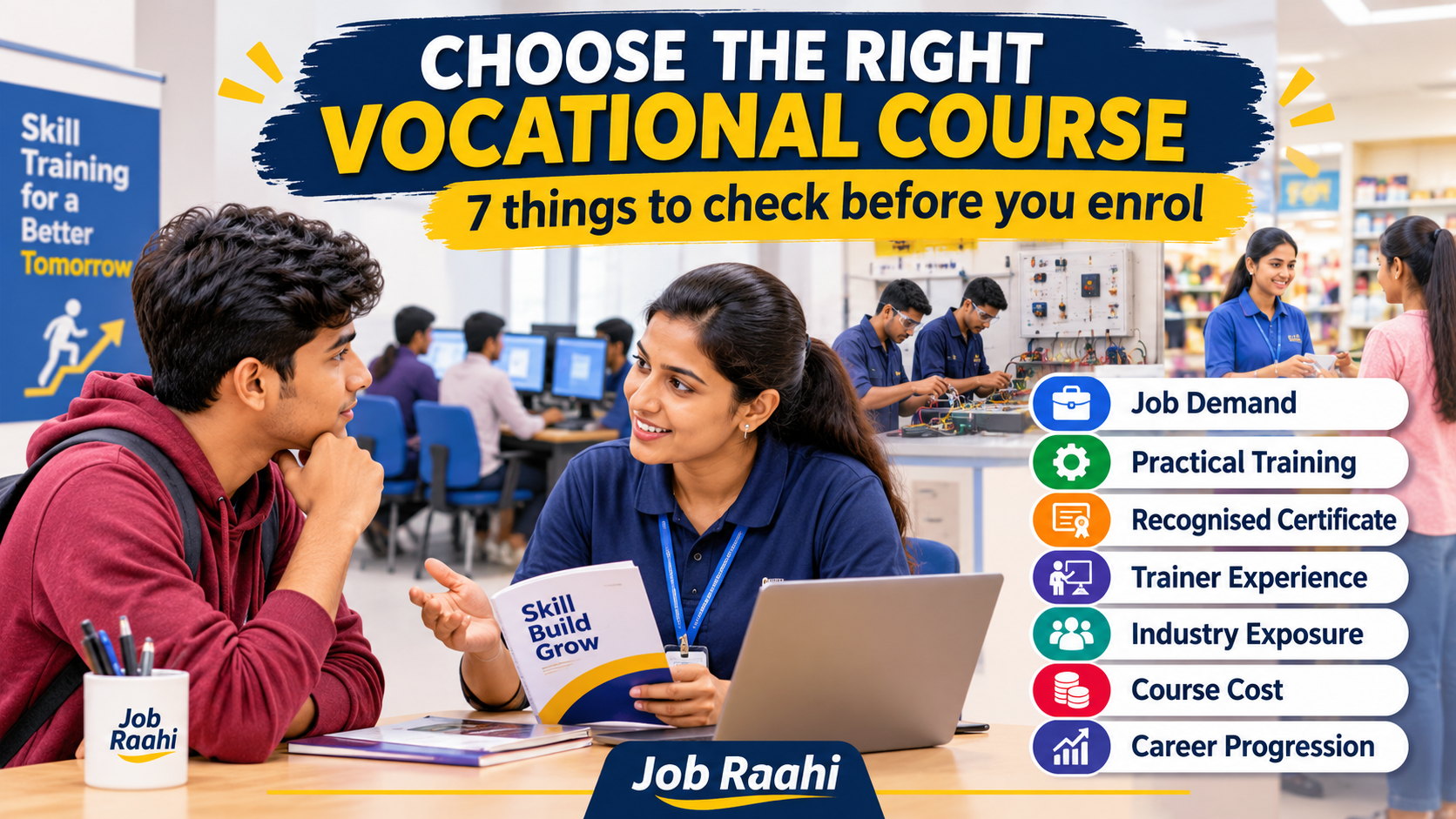
    Here are seven things every student should check before choosing a vocational course.

    Why Choosing the Right Vocational Course Matters

    Vocational education is designed to connect learning with occupational skills.

    Unlike courses that focus primarily on academic subjects, vocational programmes generally combine job-related knowledge with practical learning.

    For example:

    • An Electrician course introduces electrical systems, installation and maintenance.
    • A Fitter course develops knowledge of tools, machinery and mechanical components.
    • A Retail course introduces customer handling, store operations and sales processes.
    • A Computer Applications course develops digital and office-related skills.
    • A Logistics course introduces inventory, warehousing and supply-chain operations.

    But choosing a course simply because it sounds interesting may not be enough.

    You should consider your interests, learning abilities, available training facilities and the employment opportunities associated with that qualification.

    The right course should help you develop skills that have a practical purpose.

    Seven Things to Check Before Enrolling in a Vocational Course

    1. Is There Actual Industry Demand for the Skill?

    Before choosing a course, research whether companies are hiring people for related job roles.

    A course should connect to an identifiable occupation or career path.

    For example, if you are considering an electrical trade, explore opportunities in:

    • Electrical maintenance
    • Manufacturing facilities
    • Infrastructure projects
    • Building maintenance
    • Industrial operations

    Similarly, students interested in logistics can research roles such as warehouse associate, inventory assistant, storekeeper and operations assistant.

    How to check:

    1. Search for jobs related to the course.
    2. Read the qualifications employers mention.
    3. Check whether freshers are eligible.
    4. Understand the basic skills required.
    5. Compare opportunities across different industries.

    Do not depend entirely on the institute’s placement advertisements. Research actual job descriptions and employer requirements independently.

    2. Does the Course Include Practical Training?

    This is one of the most important factors.

    Understanding a subject and performing a task are two different things.

    For instance, reading about electrical wiring is not the same as learning how to work with electrical components under proper supervision.

    Similarly, studying inventory management is different from using inventory software or handling stock in an actual warehouse.

    Before joining, ask the institute:

    • How many hours are dedicated to practical sessions?
    • Are workshops and laboratories available?
    • Will students work with relevant equipment?
    • Are practical assessments conducted?
    • Is there any on-the-job training?

    The Directorate General of Training’s apprenticeship framework highlights the importance of supplementing institutional education with practical workplace training. Digital Government of India+1

    Look for programmes that provide a meaningful balance between theoretical understanding and hands-on learning.

    3. Is the Certification Recognised?

    A certificate can be useful, but its value depends on the qualification, awarding body and recognition applicable to the course.

    Before enrolling, find out:

    • Which organisation awards the certificate?
    • Is the course affiliated with or approved by the relevant authority?
    • Is the qualification aligned with an applicable National Skills Qualifications Framework (NSQF) level?
    • Is the assessment conducted by an authorised body?
    • Can the qualification support further education or employment?

    For ITI-related programmes, check the relevant affiliation and course information through official government resources.

    You can also explore the National Qualifications Register and official Skill India platforms to understand available qualifications.

    Important: Do not assume that every private training certificate is equivalent to a government-recognised qualification.

    Verify the exact course and awarding authority before paying the admission fee.

    4. Who Will Train You?

    The quality of teaching can make a significant difference to your learning experience.

    A well-designed course may still disappoint students if trainers cannot explain concepts clearly or provide adequate practical guidance.

    Ask about the instructors’:

    • Relevant industry experience
    • Technical qualifications
    • Teaching experience
    • Practical knowledge
    • Experience with the tools and equipment used in the industry

    You can also request a demonstration class or speak with current students.

    A good trainer should not only explain how something works but also demonstrate how to perform the task correctly.

    5. Does the Institute Offer Industry Exposure?

    Learning inside a classroom or workshop is valuable, but exposure to actual workplaces can help students understand how industries operate.

    Look for institutes that offer:

    • Industrial visits
    • Employer interactions
    • Apprenticeship opportunities
    • On-the-job training
    • Industry-based projects
    • Guest sessions by professionals

    The Directorate General of Training’s Dual System of Training combines ITI-based theoretical instruction with practical industry training. It is an example of how educational institutions and employers can work together to strengthen vocational learning. Digital Government of India

    Ask the institute whether these opportunities are formally arranged or simply mentioned as possibilities in its promotional material.

    6. Are the Course Fees Worth the Learning?

    An expensive course is not necessarily better than an affordable one.

    Instead of comparing institutes only by admission fees, evaluate what you receive in return.

    Consider:

    • Tuition fees
    • Examination and certification charges
    • Equipment or material costs
    • Travel expenses
    • Hostel or accommodation expenses
    • Training duration
    • Practical facilities
    • Placement or apprenticeship support

    Ask for a complete fee breakdown before enrolling.

    Also, be cautious of institutes promising guaranteed jobs or unusually high salaries without providing verifiable details.

    A good educational decision should consider both the financial investment and the quality of training.

    7. What Career Opportunities Come After the Course?

    Do not stop your research at the question, “What will I learn?”

    Also ask, “What can I do after completing this course?”

    A useful vocational course should have a reasonably clear progression pathway.

    For example:

    Course areaPossible entry-level opportunities
    ElectricalElectrician trainee, maintenance assistant
    MechanicalFitter trainee, machine operator trainee
    AutomobileService technician trainee, workshop assistant
    RetailRetail associate, cashier, store assistant
    LogisticsWarehouse associate, inventory assistant
    Computer applicationsData-entry operator, office assistant
    HospitalityFront-office assistant, food-service associate

    These are illustrative career pathways, not guaranteed placements. Actual eligibility depends on the employer, course qualification and individual skills.

    Also explore whether the qualification can help you progress towards advanced training, specialised roles or supervisory responsibilities.

    Your first course does not have to define your entire career. It should give you a useful starting point.

    Questions to Ask Before Joining a Vocational Course

    Before paying your admission fee, have a conversation with the institute.

    Here are some useful questions:

    1. Is the course affiliated with or recognised by an appropriate authority?
    2. What specific skills will I learn?
    3. How much practical training is included?
    4. What equipment and facilities are available?
    5. Who are the trainers?
    6. Are there apprenticeship or industry exposure opportunities?
    7. What jobs have previous students pursued?
    8. What is the complete fee structure?
    9. Is there any career guidance or placement assistance?
    10. Can I speak with former students?

    If an institute is unable to answer basic questions about its course, trainers, certification or facilities, take time to investigate before making a decision.

    Right Vocational Course

    Where Can You Research Vocational Courses in India?

    Students do not have to depend only on advertisements or recommendations from friends.

    There are official platforms that can help them explore training and career options.

    1. Skill India Digital Hub

    Explore courses, skill centres, job roles and learning opportunities through the Skill India Digital Hub.

    2. Directorate General of Training (DGT)

    Visit DGT Apprenticeship Training to understand apprenticeship programmes and practical workplace training.

    3. National Skill Development Corporation (NSDC)

    Explore NSDC Learning Resources for model curricula, participant handbooks and training resources.

    4. Apprenticeship India

    Visit Apprenticeship India to explore apprenticeship registration and opportunities.

    These platforms can help students make more informed decisions about vocational education and skill development.

    Final Thoughts: Choose Skills, Not Just Certificates

    Choosing a vocational course is an important career decision.

    Do not select a programme simply because someone recommends it, an advertisement promises quick employment or the certificate looks attractive.

    Take time to understand the course structure, training facilities, recognition, industry exposure and career possibilities.

    Remember:

    • A recognised qualification gives your learning credibility.
    • Practical training helps you develop occupational skills.
    • Industry exposure helps you understand real workplace expectations.
    • Career research helps you make informed decisions.

    Your education should prepare you for opportunities, not just give you another certificate to add to your file.

    How Job Raahi Can Help You Take the Next Step

    Once you have developed relevant skills, the next step is finding opportunities where you can apply them.

    Job Raahi helps freshers and frontline job seekers explore employment opportunities across industries, including retail, logistics, warehousing, hospitality, delivery, sales and customer support.

    Whether you have completed an ITI course, a Diploma, a vocational programme or Class 12, exploring relevant job openings can help you understand what employers are looking for. Learn a skill. Understand your opportunities. Take the first step towards your career.

  • Vocational Training to First Job: A Fresher’s Guide to Starting a Career

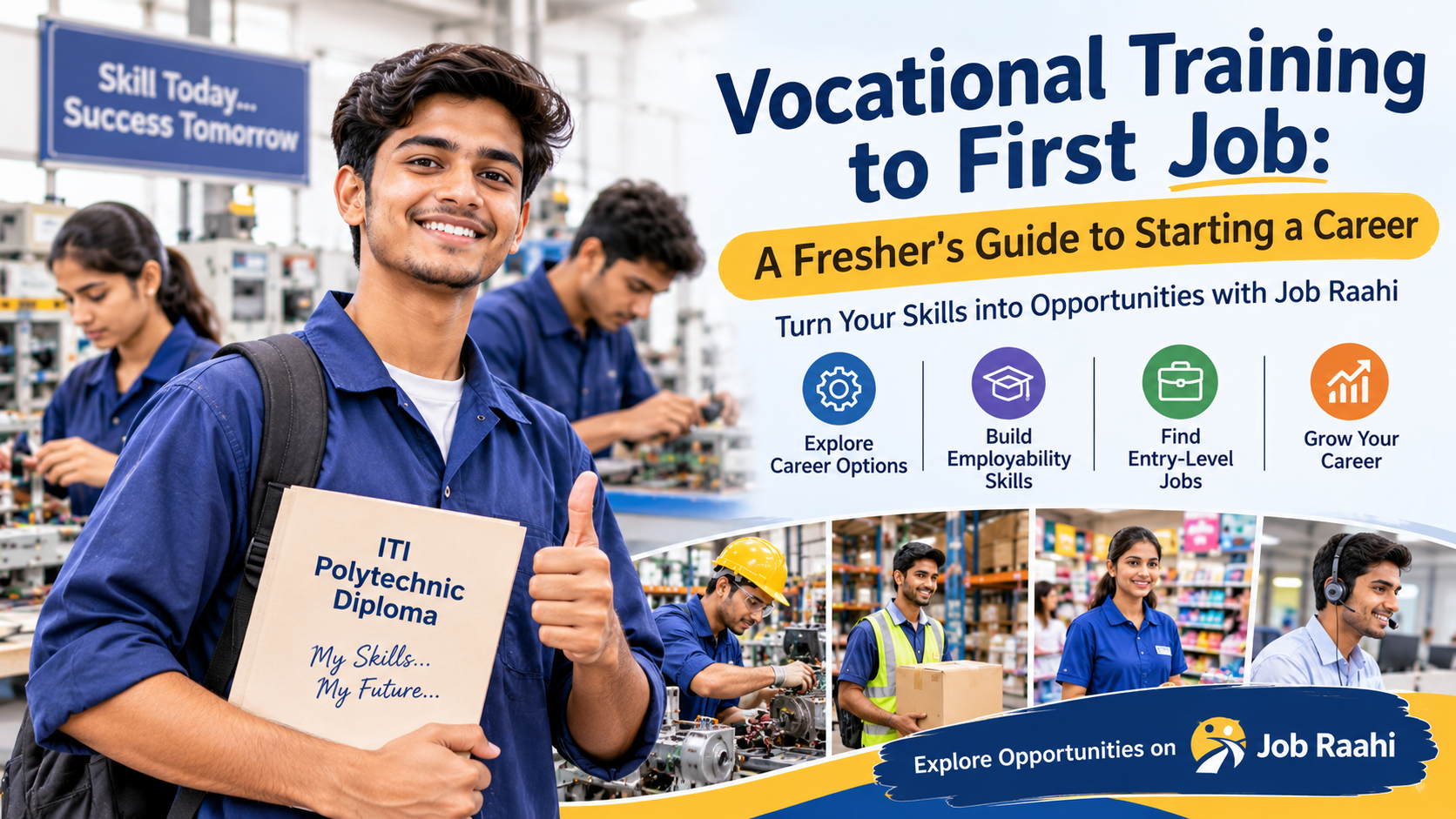
    Vocational Training to First Job: A Fresher’s Guide to Starting a Career

    Completing a vocational course is an important milestone. Whether you have completed ITI, Polytechnic, Diploma or another skill-based programme, you have already taken a step towards preparing yourself for the professional world.

    You may have spent months learning technical concepts, practising with tools, working on projects and understanding how things operate in real situations. But once your training is complete, another question begins to take priority:

    How do I turn what I have learned into my first job?

    For many freshers, the transition from a classroom or training institute to an actual workplace can be confusing. You may have the qualification but limited work experience. You may understand your trade but feel unsure about interviews, job applications or the expectations of employers.

    The good news is that your career does not need to begin with years of experience. It can begin with the skills you already have, your willingness to learn and the right opportunity.

    Let’s explore how you can make that transition.

    What Does Vocational Training Really Prepare You For?

    Vocational training focuses on developing practical knowledge and skills that can be applied in specific occupations or industries.

    Unlike learning that is primarily theoretical, skill-based education often includes practical sessions, workshop activities, equipment handling and task-based learning.

    For example:

    • An ITI Electrician student learns about electrical systems, wiring and safety practices.
    • An ITI Fitter student develops an understanding of fitting, tools and mechanical components.
    • A Diploma in Mechanical Engineering introduces students to manufacturing, production and maintenance concepts.
    • A Diploma in Civil Engineering provides a foundation in construction, surveying and site-related activities.
    • A Diploma in Electronics helps students understand electronic components, circuits and testing.
    • A vocational course in computer applications can introduce learners to digital tools and basic technical support.

    These skills can provide a starting point for exploring relevant employment opportunities.

    However, completing a course is only one part of the journey. The next step is learning how to apply your knowledge in a professional environment.

    Why Practical Skills Matter in Today’s Job Market

    Employers do not only look at what candidates have studied. They also want to understand whether candidates can apply their knowledge to actual work.

    Imagine two freshers applying for an entry-level technical position. Both have completed the same qualification. However, one can explain the practical projects completed during training, understands basic safety procedures and can confidently describe the tools used.

    That candidate may be better prepared to demonstrate their abilities during the selection process.

    Practical skills help you:

    • Understand workplace tasks more easily.
    • Follow instructions and standard operating procedures.
    • Work with tools, machines and equipment relevant to your trade.
    • Identify basic problems and seek appropriate solutions.
    • Adapt to workplace expectations.

    This does not mean you must know everything before joining your first job. Employers hiring freshers may provide role-specific training. What matters is having a foundation and being ready to build on it.

    From Training Institute to Workplace: Understanding the Gap

    One of the biggest challenges for freshers is adapting to the difference between classroom learning and workplace responsibilities.

    During your course, you may have worked on assignments with the guidance of instructors. At work, you may need to complete tasks within a schedule, coordinate with colleagues and follow company procedures.

    Here are a few ways to prepare:

    Understand workplace discipline: Learn the importance of punctuality, attendance, responsibility and following instructions.

    Improve communication: Practise explaining your work, asking questions and sharing updates with supervisors.

    Learn safety practices: Understand the safety requirements associated with your trade or workplace.

    Develop teamwork: Most jobs involve working with other people. Learn to coordinate, cooperate and respect different responsibilities.

    Stay open to feedback: Your first job will introduce new processes and challenges. Treat feedback as an opportunity to improve.

    The transition may take time, but every new experience can help you become more confident and capable.

    Career Opportunities Freshers Can Explore

    Vocational training can open doors to opportunities across different industries. The roles available will depend on your qualification, specialisation, skills, location and employer requirements.

    Here are some career areas worth exploring:

    Technical and maintenance roles

    Students from relevant ITI and Diploma trades can explore opportunities such as technician assistants, electricians, fitters, maintenance assistants and equipment operators.

    Manufacturing and production

    Manufacturing companies require people to support production activities, operate equipment, follow processes and maintain quality standards. Entry-level opportunities may include production assistants, machine operators and quality-checking assistants.

    Logistics and warehouse operations

    Warehouses and logistics businesses offer roles such as warehouse associates, inventory assistants, dispatch assistants and operations associates. These opportunities can help freshers understand inventory management, order processing and supply-chain operations.

    Retail and field operations

    Retail associates, field executives, sales assistants and customer-facing roles can provide exposure to customer interactions, product knowledge and daily business operations.

    Customer support and technical assistance

    Candidates with suitable communication and basic computer skills can explore customer support, service assistance, helpdesk and other entry-level operational roles.

    Remember, your first job does not have to define your entire career. It should give you a reasonable opportunity to learn, gain experience and move towards your future goals.

    Vocational Training to first job

    How Apprenticeships Can Help You Gain Industry Experience

    If you have completed your course but are struggling to gain practical industry exposure, consider exploring apprenticeship opportunities.

    An apprenticeship provides structured learning in a workplace, allowing eligible candidates to gain hands-on experience under an employer’s training arrangement.

    For eligible Diploma holders, the National Apprenticeship Training Scheme (NATS) is one route to explore. ITI pass-outs and other eligible candidates can also explore opportunities under the National Apprenticeship Promotion Scheme (NAPS).

    An apprenticeship can help you:

    • Understand actual workplace processes.
    • Apply your classroom knowledge to practical tasks.
    • Learn from experienced professionals.
    • Develop professional discipline and confidence.
    • Build experience that may support future job applications.

    Remember to check the eligibility, trade, duration, stipend and conditions of each opportunity. Apprenticeship training does not automatically guarantee permanent employment.

    Five Skills That Can Make You More Employable

    Your technical qualification gives you a foundation, but developing additional skills can make your transition into employment smoother.

    Here are five areas worth working on:

    1. Technical understanding: Revise the important concepts and practical tasks related to your trade. Be prepared to explain what you know.

    2. Basic digital literacy: Learn to use email, online forms, spreadsheets and other basic digital tools.

    3. Communication: Practise speaking clearly, listening carefully and asking relevant questions. You do not need perfect English for every role; communication requirements depend on the job.

    4. Problem-solving: Develop the habit of understanding a problem, identifying possible causes and seeking guidance when necessary.

    5. Adaptability: Be willing to learn new tools, processes and responsibilities as you enter the workplace.

    You can improve these skills through regular practice, short courses, practical projects and workplace exposure.

    How to Prepare for Your First Job

    You do not need an impressive employment history to apply for your first job. You need a clear profile that tells employers about your education, practical knowledge and interest in the role.

    Follow these steps:

    • Create a simple resume: Mention your qualification, specialisation, institute, year of completion and relevant skills.
    • Include practical projects: Add workshop activities, final-year projects, lab work or hands-on assignments.
    • Keep documents ready: Organise your resume, certificates and other documents requested by the employer.
    • Practise interview questions: Prepare to explain what you studied, what you learned and why you are interested in the position.
    • Read job descriptions carefully: Check the responsibilities, eligibility, location, salary details and working conditions.
    • Apply consistently: Explore relevant openings instead of waiting for one perfect opportunity.

    Most importantly, be honest about your experience. As a fresher, you are not expected to know everything. Show employers that you have a foundation and are willing to learn.

    How Job Raahi Helps Freshers Discover Opportunities

    Getting the right information at the right time can make the job search easier.

    Freshers often miss opportunities because they are unsure where to search, which roles to apply for or how to connect with employers.

    This is where Job Raahi can help.

    Job Raahi is a digital job platform that connects candidates with employment opportunities across different sectors. Candidates can explore openings in areas such as retail, logistics, warehouse operations, sales, delivery, customer support and other frontline roles.

    Whether you have recently completed your vocational course or are looking for an entry-level opportunity, you can create your profile, explore relevant vacancies and apply for suitable openings.

    The goal is simple: help candidates discover opportunities and take practical steps towards employment.

    Your training has given you a starting point. Now take the next step towards your career with Job Raahi.

    Final Thoughts

    Vocational training is not just about earning a certificate. It is about developing abilities that can be used in the workplace.

    Your first job may come with new challenges, unfamiliar responsibilities and plenty of learning opportunities. Do not let limited experience stop you from exploring suitable roles.

    Revise your skills, prepare your resume, stay open to learning and apply for opportunities that match your qualifications.

    You do not have to build your entire career in one day. You just have to take the first step.

    Learn a skill. Find an opportunity. Build your future with confidence.

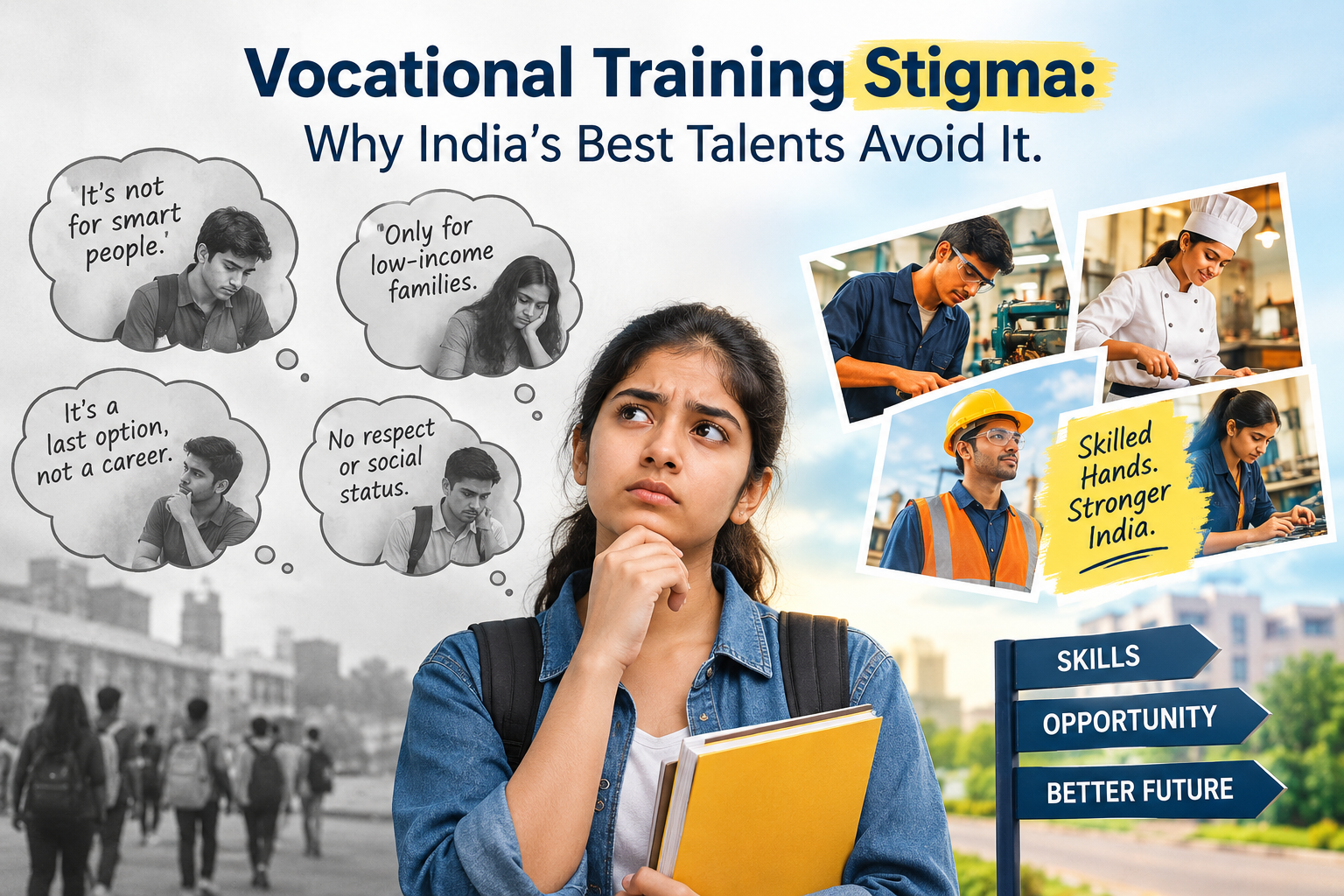
  • Vocational Training Stigma: Why India’s Best Talents Avoid It.

    Vocational Training Stigma: Why India’s Best Talents Avoid It.

    Imagine two students finishing school.
    One enrols in a traditional degree programme because it is considered the safest route to a respectable career. The other chooses vocational training to learn a practical skill, work with equipment and prepare for a specific occupation.

    Both are capable. Both want a successful future. Yet the second student may have to answer an uncomfortable question from relatives, neighbours or even friends: “You could have studied further. Why did you choose this?”

    This simple question reflects a much larger problem in India’s education and employment landscape.

    Vocational training is often presented as an alternative for students who cannot pursue conventional academic education. Instead of being recognised as a deliberate career choice, it can be treated as a second option.

    The real issue is not that India lacks talented young people. It is that we do not always encourage talent to develop through different pathways.

    1. The Career Choice We Still Look Down On

    For many Indian families, education is closely connected with security, social mobility and respect. A degree is often seen as proof that a student has progressed, while practical training may be viewed as a less ambitious choice.

    These perceptions influence decisions long before a student enters the job market.

    A student who enjoys repairing electrical equipment, understanding machines, working with technology or solving practical problems may still be encouraged to pursue a conventional degree simply because it appears more prestigious.

    Vocational education covers much more than traditional trades. Depending on the course and training provider, it can prepare learners for careers in manufacturing, automotive services, electrical work, healthcare support, logistics, hospitality, retail, electronics and other fields.

    The problem is not that academic education lacks value. Degrees are essential for many professions, and some career paths require specific academic qualifications.

    The problem begins when one pathway is treated as inherently superior, regardless of a student’s interests, abilities or career goals.

    When social approval becomes more important than career fit, capable students may overlook opportunities that suit them well.

    Vocational Training Stigma

    2. Why Talented Students Turn Away from Vocational Training

    The stigma around vocational education is reinforced by several factors.

    2.1 The prestige attached to degrees

    Students often hear about successful engineers, doctors, managers and civil servants. Skilled technicians, machine operators, maintenance specialists and other vocationally trained professionals may receive less attention in everyday conversations about success.

    This creates a narrow picture of what an ambitious career should look like.

    2.2 The fear of being judged

    Young people do not make career decisions in isolation. Parents, peers, teachers and relatives influence what they consider acceptable.

    If vocational training is repeatedly described as a fallback, a student may avoid it even when the programme matches their interests and strengths.

    2.3 Uncertainty about employment outcomes

    Students and families want to know what happens after a course. Will the qualification be recognised? Are employers hiring for the relevant skills? What are the likely starting responsibilities? Can the person progress with further training and experience?

    When these questions remain unanswered, a familiar degree may feel safer than an unfamiliar vocational pathway.

    2.4 Limited exposure to real careers

    Students cannot make informed choices about occupations they have never seen. Without career counselling, workplace visits, practical demonstrations or conversations with skilled professionals, vocational careers can remain abstract.

    NITI Aayog’s analysis of India’s school education system identifies negative perceptions, limited career guidance and a lack of visible role models as barriers to wider acceptance of vocational education.

    The lesson is clear: telling students that vocational training matters is not enough. They need credible information and a realistic picture of where it can lead.

    3. The Problem Is Bigger Than Social Stigma

    Changing public opinion is important, but stigma is not the only challenge.

    A student who chooses vocational training should be able to expect a meaningful learning experience. That means relevant equipment, capable instructors, practical exposure, recognised credentials where applicable and a connection between the course and real employment opportunities.

    If training is outdated or poorly connected to industry needs, graduates may struggle to find suitable work. Their experiences can reinforce the very doubts that discourage future students.

    Affordability and access also matter. Course fees, travel costs, family responsibilities and the time required to train can influence whether a student can participate.

    There is also a need for clearer information about career progression. Learners should understand whether they can pursue apprenticeships, additional certifications, specialised roles or further education after completing a programme.

    Vocational training should not be promoted with unrealistic promises of guaranteed jobs or high salaries. Its value depends on the quality and relevance of the training, the learner’s effort, local employment conditions and the opportunities available.

    Respect for vocational education must be backed by outcomes.

    4. What India Loses When Practical Talent Is Overlooked

    When students are discouraged from skill-based careers, the consequences extend beyond individual career choices.

    A young person who has a natural aptitude for technical or practical work may spend years pursuing a path that does not match their interests. Meanwhile, businesses may find it difficult to recruit people with the practical abilities their operations require.

    This is not a simple one-to-one mismatch: not every vocational course leads to a suitable job, and not every employer needs vocational qualifications. But it highlights why career guidance and industry-relevant training matter.

    Employers need people who can perform tasks safely, operate equipment, solve problems, work with customers and learn workplace processes. Some roles require extensive academic preparation; others depend heavily on practical competencies that can be developed through suitable training and experience.

    A stronger vocational ecosystem can help learners explore these different possibilities and help employers communicate what they actually need.

    For young people, that means more informed choices. For businesses, it means a chance to build a workforce based on relevant capabilities rather than relying exclusively on conventional educational labels.

    5. How We Can Make Skill-Based Careers Aspirational

    Changing perceptions requires action from schools, families, training institutions, employers and the wider community.

    Start career guidance earlier. Students should learn about different occupations before they make major education decisions. Career guidance should explain job responsibilities, entry requirements, training routes and realistic progression options.

    Make practical learning visible. Workshops, workplace visits, demonstrations and conversations with experienced professionals can help students understand what different jobs involve.

    Show credible success stories. Share examples of skilled professionals who have developed their careers through training, apprenticeships and experience. Explain their journeys honestly, including the time and effort involved.

    Improve the connection between training and employment. Training providers should consult employers about the skills required for relevant roles, update learning where necessary and help students understand the transition from training to work.

    Explain career pathways clearly. Learners should be able to find reliable information about course recognition, further study, apprenticeships and job opportunities. They should not have to depend entirely on word of mouth.

    Most importantly, vocational education should be presented as a valid choice—not as a rescue option for students who have supposedly failed elsewhere.

    6. The Role of Employers in Changing Perceptions

    Employers have an important part to play because their hiring practices influence how young people view different qualifications.

    When a role genuinely requires practical skills, employers can explain those requirements clearly instead of using a degree as a default filter.

    They can consider relevant vocational qualifications, practical assessments, apprenticeships and evidence of ability where appropriate. They can also provide structured onboarding and training for entry-level roles that do not require previous experience.

    This does not mean every candidate should be treated as equally qualified for every position. It means the selection process should assess the capabilities that actually matter for the job.

    Employers can strengthen the value of vocational education by collaborating with training institutions, offering workplace exposure, defining clear entry requirements and communicating realistic opportunities for development.

    They should also be transparent about job responsibilities, compensation and employment conditions. A positive image of skill-based careers must be supported by fair and credible work opportunities.

    For businesses hiring frontline teams, this approach can broaden the range of candidates they consider. For job seekers, it can create more ways to demonstrate their abilities.

    7. A Different Way to Think About Career Success

    A successful career does not have to follow one fixed sequence.

    For one person, it may involve university, postgraduate study and a specialised profession. For another, it may begin with an ITI qualification, practical training or an apprenticeship and develop through experience and additional skills.

    Neither path should be judged by its label alone.

    Students should ask themselves: What am I good at? What kind of work interests me? What qualifications does the role require? What training is available? What are the realistic opportunities for employment and progression?

    Families and educators can help by discussing these questions without treating one choice as automatically more respectable than another.

    The objective is not to persuade every student to choose vocational education. It is to make sure students who are well suited to it do not reject it simply because they fear social judgement.

    8. Building a Future Where Skills Matter

    India’s young people need more than a single definition of success. They need reliable career information, relevant training, opportunities to demonstrate their abilities and employers who understand the value of practical competence.

    Vocational education will not become aspirational through slogans alone. Its reputation will improve when students see credible pathways, families can make informed decisions and employers recognise relevant skills in their recruitment practices.

    The shift begins when we stop asking whether vocational training is good enough for talented students and start asking whether the training is good enough for the careers they want to pursue.

    Talent can take many forms. Our education and employment systems should make room for all of them.

    9. Explore Your Next Opportunity with Job Raahi

    Whether you have completed school, an ITI course, a diploma or are looking for your first job, your next step should reflect your skills, interests and goals.

    Job Raahi helps job seekers explore opportunities across frontline and entry-level roles. Discover vacancies that match your qualifications and experience, and take the next step towards putting your skills to work.

    A career can begin in different ways. What matters is finding a suitable opportunity to learn, contribute and grow.

  • Vocational Training in India: Is the Current Model Built for the Jobs of Tomorrow?

    Vocational Training in India: Is the Current Model Built for the Jobs of Tomorrow?

    Imagine two candidates applying for the same job.
    One has completed a vocational course and holds a certificate. The other has received practical training, worked with industry-standard tools and understands what the job actually demands.

    Both have studied. Both are looking for an opportunity. But when the employer asks them to perform a real workplace task, their readiness may be very different.

    This raises an important question: Are we training people to complete courses, or preparing them to build careers?

    India has made significant efforts to expand vocational education through ITIs, polytechnics, skill development programmes, apprenticeships and training centres. These initiatives play an important role in preparing young people for employment.

    But the world of work is changing quickly. Technology is reshaping industries, businesses are adopting new processes, and employers increasingly need people who can combine practical knowledge with adaptability.

    So, is the current vocational training model ready for the jobs of tomorrow? The answer depends on how well training connects with real workplace needs.

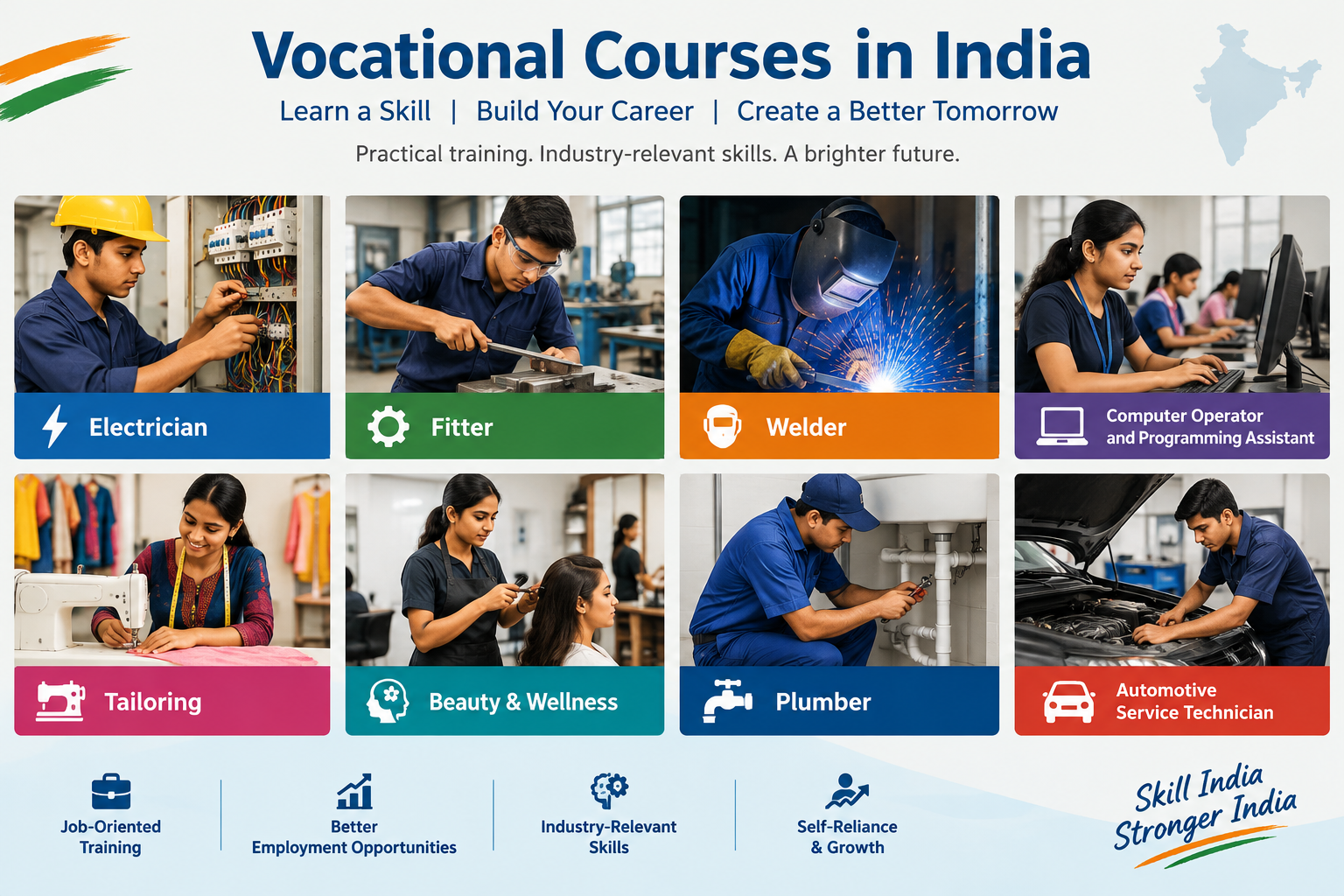
    Vocational courses in India

    1. India’s Job Market Is Changing. Is Training Keeping Up?

    Traditional vocational courses have helped learners develop practical skills for occupations across manufacturing, electrical work, automotive services, construction, retail and other industries.

    These skills remain valuable. However, many jobs are also changing.

    A warehouse employee may now need to use digital inventory systems. A retail associate may work with point-of-sale software and digital payments. A technician may need to understand automated equipment. A customer support executive may work with CRM tools and AI-assisted systems.

    New opportunities are also emerging in areas such as renewable energy, electric vehicles, robotics, data analytics and other technology-driven sectors.

    The challenge is not that traditional vocational skills are no longer useful. It is that those skills increasingly need to be combined with digital knowledge, problem-solving and the ability to learn new processes.

    Training programmes must evolve alongside the industries they serve.

    2. A Certificate Is a Starting Point, Not the Finish Line

    Vocational qualifications give learners a structured way to develop knowledge and demonstrate that they have completed a course.

    But employers also need to know what a candidate can actually do.

    Can the candidate operate the required equipment safely? Can they follow workplace instructions? Can they use the tools relevant to the role? Can they handle common problems without constant supervision?

    These are practical questions that a certificate alone may not answer.

    This does not mean qualifications are unimportant. It means that qualifications should be supported by practical assessments, demonstrations and workplace exposure.

    A stronger training model would combine classroom learning with hands-on exercises, realistic work simulations and assessments based on actual job tasks.

    The goal should be simple: when a learner finishes training, they should understand not just the theory behind the job but also what performing that job looks like in practice.

    3. Industry Must Become a More Active Partner

    One of the biggest opportunities for vocational training is stronger collaboration between training institutions and employers.

    Training institutes cannot always predict how job roles will change. Employers, on the other hand, see the skills they need today and the capabilities they expect to need in the coming years.

    Bringing these two sides together can help make training more relevant.

    Companies can contribute by:

    • Sharing the skills required for specific job roles.
    • Advising institutes on curriculum updates.
    • Providing equipment, demonstrations and practical learning opportunities.
    • Offering internships and apprenticeships.
    • Participating in assessments and candidate evaluations.
    • Giving feedback on the performance of newly hired trainees.

    For example, if a logistics company regularly hires warehouse associates, it can help training partners understand the actual requirements of warehouse work, including inventory handling, workplace safety, scanning systems and basic digital operations.

    This makes training more closely connected to employment.

    The government has also emphasised demand-driven skilling and industry alignment. The Ministry of Skill Development and Entrepreneurship’s initiatives include industry-linked training and on-the-job exposure through schemes such as the Dual System of Training.

    The next step is to make these connections meaningful, consistent and accessible across more sectors and locations.

    4. Practical Experience Should Be Part of the Learning Journey

    A learner can understand a process in theory and still struggle when they encounter it in a real workplace.

    That is why practical exposure matters.

    Apprenticeships, internships, supervised workplace training and simulated work environments can help bridge the gap between learning and employment.

    Consider someone training to become an electrician. Understanding electrical concepts is important, but so is learning to use tools correctly, follow safety procedures and troubleshoot common problems under supervision.

    Similarly, someone preparing for a retail role benefits from practising customer interactions, handling billing systems and learning how to manage everyday store operations.

    Practical exposure also helps learners understand whether a job suits their interests and expectations before they enter full-time employment.

    Training should therefore not treat practical work as an optional extra. It should make it a meaningful part of the learning process wherever the occupation requires it.

    5. Soft Skills Matter More Than Many Learners Realise

    Technical knowledge helps candidates qualify for a role. Workplace skills often determine how effectively they perform in it.

    Communication, punctuality, teamwork, problem-solving, adaptability and the ability to follow instructions are important across many occupations.

    For frontline roles, these skills can be especially relevant.

    A delivery executive needs to communicate with customers and follow delivery procedures. A retail associate must understand customer needs and coordinate with colleagues. A warehouse employee needs to follow instructions, maintain safety and work as part of a team.

    These abilities can be taught and practised.

    Training centres can introduce workplace scenarios, group activities, mock interviews, communication exercises and basic digital tasks into their programmes.

    The objective is not to turn every learner into an expert communicator overnight. It is to help them enter the workplace with greater confidence and a clearer understanding of professional expectations.

    6. Training Should Lead to Employment, Not Just Completion

    One of the most important questions for any vocational programme is what happens after the course ends.

    How many learners find jobs related to their training? How many successfully join? Are they still employed after a few months? Do they have opportunities to improve their skills and earn more over time?

    Course completion and certification are useful indicators, but they do not tell the whole story.

    Training providers should work towards tracking outcomes such as:

    • Employment after training.
    • Relevance of the job to the course.
    • Employer feedback on job readiness.
    • Successful joining rates.
    • Retention after three or six months.
    • Opportunities for career progression.
    • Learner satisfaction with the training.

    These measures can help institutions understand where their programmes are working and where changes are needed.

    For instance, if a course attracts many learners but employers repeatedly report the same practical skill gaps, the curriculum or training delivery may need to be reviewed.

    Likewise, if candidates receive offers but struggle to join because of unclear job conditions or unsuitable locations, better career guidance and employer coordination may help.

    The real measure of vocational training is not only how many people complete it, but how effectively it helps them move forward.

    7. Future-Ready Training Must Be Accessible Beyond Major Cities

    India’s talent is not limited to metropolitan areas.

    Across smaller cities, towns and districts, young people are pursuing ITI courses, diplomas, vocational qualifications and other forms of practical education.

    These learners can become an important source of talent for employers in logistics, retail, manufacturing, hospitality, customer support and many other sectors.

    However, access to quality training and employment connections can vary by location.

    Some learners may have limited access to modern equipment, experienced trainers, career counselling or employers who recruit from their region.

    A future-ready vocational system should therefore focus on both training quality and access to opportunity.

    This includes strengthening regional training centres, developing partnerships with local employers, providing digital learning resources and connecting candidates with relevant vacancies.

    Digital platforms can help learners discover opportunities beyond their immediate networks. But technology works best when combined with reliable information, practical training and real employer connections.

    The aim should be to ensure that a learner’s location does not unnecessarily limit their ability to develop skills or find suitable work.

    8. What Should the Vocational Training Model Look Like Tomorrow?

    There is no single solution for every occupation. A technician, a healthcare worker and a warehouse associate will need different training pathways.

    However, a more effective model can follow a common approach:

    Understand demand → Train for the role → Practise real tasks → Assess skills → Connect with employers → Track outcomes

    First, training providers identify the skills employers actually need.

    Next, learners receive relevant technical instruction and workplace skills training.

    They practise the tasks associated with their chosen roles and are assessed on what they can demonstrate.

    They then connect with employers through apprenticeships, placement partnerships, recruitment drives or digital platforms.

    Finally, training providers gather feedback on employment, retention and performance to improve future batches.

    This creates a continuous cycle in which training responds to the job market instead of remaining disconnected from it.

    It also allows employers to contribute to talent development rather than relying entirely on the external labour market to supply ready-made candidates.

    Final Thought: Build Skills for Real Opportunities

    India’s vocational training ecosystem has an important role to play in preparing the workforce for the future. But the future will require more than adding new courses or issuing more certificates.

    It will require practical learning, stronger industry partnerships, digital skills, workplace readiness and a clear connection between training and employment.

    It will also require recognising that people develop at different speeds. Some learners will be ready for employment immediately after training, while others may need additional practice, apprenticeships or on-the-job support.

    The answer is not to dismiss the current model. It is to keep improving it.

    Training institutions must understand industry needs. Employers must participate in building talent. Learners must have access to relevant skills and genuine job opportunities. And the entire system must pay closer attention to what happens after training ends.

    Because a vocational course should do more than prepare someone to pass an assessment. It should help them take the next step towards a livelihood, a career and a better future.

    The jobs of tomorrow will need people who can keep learning. Our training systems must be built to help them do exactly that.

  • Blue Collar Workers Career

    Blue Collar Workers Career

    Blue Collar Workers

    Blue Collar Workers are the backbone of India’s economy, and their career prospects are diverse and exciting. Furthermore, the Indian job market is witnessing a significant surge in demand for skilled and unskilled workers. Consequently, Blue Collar Workers have numerous opportunities to explore various sectors and industries. Additionally, with the right training and skills, they can secure better-paying jobs and improve their standard of living.

    Introduction to Blue Collar Workers Career

    Moreover, the Indian government has launched several initiatives to promote vocational training and skill development among Blue Collar Workers. For instance, the Ministry of Skill Development offers various programs to enhance the skills of Blue Collar Workers. Therefore, it is essential for Blue Collar Workers to stay updated about the latest trends and opportunities in the job market.

    Blue Collar Workers

    Blue Collar Workers Career Prospects

    However, Blue Collar Workers often face challenges in finding the right job opportunities. Consequently, they must be proactive in seeking out career prospects and exploring various sectors. Additionally, they can visit the Job Raahi Blog to stay informed about the latest job market trends and career advice. Some of the key sectors for Blue Collar Workers include:

    • Manufacturing and production
    • Construction and infrastructure
    • Logistics and transportation
    • Healthcare and hospitality
    • IT and technology

    Benefits of Blue Collar Workers Career

    Moreover, a career as a Blue Collar Worker offers numerous benefits, including job security, opportunities for advancement, and a sense of fulfillment. Furthermore, Blue Collar Workers can work in a variety of settings, from factories and warehouses to hospitals and hotels. Additionally, they can specialize in specific trades, such as electrical work, plumbing, or carpentry.

    Sectors and Industries for Blue Collar Workers

    However, the job market for Blue Collar Workers is constantly evolving, and new sectors and industries are emerging. Consequently, Blue Collar Workers must be adaptable and willing to learn new skills. For instance, the renewable energy sector is creating new job opportunities for Blue Collar Workers, including solar panel installation and wind turbine maintenance. Moreover, the National Career Service provides resources and support for Blue Collar Workers to explore these new opportunities.

    Types of Blue Collar Jobs

    Additionally, there are many types of Blue Collar jobs available, including:

    • Factory workers
    • Warehouse workers
    • Drivers
    • Electricians
    • Fitters
    • Welders
    • Machine operators

    Skills and Training for Blue Collar Workers

    Furthermore, Blue Collar Workers require specialized skills and training to succeed in their careers. Consequently, they must invest in vocational training and certification programs. For example, the Job Raahi platform offers resources and support for Blue Collar Workers to acquire new skills and improve their employability. Moreover, the following table highlights some of the key skills and training required for Blue Collar Workers:

    Skill Training Certification
    Electrical work Vocational training ITI certification
    Plumbing Apprenticeship Diploma certification
    Carpentry On-the-job training Certificate of completion
    Machine operation Factory training License to operate

    Importance of Vocational Training

    However, vocational training is essential for Blue Collar Workers to acquire the skills and knowledge required for their jobs. Consequently, they must prioritize vocational training and certification programs. Additionally, vocational training can help Blue Collar Workers to advance in their careers and increase their earning potential.

    Blue Collar Workers Job Opportunities

    Moreover, Blue Collar Workers can find job opportunities through various channels, including online job portals, recruitment agencies, and company websites. Furthermore, they can download Job Raahi app to search for jobs and receive job alerts. Additionally, the following are some tips for Blue Collar Workers to find job opportunities:

    • Update their resumes and profiles
    • Network with employers and recruiters
    • Practice their interview skills
    • Stay positive and motivated
    • Be open to new opportunities and challenges

    Conclusion

    In conclusion, Blue Collar Workers have numerous career prospects and opportunities in India. Furthermore, with the right skills and training, they can succeed in their careers and improve their standard of living. Therefore, Blue Collar Workers must stay informed about the latest job market trends and career advice. Additionally, they can visit the Job Raahi Blog to learn more about Blue Collar Workers career prospects and opportunities. Consequently, Blue Collar Workers can download Job Raahi app to search for jobs and receive job alerts.

    Sources and References

    The following are some sources and references used in this article:

  • Skilled Trades Career Growth

    Skilled Trades Career Growth

    Skilled Trades

    Skilled Trades career growth is an exciting and rewarding path for many individuals, offering a wide range of opportunities for advancement and professional development. Furthermore, the demand for skilled workers is on the rise, making it an ideal time to pursue a career in this field. Additionally, with the right training and education, individuals can acquire the skills and knowledge needed to succeed in Skilled Trades.

    Introduction to Skilled Trades

    Skilled Trades encompass a broad range of occupations, including electricians, fitters, welders, and machine operators, among others. Moreover, these jobs require specialized training and education, which can be obtained through vocational training programs or technical schools. For instance, the Job Raahi Blog provides valuable information and resources for individuals interested in pursuing a career in Skilled Trades.

    Skilled Trades

    Skilled Trades Career Growth Opportunities

    Skilled Trades career growth opportunities are abundant, with many industries experiencing a high demand for skilled workers. Consequently, individuals with the right training and experience can expect to find well-paying jobs with opportunities for advancement. Additionally, the Job Raahi platform provides a range of resources and tools to help individuals find Skilled Trades jobs and advance their careers.

    Types of Skilled Trades Jobs

    Some of the most in-demand Skilled Trades jobs include:
    * Electricians
    * Fitters
    * Welders
    * Machine operators
    * Automotive technicians

    Skilled Trades Career Paths

    Individuals can pursue a range of career paths in Skilled Trades, including:
    * Apprenticeships
    * Vocational training programs
    * Technical education
    * On-the-job training

    Benefits of Skilled Trades Training

    Skilled Trades training provides numerous benefits, including the acquisition of specialized skills and knowledge, as well as improved job prospects and higher earning potential. Furthermore, many Skilled Trades training programs are designed to be completed in a relatively short period, allowing individuals to quickly enter the workforce. Therefore, it is essential to research and find the right training program to meet your career goals.

    Skilled Trades Training Programs

    Some popular Skilled Trades training programs include:
    * ITI programs
    * Diploma programs
    * Certificate programs
    * Apprenticeships

    Skilled Trades Salary and Job Prospects

    Skilled Trades salary and job prospects are excellent, with many industries experiencing a high demand for skilled workers. Moreover, the salary range for Skilled Trades jobs can vary depending on the specific occupation, level of experience, and location. For example, electricians and welders are among the highest-paid Skilled Trades jobs, with median salaries ranging from 300,000 to 500,000 per year.

    Skilled Trades Job Median Salary Job Prospects
    Electrician 400,000 per year High demand
    Welder 350,000 per year High demand
    Machine operator 250,000 per year Moderate demand
    Automotive technician 300,000 per year High demand

    Skilled Trades Courses and Vocational Training

    Skilled Trades courses and vocational training programs are available at various institutions, including technical schools, community colleges, and vocational training centers. Additionally, the download Job Raahi app provides access to a range of Skilled Trades courses and training programs. Furthermore, the National Career Service and Ministry of Skill Development also offer resources and information on Skilled Trades training programs.

    Conclusion

    In conclusion, Skilled Trades career growth is an exciting and rewarding path for many individuals, offering a wide range of opportunities for advancement and professional development. Therefore, if you are interested in pursuing a career in Skilled Trades, it is essential to research and find the right training program to meet your career goals. Consequently, we encourage you to download Job Raahi app and start exploring the various Skilled Trades career growth opportunities available.

    Sources and References

    * National Career Service
    * Ministry of Skill Development

  • Skilled Certification Benefits

    Skilled Certification Benefits

    Skilled Certification

    Skilled certification benefits are numerous, and for instance, it can significantly boost one’s career and increase job prospects. Furthermore, having a skilled certification can open up new opportunities and provide a competitive edge in the job market. Additionally, it can also lead to higher salary potential and greater job security, which is a major concern for many blue-collar job seekers.

    Importance of Skilled Certification

    Moreover, skilled certification is essential for ITI students, diploma holders, and freshers who are looking to enter the workforce. Consequently, it can provide them with the necessary skills and knowledge to perform their job effectively. Therefore, it is crucial for them to consider getting certified, and for example, they can visit the Job Raahi Blog to learn more about the benefits of skilled certification.

    Skilled Certification

    Skilled Certification Benefits for Blue Collar Jobs

    However, many blue-collar job seekers are unaware of the skilled certification benefits that are available to them. Additionally, they can benefit from certification courses and vocational training, which can provide them with the necessary skills to advance in their careers. Furthermore, some of the skilled certification benefits for blue-collar jobs include:

    • Increased job prospects
    • Higher salary potential
    • Greater job security
    • Opportunities for career growth
    • Improved skills and knowledge

    Types of Skilled Certification

    Moreover, there are various types of skilled certification available, including certification courses and vocational training. Consequently, individuals can choose the type of certification that best suits their needs and career goals. Therefore, it is essential for them to research and explore the different options available, and for instance, they can visit the Job Raahi website to learn more about the skilled certification benefits.

    Benefits of Certification Courses

    Additionally, certification courses can provide individuals with the necessary skills and knowledge to perform their job effectively. Furthermore, some of the benefits of certification courses include:

    • Improved job prospects
    • Increased salary potential
    • Greater job security
    • Opportunities for career growth
    • Enhanced skills and knowledge

    Certification Courses and Vocational Training

    However, many individuals are unaware of the certification courses and vocational training that are available to them. Consequently, they can benefit from visiting the National Career Service website to learn more about the skilled certification benefits. Therefore, it is essential for them to research and explore the different options available, and for example, they can consider download Job Raahi app to stay updated about the latest job opportunities.

    Course Duration Fee Eligibility
    Certified Electrician 6 months Rs. 10,000 10th pass
    Certified Fitter 6 months Rs. 10,000 10th pass
    Certified Welder 6 months Rs. 10,000 10th pass
    Certified Machine Operator 6 months Rs. 10,000 10th pass

    Skilled Certification India

    Moreover, skilled certification India is an essential aspect of the country’s workforce development. Consequently, the government has launched various initiatives to promote skilled certification, including the Ministry of Skill Development. Therefore, it is crucial for individuals to take advantage of these initiatives and get certified, which can provide them with better job prospects and career growth.

    Skilled Certification India and Job Prospects

    However, many individuals are unaware of the skilled certification India and job prospects that are available to them. Additionally, they can benefit from skilled certification, which can provide them with the necessary skills and knowledge to perform their job effectively. Furthermore, some of the skilled certification benefits include:

    • Increased job prospects
    • Higher salary potential
    • Greater job security
    • Opportunities for career growth
    • Improved skills and knowledge

    Career Growth and Skilled Trades

    Moreover, skilled certification can provide individuals with opportunities for career growth and skilled trades. Consequently, they can advance in their careers and take on more challenging roles. Therefore, it is essential for them to consider getting certified, which can provide them with the necessary skills and knowledge to succeed in their chosen field.

    Conclusion

    In conclusion, skilled certification benefits are numerous, and it can significantly boost one’s career and increase job prospects. Furthermore, having a skilled certification can open up new opportunities and provide a competitive edge in the job market. Therefore, we encourage all ITI students, diploma holders, and freshers to consider getting certified and download Job Raahi app to stay updated about the latest job opportunities.

    Sources and References

    Some of the sources used in this article include:

  • Skill Training Benefits

    Skill Training Benefits

    Skill Training

    Blue collar workers can benefit greatly from Skill Training, which can significantly enhance their career prospects and increase their earning potential. Furthermore, Skill Training can also lead to better job security and improved working conditions. Additionally, it can provide workers with a sense of personal fulfillment and satisfaction.

    Introduction to Skill Training

    Skill Training is a process of acquiring new skills and knowledge to improve one’s career prospects and increase their earning potential. Consequently, it can lead to better job security and improved working conditions. Moreover, it can provide workers with a sense of personal fulfillment and satisfaction. For instance, Job Raahi Blog provides valuable information on Skill Training and its benefits.

    Benefits of Skill Training

    The benefits of Skill Training are numerous, and it can have a significant impact on one’s career. Moreover, it can lead to increased job prospects and higher salary potential. Additionally, it can provide workers with a competitive edge in the job market. Some of the benefits of Skill Training include:

    • Improved job prospects
    • Increased earning potential
    • Better job security
    • Personal fulfillment and satisfaction
    • Competitive edge in the job market

    Skill Training

    Types of Skill Training

    There are various types of Skill Training available, including vocational training, apprenticeships, and online courses. Furthermore, workers can also opt for download Job Raahi app to access various Skill Training courses and programs. Moreover, Job Raahi provides a platform for workers to find Skill Training courses and programs. Some of the types of Skill Training include:

    • Vocational training
    • Apprenticeships
    • Online courses
    • Certification programs
    • Diploma programs

    Upskilling and Reskilling

    Upskilling and reskilling are two important aspects of Skill Training. Consequently, they can help workers to acquire new skills and knowledge to improve their career prospects. Moreover, they can also help workers to adapt to changing job market demands. For instance, upskilling can help workers to move to higher-level positions, while reskilling can help workers to switch to new industries or sectors.

    Skill Training for Blue Collar Jobs

    Skill Training is particularly important for blue collar workers, as it can help them to acquire new skills and knowledge to improve their career prospects. Furthermore, it can also help them to increase their earning potential and improve their job security. Additionally, it can provide workers with a sense of personal fulfillment and satisfaction. Some of the benefits of Skill Training for blue collar workers include:

    Benefits Description
    Improved job prospects Increased chances of getting hired
    Increased earning potential Higher salary and benefits
    Better job security Reduced risk of job loss
    Personal fulfillment and satisfaction Increased sense of purpose and satisfaction

    Importance of Skill Development

    Skill development is a critical aspect of Skill Training, as it can help workers to acquire new skills and knowledge to improve their career prospects. Moreover, it can also help workers to adapt to changing job market demands. For instance, the National Career Service provides various resources and tools for workers to develop their skills and knowledge.

    Role of Vocational Training

    Vocational training plays a significant role in Skill Training, as it can provide workers with practical skills and knowledge to improve their career prospects. Furthermore, it can also help workers to acquire industry-specific skills and knowledge. Additionally, the Ministry of Skill Development provides various vocational training programs and courses for workers to acquire new skills and knowledge.

    Finding Skill Training Courses

    Finding Skill Training courses can be a challenging task, but there are various resources and platforms available to help workers find the right courses and programs. Moreover, workers can also opt for online courses and certification programs to acquire new skills and knowledge. Additionally, Job Raahi provides a platform for workers to find Skill Training courses and programs.

    Conclusion

    In conclusion, Skill Training is a critical aspect of career growth and development, particularly for blue collar workers. Therefore, workers should consider acquiring new skills and knowledge to improve their career prospects and increase their earning potential. Consequently, workers can download Job Raahi app to access various Skill Training courses and programs.

    Sources and References

    Some of the sources and references used in this article include: