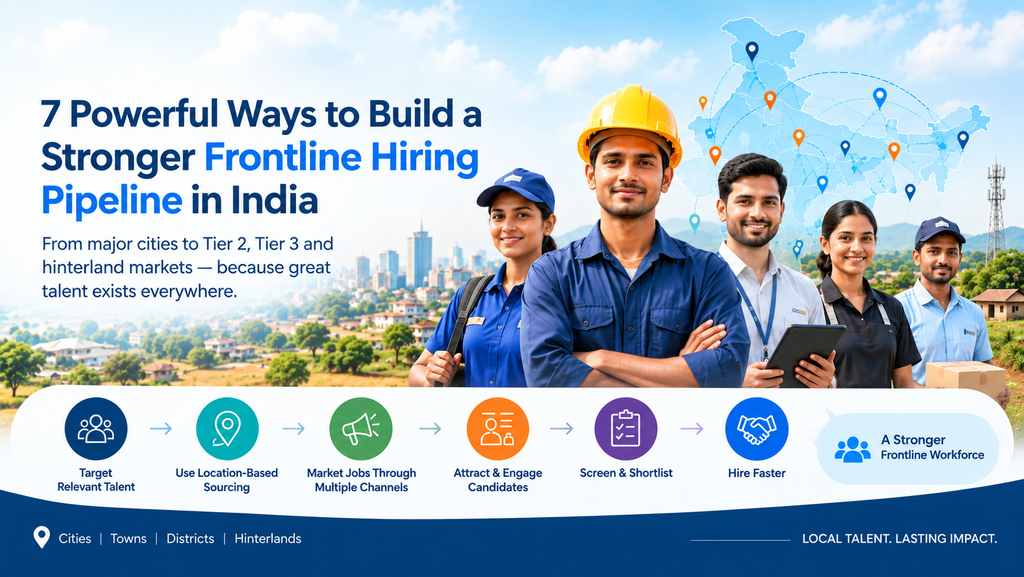
Discovering the frontline talent.
For years, hiring frontline employees followed a familiar process.
A vacancy opened.
The recruiter created a job description.
The job was posted on a portal.
Applications came in.
Candidates were screened.
And once the position was filled, the process was considered complete.
But for companies hiring frontline employees at scale, this model is becoming increasingly difficult to sustain.
When a business needs technicians, operators, field executives, sales representatives, customer service associates, warehouse employees, or other frontline workers across multiple locations, hiring cannot always begin from zero every time a vacancy opens.
The future of frontline hiring is moving towards something more continuous:
Building a Talent Pipeline Instead of Filling a Vacancy
A job vacancy is temporary.
A talent pipeline is ongoing.
This is an important distinction for companies with recurring or high-volume hiring requirements.
Instead of asking:
“Where can we find candidates for this vacancy?”
companies can start asking:
“Where are the candidates we may need for this role, location and skill set?”
This shift can fundamentally change how frontline recruitment is managed.
Why Frontline Hiring Is Different
Frontline recruitment has characteristics that make it different from many corporate hiring processes.
Frontline roles are often:
- High volume
- Location dependent
- Frequently recurring
- Time sensitive
- Entry-level or skill-based
- Distributed across multiple locations
- Closely connected to day-to-day operations
A company may need to hire 10 employees today, 30 next month, and another 50 across different locations a few months later.
If the recruitment process starts from scratch every time, recruiters repeatedly spend time on the same activities:
Searching → Reaching → Screening → Following up → Rebuilding the pipeline
This creates unnecessary friction in the hiring process.
A continuous talent pipeline changes the starting point.
What Is a Frontline Talent Pipeline?
A frontline talent pipeline is a structured pool of potential candidates who can be considered for current or future frontline hiring requirements.
Instead of maintaining one large, generic candidate database, employers can think about candidates according to relevant attributes such as:
Location + Role + Skill + Experience + Availability
For example:
Technician Pipeline
Location: Meerut
Qualification: ITI / Diploma
Experience: 0–3 years
Role: Field Technician
Availability: Ready to join
Sales Pipeline
Location: Lucknow
Qualification: Graduate
Experience: 0–2 years
Role: Sales Executive
Availability: Actively looking
Manufacturing Pipeline
Location: Rudrapur
Qualification: ITI / Diploma
Experience: Manufacturing
Role: Machine Operator
Availability: Immediate / short notice
These are not just candidate lists.
They are potential hiring pipelines.
The Problem With Starting From Zero
Imagine a company has a recurring requirement for 100 field employees across 20 locations.
The traditional approach might look like this:
Vacancy opens
↓
Recruiter publishes jobs
↓
Applications are generated
↓
Candidates are screened
↓
Candidates are rejected or drop out
↓
More candidates are sourced
↓
Positions are eventually filled
Then another requirement appears.
The cycle starts again.
The problem isn’t necessarily that the company cannot find candidates.
The problem is that the candidate discovery process keeps restarting.
A pipeline-first approach looks different.
Build candidate pools
↓
Segment by location and role
↓
Maintain candidate engagement
↓
New requirement opens
↓
Activate relevant candidate pool
↓
Generate applications
↓
The recruitment team is no longer starting from a blank page.
Why Location Matters So Much in Frontline Hiring
For many frontline jobs, location is not a secondary detail.
It can be one of the most important recruitment filters.
A candidate may be perfectly qualified for a role but may not want to relocate 300 kilometres away.
Another candidate with similar qualifications may already live 15 kilometres from the workplace.
For frontline recruitment, the second candidate can represent a much more relevant talent opportunity.
This is why location-based talent pools can become an important part of workforce planning.
Instead of asking only:
“Who can do this job?”
employers also need to ask:
“Who can do this job here?”
The Opportunity Beyond Major Cities
India’s frontline workforce is not concentrated only in major metropolitan cities.
Talent exists across:
- Tier 2 cities
- Tier 3 cities
- Industrial towns
- District headquarters
- Semi-urban markets
- Small towns
- Hinterland locations
For employers, these markets represent a significant opportunity.
However, reaching candidates outside traditional employment hubs requires a different recruitment approach.
A vacancy posted in a large city may naturally attract applicants who are already familiar with that employment market.
A vacancy in a smaller town or district may require active candidate outreach.
This is where digital recruitment platforms can play a larger role.
From Job Posting to Job Marketing
A traditional job portal largely relies on candidate discovery.
The candidate searches.
The candidate finds the vacancy.
The candidate applies.
But what happens when the right candidate isn’t actively searching?
The job can remain invisible to them.
This is why Job Raahi’s approach goes beyond simply publishing jobs.
We Don’t Just List Your Jobs. We Market Them.
Depending on the requirement, job opportunities can be amplified through:
- RCS Business Messaging
- SMS
- Email campaigns
- AI-powered calling
- Candidate database outreach
- Geographic targeting
- Candidate-segment campaigns
The objective is to actively take relevant opportunities to relevant candidates.
For high-volume frontline hiring, this distinction can be significant.
Building a Pipeline Before the Hiring Requirement Becomes Urgent
The most useful candidate pipeline is one that exists before the vacancy becomes urgent.
Suppose an organization frequently hires machine operators in a particular industrial cluster.
Instead of beginning sourcing only after a vacancy opens, the organization can continuously build awareness and candidate pools around those roles.
Similarly, a telecom organization can maintain candidate pools for technicians and field employees across specific markets.
A retail company can build local pools of sales and store employees.
A logistics company can build location-based pools for warehouse and delivery roles.
The industry changes.
The underlying recruitment model remains similar.
One Pipeline Can Serve Multiple Hiring Cycles
Another advantage of building a structured talent pipeline is that candidate relevance does not necessarily disappear when one vacancy closes.
Consider a candidate who applies for a technician role but isn’t selected because the position has already been filled.
That candidate may still be relevant for:
- Another location
- A future vacancy
- A similar role
- A different business unit
- A subsequent hiring cycle
With an organized talent pipeline, candidates can potentially remain discoverable for future opportunities, subject to their preferences and availability.
This turns recruitment from a one-time transaction into an ongoing relationship.
What This Means for Recruiters
A pipeline-first recruitment model does not eliminate recruiters.
It changes where recruiters spend their time.
Instead of constantly searching for candidates from scratch, recruitment teams can spend more time on:
- Candidate engagement
- Screening
- Assessment
- Interview coordination
- Offer management
- Joining conversion
- Workforce planning
The technology handles more of the repetitive discovery and outreach process.
The recruiter remains central to the decision-making and candidate experience.
What This Means for Employers
For employers, the goal is not simply to have a larger database.
A large database is useful only when the relevant candidates can be identified and reached.
A useful frontline talent pipeline should answer questions such as:
Where are our candidates?
What roles are they relevant for?
What skills do they have?
Which locations can they work in?
Are they actively looking?
How quickly can they join?
The more structured the pipeline, the easier it becomes to activate it when demand appears.
Job Raahi’s Role in the Frontline Hiring Ecosystem
Job Raahi is building around this broader opportunity.
The platform focuses on frontline, entry-level, blue-collar, grey-collar, industrial and high-volume hiring.
The objective is to help employers move from:
Posting jobs
to:
Building access to relevant candidate pools.
And from:
Searching only when a vacancy opens
to:
Creating continuous candidate pipelines.
This approach becomes especially valuable when hiring is distributed across multiple locations.
The Future of Frontline Recruitment in India
The next evolution of frontline recruitment may not be about having another place to post a vacancy.
It may be about creating a more connected hiring ecosystem.
One where:
Employers know where their talent pools are.
Candidates know where relevant opportunities are.
Recruiters can activate pipelines when requirements arise.
Technology can take jobs to candidates instead of waiting for candidates to find jobs.
And importantly:
Hiring can become continuous rather than reactive.
India has a massive frontline workforce.
The challenge is connecting that workforce with the right opportunities efficiently.
The opportunity for recruitment technology is to make that connection easier, faster, and more localized.
From Vacancy Filling to Workforce Readiness
The fundamental shift is simple.
A vacancy is a requirement.
A candidate pipeline is an asset.
For companies with recurring frontline hiring requirements, building that asset can make recruitment more proactive and scalable.
At Job Raahi, we believe the future of frontline hiring lies in making candidate access continuous — across industries, locations, cities, towns and India’s hinterlands.
Because the best time to build your frontline talent pipeline isn’t when the vacancy becomes urgent.
It’s before you need it.
Frequently Asked Questions
What is a frontline talent pipeline?
A frontline talent pipeline is an ongoing pool of potential candidates organized around roles, skills, locations and availability for current and future hiring requirements.
Why is a talent pipeline important for frontline hiring?
Frontline hiring is often recurring, location-specific and high volume. A talent pipeline can help employers avoid starting the sourcing process from scratch for every new vacancy.
How is a talent pipeline different from a job posting?
A job posting communicates a specific vacancy. A talent pipeline provides ongoing access to potential candidates who may be relevant for current or future vacancies.
What industries can benefit from frontline talent pipelines?
Manufacturing, telecom, logistics, retail, infrastructure, healthcare, hospitality, BFSI and other industries with recurring frontline workforce requirements can benefit from structured candidate pipelines.
How can Job Raahi help employers build frontline talent pipelines?
Job Raahi combines job posting with candidate outreach and digital recruitment channels such as WhatsApp, RCS, SMS, email, AI-powered calling and geographic candidate targeting.
Can frontline talent pipelines be built for smaller cities and towns?
Yes. Location-specific candidate sourcing can help employers build talent pools across Tier 2 and Tier 3 cities, industrial towns, districts and hinterland markets.
Build Your Frontline Hiring Pipeline With Job Raahi
If your organization regularly hires frontline employees across multiple locations, Job Raahi can help you explore a more proactive approach to candidate sourcing.
Don’t wait for the next vacancy to start searching. Build the pipeline before you need it.
Job Raahi — We Don’t Just List Your Jobs. We Market Them.