Recruiting employees is an important part of business growth. Companies invest time, money and resources in finding suitable candidates, conducting interviews and completing the joining process.
However, there is another challenge that often begins after recruitment: retaining those employees.
In frontline industries such as logistics, warehousing, manufacturing, retail, hospitality and delivery, employees may leave shortly after joining. Some resign within a few weeks, while others decide to move on before completing their first three months.
This is known as early attrition.
For employers, early exits can mean repeating the recruitment process, spending additional resources on training and managing gaps in daily operations. For employees, leaving a job soon after joining can mean losing an opportunity to gain experience and build professional stability.
Understanding why early attrition happens is therefore important for both employers and employees.
What Is Early Attrition?
Early attrition refers to employees leaving an organisation within a relatively short period after joining.
Although the exact measurement period varies between organisations, many employers monitor exits during the first 30, 60 or 90 days of employment.
Early attrition can happen for several reasons:
- The job does not match the candidate’s expectations.
- Employees find it difficult to adjust to the work environment.
- Salary or payment-related expectations are not met.
- Employees receive insufficient training or guidance.
- Work schedules or commuting arrangements become difficult.
- Employees find better-suited opportunities elsewhere.
In frontline roles, where daily operations often depend on a consistent workforce, even a small number of early exits can create additional pressure on the remaining employees and recruitment teams.
Why Do Frontline Employees Leave Within 90 Days?
There is rarely one reason behind employee attrition. Different employees may leave for different reasons, depending on their personal circumstances and workplace experiences.
However, some common factors deserve attention.
A. Difference Between Job Expectations and Reality
One of the most common reasons for early exits is a mismatch between what candidates expect and what they experience after joining.
For example, a candidate may accept a warehouse position without fully understanding the physical nature of the work, shift schedule or daily responsibilities.
Similarly, someone joining a retail role may not realise how much customer interaction and standing the job involves.
When the actual job differs significantly from what was communicated during recruitment, employees may reconsider their decision.
B. Difficulty Adjusting to Work Schedules
Frontline roles often operate according to business and customer requirements.
Employees may need to work in rotational shifts, early mornings, late evenings or weekends, depending on the organisation.
Commuting distance and transport availability can make the situation more challenging, particularly when shifts begin or end at inconvenient hours.
C. Lack of Proper Onboarding
Joining a company does not automatically mean an employee understands how to perform the job.
New employees need clear instructions, role-specific training and guidance about workplace procedures.
Without proper onboarding, they may feel confused about their responsibilities, reporting structure or performance expectations.
This uncertainty can affect their confidence and willingness to continue.
D. Limited Support from Supervisors
Frontline employees often work closely with supervisors and team leaders.
During the initial weeks, employees may have questions about tasks, processes and workplace expectations.
If they do not receive timely guidance or feedback, they may feel unsupported.
A welcoming and approachable supervisor can make a significant difference to a new employee’s experience.
E. Salary and Payment-Related Concerns
Employees naturally expect the compensation and payment conditions discussed during recruitment to be honoured.
Unclear salary structures, unexpected deductions, delayed payments or misunderstandings about incentives can damage trust.
Transparent communication about compensation is important from the beginning of the recruitment process.
F. Better Opportunities Elsewhere
Some employees leave because they receive another opportunity that better matches their expectations.
This may involve higher compensation, a more convenient location, different working hours or a role more closely aligned with their interests.
Employers need to understand that retention is influenced not only by the recruitment experience but also by the overall employment experience.
The Special Challenges Freshers Face
Early attrition can be particularly challenging when hiring freshers.
Unlike experienced employees, freshers may have limited understanding of workplace expectations and professional routines.
Their first job can introduce several changes at once:
- Following a fixed reporting schedule.
- Working with supervisors and colleagues.
- Meeting productivity or performance targets.
- Managing personal expenses and travel.
- Understanding workplace discipline and responsibilities.
- Adjusting to unfamiliar tasks and environments.
For example, a fresher joining a manufacturing unit may need time to understand production processes, safety procedures and quality standards.
A first-time warehouse employee may need guidance on inventory handling, scanning, picking and packing activities.
Employers should recognise that new employees need a reasonable learning period. Clear instructions, appropriate training and regular feedback can help them become more confident in their roles.
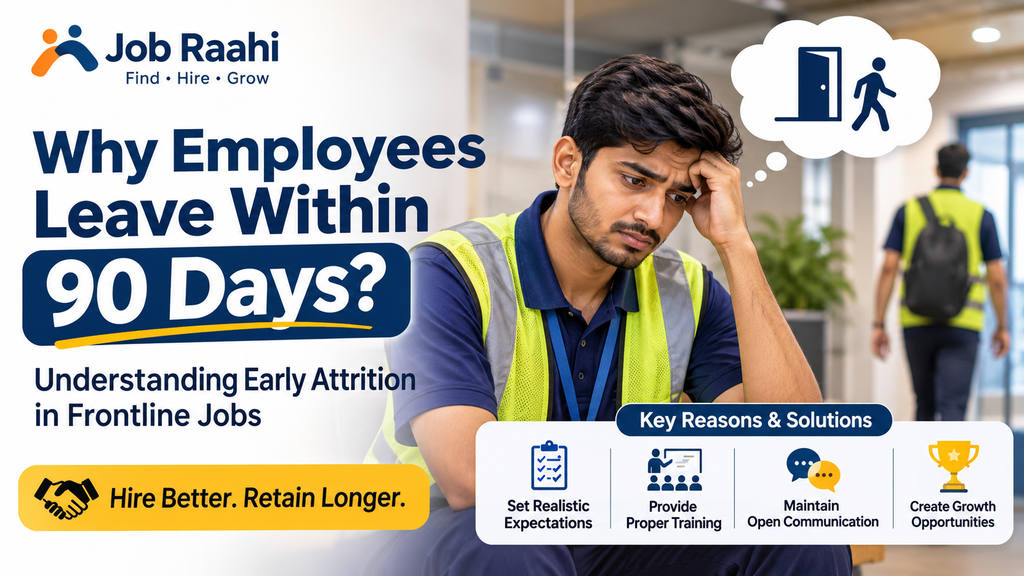
How Early Attrition Affects Businesses
When an employee leaves shortly after joining, the impact extends beyond the vacancy itself.
Repeated Recruitment Costs
The organisation must restart the sourcing, screening, interviewing and joining process to fill the vacant position.
Additional Training Requirements
Supervisors and trainers may need to spend additional time preparing replacement employees.
Operational Disruptions
In warehouses, production units, retail stores and delivery operations, employee shortages can affect daily responsibilities and work distribution.
Increased Pressure on Existing Employees
When positions remain vacant, other team members may need to manage additional responsibilities.
Lower Team Stability
Frequent changes in team composition can make it difficult to establish consistent working routines and coordination.
For businesses hiring at scale, these challenges can become particularly important because recruitment and retention need to work together.
Practical Ways Employers Can Reduce Early Attrition
Reducing early attrition does not always require expensive initiatives. In many cases, improving communication and addressing basic workplace concerns can make a meaningful difference.
A. Set Realistic Job Expectations During Recruitment
Candidates should receive accurate information before accepting an offer.
Employers should clearly explain:
- Actual job responsibilities.
- Work location and commute considerations.
- Shift timings and weekly offs.
- Salary and payment structure.
- Physical or technical requirements.
- Performance expectations.
- Available facilities and workplace conditions.
A realistic understanding of the job helps candidates make informed decisions.
B. Create a Structured Onboarding Process
The first few days should help employees understand the organisation and their responsibilities.
A basic onboarding process can include workplace orientation, introductions to supervisors, safety instructions, role-specific training and explanations of company policies.
New employees should know whom to approach when they need assistance.
C. Provide Support During the Learning Period
Employers should avoid expecting freshers to understand every process immediately.
Assigning a supervisor, trainer or experienced team member to guide new employees can help them learn more effectively.
Training should be appropriate to the role and include necessary safety precautions.
D. Maintain Regular Communication
Managers should interact with new employees during their initial weeks.
Short check-ins can help identify concerns related to workload, shifts, transport, training or workplace conditions.
Addressing problems early may prevent employees from making the decision to leave without communicating their concerns.
E. Ensure Timely and Transparent Payments
Compensation details should be communicated clearly during recruitment and joining.
Employers should explain salary components, payment dates, incentives and any applicable deductions.
Consistency between what was promised and what is delivered helps build employee trust.
F. Review the First 90 Days
Companies can divide the initial employment period into three stages:
| Period | Employer’s Focus |
|---|---|
| First 30 Days | Orientation, role clarity, basic training and workplace adjustment |
| Days 31–60 | Skill development, performance feedback and identifying challenges |
| Days 61–90 | Reviewing progress, employee engagement and long-term role suitability |
This approach gives employers a structured way to understand how new employees are adjusting.
The Importance of a Positive First 90 Days
An employee’s initial experience can influence how they view the organisation and their future within it.
A positive first 90 days should focus on more than attendance and productivity.
It should help employees:
- Understand their role and responsibilities.
- Develop confidence in performing assigned tasks.
- Build relationships with colleagues.
- Receive constructive feedback.
- Understand opportunities to improve and grow.
- Feel comfortable communicating workplace concerns.
Employers who invest in a supportive initial experience can create a stronger foundation for employee engagement and retention.
How Digital Hiring Platforms Fit into the Retention Journey
Digital job platforms play an important role in helping employers connect with potential candidates.
They can support the recruitment stage by making vacancies more accessible, expanding candidate reach and helping job seekers discover opportunities that match their qualifications and experience.
However, attracting candidates is only one part of the employee journey.
Retention depends on what happens after a candidate applies and joins the organisation.
Employers must ensure that the job information shared during recruitment accurately reflects the actual role. They must also provide proper onboarding, training, fair working conditions and continued support.
In other words, effective workforce management requires both successful hiring and a positive employee experience.
How Job Raahi Supports the Frontline Hiring Ecosystem
Job Raahi is a digital job platform focused on frontline, entry-level and mass hiring opportunities.
It connects companies with candidates exploring employment across sectors such as logistics, warehousing, retail, delivery, sales, hospitality, customer support and other frontline roles.
For employers, Job Raahi provides an additional channel to reach candidates from different locations, including freshers and individuals with limited professional experience.
Its wider ecosystem also includes skill centres across India, where candidates can be trained and developed according to industry needs.
This can help employers explore a wider pool of potential candidates while giving freshers access to relevant employment opportunities.
However, finding the right candidate is only the beginning.
Employers must also ensure that candidates understand the role before joining and receive the support needed to adjust to the workplace.
Job Raahi supports the connection between employers and job seekers; building a positive workplace experience remains an important responsibility of the employer.
Conclusion: Hiring Employees Is Important, Retaining Them Is Equally Important
Early attrition is a challenge that frontline employers cannot afford to ignore.
When employees leave within their first 90 days, organisations may face repeated recruitment efforts, additional training requirements and operational disruptions.
However, many of the factors contributing to early exits can be addressed through better communication, realistic job expectations, structured onboarding and consistent workplace support.
Freshers also need time to understand their responsibilities, develop practical skills and adjust to professional environments.
For employers, the objective should not simply be to fill vacancies quickly. It should be to create conditions in which suitable employees can learn, perform and grow.
Platforms like Job Raahi can help companies expand their candidate reach and connect with emerging frontline talent. The next step is to ensure that the employment experience matches the opportunity presented during recruitment.
Successful hiring does not end when a candidate joins. It begins a new responsibility: helping that employee become a confident, capable and valued part of the workforce.