Completing a course, earning a certificate or graduating from college is an important achievement. It reflects the time and effort you have invested in learning. But when it comes to entering the workforce, many freshers discover that knowing something and actually doing it are two different things.
You may understand how a machine works from a textbook, but operating it in a production environment requires practice. You may know the principles of customer service, but handling a real customer query requires communication and confidence. You may learn about inventory management in a classroom, but managing stock in a busy warehouse involves practical decisions.
This is where the difference between theoretical knowledge and practical knowledge becomes important.
Both are essential for building a strong career. Theory helps you understand the concepts, while practice teaches you how to apply them in real situations.
For freshers, the ability to connect these two forms of learning can make the transition from education to employment much smoother.
Table of Contents
- What Is the Difference Between Theoretical and Practical Knowledge?
- Why Theoretical Knowledge Alone May Not Be Enough
- Why Practical Skills Matter to Employers
- How Vocational Courses Connect Learning with Work
- Five Ways Freshers Can Build Practical Experience
- How to Demonstrate Practical Skills During an Interview
- Turning Learning into Career Opportunities with Job Raahi
1. What Is the Difference Between Theoretical and Practical Knowledge?
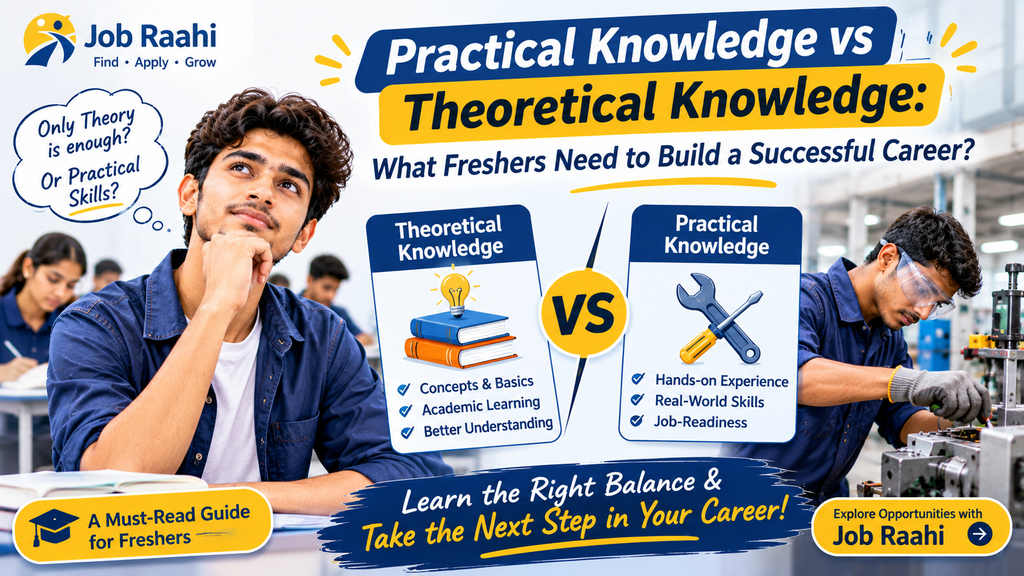
Theoretical knowledge is what you learn through books, lectures, classroom discussions, online lessons and structured training material. It helps you understand concepts, principles, processes and the reasons behind different tasks.
Practical knowledge is the ability to use that understanding in real situations. It develops through hands-on activities, projects, workplace exposure, demonstrations, internships and repeated practice.
Consider a few examples:
| Learning area | Theoretical knowledge | Practical knowledge |
|---|---|---|
| Electrical training | Understanding circuits and electrical principles | Connecting components and identifying faults under supervision |
| Retail | Learning customer service concepts | Helping customers and handling product-related questions |
| Warehousing | Understanding inventory processes | Scanning, sorting, picking and packing products |
| Computer training | Learning spreadsheet functions | Using spreadsheets to organise and update actual records |
| Manufacturing | Understanding production processes | Operating equipment and following safety procedures |
Neither form of knowledge should be treated as a replacement for the other.
Theory gives you the foundation to understand a task. Practice helps you perform it accurately, safely and confidently.
2. Why Theoretical Knowledge Alone May Not Be Enough
Many freshers have the required educational qualifications but still feel uncertain when they face real workplace responsibilities.
This does not necessarily mean their education was inadequate. It often means they need more opportunities to apply what they have learned.
Here are some common challenges:
Limited exposure to real work environments: Classroom exercises may not fully reflect the pace, responsibilities and coordination required in an actual workplace.
Difficulty applying concepts: A student may understand a process but struggle to perform it independently without demonstrations or supervised practice.
Lack of workplace confidence: Interacting with customers, reporting to supervisors or working with a team can feel unfamiliar to someone entering their first job.
Limited problem-solving experience: Real work situations do not always follow textbook examples. Employees often need to understand a problem, ask questions and decide what to do next.
The solution is not to ignore theoretical learning. It is to create more opportunities to apply it.
3. Why Practical Skills Matter to Employers
Employers hiring freshers generally understand that candidates may not have previous work experience. However, they still look for signs that a candidate can learn, follow instructions and perform the responsibilities associated with the role.
Practical skills can help demonstrate this readiness.
A. Ability to Perform Job-Related Tasks
A candidate who has practised relevant activities may find it easier to understand initial training and workplace processes.
For example, someone familiar with basic inventory records may adapt more quickly to an entry-level warehouse or stock-management role.
B. Better Problem-Solving
Practical exposure introduces candidates to situations that require observation, decision-making and attention to detail.
Even simple tasks can teach you how to identify mistakes and seek appropriate solutions.
C. Workplace Confidence
Practice reduces hesitation. Candidates who have participated in projects, demonstrations or supervised assignments often have examples they can discuss during interviews.
D. Understanding Safety and Responsibility
In technical, manufacturing and warehouse environments, following instructions and safety procedures is essential. Practical training helps candidates understand why these processes matter.
E. Willingness to Learn
Employers value candidates who are curious, open to feedback and prepared to improve. Practical learning often develops these habits.
4. How Vocational Courses Connect Learning with Work
Vocational education focuses on developing knowledge and skills related to particular occupations or industries. It can help students understand the requirements of a trade while developing practical abilities.
Courses offered through ITIs, Polytechnic institutions and other vocational training providers can introduce learners to industry-relevant subjects and activities.
Depending on the course and training quality, students may get exposure to:
- Tools, machines and technical equipment.
- Electrical, mechanical or maintenance activities.
- Computer applications and digital tools.
- Manufacturing and production processes.
- Retail, service and operational responsibilities.
- Workplace safety and professional discipline.
However, completing a vocational course should be seen as the beginning of professional development, not the end of learning.
Students should look for opportunities to practise their skills, participate in projects, explore apprenticeships where eligible and understand how their training connects with actual job responsibilities.
A certificate tells an employer what you have studied. Your ability to explain and demonstrate what you can do helps bring that qualification to life.
5. Five Ways Freshers Can Build Practical Experience
You do not always need a full-time job to start developing practical skills. There are several ways to gain exposure before entering the workforce.
1. Participate Actively in Practical Sessions
Do not treat workshops and laboratory sessions as activities to complete only for attendance or marks.
Ask questions, practise tasks, understand the equipment and learn how to identify common mistakes.
The more actively you participate, the better you understand how concepts work outside textbooks.
2. Work on Small Projects
Projects allow you to apply what you have learned.
An ITI student might build or demonstrate a basic electrical setup under supervision. A Diploma student could work on a technical model. A computer student might create a spreadsheet or simple digital project.
These examples can also become useful talking points during interviews.
3. Explore Apprenticeships and Internships
Apprenticeships and internships can provide structured exposure to professional environments.
Depending on your qualification and eligibility, explore opportunities through the National Apprenticeship Promotion Scheme (NAPS) and National Apprenticeship Training Scheme (NATS).
Always review the official eligibility conditions and terms before applying.
4. Learn from Demonstrations and Experienced Professionals
Observe how experienced workers perform tasks. Notice how they organise their work, communicate with colleagues and handle unexpected situations.
If possible, ask trainers, instructors or supervisors for feedback on your performance.
5. Improve Everyday Workplace Skills
Practical knowledge is not limited to technical tasks. Communication, punctuality, teamwork, digital literacy and time management are also important.
Practise introducing yourself, writing a professional message, following instructions and completing tasks within a given time.
These habits can help you adapt to different workplace environments.
6. How to Demonstrate Practical Skills During an Interview
An interview is an opportunity to explain what you know and how you can apply it.
If you are a fresher, you may not have previous employment experience. That is okay. You can still use examples from your education, training and projects.
Talk about what you have practised: Instead of saying only that you completed an electrical course, explain the types of supervised practical activities you performed.
Describe a project: Mention what you worked on, what your responsibility was and what you learned from the experience.
Explain how you solve problems: Share an example of a mistake or challenge you faced during training and how you addressed it.
Be honest about your abilities: Do not claim that you can independently operate equipment or perform tasks if you have only observed them. Explain your current level of experience and willingness to learn.
Ask relevant questions: You can ask about initial training, job responsibilities and the support available to new employees.
A clear and honest explanation of your abilities can help employers understand your potential.
7. Turning Learning into Career Opportunities with Job Raahi
The journey from classroom learning to employment requires more than a qualification. It involves understanding your strengths, developing practical abilities and finding opportunities where you can apply them.
The platform helps candidates discover relevant job openings and explore opportunities to begin their professional journey.
As a fresher, remember that you are not expected to know everything from your first day. What matters is having a foundation, being willing to learn and making consistent efforts to improve.
Learn the concepts. Practise the skills. Build the confidence. Take your first career step with Job Raahi.