Category: Freshers Guide

  • Workplace Communication for Freshers: How to Speak, Listen and Build Professional Confidence

    Workplace Communication for Freshers: How to Speak, Listen and Build Professional Confidence

    Starting your first job brings many new experiences. You meet unfamiliar people, learn new responsibilities and adjust to a professional environment.

    While technical knowledge and practical skills help you perform your tasks, communication plays an equally important role in how you work with others.

    Whether you are joining a warehouse, factory, retail store, delivery operation, hospitality business or office, you will need to communicate with supervisors, colleagues and customers.

    Good communication does not mean speaking fluent English or using complicated words. It means expressing information clearly, listening carefully, asking questions when necessary and responding respectfully.

    For freshers, developing these habits early can make the transition from education to employment much easier.

    Why Workplace Communication Matters

    Every workplace depends on people working together. Even when employees have individual responsibilities, their tasks are often connected.

    Consider a warehouse where one employee receives goods, another checks inventory and another prepares orders for dispatch. If information is not communicated properly, mistakes and delays can occur.

    Similarly, a retail employee needs to understand customer requirements, while a production worker must follow instructions and report operational problems.

    Effective communication helps employees:

    • Understand their responsibilities.
    • Avoid confusion and unnecessary mistakes.
    • Coordinate with team members.
    • Report problems on time.
    • Build professional relationships.
    • Develop confidence in the workplace.

    It is therefore an important skill for employees at every experience level.

    Understand the Different Types of Workplace Communication

    Workplace communication happens in different ways. Freshers should understand when and how to use each one.

    Verbal communication: Speaking directly with supervisors, colleagues or customers to exchange information.

    Written communication: Sharing information through emails, messages, notices or work-related documents.

    Non-verbal communication: Using body language, facial expressions and eye contact to support what you communicate.

    Active listening: Paying attention to instructions, understanding information and responding appropriately.

    For example, a supervisor may explain a task verbally, share the schedule through a message and expect employees to confirm that they understand their responsibilities.

    Being comfortable with these different forms of communication can help you work more effectively.

    How to Communicate with Your Supervisor

    For a fresher, communicating with a supervisor can sometimes feel intimidating. You may hesitate to ask questions because you do not want to appear inexperienced.

    However, asking for clarification is better than making assumptions and completing a task incorrectly.

    Here are some useful habits:

    • Listen carefully when instructions are given.
    • Ask questions if any part of the task is unclear.
    • Confirm important deadlines and responsibilities.
    • Inform your supervisor if you face a problem.
    • Share updates when requested.
    • Accept feedback positively.

    For example, instead of saying, “I don’t understand this work,” you can ask, “Could you please explain the process once more so I can complete it correctly?”

    Similarly, if you are unable to finish a task on time, communicate the reason early instead of waiting until the deadline has passed.

    Communication at workplace & it's importance

    The Importance of Listening

    Communication is not only about speaking. Listening is equally important.

    Many workplace mistakes happen because employees do not fully understand instructions or miss important details.

    Good listening involves:

    • Paying attention without interrupting.
    • Avoiding distractions during instructions.
    • Asking questions when something is unclear.
    • Repeating important information to confirm understanding.
    • Remembering key details such as quantities, deadlines and safety instructions.

    For example, if a warehouse supervisor assigns you a particular set of orders, confirm the order numbers, quantities and expected completion time before starting.

    Listening carefully can save time and reduce avoidable errors.

    Communicating with Colleagues and Team Members

    Most jobs involve some level of teamwork. Your ability to communicate respectfully with colleagues can influence how smoothly daily work gets completed.

    A few simple practices can help:

    Be respectful: Treat colleagues with courtesy, regardless of their role or experience.

    Share relevant information: Inform team members about important updates that affect their work.

    Offer support: Help colleagues when appropriate and within your responsibilities.

    Avoid unnecessary arguments: Discuss disagreements calmly and focus on resolving the issue.

    Appreciate teamwork: Recognise the contribution of others.

    Remember, a good team is built not only through individual performance but also through cooperation and mutual respect.

    Professional Communication on Calls and Messages

    Digital communication has become a regular part of many workplaces. Employees may receive shift updates, task instructions and work-related information through phone calls or messaging applications.

    Freshers should follow a few basic guidelines:

    • Respond to work-related messages within a reasonable time.
    • Keep messages short and clear.
    • Use respectful language.
    • Avoid sending incomplete or confusing information.
    • Confirm important instructions when necessary.
    • Do not share confidential workplace information with unauthorised people.

    For example, if your supervisor asks whether you can report for a scheduled shift, respond clearly instead of sending an unclear or unrelated message.

    Professional communication does not require formal language in every situation. It requires clarity, respect and responsibility.

    Common Communication Mistakes to Avoid

    Even small communication mistakes can create unnecessary confusion.

    Here are some habits freshers should avoid:

    Pretending to understand: Never say you understand an instruction if you are actually confused.

    Not reporting problems: Inform the concerned person when something goes wrong rather than hiding the issue.

    Interrupting others: Allow people to finish explaining before responding.

    Using disrespectful language: Maintain professional behaviour even during disagreements.

    Ignoring messages or calls: Important work-related information should not be overlooked.

    Sharing incorrect information: If you are unsure about something, verify it before communicating it to others.

    The goal is not to communicate perfectly every time. It is to develop the habit of communicating responsibly.

    How Freshers Can Improve Their Communication Skills

    Communication is a skill that improves with regular practice. You do not need expensive courses or advanced language knowledge to begin.

    Try these simple exercises:

    1. Practice introducing yourself: Prepare a short introduction that includes your name, education, skills and career interests.
    2. Read instructions carefully: Develop the habit of understanding information before responding.
    3. Practise asking questions: Learn to seek clarification politely and confidently.
    4. Improve your vocabulary: Learn common workplace words related to your industry and job responsibilities.
    5. Practice active listening: Pay attention when someone is explaining a task.
    6. Learn basic digital communication: Practise writing clear and professional messages.
    7. Ask for feedback: Request suggestions from trainers, supervisors or experienced colleagues.

    Most importantly, do not let language barriers stop you from communicating. Clear and respectful communication matters more than using complicated vocabulary.

    Conclusion: Communication Is a Skill You Build Every Day

    Your first job is an opportunity to learn more than just technical tasks. It teaches you how to work with people, manage responsibilities and become part of a professional environment.

    Good communication helps you understand instructions, build relationships, solve problems and become a dependable team member.

    Whether you work in a factory, warehouse, retail store, delivery operation or office, the ability to communicate clearly can support your professional development.

    As you explore your first career opportunity, remember that confidence does not come from knowing everything. It comes from being willing to listen, learn, ask questions and improve.

    Speak clearly. Listen carefully. Learn continuously. Build your career confidently.

    Job Raahi aims to connect candidates with employment opportunities across frontline and mass hiring roles. As you explore suitable openings, continue developing the practical and professional skills that help you prepare for the workplace.
  • Digital Job Platforms for Freshers: How to Turn Online Applications into Real Opportunities

    Digital Job Platforms for Freshers: How to Turn Online Applications into Real Opportunities

    Completing your education or vocational training is an important achievement. But what comes next?

    For many freshers, the biggest challenge is finding the right first job. You may have the required education, basic skills and willingness to work, but limited experience can make the job search confusing.

    Traditionally, candidates depended on newspaper advertisements, personal references, walk-in interviews and college placement opportunities. These methods still have value, but the way people discover jobs is changing.

    Today, digital job platforms are becoming an important part of the employment journey. They allow candidates to explore vacancies, understand job requirements and apply for opportunities through online channels.

    For freshers, knowing how to use these platforms effectively can make the job search more organised and accessible.

    Why Finding the First Job Can Be Difficult

    The first job search comes with a different set of challenges compared to searching for a new job after gaining experience.

    Some common difficulties include:

    • Limited work experience: Many entry-level vacancies require candidates to demonstrate practical knowledge, even when they are applying for their first job.
    • Lack of awareness: Freshers may not know which companies are hiring or what roles match their qualifications.
    • Limited professional networks: Candidates starting their careers may not have industry contacts who can help them discover vacancies.
    • Location-related challenges: Suitable opportunities may exist in nearby cities or industrial areas, but candidates might not know where to find them.
    • Confusion about job requirements: Understanding salary, working hours, responsibilities and eligibility can be difficult when candidates are new to the employment market.

    Digital job platforms can help address some of these challenges by bringing job information and application opportunities together.

    What Are Digital Job Platforms?

    Digital job platforms are online services that help employers share vacancies and allow candidates to discover and apply for suitable jobs.

    Instead of depending entirely on physical advertisements or personal references, candidates can explore available opportunities using a website or mobile application.

    Depending on the platform, candidates may be able to:

    • Create a professional profile.
    • Add educational qualifications and skills.
    • Search for jobs by role or location.
    • Review eligibility requirements.
    • Apply for suitable vacancies.
    • Receive updates about opportunities.

    These platforms serve as an additional channel connecting job seekers with employers.

    For freshers, this means they can begin exploring opportunities without necessarily having an established professional network.

    How Digital Job Platforms Help Freshers

    Digital job platforms can make several parts of the job search process more convenient.

    A. Access to More Job Information

    Freshers can explore opportunities across different industries and job categories instead of depending on a single source of information.

    For example, candidates may discover openings in retail, logistics, warehousing, manufacturing, hospitality, customer support and sales.

    B. Opportunities Based on Qualifications

    Candidates can look for vacancies that match their education, training and experience level.

    An ITI graduate may explore technical or machine-operation roles, while a 12th-pass candidate may consider suitable retail, delivery or warehouse opportunities.

    C. Convenient Job Discovery

    Candidates can explore job listings online rather than visiting multiple workplaces just to enquire about vacancies.

    This can save time during the initial job search.

    D. Better Understanding of Job Requirements

    Job descriptions can help candidates understand the qualifications, responsibilities and skills expected by employers.

    This also allows freshers to identify areas where they need additional preparation.

    E. Exploring Opportunities Beyond Familiar Locations

    Candidates can discover openings in different locations and consider opportunities they might not have heard about through their immediate networks.

    However, they should always check the work location, relocation requirements and other employment conditions before applying.

    How to Use a Job Platform Effectively

    Simply registering on a job platform is not enough. Candidates need to use it actively and carefully.

    Here are some practical steps freshers can follow.

    Step 1: Create an Accurate Profile

    Enter your correct name, contact details, educational qualifications and relevant skills. Make sure the information is updated and easy for employers to understand.

    Step 2: Mention Your Practical Skills

    Even without formal work experience, you may have practical knowledge from ITI training, diploma courses, college projects, internships or vocational programmes.

    Highlight relevant abilities rather than leaving your profile incomplete.

    Step 3: Search for Relevant Roles

    Look for vacancies that match your qualifications and interests. Do not apply randomly to every available opening.

    Step 4: Read Job Descriptions Carefully

    Before applying, understand the responsibilities, eligibility criteria, work location, salary information and working hours wherever provided.

    Step 5: Apply Consistently

    Make job searching a regular activity. Check for relevant openings, submit suitable applications and keep track of where you have applied.

    Step 6: Prepare for the Next Stage

    An online application is only the beginning. Be prepared for recruiter calls, interviews, document verification and other selection steps.

    How to Identify Genuine Job Opportunities

    One important responsibility of every job seeker is to verify an opportunity before proceeding.

    Not every job advertisement available online is necessarily genuine.

    Freshers should keep these points in mind:

    • Check the company name and available company information.
    • Read the complete job description.
    • Verify the work location and contact details.
    • Be cautious if someone demands money in exchange for a guaranteed job.
    • Never share OTPs, passwords or sensitive banking information with unknown individuals.
    • Confirm important employment conditions directly with the employer through reliable contact channels.

    A responsible job search involves checking opportunities instead of applying without understanding the details.

    Common Mistakes Freshers Should Avoid

    Even with access to digital platforms, some common mistakes can reduce the effectiveness of a job search.

    Creating an incomplete profile: Missing educational details or contact information can make it harder for employers to understand your suitability.

    Applying without reading requirements: Every vacancy has different eligibility conditions. Check them before applying.

    Ignoring phone calls: Recruiters may contact candidates using the details provided during registration. Keep your contact information active.

    Sharing incorrect information: Always provide accurate qualifications, experience and personal details.

    Expecting immediate results: Finding the right opportunity can take time. Consistency and preparation matter.

    Ignoring job conditions: Salary, location, shifts, responsibilities and employment terms should be understood before accepting an offer.

    The Growing Role of Digital Platforms in Frontline Hiring

    Digital recruitment is relevant not only for corporate and office-based positions but also for frontline and mass hiring.

    Industries such as logistics, warehousing, retail, manufacturing, delivery and hospitality regularly require employees for operational roles.

    For employers, digital job platforms offer an additional channel to share vacancies and reach candidates.

    For job seekers, they provide another way to discover opportunities beyond traditional networks and local advertisements.

    This is particularly relevant for freshers and candidates with limited experience who are exploring their first employment opportunities.

    As access to smartphones and digital services continues to expand, online platforms can play a useful role in connecting employers with a wider range of job seekers.

    However, successful hiring still depends on suitable candidates, clear job information, employer selection processes and effective communication.

    How Job Raahi Supports the Job Search Journey

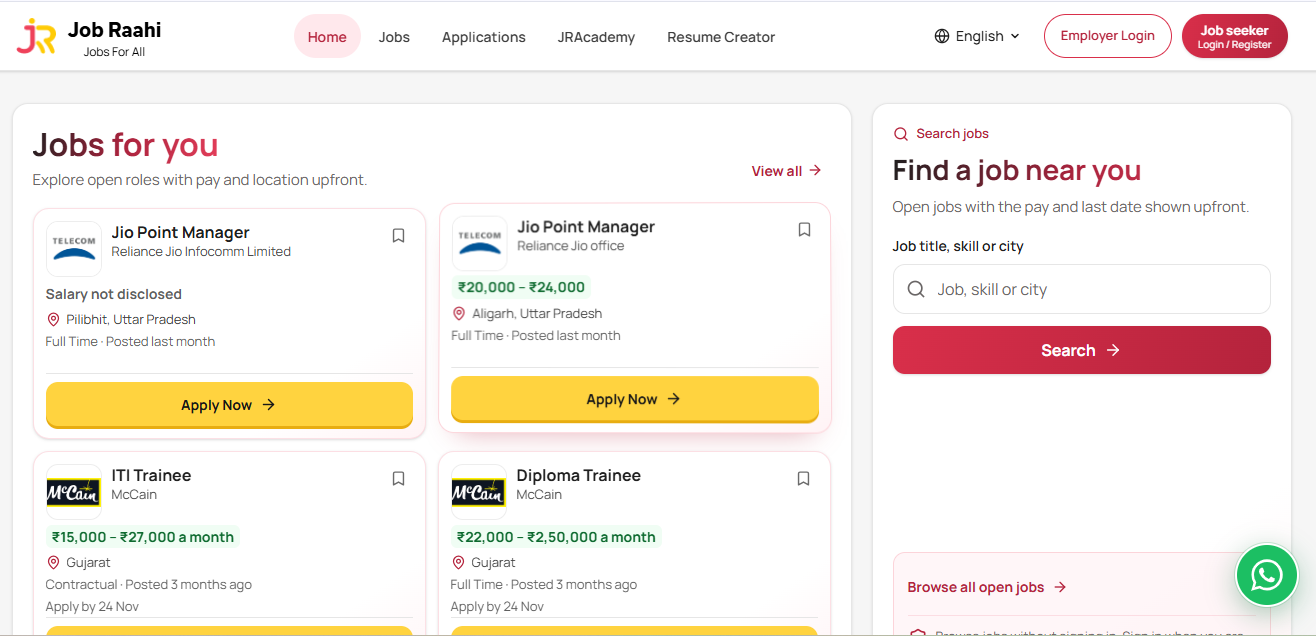
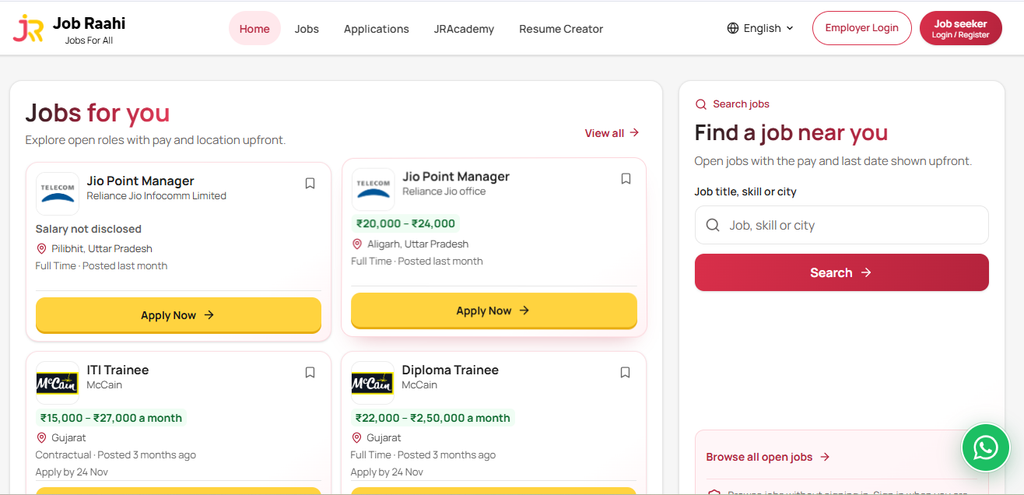
    Job Raahi is a digital job platform focused on frontline and mass hiring opportunities.

    It connects companies with candidates exploring employment opportunities across areas such as logistics, warehousing, retail, delivery, sales, customer support, hospitality and other frontline roles.

    For freshers and candidates with limited work experience, platforms like Job Raahi offer an additional channel to discover relevant job openings and explore opportunities.

    The objective is to make job discovery more accessible by connecting employers with candidates from different backgrounds and locations.

    For someone starting their career, exploring digital job platforms can be one practical step towards understanding the employment market and finding suitable opportunities.

    DIgital Job platform Job Raahi for freshers

    Conclusion: Make Digital Platforms Part of Your Career Journey

    Your first job search does not have to depend on personal references or limited local information alone.

    Digital job platforms have created another way for freshers to discover vacancies, understand employer requirements and apply for opportunities across different industries.

    However, the real value comes from using these platforms wisely.

    Build an accurate profile, explore relevant vacancies, verify employers, apply consistently and prepare yourself for the selection process.

    Remember, your first job is not just about getting employed. It is about finding an opportunity where you can learn, gain practical experience and build the foundation for your future career.

    Start exploring, keep learning and take your first step towards a career with confidence

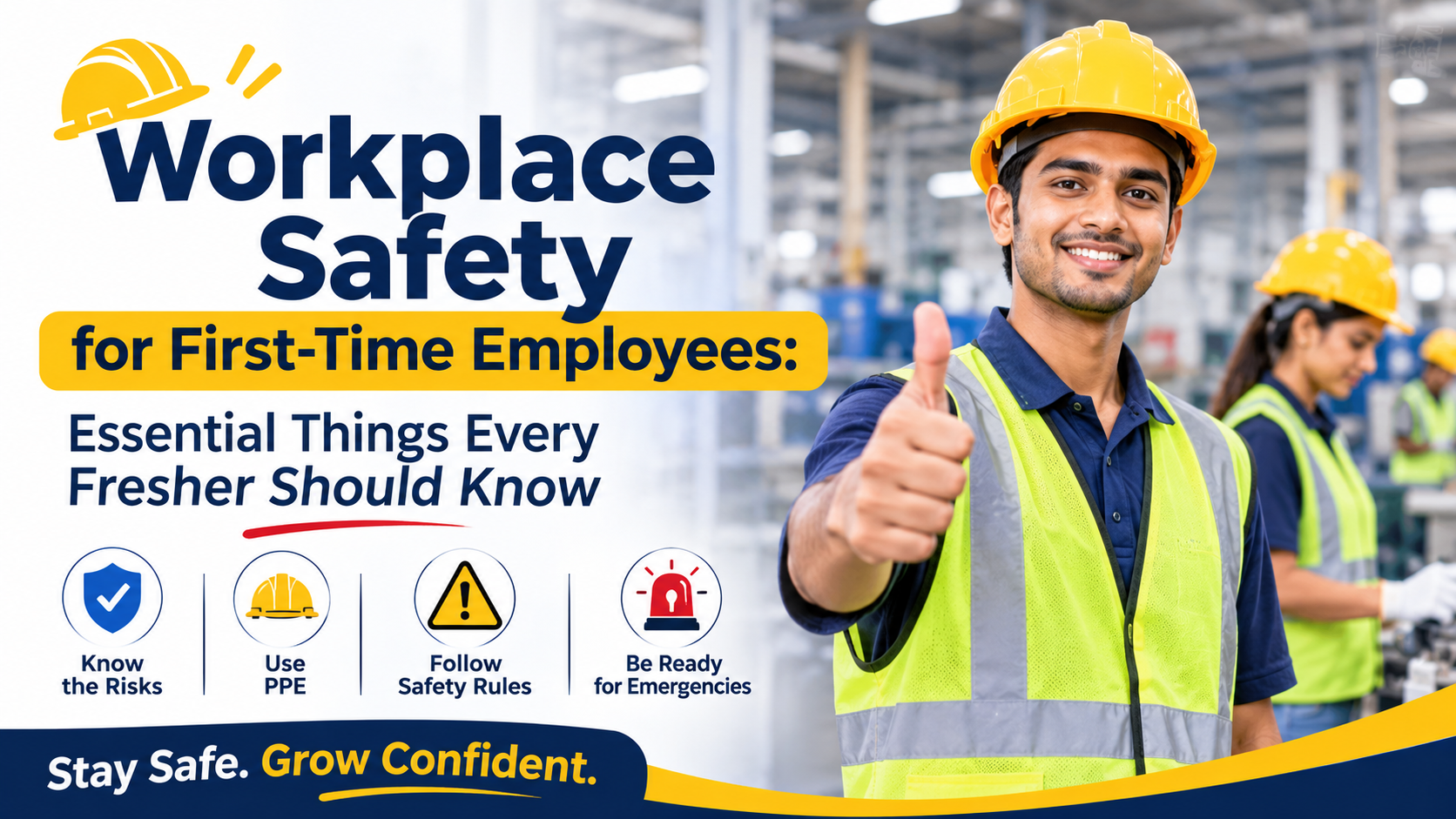
  • Workplace Safety for First-Time Employees: Essential Things Every Fresher Should Know

    Workplace Safety for First-Time Employees: Essential Things Every Fresher Should Know

    Getting your first job is an important milestone. Whether you are joining a factory, warehouse, retail store, delivery operation or hospitality business, your first few days will involve learning new tasks, meeting colleagues and understanding how the workplace operates.

    But there is one thing every new employee should prioritise from the beginning: workplace safety.

    For someone entering the workforce for the first time, workplace environments can be unfamiliar. Machinery, electrical equipment, heavy materials, slippery floors, crowded storage areas and long working hours may introduce risks that are not always obvious.

    Understanding basic safety practices can help you protect yourself, support your colleagues and become a more responsible employee.

    Why Workplace Safety Matters

    Workplace safety is not just about following instructions or wearing a helmet. It is about creating an environment where employees can perform their responsibilities without unnecessary risks.

    For example:

    • A warehouse associate needs to understand safe material handling.
    • A factory worker must follow machinery operating instructions.
    • A delivery executive should understand road safety and vehicle precautions.
    • A retail employee should know how to handle equipment and maintain clear walkways.

    Every role comes with different responsibilities and potential hazards. The International Labour Organization recognises a safe and healthy working environment as a fundamental principle and right at work.

    For freshers, learning safety practices early can also build confidence and demonstrate professionalism.

    Understand Your Workplace Before Starting

    Before beginning any task, take time to understand your work environment.

    During your induction or initial training, pay attention to:

    • Entry and exit points.
    • Emergency exits and assembly areas.
    • First-aid facilities.
    • Fire extinguishers and alarm systems.
    • Restricted or hazardous areas.
    • Safety signs and instructions.
    • The person to contact in case of an emergency.

    Never assume that you already know how a workplace operates. Ask your supervisor whenever something is unclear.

    A few questions at the beginning can prevent confusion later.

    Learn to Use Personal Protective Equipment

    Personal Protective Equipment (PPE) refers to equipment designed to reduce exposure to workplace hazards.

    Depending on the job, it may include:

    • Safety helmets: To protect against certain head injuries.
    • Safety shoes: To protect feet from impact and other workplace hazards.
    • Gloves: To protect hands when handling suitable materials.
    • Safety goggles: To protect eyes from dust, particles or splashes.
    • Reflective jackets: To improve visibility in certain work environments.
    • Ear protection: To reduce exposure to excessive noise.

    However, simply wearing PPE is not enough. Employees must understand which equipment is suitable for their tasks, how to wear it correctly and when it needs replacement.

    Always follow your employer’s training and instructions. Never use damaged or unsuitable protective equipment.

    Identify and Report Workplace Hazards

    A workplace hazard is anything that could potentially cause injury or harm.

    Some common examples include:

    • Wet or slippery floors.
    • Exposed electrical wires.
    • Damaged machinery.
    • Unsecured heavy materials.
    • Blocked emergency exits.
    • Poorly stored chemicals.
    • Unsafe lifting or handling practices.

    Freshers should develop the habit of observing their surroundings.

    If you notice something unsafe, inform your supervisor or the designated safety representative immediately. Do not try to repair machinery or handle hazardous materials unless you are trained and authorised to do so.

    Reporting a potential risk is not complaining. It is a responsible action that can help prevent accidents.

    Follow Safety Rules and Instructions

    Every workplace has procedures designed to help employees perform tasks safely.

    As a new employee, make sure you:

    • Follow the instructions given during training.
    • Operate machinery only when authorised.
    • Never bypass safety guards or warning systems.
    • Avoid running or rushing in work areas.
    • Use the correct tools for assigned tasks.
    • Follow material handling and lifting instructions.
    • Avoid distractions while performing safety-sensitive work.

    If you are asked to perform a task you have not been trained for, seek guidance before proceeding.

    Being willing to learn is important, but taking unnecessary risks to prove yourself is not.

    workplace safety

    Know What to Do During an Emergency

    Emergencies can happen unexpectedly. Knowing the correct response can make a significant difference.

    Every employee should understand:

    • How to recognise emergency alarms.
    • Which evacuation route to follow.
    • Where the assembly point is located.
    • Whom to contact during an emergency.
    • Where first-aid support is available.

    Participate seriously in fire drills and emergency training. Do not use lifts during a fire evacuation unless the workplace’s emergency procedure specifically instructs otherwise.

    Most importantly, remain calm and follow the instructions of trained emergency personnel.

    Build Good Safety Habits from Day One

    Workplace safety becomes more effective when it is part of your daily routine.

    Here are a few habits every fresher should develop:

    Arrive prepared: Wear the required uniform and protective equipment.

    Stay attentive: Avoid distractions while working around machinery, vehicles or moving equipment.

    Keep your area organised: Do not leave tools, materials or waste in walkways.

    Ask questions: Never hesitate to clarify an unfamiliar instruction.

    Take breaks responsibly: Follow workplace guidelines and pay attention to fatigue, heat and physical discomfort.

    Look out for others: If you notice a colleague working in an unsafe way, raise the concern respectfully or inform the supervisor.

    Small habits can contribute to a safer working environment for everyone.

    The Role of Employers in Workplace Safety

    Workplace safety is a shared responsibility, but employers play a major role in creating safe working conditions.

    Organisations should provide appropriate safety training, communicate workplace risks, maintain equipment, make suitable protective equipment available and establish clear emergency procedures.

    New employees should receive role-specific guidance rather than being expected to understand every safety requirement on their own.

    The Directorate General Factory Advice Service & Labour Institutes (DGFASLI), under India’s Ministry of Labour & Employment, works on occupational safety, health and welfare in factories and ports.

    A workplace that takes safety seriously helps employees learn their responsibilities and perform their jobs with greater confidence.

    Conclusion: Make Safety Part of Your Career Journey

    Your first job is about more than earning a salary. It is where you develop professional habits, learn practical skills and understand workplace responsibilities.

    Whether you are starting as a warehouse associate, production worker, delivery executive, retail assistant or customer support employee, safety should always be part of your working routine.

    Remember: A good employee is not just someone who completes tasks on time, but someone who understands how to complete them responsibly and safely.

    As you explore new career opportunities, look for employers who value proper training, clear instructions and employee well-being.

    At Job Raahi, candidates can explore job opportunities across frontline and entry-level roles. As you take your next career step, make learning, responsibility and workplace safety part of your professional journey.

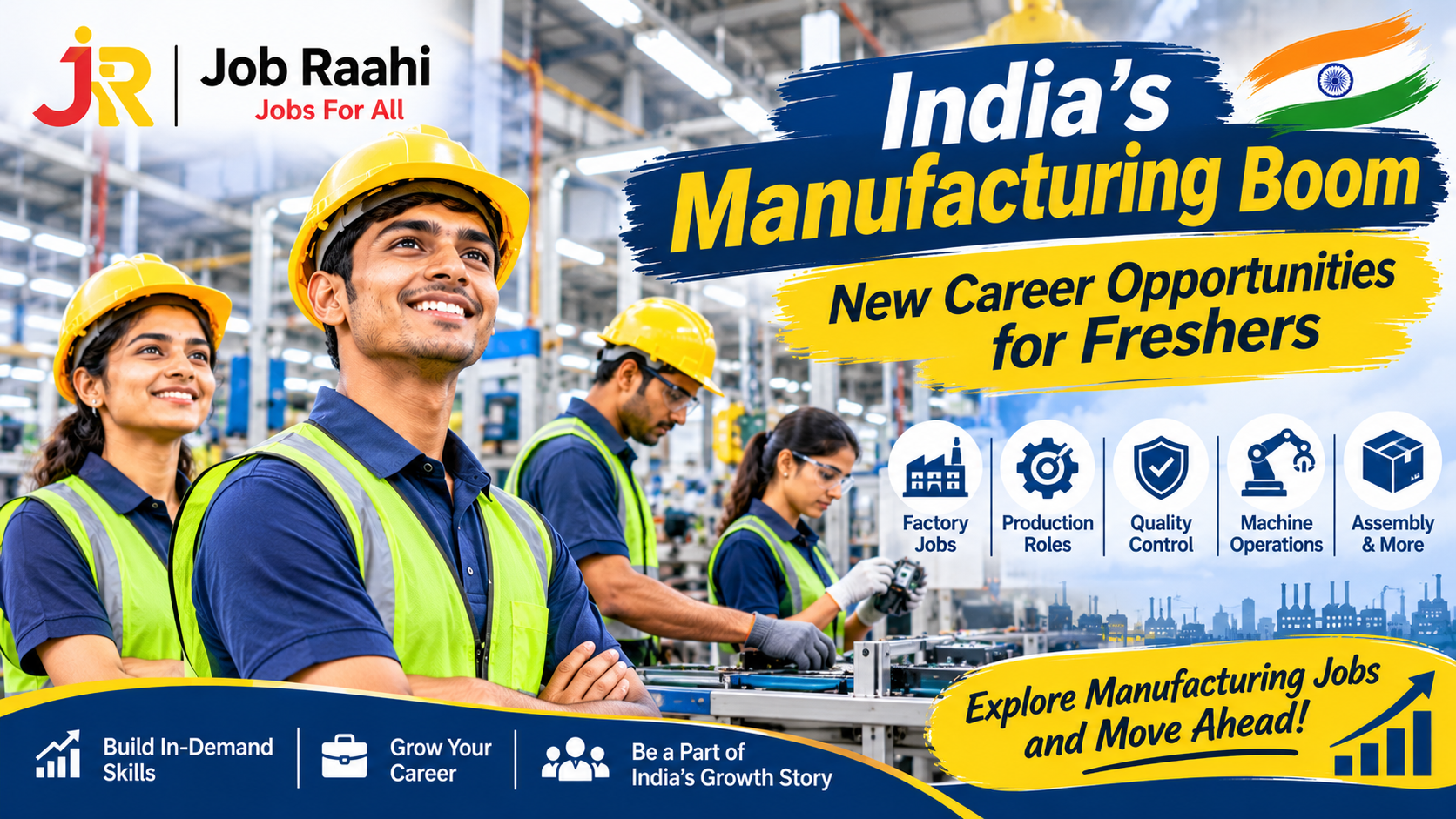
  • India’s Manufacturing Boom: What It Means for Entry-Level Job Seekers

    India’s Manufacturing Boom: What It Means for Entry-Level Job Seekers

    When people think about manufacturing, they often imagine large factories, heavy machinery and experienced engineers working on production systems. But behind every manufactured product is a much larger workforce performing different tasks, from assembling components and operating machines to checking product quality, packaging goods and managing production activities.

    India’s manufacturing industry is evolving. Businesses across automobiles, electronics, pharmaceuticals, textiles, food processing, chemicals and other industries are investing in production capabilities and improving their manufacturing processes.

    This growth is creating opportunities not only for engineers and experienced professionals but also for people entering the workforce for the first time.

    For freshers, ITI students, diploma holders and candidates looking for practical employment, manufacturing can offer a pathway to learn industry-specific skills, gain experience and build a long-term career.

    So, what kinds of jobs are available, and how can candidates prepare themselves?

    Let’s explore.

    1. India’s Manufacturing Sector: Why It Matters

    Manufacturing plays an important role in India’s economic development. It supports industrial production, creates demand for raw materials, strengthens supply chains and generates employment across different skill levels.

    The government’s Annual Survey of Industries (ASI) 2024–25 provides a useful picture of this progress.

    According to the Ministry of Statistics and Programme Implementation (MoSPI):

    • India had approximately 2.67 lakh registered manufacturing establishments during 2024–25.
    • The estimated number of persons engaged in registered manufacturing increased to approximately 2.10 crore, compared with 1.96 crore in the previous survey year.
    • Manufacturing employment recorded growth of 7.19% over the previous year.
    • The sector added more than 14 lakh persons engaged during the year.

    The five leading states in manufacturing employment were Tamil Nadu, Maharashtra, Gujarat, Uttar Pradesh and Haryana.

    These figures indicate that manufacturing is an important source of employment in India. However, they cover registered manufacturing establishments and should not be interpreted as the number of vacancies currently available.

    For job seekers, the bigger takeaway is that manufacturing offers employment across a wide range of industries, locations and job responsibilities.

    2. How Manufacturing Growth Creates Job Opportunities

    When a manufacturing business expands its production capacity, it needs more than machines and infrastructure. It also needs people to operate, monitor and support its daily activities.

    For example, when an automobile manufacturer increases production, its workforce requirements may include:

    • Production line associates
    • Assembly technicians
    • Machine operators
    • Quality inspection assistants
    • Material handling workers
    • Packaging associates
    • Maintenance assistants
    • Warehouse and dispatch staff

    Similarly, an electronics manufacturing unit may require employees for component assembly, testing, inspection, packaging and inventory handling.

    This creates opportunities at different entry levels.

    Candidates do not necessarily need an engineering degree for every manufacturing position. Some roles are suitable for candidates with Class 10 or 12 qualifications, while technical positions may require ITI, Polytechnic, Diploma or specialised training.

    The important thing is to understand the job requirements and identify the skills needed for the specific role.

    3. Entry-Level Manufacturing Jobs You Should Know About

    Manufacturing offers several job roles that freshers can explore, depending on their qualifications and the employer’s requirements.

    A. Production Associate

    Production associates support everyday manufacturing activities and help ensure that products are made according to established processes.

    Typical responsibilities:

    • Supporting daily production activities.
    • Handling materials and components.
    • Following instructions from supervisors.
    • Maintaining cleanliness and workplace safety.
    • Meeting assigned production targets.

    This role can be a starting point for candidates interested in factory operations.

    B. Assembly Line Worker

    Assembly line employees work on putting together different components to create finished products or subassemblies.

    For example, automobile and electronics manufacturing units require employees to assemble parts, fit components and complete defined production tasks.

    Typical responsibilities:

    • Assembling components according to instructions.
    • Using basic tools and equipment.
    • Following standard operating procedures.
    • Checking whether components are fitted correctly.

    Attention to detail, coordination and consistency are important for this role.

    C. Machine Operator

    Machine operators work with manufacturing equipment used for cutting, shaping, processing or producing different products.

    Typical responsibilities:

    • Operating assigned machinery after appropriate training.
    • Monitoring machine performance.
    • Following safety procedures.
    • Reporting unusual sounds, faults or operational problems.
    • Maintaining basic production records.

    Some machine operator positions require technical qualifications or prior experience, while others offer supervised training for suitable entry-level candidates.

    D. Quality Control Assistant

    Quality control employees help ensure that products meet the required standards before moving to the next stage.

    Typical responsibilities:

    • Checking products for visible defects.
    • Measuring or inspecting components.
    • Identifying quality issues.
    • Recording inspection results.
    • Reporting problems to supervisors.

    Basic measurement skills, observation and attention to detail can be valuable.

    E. Packaging Associate

    Packaging associates prepare finished products for storage, transportation or distribution.

    Typical responsibilities:

    • Packing finished products.
    • Checking labels and product details.
    • Following packaging instructions.
    • Maintaining packaging quality.
    • Preparing goods for dispatch.

    This role is common across food processing, pharmaceuticals, consumer goods, electronics and other manufacturing industries.

    F. Material Handling Assistant

    Material handling employees support the movement of raw materials, components and finished products within a manufacturing facility.

    Typical responsibilities:

    • Moving materials between designated areas.
    • Supporting loading and unloading.
    • Organising materials.
    • Maintaining records where required.
    • Following material-handling safety procedures.

    4. Which Industries Can Freshers Explore?

    India’s manufacturing ecosystem includes several industries, each with different employment requirements.

    1. Automobile Manufacturing

    Automobile companies and their suppliers require workers for assembly, production, inspection, material handling and maintenance.

    Potential roles include assembly associate, production assistant, quality checker and machine operator.

    2. Electronics Manufacturing

    The electronics industry involves assembling, testing and inspecting electronic components and devices.

    Potential roles include electronics assembly associate, testing assistant, production operator and packaging associate.

    ITI and Diploma candidates with electrical or electronics knowledge may find relevant technical pathways.

    3. Food Processing

    Food processing units require employees to support production, sorting, packaging, quality checks and storage.

    Potential roles include production helper, packaging associate, quality assistant and machine operator.

    4. Textile and Garment Manufacturing

    Textile and garment factories involve fabric processing, stitching, finishing, inspection and packaging.

    Potential roles include sewing machine operator, production assistant, finishing associate and quality checker.

    5. Pharmaceutical Manufacturing

    Pharmaceutical manufacturing involves regulated production and quality processes.

    Depending on eligibility and training, entry-level opportunities may include packaging assistant, production support and quality documentation support.

    Some roles require specific educational qualifications and compliance training.

    6. Metal and Engineering Manufacturing

    Metal and engineering units manufacture industrial components, tools, machinery and equipment.

    Potential roles include fitter, fabrication assistant, machine operator, maintenance trainee and inspection assistant.

    Manufacturing sector for freshers

    5. Skills Required to Start a Manufacturing Career

    A manufacturing job requires more than the ability to complete physical tasks. Employees must understand workplace procedures, follow instructions and work safely.

    Here are some useful skills candidates should develop.

    A. Basic Technical Knowledge

    Understanding tools, equipment, measurements and basic machine operations can be useful for production and assembly roles.

    Candidates from ITI trades such as fitter, electrician, machinist, welder and electronics may have relevant foundational knowledge.

    B. Safety Awareness

    Factories may involve machinery, electrical equipment, moving materials and other workplace hazards.

    Candidates should understand the importance of protective equipment, safety instructions and reporting unsafe conditions.

    Job-specific safety training must be provided before employees operate machinery or handle hazardous materials.

    C. Attention to Detail

    Small mistakes in assembly, measurement or packaging can affect product quality.

    Employees should develop the habit of checking their work and following instructions carefully.

    D. Teamwork and Communication

    Manufacturing operations depend on coordination between production, quality, maintenance, inventory and dispatch teams.

    Basic communication and teamwork help employees understand tasks and report problems.

    E. Basic Digital Skills

    Many factories use digital systems to record production, monitor equipment and maintain inventory.

    Basic computer knowledge, digital reporting and familiarity with workplace applications can help candidates adapt to modern production environments.

    F. Discipline and Time Management

    Production activities often follow shift schedules and defined timelines.

    Punctuality, attendance, consistency and the ability to complete assigned tasks are important workplace habits.

    6. How Technology Is Changing Factory Jobs

    Modern manufacturing is increasingly adopting digital systems, automation and advanced machinery.

    Some examples include:

    Industrial Automation: Automated machines and robotic systems are being used for repetitive and precision-based production activities.

    Digital Monitoring: Production teams use software and digital dashboards to monitor output, equipment performance and operational efficiency.

    Quality Inspection Technology: Digital measuring tools and inspection systems help identify product defects and maintain quality standards.

    Computer-Controlled Machines: CNC machines and other computer-controlled equipment require trained operators who understand machine settings and operating procedures.

    Inventory and Production Software: Digital systems help companies monitor raw materials, work-in-progress and finished products.

    Does this mean technology will eliminate factory jobs?

    Not necessarily. Technology changes the nature of work, but manufacturing facilities still need people to operate equipment, monitor processes, inspect products, maintain machines and resolve operational issues.

    For candidates, learning how to work alongside technology can create an advantage.

    7. Can ITI and Diploma Freshers Find Opportunities?

    Yes. Manufacturing is one of the sectors where vocational and technical education can be directly relevant to workplace requirements.

    Different qualifications can lead to different career pathways.

    Educational BackgroundPossible Manufacturing Roles
    Class 10 / Class 12Production helper, packaging associate, material handling assistant
    ITI FitterAssembly assistant, fitter trainee, maintenance assistant
    ITI ElectricianElectrical maintenance trainee, electrical assistant
    ITI WelderWelding trainee, fabrication assistant
    ITI MachinistMachine operator trainee, machining assistant
    Diploma in MechanicalProduction technician, quality assistant, maintenance trainee
    Diploma in Electrical / ElectronicsElectrical technician, testing assistant, production technician

    These are indicative pathways, not guaranteed job eligibility. Actual requirements depend on the employer, machinery, industry and responsibilities.

    Candidates should also consider apprenticeship opportunities, where eligible, to gain structured practical exposure and workplace experience.

    8. How to Prepare for Your First Manufacturing Job

    If you are a fresher interested in manufacturing, you can take the following steps to prepare.

    Step 1: Identify Your Area of Interest

    Explore different industries and roles. Decide whether you are more interested in production, assembly, machine operations, quality inspection or maintenance.

    Step 2: Understand Job Requirements

    Read job descriptions carefully. Check the required education, technical knowledge, work location, shift timings and other conditions.

    Step 3: Improve Practical Skills

    Revise the basics of your ITI trade or diploma subject. Learn about relevant tools, equipment, measurements and safety procedures.

    Step 4: Build a Simple Resume

    Mention your educational qualifications, technical trade, practical training, projects, certifications and relevant skills.

    Even if you do not have professional experience, your practical learning can demonstrate your readiness for an entry-level position.

    Step 5: Explore Apprenticeships and Entry-Level Vacancies

    Apprenticeships and trainee positions can help candidates gain workplace exposure. Explore recognised opportunities and verify the terms, eligibility and training arrangements before applying.

    Step 6: Prepare for Interviews

    Be ready to explain what you learned during your course, which tools or machines you have worked with and why you are interested in manufacturing.

    Employers may also assess your willingness to learn, safety awareness, discipline and ability to follow instructions.

    9. Career Growth in the Manufacturing Industry

    An entry-level manufacturing job can become the foundation for a longer career.

    With practical experience, technical training and consistent performance, employees may gradually take on more responsibilities.

    A possible career pathway could look like:

    Production Helper → Production Associate → Senior Operator → Team Leader → Production Supervisor

    Other career pathways include:

    • Packaging Associate → Packaging Machine Operator → Packaging Supervisor
    • Quality Assistant → Quality Inspector → Quality Supervisor
    • Maintenance Trainee → Maintenance Technician → Maintenance Supervisor
    • Assembly Associate → Skilled Assembly Technician → Line Leader

    Career growth depends on the employee’s performance, technical development, available vacancies and company policies.

    The important point is that an entry-level role can help candidates build industry experience and identify the area in which they want to specialise.

    10. Conclusion: India’s Manufacturing Growth Can Open New Career Pathways

    India’s manufacturing industry is creating opportunities across production, assembly, quality control, machine operations, packaging and maintenance.

    For freshers, this means there are career options beyond traditional office-based employment. Candidates with practical knowledge, technical training, discipline and a willingness to learn can explore opportunities in different manufacturing industries.

    For ITI and Diploma students, manufacturing can provide a chance to apply classroom knowledge in real workplace environments. For candidates without specialised technical qualifications, suitable entry-level roles can offer an opportunity to gain experience and develop new skills.

    The manufacturing industry needs more than advanced technology and investment. It also needs people who can operate, maintain, manage and improve everyday production processes.

    Your first manufacturing job could be the beginning of a skilled career. Start with the right opportunity, develop your abilities and keep moving forward.

    At Job Raahi, we believe that employment opportunities should be accessible to candidates from different educational and professional backgrounds. By connecting employers with motivated freshers and frontline talent, we aim to make more career pathways visible and accessible.

    Learn a skill. Find an opportunity. Build your future.

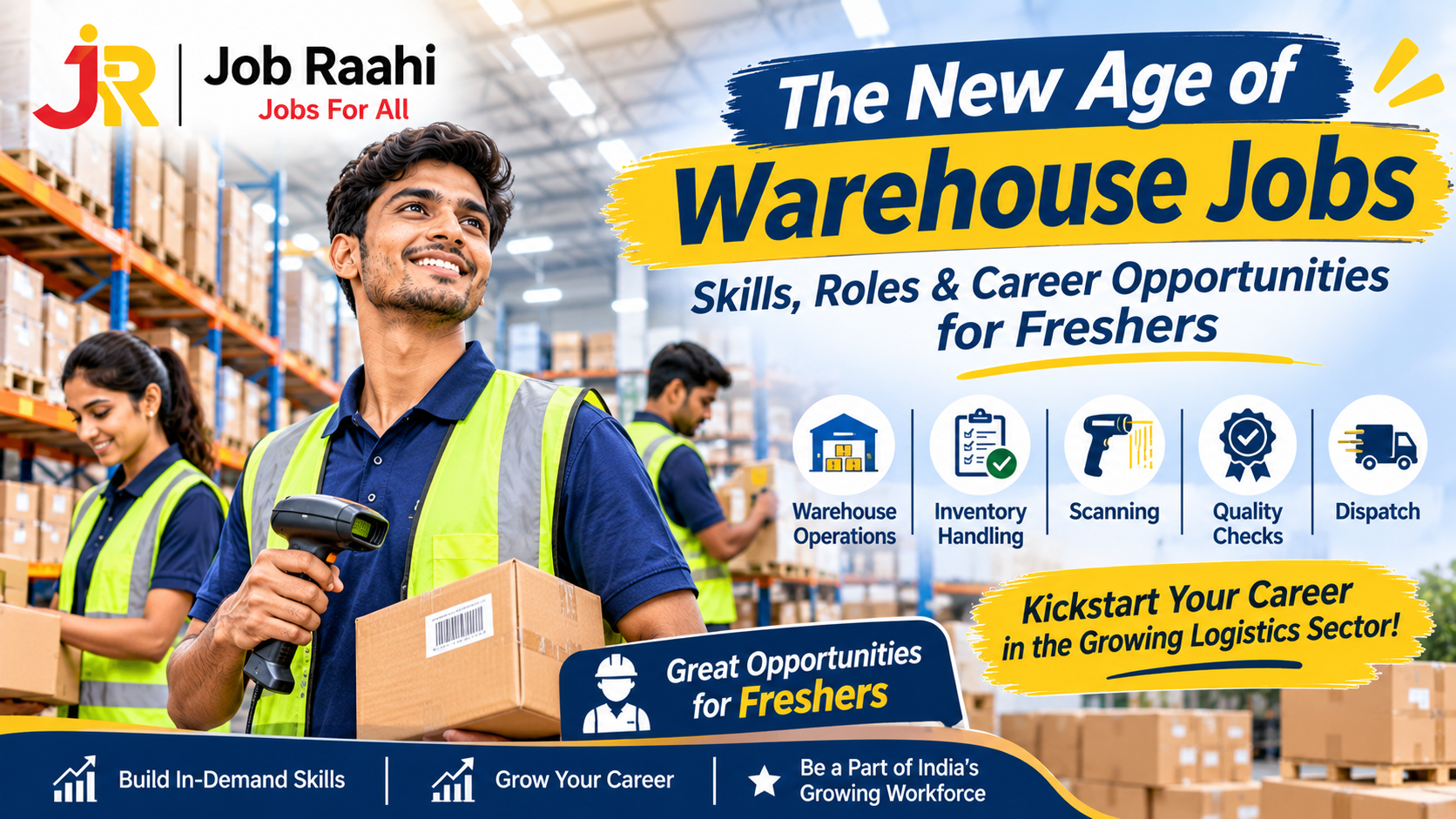
  • The New Age of Warehouse Jobs: Skills, Roles and Career Opportunities

    The New Age of Warehouse Jobs: Skills, Roles and Career Opportunities

    Think about what happens after you place an order online. The product may be stored in a warehouse, located through an inventory system, picked by a warehouse associate, checked, packed and prepared for dispatch. Only after completing these steps does it move towards your doorstep.

    Behind this seemingly simple process is an entire team of people managing products, technology, inventory and daily operations.

    As e-commerce, retail, manufacturing and logistics businesses expand, warehouse operations are becoming increasingly organised and technology-driven. Warehouses are no longer just storage spaces. They are important parts of the supply chain, where every activity contributes to delivering products accurately and on time.

    This transformation is also creating different employment opportunities for freshers, ITI students, Class 10 and 12 pass candidates and people looking to enter the frontline workforce.

    Let’s explore the new age of warehouse jobs, the roles available and the skills candidates need to get started.

    1. How Warehouse Jobs Are Changing

    Traditionally, warehouse work was associated mainly with loading, unloading and storing goods. While these activities remain important, modern warehouse operations involve much more.

    Businesses now use digital systems to track inventory, manage orders, monitor stock movement and coordinate dispatch activities.

    For example, when an online order is received, warehouse teams may use handheld scanners or mobile applications to locate products, confirm quantities and update order status.

    This means warehouse employees need a combination of practical, technical and operational skills.

    Some important changes include:

    • Digital inventory management: Stock information is increasingly recorded and updated through software.
    • Barcode scanning: Employees use scanners to identify products and update their movement.
    • Order-based operations: Picking and packing activities are organised around customer orders.
    • Quality checks: Products are inspected to reduce errors, damage and incorrect deliveries.
    • Faster dispatch processes: Teams coordinate to prepare orders within operational timelines.
    • Safety and process compliance: Warehouses follow defined procedures for handling products, equipment and workplace risks.

    As a result, warehouse jobs are becoming more structured, and employees who understand both physical operations and basic technology can be valuable to employers.

    2. Understanding How a Modern Warehouse Works

    Before exploring job roles, it helps to understand the basic warehouse process.

    A typical warehouse operation involves several stages.

    A. Receiving Goods

    Products arrive at the warehouse from suppliers, manufacturers or distribution centres. Employees receive shipments and check quantities against delivery documents.

    B. Sorting and Put-Away

    After receiving, products are sorted and moved to their designated storage locations. Proper placement makes it easier to locate items when orders arrive.

    C. Inventory Management

    The warehouse team maintains records of available stock, product movement and storage locations. Accurate inventory information helps businesses avoid shortages, excess stock and misplaced products.

    D. Picking and Packing

    When an order is received, employees locate the required products, collect the correct quantities and prepare them for packaging.

    E. Quality Checking

    Products may be checked for damage, incorrect quantities, packaging issues or other problems before dispatch.

    F. Dispatch

    Finally, orders are labelled, sorted and handed over for transportation or delivery.

    Every stage depends on coordination. A mistake in receiving or inventory management can affect picking, packing and dispatch. This is why warehouse employees play an important role in the overall supply chain.

    3. Different Types of Warehouse Jobs

    Warehouse operations offer several entry-level and specialised roles. Candidates can explore opportunities based on their education, physical capabilities, technical knowledge and interests.

    1. Warehouse Associate

    Warehouse associates support everyday operations, including receiving, sorting, moving and organising products.

    Typical responsibilities:

    • Handling products and maintaining organised storage areas.
    • Supporting loading and unloading activities.
    • Following instructions from supervisors.
    • Maintaining workplace cleanliness and safety.

    This can be a starting point for candidates entering the logistics industry.

    2. Picker

    Pickers locate and collect products according to customer orders or internal requirements.

    Typical responsibilities:

    • Checking order details.
    • Locating products in assigned storage areas.
    • Collecting the correct quantity and product.
    • Using barcode scanners or picking applications where required.

    Accuracy and attention to detail are important for this role.

    3. Packer

    Packers prepare products for shipment while ensuring they are properly protected.

    Typical responsibilities:

    • Checking picked items against order details.
    • Selecting suitable packaging materials.
    • Packing and labelling products.
    • Following packaging and quality guidelines.

    This role requires care, consistency and the ability to follow standard procedures.

    4. Inventory Assistant

    Inventory assistants help maintain accurate records of products stored in a warehouse.

    Typical responsibilities:

    • Updating stock information.
    • Supporting physical stock counts.
    • Identifying discrepancies.
    • Recording incoming and outgoing products.
    • Coordinating with warehouse supervisors.

    Basic computer knowledge and attention to detail can be useful.

    5. Scanning and Data Entry Associate

    Many warehouses use barcode-based systems to track products and orders.

    Employees in these roles scan items, update records and ensure that product movement is correctly reflected in digital systems.

    Basic smartphone or computer knowledge, accuracy and familiarity with digital applications can help candidates perform these responsibilities.

    6. Quality Checker

    Quality checkers inspect products and packaging before items move to the next stage.

    Typical responsibilities:

    • Identifying damaged or defective products.
    • Checking quantities and product details.
    • Reporting packaging issues.
    • Following quality inspection procedures.

    Observation and attention to detail are particularly important.

    7. Dispatch Associate

    Dispatch associates help prepare completed orders for transportation.

    Typical responsibilities:

    • Sorting orders according to destination or route.
    • Checking labels and shipment details.
    • Coordinating with loading teams.
    • Maintaining dispatch records.
    • Ensuring orders are handed over according to procedures.

    This role requires coordination, organisation and accuracy.

    4. Essential Skills Required for Warehouse Jobs

    Candidates do not always need advanced qualifications to enter warehouse operations. However, certain skills can improve their ability to perform effectively.

    A. Basic Digital Literacy

    Employees may need to use smartphones, barcode scanners, handheld devices and basic computer applications.

    Knowing how to navigate applications, enter information and follow digital instructions can be an advantage.

    B. Attention to Detail

    Incorrect product selection, quantity mismatches and scanning errors can affect the entire order process.

    Candidates should develop the habit of checking details carefully.

    C. Communication and Teamwork

    Warehouse activities involve coordination between receiving, inventory, picking, packing and dispatch teams.

    Clear communication helps employees understand instructions and complete tasks efficiently.

    D. Time Management

    Warehouse operations often work according to order volumes and dispatch schedules. Employees need to manage their assigned tasks while maintaining accuracy and safety.

    E. Safety Awareness

    Workers should understand basic workplace safety, proper handling procedures and the correct use of protective equipment.

    Training is particularly important when handling machinery, heavy goods or specialised equipment.

    F. Willingness to Learn

    Warehouse technologies and processes can vary between employers. Candidates who are open to learning new systems and following standard operating procedures can adapt more effectively.

    5. How Technology Is Transforming Warehouse Operations

    Technology is changing how warehouses manage products, employees and orders.

    Some commonly used technologies include:

    Barcode Scanners: Help employees identify products and record stock movement accurately.

    Warehouse Management Systems (WMS): Software used to manage inventory, storage locations, orders and warehouse activities.

    Digital Inventory Tools: Help teams monitor stock availability and maintain records.

    Conveyor Systems: Move products between different operational areas and support faster handling.

    Automated Equipment: Some facilities use automated storage systems, sorting equipment and robotics to support repetitive tasks.

    However, technology does not eliminate the need for people. Employees are still needed to monitor processes, handle exceptions, maintain equipment, perform quality checks and coordinate daily activities.

    The ability to work alongside digital tools is becoming an increasingly useful skill for warehouse employees.

    warehouse jobs

    6. Can Freshers Build a Career in Warehousing?

    Yes. Warehouse operations can offer an entry point into the employment market for candidates with different educational backgrounds.

    Freshers do not necessarily need previous warehouse experience for every entry-level vacancy. Employers may provide role-specific training to help new employees understand operational procedures.

    Candidates who may explore these opportunities include:

    • Class 10 and Class 12 pass candidates.
    • ITI and Polytechnic students.
    • Diploma holders.
    • Candidates looking for their first employment opportunity.
    • Individuals with basic computer and digital skills.
    • Workers interested in developing a career in logistics and supply chain operations.

    However, eligibility varies by employer and role. Some positions may have specific educational, physical, location or shift requirements.

    Candidates should always review the job description carefully before applying.

    7. Career Growth Opportunities in Warehouse Operations

    Warehouse jobs do not have to remain limited to entry-level responsibilities.

    With experience, performance and additional training, employees may get opportunities to take on greater responsibilities.

    A possible career pathway could look like this:

    Warehouse Associate → Senior Associate → Team Leader → Warehouse Supervisor → Warehouse Operations Manager

    Other employees may choose to specialise in inventory management, quality control, dispatch coordination or warehouse technology.

    For example, a warehouse associate who develops strong inventory knowledge and digital skills may eventually explore inventory control responsibilities.

    Similarly, an employee who understands team coordination and operational planning may prepare for a supervisory role.

    Career progression is not automatic. It depends on performance, available vacancies, employer policies, training and the skills an employee develops over time.

    8. How to Prepare for Your First Warehouse Job

    If you are interested in entering the warehouse and logistics industry, here are some practical steps to get started.

    Step 1: Understand Different Job Roles

    Explore the responsibilities of warehouse associates, pickers, packers, inventory assistants and dispatch associates. Identify which roles match your interests and abilities.

    Step 2: Improve Basic Digital Skills

    Practise using smartphones, mobile applications, basic computer functions and simple data-entry tools.

    Step 3: Learn Workplace Safety

    Understand the importance of protective equipment, safe product handling, workplace instructions and reporting unsafe conditions.

    Step 4: Prepare a Simple Resume

    Mention your education, ITI or diploma qualification, relevant training, digital skills and any practical experience.

    Step 5: Check Job Requirements

    Before applying, understand the location, salary, shift timings, weekly offs, job responsibilities and any additional requirements.

    Step 6: Be Ready to Learn

    During interviews, communicate your willingness to learn, follow instructions and take responsibility for assigned work.

    Candidates can also explore job opportunities through digital employment platforms such as Job Raahi, where they can discover relevant openings and apply according to their qualifications and interests.

    9. The Future of Warehouse Jobs

    As businesses continue to invest in logistics, e-commerce, retail distribution and supply chain operations, warehouses will remain important employment destinations.

    The nature of these jobs may continue to evolve with the adoption of digital tools, automation and improved operational systems.

    For candidates, this creates an opportunity to enter an industry where practical skills, discipline, accuracy and continuous learning matter.

    For employers, it highlights the importance of recruiting candidates who can adapt to operational requirements and providing them with the training needed to perform effectively.

    Conclusion

    A modern warehouse is much more than a place where products are stored. It is a coordinated operational environment that connects suppliers, businesses and customers.

    From picking and packing to inventory management, scanning, quality checks and dispatch, every role contributes to keeping the supply chain moving.

    For freshers, warehouse jobs can offer a practical starting point to gain workplace experience, develop technical and operational skills and explore long-term career opportunities.

    Your career in logistics does not have to begin with a management position. It can begin with one opportunity, one skill and the willingness to learn.

    At Job Raahi, we believe that every job can be a starting point for something bigger. Our aim is to help candidates discover relevant employment opportunities and connect with employers looking for motivated frontline talent.
    Explore opportunities. Build practical skills. Move your career forward.

  • Upskilling for the Green Economy: What India’s Workforce Needs to Learn Now

    Upskilling for the Green Economy: What India’s Workforce Needs to Learn Now

    The future of work is changing, and one of the biggest forces behind this change is the shift towards a greener economy.

    Across India, businesses are exploring renewable energy, electric vehicles, energy-efficient buildings, waste recycling and sustainable manufacturing. These changes are not only about protecting the environment. They are also creating new kinds of work and changing the skills employers need.

    Think about a solar installation company. It needs more than engineers to design systems. It also needs technicians to install panels, electricians to connect equipment, workers to inspect installations and service teams to maintain systems.

    The same is true for electric vehicles, recycling facilities and energy-efficient industries.

    This creates an important opportunity for India’s workforce: workers who build relevant technical and practical skills today can prepare themselves for the jobs emerging tomorrow.

    1. Why Green Skills Are Becoming Important in India

    India’s green transition is moving beyond long-term environmental goals and becoming a workforce and business priority.

    A June 2026 study by the Council on Energy, Environment and Water (CEEW) and NRDC reported that selected clean-energy sectors added approximately 6.5 lakh workers between FY2023 and FY2026. It also estimated that India’s clean-energy targets and green hydrogen ambitions could support more than 44 lakh full-time-equivalent jobs by 2030. These are estimates, not guaranteed job openings, but they demonstrate the scale of potential workforce demand.

    The study also highlights that around 60% of jobs in clean-energy project deployment require highly skilled or semi-skilled workers. This makes practical training and technical upskilling especially important.

    In August 2026, NITI Aayog’s report on reimagining India’s skilling system also identified areas such as rooftop solar and electric mobility as sectors requiring focused workforce development.

    The message is clear: India’s green transition will need people who can work with new technologies, equipment and processes.

    2. What Is the Green Economy?

    The green economy refers to economic activities that aim to reduce environmental impact while supporting sustainable growth.

    It includes industries that produce cleaner energy, use resources more efficiently, reduce waste and develop environmentally responsible products and services.

    Some important areas include:

    • Renewable energy: Solar, wind and other clean-energy systems.
    • Electric mobility: Electric vehicles, charging infrastructure, battery systems and servicing.
    • Waste management: Recycling, waste segregation, material recovery and processing.
    • Sustainable manufacturing: Reducing energy consumption, material waste and pollution in production.
    • Green construction: Energy-efficient buildings, water conservation and sustainable materials.
    • Environmental services: Water treatment, pollution monitoring and resource management.

    Each area requires a different combination of technical, digital and workplace skills.

    3. Which Industries Are Creating Green Job Opportunities?

    A. Solar and Renewable Energy

    Solar energy is creating opportunities in installation, electrical work, equipment maintenance and field operations.

    Potential roles include:

    • Solar panel installation technician
    • Solar maintenance assistant
    • Electrical technician
    • Site survey assistant
    • Renewable energy field executive

    Workers need basic electrical knowledge, safety awareness, equipment handling and the ability to follow installation procedures.

    B. Electric Vehicles and Battery Technology

    As electric mobility expands, the need for trained people who can maintain and service EVs will also grow.

    Potential roles include:

    • EV service technician
    • Battery maintenance assistant
    • Charging station installation technician
    • EV workshop assistant
    • Quality inspection associate

    Knowledge of electrical systems, batteries, diagnostic tools and safety procedures can be valuable.

    C. Waste Management and Recycling

    Recycling and resource recovery require workers who understand material identification, segregation, processing and safe handling.

    Potential roles include:

    • Recycling plant operator
    • Waste segregation supervisor
    • Material recovery associate
    • Waste collection operations executive
    • Quality control assistant

    D. Sustainable Manufacturing and Green Construction

    Factories and construction businesses are increasingly looking at energy efficiency, resource conservation and improved production practices.

    Potential roles include:

    • Production technician
    • Energy monitoring assistant
    • Equipment maintenance technician
    • Quality control associate
    • Green building site assistant

    These roles often build on existing manufacturing, electrical, mechanical and construction experience.

    Green Economy

    4. Seven Skills India’s Workforce Needs to Learn

    Workers do not necessarily need to begin with advanced degrees to participate in the green economy. Many roles require a strong foundation in practical and technical skills.

    Here are seven areas worth focusing on.

    1. Basic Electrical and Technical Knowledge

    Understanding electrical components, wiring, circuits, tools and equipment is useful in solar installation, EV servicing and industrial maintenance.

    ITI students from electrician, electronics and related trades can build on their existing knowledge.

    2. Renewable Energy Fundamentals

    Workers interested in solar and wind energy should understand how these systems operate, their major components and basic maintenance requirements.

    Learning about solar panels, inverters, batteries and energy generation can provide a useful starting point.

    3. EV and Battery Technology

    Electric vehicles use different systems from conventional vehicles. Workers should begin learning about battery packs, charging systems, electrical safety and basic vehicle diagnostics.

    Automobile and mechanical trade learners can explore additional EV-focused training.

    4. Digital and Data Skills

    Green industries increasingly use digital tools to monitor performance, track energy consumption, record maintenance and manage operations.

    Basic computer skills, spreadsheets, mobile applications, digital reporting and equipment-monitoring software can help workers perform their jobs more effectively.

    5. Safety and Equipment Handling

    Working with electrical systems, batteries, machinery and industrial equipment requires proper safety practices.

    Workers should understand personal protective equipment, safe tool usage, hazard identification, emergency procedures and workplace instructions.

    Safety training should always be specific to the equipment and job role.

    6. Waste Management and Resource Efficiency

    Understanding waste segregation, recycling processes, material recovery and responsible resource use can open pathways into waste management and sustainable manufacturing.

    These skills are also useful in warehouses, factories, commercial facilities and service operations.

    7. Problem-Solving and Communication

    Technical knowledge is important, but workers also need to identify problems, report faults, follow instructions and coordinate with supervisors and customers.

    For field technicians, communication and problem-solving are essential parts of the job.

    5. Who Should Start Upskilling?

    The green economy is not limited to one educational background. Different groups can prepare through different learning pathways.

    ITI and Polytechnic students: Electrician, fitter, electronics, mechanical and automobile students can explore solar, EV maintenance, electrical safety and equipment servicing.

    Freshers and Class 10/12 pass candidates: Entry-level training in waste management, recycling operations, field support and technical assistance can help them explore suitable opportunities.

    Existing frontline and industrial workers: Electricians, mechanics, machine operators, facility staff and maintenance workers may be able to upgrade their existing skills for emerging green roles.

    Women entering technical careers: Accessible training, practical exposure, safe workplaces and employer support can help more women participate in technical green jobs.

    Upskilling does not always mean changing careers completely. Sometimes, adding one relevant skill to an existing trade can create a new career pathway.

    6. How Can Workers Prepare for Green Economy Jobs?

    A practical starting point is more valuable than simply collecting certificates.

    Here is a simple action plan:

    1. Identify an area of interest: Explore solar energy, EVs, recycling, sustainable manufacturing or green construction.
    2. Check the skills required: Study actual job descriptions and identify the technical knowledge employers expect.
    3. Choose relevant training: Look for recognised courses, vocational programmes and practical workshops.
    4. Get hands-on experience: Practise using tools, equipment and safety procedures under qualified supervision.
    5. Build digital confidence: Learn basic computer operations, digital reporting and job-related applications.
    6. Create a skills-based resume: Mention practical training, projects, equipment knowledge and relevant certifications.
    7. Keep learning: Green technologies evolve, so workers should update their knowledge as tools and industry requirements change.

    Useful starting points include Skill India Digital Hub, the Skill Council for Green Jobs and the National Career Service. Candidates should check current course availability, eligibility, certification and placement claims directly with the relevant provider.

    7. What Employers and Training Institutes Need to Do

    Preparing India’s workforce for green jobs cannot be the responsibility of candidates alone.

    Employers should identify the skills required for upcoming projects, offer practical training, provide supervised workplace exposure and create progression opportunities for entry-level workers.

    ITI and vocational institutes should regularly update course content, introduce relevant equipment and provide industry-linked training. Students should understand not only how a technology works, but also how it is installed, maintained and used in real workplaces.

    Training partners and policymakers should connect training programmes with actual labour-market demand. A certificate is useful, but it should lead to demonstrable skills and a realistic employment pathway.

    There is also a need to make technical training more accessible to women and workers in smaller cities, where many emerging green projects and supply chains may create local opportunities.

    8. The Future of Work Is Becoming Greener

    India’s green transition will require investment, technology and supportive policies. But it will also depend on the people who install solar systems, maintain electric vehicles, operate recycling facilities, manage energy-efficient production and keep new infrastructure running.

    For India’s workforce, this is an opportunity to look beyond traditional career paths and prepare for emerging industries.

    A fresher does not need to know everything about the green economy today. An ITI student does not need to master every new technology at once. The important step is to identify a relevant career direction and start learning the skills that employers will need.

    The future will not belong only to people with new degrees. It will also belong to workers who are willing to upgrade their skills, adapt to technology and learn continuously.

    At Job Raahi, we believe that access to the right opportunities should grow alongside access to the right skills. As industries evolve, connecting job seekers with relevant employment opportunities can help more people participate in India’s changing workforce.

    Learn new skills. Stay adaptable. Prepare for the opportunities ahead

  • India’s Next Growth Story Is Local: The Untapped Potential of Tier 2 and Tier 3 Cities

    India’s Next Growth Story Is Local: The Untapped Potential of Tier 2 and Tier 3 Cities

    Table of Contents

    1. Why Are Tier 2 and Tier 3 Cities Gaining Attention?
    2. What Makes These Cities Attractive for Business Growth?
    3. Industries Creating New Opportunities Beyond Metros
    4. The Biggest Opportunity: India’s Local Workforce
    5. Challenges That Still Need Attention
    6. How Businesses Can Unlock the Potential of Smaller Cities
    7. What This Growth Means for Job Seekers
    8. India’s Next Opportunity May Be Closer Than You Think

    For years, India’s biggest metropolitan cities have attracted businesses, investments and job seekers. Cities such as Delhi, Mumbai, Bengaluru and Hyderabad have become familiar destinations for people looking to build their careers.

    But India’s growth story is no longer limited to these major urban centres.

    Look beyond the metros, and a different picture begins to emerge. Cities such as Indore, Coimbatore, Jaipur, Lucknow, Surat, Nagpur, Bhubaneswar and Guwahati are developing stronger business ecosystems, attracting investments and creating employment opportunities.

    These cities are not simply alternatives to metropolitan areas. They are becoming important contributors to India’s economic development.

    The real question is no longer whether smaller cities have potential. It is whether businesses and job seekers are ready to recognise and make use of it.

    1. Why Are Tier 2 and Tier 3 Cities Gaining Attention?

    India’s urban growth is becoming more geographically distributed.

    Businesses are exploring locations beyond traditional metropolitan markets because smaller cities offer opportunities to expand operations, reach new customers and access local talent.

    The Government of India’s Economic Survey 2025–26 highlights the expansion of manufacturing activity beyond metropolitan cities. It points to advantages such as affordable land, lower real estate and wage costs, and proximity to raw materials.

    This shift matters because when businesses expand into a new city, they create demand beyond just a few specialised positions.

    They need people for production, warehouse operations, transportation, retail, sales, customer support, maintenance and administration.

    That means economic expansion can create opportunities for people with different educational qualifications and experience levels.

    2. What Makes These Cities Attractive for Business Growth?

    There is no single reason behind the growing interest in smaller cities. Several factors are working together.

    A. More Accessible Operating Costs

    Compared with many large metropolitan markets, some Tier 2 and Tier 3 locations offer more affordable commercial space, land and operating costs.

    For businesses looking to establish warehouses, manufacturing units, service centres or retail operations, this can make expansion more practical.

    B. Growing Infrastructure

    Road connectivity, industrial corridors, logistics facilities, airports and digital infrastructure are improving across several smaller cities.

    Better connectivity makes it easier for businesses to transport goods, serve customers and manage operations across different locations.

    C. Expanding Local Markets

    Smaller cities are also becoming important consumer markets.

    As incomes, digital access and purchasing preferences change, demand for retail, e-commerce, financial services, healthcare and other services can grow.

    Businesses that enter these markets can build stronger regional customer relationships.

    D. Availability of Local Talent

    Every city has people looking for employment, including fresh graduates, ITI students, diploma holders, semi-skilled workers and experienced frontline employees.

    Hiring locally can help companies reach candidates who already understand the region, language and customer environment.

    3. Industries Creating New Opportunities Beyond Metros

    The potential of smaller cities becomes clearer when we look at the industries expanding across them.

    Manufacturing and Industrial Operations

    Manufacturing is one of the important drivers of employment beyond metros.

    Industrial clusters and production facilities require machine operators, quality assistants, technicians, helpers, packaging staff and maintenance workers.

    Cities such as Rajkot, Coimbatore, Belagavi and Vadodara have established or emerging manufacturing ecosystems.

    Logistics and Warehousing

    The growth of e-commerce, organised retail and regional distribution networks is increasing the importance of logistics infrastructure.

    Warehouses, fulfilment centres and distribution facilities create demand for:

    • Pickers and packers
    • Warehouse associates
    • Inventory assistants
    • Dispatch coordinators
    • Delivery executives
    • Loading and unloading staff

    As supply chains expand into smaller markets, these roles can become important sources of local employment.

    Retail and Consumer Services

    Growing consumer markets create opportunities for retail stores, supermarkets, electronics outlets, restaurants and service businesses.

    This generates demand for store associates, sales executives, cashiers, customer support staff and store operations teams.

    Local-language communication and familiarity with customer preferences can be valuable advantages in these roles.

    Healthcare and Hospitality

    Healthcare facilities, diagnostic centres, hotels, restaurants and other service businesses also support employment growth.

    These industries require people across different functions, including facility operations, housekeeping, reception, food services, customer assistance and technical support.

    Technology and Digital Services

    Technology-related employment is also expanding beyond traditional IT hubs.

    Coimbatore, Indore, Jaipur, Kochi and other cities are attracting attention for IT services, digital operations and business support functions.

    The opportunity is not limited to software development. It can also include customer support, data operations, technical assistance and administrative roles.

    Tier 2 & 3 cities

    4. The Biggest Opportunity: India’s Local Workforce

    Infrastructure and investment are important, but people are what make economic growth sustainable.

    Tier 2 and Tier 3 cities have large populations of young people who want to build careers without necessarily moving to a major metropolitan city.

    Consider three examples:

    An ITI graduate in a smaller city: A candidate with electrical training may find opportunities in manufacturing, maintenance, solar installation or technical services.

    A Class 12 fresher: Someone who has recently completed school may explore retail, sales, customer support, delivery or warehouse operations.

    An experienced frontline worker: A person with experience in logistics or retail may be able to find a new opportunity closer to home as local businesses expand.

    These examples show why smaller cities should not be viewed only as sources of inexpensive labour.

    They are talent markets with different skills, educational backgrounds, languages and work experiences.

    For employers, recognising this diversity can create access to a much wider candidate base.

    For job seekers, it can mean more opportunities to build a career without relocating immediately.

    5. Challenges That Still Need Attention

    Despite their potential, smaller cities face challenges that businesses and policymakers must address.

    Skill-to-Job Mismatch

    Candidates may have educational qualifications but lack the practical skills required for specific roles.

    Industry-aligned training, apprenticeships and workplace learning can help bridge this gap.

    Limited Awareness of Opportunities

    Many job seekers do not know which companies are hiring in their own cities or what qualifications different roles require.

    Better access to reliable job information can help candidates make informed decisions.

    Infrastructure Gaps

    Not every smaller city has the same level of transport, connectivity, industrial infrastructure or access to support services.

    Companies must evaluate local conditions before expanding operations.

    Recruitment Reach

    Employers entering new markets may not have established recruitment networks or local hiring partners.

    They need ways to connect with suitable candidates, communicate job requirements and manage applications efficiently.

    Addressing these challenges is essential to converting potential into sustainable employment.

    6. How Businesses Can Unlock the Potential of Smaller Cities

    Companies that want to expand beyond major metros need to think beyond simply opening a new office or facility.

    They should build a local employment strategy.

    Here are five practical steps:

    1. Understand local demand: Identify which roles are required and whether hiring needs are seasonal, recurring or long-term.
    2. Explore local talent sources: Connect with ITIs, colleges, training institutes and relevant employment platforms.
    3. Design location-specific recruitment: Consider language, commute, shift timings and local candidate preferences.
    4. Invest in practical training: Provide role-specific training to help candidates meet workplace expectations.
    5. Build a wider hiring network: Use digital platforms and local outreach to reach candidates across different neighbourhoods and surrounding towns.

    A local hiring strategy can help companies expand their reach while creating stronger connections with the communities in which they operate.

    7. What This Growth Means for Job Seekers

    For candidates living in smaller cities, this changing employment landscape is worth paying attention to.

    You do not necessarily need to relocate to Delhi, Mumbai or Bengaluru to begin your professional journey.

    Depending on your qualifications and interests, you can explore opportunities in:

    • Manufacturing and production
    • Retail and sales
    • Logistics and warehousing
    • Delivery and field operations
    • Customer support
    • Hospitality
    • Technical services
    • Digital and business support operations

    Start by understanding what industries operate in and around your city.

    Identify the skills required for their jobs, prepare your resume and explore relevant vacancies regularly.

    If you are a fresher, do not ignore entry-level positions. Your first job can help you gain practical experience, understand workplace expectations and develop skills for future opportunities.

    8. India’s Next Opportunity May Be Closer Than You Think

    India’s Tier 2 and Tier 3 cities have the potential to become important centres of business activity and employment.

    Their growth can benefit companies looking to expand, job seekers searching for opportunities and communities looking for stronger local economies.

    However, this potential will only become meaningful when investment, infrastructure, skills and employment opportunities grow together.

    At Job Raahi, we believe access to employment opportunities should not be limited by geography.

    Our platform connects job seekers with employers across industries, helping freshers and frontline candidates discover relevant opportunities.

    Whether you live in a major city or a smaller town, your next career opportunity deserves to be within reach.

    Your city has potential. Your skills have value. Your journey can start right where you are.

    Explore opportunities with Job Raahi and take your next step towards a better career.

  • Job Raahi: Making Job Opportunities More Accessible for Everyone

    Job Raahi: Making Job Opportunities More Accessible for Everyone

    Table of Contents

    1. Why Does Finding the Right Job Still Feel Difficult?
    2. What Is Job Raahi?
    3. Who Can Explore Opportunities on Job Raahi?
    4. How Does Job Raahi Make Job Searching Simpler?
    5. How Job Raahi Supports Employers
    6. Why Accessibility Matters in the Future of Employment
    7. Take Your Next Step with Job Raahi

    A job is more than a monthly salary. It can mean financial independence, a fresh beginning, greater confidence and an opportunity to build a better future.

    Yet, finding the right job is not always easy.

    Many candidates struggle to discover openings in their preferred locations. Freshers may not know where to begin, while frontline workers may find it difficult to identify opportunities that match their experience and skills. At the same time, employers often face challenges reaching suitable candidates, especially when they need to hire across multiple locations.

    This raises an important question: Can technology make the connection between job seekers and employers simpler?

    This is the idea behind Job Raahi — a digital employment platform designed to connect job seekers with employers and make job opportunities more accessible.

    1. Why Does Finding the Right Job Still Feel Difficult?

    The job market has changed significantly. People can now search for opportunities through websites, mobile applications, social media and professional networks.

    However, access to information does not automatically make the job-search process easier.

    Consider a fresher who has completed Class 12 or an ITI course. They may have the required skills but might not know which companies are hiring or where to find suitable openings.

    Similarly, a warehouse associate looking for a new opportunity may want a job closer to home but struggle to identify relevant vacancies.

    Employers face a different challenge. Businesses in retail, logistics, hospitality, manufacturing and other industries regularly need frontline employees. Reaching the right candidates at the right location and time can be difficult.

    The problem is not always a lack of opportunities or talent. Sometimes, it is the gap between the two.

    2. What Is Job Raahi?

    Job Raahi is a digital job platform that connects job seekers with employment opportunities across India.

    The platform focuses on making job discovery accessible to people from different educational and professional backgrounds, including freshers, blue-collar workers, grey-collar workers and frontline employees.

    Instead of limiting job opportunities to a particular qualification or professional category, Job Raahi aims to help people explore roles that match their profiles and requirements.

    The platform also helps employers connect with candidates through structured candidate information and digital hiring tools.

    Its central idea is simple: make job opportunities easier to discover and hiring easier to manage.

    3. Who Can Explore Opportunities on Job Raahi?

    A career journey can begin at different stages of life. Job Raahi is designed to serve candidates with different levels of education, skills and experience.

    Freshers Starting Their Careers

    If you have recently completed school, college, ITI or a diploma, finding your first job can feel confusing.

    Job Raahi helps freshers explore entry-level opportunities and identify openings that match their qualifications and interests.

    Blue-Collar and Frontline Workers

    People working in delivery, warehousing, retail, field operations and other frontline roles can explore opportunities relevant to their experience and location.

    Grey-Collar and Semi-Skilled Workers

    Candidates with practical knowledge, technical abilities or supervisory experience can also explore relevant employment opportunities.

    Candidates Looking for a Career Change

    Sometimes, people want to move to a different company, location or role. Exploring new vacancies can help them understand what opportunities are available and what employers require.

    4. How Does Job Raahi Make Job Searching Simpler?

    A useful job platform should do more than display vacancies. It should help candidates understand opportunities and take action.

    Here are some features of the Job Raahi experience.

    Explore Jobs Near You

    Location matters when searching for a job. A suitable opportunity may be less useful if it involves an impractical daily commute.

    Job Raahi allows candidates to explore job openings and discover opportunities relevant to their locations.

    Check Important Job Details

    Job seekers should understand what they are applying for before submitting an application.

    The Job Raahi website highlights important information such as available pay and application deadlines on job listings, helping candidates make more informed choices.

    Browse Before Signing In

    Candidates can browse available job openings without signing in first. They can sign in when they are ready to apply.

    This makes it easier to explore opportunities before deciding which roles are worth pursuing.

    Use the Mobile App

    A smartphone can make job searching more convenient, especially for candidates who prefer accessing opportunities on the go.

    With the Job Raahi mobile app, candidates can discover opportunities, save roles and apply more conveniently from their phones.

    Learn While You Grow

    Finding a job is one part of building a career. Developing workplace skills is equally important.

    Job Raahi also provides access to short, practical learning content through its learning experience, helping candidates understand job requirements and improve their employability.

    Job Raahi-Jobs for all

    5. How Job Raahi Supports Employers

    Job seekers are only one side of the employment ecosystem. Employers also need efficient ways to reach suitable candidates.

    Businesses across industries often recruit for roles such as:

    • Warehouse Associates
    • Pickers and Packers
    • Retail Associates
    • Delivery Executives
    • Field Sales Executives
    • Customer Support Executives
    • Helpers and Operations Staff
    • Technical and Support Roles

    For employers, Job Raahi offers a digital channel to share vacancies and reach candidates across relevant employment markets.

    The platform’s employer-facing approach focuses on structured candidate information and helping companies connect with frontline and entry-level talent.

    This can be particularly useful for businesses with recurring hiring requirements or vacancies across multiple locations.

    Hiring Beyond Traditional Talent Pools

    Not every suitable candidate comes from a large city or a conventional recruitment channel.

    Many capable individuals live in smaller towns and emerging employment markets. Some have formal qualifications, while others have developed practical skills through work experience or vocational training.

    Expanding recruitment reach can help employers discover candidates they might otherwise overlook.

    Job Raahi aims to make this connection easier by bringing job seekers and employers onto a common digital platform.

    6. Why Accessibility Matters in the Future of Employment

    The future of employment should create opportunities for people with different educational backgrounds, professional experiences and skill levels.

    A person who has completed an ITI course may be interested in technical work. Someone who has completed Class 12 may be looking for an entry-level role in retail or operations. Another candidate may already have experience in logistics and want to move to a better opportunity.

    Each person has different requirements.

    A more accessible employment ecosystem should help candidates discover relevant vacancies, understand job expectations and apply with greater confidence.

    It should also help employers look beyond narrow recruitment channels and reach people who have the skills and willingness to contribute.

    Technology can play an important role in reducing this gap. But the real value comes from connecting the right opportunity with the right person.

    7. Take Your Next Step with Job Raahi

    Whether you are searching for your first job, exploring a new industry or looking for your next career opportunity, getting started is important.

    With Job Raahi, you can explore available job openings, review important vacancy details and find opportunities that match your profile.

    If you are an employer, you can also explore Job Raahi as an additional channel to share vacancies and connect with frontline and entry-level candidates.

    A better employment journey begins when opportunities become easier to find and access.

    Find. Apply. Grow.Explore your next opportunity with Job Raahi today.
    Visit www.jobraahi.com and take the next step towards your career.

  • The Rise of Jobs You Didn’t Know Existed: Exploring New-Age Frontline Careers

    The Rise of Jobs You Didn’t Know Existed: Exploring New-Age Frontline Careers

    Table of Contents

    1. Why Are New-Age Frontline Careers Emerging?
    2. 10 New-Age Frontline Jobs You Should Know About
    3. Skills That Can Help You Enter These Careers
    4. How Freshers Can Prepare for Emerging Job Opportunities
    5. Where to Discover Your Next Career Opportunity

    When people think about frontline jobs, they often imagine retail sales, delivery executives, warehouse workers or customer support staff. These are important career options, but the employment landscape is expanding far beyond these familiar roles.

    Think about who installs solar panels, maintains electric vehicle charging stations, operates drones, supports smart manufacturing or helps organise digital information for businesses. These are real job functions, and many are creating new opportunities for people with practical skills and a willingness to learn.

    India’s changing industries are opening doors to careers that were not widely discussed a few years ago. The interesting part? Not every emerging opportunity requires an advanced degree or years of experience. Some roles can be explored through vocational training, technical courses, ITI qualifications and entry-level learning pathways.

    Let’s explore some new-age frontline careers that deserve more attention.

    1. Why Are New-Age Frontline Careers Emerging?

    Industries are changing the way they operate. Electric vehicles are creating demand for specialised maintenance. Renewable energy projects need trained installation professionals. E-commerce and digital businesses require people who can manage technology-supported operations.

    At the same time, businesses are adopting automation, connected devices and digital tools. This does not mean every job is becoming a software job. It means many hands-on roles now involve a combination of practical knowledge and basic technology skills.

    The Government of India’s skill development initiatives also reflect this shift, with training pathways covering areas such as electric vehicles, drones, renewable energy, industrial robotics, semiconductors and data-related work.

    For job seekers, this creates an important opportunity: learning about emerging roles before they become familiar career choices.

    2. 10 New-Age Frontline Jobs You Should Know About

    Here are ten career options worth exploring.

    1. Electric Vehicle Service Technician

    As electric vehicles become more common, trained professionals are needed to inspect, service and maintain them.

    What you may do:

    • Assist with EV servicing and routine maintenance.
    • Identify basic electrical or mechanical faults.
    • Support battery and component inspections.
    • Follow workshop safety procedures.

    Who can explore it: ITI students, automobile trainees and candidates with electrical or mechanical knowledge.

    2. Solar Panel Installation Technician

    Solar energy projects require people who can install, inspect and maintain solar systems at homes, commercial buildings and project sites.

    What you may do:

    • Assist in installing solar panels.
    • Check electrical connections and equipment.
    • Support system testing and maintenance.
    • Follow site safety practices.

    Who can explore it: Candidates with electrical training, ITI qualifications or relevant technical skills.

    3. Drone Pilot or Drone Technician

    Drones are being used in agriculture, surveying, mapping, inspections and other specialised operations.

    These applications create opportunities for trained operators and technicians.

    What you may do:

    • Operate drones for approved activities.
    • Conduct basic pre-flight checks.
    • Assist with equipment maintenance.
    • Support data collection and field operations.

    Who can explore it: Candidates interested in technology, electronics, aviation-related activities and fieldwork. Pilot roles require appropriate training and regulatory compliance.

    4. Data Annotation Assistant

    Artificial intelligence systems need organised and labelled data to learn and perform tasks. Data annotation assistants help prepare this information.

    What you may do:

    • Label images, text or other datasets.
    • Categorise information according to instructions.
    • Review entries for accuracy.
    • Follow quality and confidentiality guidelines.

    Who can explore it: Freshers with basic computer knowledge, attention to detail and the ability to follow instructions.

    5. Fibre-to-the-Home (FTTH) Technician

    Internet connectivity depends on professionals who install and maintain fibre-optic connections.

    What you may do:

    • Assist with fibre cable installation.
    • Support customer connection setup.
    • Identify basic connectivity issues.
    • Coordinate field visits and repairs.

    Who can explore it: ITI electronics, telecom and electrical candidates, along with people interested in technical fieldwork.

    6. Industrial Robotics and Automation Technician

    Factories increasingly use automated machines and robotic systems to support production. These systems also require people who can monitor operations and assist with maintenance.

    What you may do:

    • Monitor automated equipment.
    • Assist with routine machine checks.
    • Report operational issues.
    • Support maintenance and production teams.

    Who can explore it: Candidates with mechanical, electrical, electronics or mechatronics knowledge.

    7. Semiconductor Production Technician

    Semiconductor manufacturing involves specialised processes, equipment and quality checks. Production technicians support operations in controlled manufacturing environments.

    What you may do:

    • Assist with production activities.
    • Follow process and safety instructions.
    • Support equipment monitoring.
    • Maintain production and quality records.

    Who can explore it: Candidates with technical education and an interest in electronics and manufacturing. Specialised training may be required.

    8. Smart Agriculture Field Technician

    Technology is changing agricultural operations through sensors, connected devices and automated irrigation systems.

    Field technicians help install, monitor and maintain these solutions.

    What you may do:

    • Assist with sensor installation.
    • Support irrigation monitoring systems.
    • Collect field information.
    • Help farmers understand basic equipment operations.

    Who can explore it: Candidates interested in agriculture, electronics, fieldwork and practical technology.

    9. E-commerce Operations Associate

    Online shopping requires much more than a website and a delivery partner. Behind every order are people managing inventory, returns, packaging, quality checks and dispatch operations.

    What you may do:

    • Monitor incoming and outgoing orders.
    • Manage inventory records.
    • Coordinate packing and dispatch.
    • Support returns and quality checks.

    Who can explore it: Freshers, 10th/12th-pass candidates and people with basic computer and operational skills, depending on employer requirements.

    10. Smart Facility Operations Technician

    Modern offices, hospitals, malls and commercial buildings use connected systems for security, access control, lighting, energy management and maintenance.

    Technicians help keep these systems running smoothly.

    What you may do:

    • Monitor building equipment.
    • Assist with basic system maintenance.
    • Report faults and coordinate repairs.
    • Support daily facility operations.

    Who can explore it: Candidates with electrical, electronics, HVAC or maintenance-related knowledge.

    Frontline new age jobs

    3. Skills That Can Help You Enter These Careers

    You do not need to master every new technology before applying for a job. Start by understanding the requirements of the role you want to pursue.

    Some useful skills include:

    Basic digital literacy: Be comfortable using smartphones, computers, applications and digital records.

    Technical understanding: Learn the basic tools, equipment and processes used in your chosen industry.

    Problem-solving: Develop the ability to identify an issue, understand instructions and seek the right solution.

    Communication: Learn to coordinate with supervisors, colleagues and customers.

    Safety awareness: Technical and field-based jobs often require strict attention to workplace safety.

    Willingness to learn: New-age industries change quickly. Being open to training and learning new tools can help you grow.

    4. How Freshers Can Prepare for Emerging Job Opportunities

    If you are a fresher, you may wonder how to enter an industry when you have little or no experience. A practical approach can make the journey easier.

    1. Choose an area of interest: Start with EVs, renewable energy, electronics, logistics, digital operations or another field that matches your interests.
    2. Understand eligibility: Check the educational qualifications, technical knowledge and physical or field requirements of the role.
    3. Explore relevant training: Look for recognised courses, ITI trades, practical workshops and apprenticeship opportunities.
    4. Build hands-on experience: Practical assignments, supervised training and apprenticeships can help you understand workplace expectations.
    5. Prepare a relevant resume: Mention your qualification, projects, practical training, tools you know and willingness to learn.
    6. Apply consistently: Explore suitable entry-level openings and follow up on applications.

    Remember, not every new-age job is suitable for every candidate. Some positions require specialised certification, technical training or experience. Always check the employer’s actual eligibility requirements before applying.

    5. Where to Discover Your Next Career Opportunity

    Emerging careers can be difficult to discover because their job titles may be unfamiliar. A good starting point is to explore government skill-development resources, vocational training programmes and employment platforms.

    You can explore the Skill India Digital Hub for training and certification options, Bharat Skills for ITI learning resources, and the National Career Service for employment and career-related information.

    Job seekers can also explore Job Raahi to discover relevant entry-level and frontline opportunities across industries. Whether you are beginning your career or looking for a role that matches your practical skills, staying aware of new openings can help you take the next step.

    Final Thoughts: Your Next Career May Be in an Industry You Haven’t Explored Yet

    The future of frontline employment is not limited to traditional job titles. From maintaining electric vehicles and installing solar systems to supporting automated factories and digital operations, new opportunities are taking shape across India’s industries.

    You do not have to know everything today. Start by identifying what interests you, understanding the skills required and taking one practical step towards learning.

    Your first career opportunity might not be in the industry you originally imagined. Sometimes, the best opportunity is the one you haven’t discovered yet.

    Explore opportunities, build your skills and take your next career step with Job Raahi.

  • Why Your Location Can Become Your Biggest Career Advantage

    Why Your Location Can Become Your Biggest Career Advantage

    For many young job seekers, getting a good job often seems connected to moving to a big city.

    Delhi, Mumbai, Bengaluru, Pune and Hyderabad are commonly seen as destinations for better career opportunities. As a result, freshers from smaller towns and rural areas sometimes believe that they must leave their hometown to build a successful professional life.

    But is relocating always necessary?

    Not necessarily.

    Opportunities in retail, logistics, manufacturing, hospitality, sales, customer support and other frontline sectors can also exist in nearby towns, industrial areas and developing business locations.

    For someone beginning their career, finding the right job closer to home can offer several practical advantages. It may reduce travel expenses, make daily life easier and provide an opportunity to gain valuable work experience without immediately taking on the costs of relocation.

    Your location does not have to limit your career. In many situations, it can become an advantage.

    1. Does a Successful Career Always Require Moving to a Big City?

    There is no doubt that metropolitan cities offer a wide range of employment opportunities. They have large companies, corporate offices, industrial clusters and established business networks.

    However, employment opportunities are not limited to metropolitan locations.

    Consider the growing business activity in places such as Noida, Greater Noida, Ghaziabad, Gurugram, Lucknow, Jaipur, Indore, Surat and other developing cities.

    These locations have different types of businesses, including:

    • Manufacturing and production units.
    • Warehousing and logistics facilities.
    • Retail stores and supermarkets.
    • Delivery and distribution operations.
    • Hotels and hospitality businesses.
    • Customer support and service centres.
    • Sales and field operations.

    The Government of India’s employment data also highlights differences between rural and urban employment patterns. NITI Aayog’s analysis of PLFS 2023–24 shows that employment opportunities vary significantly by location and industry. This is an important reminder that job seekers should understand the employment landscape around them rather than assume every opportunity is concentrated in major cities. NITI Aayog+1

    The right career decision is not necessarily about finding the biggest city. It is about finding an opportunity that matches your skills, financial situation and long-term goals.

    2. Why Your Location Matters More Than You Think

    Your workplace location affects more than just the distance between your home and office.

    It can influence your monthly expenses, daily routine, family responsibilities and even the amount of time you have available for learning new skills.

    For a fresher earning their first salary, these factors can make a considerable difference.

    For example, two candidates may receive similar salary offers, but one may need to spend significantly more on rent, food and transportation.

    The actual financial benefit of a job should therefore be evaluated after considering the expenses involved in reaching and maintaining that employment.

    3. Five Advantages of Finding a Job Closer to Home

    1. Save Money on Daily Travel

    One of the biggest advantages of local employment is the possibility of reducing commuting expenses.

    Travelling long distances every day can involve:

    • Public transportation fares.
    • Fuel expenses.
    • Auto-rickshaw or cab charges.
    • Additional food expenses.
    • Occasional accommodation costs.

    A workplace closer to home may help you reduce these expenses and retain more of your monthly income.

    For freshers who are just starting to become financially independent, even small monthly savings can be useful.

    2. Spend Less Time Travelling

    Time is another important factor.

    A long commute can make your working day considerably longer, particularly when employees depend on multiple transport connections.

    Working closer to home may provide additional time for:

    • Learning new skills.
    • Preparing for professional certifications.
    • Spending time with family.
    • Resting after work.
    • Pursuing personal development.

    This additional time can contribute to a healthier and more manageable routine.

    3. Stay Connected to Your Family and Community

    Relocating for work can be challenging, particularly for candidates who are entering employment for the first time.

    Moving to another city may involve finding accommodation, managing household expenses, adjusting to a different environment and living away from family.

    A local job can make this transition easier.

    You may be able to start earning while continuing to stay with your family and maintain your existing support network.

    This can be particularly helpful for young candidates who are not yet financially prepared to manage an independent household in another city.

    4. Build Experience Without Immediate Relocation

    One of the biggest challenges for freshers is getting their first opportunity.

    Sometimes candidates reject suitable entry-level jobs because they believe only a large company or metropolitan location can provide valuable experience.

    However, practical experience can be developed in different working environments.

    A local retail job can help you develop customer-handling skills. A warehouse role can introduce you to inventory management and operational processes. A manufacturing position can help you understand production systems and workplace safety.

    These experiences can strengthen your professional profile and help you explore future opportunities.

    The important factor is not simply where you work, but what you learn and how you grow.

    5. Discover Opportunities in Your Own Region

    Many job seekers focus so heavily on metropolitan employment that they overlook businesses operating in their own districts.

    For example, an industrial area may have manufacturing companies, warehouses, distributors and service providers that regularly require entry-level employees.

    Similarly, growing residential and commercial areas may create demand for retail staff, delivery personnel, sales executives, technicians and customer support employees.

    Understanding your local employment landscape can help you identify opportunities that you may otherwise miss.

    Job at your Location

    4. Industries Offering Local Employment Opportunities

    Different regions have different employment patterns. However, several industries commonly create opportunities across cities, towns and developing business areas.

    IndustryPossible entry-level roles
    RetailStore Associate, Cashier, Sales Associate
    LogisticsPicker, Packer, Warehouse Associate
    ManufacturingProduction Helper, Machine Operator Trainee
    HospitalityHousekeeping Staff, Kitchen Assistant, Front Office Associate
    DeliveryDelivery Executive, Distribution Assistant
    Field SalesSales Executive, Field Promoter
    Customer SupportCustomer Support Executive, Process Associate
    Technical ServicesElectrician Trainee, Maintenance Assistant

    For ITI and Polytechnic candidates, local industrial clusters may also offer opportunities related to their technical training.

    The key is to explore employers across different sectors instead of limiting your search to one familiar industry.

    5. How to Find the Right Job in Your Area

    Finding local employment requires more than searching for the name of your city on a job portal.

    You need a systematic approach.

    Step 1: Identify your preferred work radius

    Start by identifying the locations you can comfortably travel to every day.

    Consider your home, nearby commercial areas, industrial zones and accessible transport routes.

    Do not restrict your search to your immediate neighbourhood. A workplace slightly farther away may still be practical if transport connectivity is good.

    Step 2: Explore different industries

    Search for opportunities in retail, logistics, manufacturing, hospitality, sales and customer support.

    You may discover suitable roles in industries you had not previously considered.

    Step 3: Use digital job platforms

    Job portals can help you discover vacancies across multiple locations without physically visiting every employer.

    Use location filters and relevant job titles to narrow your search.

    Platforms such as the Government of India’s National Career Service also provide job-search, matching, career counselling and vocational guidance services.

    Step 4: Check the employer and job details

    Before applying, understand:

    • Job responsibilities.
    • Salary structure.
    • Workplace address.
    • Shift timings.
    • Weekly offs.
    • Required qualifications.
    • Transport or other applicable benefits.

    Always verify the employer and never pay an unauthorised recruitment fee to secure a job.

    Step 5: Compare the actual value of the opportunity

    Do not evaluate a job only by its advertised salary.

    Consider the income you will retain after travel, accommodation and other work-related expenses.

    Also consider the skills you will develop and the future opportunities the experience may create.

    6. Local Job vs. Outstation Job: What Should You Consider?

    A local job is not automatically better than an outstation job. Similarly, a job in a metropolitan city is not automatically a better career opportunity.

    The right decision depends on your individual circumstances.

    Consider this illustrative comparison:

    FactorLocal jobOutstation job
    AccommodationMay stay at homeMay require rent
    TravelPotentially lowerMay involve higher costs
    Family proximityUsually closerMay involve living away
    Career exposureDepends on employer and roleDepends on employer and role
    IndependenceDepends on circumstancesMay offer more independent living
    SavingsDepends on total expensesDepends on salary and living costs

    Before accepting either opportunity, calculate your likely monthly expenses.

    For example, a job offering a higher salary may not necessarily leave you with more savings if rent, food and transportation costs are substantially higher.

    At the same time, relocating may be worthwhile if the new role offers significantly better training, career progression, working conditions or long-term prospects.

    The best decision is the one that balances income, expenses, learning and future growth.

    7. Common Myths About Working in Your Hometown

    Myth 1: Good jobs only exist in metropolitan cities

    Reality: Different industries operate across cities, towns and industrial regions. The availability and quality of opportunities vary, but local employment should not be overlooked.

    Myth 2: Local jobs offer no career growth

    Reality: Career growth depends on the employer, responsibilities, skills, performance and opportunities for advancement. A local role can provide valuable experience.

    Myth 3: Working closer to home means earning less

    Reality: Salary depends on the role, employer, experience and location. Compare the overall compensation and expenses rather than making assumptions.

    Myth 4: You must relocate to become independent

    Reality: Financial independence begins with earning, managing income responsibly and developing skills. Relocation is one possible step, not a compulsory requirement.

    8. Your Location Is Your Starting Point, Not Your Limitation

    Your hometown or current location should not define the limits of your ambitions.

    You can begin your career locally, develop practical experience, improve your skills and gradually explore opportunities in other locations if that supports your goals.

    For some candidates, relocating will be the right decision. For others, starting closer to home may provide a more practical and financially manageable route into employment.

    What matters is making an informed choice.

    Do not overlook an opportunity simply because it is not located in a major city. Equally, do not reject a better opportunity elsewhere only because it requires moving.

    Look at the complete picture and choose the path that supports your future.

    9. Find Opportunities Closer to Home with Job Raahi

    At Job Raahi, the objective is to connect job seekers with employment opportunities across different industries and locations.

    Whether you are a fresher, an ITI student, a Diploma holder or someone looking for a frontline role, exploring opportunities in accessible locations can be a useful starting point.

    From retail and logistics to manufacturing, sales, delivery and customer support, different industries offer different pathways into employment.

    Instead of limiting your search to a handful of well-known companies or metropolitan cities, explore the opportunities available around you.

    Your next career opportunity might be closer than you think.