Category: How to use job raahi

  • From Apprentice to Employee: How Practical Training Opens Career Doors

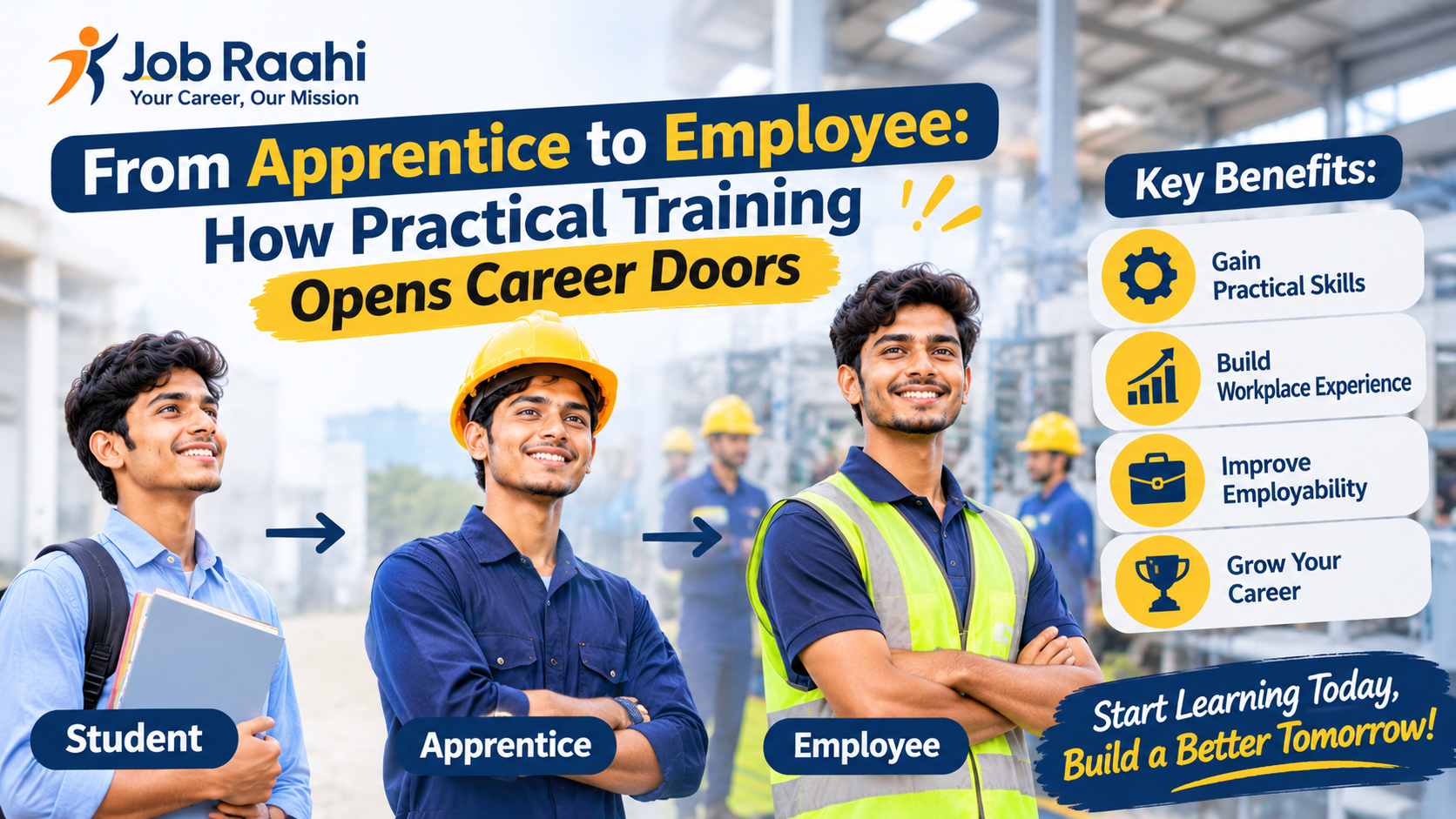
    From Apprentice to Employee: How Practical Training Opens Career Doors

    Completing an ITI course, diploma, graduation or vocational programme is an important milestone for any student. It represents years of learning, effort and preparation for a professional career.

    But once education is complete, a new challenge begins: entering the workplace.

    Many freshers understand the concepts they have studied but have limited experience applying them in real working environments. They may know how a process works theoretically but have never performed it independently. They may understand technical concepts but need practical exposure to workplace equipment, tools and procedures.

    This is where apprenticeships and practical training become valuable.

    They provide an opportunity to learn while experiencing the actual responsibilities of a job. For freshers, this can be an important step towards becoming more confident, developing relevant skills and preparing for future employment.

    Why Practical Experience Matters for Freshers

    The transition from education to employment is not always easy.

    Educational institutions provide foundational knowledge, but workplaces have their own processes, expectations and working environments.

    For example, an ITI student may understand the basics of electrical systems but still need hands-on experience with industrial equipment. A logistics student may know the fundamentals of supply chain operations but need practical exposure to inventory handling, scanning and dispatch processes.

    Similarly, a graduate joining a customer support team may understand communication principles but need experience handling actual customer interactions.

    Practical experience helps candidates understand:

    • How daily workplace operations function.
    • How to use tools, equipment and technology relevant to their roles.
    • How to follow instructions and standard operating procedures.
    • How to coordinate with supervisors and colleagues.
    • How to manage time and assigned responsibilities.
    • How workplace safety and quality standards are maintained.

    These experiences help freshers connect what they have learned with what employers expect.

    What Is an Apprenticeship?

    An apprenticeship is a structured form of practical training in which individuals learn a trade, occupation or specific job-related skills through a combination of workplace exposure and relevant instruction.

    Unlike purely classroom-based learning, apprenticeships allow participants to understand how work is performed in an actual professional environment.

    Apprenticeships are available across different industries and occupational areas, depending on employer requirements and applicable programmes.

    They can be particularly useful for:

    • ITI students and graduates.
    • Polytechnic and diploma holders.
    • Technical course students.
    • Fresh graduates.
    • Candidates looking to develop industry-specific skills.

    An apprenticeship is not automatically the same as a permanent job. Its duration, training structure, stipend, responsibilities and employment possibilities depend on the specific programme and applicable terms.

    However, the experience can help candidates prepare for future employment.

    How Apprenticeships Bridge the Education-to-Employment Gap

    One of the biggest advantages of practical training is that it introduces candidates to real workplace responsibilities.

    Here are some ways apprenticeships can support this transition.

    Applying Theoretical Knowledge

    Students get an opportunity to understand how academic concepts are used in actual work situations.

    For example, someone who has studied mechanical engineering may gain exposure to equipment maintenance, production processes or quality checks.

    Understanding Workplace Expectations

    An apprenticeship introduces candidates to reporting structures, working schedules, workplace discipline and professional communication.

    These experiences can make the transition into full-time employment easier.

    Developing Industry-Relevant Skills

    Candidates can learn tools, equipment, technologies and processes that are specific to their chosen field.

    This helps them understand the practical requirements of different job roles.

    Building Professional Confidence

    Working alongside experienced employees gives freshers an opportunity to ask questions, observe processes and gradually take on responsibilities.

    As they become familiar with their tasks, their confidence can improve.

    Understanding Career Interests

    Practical exposure can also help candidates understand which roles and industries match their interests and abilities.

    This can help them make better career decisions.
    Apprenticeship to practical training

    Industries Offering Practical Learning Opportunities

    Apprenticeship and workplace training opportunities exist across several industries. The available roles depend on the employer, qualification requirements and training programme.

    IndustryExamples of Practical Learning Areas
    ManufacturingProduction processes, machine operations, quality checks
    AutomotiveVehicle assembly, maintenance, inspection
    Logistics and WarehousingInventory handling, picking, packing, dispatch
    RetailStore operations, billing, customer service
    Electrical and ElectronicsEquipment maintenance, installation, testing
    HospitalityGuest services, food operations, housekeeping
    IT and Business ServicesTechnical support, data handling, customer support

    For freshers, these opportunities can provide exposure to different professional environments and help them identify suitable career paths.

    Skills Freshers Can Develop Through Apprenticeships

    Practical training is not limited to learning how to perform a particular task. It also helps candidates develop professional skills that are useful throughout their careers.

    Technical Skills: Candidates learn to use relevant tools, machinery, software and equipment according to their roles.

    Communication: They practise interacting with supervisors, colleagues and customers in professional situations.

    Time Management: They understand how to organise tasks and complete responsibilities within assigned schedules.

    Teamwork: They learn to coordinate with others and contribute towards shared objectives.

    Problem-Solving: They develop the ability to identify issues, understand instructions and seek appropriate solutions.

    Workplace Safety: They become familiar with safety procedures, protective equipment and responsible working practices.

    Adaptability: They learn to adjust to new tasks, technologies and working environments.

    These capabilities can make a candidate better prepared for the expectations of an employer.

    From Apprentice to Full-Time Employee: Understanding the Journey

    For many candidates, an apprenticeship can become an important stepping stone towards a professional career.

    The journey generally involves several stages:

    Stage 1: Learning the Basics

    The candidate understands the role, workplace environment, safety requirements and basic procedures.

    Stage 2: Gaining Practical Exposure

    The candidate observes experienced employees and begins performing assigned tasks under appropriate supervision.

    Stage 3: Developing Competence

    With practice, the candidate becomes more familiar with the processes and improves the quality and consistency of their work.

    Stage 4: Demonstrating Workplace Readiness

    The candidate develops confidence, understands responsibilities and demonstrates the ability to work within established procedures.

    Stage 5: Exploring Employment Opportunities

    After completing the training, the candidate can explore relevant vacancies based on their skills, experience and eligibility.

    Some employers may consider apprentices for further employment, depending on business requirements and performance. However, permanent employment is not guaranteed simply because an apprenticeship has been completed.

    The experience itself can still strengthen a candidate’s preparation for future opportunities.

    How Freshers Can Find the Right Apprenticeship

    Choosing the right training opportunity is important. Freshers should not select an apprenticeship only because it is available.

    They should consider whether it supports their long-term career interests.

    Here are some things to check:

    1. Match Your Educational Background: Look for programmes related to your ITI trade, diploma, degree or vocational qualification.
    2. Understand the Job Responsibilities: Check what you will actually learn and perform during the training period.
    3. Verify the Employer: Research the organisation and confirm that the opportunity is genuine.
    4. Check the Training Structure: Understand the duration, working conditions, supervision and learning objectives.
    5. Review the Stipend and Terms: Read the applicable conditions carefully before accepting.
    6. Understand Future Opportunities: Ask whether the employer has any potential pathway to further employment, without assuming that a job is guaranteed.

    Candidates can explore official resources such as Apprenticeship India and the National Career Service to learn about available opportunities and employment-related information.

    The Role of Employers in Developing Young Talent

    Employers also benefit from creating opportunities for practical learning.

    Apprenticeship programmes allow organisations to introduce young candidates to their processes while helping them develop relevant skills.

    For businesses across manufacturing, logistics, retail and other operational sectors, developing entry-level talent can contribute to building a more prepared workforce.

    Employers can make these programmes more effective by:

    • Defining clear learning objectives.
    • Assigning experienced employees or trainers for guidance.
    • Providing appropriate equipment and safety training.
    • Giving candidates meaningful practical exposure.
    • Offering regular feedback on performance.
    • Communicating possible career pathways honestly.

    A good training environment should help candidates learn, not simply assign them routine work without guidance.

    How Job Raahi Supports the Journey Towards Employment

    Practical training is an important step, but candidates also need access to suitable employment opportunities after developing their skills.

    This is where digital job platforms can help connect trained candidates with employers.

    Job Raahi is a digital job platform focused on frontline, entry-level and mass hiring opportunities.

    It aims to connect companies with candidates across different educational and experience backgrounds, including freshers and individuals with limited professional experience.

    Through Job Raahi, candidates can explore relevant openings across sectors such as logistics, warehousing, retail, delivery, sales, hospitality and customer support, depending on available vacancies and eligibility requirements.

    Job Raahi’s wider ecosystem also includes skill centres across India, where candidates can be trained and developed in line with industry requirements.

    For employers, this provides an additional channel to reach candidates who are beginning their careers or developing practical skills.

    For freshers, it creates another opportunity to move from learning and preparation towards actual employment.

    The connection between training and employment is important: candidates need the right skills, but they also need visibility of opportunities where those skills can be applied.

    Conclusion: Practical Learning Can Be the Beginning of a Strong Career

    A qualification provides a foundation, but practical experience helps candidates understand how to use their knowledge in a professional environment.

    For freshers, apprenticeships can provide valuable exposure to workplace responsibilities, industry processes and professional expectations.

    They also give employers an opportunity to engage with emerging talent and help develop candidates according to relevant industry requirements.

    The journey from apprentice to employee may not look the same for everyone. Some candidates may continue in the same industry, while others may use their experience to explore different roles.

    What matters is the learning gained along the way.

    Platforms like Job Raahi can support the next step by helping candidates discover relevant employment opportunities and helping employers connect with emerging frontline talent.

    Your first professional opportunity does not always have to be a permanent job. Sometimes, the right practical learning experience can become the foundation of your entire career.
  • Your First Frontline Job: How Freshers Can Manage Workload, Targets and Daily Responsibilities

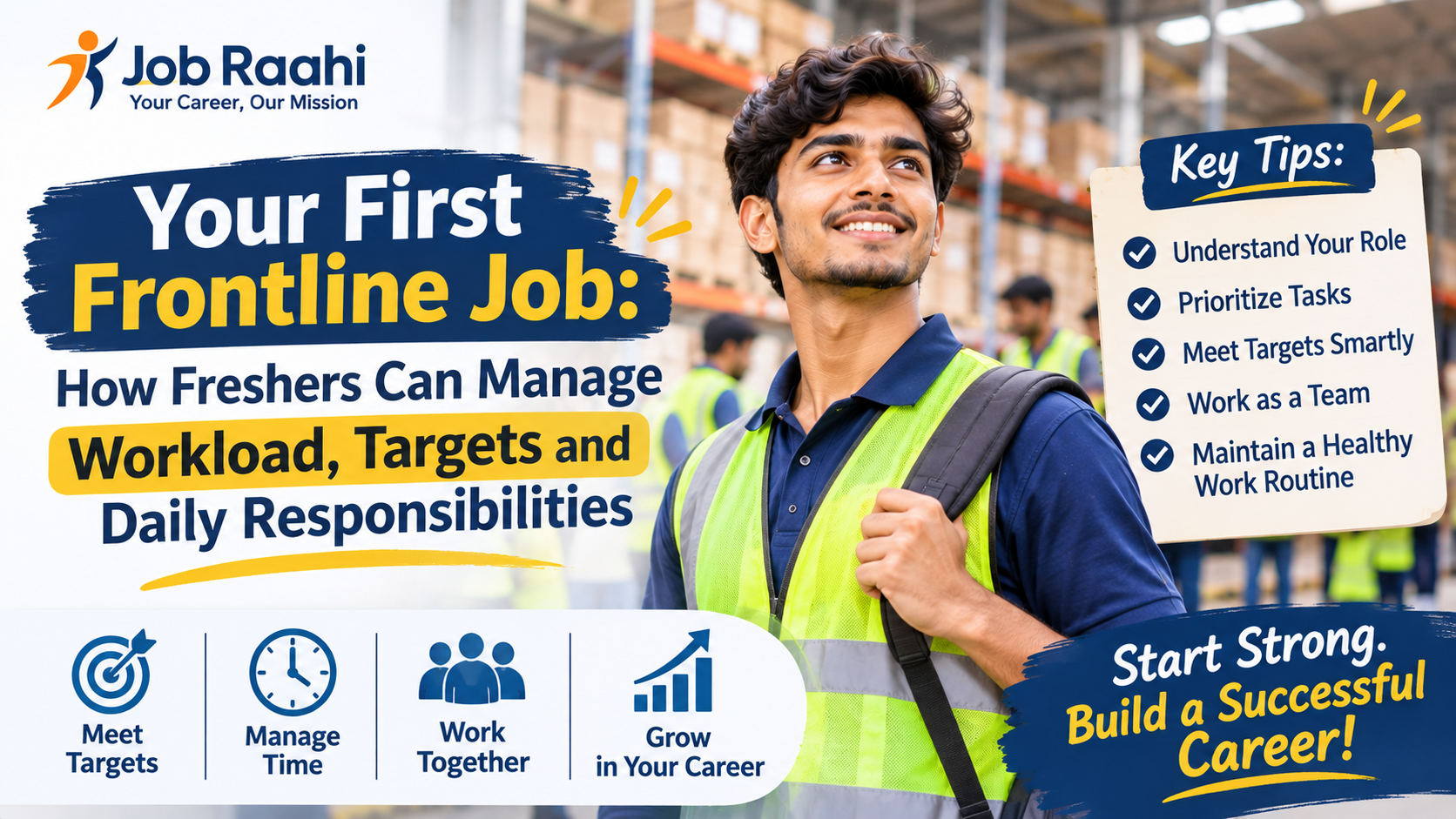
    Your First Frontline Job: How Freshers Can Manage Workload, Targets and Daily Responsibilities

    Getting your first job is an important milestone. After completing your education or vocational training, entering the professional world gives you an opportunity to earn, learn practical skills and become more independent.

    For many freshers, frontline jobs are an important starting point. Opportunities in retail, warehousing, logistics, manufacturing, delivery, hospitality and customer support allow candidates to gain real workplace experience.

    However, the transition from education to employment also brings new responsibilities.

    You may need to follow a shift schedule, complete assigned tasks within a specific time, coordinate with colleagues, meet daily targets and adapt to an entirely new working environment.

    At first, managing all these responsibilities can feel overwhelming.

    The good news is that workload management is a skill that develops with experience, practice and the right guidance. Understanding your responsibilities and building a few effective work habits can make your first job more manageable.

    Understanding Workload in Frontline Jobs

    Workload refers to the tasks, responsibilities and activities an employee is expected to complete during a particular working period.

    In frontline jobs, workload can vary depending on the industry, role, location and business demand.

    For example:

    • Warehouse Associate: Receiving, sorting, scanning, picking, packing and dispatching products.
    • Retail Associate: Assisting customers, arranging products, managing billing and maintaining store operations.
    • Production Associate: Supporting production activities, operating equipment as instructed and following quality procedures.
    • Delivery Executive: Managing assigned deliveries, following routes and coordinating with customers.
    • Customer Support Executive: Handling customer queries, maintaining records and resolving issues according to company guidelines.
    • Hospitality Associate: Supporting guest services, maintaining cleanliness and coordinating daily service activities.

    Some roles involve physical activities, while others require continuous customer interaction, attention to detail or meeting productivity targets.

    Understanding what your job involves is the first step towards managing your workload effectively.

    Why the First Frontline Job Can Feel Challenging

    For a fresher, the workplace can be very different from a classroom or training environment.

    During education, tasks are often organised around lessons, assignments and examinations. At work, responsibilities may follow operational schedules and business requirements.

    Some common reasons the first job can feel challenging include:

    A New Working Environment: Learning workplace rules, processes, equipment and reporting structures takes time.

    Unfamiliar Tasks: Even if you have studied a subject, performing the actual job may require practical experience.

    Time-Based Responsibilities: Some roles require employees to complete tasks within specific time limits.

    Shift Schedules: Adjusting to fixed shifts, rotating shifts or early reporting times may require changes to daily routines.

    Performance Expectations: Employees may be expected to maintain accuracy, productivity and quality while completing assigned responsibilities.

    These challenges are a normal part of entering the workforce. Freshers should focus on learning the process rather than expecting themselves to perform perfectly from the beginning.

    Common Workload Challenges Freshers May Face

    Different frontline roles have different demands, but some challenges are common across industries.

    Managing Multiple Tasks

    An employee may need to complete several activities during a shift. Without understanding which tasks are most important, it can become difficult to organise the work.

    Meeting Daily Targets

    Some jobs involve daily productivity targets, such as processing orders, completing production tasks or handling customer queries.

    Freshers may initially need time to understand how these targets are measured.

    Maintaining Accuracy

    Working quickly is important in many operational roles, but speed should not come at the cost of accuracy.

    For example, incorrect inventory entries, packaging mistakes or billing errors can affect business operations.

    Adjusting to Physical Work

    Certain frontline positions involve standing for extended periods, walking, lifting approved loads or performing repetitive tasks. Employees need proper training and must follow workplace safety procedures.

    Understanding Instructions

    New employees may receive instructions from supervisors or different team members. Understanding priorities and asking questions when something is unclear can prevent mistakes.

    Practical Ways to Manage Daily Responsibilities

    Good workload management does not require complicated techniques. A few consistent habits can help freshers become more organised.

    A. Understand Your Daily Tasks

    At the beginning of your shift, understand what responsibilities have been assigned to you.

    If the instructions are unclear, ask your supervisor for clarification.

    Knowing what is expected helps you organise your time and avoid unnecessary confusion.

    B. Prioritise Important Activities

    Not every task has the same level of urgency.

    Understand which responsibilities need immediate attention and which can be completed later.

    For example, a warehouse employee may need to prioritise an assigned dispatch activity according to the supervisor’s instructions rather than independently choosing tasks.

    C. Focus on One Task at a Time

    Trying to handle too many activities simultaneously can increase the chances of mistakes.

    Complete tasks in the required sequence, follow standard operating procedures and maintain accuracy.

    D. Learn the Correct Process

    Do not focus only on completing tasks quickly. First understand the correct way to perform them.

    Once you become familiar with the process, your speed and confidence can improve naturally.

    E. Track Your Progress

    Pay attention to the tasks you have completed and those that are still pending.

    Where appropriate, use a checklist or follow the tracking system provided by your organisation.

    This can help you stay organised throughout the shift.

    Frontline jobs for freshers

    How to Handle Targets and Work Pressure

    Targets are common in several frontline roles. They help organisations monitor productivity and plan daily operations.

    However, freshers may find it difficult to meet targets while they are still learning.

    Here are some ways to approach them:

    Understand How Targets Work: Ask your supervisor how performance is measured and what is expected from your role.

    Focus on Consistency: Rather than rushing to complete everything, develop a steady and accurate working pace.

    Learn from Feedback: If your performance needs improvement, understand which part of the process requires attention.

    Communicate Difficulties Early: If you are facing an operational challenge or cannot complete an assigned task, inform your supervisor instead of waiting until the end of the shift.

    Avoid Unnecessary Comparisons: Experienced employees may work faster because they are familiar with the process. Give yourself time to learn and improve.

    It is also important to remember that targets should be realistic, communicated clearly and supported by appropriate training, equipment and working conditions.

    The Importance of Teamwork and Asking for Help

    Frontline operations rarely depend on one employee working independently. Most activities require coordination between different people and teams.

    In a warehouse, employees may work together across receiving, inventory, picking, packing and dispatch. In retail, store associates coordinate with billing teams and supervisors. In hospitality, service staff work together to maintain daily operations.

    Freshers should understand that asking for help is not a sign of weakness.

    If you are unsure about a task, seek guidance from an experienced colleague or supervisor.

    Good teamwork involves:

    • Listening carefully to instructions.
    • Sharing relevant information with colleagues.
    • Respecting assigned responsibilities.
    • Informing the team about delays or difficulties.
    • Supporting others when your own responsibilities allow it.
    • Following established reporting procedures.

    Learning to work as part of a team can make daily responsibilities easier to manage and improve your professional confidence.

    Maintaining a Healthy Work Routine

    Managing workload also involves preparing yourself for the demands of your job outside working hours.

    A consistent routine can help employees adjust to their responsibilities.

    Consider the following habits:

    Get Adequate Rest: Maintain a suitable sleep routine, particularly if your role involves early morning, late-night or rotating shifts.

    Plan Your Commute: Allow enough time to reach the workplace without unnecessary last-minute stress.

    Follow Break Schedules: Use designated breaks appropriately and follow workplace policies.

    Stay Hydrated: Drink water regularly, especially in roles involving physical activity or warm working environments.

    Follow Safety Instructions: Use required protective equipment and follow the training provided for handling tools, machinery or materials.

    Make Time for Personal Life: Maintain a routine that gives you time to rest, spend time with family and pursue personal interests.

    A sustainable work routine can help freshers adjust to their responsibilities over time.

    What Employers Can Do to Support Freshers

    Workload management is not only an employee responsibility. Employers also play an important role in helping new employees adjust to their jobs.

    Companies can support freshers through:

    • Clear explanations of job responsibilities.
    • Structured onboarding and role-specific training.
    • Realistic productivity expectations during the learning period.
    • Accessible supervisors and reporting channels.
    • Proper equipment and workplace safety instructions.
    • Clear shift schedules and break policies.
    • Regular feedback and performance guidance.

    When employees understand their responsibilities and receive the right support, they have a better opportunity to develop confidence and perform their work effectively.

    For frontline businesses, investing in employee readiness can also help create a more organised and productive workforce.

    How Job Raahi Helps Freshers Discover Frontline Opportunities

    Finding a suitable first job is an important part of beginning a professional journey.

    Freshers need opportunities that match their educational background, practical skills and experience level. They also need clear information about job responsibilities and eligibility before applying.

    Job Raahi is a digital job platform focused on connecting companies with candidates exploring frontline, entry-level and mass hiring opportunities.

    It provides candidates with an additional channel to discover openings across sectors such as logistics, warehousing, retail, delivery, sales, hospitality and customer support.

    For freshers and candidates with limited experience, this can help make relevant employment opportunities more accessible.

    Job Raahi also works with skill centres across India, where candidates can be trained and developed in line with industry requirements.

    The objective is to connect candidates with suitable employment opportunities while helping employers reach a wider pool of potential frontline talent.

    For someone beginning their career, discovering the right opportunity is the first step. Learning to manage responsibilities and developing workplace skills comes next.

    Conclusion: Your First Job Is Also Your First Learning Experience

    Starting a frontline job brings new responsibilities, expectations and challenges. Managing daily tasks, understanding targets, adjusting to shifts and working with a team may take time, particularly for someone entering the workforce for the first time.

    The key is to remain organised, understand your responsibilities, follow instructions and stay open to learning.

    Do not measure your progress only by how quickly you complete a task. Focus on improving accuracy, building confidence and developing good professional habits.

    Employers also have a responsibility to provide clear instructions, proper training and a supportive working environment.

    Platforms like Job Raahi can help freshers discover relevant frontline opportunities and take their first step towards employment.

    Your first job is not just about completing daily tasks. It is about learning how the workplace operates, developing responsibility and building the foundation for your future career.

  • High-Volume Hiring: How Businesses Can Attract the Right Frontline Workforce

    High-Volume Hiring: How Businesses Can Attract the Right Frontline Workforce

    For businesses operating across logistics, warehousing, manufacturing, retail, hospitality and delivery, having the right workforce is essential to maintaining daily operations.

    A warehouse needs associates to manage inventory and dispatch. A retail chain needs employees across multiple stores. A manufacturing unit requires production workers to maintain its operations. A delivery business needs people to support its growing service network.

    When these requirements arise across several locations or within a short period, companies face the challenge of high-volume hiring.

    However, bulk recruitment is not simply about attracting a large number of applicants. Employers must find candidates who meet the job requirements, are genuinely interested in the opportunity and are willing to join.

    The real challenge is therefore not just hiring at scale. It is attracting the right workforce at scale.

    What Is High-Volume Hiring?

    High-volume hiring refers to the recruitment of a large number of employees within a specific period to meet an organisation’s workforce requirements.

    It is commonly required when businesses:

    • Open new warehouses, stores, factories or operational facilities.
    • Expand into new cities or geographical markets.
    • Experience seasonal increases in business demand.
    • Launch new projects or operational units.
    • Need to replace employees who have left the organisation.
    • Expand delivery, sales or customer support operations.

    Unlike specialised recruitment, where companies may focus on filling a few positions, high-volume hiring involves attracting and evaluating multiple candidates for similar or different roles.

    Common examples include:

    IndustryCommon High-Volume Roles
    Logistics and WarehousingWarehouse Associates, Pickers, Packers, Helpers
    RetailStore Associates, Cashiers, Sales Executives
    ManufacturingProduction Associates, Machine Operators, Packaging Staff
    DeliveryDelivery Executives, Field Associates
    HospitalityHousekeeping Staff, Kitchen Helpers, Service Associates
    BPO and Customer SupportCustomer Support Executives, Telecallers

    Each role has different eligibility requirements, but all require employers to communicate vacancies effectively and reach relevant candidates.

    Why High-Volume Frontline Hiring Is Challenging

    Recruiting a large number of employees comes with challenges that are different from hiring for a small number of specialised positions.

    Limited Candidate Reach

    Companies may depend on familiar job portals, referrals or local recruitment drives. While these channels can be useful, relying on a limited number of sources may restrict access to candidates from other locations.

    High Competition for Frontline Talent

    Several employers may be looking for similar candidates in the same geographical area. This makes it important to communicate job opportunities clearly and attract candidates who are genuinely interested.

    Candidate Drop-Offs

    Not every candidate who applies will attend an interview or complete the joining process. Some may accept another offer, change their plans or find that the job does not match their expectations.

    Unclear Job Information

    Incomplete information about salary, location, working hours, responsibilities or eligibility can lead to unsuitable applications and confusion during recruitment.

    Urgent Hiring Requirements

    Operational businesses often work with strict timelines. Delays in hiring can affect productivity, service delivery and business expansion.

    These challenges make it necessary for employers to develop a structured approach rather than depending only on application volume.

    Why Receiving More Applications Does Not Always Mean Better Hiring

    One common mistake in mass recruitment is treating the number of applications as the main measure of success.

    A campaign may generate hundreds of applications but still fail to meet the actual hiring requirement.

    For example, imagine a warehouse hiring 100 associates. It receives 500 applications, but many candidates do not meet the eligibility criteria, some are unwilling to work at the given location, and others do not attend interviews.

    The employer may have generated considerable interest without achieving the required number of joinings.

    This highlights an important difference:

    • Application volume: How many candidates apply.
    • Candidate relevance: How many applicants meet the job requirements.
    • Candidate engagement: How many remain interested throughout the process.
    • Hiring conversion: How many selected candidates actually join.

    A successful high-volume hiring strategy must consider all four.

    Strategies to Attract the Right Frontline Workforce

    Attracting suitable candidates requires employers to understand their target workforce and select recruitment channels accordingly.

    A. Define Job Requirements Clearly

    Before starting a hiring campaign, employers should establish the exact requirements for each position.

    Important details include:

    • Job title and responsibilities.
    • Educational qualifications.
    • Required experience, if any.
    • Salary and payment structure.
    • Work location.
    • Shift timings and weekly offs.
    • Physical or technical requirements, where relevant.
    • Joining timeline.

    Clear job descriptions help candidates understand the opportunity before applying and allow employers to attract more relevant applicants.

    B. Expand Beyond Traditional Hiring Locations

    Employers should not restrict their recruitment efforts to major metropolitan cities.

    Smaller cities, nearby towns and hinterland regions can offer access to freshers and candidates with different educational and vocational backgrounds.

    For example, a manufacturing company may explore ITI and diploma candidates from nearby districts, while a logistics business may reach candidates interested in warehouse operations from surrounding towns.

    Expanding geographical reach can help businesses explore additional talent markets.

    C. Use Multiple Recruitment Channels

    A strong high-volume hiring strategy should not depend on just one source.

    Companies can combine:

    • Digital job portals.
    • Employee referrals.
    • Campus and ITI placements.
    • Local job fairs and recruitment drives.
    • Community-level outreach.
    • Social media campaigns.
    • Regional recruitment networks.

    Different channels may perform differently depending on the role, location and candidate profile. Employers should identify which sources bring suitable applicants and actual joinings.

    D. Make Job Opportunities Easy to Understand

    Frontline candidates may not be familiar with complex job descriptions or corporate recruitment language.

    Use simple and direct communication.

    Instead of writing a lengthy description, explain what the candidate will do, where the job is located, what qualifications are needed and what the employment conditions are.

    Where appropriate, communicating in regional languages can make vacancies easier to understand.

    E. Highlight Opportunities for Freshers

    Not every frontline position requires extensive work experience.

    Many roles offer opportunities for candidates entering the workforce for the first time.

    Employers can expand their potential candidate pool by considering freshers and candidates with limited experience where the role permits.

    This can also help young people gain practical exposure and begin their professional journeys.

    How to Improve Candidate Quality During Bulk Hiring

    Attracting more candidates is only the beginning. Employers must also make sure the recruitment process identifies people who are suitable for the role.

    Here are some practical ways to improve candidate quality.

    Use Role-Based Screening: Evaluate candidates according to the actual responsibilities and eligibility criteria rather than relying only on general qualifications.

    Communicate Expectations Early: Explain working conditions, shifts, salary, location and responsibilities before the interview stage.

    Keep the Application Process Simple: Avoid unnecessary complexity that may discourage suitable candidates from applying.

    Conduct Relevant Assessments: Depending on the position, use basic practical tests, communication assessments or role-specific questions.

    Maintain Regular Communication: Keep candidates informed about interview schedules, selection updates and joining requirements.

    Provide a Realistic Job Preview: Help candidates understand what the job involves so they can make informed decisions.

    A transparent recruitment process can reduce mismatches between candidate expectations and employer requirements.

    high volume hiring

    The Role of Technology and Digital Job Platforms

    Technology has changed how employers approach recruitment, particularly when vacancies need to reach candidates across multiple locations.

    Digital job platforms allow companies to publish vacancies and make them accessible to job seekers beyond their immediate geographical networks.

    For high-volume hiring, this creates additional opportunities to:

    • Promote multiple job openings.
    • Reach candidates across different locations.
    • Attract freshers and candidates with limited experience.
    • Communicate job requirements more widely.
    • Create another channel for candidate applications.

    However, technology alone cannot guarantee suitable hiring outcomes. Employers still need clear job descriptions, appropriate screening, candidate communication and a structured selection process.

    The most effective approach is to combine digital recruitment with local engagement and human interaction.

    How Job Raahi Can Support High-Volume Hiring

    For companies hiring frontline employees in bulk, expanding candidate reach is an important part of the recruitment strategy.

    Job Raahi is a digital job platform focused on connecting companies with candidates looking for frontline, entry-level and mass hiring opportunities.

    It provides employers with an additional channel to communicate vacancies and explore a wider candidate pool.

    Reach Beyond Traditional Employment Markets

    Job Raahi focuses on connecting employers with candidates across different parts of India, including smaller cities and hinterland regions.

    This can help businesses explore talent beyond the locations and recruitment channels they already depend on.

    Access to Freshers and Candidates with Limited Experience

    Many frontline roles are suitable for candidates who are beginning their careers.

    Job Raahi helps employers reach freshers and candidates with limited professional experience, depending on the eligibility requirements of the vacancy.

    This gives companies an opportunity to consider candidates who may have the right basic qualifications, practical knowledge and willingness to learn.

    Support Across Multiple Frontline Sectors

    Job Raahi focuses on opportunities across sectors such as:

    • Logistics and warehousing.
    • Retail and sales.
    • Delivery operations.
    • Hospitality.
    • BPO and customer support.
    • Field operations.
    • Other frontline and operational roles.

    This makes the platform relevant to employers with different types of frontline recruitment requirements.

    An Additional Sourcing Channel for Employers

    Companies do not need to replace their existing recruitment methods to explore Job Raahi.

    They can continue using referrals, job portals, campus placements and recruitment drives while using Job Raahi as another channel to promote vacancies and reach potential candidates.

    Job Raahi currently offers companies free onboarding and job posting, allowing employers to explore the platform without an initial job-posting cost.

    The objective is to make it easier for companies to connect with a broader candidate market while helping freshers and other job seekers discover relevant employment opportunities.

    Recruitment Metrics Every Employer Should Track

    High-volume hiring should be measured through meaningful recruitment outcomes rather than application numbers alone.

    Some important metrics include:

    Recruitment MetricWhat It Measures
    Number of ApplicationsTotal candidates applying for vacancies
    Relevant Application RatePercentage of applicants meeting basic requirements
    Interview Attendance RateCandidates attending scheduled interviews
    Selection RatePercentage of interviewed candidates selected
    Offer Acceptance RateCandidates accepting employment offers
    Joining RateSelected candidates who actually join
    Time to FillTime taken to close a vacancy
    Source-Wise HiringApplications, selections and joinings from each recruitment channel
    Early AttritionEmployees leaving within an initial period of employment

    Tracking these metrics helps employers understand which recruitment channels are performing well and where improvements are needed.

    For example, if one sourcing channel generates many applications but very few joinings, the company may need to review candidate relevance, job communication or the location being targeted.

    The purpose of measurement is to improve hiring decisions continuously.

    Conclusion: Successful Bulk Hiring Starts with Reaching the Right People

    High-volume hiring is not just about filling multiple vacancies quickly. It is about building a recruitment strategy that consistently attracts suitable candidates and converts genuine interest into successful joinings.

    Employers need to look beyond application numbers and focus on candidate relevance, clear communication, geographical reach and effective recruitment channels.

    Exploring smaller cities, connecting with educational institutions, considering freshers and using digital job platforms can help businesses broaden their sourcing approach.

    Platforms like Job Raahi can contribute by giving employers an additional channel to reach frontline candidates, including freshers and individuals from hinterland regions.

    As businesses continue to expand their operations, the ability to attract the right workforce will remain an important part of sustainable growth.

    Because successful high-volume hiring is not about collecting the maximum number of applications. It is about connecting the right opportunities with the right people, at the right time.

  • The Employability Gap: Why Having a Degree Is Not Always Enough to Get a Job

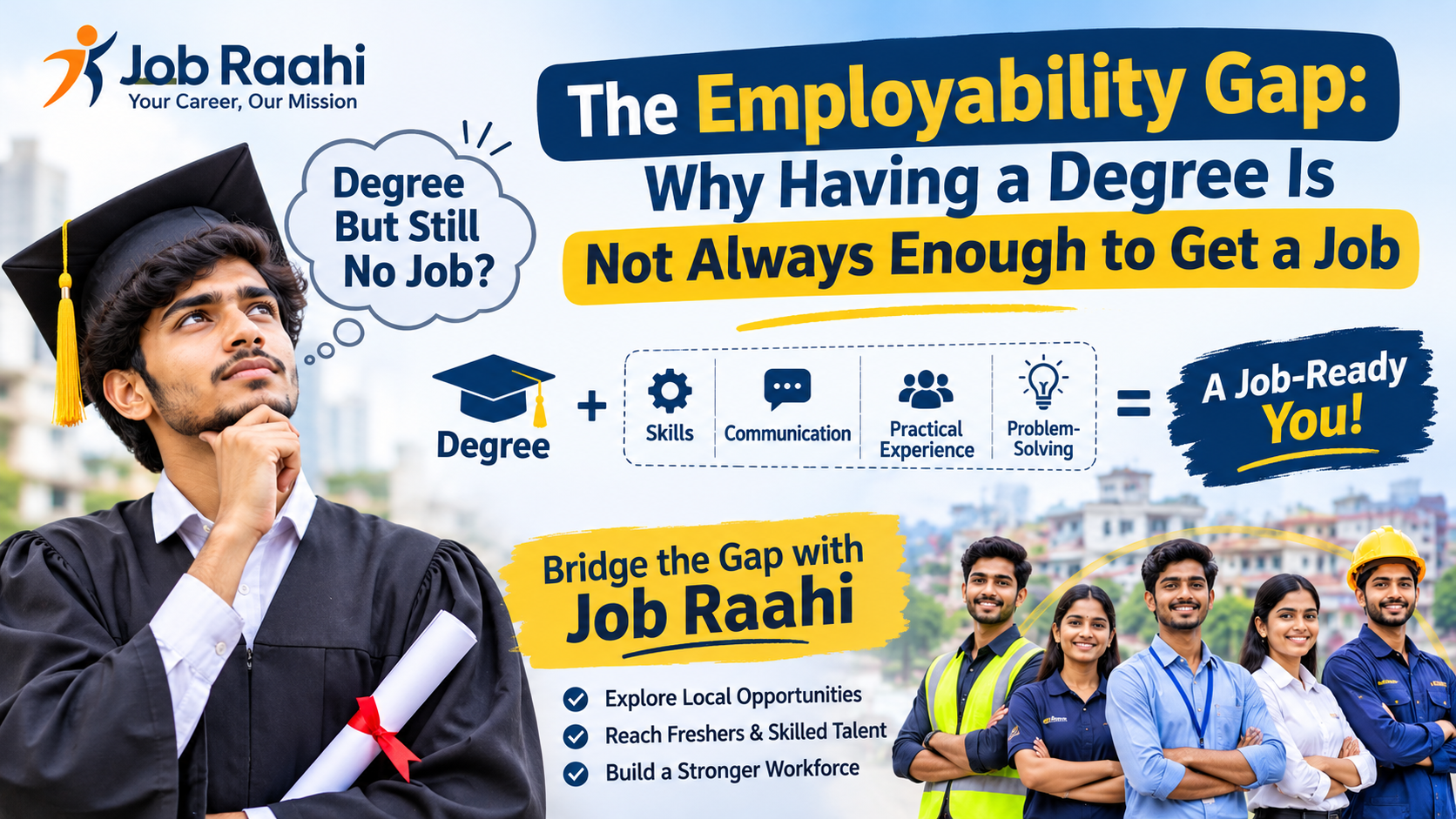
    The Employability Gap: Why Having a Degree Is Not Always Enough to Get a Job

    For many students, earning a college degree is considered one of the most important steps towards building a successful career. Years of studying, attending classes, completing assignments and passing examinations are all directed towards one goal: getting a good job.

    However, after graduation, many candidates discover that finding employment is not as straightforward as they expected.

    They have a degree, but employers are asking for practical knowledge. They understand academic concepts, but struggle to apply them in a professional environment. They meet the educational requirements of a vacancy, but may not have the communication, technical or workplace skills needed to perform the role.

    This difference between educational qualifications and the skills required to secure and perform a job is known as the employability gap.

    It does not mean that degrees have lost their value. Rather, it highlights the need to connect academic learning with practical skills, industry expectations and workplace readiness.

    What Is the Employability Gap?

    The employability gap refers to the difference between the skills and abilities candidates possess and what employers expect from them in the workplace.

    A candidate may have completed a bachelor’s degree, diploma or professional course but still require additional preparation before becoming suitable for a particular job.

    For example, a commerce graduate may understand accounting principles but have limited experience using accounting software. An engineering graduate may understand technical concepts but have little exposure to industrial equipment or practical operations.

    Similarly, a graduate applying for a customer support role may have good academic results but struggle with professional communication and customer interaction.

    The gap is not always about a lack of intelligence or education. It can also result from limited practical exposure, outdated learning methods or insufficient understanding of actual job responsibilities.

    The issue is important in India. Mercer | Mettl’s India Graduate Skill Index 2025 reported that 42.6% of Indian graduates assessed in its study were overall employable. The report also highlighted the importance of non-technical skills alongside technical capabilities.

    This finding indicates why employability needs to be considered beyond academic qualifications alone.

    Why a Degree Does Not Always Translate into Employment

    A degree provides knowledge and demonstrates academic achievement. However, employers also need to understand whether a candidate can apply that knowledge to real responsibilities.

    Several factors contribute to the employability gap.

    Limited Practical Exposure

    Many students spend most of their academic years learning theoretical concepts. Although theory builds a foundation, candidates may have limited opportunities to work with industry tools, equipment, software or actual workplace processes.

    Outdated or Limited Industry Exposure

    Industries continue to adopt new technologies, processes and working methods. When educational programmes do not keep pace with these changes, graduates may enter the job market without familiarity with current industry requirements.

    Lack of Workplace Skills

    Professional environments require more than subject knowledge. Communication, teamwork, punctuality, problem-solving and the ability to follow instructions are important across many roles.

    Limited Understanding of Job Roles

    Some freshers apply for positions without fully understanding the responsibilities, working conditions or skills required. This can create a mismatch between candidate expectations and employer requirements.

    Insufficient Practical Training

    Internships, apprenticeships, vocational training and industry projects can help students understand how work happens outside the classroom. Without such exposure, the transition from education to employment can become difficult.

    The Difference Between Being Educated and Being Job-Ready

    Being educated and being job-ready are related, but they are not exactly the same.

    Education provides a foundation of knowledge. Job readiness involves using that knowledge, developing relevant skills and adapting to workplace expectations.

    Consider the following examples:

    Academic QualificationAdditional Skills That May Be Needed
    B.Com graduateAccounting software, Excel, documentation and professional communication
    B.A. graduateCommunication, digital literacy, administration and customer interaction
    B.Tech graduatePractical application, technical tools, teamwork and problem-solving
    ITI graduateEquipment handling, workplace safety and practical operations
    Diploma holderTechnical execution, quality checks and industry-specific processes

    These are indicative examples. The skills required depend on the specific job and employer.

    The important takeaway is that academic qualifications and practical capabilities should complement each other.

    Bridging the employability gap

    Skills Employers Look for Beyond Academic Qualifications

    While technical requirements vary by industry, certain skills are valuable across a wide range of entry-level and professional roles.

    Communication Skills

    Employees need to understand instructions, interact with colleagues, communicate with supervisors and share information clearly.

    Digital Literacy

    Basic computer knowledge, email, online applications, spreadsheets and familiarity with digital tools are increasingly useful in different industries.

    Problem-Solving

    Employers value candidates who can understand challenges, think logically and seek appropriate solutions rather than simply waiting for instructions.

    Teamwork and Coordination

    Most workplaces require people to work together. The ability to cooperate, respect responsibilities and communicate with colleagues is essential.

    Adaptability and Learning Agility

    Work processes and technologies change. Candidates who are willing to learn new tasks and adapt to different situations can become more effective employees.

    Role-Specific Practical Skills

    A warehouse associate may need to understand inventory handling and scanning processes. A retail employee may need customer interaction and billing knowledge. A production trainee may need basic machine awareness and safety practices.

    Employability is therefore a combination of foundational knowledge, practical ability and professional behaviour.

    How Freshers Can Bridge the Employability Gap

    Freshers do not need to wait until they have completed several years of employment to become more job-ready. They can begin developing relevant capabilities while studying or searching for their first job.

    Here are some practical steps:

    Identify the Skills Required for Your Target Role: Read job descriptions and understand what employers expect. Focus on developing skills that are relevant to the roles you want.

    Gain Practical Exposure: Participate in internships, apprenticeships, workshops, academic projects or vocational training programmes.

    Improve Digital Skills: Develop confidence in using computers, smartphones, email, spreadsheets and other tools relevant to your career interests.

    Work on Communication: Practise introducing yourself, explaining your qualifications, asking questions and communicating professionally.

    Understand Workplace Expectations: Learn about punctuality, discipline, teamwork, safety procedures and professional conduct.

    Be Open to Entry-Level Opportunities: Your first job does not have to be your final career destination. Suitable entry-level roles can provide practical experience and help you understand the professional environment.

    Keep Learning: Use short courses, online learning resources and practical assignments to strengthen your knowledge.

    The goal is not to collect as many certificates as possible. It is to develop skills that can actually be applied at work.

    The Role of Employers in Building a Job-Ready Workforce

    Bridging the employability gap is not only the responsibility of students and educational institutions. Employers also have an important role to play.

    Companies can improve the transition from education to employment by:

    • Clearly defining the skills and qualifications required for each role.
    • Considering practical ability and learning potential alongside academic credentials.
    • Offering internships, apprenticeships and structured entry-level opportunities.
    • Providing appropriate onboarding and workplace training.
    • Working with educational institutions to communicate changing industry requirements.
    • Giving freshers opportunities to demonstrate their capabilities.

    For many frontline and operational positions, employers may find that a candidate’s willingness to learn, discipline and relevant basic skills are valuable starting points.

    Instead of expecting every fresher to arrive fully trained, organisations can identify suitable candidates and help them develop through workplace exposure.

    How Digital Job Platforms Can Connect Skills with Opportunities

    Even when candidates have the required qualifications and skills, they need access to relevant employment opportunities.

    This is another important part of the employability challenge.

    Many freshers are unaware of companies hiring in their region. Some candidates from smaller cities may have limited access to professional networks or recruitment channels. Others may not know which job roles match their educational background.

    Digital job platforms can help reduce this information gap by connecting employers and job seekers through accessible vacancy listings.

    For candidates, they provide another way to discover opportunities, understand job requirements and apply for suitable positions.

    For employers, they create an additional channel to reach candidates across different locations and experience levels.

    However, finding a vacancy is only one part of the process. Candidates must still evaluate the opportunity, meet its requirements and prepare themselves for the responsibilities involved.

    How Job Raahi Supports Freshers and Employers

    At Job Raahi, the focus is on connecting companies with candidates exploring frontline, entry-level and mass hiring opportunities.

    The platform can contribute to bridging the employability gap by improving access to relevant employment opportunities, particularly for freshers and candidates with limited professional experience.

    Making Entry-Level Opportunities More Accessible

    Freshers often struggle to find opportunities because many vacancies ask for previous experience. Job Raahi provides a digital platform where candidates can explore relevant openings and apply according to the eligibility requirements.

    Connecting Employers with a Wider Candidate Pool

    Companies hiring for frontline and operational roles can use Job Raahi as an additional sourcing channel to reach candidates from different regions, including smaller cities and hinterland areas.

    Supporting Candidates from Different Educational Backgrounds

    Not every job requires the same qualification or level of experience. Depending on the vacancy, candidates with 10th, 12th, ITI, diploma or graduate qualifications may find relevant opportunities across different sectors.

    Connecting Skill Development with Employment Needs

    Job Raahi’s wider ecosystem includes skill centres that focus on developing candidates in line with industry requirements. This creates an opportunity to connect practical skill development with relevant employment opportunities.

    For freshers, the objective is to make the first step towards employment more accessible. For employers, it is to explore candidates beyond conventional hiring channels and identify people who may be suitable for their requirements.

    Job Raahi does not replace education or practical training. Instead, it aims to help connect candidates with employment opportunities where their qualifications, skills and experience may be relevant.

    Conclusion: A Degree Opens the Door, Skills Help You Move Forward

    A degree remains an important achievement. It builds knowledge, demonstrates commitment and can create access to career opportunities.

    However, in today’s employment landscape, qualifications alone may not be enough. Employers also need people who can apply their knowledge, communicate effectively, adapt to workplace expectations and perform the responsibilities of a role.

    Bridging the employability gap requires collaboration between students, educational institutions, training providers and employers.

    Freshers should focus on practical learning and continuous skill development. Employers should create opportunities for candidates with potential, including those who are beginning their professional journeys.

    Platforms like Job Raahi can support this connection by helping candidates discover relevant entry-level and frontline opportunities while giving companies an additional way to reach emerging talent.

    Your degree tells employers what you have studied. Your skills, attitude and ability to learn show them what you can contribute.

    The future of employment depends not just on how many people earn degrees, but on how effectively education, skills and opportunities come together.

  • Beyond Job Portals: How Employers Can Reach Candidates in Smaller Cities

    Beyond Job Portals: How Employers Can Reach Candidates in Smaller Cities

    For many employers in India, recruitment has traditionally focused on major employment hubs such as Delhi NCR, Mumbai, Bengaluru, Pune and Hyderabad. These cities offer access to large candidate markets, established professional networks and multiple recruitment channels.

    However, this approach can leave a significant part of India’s workforce unexplored.

    Across smaller cities, towns and hinterland regions, many candidates are actively looking for employment opportunities. They may have completed their 10th or 12th standard, earned an ITI or diploma qualification, graduated recently or developed practical skills through vocational training. Yet, connecting them with suitable employers is not always easy.

    For companies hiring in large numbers, particularly for frontline, operational and entry-level roles, expanding beyond major cities can open up new sourcing possibilities.

    The question is no longer just where employers can find candidates. It is how they can reach the right candidates wherever they are.

    Why Employers Need to Look Beyond Major Cities

    Hiring from established employment hubs may seem convenient, but depending entirely on a few locations can limit the available talent pool.

    For businesses with multiple warehouses, retail outlets, production facilities, delivery operations or customer support centres, recruitment requirements often extend beyond metropolitan areas.

    Consider a company opening a warehouse in a developing industrial area. Hiring exclusively from a distant metropolitan city may create challenges related to commuting, relocation and candidate availability.

    Reaching people from nearby towns and surrounding districts could provide access to candidates who are already familiar with the local area and interested in employment closer to home.

    Expanding recruitment geographically can help employers:

    • Explore a wider pool of potential candidates.
    • Connect with people who may not actively use mainstream job platforms.
    • Discover freshers and candidates with limited work experience.
    • Reach candidates closer to operational locations.
    • Reduce overdependence on a limited number of sourcing markets.

    The objective is not to stop hiring from major cities. It is to make recruitment more geographically diverse.

    Beyond Job Portals, exploring talent

    The Untapped Potential of Smaller Cities and Hinterlands

    India’s smaller cities and hinterland regions have a diverse workforce with different educational backgrounds, practical skills and career interests.

    Many candidates from these regions have completed vocational courses, ITI programmes, polytechnic diplomas or general graduation. Others have developed practical knowledge through informal work, family businesses or local training initiatives.

    However, access to employment information and direct connections with employers can vary significantly across locations.

    This creates an opportunity for companies to expand their recruitment approach.

    For example:

    • A manufacturing company can explore ITI and diploma candidates from nearby districts.
    • A logistics business can connect with freshers interested in warehouse and inventory operations.
    • A retail organisation can reach candidates looking for sales and store-level opportunities.
    • A customer support company can explore graduates from smaller educational institutions.

    The important point is that a candidate’s location should not automatically become a limitation. Employers should evaluate qualifications, relevant skills, willingness to learn and suitability for the role.

    Why Traditional Recruitment Channels May Not Be Enough

    Traditional recruitment channels continue to play an important role. Job portals, recruitment agencies, employee referrals and campus placements can help companies attract candidates.

    However, relying on only a few channels may restrict the reach of a hiring campaign.

    Some candidates may not know which platforms to use. Others may not have professional networks or experience creating resumes and applying for jobs online.

    Similarly, employers may find it difficult to establish connections with candidates in locations where they have limited recruitment presence.

    This is particularly relevant for frontline and mass hiring, where companies may need to fill multiple similar positions across different locations.

    A more effective approach is to combine existing recruitment channels with additional local and digital sourcing methods.

    Practical Ways to Reach Candidates in Smaller Cities

    Employers do not need to depend on a single recruitment method. A combination of local engagement and digital outreach can help improve candidate reach.

    A. Connect with ITIs, Polytechnics and Colleges

    Educational institutions are useful starting points for reaching freshers and candidates with technical or vocational qualifications.

    Companies can collaborate with local ITIs, diploma colleges, polytechnics and degree colleges to communicate relevant job openings.

    Campus visits, placement discussions, seminars and job-awareness sessions can help employers introduce opportunities directly to students.

    B. Build Local Community Networks

    Local employment networks can help employers reach people who may not regularly search for jobs online.

    Companies can explore connections with community organisations, local employment groups, training centres and other relevant networks.

    Clear communication about job roles, eligibility, location and application processes is important to build trust.

    C. Use Regional Digital Outreach

    Digital recruitment campaigns can help employers communicate openings to candidates in specific cities, districts or regions.

    Using relevant regional languages and simple job descriptions can make vacancies easier to understand.

    Employers should clearly mention the work location, salary range where possible, shift requirements, eligibility and application process.

    D. Explore Local Hiring Partners

    For companies with recurring requirements, local recruitment partners and institutions can support candidate awareness and sourcing.

    The key is to work with reliable partners who understand the local candidate market and can communicate genuine job opportunities.

    E. Use Digital Job Platforms

    Digital platforms can help employers extend their reach beyond their immediate geographical network.

    By posting relevant vacancies on platforms that connect with frontline and entry-level job seekers, companies can explore candidates from different cities and regions without depending entirely on physical recruitment drives.

    The Role of Digital Job Platforms in Expanding Local Hiring

    Digital recruitment has made it easier for employers to communicate vacancies across geographical boundaries.

    A company based in one city can publish a job opportunity and make it discoverable to candidates in other locations, depending on the platform’s reach and the candidate’s access.

    For frontline and entry-level recruitment, this can be particularly useful.

    Consider a logistics company looking for warehouse associates in multiple locations. Instead of relying only on walk-in drives or local referrals, it can use digital job platforms as an additional channel to communicate openings and attract interested candidates.

    Similarly, a retail business can explore candidates from nearby towns for store-level roles, while a manufacturing unit can reach ITI and diploma freshers for suitable operational positions.

    Digital platforms do not replace local recruitment efforts. They complement them by making job information more accessible and creating another connection between employers and candidates.

    How Job Raahi Helps Employers Reach Hinterland Talent

    This is where platforms focused on frontline and mass hiring can play an important role.

    Job Raahi is a digital job platform that connects companies with candidates looking for frontline, entry-level and mass hiring opportunities.

    Its focus on candidates beyond the traditional white-collar job market creates an additional channel for employers looking to expand their sourcing reach.

    Here is how Job Raahi supports this approach:

    Reaching Candidates Beyond Major Employment Hubs

    Job Raahi focuses on connecting employers with candidates from different parts of India, including hinterland and less-explored talent markets.

    This gives companies another avenue to communicate their vacancies beyond the candidate networks they may already be using.

    For employers hiring for operational and frontline positions, reaching candidates from different regions can help broaden their sourcing efforts.

    Access to Freshers and Candidates with Limited Experience

    Not every frontline vacancy requires several years of professional experience.

    Many employers are open to candidates who are entering the workforce, have recently completed their education or have limited work experience.

    Job Raahi provides an additional platform for employers to reach such candidates, including freshers and individuals with around six months to a couple of years of experience, depending on the vacancy requirements.

    Connecting Employers with Job-Ready and Developing Talent

    Job Raahi’s wider ecosystem includes skill centres across India, where candidates can be trained and developed in line with industry needs.

    This creates a connection between skill development and employment opportunities, helping candidates explore relevant openings based on their backgrounds and preparation.

    Supporting Frontline and Mass Hiring Requirements

    Job Raahi focuses on opportunities across areas such as:

    • Logistics and warehousing
    • Retail and sales
    • Delivery operations
    • Hospitality
    • BPO and customer support
    • Field operations
    • Other frontline and operational roles

    For employers, Job Raahi can work as an additional sourcing channel alongside their existing job portals, recruitment partners, referrals and campus networks.

    The idea is simple: companies should not have to limit their search to candidates who are already visible in the most familiar hiring markets.

    By extending their reach through platforms like Job Raahi, employers can explore a wider pool of candidates and communicate opportunities to people who may otherwise have limited access to such openings.

    Why Smaller-City Hiring Can Benefit Freshers

    Expanding recruitment into smaller cities is not only beneficial for employers. It can also create meaningful opportunities for young people entering the workforce.

    Freshers often face a common challenge: they need professional experience to get a job, but they need a job to gain that experience.

    When employers consider candidates from smaller cities for suitable entry-level roles, they create more opportunities for people to begin their careers.

    Some potential benefits include:

    Access to More Opportunities: Candidates can discover vacancies from employers they may not have known about earlier.

    Opportunities Closer to Home: Local or nearby openings may allow candidates to start working without immediately relocating to a major city.

    A Starting Point for Career Growth: Entry-level roles can help freshers develop practical knowledge, workplace discipline and industry exposure.

    Greater Visibility for Vocational Qualifications: ITI, diploma and other vocational candidates can explore roles where their education and practical skills are relevant.

    Digital platforms like Job Raahi can support this process by making frontline and entry-level job opportunities more accessible to candidates across different locations.

    Building a More Inclusive and Wider Hiring Strategy

    Reaching candidates in smaller cities requires more than simply posting vacancies online. Employers need a clear strategy that connects geographical reach with actual hiring requirements.

    A few practical steps can help:

    1. Map hiring locations: Identify where your business needs employees and which nearby towns or districts could be relevant sourcing markets.
    2. Understand candidate requirements: Define the education, experience, skills and other eligibility criteria for each role.
    3. Use multiple sourcing channels: Combine job portals, local institutions, referrals, regional outreach and digital platforms.
    4. Make job information accessible: Use clear language and provide complete information about the position.
    5. Measure sourcing performance: Track applications, interview attendance, selection rates, joining rates and retention by location and source.
    6. Improve based on results: Identify which regions and channels are bringing suitable candidates and refine your approach.

    A wider hiring strategy should also maintain consistent screening standards. Reaching more candidates is valuable only when employers can identify people who are genuinely suitable for the role.

    Conclusion: The Next Talent Opportunity May Be Beyond Your Usual Hiring Market

    India’s talent market extends far beyond its major metropolitan cities. Smaller cities, towns and hinterland regions have candidates who are looking for opportunities to learn, earn and build their careers.

    For employers, exploring these markets can create additional sourcing opportunities, particularly for frontline, operational and entry-level positions.

    The way forward is not to abandon traditional recruitment channels but to strengthen them with local engagement, educational partnerships and digital job platforms.

    Job Raahi aims to contribute to this wider approach by connecting employers with candidates across different regions, including freshers and individuals with limited experience who are looking for relevant frontline opportunities.

    The next suitable candidate for your organisation may not be in the city where you usually recruit. They may be in a smaller town, a nearby district or a hinterland region that your current hiring strategy has not yet reached.

    It is time to look beyond familiar talent markets and make recruitment more accessible, diverse and geographically inclusive.

  • How to Build a Career When You Have No Professional Experience

    How to Build a Career When You Have No Professional Experience

    Completing your education is an important milestone. You have spent years studying, learning new concepts and preparing yourself for the professional world. But when it is finally time to find a job, one common challenge appears: employers are looking for experience.

    For freshers, this can feel like a difficult situation. You need a job to gain experience, but getting that first job often seems to require experience already.

    The good news is that professional experience is not the only thing employers consider. Your skills, practical knowledge, willingness to learn, communication and ability to take responsibility can also make a difference.

    Building a career without previous work experience is possible. What matters is how you prepare yourself, identify suitable opportunities and make the most of the opportunities you receive.

    Why Starting a Career Without Experience Is Difficult

    The transition from education to employment can be challenging because academic learning and workplace responsibilities are not always the same.

    You may understand a subject theoretically but have limited exposure to how it is used in a real working environment.

    Some common challenges freshers face include:

    • Limited practical exposure: You may not have worked with industry tools, equipment or professional processes.
    • Strong competition: Many candidates apply for the same entry-level vacancies.
    • Unclear career direction: You may not know which job roles match your qualifications and interests.
    • Lack of professional networks: You may have limited connections with employers and industry professionals.
    • Low confidence: Attending interviews and communicating with recruiters can feel unfamiliar.

    These challenges are normal for someone beginning a career. Instead of treating the absence of experience as a permanent disadvantage, consider it an area where you can gradually build confidence and capability.

    Understand That Experience Comes in Different Forms

    One of the biggest mistakes freshers make is assuming that experience only means having worked in a full-time job.

    In reality, there are several ways to demonstrate your abilities before entering formal employment.

    Academic Projects: Projects completed during school, college, ITI or diploma courses can demonstrate your ability to understand and apply knowledge.

    Internships: Internships provide exposure to professional environments and help candidates understand workplace expectations.

    Apprenticeships: Apprenticeship programmes offer opportunities to develop practical skills through structured workplace training.

    Vocational Training: Practical training in areas such as electrical work, machine operations, computer applications and manufacturing can help candidates develop job-related abilities.

    Volunteer Activities: Participating in organised activities can demonstrate teamwork, responsibility and communication skills.

    These experiences may not replace formal employment experience, but they can help employers understand what you are capable of doing.

    Identify Your Strengths and Career Interests

    Before applying for every available vacancy, spend some time understanding what kind of work suits you.

    Your educational background, practical abilities, interests and preferred working environment can help you identify suitable career options.

    For example:

    Background or InterestPossible Career Areas
    10th or 12th passRetail, delivery, packaging, warehouse support
    ITI qualificationElectrical, mechanical, maintenance, machine operations
    DiplomaProduction, quality assistance, technical operations
    GraduateSales, customer support, administration, operations
    Computer knowledgeData entry, basic IT support, customer service

    These are indicative examples. Actual eligibility depends on the employer and specific vacancy.

    You should also consider practical factors such as job location, working hours, salary expectations and willingness to relocate.

    Choosing a direction makes your job search more focused and helps you prepare for relevant opportunities.

    Build your career without prior work experience

    Develop Skills That Employers Value

    You do not need to master everything before getting your first job. However, developing a combination of practical and professional skills can improve your readiness.

    Some important skills include:

    Communication Skills

    Learn to introduce yourself, explain your qualifications, understand instructions and communicate respectfully with others.

    Digital Literacy

    Basic knowledge of smartphones, computers, email, online applications and commonly used digital tools can be useful across many industries.

    Problem-Solving

    Develop the ability to understand a problem, think through possible solutions and ask for help when required.

    Teamwork

    Most workplaces require employees to coordinate with others. Learn to cooperate, share information and respect different responsibilities.

    Time Management

    Understand how to organise tasks, follow schedules and complete assigned work within deadlines.

    Technical Skills

    Depending on your career interest, develop relevant practical knowledge such as machine handling, electrical basics, inventory management, computer applications or customer service.

    Remember, skills improve through practice. You do not have to wait until you feel completely prepared before exploring entry-level opportunities.

    Gain Practical Exposure Before Your First Job

    If you have limited professional experience, look for opportunities to learn by doing.

    Here are some ways to gain practical exposure:

    Join an Internship or Apprenticeship: Look for opportunities that provide structured learning and exposure to actual workplace activities.

    Take Short-Term Skill Courses: Choose training that is relevant to your intended career rather than collecting certificates without a clear purpose.

    Work on Practical Projects: Apply what you have learned through small projects, assignments or demonstrations.

    Visit Industry Events and Job Fairs: These can help you understand employer expectations and interact with recruiters.

    Participate in Workshops: Workshops can provide opportunities to learn tools, techniques and practical processes.

    For example, an ITI student interested in manufacturing can practise using relevant tools and understand basic safety procedures. A candidate interested in retail can develop customer interaction and billing skills.

    The objective is to become familiar with the kind of work you want to pursue.

    Create a Resume That Highlights Your Potential

    A resume is often the first introduction an employer has to a candidate. Even without professional experience, you can create a resume that communicates your strengths.

    Instead of leaving the experience section empty, focus on relevant information such as:

    • Educational qualifications.
    • Technical and practical skills.
    • Academic or vocational projects.
    • Internships and apprenticeships, if applicable.
    • Certifications and training.
    • Languages known.
    • Relevant extracurricular activities.

    Keep your resume simple, accurate and easy to read.

    Avoid adding skills you cannot demonstrate or claiming work experience you do not have.

    Your objective is to show employers that although you are new to the professional world, you have a foundation to learn and perform the responsibilities of the role.

    Explore Entry-Level Opportunities

    Your first job does not necessarily need to be your dream position. It should be an opportunity that helps you begin learning, earning and gaining workplace exposure.

    Depending on your qualifications, you can explore roles such as:

    • Production Associate
    • Warehouse Associate
    • Retail Assistant
    • Customer Support Executive
    • Sales Trainee
    • Packaging Associate
    • Delivery Executive
    • Machine Operator Trainee
    • Quality Control Assistant
    • Data Entry Associate

    When exploring vacancies, read the job description carefully. Understand the responsibilities, eligibility criteria, salary, location and working conditions before applying.

    You can discover opportunities through company career pages, job fairs, campus placements, employment services and digital job platforms.

    Do not restrict your search to one job title. Explore related roles that match your abilities and offer opportunities to learn.

    Prepare for Your First Interview

    An interview is an opportunity to demonstrate your attitude, communication and understanding of the role.

    As a fresher, you may not have previous employment stories to share. However, you can explain your education, practical training, projects and willingness to learn.

    Prepare answers to common questions such as:

    Tell me about yourself.

    Introduce your educational background, relevant skills and career interests in a clear and concise way.

    Why should we hire you without experience?

    Explain your willingness to learn, your relevant knowledge and the strengths you can bring to the role.

    What are your strengths?

    Mention genuine strengths such as discipline, teamwork, adaptability, practical knowledge or communication.

    Are you comfortable learning new tasks?

    Share examples of how you have learned something new during your education or training.

    Most importantly, be honest. Employers do not expect every fresher to know everything. They want to understand whether you are prepared to learn and take responsibility.

    Turn Your First Job into a Long-Term Career

    Getting your first job is an important achievement, but building a career requires continuous effort.

    Once you enter the workplace, focus on developing good professional habits.

    • Understand your responsibilities and workplace rules.
    • Learn from experienced colleagues and supervisors.
    • Ask questions when instructions are unclear.
    • Complete assigned tasks responsibly.
    • Take feedback positively.
    • Improve your practical and technical skills.
    • Look for opportunities to take on additional responsibilities.

    Over time, the knowledge and experience you gain can help you explore new roles and greater responsibilities.

    For example, a warehouse associate may develop skills in inventory management and eventually explore team coordination or supervisory opportunities. Similarly, a production associate may gain technical knowledge and move towards specialised operational roles.

    Career progression is not automatic, but consistent learning and performance can help create opportunities for growth.

    Conclusion: Your Career Begins with the First Step

    Having no professional experience does not mean you have nothing to offer.

    Your education, practical knowledge, personal strengths and willingness to learn are all valuable starting points. What matters is how you develop these qualities and use them to prepare for employment.

    Start by identifying your strengths, learning relevant skills, gaining practical exposure and applying for suitable entry-level opportunities.

    Do not wait until you feel completely ready. Every professional has a starting point, and your first opportunity can become the foundation for something bigger.

    At Job Raahi, the focus is on connecting companies with candidates exploring frontline and mass hiring opportunities. For freshers and candidates with limited experience, digital job platforms can provide another channel to discover relevant openings and take the first step towards employment.

    You do not need years of experience to begin building a career. You need the willingness to learn, the confidence to start and the determination to keep improving.

  • Manufacturing Sector: A Boon for Freshers and a Gateway to Career Opportunities

    Manufacturing Sector: A Boon for Freshers and a Gateway to Career Opportunities

    For many freshers, completing education is followed by one important question: Where do I begin my career?

    While office-based jobs often receive more attention, India’s manufacturing sector offers another promising path for young people entering the workforce.

    From automobiles and electronics to food processing, textiles, pharmaceuticals and engineering, manufacturing businesses require people across different stages of production and operations.

    These opportunities are not limited to experienced professionals or highly qualified candidates. Many manufacturing roles also provide entry points for freshers, ITI graduates, diploma holders and candidates with basic educational qualifications.

    More importantly, manufacturing can offer something valuable at the beginning of a career: practical experience, technical learning and an opportunity to develop skills while working.

    Why Manufacturing Is an Opportunity-Rich Sector

    Manufacturing plays an important role in producing the goods people use every day. From household appliances and mobile phones to vehicles, clothing and packaged food, countless products depend on manufacturing operations.

    Behind every finished product is a workforce responsible for production, assembly, inspection, packaging, maintenance, storage and quality checks.

    This creates demand for employees with different educational backgrounds and skill levels.

    Here are a few reasons why the sector can be attractive to freshers:

    Multiple Entry Points: Candidates can explore production, packaging, assembly, machine operation and other operational roles.

    Practical Learning: Employees get opportunities to understand industrial processes and develop job-related skills.

    Technical Exposure: Working with equipment, tools and production systems can help candidates build practical knowledge.

    Different Industries: Manufacturing offers opportunities across automobiles, electronics, textiles, food processing, pharmaceuticals and more.

    Scope for Development: With experience, training and improved skills, employees can explore higher responsibilities and specialised roles.

    For someone looking for a practical beginning to their professional journey, manufacturing can be a valuable career option.

    Entry-Level Job Opportunities in Manufacturing

    One of the biggest advantages of manufacturing is the variety of roles available across production and supporting operations.

    Freshers can explore several entry-level opportunities depending on their qualifications and the employer’s requirements.

    Production Associate

    Production associates support daily manufacturing activities, help maintain workflow and assist with different stages of production.

    Assembly Line Worker

    Assembly line workers help put together components and products according to defined instructions and quality standards.

    Machine Operator Trainee

    These employees learn to operate specific machines under supervision. The role may involve basic machine handling, monitoring and following safety procedures.

    Quality Control Assistant

    Quality control assistants help inspect products, identify visible defects and support quality-related activities.

    Packaging Associate

    Packaging associates prepare finished products for storage, transportation or dispatch. Their work may involve labelling, sorting, checking and packing.

    Material Handling Assistant

    These employees help move and organise raw materials, components and finished products within manufacturing facilities.

    The eligibility requirements differ from one company and position to another. Some roles may require ITI or diploma qualifications, while others may accept candidates with basic educational qualifications.

    How Freshers from Different Educational Backgrounds Can Enter

    Manufacturing is not restricted to candidates from one particular educational background.

    Different qualifications can open different entry points.

    Educational BackgroundPossible Job Opportunities
    10th PassPackaging, helper and selected production support roles
    12th PassProduction associate, assembly and packaging roles
    ITITechnician trainee, machine operator trainee, maintenance support
    DiplomaProduction technician, quality assistant, technical operations
    Engineering GraduateGraduate trainee, production planning, quality and technical roles

    These are indicative pathways, not fixed eligibility rules. Candidates should always check the requirements mentioned in individual job vacancies.

    The important thing is to identify roles that match your education, practical knowledge and willingness to learn.

    Manufacturing careers in India

    Skills That Help Freshers Succeed

    Getting selected for a manufacturing job is only the beginning. Performing well requires a combination of technical knowledge, discipline and practical skills.

    Some important skills include:

    Basic Technical Understanding: Knowledge of tools, equipment and basic production processes can be useful for technical roles.

    Attention to Detail: Employees must follow instructions carefully and identify defects or errors.

    Teamwork: Manufacturing operations involve coordination between different employees and departments.

    Time Management: Production activities often follow specific schedules and targets.

    Safety Awareness: Understanding workplace safety procedures and using protective equipment correctly is essential.

    Willingness to Learn: Freshers should be open to training, feedback and learning new processes.

    Candidates do not need to know everything before joining. The ability to learn and follow instructions is equally important for many entry-level positions.

    Career Growth: From Entry-Level to Experienced Professional

    A manufacturing job does not have to remain limited to an entry-level position.

    As employees gain experience, understand production processes and develop additional skills, they may become eligible for higher responsibilities.

    A possible career pathway could look like this:

    Production Helper → Production Associate → Senior Operator → Team Leader → Production Supervisor

    Similarly, someone entering through a technical trainee position may gradually develop specialised machine-handling or maintenance skills.

    Career progression depends on several factors, including individual performance, training, qualifications, experience and available organisational opportunities.

    Freshers should therefore look beyond their first designation and consider what they can learn from the role.

    Challenges Freshers Should Be Prepared For

    Although manufacturing offers opportunities, freshers should also understand the working environment before choosing a role.

    Some common aspects include:

    • Shift-Based Work: Certain manufacturing units operate in multiple shifts, including night shifts.
    • Standing for Long Hours: Some production and assembly roles involve extended periods of standing.
    • Safety Requirements: Employees must follow workplace safety procedures and use the required protective equipment.
    • Production Targets: Some roles involve completing tasks within defined production schedules.
    • Physical Work: Depending on the position, employees may need to handle materials or perform repetitive activities.

    Before accepting a job, candidates should understand the working hours, salary, location, responsibilities, safety arrangements and other employment conditions.

    Choosing a suitable workplace is just as important as finding a vacancy.

    How to Prepare for a Manufacturing Career

    Freshers can take a few practical steps to improve their readiness.

    1. Understand the Industry: Learn about different manufacturing sectors and the types of jobs available.
    2. Identify Suitable Roles: Explore opportunities based on your educational qualifications and interests.
    3. Develop Practical Skills: Consider relevant vocational training or short-term skill development programmes.
    4. Learn Workplace Safety: Understand basic safety practices and the importance of protective equipment.
    5. Prepare Your Resume: Mention your qualifications, technical skills, projects, internships and relevant training.
    6. Practise Interviews: Be ready to explain why you want to work in manufacturing and what you are willing to learn.
    7. Explore Job Opportunities: Use job portals, company career pages, campus placement channels and other reliable sources.

    Preparation can help candidates approach employers with greater confidence.

    The Role of Digital Job Platforms

    Finding suitable manufacturing opportunities can be difficult when candidates are unfamiliar with employers, job locations or available vacancies.

    Digital job platforms provide an additional way to discover employment opportunities.

    Candidates can explore job listings, review eligibility requirements and apply for roles that match their qualifications.

    For employers, these platforms offer another channel to connect with potential candidates, including freshers and people with limited work experience.

    Platforms such as Job Raahi focus on connecting companies with candidates for frontline and mass hiring opportunities. Manufacturing-related openings can be relevant to candidates exploring production, packaging, material handling and other suitable operational roles, depending on the vacancies available.

    Digital access to job information can help make the employment search more organised and accessible.

    Conclusion: Start Small, Learn and Build Your Future

    The manufacturing sector can be a meaningful starting point for freshers who want to enter the workforce, develop practical skills and gain industry experience.

    Whether you are a 10th-pass candidate, 12th-pass student, ITI graduate, diploma holder or engineering fresher, there may be opportunities that match your qualifications and career interests.

    The key is to stay open to learning, understand workplace expectations and choose opportunities carefully.

    Your first role may be an entry-level position, but the experience and skills you gain can become the foundation for future growth.

    A career does not always begin with a big designation. Sometimes, it begins with the right opportunity to learn, work and improve.

    Explore the opportunities around you, take your first step and build your career with confidence.

  • Workplace Communication for Freshers: How to Speak, Listen and Build Professional Confidence

    Workplace Communication for Freshers: How to Speak, Listen and Build Professional Confidence

    Starting your first job brings many new experiences. You meet unfamiliar people, learn new responsibilities and adjust to a professional environment.

    While technical knowledge and practical skills help you perform your tasks, communication plays an equally important role in how you work with others.

    Whether you are joining a warehouse, factory, retail store, delivery operation, hospitality business or office, you will need to communicate with supervisors, colleagues and customers.

    Good communication does not mean speaking fluent English or using complicated words. It means expressing information clearly, listening carefully, asking questions when necessary and responding respectfully.

    For freshers, developing these habits early can make the transition from education to employment much easier.

    Why Workplace Communication Matters

    Every workplace depends on people working together. Even when employees have individual responsibilities, their tasks are often connected.

    Consider a warehouse where one employee receives goods, another checks inventory and another prepares orders for dispatch. If information is not communicated properly, mistakes and delays can occur.

    Similarly, a retail employee needs to understand customer requirements, while a production worker must follow instructions and report operational problems.

    Effective communication helps employees:

    • Understand their responsibilities.
    • Avoid confusion and unnecessary mistakes.
    • Coordinate with team members.
    • Report problems on time.
    • Build professional relationships.
    • Develop confidence in the workplace.

    It is therefore an important skill for employees at every experience level.

    Understand the Different Types of Workplace Communication

    Workplace communication happens in different ways. Freshers should understand when and how to use each one.

    Verbal communication: Speaking directly with supervisors, colleagues or customers to exchange information.

    Written communication: Sharing information through emails, messages, notices or work-related documents.

    Non-verbal communication: Using body language, facial expressions and eye contact to support what you communicate.

    Active listening: Paying attention to instructions, understanding information and responding appropriately.

    For example, a supervisor may explain a task verbally, share the schedule through a message and expect employees to confirm that they understand their responsibilities.

    Being comfortable with these different forms of communication can help you work more effectively.

    How to Communicate with Your Supervisor

    For a fresher, communicating with a supervisor can sometimes feel intimidating. You may hesitate to ask questions because you do not want to appear inexperienced.

    However, asking for clarification is better than making assumptions and completing a task incorrectly.

    Here are some useful habits:

    • Listen carefully when instructions are given.
    • Ask questions if any part of the task is unclear.
    • Confirm important deadlines and responsibilities.
    • Inform your supervisor if you face a problem.
    • Share updates when requested.
    • Accept feedback positively.

    For example, instead of saying, “I don’t understand this work,” you can ask, “Could you please explain the process once more so I can complete it correctly?”

    Similarly, if you are unable to finish a task on time, communicate the reason early instead of waiting until the deadline has passed.

    Communication at workplace & it's importance

    The Importance of Listening

    Communication is not only about speaking. Listening is equally important.

    Many workplace mistakes happen because employees do not fully understand instructions or miss important details.

    Good listening involves:

    • Paying attention without interrupting.
    • Avoiding distractions during instructions.
    • Asking questions when something is unclear.
    • Repeating important information to confirm understanding.
    • Remembering key details such as quantities, deadlines and safety instructions.

    For example, if a warehouse supervisor assigns you a particular set of orders, confirm the order numbers, quantities and expected completion time before starting.

    Listening carefully can save time and reduce avoidable errors.

    Communicating with Colleagues and Team Members

    Most jobs involve some level of teamwork. Your ability to communicate respectfully with colleagues can influence how smoothly daily work gets completed.

    A few simple practices can help:

    Be respectful: Treat colleagues with courtesy, regardless of their role or experience.

    Share relevant information: Inform team members about important updates that affect their work.

    Offer support: Help colleagues when appropriate and within your responsibilities.

    Avoid unnecessary arguments: Discuss disagreements calmly and focus on resolving the issue.

    Appreciate teamwork: Recognise the contribution of others.

    Remember, a good team is built not only through individual performance but also through cooperation and mutual respect.

    Professional Communication on Calls and Messages

    Digital communication has become a regular part of many workplaces. Employees may receive shift updates, task instructions and work-related information through phone calls or messaging applications.

    Freshers should follow a few basic guidelines:

    • Respond to work-related messages within a reasonable time.
    • Keep messages short and clear.
    • Use respectful language.
    • Avoid sending incomplete or confusing information.
    • Confirm important instructions when necessary.
    • Do not share confidential workplace information with unauthorised people.

    For example, if your supervisor asks whether you can report for a scheduled shift, respond clearly instead of sending an unclear or unrelated message.

    Professional communication does not require formal language in every situation. It requires clarity, respect and responsibility.

    Common Communication Mistakes to Avoid

    Even small communication mistakes can create unnecessary confusion.

    Here are some habits freshers should avoid:

    Pretending to understand: Never say you understand an instruction if you are actually confused.

    Not reporting problems: Inform the concerned person when something goes wrong rather than hiding the issue.

    Interrupting others: Allow people to finish explaining before responding.

    Using disrespectful language: Maintain professional behaviour even during disagreements.

    Ignoring messages or calls: Important work-related information should not be overlooked.

    Sharing incorrect information: If you are unsure about something, verify it before communicating it to others.

    The goal is not to communicate perfectly every time. It is to develop the habit of communicating responsibly.

    How Freshers Can Improve Their Communication Skills

    Communication is a skill that improves with regular practice. You do not need expensive courses or advanced language knowledge to begin.

    Try these simple exercises:

    1. Practice introducing yourself: Prepare a short introduction that includes your name, education, skills and career interests.
    2. Read instructions carefully: Develop the habit of understanding information before responding.
    3. Practise asking questions: Learn to seek clarification politely and confidently.
    4. Improve your vocabulary: Learn common workplace words related to your industry and job responsibilities.
    5. Practice active listening: Pay attention when someone is explaining a task.
    6. Learn basic digital communication: Practise writing clear and professional messages.
    7. Ask for feedback: Request suggestions from trainers, supervisors or experienced colleagues.

    Most importantly, do not let language barriers stop you from communicating. Clear and respectful communication matters more than using complicated vocabulary.

    Conclusion: Communication Is a Skill You Build Every Day

    Your first job is an opportunity to learn more than just technical tasks. It teaches you how to work with people, manage responsibilities and become part of a professional environment.

    Good communication helps you understand instructions, build relationships, solve problems and become a dependable team member.

    Whether you work in a factory, warehouse, retail store, delivery operation or office, the ability to communicate clearly can support your professional development.

    As you explore your first career opportunity, remember that confidence does not come from knowing everything. It comes from being willing to listen, learn, ask questions and improve.

    Speak clearly. Listen carefully. Learn continuously. Build your career confidently.

    Job Raahi aims to connect candidates with employment opportunities across frontline and mass hiring roles. As you explore suitable openings, continue developing the practical and professional skills that help you prepare for the workplace.

  • Digital Job Platforms for Freshers: How to Turn Online Applications into Real Opportunities

    Digital Job Platforms for Freshers: How to Turn Online Applications into Real Opportunities

    Completing your education or vocational training is an important achievement. But what comes next?

    For many freshers, the biggest challenge is finding the right first job. You may have the required education, basic skills and willingness to work, but limited experience can make the job search confusing.

    Traditionally, candidates depended on newspaper advertisements, personal references, walk-in interviews and college placement opportunities. These methods still have value, but the way people discover jobs is changing.

    Today, digital job platforms are becoming an important part of the employment journey. They allow candidates to explore vacancies, understand job requirements and apply for opportunities through online channels.

    For freshers, knowing how to use these platforms effectively can make the job search more organised and accessible.

    Why Finding the First Job Can Be Difficult

    The first job search comes with a different set of challenges compared to searching for a new job after gaining experience.

    Some common difficulties include:

    • Limited work experience: Many entry-level vacancies require candidates to demonstrate practical knowledge, even when they are applying for their first job.
    • Lack of awareness: Freshers may not know which companies are hiring or what roles match their qualifications.
    • Limited professional networks: Candidates starting their careers may not have industry contacts who can help them discover vacancies.
    • Location-related challenges: Suitable opportunities may exist in nearby cities or industrial areas, but candidates might not know where to find them.
    • Confusion about job requirements: Understanding salary, working hours, responsibilities and eligibility can be difficult when candidates are new to the employment market.

    Digital job platforms can help address some of these challenges by bringing job information and application opportunities together.

    What Are Digital Job Platforms?

    Digital job platforms are online services that help employers share vacancies and allow candidates to discover and apply for suitable jobs.

    Instead of depending entirely on physical advertisements or personal references, candidates can explore available opportunities using a website or mobile application.

    Depending on the platform, candidates may be able to:

    • Create a professional profile.
    • Add educational qualifications and skills.
    • Search for jobs by role or location.
    • Review eligibility requirements.
    • Apply for suitable vacancies.
    • Receive updates about opportunities.

    These platforms serve as an additional channel connecting job seekers with employers.

    For freshers, this means they can begin exploring opportunities without necessarily having an established professional network.

    How Digital Job Platforms Help Freshers

    Digital job platforms can make several parts of the job search process more convenient.

    A. Access to More Job Information

    Freshers can explore opportunities across different industries and job categories instead of depending on a single source of information.

    For example, candidates may discover openings in retail, logistics, warehousing, manufacturing, hospitality, customer support and sales.

    B. Opportunities Based on Qualifications

    Candidates can look for vacancies that match their education, training and experience level.

    An ITI graduate may explore technical or machine-operation roles, while a 12th-pass candidate may consider suitable retail, delivery or warehouse opportunities.

    C. Convenient Job Discovery

    Candidates can explore job listings online rather than visiting multiple workplaces just to enquire about vacancies.

    This can save time during the initial job search.

    D. Better Understanding of Job Requirements

    Job descriptions can help candidates understand the qualifications, responsibilities and skills expected by employers.

    This also allows freshers to identify areas where they need additional preparation.

    E. Exploring Opportunities Beyond Familiar Locations

    Candidates can discover openings in different locations and consider opportunities they might not have heard about through their immediate networks.

    However, they should always check the work location, relocation requirements and other employment conditions before applying.

    How to Use a Job Platform Effectively

    Simply registering on a job platform is not enough. Candidates need to use it actively and carefully.

    Here are some practical steps freshers can follow.

    Step 1: Create an Accurate Profile

    Enter your correct name, contact details, educational qualifications and relevant skills. Make sure the information is updated and easy for employers to understand.

    Step 2: Mention Your Practical Skills

    Even without formal work experience, you may have practical knowledge from ITI training, diploma courses, college projects, internships or vocational programmes.

    Highlight relevant abilities rather than leaving your profile incomplete.

    Step 3: Search for Relevant Roles

    Look for vacancies that match your qualifications and interests. Do not apply randomly to every available opening.

    Step 4: Read Job Descriptions Carefully

    Before applying, understand the responsibilities, eligibility criteria, work location, salary information and working hours wherever provided.

    Step 5: Apply Consistently

    Make job searching a regular activity. Check for relevant openings, submit suitable applications and keep track of where you have applied.

    Step 6: Prepare for the Next Stage

    An online application is only the beginning. Be prepared for recruiter calls, interviews, document verification and other selection steps.

    How to Identify Genuine Job Opportunities

    One important responsibility of every job seeker is to verify an opportunity before proceeding.

    Not every job advertisement available online is necessarily genuine.

    Freshers should keep these points in mind:

    • Check the company name and available company information.
    • Read the complete job description.
    • Verify the work location and contact details.
    • Be cautious if someone demands money in exchange for a guaranteed job.
    • Never share OTPs, passwords or sensitive banking information with unknown individuals.
    • Confirm important employment conditions directly with the employer through reliable contact channels.

    A responsible job search involves checking opportunities instead of applying without understanding the details.

    Common Mistakes Freshers Should Avoid

    Even with access to digital platforms, some common mistakes can reduce the effectiveness of a job search.

    Creating an incomplete profile: Missing educational details or contact information can make it harder for employers to understand your suitability.

    Applying without reading requirements: Every vacancy has different eligibility conditions. Check them before applying.

    Ignoring phone calls: Recruiters may contact candidates using the details provided during registration. Keep your contact information active.

    Sharing incorrect information: Always provide accurate qualifications, experience and personal details.

    Expecting immediate results: Finding the right opportunity can take time. Consistency and preparation matter.

    Ignoring job conditions: Salary, location, shifts, responsibilities and employment terms should be understood before accepting an offer.

    The Growing Role of Digital Platforms in Frontline Hiring

    Digital recruitment is relevant not only for corporate and office-based positions but also for frontline and mass hiring.

    Industries such as logistics, warehousing, retail, manufacturing, delivery and hospitality regularly require employees for operational roles.

    For employers, digital job platforms offer an additional channel to share vacancies and reach candidates.

    For job seekers, they provide another way to discover opportunities beyond traditional networks and local advertisements.

    This is particularly relevant for freshers and candidates with limited experience who are exploring their first employment opportunities.

    As access to smartphones and digital services continues to expand, online platforms can play a useful role in connecting employers with a wider range of job seekers.

    However, successful hiring still depends on suitable candidates, clear job information, employer selection processes and effective communication.

    How Job Raahi Supports the Job Search Journey

    Job Raahi is a digital job platform focused on frontline and mass hiring opportunities.

    It connects companies with candidates exploring employment opportunities across areas such as logistics, warehousing, retail, delivery, sales, customer support, hospitality and other frontline roles.

    For freshers and candidates with limited work experience, platforms like Job Raahi offer an additional channel to discover relevant job openings and explore opportunities.

    The objective is to make job discovery more accessible by connecting employers with candidates from different backgrounds and locations.

    For someone starting their career, exploring digital job platforms can be one practical step towards understanding the employment market and finding suitable opportunities.

    DIgital Job platform Job Raahi for freshers

    Conclusion: Make Digital Platforms Part of Your Career Journey

    Your first job search does not have to depend on personal references or limited local information alone.

    Digital job platforms have created another way for freshers to discover vacancies, understand employer requirements and apply for opportunities across different industries.

    However, the real value comes from using these platforms wisely.

    Build an accurate profile, explore relevant vacancies, verify employers, apply consistently and prepare yourself for the selection process.

    Remember, your first job is not just about getting employed. It is about finding an opportunity where you can learn, gain practical experience and build the foundation for your future career.

    Start exploring, keep learning and take your first step towards a career with confidence

  • Scaling Hiring Without Scaling Teams: The New Operating Model for Talent Acquisition

    Scaling Hiring Without Scaling Teams: The New Operating Model for Talent Acquisition

    Imagine a company that needs to hire 100 employees this month. A few months later, its requirement increases to 300 employees across multiple locations.

    Does the company need to increase its recruitment team threefold to manage this growth?

    Not necessarily.

    Traditional recruitment models often depend heavily on individual recruiters managing vacancies, sourcing candidates, conducting follow-ups and coordinating interviews. As hiring requirements increase, the workload grows, and organisations may respond by adding more recruiters.

    But this approach has limitations. Increasing team size also increases coordination requirements, operational costs and management complexity.

    Businesses today need a different way of thinking about recruitment: building the capacity to hire more people without increasing internal recruitment resources at the same rate.

    This is particularly important for industries such as retail, logistics, warehousing, manufacturing, hospitality and customer support, where hiring requirements can change quickly and vacancies may need to be filled across multiple locations.

    The solution lies in developing a more scalable talent acquisition operating model.

    1. Why Traditional Recruitment Models Struggle to Scale

    Recruitment is often managed through a relatively straightforward structure: a vacancy is assigned to a recruiter, the recruiter sources candidates, conducts initial screening, coordinates interviews and follows up until the position is filled.

    This model can work effectively when hiring volumes are manageable. However, problems emerge when businesses need to recruit at scale.

    A. Increasing Workload Per Recruiter

    When the number of vacancies increases, recruiters have to manage more applications, calls, interviews and follow-ups.

    Without efficient processes, important activities can get delayed, affecting the overall hiring timeline.

    B. Repetitive Recruitment Activities

    A significant amount of recruitment time is spent on recurring activities such as sharing job details, collecting candidate information, checking basic eligibility and coordinating interview schedules.

    When these activities are handled manually for every vacancy, the recruitment process becomes difficult to scale.

    C. Limited Sourcing Capacity

    Depending on a small number of sourcing channels can restrict access to candidates.

    This becomes particularly challenging when companies are hiring for different locations, educational backgrounds and experience levels.

    D. Coordination Across Multiple Locations

    High-volume hiring often involves multiple branches, warehouses, factories or retail outlets.

    Recruitment teams must coordinate with local managers, understand location-specific requirements and ensure that candidates are available for the required positions.

    E. Difficulty Tracking Hiring Performance

    When recruitment activities are spread across different people and channels, it can become difficult to identify which sources are delivering relevant candidates and where candidates are dropping out.

    These challenges show that recruitment capacity cannot depend only on the number of people working in the HR team.

    2. What Does Scaling Hiring Without Scaling Teams Mean?

    Scaling hiring without scaling teams means increasing recruitment output without increasing the internal recruitment workforce at the same rate.

    It does not mean expecting recruiters to work longer hours or handle unlimited vacancies.

    Instead, it involves redesigning the recruitment process so that repetitive activities are reduced, sourcing capacity improves and responsibilities are distributed more effectively.

    For example, instead of assigning every activity to an internal recruiter, a company can:

    • Standardise job descriptions and eligibility requirements.
    • Build multiple candidate sourcing channels.
    • Use digital job platforms to expand candidate reach.
    • Create consistent screening and interview processes.
    • Improve coordination between HR teams and hiring managers.
    • Track recruitment performance through defined metrics.

    The objective is to allow a relatively stable recruitment team to manage changing hiring volumes through better systems and processes.

    3. The New Operating Model for Talent Acquisition

    A scalable talent acquisition model requires more than adopting new recruitment software. It needs a clear structure that connects workforce planning, sourcing, screening, selection and joining.

    Here are six important components.

    A. Centralised Workforce Planning

    Recruitment should begin with a clear understanding of business requirements.

    Instead of handling every vacancy as an independent request, organisations should consolidate hiring needs across departments and locations.

    For example, a logistics company planning to hire warehouse associates across five locations should identify:

    • Total number of vacancies.
    • Location-wise hiring requirements.
    • Educational qualifications.
    • Required experience, if any.
    • Salary and shift details.
    • Expected joining timelines.

    This allows the recruitment team to plan sourcing activities in advance rather than responding to every requirement at the last moment.

    B. Standardised Job Requirements

    Repeatedly creating new job descriptions and screening criteria for similar positions wastes time.

    Companies can develop standard job templates for frequently hired roles such as:

    • Warehouse associates
    • Pickers and packers
    • Retail associates
    • Delivery executives
    • Production assistants
    • Customer support executives
    • Field sales executives

    Standardisation helps recruiters understand the requirements quickly and communicate consistent information to candidates.

    It also makes it easier to compare candidates against the same eligibility criteria.

    C. Multiple Sourcing Channels

    A scalable recruitment model should not depend entirely on one source of candidates.

    Businesses can build a sourcing ecosystem that includes:

    • Digital job portals.
    • Employee referrals.
    • ITI and vocational institutes.
    • Campus and local hiring drives.
    • Community-based outreach.
    • Recruitment partners, where appropriate.
    • Existing candidate databases.

    Different channels can serve different hiring requirements.

    For example, vocational institutes may be relevant for technical entry-level positions, while digital job platforms can help employers reach candidates across multiple locations and job categories.

    The important thing is to understand which channels deliver relevant applicants and which are suitable for specific roles.

    D. Clear Distribution of Responsibilities

    One of the biggest opportunities to improve recruitment efficiency is to ensure that every activity has clear ownership.

    A possible operating structure could look like this:

    FunctionPrimary Responsibility
    HR / Talent Acquisition LeadWorkforce planning, hiring priorities and performance monitoring
    RecruitersCandidate screening, interviews and selection coordination
    Hiring ManagersRole requirements, technical evaluation and final selection
    Sourcing ChannelsExpanding candidate reach and generating applications
    Operations TeamsJoining coordination and initial workplace onboarding

    This structure helps prevent recruitment teams from becoming responsible for every activity in the hiring process.

    E. Digital Recruitment Platforms

    Digital platforms can support recruitment by making job opportunities accessible to a wider candidate base.

    Instead of depending exclusively on manual outreach, employers can publish vacancies through online job platforms and allow interested candidates to discover and apply for relevant positions.

    For frontline and mass hiring, this can be especially useful when companies need candidates with different educational backgrounds, experience levels and location preferences.

    Job platforms can complement existing recruitment channels rather than necessarily replacing them.

    F. Structured Follow-Up and Joining Coordination

    Recruitment does not end when a candidate is selected.

    Candidates may drop out between application, interview, selection and joining because of unclear communication, salary expectations, location issues or delays.

    A scalable operating model should therefore include:

    • Timely interview communication.
    • Clear information about job responsibilities.
    • Salary and shift transparency.
    • Joining-date confirmation.
    • Regular candidate follow-ups.
    • Coordination with the hiring location.

    A structured process can help recruiters manage larger candidate volumes without losing visibility over individual candidates.

    Sacaling & Hiring teams

    4. The Role of Digital Platforms in Scalable Recruitment

    Digital recruitment platforms are becoming an important part of the talent acquisition ecosystem.

    For employers, they provide an additional way to communicate vacancies and reach candidates who may not be accessible through traditional sourcing methods.

    For candidates, they make it easier to discover employment opportunities based on their qualifications, experience and location preferences.

    This is particularly relevant in frontline recruitment.

    A company hiring warehouse associates, production assistants or retail employees across different locations may need to reach candidates beyond its immediate network.

    Digital job platforms can support this requirement by providing another channel for vacancy visibility and candidate applications.

    Where Job Raahi Fits In

    Job Raahi is a digital job platform focused on frontline and mass hiring opportunities. It connects companies with candidates across areas such as logistics, warehousing, retail, delivery, sales, customer support, hospitality and other frontline roles.

    For employers, Job Raahi can serve as an additional sourcing channel when they want to publish vacancies and reach candidates, including freshers and individuals with limited work experience.

    Rather than treating digital platforms as a replacement for existing hiring methods, businesses can consider them as part of a wider sourcing strategy.

    The larger objective is to create a recruitment ecosystem in which employers can access candidates through multiple channels instead of depending entirely on the internal recruitment team’s individual sourcing efforts.

    5. Why This Model Matters for Frontline and Mass Hiring

    Frontline recruitment has some specific challenges that make scalability particularly important.

    High Hiring Volumes

    Businesses may need to recruit dozens or hundreds of employees for similar roles within a short period.

    A standardised process can help reduce repetitive work.

    Location-Specific Requirements

    A vacancy in one city may have different requirements from a similar vacancy in another location.

    Local sourcing channels and clear location-based planning can improve recruitment coordination.

    Different Candidate Backgrounds

    Frontline roles often include candidates from diverse educational and professional backgrounds.

    Recruiters need to evaluate candidates according to the actual job requirements rather than applying unnecessarily restrictive experience criteria.

    Joining and Retention Challenges

    In high-volume recruitment, the number of selected candidates does not always translate into the same number of actual joiners.

    Employers need to monitor the complete recruitment journey, including joining and early retention.

    A scalable model must therefore focus on successful hiring outcomes, not simply the number of applications received.

    6. Metrics That Help Measure Recruitment Efficiency

    A recruitment operating model cannot improve without proper measurement.

    Instead of focusing only on the number of vacancies filled, companies should track the performance of the entire hiring process.

    Here are some useful metrics:

    MetricWhat It Measures
    Time to FillTime taken to fill an approved vacancy
    Cost per HireRecruitment expenditure for each successful hire
    Application-to-Interview RatioHow effectively applications convert into interviews
    Interview-to-Selection RatioHow effectively interviews result in selections
    Selection-to-Joining RatioHow many selected candidates actually join
    Source-wise ApplicationsCandidate applications generated by each sourcing channel
    Source-wise Joining RateSuccessful joinings from different sourcing channels
    Early AttritionEmployees leaving within an initial defined period

    For example, a sourcing channel may generate a high number of applications but very few successful joinings.

    Another channel may generate fewer applications but deliver candidates who meet the requirements and actually join.

    Understanding this difference helps employers make better sourcing decisions.

    7. Common Challenges Businesses Should Prepare For

    Although a scalable recruitment model offers several advantages, implementing it requires careful planning.

    Poor-quality applications: Expanding candidate reach without clear eligibility requirements can increase screening workload. Employers should communicate job requirements accurately.

    Inconsistent candidate information: Different sourcing channels may provide information in different formats. Standardised candidate records and screening criteria can improve consistency.

    Lack of coordination: If responsibilities are not clearly defined, candidates may receive delayed responses or conflicting information.

    Overdependence on technology: Digital platforms can support sourcing, but candidate evaluation, communication and final selection still require appropriate human involvement.

    Ignoring retention: Filling vacancies quickly has limited value if employees leave soon after joining. Employers must also focus on realistic job expectations, onboarding and workplace conditions.

    A successful operating model balances efficiency with candidate experience and hiring quality.

    8. Building a Recruitment Model That Can Grow

    Businesses do not need to redesign their entire recruitment function at once.

    They can begin with a few practical changes:

    1. Identify frequently hired roles and standardise their job descriptions.
    2. Consolidate vacancy requirements across locations.
    3. Review existing sourcing channels and identify gaps.
    4. Introduce digital platforms as additional sourcing options.
    5. Define clear responsibilities between recruiters, hiring managers and operations teams.
    6. Track conversion rates from application to joining.
    7. Review sourcing performance regularly and improve the process.

    Companies can also test the model with one high-volume job category before expanding it across other departments.

    This approach allows the organisation to identify operational gaps, measure results and make improvements without creating unnecessary complexity.

    9. Conclusion: Recruitment Needs a Better Operating Model, Not Just a Bigger Team

    As businesses expand, their hiring requirements will continue to change. Some organisations may need to recruit across multiple cities, while others may experience sudden increases in frontline workforce demand.

    In such situations, simply increasing the number of recruiters may not always be the most sustainable answer.

    A better approach is to build a talent acquisition model supported by workforce planning, standardised processes, multiple sourcing channels, digital platforms and measurable outcomes.

    For frontline and mass hiring in particular, expanding access to relevant candidates and improving coordination across the recruitment journey can help organisations manage growing requirements more effectively.

    At Job Raahi, we focus on connecting employers with candidates for frontline and mass-hiring requirements. As an additional digital sourcing channel, Job Raahi can form part of a broader recruitment approach for companies looking to reach freshers and candidates across different experience levels.

    The future of talent acquisition is not simply about hiring more recruiters. It is about building smarter systems that allow recruitment teams to achieve more with the resources they have.