Category: Interview tips

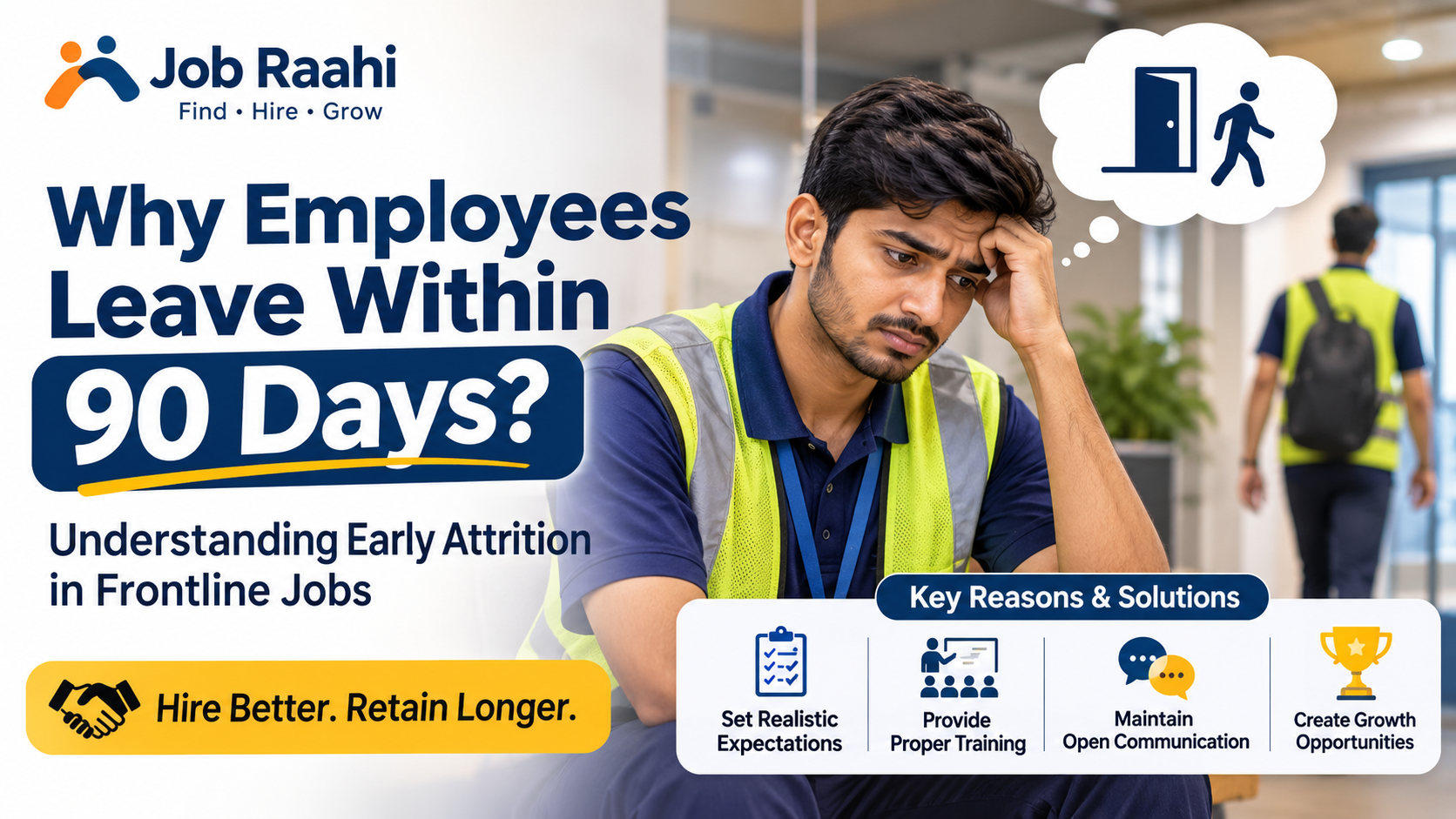
  • Why Employees Leave Within 90 Days: Understanding Early Attrition in Frontline Jobs

    Why Employees Leave Within 90 Days: Understanding Early Attrition in Frontline Jobs

    Recruiting employees is an important part of business growth. Companies invest time, money and resources in finding suitable candidates, conducting interviews and completing the joining process.

    However, there is another challenge that often begins after recruitment: retaining those employees.

    In frontline industries such as logistics, warehousing, manufacturing, retail, hospitality and delivery, employees may leave shortly after joining. Some resign within a few weeks, while others decide to move on before completing their first three months.

    This is known as early attrition.

    For employers, early exits can mean repeating the recruitment process, spending additional resources on training and managing gaps in daily operations. For employees, leaving a job soon after joining can mean losing an opportunity to gain experience and build professional stability.

    Understanding why early attrition happens is therefore important for both employers and employees.

    What Is Early Attrition?

    Early attrition refers to employees leaving an organisation within a relatively short period after joining.

    Although the exact measurement period varies between organisations, many employers monitor exits during the first 30, 60 or 90 days of employment.

    Early attrition can happen for several reasons:

    • The job does not match the candidate’s expectations.
    • Employees find it difficult to adjust to the work environment.
    • Salary or payment-related expectations are not met.
    • Employees receive insufficient training or guidance.
    • Work schedules or commuting arrangements become difficult.
    • Employees find better-suited opportunities elsewhere.

    In frontline roles, where daily operations often depend on a consistent workforce, even a small number of early exits can create additional pressure on the remaining employees and recruitment teams.

    Why Do Frontline Employees Leave Within 90 Days?

    There is rarely one reason behind employee attrition. Different employees may leave for different reasons, depending on their personal circumstances and workplace experiences.

    However, some common factors deserve attention.

    A. Difference Between Job Expectations and Reality

    One of the most common reasons for early exits is a mismatch between what candidates expect and what they experience after joining.

    For example, a candidate may accept a warehouse position without fully understanding the physical nature of the work, shift schedule or daily responsibilities.

    Similarly, someone joining a retail role may not realise how much customer interaction and standing the job involves.

    When the actual job differs significantly from what was communicated during recruitment, employees may reconsider their decision.

    B. Difficulty Adjusting to Work Schedules

    Frontline roles often operate according to business and customer requirements.

    Employees may need to work in rotational shifts, early mornings, late evenings or weekends, depending on the organisation.

    For freshers who are entering the workforce for the first time, adjusting to these schedules can take time.

    Commuting distance and transport availability can make the situation more challenging, particularly when shifts begin or end at inconvenient hours.

    C. Lack of Proper Onboarding

    Joining a company does not automatically mean an employee understands how to perform the job.

    New employees need clear instructions, role-specific training and guidance about workplace procedures.

    Without proper onboarding, they may feel confused about their responsibilities, reporting structure or performance expectations.

    This uncertainty can affect their confidence and willingness to continue.

    D. Limited Support from Supervisors

    Frontline employees often work closely with supervisors and team leaders.

    During the initial weeks, employees may have questions about tasks, processes and workplace expectations.

    If they do not receive timely guidance or feedback, they may feel unsupported.

    A welcoming and approachable supervisor can make a significant difference to a new employee’s experience.

    E. Salary and Payment-Related Concerns

    Employees naturally expect the compensation and payment conditions discussed during recruitment to be honoured.

    Unclear salary structures, unexpected deductions, delayed payments or misunderstandings about incentives can damage trust.

    Transparent communication about compensation is important from the beginning of the recruitment process.

    F. Better Opportunities Elsewhere

    Some employees leave because they receive another opportunity that better matches their expectations.

    This may involve higher compensation, a more convenient location, different working hours or a role more closely aligned with their interests.

    Employers need to understand that retention is influenced not only by the recruitment experience but also by the overall employment experience.

    The Special Challenges Freshers Face

    Early attrition can be particularly challenging when hiring freshers.

    Unlike experienced employees, freshers may have limited understanding of workplace expectations and professional routines.

    Their first job can introduce several changes at once:

    • Following a fixed reporting schedule.
    • Working with supervisors and colleagues.
    • Meeting productivity or performance targets.
    • Managing personal expenses and travel.
    • Understanding workplace discipline and responsibilities.
    • Adjusting to unfamiliar tasks and environments.

    For example, a fresher joining a manufacturing unit may need time to understand production processes, safety procedures and quality standards.

    A first-time warehouse employee may need guidance on inventory handling, scanning, picking and packing activities.

    Employers should recognise that new employees need a reasonable learning period. Clear instructions, appropriate training and regular feedback can help them become more confident in their roles.
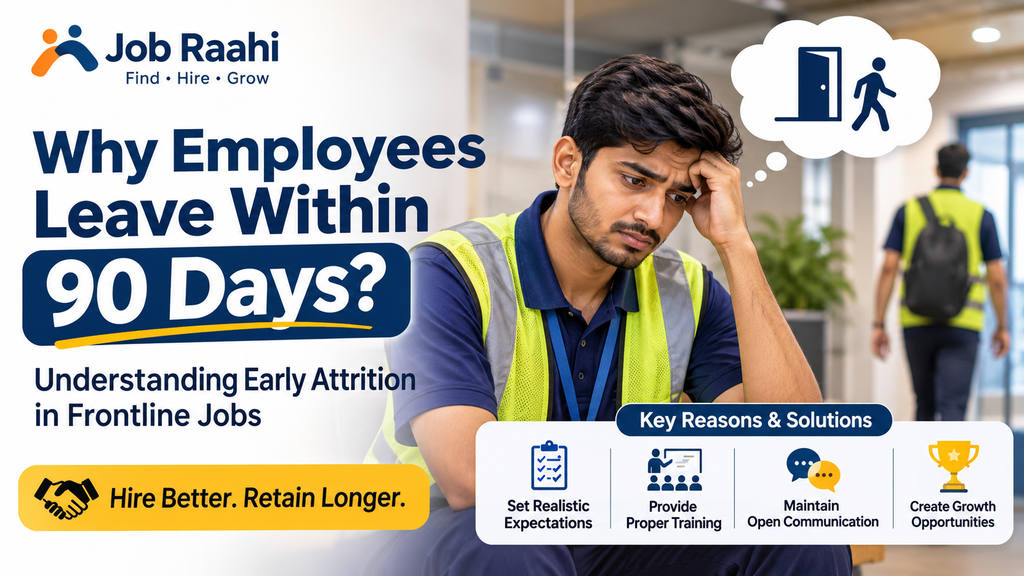
    High attrition rate within first 90 days

    How Early Attrition Affects Businesses

    When an employee leaves shortly after joining, the impact extends beyond the vacancy itself.

    Repeated Recruitment Costs

    The organisation must restart the sourcing, screening, interviewing and joining process to fill the vacant position.

    Additional Training Requirements

    Supervisors and trainers may need to spend additional time preparing replacement employees.

    Operational Disruptions

    In warehouses, production units, retail stores and delivery operations, employee shortages can affect daily responsibilities and work distribution.

    Increased Pressure on Existing Employees

    When positions remain vacant, other team members may need to manage additional responsibilities.

    Lower Team Stability

    Frequent changes in team composition can make it difficult to establish consistent working routines and coordination.

    For businesses hiring at scale, these challenges can become particularly important because recruitment and retention need to work together.

    Practical Ways Employers Can Reduce Early Attrition

    Reducing early attrition does not always require expensive initiatives. In many cases, improving communication and addressing basic workplace concerns can make a meaningful difference.

    A. Set Realistic Job Expectations During Recruitment

    Candidates should receive accurate information before accepting an offer.

    Employers should clearly explain:

    • Actual job responsibilities.
    • Work location and commute considerations.
    • Shift timings and weekly offs.
    • Salary and payment structure.
    • Physical or technical requirements.
    • Performance expectations.
    • Available facilities and workplace conditions.

    A realistic understanding of the job helps candidates make informed decisions.

    B. Create a Structured Onboarding Process

    The first few days should help employees understand the organisation and their responsibilities.

    A basic onboarding process can include workplace orientation, introductions to supervisors, safety instructions, role-specific training and explanations of company policies.

    New employees should know whom to approach when they need assistance.

    C. Provide Support During the Learning Period

    Employers should avoid expecting freshers to understand every process immediately.

    Assigning a supervisor, trainer or experienced team member to guide new employees can help them learn more effectively.

    Training should be appropriate to the role and include necessary safety precautions.

    D. Maintain Regular Communication

    Managers should interact with new employees during their initial weeks.

    Short check-ins can help identify concerns related to workload, shifts, transport, training or workplace conditions.

    Addressing problems early may prevent employees from making the decision to leave without communicating their concerns.

    E. Ensure Timely and Transparent Payments

    Compensation details should be communicated clearly during recruitment and joining.

    Employers should explain salary components, payment dates, incentives and any applicable deductions.

    Consistency between what was promised and what is delivered helps build employee trust.

    F. Review the First 90 Days

    Companies can divide the initial employment period into three stages:

    PeriodEmployer’s Focus
    First 30 DaysOrientation, role clarity, basic training and workplace adjustment
    Days 31–60Skill development, performance feedback and identifying challenges
    Days 61–90Reviewing progress, employee engagement and long-term role suitability

    This approach gives employers a structured way to understand how new employees are adjusting.

    The Importance of a Positive First 90 Days

    An employee’s initial experience can influence how they view the organisation and their future within it.

    A positive first 90 days should focus on more than attendance and productivity.

    It should help employees:

    • Understand their role and responsibilities.
    • Develop confidence in performing assigned tasks.
    • Build relationships with colleagues.
    • Receive constructive feedback.
    • Understand opportunities to improve and grow.
    • Feel comfortable communicating workplace concerns.

    For freshers, these experiences can be especially valuable because their first job often shapes their understanding of professional life.

    Employers who invest in a supportive initial experience can create a stronger foundation for employee engagement and retention.

    How Digital Hiring Platforms Fit into the Retention Journey

    Digital job platforms play an important role in helping employers connect with potential candidates.

    They can support the recruitment stage by making vacancies more accessible, expanding candidate reach and helping job seekers discover opportunities that match their qualifications and experience.

    However, attracting candidates is only one part of the employee journey.

    Retention depends on what happens after a candidate applies and joins the organisation.

    Employers must ensure that the job information shared during recruitment accurately reflects the actual role. They must also provide proper onboarding, training, fair working conditions and continued support.

    In other words, effective workforce management requires both successful hiring and a positive employee experience.

    How Job Raahi Supports the Frontline Hiring Ecosystem

    Job Raahi is a digital job platform focused on frontline, entry-level and mass hiring opportunities.

    It connects companies with candidates exploring employment across sectors such as logistics, warehousing, retail, delivery, sales, hospitality, customer support and other frontline roles.

    For employers, Job Raahi provides an additional channel to reach candidates from different locations, including freshers and individuals with limited professional experience.

    Its wider ecosystem also includes skill centres across India, where candidates can be trained and developed according to industry needs.

    This can help employers explore a wider pool of potential candidates while giving freshers access to relevant employment opportunities.

    However, finding the right candidate is only the beginning.

    Employers must also ensure that candidates understand the role before joining and receive the support needed to adjust to the workplace.

    Job Raahi supports the connection between employers and job seekers; building a positive workplace experience remains an important responsibility of the employer.

    Conclusion: Hiring Employees Is Important, Retaining Them Is Equally Important

    Early attrition is a challenge that frontline employers cannot afford to ignore.

    When employees leave within their first 90 days, organisations may face repeated recruitment efforts, additional training requirements and operational disruptions.

    However, many of the factors contributing to early exits can be addressed through better communication, realistic job expectations, structured onboarding and consistent workplace support.

    Freshers also need time to understand their responsibilities, develop practical skills and adjust to professional environments.

    For employers, the objective should not simply be to fill vacancies quickly. It should be to create conditions in which suitable employees can learn, perform and grow.

    Platforms like Job Raahi can help companies expand their candidate reach and connect with emerging frontline talent. The next step is to ensure that the employment experience matches the opportunity presented during recruitment.

    Successful hiring does not end when a candidate joins. It begins a new responsibility: helping that employee become a confident, capable and valued part of the workforce.
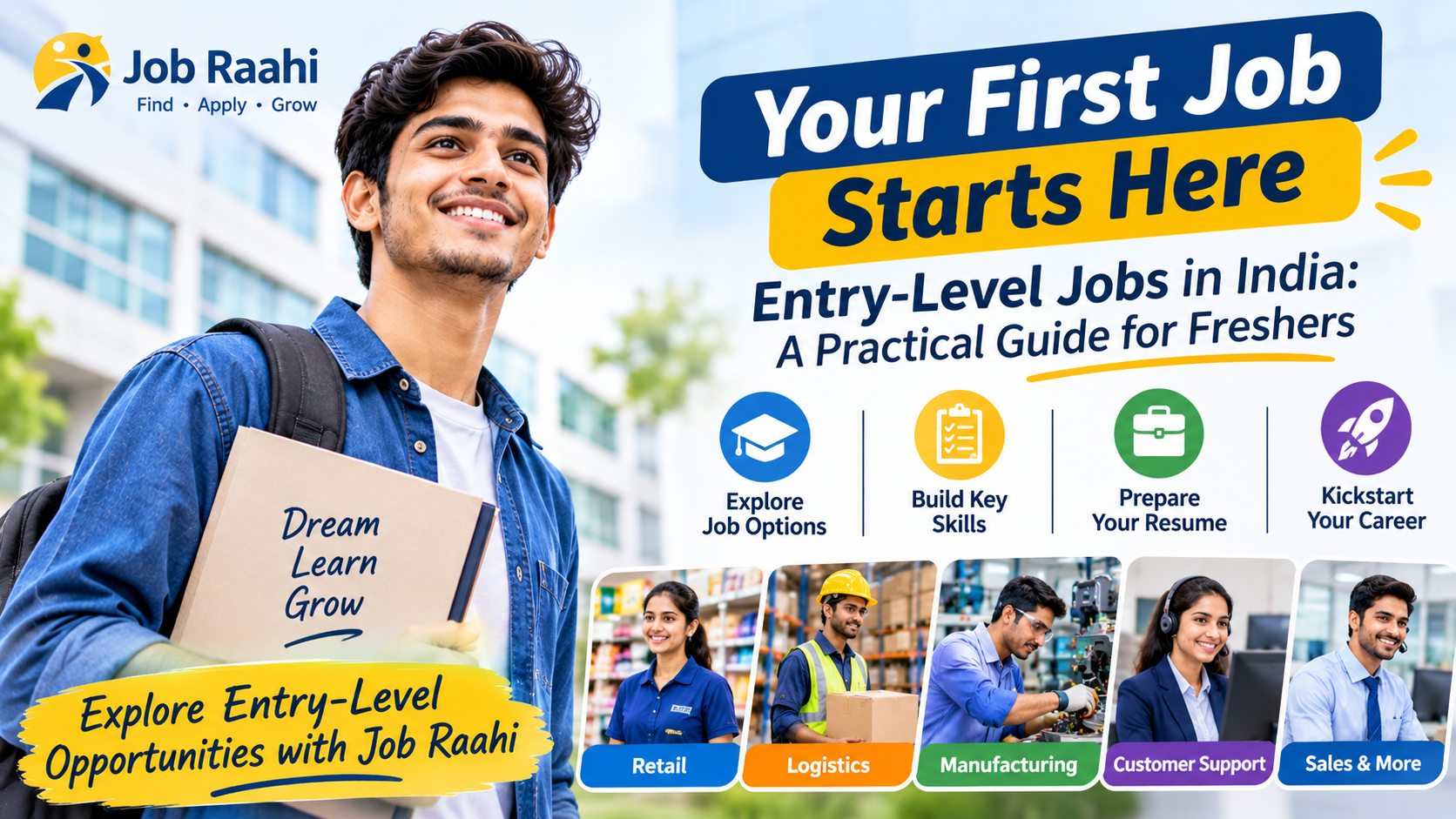
  • Entry-Level Jobs in India: A Practical Guide for Freshers to Start Their Careers

    Entry-Level Jobs in India: A Practical Guide for Freshers to Start Their Careers

    Table of Contents

    1. What Are Entry-Level Jobs?
    2. Why Are Entry-Level Jobs Important for Freshers?
    3. Types of Entry-Level Jobs You Can Explore
      a. Retail and customer service
      b. Logistics and warehouse
      c. Manufacturing and Technical Operations
      d. Sales and field Operations
      e. BPO and Customer Support
    4. What Do Employers Expect from Freshers?
    5. How to Find Entry-Level Jobs in India
    6. How to Prepare for Your First Job
    7. Common Mistakes to Avoid While Applying
    8. Build Your Career with Job Raahi

    Getting your first job is an important milestone. It brings the opportunity to earn, become independent, gain practical experience and understand how the professional world works. However, for many freshers, finding that first opportunity can feel challenging.

    One common question job seekers face is: How can I get a job when most employers ask for experience?

    The good news is that not every job requires years of experience. Many companies hire candidates for entry-level positions and provide the initial training needed to perform the role. These opportunities are designed for people who are beginning their careers, including candidates who have completed their 10th, 12th, ITI, Polytechnic, Diploma or graduation.

    With the right approach, preparation and willingness to learn, your first job can become the foundation of a long-term career.

    1. What Are Entry-Level Jobs?

    Entry-level jobs are positions designed for candidates who have little or no previous work experience. These roles help individuals enter the workforce, understand workplace responsibilities and develop professional skills.

    Unlike experienced positions, entry-level roles generally focus on basic qualifications, communication, practical ability and the candidate’s willingness to learn.

    Depending on the industry and employer, candidates may be eligible with:

    • 10th or 12th standard education
    • ITI or vocational training
    • Polytechnic or Diploma qualifications
    • Graduation or other relevant qualifications
    • Basic computer or technical knowledge

    For example, a candidate who has completed an ITI course may start as a technician trainee or production associate. Similarly, a 12th-pass candidate may explore opportunities in retail, customer support, field sales or warehouse operations.

    The eligibility criteria vary from one employer to another, so always check the job description before applying.

    2. Why Are Entry-Level Jobs Important for Freshers?

    Your first job is more than a source of income. It is an opportunity to understand how workplaces operate and develop the habits that support career growth.

    Practical experience: Training gives you knowledge, but working in a real environment helps you understand how to apply it. You learn to handle responsibilities, follow processes and solve everyday problems.

    Financial independence: Earning your first salary can help you manage personal expenses and become more financially independent.

    Professional confidence: Communicating with colleagues, interacting with customers and completing assigned tasks gradually build confidence.

    Career development: Your first role can help you identify your strengths, understand your interests and prepare for better opportunities in the future.

    Learning workplace discipline: Punctuality, teamwork, accountability and professional behaviour are important habits that develop through practical experience.

    You do not need to find your dream job in your first attempt. Focus on finding a suitable opportunity where you can learn, contribute and grow.

    3. Types of Entry-Level Jobs You Can Explore

    Entry-level opportunities are available across several industries. Your options will depend on your educational background, location, interests and the requirements of employers.

    A. Retail and Customer Service

    Retail companies hire freshers for positions that involve assisting customers, managing products and supporting daily store operations.

    Common roles include:

    • Retail Sales Associate
    • Store Assistant
    • Customer Service Executive
    • Cashier
    • Store Operations Assistant

    These roles can help candidates develop communication, customer-handling and problem-solving skills.

    B. Logistics and Warehouse

    The growing movement of goods across e-commerce, retail and supply-chain businesses creates opportunities in warehouse and logistics operations.

    Common roles include:

    • Picker and Packer
    • Warehouse Associate
    • Inventory Assistant
    • Dispatch Assistant
    • Loading and Unloading Associate

    These positions may suit candidates who are comfortable with operational responsibilities and following process-based work.

    C. Manufacturing and Technical Operations

    Candidates with ITI, Polytechnic or Diploma qualifications can explore opportunities in manufacturing, production and technical operations.

    Common roles include:

    • Production Trainee
    • Machine Operator Trainee
    • Technician Trainee
    • Quality Assistant
    • Maintenance Assistant

    Some employers provide on-the-job training, while others require specific technical knowledge or trade qualifications.

    D. Sales and Field Operations

    Sales roles offer opportunities to interact with customers, understand products and develop communication skills.

    Common positions include:

    • Field Sales Executive
    • Sales Promoter
    • Business Development Associate
    • Field Relationship Executive
    • Customer Acquisition Executive

    Candidates who enjoy interacting with people and are comfortable working in the field may find these roles suitable.

    E. BPO and Customer Support

    Many businesses hire freshers to manage customer queries, provide product information and support daily communication.

    Common positions include:

    • Customer Support Executive
    • Voice Process Associate
    • Non-Voice Process Associate
    • Back Office Executive
    • Data Entry Operator

    Basic communication, computer knowledge and attention to detail can be useful for these roles. Language requirements depend on the employer and process.

    First Job for fresher

    4. What Do Employers Expect from Freshers?

    Employers do not always expect freshers to know everything from day one. However, they do look for certain qualities that indicate whether a candidate can learn and perform the job.

    Communication: The ability to understand instructions, ask questions and communicate clearly with customers or team members.

    Willingness to learn: Employers value candidates who are open to feedback and interested in improving their skills.

    Punctuality and discipline: Reporting on time, following workplace rules and completing assigned responsibilities demonstrate professionalism.

    Basic digital knowledge: Familiarity with smartphones, email, online forms and basic computer applications can be useful in many roles.

    Teamwork: Most workplaces require employees to coordinate with colleagues and contribute towards shared goals.

    Problem-solving: Even in an entry-level position, the ability to identify an issue and seek the right solution is valuable.

    Remember, your attitude and willingness to learn can make a positive impression, even when you have limited experience.

    5. How to Find Entry-Level Jobs in India

    Finding a suitable first job requires more than applying randomly to every opening. A focused approach can help you identify opportunities that match your qualifications and expectations.

    Step 1: Identify Your Suitable Job Category

    Start by understanding what type of work you want to explore. Consider your education, skills, location and interests.

    For example:

    • ITI candidates can explore technical and production roles.
    • 12th-pass candidates can consider retail, sales and customer support.
    • Diploma holders can explore technical, operational and trainee positions.
    • Graduates can consider entry-level opportunities across sales, operations and support functions.

    Step 2: Use Reliable Job Platforms

    Search for openings through established employment platforms and check whether the job details are genuine.

    You can explore resources such as:

    • National Career Service (NCS)
    • Job Raahi
    • Apprenticeship India
    • National Apprenticeship Training Scheme (NATS), where applicable

    Step 3: Read Job Descriptions Carefully

    Before applying, check the eligibility criteria, job location, responsibilities, working hours, salary details and experience requirements.

    Do not apply only because the job title sounds attractive. Make sure the actual responsibilities suit your expectations.

    Step 4: Keep Your Documents Ready

    Prepare an updated resume and keep important documents accessible. These may include educational certificates, identity proof, photographs and relevant training certificates.

    Share personal documents only through legitimate and appropriate hiring processes.

    Step 5: Apply Consistently and Follow Up

    Make job searching a regular activity. Apply to relevant openings, attend scheduled interviews and follow up professionally when required.

    Consistency and preparation can improve your chances of finding a suitable opportunity.

    6. How to Prepare for Your First Job

    Once you start receiving interview calls, preparation becomes important.

    Create a simple resume: Mention your educational qualifications, technical training, projects, internships, practical skills and contact details. If you have no work experience, highlight what you have learned and practised.

    Prepare your introduction: Practise explaining who you are, what you have studied and what kind of opportunity you are looking for.

    Understand the job role: Research the company and read the job description. Be prepared to explain why you are interested in that position.

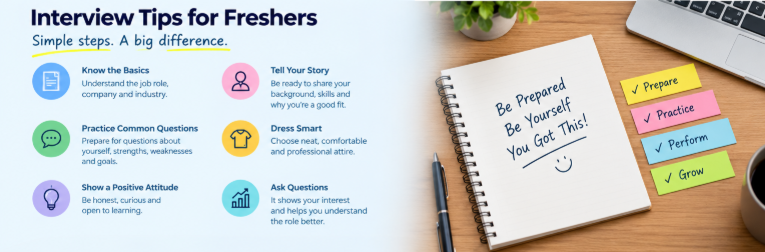
    Practise common interview questions: Questions such as “Tell me about yourself”, “Why should we hire you?” and “Are you willing to learn?” are useful to practise.

    Be honest: Do not exaggerate your skills or claim experience you do not have. Employers appreciate candidates who communicate honestly about their abilities.

    Most importantly, do not let nervousness stop you from attending interviews. Every interview is also an opportunity to learn.

    7. Common Mistakes to Avoid While Applying

    Freshers sometimes miss good opportunities because they overlook a few important details.

    • Applying without checking eligibility: Always read the requirements before submitting an application.
    • Using the same incomplete resume everywhere: Keep your resume accurate and relevant to the role.
    • Ignoring job location: Check whether the workplace is accessible and whether relocation is required.
    • Accepting unclear job offers: Understand the salary, working hours, responsibilities and employment terms before joining.
    • Paying money to secure a job: Be cautious of recruiters or individuals demanding registration fees, deposits or payments in exchange for guaranteed employment.
    • Giving up after rejection: Rejections are part of the job-search process. Use feedback to improve your preparation.

    A careful approach can help you avoid unnecessary problems and make better career decisions.

    8. Build Your Career with Job Raahi

    Your first job is an opportunity to turn your education, training and potential into practical experience. Whether you have completed your 10th, 12th, ITI, Polytechnic, Diploma or graduation, there are entry-level opportunities across industries that can help you begin your professional journey.

    Job Raahi aims to connect job seekers with employers hiring across frontline and entry-level roles in sectors such as retail, logistics, warehousing, sales, customer support and hospitality.

    The platform helps candidates discover relevant job opportunities and take the next step towards employment.

    You do not need to have your entire career figured out before getting started. Focus on finding the right first opportunity, developing useful skills and learning with every experience.

    Your first job is not the end goal. It is where your career begins. Explore opportunities and take your next career step with Job Raahi.

  • Vocational Training to First Job: A Fresher’s Guide to Starting a Career

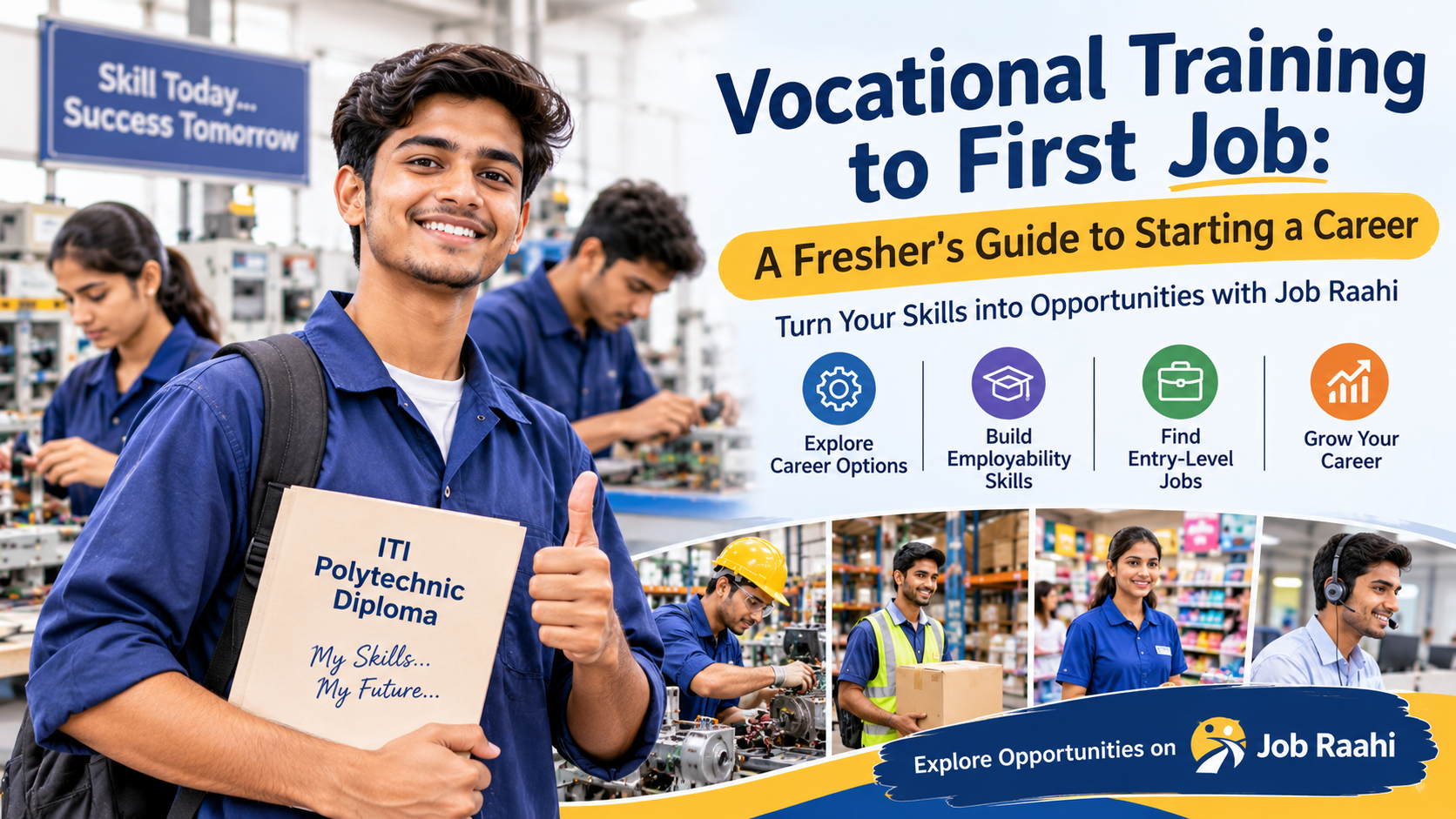
    Vocational Training to First Job: A Fresher’s Guide to Starting a Career

    Completing a vocational course is an important milestone. Whether you have completed ITI, Polytechnic, Diploma or another skill-based programme, you have already taken a step towards preparing yourself for the professional world.

    You may have spent months learning technical concepts, practising with tools, working on projects and understanding how things operate in real situations. But once your training is complete, another question begins to take priority:

    How do I turn what I have learned into my first job?

    For many freshers, the transition from a classroom or training institute to an actual workplace can be confusing. You may have the qualification but limited work experience. You may understand your trade but feel unsure about interviews, job applications or the expectations of employers.

    The good news is that your career does not need to begin with years of experience. It can begin with the skills you already have, your willingness to learn and the right opportunity.

    Let’s explore how you can make that transition.

    What Does Vocational Training Really Prepare You For?

    Vocational training focuses on developing practical knowledge and skills that can be applied in specific occupations or industries.

    Unlike learning that is primarily theoretical, skill-based education often includes practical sessions, workshop activities, equipment handling and task-based learning.

    For example:

    • An ITI Electrician student learns about electrical systems, wiring and safety practices.
    • An ITI Fitter student develops an understanding of fitting, tools and mechanical components.
    • A Diploma in Mechanical Engineering introduces students to manufacturing, production and maintenance concepts.
    • A Diploma in Civil Engineering provides a foundation in construction, surveying and site-related activities.
    • A Diploma in Electronics helps students understand electronic components, circuits and testing.
    • A vocational course in computer applications can introduce learners to digital tools and basic technical support.

    These skills can provide a starting point for exploring relevant employment opportunities.

    However, completing a course is only one part of the journey. The next step is learning how to apply your knowledge in a professional environment.

    Why Practical Skills Matter in Today’s Job Market

    Employers do not only look at what candidates have studied. They also want to understand whether candidates can apply their knowledge to actual work.

    Imagine two freshers applying for an entry-level technical position. Both have completed the same qualification. However, one can explain the practical projects completed during training, understands basic safety procedures and can confidently describe the tools used.

    That candidate may be better prepared to demonstrate their abilities during the selection process.

    Practical skills help you:

    • Understand workplace tasks more easily.
    • Follow instructions and standard operating procedures.
    • Work with tools, machines and equipment relevant to your trade.
    • Identify basic problems and seek appropriate solutions.
    • Adapt to workplace expectations.

    This does not mean you must know everything before joining your first job. Employers hiring freshers may provide role-specific training. What matters is having a foundation and being ready to build on it.

    From Training Institute to Workplace: Understanding the Gap

    One of the biggest challenges for freshers is adapting to the difference between classroom learning and workplace responsibilities.

    During your course, you may have worked on assignments with the guidance of instructors. At work, you may need to complete tasks within a schedule, coordinate with colleagues and follow company procedures.

    Here are a few ways to prepare:

    Understand workplace discipline: Learn the importance of punctuality, attendance, responsibility and following instructions.

    Improve communication: Practise explaining your work, asking questions and sharing updates with supervisors.

    Learn safety practices: Understand the safety requirements associated with your trade or workplace.

    Develop teamwork: Most jobs involve working with other people. Learn to coordinate, cooperate and respect different responsibilities.

    Stay open to feedback: Your first job will introduce new processes and challenges. Treat feedback as an opportunity to improve.

    The transition may take time, but every new experience can help you become more confident and capable.

    Career Opportunities Freshers Can Explore

    Vocational training can open doors to opportunities across different industries. The roles available will depend on your qualification, specialisation, skills, location and employer requirements.

    Here are some career areas worth exploring:

    Technical and maintenance roles

    Students from relevant ITI and Diploma trades can explore opportunities such as technician assistants, electricians, fitters, maintenance assistants and equipment operators.

    Manufacturing and production

    Manufacturing companies require people to support production activities, operate equipment, follow processes and maintain quality standards. Entry-level opportunities may include production assistants, machine operators and quality-checking assistants.

    Logistics and warehouse operations

    Warehouses and logistics businesses offer roles such as warehouse associates, inventory assistants, dispatch assistants and operations associates. These opportunities can help freshers understand inventory management, order processing and supply-chain operations.

    Retail and field operations

    Retail associates, field executives, sales assistants and customer-facing roles can provide exposure to customer interactions, product knowledge and daily business operations.

    Customer support and technical assistance

    Candidates with suitable communication and basic computer skills can explore customer support, service assistance, helpdesk and other entry-level operational roles.

    Remember, your first job does not have to define your entire career. It should give you a reasonable opportunity to learn, gain experience and move towards your future goals.

    Vocational Training to first job

    How Apprenticeships Can Help You Gain Industry Experience

    If you have completed your course but are struggling to gain practical industry exposure, consider exploring apprenticeship opportunities.

    An apprenticeship provides structured learning in a workplace, allowing eligible candidates to gain hands-on experience under an employer’s training arrangement.

    For eligible Diploma holders, the National Apprenticeship Training Scheme (NATS) is one route to explore. ITI pass-outs and other eligible candidates can also explore opportunities under the National Apprenticeship Promotion Scheme (NAPS).

    An apprenticeship can help you:

    • Understand actual workplace processes.
    • Apply your classroom knowledge to practical tasks.
    • Learn from experienced professionals.
    • Develop professional discipline and confidence.
    • Build experience that may support future job applications.

    Remember to check the eligibility, trade, duration, stipend and conditions of each opportunity. Apprenticeship training does not automatically guarantee permanent employment.

    Five Skills That Can Make You More Employable

    Your technical qualification gives you a foundation, but developing additional skills can make your transition into employment smoother.

    Here are five areas worth working on:

    1. Technical understanding: Revise the important concepts and practical tasks related to your trade. Be prepared to explain what you know.

    2. Basic digital literacy: Learn to use email, online forms, spreadsheets and other basic digital tools.

    3. Communication: Practise speaking clearly, listening carefully and asking relevant questions. You do not need perfect English for every role; communication requirements depend on the job.

    4. Problem-solving: Develop the habit of understanding a problem, identifying possible causes and seeking guidance when necessary.

    5. Adaptability: Be willing to learn new tools, processes and responsibilities as you enter the workplace.

    You can improve these skills through regular practice, short courses, practical projects and workplace exposure.

    How to Prepare for Your First Job

    You do not need an impressive employment history to apply for your first job. You need a clear profile that tells employers about your education, practical knowledge and interest in the role.

    Follow these steps:

    • Create a simple resume: Mention your qualification, specialisation, institute, year of completion and relevant skills.
    • Include practical projects: Add workshop activities, final-year projects, lab work or hands-on assignments.
    • Keep documents ready: Organise your resume, certificates and other documents requested by the employer.
    • Practise interview questions: Prepare to explain what you studied, what you learned and why you are interested in the position.
    • Read job descriptions carefully: Check the responsibilities, eligibility, location, salary details and working conditions.
    • Apply consistently: Explore relevant openings instead of waiting for one perfect opportunity.

    Most importantly, be honest about your experience. As a fresher, you are not expected to know everything. Show employers that you have a foundation and are willing to learn.

    How Job Raahi Helps Freshers Discover Opportunities

    Getting the right information at the right time can make the job search easier.

    Freshers often miss opportunities because they are unsure where to search, which roles to apply for or how to connect with employers.

    This is where Job Raahi can help.

    Job Raahi is a digital job platform that connects candidates with employment opportunities across different sectors. Candidates can explore openings in areas such as retail, logistics, warehouse operations, sales, delivery, customer support and other frontline roles.

    Whether you have recently completed your vocational course or are looking for an entry-level opportunity, you can create your profile, explore relevant vacancies and apply for suitable openings.

    The goal is simple: help candidates discover opportunities and take practical steps towards employment.

    Your training has given you a starting point. Now take the next step towards your career with Job Raahi.

    Final Thoughts

    Vocational training is not just about earning a certificate. It is about developing abilities that can be used in the workplace.

    Your first job may come with new challenges, unfamiliar responsibilities and plenty of learning opportunities. Do not let limited experience stop you from exploring suitable roles.

    Revise your skills, prepare your resume, stay open to learning and apply for opportunities that match your qualifications.

    You do not have to build your entire career in one day. You just have to take the first step.

    Learn a skill. Find an opportunity. Build your future with confidence.

  • From Classroom to Career: A Practical Guide for ITI, Polytechnic and Diploma Freshers

    From Classroom to Career: A Practical Guide for ITI, Polytechnic and Diploma Freshers

    Completing an ITI, Polytechnic or Diploma course is an important achievement. You have spent time learning technical concepts, understanding tools and equipment, attending practical sessions and preparing yourself for the professional world.

    But after receiving your certificate, one question often comes to mind:

    “What should I do next to get my first job?”

    For many freshers, the transition from education to employment can feel confusing. You may have technical knowledge but limited industry exposure. You may know your trade but feel unsure about interviews, workplace expectations or where to find suitable openings.

    The good news is that your career does not have to begin with years of experience. Your technical education, willingness to learn and practical abilities can help you take the first step.

    Let’s understand how.

    Screenshot 2026 10 30 103150

    Your Course Is Complete. What’s the Next Step?

    The first step is to understand what you have learned and where those skills can be used.

    An ITI, Polytechnic or Diploma qualification can open doors to different types of opportunities depending on your specialisation, practical skills and the employer’s requirements.

    For example:

    • ITI Electrician: Electrical maintenance, installation assistance and technician roles.
    • ITI Fitter: Fitter, production assistant and machine maintenance roles.
    • ITI Welder: Welding, fabrication and workshop-related opportunities.
    • Diploma in Mechanical Engineering: Production, quality inspection and maintenance roles.
    • Diploma in Civil Engineering: Site supervision assistance, surveying and quality-related roles.
    • Diploma in Electronics: Electronics assembly, testing and technician roles.
    • Diploma in Computer Science or IT: Technical support, hardware assistance and entry-level IT support roles.

    These are examples, not guaranteed job placements. Actual eligibility and responsibilities depend on the vacancy.

    Before applying, identify your trade, the skills you have practised and the kind of workplace where you would like to begin.

    What Career Opportunities Can You Explore?

    Many students assume that their only option is to find a job with a designation that exactly matches their course. While finding a relevant technical role is a good goal, it is worth exploring other entry-level opportunities too.

    Here are a few career paths to consider:

    Technical and trade-related jobs

    These roles allow you to apply your course knowledge in practical settings. Examples include technicians, machine operators, electricians, fitters, maintenance assistants and quality-checking assistants.

    Production and manufacturing

    Manufacturing units need people who can support production activities, operate equipment, follow safety procedures and maintain quality standards.

    Warehouse and logistics

    Warehouses and logistics companies offer roles such as warehouse associates, inventory assistants, dispatch assistants and operations associates. These can help freshers understand supply chains, inventory handling and day-to-day operations.

    Field and service roles

    Installation support, equipment servicing, customer support and field operations can offer practical exposure to people who enjoy hands-on work and interacting with customers.

    Customer support and operations

    Students with basic computer knowledge, communication skills and an interest in problem-solving can also explore customer support, back-office and operations opportunities.

    Your first job does not have to define your entire career. It can be a starting point from which you learn, gain experience and move towards your long-term goals.

    ITI students getting industrial Experience

    Don’t Ignore Apprenticeships: Your First Step into Industry

    One of the most useful routes for eligible freshers is apprenticeship training.

    An apprenticeship allows candidates to gain practical experience in an actual workplace while learning under an employer’s training arrangement. It can help bridge the gap between what you studied and what an industry expects.

    ITI pass-outs and eligible Diploma holders can explore apprenticeship opportunities through the relevant government portals.

    For example:

    • National Apprenticeship Promotion Scheme (NAPS): A route for eligible ITI pass-outs and other categories of apprentices.
    • National Apprenticeship Training Scheme (NATS): Offers apprenticeship opportunities for eligible Diploma and Graduate candidates.

    Remember that eligibility, available trades, duration and selection requirements vary. An apprenticeship is a training opportunity and does not automatically guarantee a permanent job.

    However, the practical exposure, workplace discipline and professional experience you gain can strengthen your profile when applying for future roles.

    Skills That Can Make You More Employable

    Your technical qualification matters, but employers also look at how well you can apply your knowledge and work with others.

    Here are five skills worth developing:

    1. Practical knowledge

    Understand the tools, equipment, processes and safety practices related to your trade. Be prepared to explain what you have actually worked on during practical sessions.

    2. Basic computer skills

    Learn to use email, spreadsheets, online forms and basic digital tools. These skills are useful across technical, warehouse and administrative roles.

    3. Communication

    You do not need perfect English for every job. What matters is being able to understand instructions, ask questions and communicate clearly in the language required for the role.

    4. Problem-solving

    Workplaces often involve small challenges that require patience and logical thinking. Learn to understand a problem before jumping to a solution.

    5. Workplace discipline

    Punctuality, teamwork, safety awareness and responsibility are important in almost every industry. These habits can help employers see you as someone they can rely on.

    How to Prepare for Your First Job

    You do not need an elaborate resume or years of experience to start applying. You need a clear profile that communicates your education, skills and willingness to learn.

    Here are some practical steps:

    • Prepare a simple resume: Include your course, trade or specialisation, institute, year of completion and relevant skills.
    • Mention practical projects: Add workshop assignments, final-year projects, lab work or hands-on training.
    • Keep your documents ready: Organise your resume, educational certificates, identity documents and other required records.
    • Practise common interview questions: Be ready to explain what you studied, what you can do and why you want the role.
    • Understand the job before applying: Read the responsibilities, location, working hours, salary details and eligibility criteria.
    • Stay open to learning: Your first workplace may introduce tools and processes that you did not encounter during your course.

    A fresher who can explain their knowledge honestly and demonstrate a willingness to learn can make a positive impression.

    Five Mistakes Freshers Should Avoid

    Starting a career can be challenging, especially when you are applying for your first job. Avoid these common mistakes:

    1. Applying without reading the job description: Make sure the role matches your qualifications and expectations.
    2. Ignoring practical experience: Even college projects and workshop activities can demonstrate your abilities.
    3. Waiting only for the perfect job: Explore relevant entry-level opportunities while continuing to work towards your preferred role.
    4. Sharing incorrect information: Keep your resume and application details accurate.
    5. Paying money for a promised job: Be cautious of anyone demanding payment in exchange for guaranteed selection. Verify the employer and recruitment process before sharing sensitive documents or making payments.

    A genuine opportunity should have clear details about the employer, role, selection process and employment conditions.

    A Simple Action Plan to Start Your Career

    If you are unsure where to begin, follow this seven-day plan:

    • Day 1: Identify your trade, specialisation and preferred job roles.
    • Day 2: Prepare your resume and organise your certificates.
    • Day 3: Practise explaining your course, projects and practical skills.
    • Day 4: Register on relevant job and apprenticeship portals.
    • Day 5: Search for suitable technical, operations and entry-level vacancies.
    • Day 6: Apply to relevant openings and prepare for interviews.
    • Day 7: Review your applications, follow up where appropriate and identify skills you can improve.

    You do not need to complete everything perfectly in one week. The purpose is to build a consistent job-search routine.

    Find Your Next Opportunity with Job Raahi

    Your ITI, Polytechnic or Diploma course has given you a foundation. Now it is time to take that knowledge into the workplace.

    Whether you are looking for your first technical role, an entry-level operations opportunity or a job where you can learn through practical experience, keep exploring suitable openings.

    Job Raahi helps candidates discover job opportunities across sectors such as logistics, retail, sales, customer support, warehouse operations and other frontline roles.

    You can create your profile, explore relevant vacancies and apply for opportunities that match your interests and qualifications.

    Your first job may be the beginning of something much bigger. Stay curious, keep learning and take that first step towards your career.

    Explore opportunities and get started with Job Raahi.

  • How to find your First Job? 8 Practical Job Search Guide for Freshers and Frontline Workers

    How to find your First Job? 8 Practical Job Search Guide for Freshers and Frontline Workers

    1. Why Does Finding Your First Job Feel Difficult?

    You have completed your education and are ready to start working. You are motivated to earn, learn new skills and become financially independent. But when you begin searching for your first job, you may not know where to start.

    Some employers ask for experience. Certain vacancies require strong English communication skills. Sometimes, the job description itself is difficult to understand. You may also feel uncertain about preparing a resume, applying online or answering interview questions.

    For freshers and frontline workers, these challenges can make the job search feel overwhelming.

    The good news is that finding your first job is a skill you can develop. With the right information, a little planning and consistent effort, you can begin identifying opportunities that match your qualifications and abilities.

    Whether you have completed Class 10, Class 12, an ITI course, a diploma or a degree, your first step is to understand what you can offer and which roles are suitable for you.

    2. Start by Choosing the Right Job for You

    Every job has different requirements. Instead of applying randomly, focus on positions that match your education, interests, skills and location.

    Retail and store jobs

    If you enjoy interacting with people, explaining products and helping customers, consider roles such as retail associate, cashier or store assistant. Depending on the position, employers may look for communication skills, customer service ability and basic numerical skills.

    Frontline sales jobs

    If you are comfortable meeting people, explaining products and building relationships, explore opportunities such as field sales executive, sales representative or field promoter.

    Understanding the local market, listening to customers and following up professionally can be valuable strengths in these roles.

    Warehouse and logistics jobs

    If you prefer practical, operational work, consider positions such as warehouse associate, picker, packer, inventory assistant or dispatch associate.

    Some positions may require physical fitness, shift flexibility, basic digital skills or familiarity with warehouse processes. Always review the specific requirements before applying.

    Delivery and customer support jobs

    Delivery roles may require local area knowledge, punctuality and the ability to follow route instructions. Customer support roles often require patience, listening skills and the ability to communicate clearly in the language used by customers.

    Remember: The right job is not necessarily the one with the most impressive title. It is one that matches your current abilities, offers suitable working conditions and gives you a realistic opportunity to learn and grow.

    3. Where Should You Begin Your Job Search?

    You do not have to depend only on newspaper advertisements or personal contacts to find employment. Online job portals, government employment services, educational institutions and local employer networks can all help you discover vacancies.

    Use online job portals

    Job platforms allow you to explore openings based on location, qualifications, experience and preferred job roles.

    Complete your profile accurately, read the job description carefully and apply for positions that match your background.

    Platforms such as Job Raahi can help candidates explore frontline and entry-level opportunities across different sectors.

    Explore government employment resources

    The National Career Service (NCS), an initiative of the Ministry of Labour and Employment, provides job-search services and career-related resources.

    You can also explore the Skill India Digital Hub for information about skill development and training opportunities.

    These resources can help you understand available career pathways and identify opportunities relevant to your interests.

    Use your local network

    Check the official career pages of nearby stores, warehouses, service businesses and other employers. If you have studied at an ITI, polytechnic or college, ask the placement office about relevant vacancies.

    You can also ask trusted contacts about openings in your area. However, always verify the employer and job details before sharing personal information or accepting an offer.

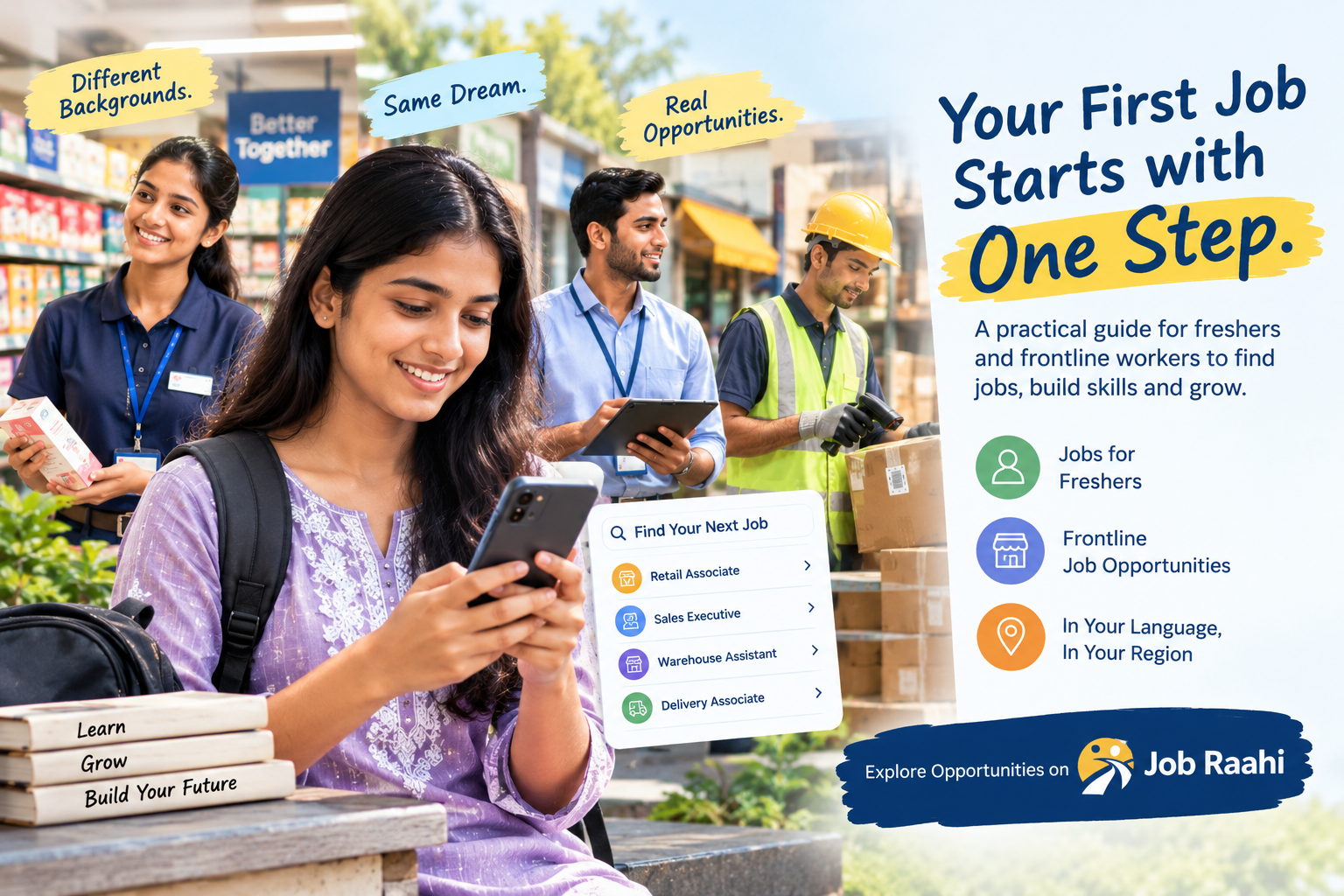
    Your first job starts here

    4. Six Things to Check Before Applying

    Before applying for any vacancy, make sure you understand what the employer is offering.

    1. Job responsibilities: What tasks will you be expected to perform?
    2. Job location: How far is the workplace, and what will your daily travel cost?
    3. Salary: What is the expected in-hand salary? Are incentives, deductions or additional payments involved?
    4. Working hours: What are the shift timings, weekly holidays and overtime arrangements?
    5. Eligibility: Does your education, experience and skill set meet the requirements?
    6. Employer details: Can you verify the company name, workplace address and official contact information?

    If anything is unclear, ask questions before accepting the position.

    A suitable job is one where you understand the responsibilities, salary and working conditions well enough to make an informed decision.

    5. Not Confident in English? You Can Still Get Started

    English proficiency is important for some of your first jobs, but it is not a universal requirement for every frontline or entry-level role. Language expectations depend on the employer, position and customers the employee will serve.

    If you are more comfortable communicating in Hindi or another regional language, begin by strengthening your overall communication skills.

    Practise introducing yourself, understanding instructions, asking questions and responding politely. These abilities can help you prepare for interviews and workplace interactions.

    For example, you could introduce yourself by explaining your education, relevant abilities, willingness to learn and preferred job role in the language you speak confidently.

    You can then practise a simple English version if your target position requires it.

    It is also helpful to learn job-specific vocabulary. Sales professionals may need to understand terms related to products, orders and customer follow-ups. Warehouse workers may benefit from learning common terms related to stock, packing and dispatch.

    You do not need to master every aspect of a language before applying for a job. Instead, understand the language requirements of your chosen role and work towards meeting them.

    Your language background does not define your potential. Focus on the skills the job requires while continuing to improve your communication.

    6. How to Protect Yourself from Job Scams

    When you urgently need employment, it can be tempting to trust anyone promising a quick job. Unfortunately, misleading recruitment offers can put job seekers at financial and personal risk.

    Keep these precautions in mind:

    • Be cautious if someone demands a registration, interview or guaranteed-placement fee without clearly explaining the terms.
    • Verify the company’s official website, contact details and workplace address.
    • Understand the salary, responsibilities and joining conditions before accepting an offer.
    • Never share passwords, banking PINs or OTPs with someone claiming to be a recruiter.
    • Do not assume a vacancy is genuine simply because it appears on social media or arrives through a messaging app.
    • Be especially careful when an offer promises unusually high earnings without a credible selection process.

    Not every payment or recruitment arrangement is necessarily fraudulent, but you should verify its purpose, terms and legitimacy before paying anything.

    If an offer seems suspicious, pause and seek advice from a trusted person or an appropriate official resource.

    7. A Seven-Day Action Plan for Your First Job

    If you are unsure what to do each day, follow this simple plan to organise your job search.

    Day 1: Understand your profile. Write down your education, location, skills, preferred roles and salary expectations.

    Day 2: Prepare your resume. Keep it clear and accurate. If you have no work experience, highlight relevant training, projects, practical skills or responsibilities you have handled.

    Day 3: Create your job-search profiles. Register on suitable job platforms and complete your profile with accurate information.

    Day 4: Shortlist relevant vacancies. Compare job responsibilities, eligibility, location, salary and working conditions.

    Day 5: Apply for suitable positions. Submit applications that match your background rather than applying indiscriminately.

    Day 6: Practise for interviews. Prepare answers to common questions, including “Tell me about yourself,” “What are your strengths?” and “Why do you want this job?”

    Day 7: Review and follow up. Track your applications, check for responses and identify areas where you can improve your profile.

    Repeat this process as needed. Finding a job can take time, so focus on consistent effort rather than expecting immediate results.

    8. Explore Your Next Opportunity with Job Raahi

    Finding your first job begins with taking action. Understand your qualifications, identify your strengths and learn how to apply for suitable vacancies.

    If you are a fresher or looking to build your career in the frontline workforce, explore available opportunities on Job Raahi.

    You can look for openings in retail, field sales, delivery, logistics, warehouse operations, customer support and other frontline roles. Review each vacancy carefully to check whether its qualifications, location and requirements match your profile.

    You do not need to know everything on your first day. What matters is choosing a suitable role, being honest about your abilities and staying willing to learn.

    Your first job can help you build practical experience, develop workplace skills and prepare for future opportunities.

    Start with one application today. Your next career opportunity could begin with that first step.

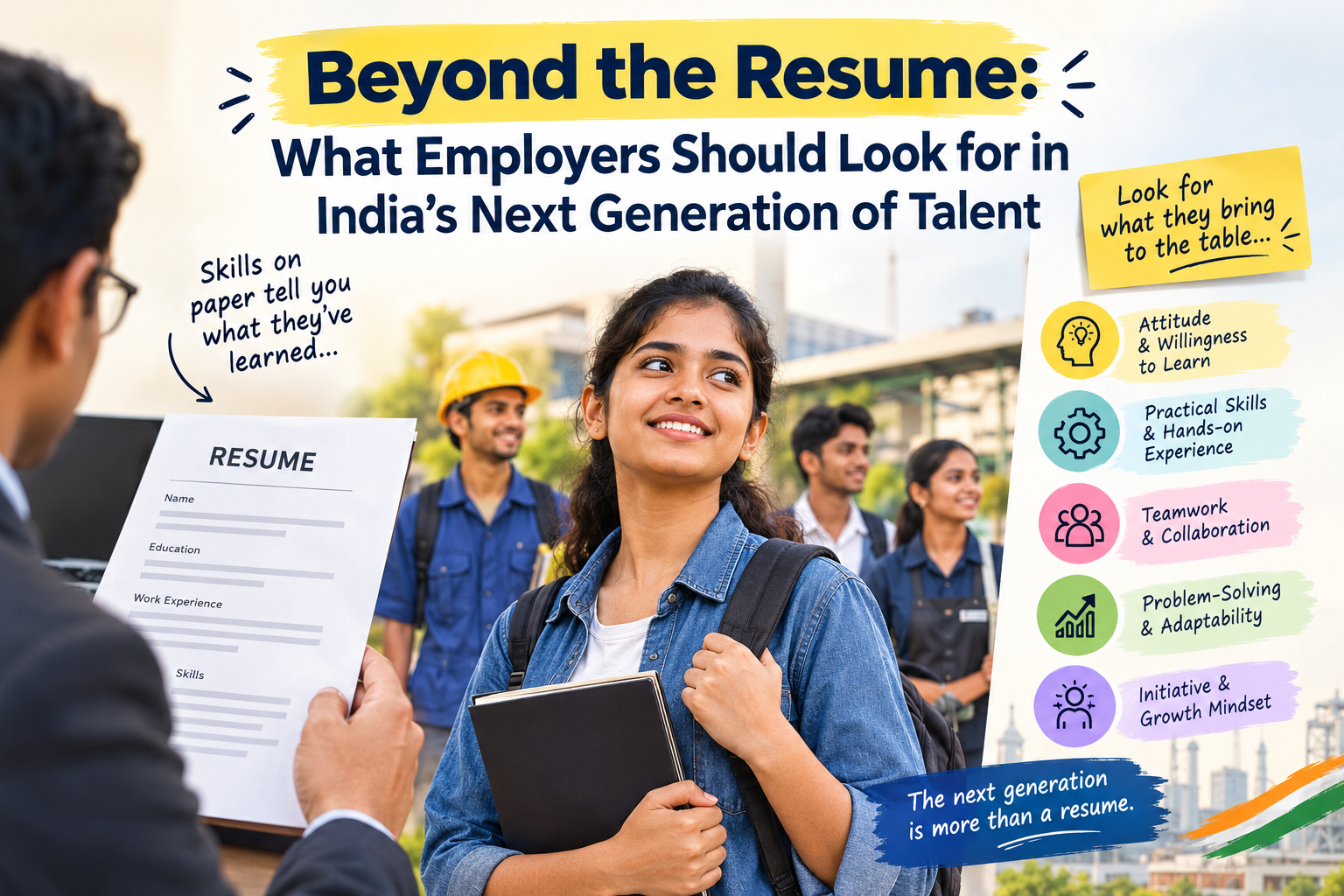
  • Beyond the Resume: What Employers Should Look for in India’s Emerging Talent

    Beyond the Resume: What Employers Should Look for in India’s Emerging Talent

    Two candidates apply for the same entry-level job.

    The first has a polished resume, a recognised qualification and a year of experience. The second is a fresher who has skills, completed relevant training, understands the basics of the role and is eager to learn.

    Which candidate should the employer choose?

    The answer depends on the job. But if the employer automatically rejects the second candidate because they lack experience, they may never discover whether that person could perform the work well.

    This is one of the central questions facing modern recruitment: are businesses identifying the right talent, or are they relying too heavily on familiar indicators of capability?

    In India, where job seekers enter the workforce through different educational pathways and life experiences, the distinction matters.

    A resume is useful evidence, but it is not the complete measure of a person’s ability or potential.

    The Resume Is Only Part of the Story

    A resume helps employers understand a candidate’s education, work history, qualifications and achievements. These details are important, particularly when a position requires specialised knowledge, professional licensing or substantial experience.

    However, a resume cannot always show how someone performs a practical task, responds to feedback, handles a customer or learns a new process.

    Consider a warehouse role. A candidate’s ability to follow safety procedures, identify products accurately and learn inventory systems may be more directly relevant than the prestige of their college.

    For a retail position, communication, customer handling and reliability may be essential. For a technical role, employers may need to assess specific knowledge, practical competence and the ability to troubleshoot problems.

    The right evaluation depends on the responsibilities of the job.

    This does not mean qualifications should be ignored. It means employers should distinguish between requirements that are genuinely necessary and preferences that may unnecessarily narrow the candidate pool.

    The goal is not to hire people with fewer qualifications. It is to identify people with the right qualifications and capabilities for the work.

    Why Skills Matter More Than We Sometimes Realise

    Recruitment has traditionally relied on familiar signals: degrees, previous employers, job titles and years of experience. These can help with shortlisting, but they do not always tell the full story.

    Skills-based hiring adds another question: can the candidate demonstrate the abilities needed to perform the role, or learn them through appropriate training?

    This approach is especially relevant for entry-level and frontline positions in sectors such as retail, logistics, hospitality, customer support and operations.
    A candidate may have developed useful abilities through an ITI course, a diploma, an apprenticeship, practical training, a family business or previous informal work. Another may be entering the workforce for the first time but have the aptitude to learn the required tasks.

    Employers should assess these experiences in context rather than assume that only conventional employment counts. The shift towards skills-based hiring is also reflected in India’s recruitment discussion.
    Reporting on the 2026 State of College Hiring in India describes a market where skills-first approaches are gaining attention, while traditional academic indicators continue to influence many hiring decisions.

    The important point is not that degrees no longer matter. It is that qualifications and demonstrated ability should be evaluated in a way that reflects the actual role.

    Look for Skills rather than just a resume

    The Barriers That Keep Capable Candidates Out

    Even when employers want capable people, their recruitment processes can unintentionally exclude suitable candidates.

    Unnecessary experience requirements

    A job described as entry-level may still ask for one or two years of experience. When that experience is not essential, the requirement can discourage freshers who might otherwise be suitable.

    Overly restrictive educational filters

    A specific qualification is necessary for some jobs. For others, requiring a particular degree or institution may not meaningfully predict performance.

    Resumes that favour presentation over ability

    Candidates with stronger writing skills or more guidance may produce more impressive resumes, even when another applicant has comparable practical ability.

    Limited opportunities to demonstrate skills

    If selection depends entirely on resume screening and a short interview, employers may miss abilities that become apparent through a relevant practical exercise or structured assessment.

    Assumptions about non-traditional backgrounds

    Candidates returning to work, changing careers or coming from informal employment may have relevant skills that are not clearly represented by conventional job titles.

    These barriers are not present in every recruitment process. But when they do exist, they can reduce the range of candidates an employer considers.

    A better process makes it easier for relevant capability to become visible.

    What Employers Should Look for Beyond Qualifications

    Skills-based hiring works best when employers identify the competencies required for each position before evaluating candidates.

    Four areas deserve particular attention.

    Practical Ability

    Can the candidate perform the task, demonstrate the relevant knowledge or learn the required process?

    For experienced candidates, this may involve reviewing work samples or previous achievements. For freshers, it may involve a practical exercise, a relevant qualification or evidence from training.

    The assessment should match the actual job and should not demand unpaid work that provides little value to the candidate.

    Willingness to Learn

    Not every entry-level candidate will arrive fully prepared for every workplace process. Employers should consider whether the person can understand instructions, respond to feedback and develop the skills needed for the role.

    A willingness to learn is not a substitute for essential competence. It is a useful indicator when the position includes appropriate training and development.

    Communication and Reliability

    Many jobs require candidates to communicate clearly, follow instructions, coordinate with colleagues and raise concerns when something goes wrong.

    These abilities can be assessed through relevant interview questions and realistic scenarios rather than assumptions based on educational background or fluency in a language that the role does not require.

    Reliability should also be assessed fairly, using relevant evidence instead of stereotypes about a candidate’s age, location or background.

    Evidence of Potential

    For a fresher, evidence of potential might include practical coursework, an apprenticeship, a project, a demonstration of relevant skills or the way the candidate approaches an unfamiliar task.

    Employers should look for evidence, not simply rely on intuition. Structured questions and consistent scoring help compare candidates more fairly.

    How Job Seekers Can Demonstrate Their Skills

    Candidates also have a role in making their abilities visible.

    If you are a fresher, do not assume that having limited work experience means you have nothing valuable to show.

    Start by identifying the skills relevant to the jobs you want. These might include operating equipment, using spreadsheets, handling customers, communicating with a team, maintaining records or following safety procedures.

    Then gather honest evidence of those abilities. You could include relevant coursework, practical training, apprenticeship experience, personal projects or responsibilities from previous work. Describe what you actually did rather than relying on broad claims such as “hard-working” or “quick learner.”

    For example, instead of writing only “completed warehouse training,” explain the tasks you practised, such as inventory recording, order picking or packaging—provided these accurately reflect your experience.

    Prepare examples that show how you learned something, solved a problem or handled responsibility.

    You can also use career resources and employability guidance from the Government of India’s National Career Service portal to support your job search and profile development.

    The objective is simple: help an employer understand what you can offer, even if your employment history is short.

    Building a Better Skills-Based Hiring Process

    Employers do not need to redesign their entire recruitment system overnight. They can begin with a few practical changes.

    Write Clearer Job Descriptions

    Separate essential requirements from preferred qualifications. Explain the actual responsibilities, required skills, location, salary range where possible and any training provided.

    If experience is mandatory, explain why it matters for the position.

    Assess Skills Relevant to the Role

    Use structured interviews, practical demonstrations or work-related scenarios where appropriate. Ensure that assessments are accessible, consistent and proportionate to the job.

    For a customer support position, a short role-play may reveal communication and problem-solving ability. For a warehouse role, a safety-focused scenario or relevant task demonstration may be more useful than an unrelated written test.

    Give Suitable Freshers a Fair Chance

    Where previous experience is not essential, consider candidates who have the required foundation and can develop through training.

    Clear onboarding, realistic expectations and early feedback can help new employees understand the role and become productive.

    Hiring freshers is not suitable for every position. Safety-critical, regulated or highly specialised roles may require specific qualifications or proven experience. The decision should reflect the real requirements of the work.

    Measure Hiring Outcomes

    Employers should track more than the number of resumes received.

    Useful measures include assessment pass rates, time to fill, offer acceptance, joining rates, early retention, training progress and job performance.

    Review these indicators by role and hiring channel. If a particular requirement repeatedly excludes candidates who later prove capable, it may be worth reassessing that requirement.

    Skills-based hiring should be evaluated through results, not treated as a slogan.

    A More Inclusive Future of Work

    India’s workforce includes graduates, ITI-trained candidates, diploma holders, freshers, experienced workers and people whose abilities have developed through informal work.

    No single hiring method will suit every role. Qualifications remain essential where the work demands them, and experience can provide valuable evidence of performance.

    But neither a degree nor a job title tells the whole story.

    Employers can make better decisions by identifying the skills the role requires, assessing those skills consistently and remaining open to candidates who can demonstrate relevant capability through different pathways.

    For job seekers, this creates a stronger incentive to develop practical skills and explain their value clearly. For employers, it offers a way to reconsider unnecessary filters and reach candidates who may otherwise be overlooked.

    The next generation of talent will not all arrive with identical resumes. The opportunity is to build recruitment processes that can recognise what makes each candidate suitable for the work.

    The future of hiring should not be about choosing between qualifications and skills. It should be about understanding what the job requires—and finding the person best prepared to meet that need.

    Find Your Next Opportunity with Job Raahi

    Looking for a job that matches your skills, qualifications and experience?

    Job Raahi helps job seekers explore opportunities across frontline and entry-level roles. Whether you are a fresher or have already gained practical experience, explore vacancies that match your profile and take the next step in your career.

    For employers, a clearer understanding of role requirements can open the door to a wider range of suitable candidates. Consider adding Job Raahi as an additional channel to share vacancies and reach job seekers who may match your hiring needs.

  • Your First Job Is More Than a Starting Point: How to Turn Potential into Career Growth

    Your First Job Is More Than a Starting Point: How to Turn Potential into Career Growth

    Your first job can bring a mix of excitement, uncertainty and pressure. You may be eager to start earning, support your family or become financially independent. At the same time, you may wonder whether your qualifications are enough, whether you have the right skills or whether a company will hire you without experience.

    These concerns are common, especially when many job descriptions appear to ask for experience before giving candidates an opportunity to gain it.

    But here is an important thought: your first job is not just about getting hired. It is about building the foundation for what comes next.

    Whether you start as a retail associate, warehouse assistant, delivery executive, customer support representative, machine operator or sales trainee, the right opportunity can help you develop skills, understand workplace expectations and discover your strengths.

    The key is to approach your first job with a clear purpose: learn, contribute and grow.

    First job, new journey

    Why Your First Job Matters More Than You Think

    A first job introduces you to the realities of working life. You begin to understand how teams operate, how responsibilities are managed and how your work contributes to a larger business.

    For example, a warehouse associate may begin by learning inventory handling, order picking and packing. With experience and consistent performance, that employee may develop an understanding of stock management, quality checks and team coordination.

    Similarly, someone starting in retail can learn customer communication, billing, product knowledge and store operations. These skills can create a foundation for taking on greater responsibilities over time.

    Your first designation does not have to define your entire career. What matters is what you learn from the role and how you use that learning to move forward.
    Instead of asking only, “What is the salary?” consider asking, “What will I learn here, and where could this experience take me?”

    Salary, work hours, location, safety and working conditions still matter. Career growth should not mean accepting an unsuitable job. It means looking for a reasonable opportunity that supports both your present needs and future goals.

    Experience Is Built Somewhere

    One of the biggest challenges for freshers is the expectation that they should already have experience.

    But experience has to begin somewhere.

    Employers may need people who can follow instructions, communicate clearly, work responsibly and learn the tasks required for a role. These qualities can be demonstrated through training, practical assignments, internships, apprenticeships, college projects or previous responsibilities—not only through a long employment history.

    If you are a fresher, focus on what you can already offer.

    Have you completed an ITI course? Have you worked on machines during practical training? Have you helped manage a family business? Have you coordinated a college event, handled customers or learned to use basic computer tools?

    These experiences may demonstrate useful abilities when explained honestly and clearly. You do not need to pretend to have professional experience. Instead, show that you are prepared to learn and take responsibility.

    Employers also have a role to play. When a position can reasonably be performed by a trained fresher, requiring unnecessary years of experience may exclude candidates who could develop into capable employees. A better approach is to distinguish between skills a candidate must already possess and skills that can be taught after joining.

    How to Choose the Right First Job

    Your first opportunity deserves careful consideration. A job that looks attractive on paper may not be the right fit for your needs or abilities.

    Before applying, evaluate five things:

    Role clarity: Understand your actual responsibilities. Ask what a typical working day looks like and what performance expectations will be.

    Salary and benefits: Confirm the salary structure, payment frequency, deductions and any applicable benefits before accepting an offer.

    Location and commute: Consider travel time, transport availability and whether the job location is practical for you.

    Learning opportunities: Look for roles where you can develop useful skills, receive appropriate training and understand how performance is evaluated.

    Workplace conditions: Ask about shifts, weekly offs, safety arrangements and the support available to new employees.

    Do not choose a job only because it has an impressive title. A clearly defined role with supportive supervision and meaningful learning may be more valuable than a title that offers little development.

    At the same time, do not assume that every entry-level job automatically leads to promotion. Ask questions, understand the terms and make an informed decision.

    Five Skills That Can Help You Grow Faster

    You do not need to master everything before your first day. However, a few foundational skills can make the transition into employment easier.

    1. Communication

    Learn to explain a problem, ask for clarification and share updates. You do not need perfect English for every role. Clear communication in the language required by your workplace is what matters.

    2. Punctuality and reliability

    Arriving on time, following agreed schedules and informing your supervisor when an issue arises help build trust.

    3. Willingness to learn

    Listen carefully during training, take notes where useful and ask questions when instructions are unclear. Learning a task correctly is more important than pretending to know everything.

    4. Basic digital skills

    Depending on your role, you may need to use a smartphone application, scan barcodes, enter information, manage digital payments or communicate through workplace tools. Practising these skills can improve your readiness.

    5. Teamwork and problem-solving

    Most jobs involve working with other people. Learn how to coordinate, handle routine challenges and seek help when a problem is beyond your responsibility.

    These abilities are not limited to office jobs. They are valuable across retail, logistics, hospitality, manufacturing, customer support and many other sectors.

    Make Your First Job a Learning Experience

    Getting hired is an important milestone, but your development continues after joining. During your first few weeks, focus on understanding the job rather than comparing your progress with everyone else’s.

    Learn the correct process. Understand the quality and safety standards. Observe experienced colleagues. Ask your supervisor what good performance looks like.
    Once you become comfortable with your responsibilities, look for opportunities to improve. Can you complete a task more accurately? Can you communicate a customer issue more clearly? Can you learn another part of the operation?

    Keep a simple record of what you learn and the responsibilities you take on. This will help you explain your experience when applying for future opportunities.
    For instance, rather than writing only “worked in a warehouse” on your CV, describe the responsibilities you genuinely handled, such as order picking, packing, inventory updates or dispatch coordination.

    Never exaggerate your achievements. Specific, honest examples are more useful than impressive-sounding claims that you cannot support.
    You can also explore career guidance, job-search support and skill-development resources through the National Career Service portal.

    What Employers Can Do to Help New Employees Succeed

    Career growth is not solely the responsibility of the employee. Employers influence how easily a new hire adjusts, learns and contributes. A candidate who joins without previous work experience may still have the attitude, basic aptitude and willingness to learn needed for the role. Without proper onboarding, even a promising candidate can struggle to understand expectations.

    Employers can help by setting clear responsibilities, providing practical training, assigning an approachable supervisor and giving feedback during the early weeks.
    They can also make job descriptions more realistic by separating essential requirements from skills that can be taught.

    This creates a more meaningful way to evaluate candidates: not just by where they have worked before, but also by what they can do, what they can learn and how well they match the role.
    For businesses hiring at scale, this approach can expand the pool of potential candidates. For job seekers, it can make suitable entry-level opportunities easier to identify. The aim is not to overlook experience when it is genuinely necessary. It is to avoid treating experience as the only sign of capability.

    Your Career Starts with Your Next Step

    You do not need to have your entire career planned before applying for your first job.

    Start by understanding your strengths, identifying suitable roles and preparing an honest CV. Apply for opportunities that match your qualifications and practical abilities. Research employers, ask questions and understand the terms before accepting an offer.

    Once you begin working, keep learning. Build reliable habits, improve your skills and take responsibility for the work assigned to you. Your first job may not be your final destination. It can still be an important step towards greater confidence, better skills and new opportunities.

    You do not need years of experience to begin building your future. You need a suitable opportunity, the willingness to learn and the determination to make the most of each step.

    Find Your Next Opportunity with Job Raahi

    If you are looking for your first job or exploring your next career move, Job Raahi can help you discover opportunities across frontline and entry-level roles.

    Explore available vacancies, look for positions that match your skills and qualifications, and take the next step towards your career.
    Your journey does not have to begin with the perfect job. It can begin with the right opportunity to learn, contribute and grow.

  • First Job Interview Tips for Freshers: How to Prepare and Answer with Confidence

    First Job Interview Tips for Freshers: How to Prepare and Answer with Confidence

    Getting your first interview call can be exciting.

    It can also make you nervous.

    You might start wondering: What will they ask me? What if I don’t know the answer? What should I wear? What if they ask about my experience when I don’t have any?

    If you have ever had these thoughts before an interview, you are not alone.

    For a fresher, the first job interview can feel like a big moment. You may not have years of work experience to talk about, but that does not mean you have nothing to offer. Your education, projects, internships, vocational training, part-time work, college activities and even everyday experiences can tell an interviewer a lot about how you learn, communicate and handle responsibility.

    The key is knowing how to present yourself. Your First Interview Is Not About Being Perfect. One of the biggest mistakes freshers make is thinking they need to have the perfect answer to every question.

    You don’t.

    An interview is a conversation where the employer is trying to understand whether you are suitable for the role and whether you are willing to learn.

    For entry-level positions, interviewers may look at things such as communication, attitude, basic knowledge, reliability and your interest in the role.

    So instead of thinking, “I don’t have enough experience,” try asking yourself:

    “What have I learned, and how can I show that I am ready to learn more?”

    That small change in mindset can make a big difference.

    Crack your first Interview

    1. Understand the Job Before You Walk In

    Before preparing answers, read the job description carefully. What exactly will you be doing?

    What skills are mentioned?

    Is the job related to sales, customer service, logistics, retail, warehouse operations, hospitality or something else?

    For example, if you are interviewing for a warehouse associate role, understand the basic responsibilities of the position. If it is a retail job, think about customer interaction, product handling and store operations.

    You don’t need to become an expert overnight. But you should know what you are applying for. It shows that you are genuinely interested in the opportunity rather than simply attending every interview you receive.

    2. Research the Company

    Spend some time learning about the company before your interview. Start with the company’s website. Understand what it does, what products or services it offers and the kind of customers it serves.

    You can also look at its recent updates or social media pages. Why does this matter?

    Because you may be asked:

    “What do you know about our company?”

    A candidate who has done even basic research can answer this question much more naturally than someone who knows nothing about the organisation.

    You don’t need to memorise the company’s entire history. Just know the basics and understand why the job interests you.

    3. Prepare Your Answer to “Tell Me About Yourself”

    This is one of the most common questions in a first interview. And many freshers make it unnecessarily complicated. You don’t need to tell your entire life story.

    Keep your answer simple:

    Who you are → What you have studied → What skills or experience you have → What kind of opportunity you are looking for

    For example:

    “I recently completed my 12th and have been interested in customer-facing roles. During my studies, I participated in activities where I had to interact with people and work as part of a team. I am now looking for an entry-level opportunity where I can develop my communication skills and gain practical work experience.”

    Don’t memorise this word by word. Understand the structure and speak naturally.

    4. Be Ready for Common Fresher Interview Questions

    You will probably face some familiar questions during your interview. Prepare for questions such as:

    • Tell me about yourself.
    • Why do you want this job?
    • Why do you want to work with our company?
    • What are your strengths?
    • What is one area you want to improve?
    • Why should we hire you?
    • What do you know about this role?
    • Where do you see yourself in the future?
    • Are you comfortable working in shifts?
    • Are you comfortable working with a team?
    • Do you have any questions for us?

    Don’t prepare by memorising long answers. Instead, think about your own experiences and prepare a few points for each question. That way, your answers will sound like you, rather than something copied from the internet.

    5. You Don’t Need Work Experience to Show Your Skills

    This is particularly important for freshers. Suppose the interviewer asks:

    “Can you give me an example of working in a team?”

    You don’t necessarily need to have worked in a company.

    You can talk about a college project, school activity, sports team, volunteer activity or any other situation where you worked with other people.

    Similarly, if you are asked about responsibility, think about a real situation where you were responsible for completing something.

    The interviewer is often interested in how you handled the situation, not just where it happened.

    Your experiences count. You just need to learn how to talk about them.

    6. Don’t Be Afraid to Say “I Don’t Know”

    This is something many freshers struggle with. They think saying “I don’t know” will automatically ruin their chances. But pretending to know something you don’t can be worse.

    If you genuinely don’t know the answer, you can say:

    “I’m not familiar with that yet, but I would be interested in learning it.”

    Or:

    “I haven’t worked with that before, but I understand the basics and would be happy to learn.”

    Being honest while showing a willingness to learn is much better than making up an answer.

    7. Practice Before the Interview

    You can read interview tips all day, but speaking your answers out loud is different.

    Take your phone and record yourself answering a few questions.

    Start with:

    “Tell me about yourself.”

    Then try:

    “Why should we hire you?”

    And:

    “Why do you want this job?”

    Listen to your recording.

    Are you speaking too quickly?

    Are your answers too long?

    Are you using “umm” and “actually” too often?

    Are you sounding confident?

    You will notice things that you may not realise while simply thinking about your answers. If possible, ask a friend, teacher or family member to conduct a mock interview with you.

    8. Dress Neatly and Reach on Time

    You don’t need expensive clothes for an interview. You need to look clean, neat and appropriate for the workplace.

    Choose comfortable and professional clothing, keep your appearance tidy and avoid anything that makes you uncomfortable during the interview.

    And don’t underestimate punctuality. Plan your route beforehand and try to reach a little early. Arriving in a hurry can make you nervous before the interview even begins.

    9. Communication Is More Than Speaking English

    Many freshers worry that their English is not perfect. But good communication is not about using complicated English. It is about expressing your thoughts clearly.

    Listen carefully to the question. Take a moment if you need to think. Speak at a comfortable pace.

    And if you don’t understand something, simply ask the interviewer to repeat or explain the question.

    You don’t need to sound like someone else. You need to be clear, respectful and confident enough to express yourself.

    10. Ask a Question When the Interview Ends

    At the end of an interview, you may hear:

    “Do you have any questions for us?”

    Don’t automatically say no.

    You can ask something simple and relevant, such as:

    • “What would my responsibilities be in this role?”
    • “What skills are most important for this position?”
    • “What would the next step in the hiring process be?”
    • “Is there any training provided for someone joining this role?”

    It shows that you are paying attention and genuinely interested in understanding the opportunity.

    What If You Don’t Get Selected? This is probably the most important thing to remember. Your first interview may not lead to your first job.

    And that’s okay.

    You may attend one interview, then another, and another before receiving an offer. Each interview teaches you something. Maybe you realised you need to improve your communication. Maybe you struggled with a particular question. Maybe you discovered that you need to learn more about the industry.

    Take that learning with you to the next interview. Over time, the process becomes less unfamiliar, and your confidence starts to grow.

    A Simple Interview Checklist for Freshers

    Screenshot 2026 10 06 115843

    Before leaving for your interview, take a minute to check:

    • Have I read the job description?
    • Do I know what the company does?
    • Is my resume updated?
    • Can I introduce myself confidently?
    • Have I practised common interview questions?
    • Do I know how to explain my skills and education?
    • Have I planned my route?
    • Am I carrying the required documents?
    • Have I prepared one or two questions to ask?
    • Most importantly, am I ready to be honest and learn?

    Your First Interview Is a Learning Experience Getting your first job is not about having everything figured out. You are a fresher. Employers know that. What matters is showing that you are prepared, willing to learn and serious about the opportunity.

    So take a breath.

    Read the job description. Do your research. Practise your answers. Be honest about what you know. And walk into the interview with the confidence that you have something valuable to offer.

    Your first interview may be the beginning of your professional journey. You don’t need to be perfect. You just need to be prepared enough to take the first step.

  • Blue Collar Interview Questions

    Blue Collar Interview Questions

    Blue Collar Interview

    Blue Collar Interview is an essential step for ITI students, diploma holders, and freshers to get hired in their desired field. Furthermore, it is crucial to prepare for common interview questions to increase the chances of getting selected. Additionally, a well-prepared resume and cover letter can make a significant difference in the Blue Collar Interview process.

    Introduction to Blue Collar Interview Questions

    For instance, a Blue Collar Interview can be intimidating, especially for freshers. However, with proper preparation and practice, it can become a cakewalk. Consequently, it is essential to research the company and the position you are applying for. Moreover, practicing common interview questions can help you to build confidence. Therefore, it is crucial to prepare a list of questions that are commonly asked in a Blue Collar Interview.

    Blue Collar Interview Questions and Answers

    Moreover, a Blue Collar Interview requires a different set of skills and knowledge. Furthermore, it is essential to be honest and transparent during the interview process. Additionally, a positive attitude and a willingness to learn can make a significant difference.

    Blue Collar Interview

    For example, some common Blue Collar Interview questions include:

    • What are your strengths and weaknesses?
    • Why do you want to work for our company?
    • What are your long-term career goals?
    • How would you handle a difficult situation at work?
    • Why do you think you are the best fit for this position?

    Types of Blue Collar Interview Questions

    However, there are different types of Blue Collar Interview questions that can be asked. For instance, behavioral questions, technical questions, and situational questions are common. Moreover, it is essential to prepare for each type of question to increase the chances of getting selected. Consequently, researching the company and the position can help you to prepare for the interview.

    Tips for Blue Collar Interview Preparation

    Additionally, preparing for a Blue Collar Interview requires a lot of effort and dedication. Furthermore, it is essential to practice common interview questions and to research the company. Moreover, a well-prepared resume and cover letter can make a significant difference. Therefore, it is crucial to tailor your resume and cover letter to the position you are applying for. You can find more tips and tricks on Job Raahi Blog to help you prepare for your Blue Collar Interview.

    Importance of Blue Collar Interview Preparation

    However, preparing for a Blue Collar Interview is not just about practicing common interview questions. For instance, it is essential to research the company and the position you are applying for. Moreover, a positive attitude and a willingness to learn can make a significant difference. Consequently, it is crucial to be honest and transparent during the interview process. You can also visit Job Raahi to find more resources on Blue Collar Interview preparation.

    Common Blue Collar Interview Questions

    Furthermore, common Blue Collar Interview questions can vary depending on the position and the company. However, some common questions include:

    • What are your strengths and weaknesses?
    • Why do you want to work for our company?
    • What are your long-term career goals?
    • How would you handle a difficult situation at work?
    • Why do you think you are the best fit for this position?

    You can also download Job Raahi app to get more information on Blue Collar Interview questions and answers.

    Blue Collar Interview Questions and Answers for Freshers

    However, freshers may face different challenges during a Blue Collar Interview. For instance, they may not have the required experience or skills. Moreover, they may not know how to answer common interview questions. Consequently, it is essential to prepare for the interview and to practice common interview questions. You can visit the National Career Service website to get more information on Blue Collar Interview questions and answers for freshers.

    Blue Collar Career and Salary

    Moreover, a Blue Collar career can be rewarding and challenging. Furthermore, the salary for Blue Collar jobs can vary depending on the position and the company. Additionally, the salary can also depend on the location and the industry. Therefore, it is essential to research the company and the position to get an idea of the salary range. You can visit the Ministry of Skill Development website to get more information on Blue Collar careers and salaries.

    Position Salary Range Location Industry
    Electrician 20000-50000 Delhi Construction
    Fitter 15000-30000 Mumbai Manufacturing
    Welder 10000-25000 Chennai Automotive
    Machine Operator 12000-28000 Bangalore IT

    Conclusion

    In conclusion, a Blue Collar Interview requires preparation and practice. Furthermore, it is essential to research the company and the position to get an idea of the salary range and the required skills. Additionally, a positive attitude and a willingness to learn can make a significant difference. Therefore, it is crucial to prepare for common Blue Collar Interview questions and to practice answering them. You can download Job Raahi app to get more information on Blue Collar Interview questions and answers and to prepare for your interview.

    Sources and References

    Some of the sources used in this article include:

  • ITI Fresher Interview Questions

    ITI Fresher Interview Questions

    ITI Fresher Interview

    An ITI Fresher Interview is a crucial step for students who have completed their Industrial Training Institute courses, as it determines their entry into the job market. Furthermore, preparing for such interviews can be challenging, especially for those who are new to the process. Consequently, it is essential to understand the most common questions asked in ITI fresher interviews to increase one’s chances of getting hired. Additionally, researching the company and practicing responses to typical interview questions can help ITI students feel more confident during the interview process.

    Introduction to ITI Fresher Interview Questions

    For instance, many ITI students struggle to find the right resources to prepare for their interviews. However, with the help of online platforms such as Job Raahi Blog, they can access a wide range of interview questions and tips. Moreover, ITI fresher interview questions can vary depending on the company and the position, but there are some common questions that are often asked.

    Common ITI Fresher Interview Questions

    An ITI Fresher Interview typically includes a combination of technical and behavioral questions, such as those related to the student’s coursework, projects, and skills. Therefore, it is essential to review the course material and be prepared to answer questions about it. Some common ITI fresher interview questions include:

    • What inspired you to pursue an ITI course?
    • Can you describe your final year project?
    • How do you stay updated with the latest developments in your field?
    • Why do you want to work for our company?
    • Where do you see yourself in five years?

    ITI Fresher Interview

    ITI Fresher Interview Preparation Tips

    To prepare for an ITI Fresher Interview, students should research the company and the position they are applying for. Additionally, they should practice answering common interview questions and prepare any materials they may need, such as a resume and references. Furthermore, it is essential to dress professionally and be punctual for the interview. For example, Job Raahi provides a range of resources and tips to help ITI students prepare for their interviews.

    Researching the Company

    Researching the company is a crucial step in preparing for an ITI Fresher Interview. Consequently, students should learn about the company’s products, services, and mission. Moreover, they should review the company’s website and social media pages to get a sense of their values and culture.

    Practicing Interview Questions

    Practicing interview questions is another essential step in preparing for an ITI Fresher Interview. Therefore, students should review common interview questions and practice answering them. Additionally, they should consider using online resources, such as download Job Raahi app, to access a wide range of interview questions and tips.

    ITI Fresher Salary and Job Openings

    An ITI Fresher Interview can lead to a range of job opportunities, depending on the student’s skills and qualifications. Furthermore, the salary for ITI fresher jobs can vary depending on the company and the position. However, with the help of online platforms such as National Career Service, students can access a wide range of job openings and salary information.

    Company Position Salary
    Tata Motors Technician 15000-20000
    Maruti Suzuki Automotive Engineer 20000-25000
    LG Electronics Electrical Engineer 25000-30000
    Samsung Mechanical Engineer 20000-25000

    Job Openings

    There are a range of job openings available for ITI fresher students, depending on their skills and qualifications. Moreover, online platforms such as Ministry of Skill Development provide a wide range of job openings and training programs for ITI students.

    ITI Training Institutes and Career Opportunities

    ITI training institutes play a crucial role in providing students with the skills and qualifications they need to succeed in their careers. Furthermore, these institutes offer a range of career opportunities, depending on the student’s interests and skills. Some of the most common career opportunities for ITI students include:

    • Technician
    • Automotive Engineer
    • Electrical Engineer
    • Mechanical Engineer
    • Quality Control Inspector

    An ITI Fresher Interview is an essential step in securing these career opportunities, and students should be well-prepared to answer common interview questions and showcase their skills and qualifications.

    Conclusion

    In conclusion, an ITI Fresher Interview is a crucial step for students who have completed their Industrial Training Institute courses. Moreover, preparing for such interviews can be challenging, but with the help of online resources and tips, students can increase their chances of getting hired. Therefore, we recommend that ITI students download the Job Raahi app to access a wide range of interview questions and tips, and to stay updated with the latest job openings and career opportunities.

    Sources and References

    Some of the sources used in this article include: