When people think about working in a retail store, the first job that usually comes to mind is that of a salesperson. However, a successful retail store depends on much more than employees assisting customers and completing purchases.
From receiving products and maintaining stock to arranging displays, processing payments and resolving customer queries, several activities take place behind the scenes every day. Each function plays an important role in ensuring that customers find what they need and that the store operates smoothly.
The retail industry offers career opportunities for people with different educational backgrounds and skill sets. Many roles are suitable for freshers who want to enter the workforce, develop practical experience and build a career.
Understanding how a retail store operates can help job seekers discover opportunities they may not have considered before.
How a Retail Store Works Behind the Scenes
A retail store follows a series of connected activities. Products must reach the store, be organised, displayed, sold and replenished when stock runs low.
Here are some important functions that keep a store running.
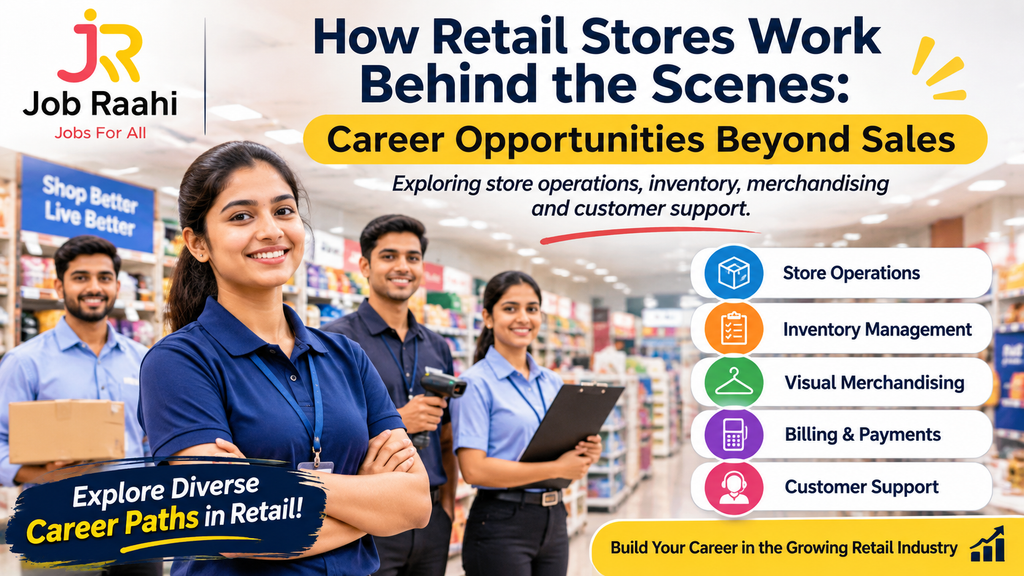
A. Receiving and Managing Inventory
Before products reach store shelves, they must be received, counted and checked. Store teams verify deliveries against purchase records, identify damaged goods and update stock information.
Inventory management also involves tracking available products, maintaining stock levels and ensuring that popular items are replenished on time.
Without proper inventory management, a store may face stock shortages, excess inventory or confusion during daily operations.
B. Store Operations and Maintenance
Store operations cover the everyday activities required to keep a retail outlet organised and functional.
This includes opening and closing procedures, arranging products, maintaining cleanliness, checking equipment, coordinating staff and ensuring that store processes are followed.
Store operations teams also coordinate with warehouses, delivery personnel, supervisors and other departments to keep activities running smoothly.
C. Visual Merchandising and Product Displays
Have you ever entered a store because an attractive display caught your attention? That is often the result of visual merchandising.
Visual merchandising involves arranging products, shelves, promotional displays, signage and store layouts in a way that makes products easier to notice and access.
It combines creativity with an understanding of customer behaviour. A well-organised display can improve the shopping experience and help customers discover relevant products.
D. Billing and Payment Management
Every purchase must be processed accurately. Billing teams operate point-of-sale (POS) systems, scan products, process cash and digital payments, generate receipts and handle basic transaction-related queries.
Accuracy, attention to detail and familiarity with digital payment systems are important in these roles.
E. Customer Support and Returns
Not every customer interaction involves making a purchase. Customers may need assistance with product information, exchanges, returns, complaints or order-related questions.
Customer support teams help resolve these concerns and ensure that customers receive appropriate assistance.
These responsibilities require patience, listening skills and clear communication.
Career Opportunities Beyond Sales
Retail stores offer several roles that do not primarily involve selling products. Some of these positions are suitable for candidates entering the workforce for the first time.
1. Store Operations Assistant
This role can be a good starting point for candidates who prefer practical, activity-based work.
2. Inventory Assistant
Inventory assistants help maintain accurate stock records. They may count products, update inventory systems, check incoming deliveries and report shortages or damaged items.
Basic computer knowledge, accuracy and organisational skills are useful for this position.
3. Visual Merchandising Assistant
Visual merchandising assistants help arrange product displays, organise promotional sections, maintain shelf presentation and support seasonal store arrangements.
Candidates with creativity, an eye for detail and an interest in design may find this role appealing.
4. Retail Cashier or Billing Executive
Cashiers manage customer payments and billing transactions. They operate POS systems, generate bills, process digital payments and maintain transaction accuracy.
Basic mathematics, computer familiarity and customer-handling skills are important.
5. Customer Support Executive
Customer support executives assist shoppers with product information, returns, complaints and other service-related queries.
Good communication, patience and problem-solving abilities can help candidates perform well in this role.
6. Stockroom or Back-End Operations Associate
These employees work in the areas of a store that customers may not usually see. They organise incoming goods, maintain storage areas, prepare products for the sales floor and support stock movement.
The role is particularly relevant for candidates interested in inventory handling and logistics-related activities.
Skills Needed to Work in Retail Operations
Attention to detail: Important for checking stock, handling payments, updating records and maintaining product displays.
Basic computer skills: Useful for operating billing systems, scanning products and updating inventory information.
Communication: Helps employees coordinate with colleagues, supervisors, customers and delivery teams.
Time management: Retail stores often handle several activities simultaneously, especially during weekends, holidays and promotional periods.
Teamwork: Store operations depend on coordination between inventory, billing, customer support and other teams.
Problem-solving: Employees may need to handle stock mismatches, customer concerns, delayed deliveries or unexpected operational issues.
Willingness to learn: Retail systems, products and store processes can vary between organisations. Being open to training helps employees adapt.
Career Opportunities for Freshers
Retail can provide an accessible entry point into the formal workforce. Candidates who have completed Class 10, Class 12, ITI, a diploma or graduation may find opportunities depending on the employer, role and eligibility requirements.
Some entry-level positions focus on practical responsibilities and provide workplace training. Candidates do not always need extensive professional experience to begin, although basic skills and a willingness to learn are important.
For example:
- A fresher interested in physical operations can explore store operations or stockroom roles.
- Someone comfortable with numbers and computers can consider billing or inventory-related work.
- A candidate with creative interests may explore visual merchandising assistance.
- Someone with good communication skills may consider customer support.
With experience, employees can develop specialised skills and move towards supervisory or departmental responsibilities. Career progression depends on performance, training, qualifications and the organisation’s requirements.
How to Prepare for a Career in Retail
Before applying for retail jobs, candidates should take a few practical steps:
- Understand the role: Read the job description carefully and identify the actual responsibilities.
- Develop basic digital skills: Practise using computers, spreadsheets, digital payment systems and basic workplace applications.
- Improve communication: Learn to communicate clearly with customers, colleagues and supervisors.
- Build an organised resume: Highlight education, relevant training, practical experience and transferable skills.
- Prepare for interviews: Be ready to explain why you are interested in retail and how you would handle everyday workplace situations.
- Check job details: Understand salary, working hours, weekly offs, location, shift requirements and other employment conditions before accepting an offer.
Candidates can also explore retail-related training and occupational qualifications to understand the skills expected by employers.
How Digital Job Platforms Can Help
Finding the right opportunity is an important part of starting a career. Digital job platforms make it easier for candidates to explore openings across different industries and job categories.
Instead of limiting their search to sales positions, job seekers can look for store operations, inventory, cashier, stockroom and customer support opportunities.
For employers, digital platforms can provide an additional channel to reach candidates interested in frontline and entry-level roles.
Job Raahi aims to connect companies with candidates looking for frontline and mass-hiring opportunities. As retail businesses recruit for different store-level responsibilities, relevant openings can help freshers and other job seekers explore career options beyond traditional sales roles.
Conclusion
A retail store is much more than a place where products are displayed and sold. It is a coordinated workplace where inventory teams, store operations staff, cashiers, merchandising assistants and customer support employees contribute to everyday business activities.
For freshers and entry-level job seekers, this creates opportunities to explore different roles based on their interests, abilities and qualifications.
The next time you visit a retail store, look beyond the sales counter. There is an entire team working behind the scenes to make the shopping experience possible and those functions can become the starting point of a meaningful career.