Digital marketing in recruitment has changed significantly over the past decade. Employers no longer depend entirely on newspaper advertisements, walk-in drives, referrals or traditional job portals to find candidates. Digital channels have introduced new ways to promote vacancies, reach job seekers and communicate with potential applicants.
But digital recruitment is evolving beyond simply posting a job online.
Today, employers can actively market vacancies through targeted digital campaigns, messaging platforms, social media, candidate databases and automated communication. This shift is particularly relevant for frontline, entry-level, industrial and bulk workforce hiring, where reaching a large number of candidates across different locations can be a major challenge.
Digital marketing is gradually becoming an important part of recruitment—not just a marketing function, but a way of expanding how employers connect with the workforce.
1. Recruitment Is No Longer Limited to Job Posting
Traditional recruitment often begins with publishing a vacancy and waiting for candidates to apply.
Although job portals remain an important sourcing channel, this approach relies heavily on candidates actively searching for a job and discovering the vacancy.
Digital marketing changes this dynamic.
Instead of waiting for candidates to find an opening, employers can promote job opportunities across digital channels and reach individuals who may not actively be searching on a job portal at that moment.
Recruitment campaigns can now be designed to generate awareness, encourage applications and remind potential candidates about available opportunities.
This shift moves recruitment from simply publishing vacancies towards actively promoting them.
2. Social Media Has Expanded Recruitment Reach
Social media platforms have become an additional channel through which employers can communicate job opportunities.
Platforms such as Instagram, Facebook, YouTube and LinkedIn allow businesses to share vacancies, workplace information, recruitment announcements, employee stories and hiring campaigns.
For frontline recruitment, social media can help employers reach audiences beyond traditional professional networking platforms.
For example, a company hiring 100 warehouse associates in a specific city can promote its vacancies through geographically targeted digital campaigns, rather than relying only on candidates who visit a job portal.
Social media recruitment can also make job opportunities more visible through:
- Short videos highlighting job roles and workplaces.
- Recruitment announcements and job creatives.
- Employee testimonials and workplace content.
- Local hiring campaigns.
- Application links and mobile-friendly forms.
The effectiveness of these campaigns depends on the target audience, campaign design, job requirements and the ease with which candidates can apply.
3. Geo-Targeted Marketing Is Changing Local Hiring
One of the most useful applications of digital marketing in recruitment is location-based targeting.
For frontline roles, the location of a job can influence whether a candidate applies, attends an interview and eventually joins.
A candidate may be interested in a warehouse, factory, retail store or service facility but may not be willing to commute long distances.
Employers can therefore use geographically targeted digital campaigns to promote vacancies in specific locations, neighbourhoods, cities or areas surrounding their workplaces.
This can help businesses:
- Promote vacancies around manufacturing facilities.
- Reach candidates in nearby residential areas.
- Target hiring campaigns by city or region.
- Promote walk-in interviews to relevant local audiences.
- Support recruitment across multiple locations simultaneously.
Hyperlocal recruitment is particularly useful when workforce availability, transportation and commute distance influence hiring decisions.
4. Messaging Platforms Have Made Candidate Communication Easier
Recruitment does not end when a candidate submits an application.
Candidates need information about interview dates, job requirements, documentation, selection status and joining schedules.
When recruitment volumes are high, communicating individually with every candidate can become difficult.
Digital messaging channels such as WhatsApp, SMS, email and RCS Business Messaging can help recruiters communicate with candidates at scale, subject to appropriate consent and communication practices.
These channels can be used to:
- Share job details and application links.
- Send interview reminders.
- Communicate walk-in recruitment schedules.
- Share document requirements.
- Follow up with selected candidates.
- Send joining reminders and updates.
Timely communication can help reduce uncertainty during the recruitment process and make it easier for candidates to stay informed.
5. Digital Recruitment Campaigns Can Support Bulk Hiring
Bulk recruitment often involves sourcing candidates across multiple locations within a limited timeframe.
For example, an organisation may need 200 employees for a new facility, 50 workers for an additional production shift or several hundred associates for seasonal operations.
Traditional sourcing methods may still be effective, but employers can complement them with digital recruitment campaigns.
A structured digital campaign can combine:
Job postings: Making vacancies available for candidates to discover and apply.
Digital advertisements: Promoting jobs to relevant audiences across selected locations.
Messaging campaigns: Communicating job opportunities through SMS, WhatsApp, email and other supported channels.
Candidate databases: Reconnecting with relevant candidates where appropriate.
Automated communication: Supporting follow-ups and recruitment coordination through automated tools.
The objective is to create multiple routes through which candidates can discover and respond to job opportunities.
6. Data Is Helping Employers Understand Recruitment Performance
Digital marketing provides recruitment teams with additional data to understand how their hiring campaigns perform.
Instead of measuring recruitment only through the number of applications received, employers can examine different stages of the candidate journey.
Some useful metrics include:
- Campaign reach and impressions.
- Click-through rates.
- Applications generated.
- Cost per application.
- Interview attendance.
- Selection-to-joining conversion.
- Offer-to-joining ratio.
- Location-wise campaign performance.
For example, a campaign may generate a large number of applications but relatively few interview attendees.
This may indicate that the job information is unclear, the location is unsuitable, candidates are not being followed up with effectively or the campaign is reaching an audience that does not match the requirement.
Digital campaign data can help recruitment teams identify such gaps and adjust their recruitment approach.
However, campaign metrics should be interpreted alongside candidate quality, hiring outcomes and retention. High reach or application numbers alone do not guarantee successful hiring.
7. Recruitment Is Becoming More Mobile-Friendly
Many candidates discover job opportunities through their smartphones.
This makes mobile accessibility an important part of recruitment marketing.
If a candidate sees a job advertisement but encounters a lengthy application process, confusing instructions or a form that does not work properly on a mobile device, the candidate may abandon the application.
Employers should therefore consider:
- Mobile-friendly job advertisements.
- Simple application processes.
- Clear job descriptions.
- Accessible application links.
- Easy-to-understand instructions.
- Timely mobile communication.
Digital recruitment is not only about reaching candidates. It is also about making it easier for them to respond.
8. AI and Automation Are Adding Another Layer to Digital Recruitment
Artificial intelligence and automation are increasingly being used to support recruitment activities.
Depending on the technology and implementation, these tools can help recruiters manage repetitive tasks such as candidate communication, screening assistance, scheduling, application processing and follow-ups.
AI-powered calling and automated messaging can also support communication with large candidate groups.
For frontline recruitment teams managing recurring requirements, automation may help reduce repetitive administrative work and improve the consistency of communication.
However, automation should not replace human judgement in important hiring decisions. Candidate assessment, fair selection, role suitability and verification still require appropriate human oversight.
9. Digital Marketing Does Not Replace Recruitment. It Expands It.
Digital marketing should not be viewed as a replacement for traditional recruitment methods.
Referrals, recruitment agencies, walk-in drives, job portals, training institutions and local networks continue to play important roles in sourcing candidates.
Digital marketing adds another layer to the recruitment process.
It helps employers promote opportunities, reach audiences beyond existing sourcing channels, communicate more efficiently and understand how recruitment campaigns perform.
The most effective recruitment strategies are likely to combine multiple sourcing methods according to the type of workforce being hired, the location, the urgency and the hiring objective.
How Job Raahi Is Bringing Digital Marketing into Frontline Recruitment
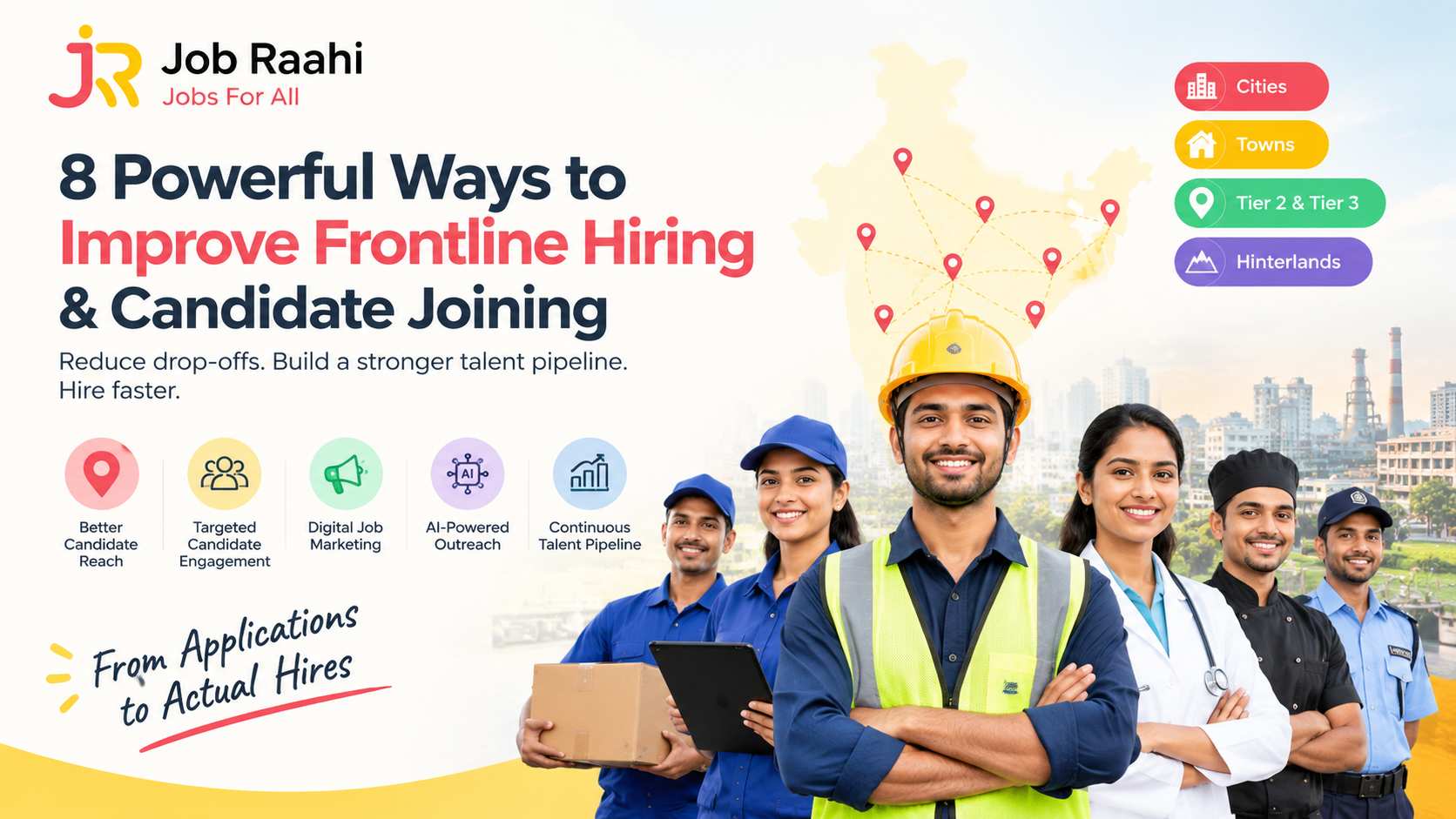
Job Raahi is a digital job board designed for frontline, entry-level, blue-collar, grey-collar, industrial, contractual and bulk workforce hiring.
The platform combines free and unlimited job postings with additional digital job marketing capabilities, helping employers promote vacancies beyond traditional job listings.
Employers can explore capabilities including:
- Geo-targeted candidate marketing.
- WhatsApp campaigns.
- RCS Business Messaging.
- SMS and email campaigns.
- AI-powered calling.
- Candidate-segmented digital outreach.
- Multiple recruiter users under an employer account.
The objective is to help employers increase vacancy visibility and reach potential candidates across relevant locations and segments.
With free employer onboarding and a virtual product walkthrough, employers can explore how digital job marketing can complement their existing recruitment processes.
Conclusion
Digital marketing is changing recruitment by shifting the focus from simply publishing vacancies to actively promoting job opportunities and reaching candidates through multiple digital channels.
Social media, geo-targeted campaigns, messaging platforms, mobile applications, data analytics and automation are creating additional ways for employers to connect with job seekers.
For frontline and bulk workforce hiring, these capabilities can be particularly useful because recruitment often involves reaching large candidate groups across different locations within limited timeframes.
Digital marketing does not guarantee hiring success. But when combined with clear job information, effective screening, candidate communication and structured recruitment processes, it can become a valuable part of how organisations build and manage their workforce.
Further Reading & Resources
- LinkedIn Talent Solutions
https://business.linkedin.com/talent-solutions
Recruitment tools, employer branding and digital sourcing. - Meta for Business
https://www.facebook.com/business/
Digital advertising, audience targeting and campaign promotion. - Google Ads
https://ads.google.com/
Digital advertising, audience reach and campaign optimisation. - National Career Service – Government of India
https://www.ncs.gov.in/
Online employment services and job matching. - International Labour Organization (ILO)
https://www.ilo.org/
Labour market, employment and workforce research.