Tag: Job Opportunities

  • Before You Accept That Job: 7 Things Every Job Seeker Should Check

    Before You Accept That Job: 7 Things Every Job Seeker Should Check

    Getting a call for an interview or receiving a job offer can be an exciting moment. For a fresher, it may mean the beginning of a career. For someone already working, it could be a chance to earn more, learn new skills or find a better opportunity.

    But excitement can sometimes make it easy to overlook important details.
    What exactly will your job involve? Is the salary what you were promised? Where will you work? Is the recruiter genuinely representing the company?

    These questions matter whether you are applying for a warehouse position, a retail job, a delivery role, a customer support position or your first job after completing an ITI, diploma or school education.

    A good job search is not just about finding an opening. It is about finding an opportunity that is genuine, suitable and clearly explained.

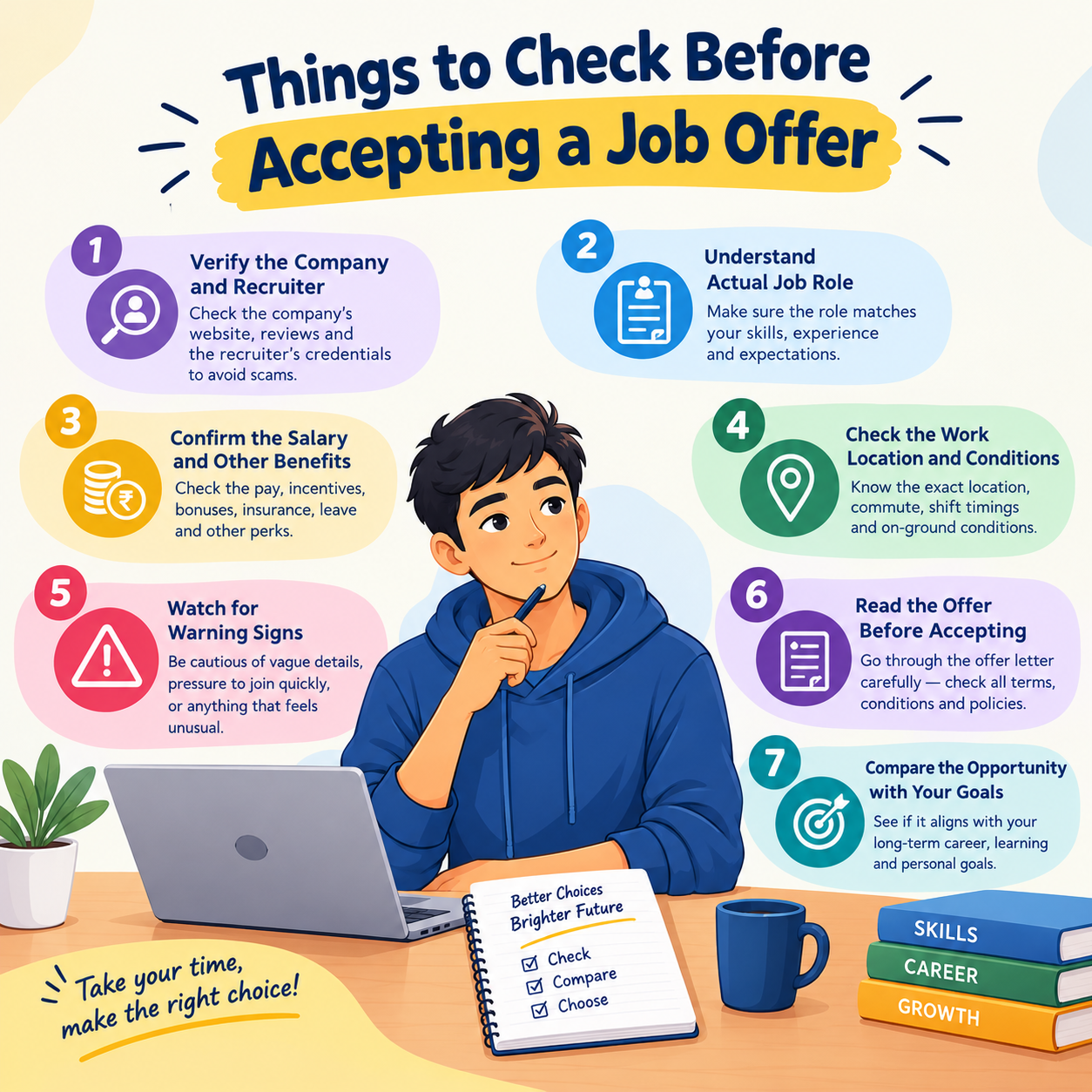
    Here are seven things to check before accepting a job offer.
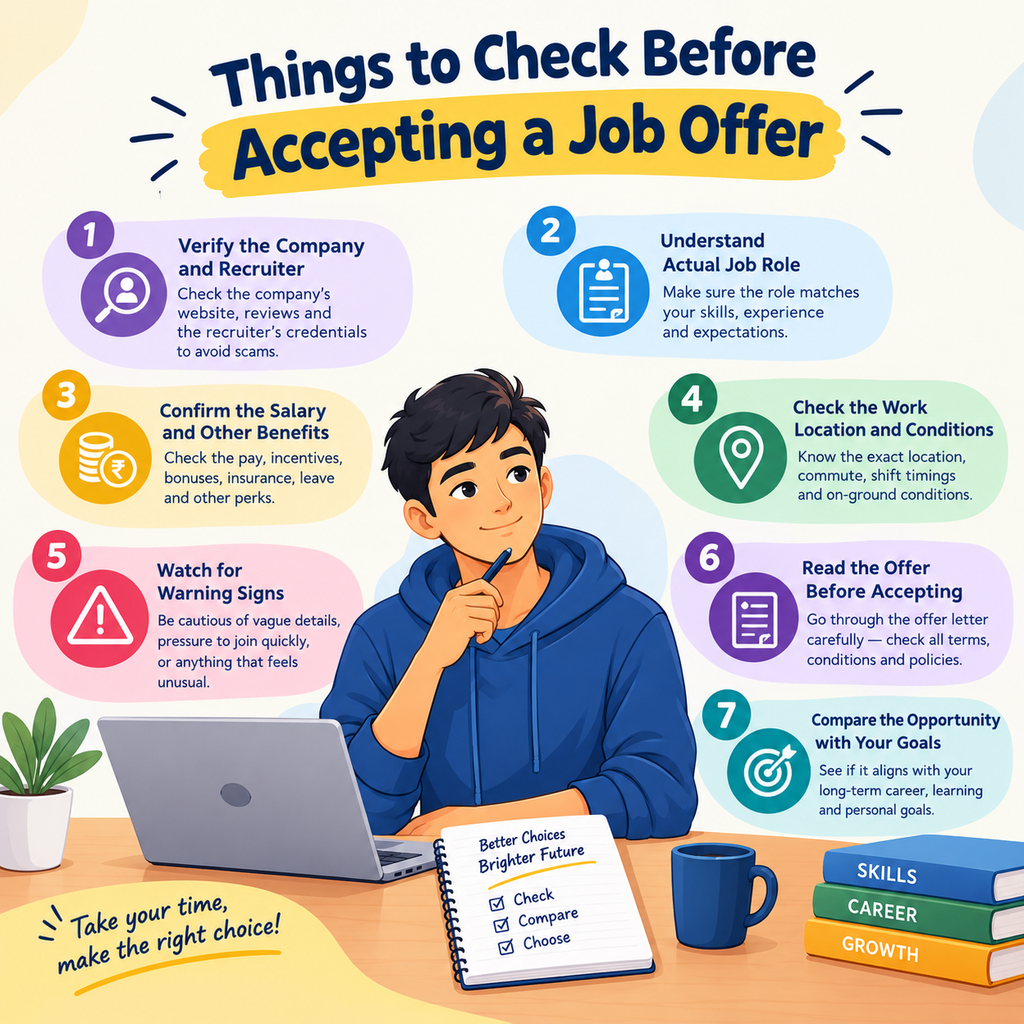
    Things to check before accepting a Job Offer

    1. Verify the Company and Recruiter

    Before sharing sensitive information or agreeing to join, take time to understand who is offering you the job. Start by checking the company’s official website, business details and publicly available contact information. If a recruiter contacts you, ask for their name, designation and the company they represent.

    You can also look for the vacancy on the company’s official careers page or contact the company through independently verified contact details to confirm whether the opportunity is genuine.

    Be cautious if someone refuses to identify the employer, uses inconsistent company names or pressures you to make a decision immediately.

    Remember that a professional-looking website, an impressive logo or a social media profile does not, by itself, prove that a job offer is genuine. If anything feels unclear, ask questions and verify the details before proceeding.

    2. Understand the Actual Job Role

    A job title may sound attractive, but the responsibilities are what you will actually be expected to perform.

    For example, a job advertised as a warehouse associate may involve picking and packing orders, handling inventory, scanning products or preparing dispatches. A retail associate may be responsible for customer assistance, billing, stock management or store operations.

    Before accepting, ask:

    • What will my daily responsibilities be?
    • Will training be provided?
    • What skills or qualifications are required?
    • Who will I report to?
    • How will my performance be evaluated?

    These questions are particularly useful for freshers who may not have previous workplace experience.

    A clear understanding of the role helps you assess whether the job matches your skills, physical requirements, interests and expectations. It also reduces the likelihood of joining and discovering that the actual work is very different from what you were told.

    3. Confirm the Salary and Other Benefits

    Never rely entirely on a verbal salary promise. Ask for the compensation details in writing before making your decision.

    Understand the difference between the total salary package, gross salary and the amount you are likely to receive in your bank account after applicable deductions.

    Clarify the following:

    • Monthly salary and payment date
    • Incentives, if any, and how they are calculated
    • Applicable deductions and benefits
    • Overtime arrangements, where relevant
    • Any allowances for travel, meals or accommodation
    • Whether the position is permanent, temporary, contractual or probationary

    For example, an advertised salary may include incentives that depend on targets. If those incentives are not guaranteed, your actual monthly earnings could be different from what you initially expected.

    Ask for an explanation rather than making assumptions.

    Also be cautious when someone demands money to secure a job, guarantee selection or release an offer letter. The National Career Service explicitly warns job seekers that its services are free and advises them not to pay fees to employers. Verify any unusual payment request independently before proceeding.

    4. Check the Work Location and Conditions

    A job can appear suitable until you understand the practical details of getting to work and completing your shift.

    Confirm the exact work location, reporting time, shift timings and weekly offs. If the job involves night shifts, travel, field visits or physically demanding tasks, ask what these responsibilities involve.

    For roles in warehouses, manufacturing, hospitality and delivery, it is also sensible to understand the workplace safety arrangements, equipment provided and support available during your shift.

    Consider your daily commute. Calculate the likely transport cost and travel time, especially if the salary is close to your current earnings or budget.

    If accommodation is offered, confirm whether it is free or paid, what facilities are included and whether any deductions apply. A suitable job should make sense not just on paper but also in your everyday life.

    5. Watch for Warning Signs

    Not every unusual message is fraudulent, but certain warning signs deserve attention.

    Be careful if someone:

    • Promises selection without a reasonable assessment for a role that requires one.
    • Demands an urgent payment for registration, training, an interview or a guaranteed appointment.
    • Requests your OTP, banking password, PIN or other sensitive credentials.
    • Sends an offer using an unrelated email address while claiming to represent a known company.
    • Avoids explaining the job responsibilities, salary or employer identity.
    • Pressures you to share identity documents before you can establish who is collecting them and why.

    Do not share OTPs or banking credentials with recruiters. Share personal documents only when you understand who needs them, why they are required and how they will be handled.

    If you suspect fraud, stop the process and seek verification. In India, suspected cybercrime can be reported through the official cybercrime reporting portal. The National Cyber Crime helpline is 1930.

    Taking precautions does not mean distrusting every employer. It means protecting yourself while making a career decision.

    6. Read the Offer Before Accepting

    When you receive an offer letter, read it carefully instead of accepting it immediately out of excitement.

    Check whether the employer’s name, job title, salary, work location, joining date and employment terms match what was discussed.

    Pay attention to probation conditions, notice periods, contractual obligations and any clauses that you do not understand.

    If a detail is missing or differs from the verbal promise, ask the recruiter to clarify it in writing. Keep copies of relevant communications and the final offer for your records.

    You do not need to feel uncomfortable about asking reasonable questions. A genuine hiring process should allow candidates to understand the terms of employment.

    If the employer changes important conditions at the last moment, take time to evaluate the revised offer before deciding.

    7. Compare the Opportunity with Your Goals

    The highest advertised salary is not always the best option for every candidate.

    Consider what matters most to you right now. You may need immediate income, a job close to home, a predictable shift, practical training or an opportunity to enter a new industry.

    A fresher might value structured training and the chance to gain relevant experience. Someone supporting a family might place greater importance on reliable pay and manageable travel costs.

    Make a simple comparison of your options using salary, location, work hours, job responsibilities, employment terms and learning opportunities.

    Do not assume that every entry-level position guarantees promotion. Instead, ask whether training is available, how performance is reviewed and what additional responsibilities employees may be able to take on over time.

    Your decision should reflect your real circumstances, not only the excitement of receiving an offer.

    How Employers Can Build Trust with Job Seekers

    Trust is not created by a job advertisement alone. It develops through clear communication, realistic expectations and consistent hiring practices.

    Employers can help candidates make informed decisions by providing accurate job descriptions, transparent salary details, clear location information and timely updates throughout the recruitment process.

    They can also explain selection stages, identify the person candidates can contact with questions and ensure that the offer letter reflects the agreed terms.

    These practices matter particularly when recruiting freshers and frontline workers, many of whom may be navigating formal recruitment processes for the first time.

    For employers, transparency can help candidates understand whether a role suits them before joining. For job seekers, it makes comparing opportunities easier.

    Recruitment works better when both sides know what to expect.

    Make Your Next Career Move with Confidence

    Finding a job is an important step, but choosing the right opportunity deserves equal attention.

    Verify the employer, understand the role, confirm the salary, check the work conditions and read the offer carefully. If something is unclear, ask questions before making a commitment. You do not need to know everything about the world of work to make a good decision. You simply need to take the time to check the details that matter.

    Find Opportunities with Job Raahi

    Looking for your next opportunity? Job Raahi helps job seekers explore job openings across frontline and entry-level roles.

    Explore vacancies that match your qualifications, location and interests. Review the available job details, ask questions when you need clarification and make informed decisions about your next step.

    Your next opportunity should bring you closer to your goals—and confidence starts with knowing what you are applying for.


  • Your First Job Is More Than a Starting Point: How to Turn Potential into Career Growth

    Your First Job Is More Than a Starting Point: How to Turn Potential into Career Growth

    Your first job can bring a mix of excitement, uncertainty and pressure. You may be eager to start earning, support your family or become financially independent. At the same time, you may wonder whether your qualifications are enough, whether you have the right skills or whether a company will hire you without experience.

    These concerns are common, especially when many job descriptions appear to ask for experience before giving candidates an opportunity to gain it.

    But here is an important thought: your first job is not just about getting hired. It is about building the foundation for what comes next.

    Whether you start as a retail associate, warehouse assistant, delivery executive, customer support representative, machine operator or sales trainee, the right opportunity can help you develop skills, understand workplace expectations and discover your strengths.

    The key is to approach your first job with a clear purpose: learn, contribute and grow.

    First job, new journey

    Why Your First Job Matters More Than You Think

    A first job introduces you to the realities of working life. You begin to understand how teams operate, how responsibilities are managed and how your work contributes to a larger business.

    For example, a warehouse associate may begin by learning inventory handling, order picking and packing. With experience and consistent performance, that employee may develop an understanding of stock management, quality checks and team coordination.

    Similarly, someone starting in retail can learn customer communication, billing, product knowledge and store operations. These skills can create a foundation for taking on greater responsibilities over time.

    Your first designation does not have to define your entire career. What matters is what you learn from the role and how you use that learning to move forward.
    Instead of asking only, “What is the salary?” consider asking, “What will I learn here, and where could this experience take me?”

    Salary, work hours, location, safety and working conditions still matter. Career growth should not mean accepting an unsuitable job. It means looking for a reasonable opportunity that supports both your present needs and future goals.

    Experience Is Built Somewhere

    One of the biggest challenges for freshers is the expectation that they should already have experience.

    But experience has to begin somewhere.

    Employers may need people who can follow instructions, communicate clearly, work responsibly and learn the tasks required for a role. These qualities can be demonstrated through training, practical assignments, internships, apprenticeships, college projects or previous responsibilities—not only through a long employment history.

    If you are a fresher, focus on what you can already offer.

    Have you completed an ITI course? Have you worked on machines during practical training? Have you helped manage a family business? Have you coordinated a college event, handled customers or learned to use basic computer tools?

    These experiences may demonstrate useful abilities when explained honestly and clearly. You do not need to pretend to have professional experience. Instead, show that you are prepared to learn and take responsibility.

    Employers also have a role to play. When a position can reasonably be performed by a trained fresher, requiring unnecessary years of experience may exclude candidates who could develop into capable employees. A better approach is to distinguish between skills a candidate must already possess and skills that can be taught after joining.

    How to Choose the Right First Job

    Your first opportunity deserves careful consideration. A job that looks attractive on paper may not be the right fit for your needs or abilities.

    Before applying, evaluate five things:

    Role clarity: Understand your actual responsibilities. Ask what a typical working day looks like and what performance expectations will be.

    Salary and benefits: Confirm the salary structure, payment frequency, deductions and any applicable benefits before accepting an offer.

    Location and commute: Consider travel time, transport availability and whether the job location is practical for you.

    Learning opportunities: Look for roles where you can develop useful skills, receive appropriate training and understand how performance is evaluated.

    Workplace conditions: Ask about shifts, weekly offs, safety arrangements and the support available to new employees.

    Do not choose a job only because it has an impressive title. A clearly defined role with supportive supervision and meaningful learning may be more valuable than a title that offers little development.

    At the same time, do not assume that every entry-level job automatically leads to promotion. Ask questions, understand the terms and make an informed decision.

    Five Skills That Can Help You Grow Faster

    You do not need to master everything before your first day. However, a few foundational skills can make the transition into employment easier.

    1. Communication

    Learn to explain a problem, ask for clarification and share updates. You do not need perfect English for every role. Clear communication in the language required by your workplace is what matters.

    2. Punctuality and reliability

    Arriving on time, following agreed schedules and informing your supervisor when an issue arises help build trust.

    3. Willingness to learn

    Listen carefully during training, take notes where useful and ask questions when instructions are unclear. Learning a task correctly is more important than pretending to know everything.

    4. Basic digital skills

    Depending on your role, you may need to use a smartphone application, scan barcodes, enter information, manage digital payments or communicate through workplace tools. Practising these skills can improve your readiness.

    5. Teamwork and problem-solving

    Most jobs involve working with other people. Learn how to coordinate, handle routine challenges and seek help when a problem is beyond your responsibility.

    These abilities are not limited to office jobs. They are valuable across retail, logistics, hospitality, manufacturing, customer support and many other sectors.

    Make Your First Job a Learning Experience

    Getting hired is an important milestone, but your development continues after joining. During your first few weeks, focus on understanding the job rather than comparing your progress with everyone else’s.

    Learn the correct process. Understand the quality and safety standards. Observe experienced colleagues. Ask your supervisor what good performance looks like.
    Once you become comfortable with your responsibilities, look for opportunities to improve. Can you complete a task more accurately? Can you communicate a customer issue more clearly? Can you learn another part of the operation?

    Keep a simple record of what you learn and the responsibilities you take on. This will help you explain your experience when applying for future opportunities.
    For instance, rather than writing only “worked in a warehouse” on your CV, describe the responsibilities you genuinely handled, such as order picking, packing, inventory updates or dispatch coordination.

    Never exaggerate your achievements. Specific, honest examples are more useful than impressive-sounding claims that you cannot support.
    You can also explore career guidance, job-search support and skill-development resources through the National Career Service portal.

    What Employers Can Do to Help New Employees Succeed

    Career growth is not solely the responsibility of the employee. Employers influence how easily a new hire adjusts, learns and contributes. A candidate who joins without previous work experience may still have the attitude, basic aptitude and willingness to learn needed for the role. Without proper onboarding, even a promising candidate can struggle to understand expectations.

    Employers can help by setting clear responsibilities, providing practical training, assigning an approachable supervisor and giving feedback during the early weeks.
    They can also make job descriptions more realistic by separating essential requirements from skills that can be taught.

    This creates a more meaningful way to evaluate candidates: not just by where they have worked before, but also by what they can do, what they can learn and how well they match the role.
    For businesses hiring at scale, this approach can expand the pool of potential candidates. For job seekers, it can make suitable entry-level opportunities easier to identify. The aim is not to overlook experience when it is genuinely necessary. It is to avoid treating experience as the only sign of capability.

    Your Career Starts with Your Next Step

    You do not need to have your entire career planned before applying for your first job.

    Start by understanding your strengths, identifying suitable roles and preparing an honest CV. Apply for opportunities that match your qualifications and practical abilities. Research employers, ask questions and understand the terms before accepting an offer.

    Once you begin working, keep learning. Build reliable habits, improve your skills and take responsibility for the work assigned to you. Your first job may not be your final destination. It can still be an important step towards greater confidence, better skills and new opportunities.

    You do not need years of experience to begin building your future. You need a suitable opportunity, the willingness to learn and the determination to make the most of each step.

    Find Your Next Opportunity with Job Raahi

    If you are looking for your first job or exploring your next career move, Job Raahi can help you discover opportunities across frontline and entry-level roles.

    Explore available vacancies, look for positions that match your skills and qualifications, and take the next step towards your career.
    Your journey does not have to begin with the perfect job. It can begin with the right opportunity to learn, contribute and grow.

  • The Hidden Cost of Unfilled Frontline Positions: What Employers Often Overlook

    The Hidden Cost of Unfilled Frontline Positions: What Employers Often Overlook

    When a company has ten vacant positions, the immediate concern is usually straightforward: the recruitment team needs to find ten people.

    But what happens while those positions remain unfilled?

    A warehouse may need existing employees to handle additional work. A retail store may struggle to maintain its usual service levels. A hospitality team may have to manage busy shifts with fewer people than planned. A delivery operation may find it harder to meet daily requirements.

    The vacancy may appear as a number on an HR dashboard, but its effects can reach far beyond the recruitment department.

    The real cost of an unfilled position is not just the cost of hiring someone. It is also the operational impact of working without that person.

    For employers managing frontline teams, understanding this difference can lead to better workforce planning, smarter recruitment decisions and more effective use of hiring budgets.

    Hidden cost of Unfilled frontline position

    Why an Unfilled Position Costs More Than You Think ?

    A vacant role does not automatically create the same cost for every business. The impact depends on the job, the duration of the vacancy, the availability of existing staff and how essential the position is to daily operations.

    A vacancy in a warehouse during a peak order period may have a different effect from a vacancy in a department with flexible workloads. A missing store associate may create additional pressure during busy hours, while an unfilled support position may increase waiting times for customers.

    The important point is that vacancies have both visible costs and less obvious operational consequences.

    Visible costs include recruitment advertising, agency fees, screening and onboarding expenses. Less visible costs may include overtime, delayed work, lost sales opportunities, additional pressure on existing employees and the time managers spend covering gaps.

    These costs do not always appear together in a single report. That is why employers should evaluate vacancies from both an HR and an operational perspective.

    5 Hidden Costs of Frontline Vacancies

    1. Increased Workload for Existing Employees

    When a position remains vacant, the work rarely disappears. Other employees may need to cover additional shifts, complete extra tasks or take responsibility for activities outside their normal workload.

    Some flexibility is part of running a business. However, when understaffing continues for too long, it can make schedules harder to manage and leave employees with less time for their primary responsibilities.

    Managers should monitor overtime, workload distribution, absenteeism and employee feedback to understand whether vacancies are placing sustained pressure on existing teams.

    2. Disruption to Daily Operations

    Frontline roles are often directly connected to everyday business activities.

    A shortage of warehouse associates can affect picking, packing and dispatch schedules. A retail staffing gap may make stock replenishment and customer assistance more difficult. A shortage of hospitality staff can put pressure on service teams during busy periods.

    The impact depends on the business and should be measured rather than assumed.

    Employers can identify critical roles, map the tasks that depend on them and assess what happens when staffing falls below the required level.

    This helps HR teams prioritise vacancies according to operational importance rather than treating every open position as equally urgent.

    3. Additional Recruitment and Overtime Expenses

    When recruitment takes longer than planned, businesses may need temporary staffing support, overtime or additional sourcing efforts.

    These expenses can add to the original recruitment budget.

    For example, an employer might begin with a standard job advertisement but later engage a recruitment agency, organise an additional hiring drive and ask supervisors to cover unfilled shifts.

    Each decision may be reasonable in isolation. The combined expense, however, can become difficult to track unless the business measures it.

    A useful approach is to compare the cost of maintaining the vacancy with the cost of realistic alternatives, such as adding a suitable sourcing channel or improving the recruitment process.

    4. Customer Experience Can Suffer

    Customers may not know that a company has vacancies, but they can experience the consequences.

    Depending on the role, understaffing may contribute to longer queues, slower service, delayed deliveries or reduced availability of assistance.

    This does not mean every vacancy causes lost sales or dissatisfied customers. Other factors, such as demand fluctuations, processes and technology, also matter.

    However, if customer complaints or service delays repeatedly coincide with staffing gaps, the business should investigate whether workforce availability is contributing to the problem. Connecting operational data with recruitment data can help managers identify these patterns.

    5. Managers Lose Time Covering Staffing Gaps

    Supervisors and managers are often responsible for keeping operations running when teams are understaffed.

    They may spend time rearranging shifts, redistributing work, following up with recruiters or managing temporary solutions instead of focusing on planning, quality and team performance.

    This is an indirect cost that can be easy to overlook.

    Employers can track how frequently managers need to intervene because of staffing shortages and which roles create the most disruption. These insights can help prioritise recruitment and improve future workforce planning.

    How to Calculate the Cost of an Unfilled Position

    Employers do not need an elaborate analytics system to begin understanding vacancy costs. A simple calculation can provide a useful starting point.

    Consider a hypothetical warehouse associate position.

    Suppose the employer estimates the following additional costs while the position remains vacant:

    • Overtime or temporary coverage: ₹600 per day
    • Additional operational support: ₹200 per day
    • Vacancy duration: 20 working days

    The estimated additional cost would be:

    ₹800 per day × 20 working days = ₹16,000

    This is an illustrative example, not an industry benchmark. Actual costs may be higher, lower or negligible depending on the role and operating conditions.

    The estimate also excludes potential effects on productivity, service quality and missed business opportunities unless these can be reliably measured.

    A more complete assessment could use this framework:

    Estimated vacancy cost = Additional coverage costs + Additional recruitment costs + Measurable operational impact

    Avoid counting the same expense twice. For example, if temporary staffing costs already include overtime, these should not be added again as separate costs.

    Employers should also compare the vacancy cost against the cost of filling the role. The objective is not to hire at any price; it is to make a sound decision based on operational need, hiring quality and total cost.

    Why Frontline Positions Can Be Difficult to Fill

    Before trying to reduce vacancy costs, employers need to understand why positions remain open.

    Several issues can contribute to delays.

    Unclear job requirements: Candidates may apply without understanding the actual duties, work location, shifts or eligibility criteria.

    Limited sourcing channels: Depending on a narrow set of recruitment sources can restrict the candidates available to the employer.

    Mismatch between job expectations and offers: Compensation, working hours, commute requirements or other conditions may not align with candidate expectations.

    Slow decision-making: Delayed screening, interview scheduling or feedback can cause candidates to disengage.

    Joining-stage drop-offs: A candidate may be selected but fail to join because of changed circumstances, competing offers or unclear communication.

    These challenges require different solutions. More advertising will not necessarily solve a slow interview process, and faster screening will not fix a mismatch between the job and the compensation offered.

    The first step is to identify where the recruitment process is losing time or suitable candidates.

    6 Practical Ways to Reduce Vacancy Costs

    1. Prioritise Vacancies by Business Impact

    Not every open position needs the same level of urgency.

    Work with operations managers to identify roles that directly affect production, service delivery, safety or customer commitments.

    Use factors such as vacancy duration, workload, shift coverage and business criticality to decide which positions need immediate attention.

    This helps recruiters allocate their time and resources where they can make the greatest difference.

    2. Create a Clear and Realistic Job Description

    A job description should help candidates understand the opportunity before applying. Include the job title, responsibilities, workplace location, compensation or pay range where possible, shift details, eligibility requirements and selection process.

    Avoid adding unnecessary experience requirements if the role can be performed by a suitable fresher with appropriate training. Clear information can improve candidate-role alignment and reduce time spent on unsuitable applications.

    3. Diversify Your Recruitment Channels

    Do not rely entirely on one job portal, agency or referral network.
    Depending on the role and location, employers can explore local educational institutions, ITIs, skill centres, community networks, employee referrals and digital recruitment platforms.

    The objective is to reach relevant candidates through additional channels while retaining those that already work.

    Review each source based on qualified applicants, interviews, offers and successful joinings—not just the number of applications generated.

    4. Set Timelines for Every Hiring Stage

    Recruitment delays often occur between stages rather than during sourcing alone.

    Establish clear timelines for screening applications, scheduling interviews, collecting feedback, approving offers and communicating decisions.
    Assign responsibility for each step so that applications do not remain unattended.

    The appropriate timeline will vary by role, but regular reviews can help identify bottlenecks before they become major operational problems.

    5. Improve Candidate Communication

    Candidates need to know what happens after they apply.

    Communicate interview schedules, required documents, selection decisions and joining instructions clearly. Where a decision is delayed, provide an update rather than leaving candidates uncertain.

    For frontline recruitment, practical details matter. Candidates should understand the work location, shift arrangements, compensation and joining requirements before making a commitment.

    Clear communication helps candidates make informed decisions and gives employers a better opportunity to manage the process professionally.

    6. Build a Talent Pipeline Before Demand Peaks

    Recruitment is easier to plan when businesses anticipate their workforce needs.

    If a company regularly hires warehouse associates, retail staff or customer support employees, it can maintain relationships with relevant sourcing partners and develop a pipeline for recurring roles.

    Use previous hiring patterns, planned expansion and seasonal demand to estimate future requirements.

    A pipeline does not guarantee that every candidate will remain available, but it can reduce the need to start from scratch each time a vacancy opens.

    The Recruitment Metrics Every Employer Should Track

    To improve hiring, employers need more than a count of open positions.

    Start with a small set of practical metrics:

    • Time to fill: How long it takes to fill a vacancy, using a consistent definition.
    • Cost per hire: The recruitment costs attributable to each successful hire.
    • Application-to-interview rate: The proportion of applicants who progress to interviews.
    • Offer acceptance rate: The proportion of offers accepted by candidates.
    • Joining rate: The proportion of selected or offered candidates who actually join, with the denominator clearly defined.
    • Early attrition: The proportion of new employees who leave within a defined period.
    • Source of hire: Which channels generate successful hires.
    • Vacancy age: How long each position has remained open.

    Review these metrics by role, location and recruitment channel where the data is sufficient.

    For example, if a source generates many applications but few joiners, the issue may be candidate fit, job information or communication. If candidates regularly accept offers but do not join, employers may need to review the time between offer and joining.

    Speed alone is not the goal. A successful recruitment process balances timeliness, cost, suitability and retention.

    Build a Hiring Strategy Before the Vacancy Becomes Urgent

    Unfilled frontline positions can create a chain of operational challenges, but the answer is not simply to recruit faster at any cost.

    Employers need to understand which vacancies matter most, identify the reasons for delays, improve the candidate journey and measure the results.

    This requires coordination between HR teams and operational managers. Recruitment should be connected to workforce planning rather than treated as a separate activity that begins only when someone leaves.

    Businesses can also strengthen their sourcing strategy by exploring additional candidate pools and digital recruitment channels. Platforms such as Job Raahi can serve as an additional route for employers seeking frontline and entry-level talent, alongside their existing recruitment methods.

    The value of any channel should ultimately be assessed through relevant candidates, successful joinings, cost and hiring outcomes.

    An open position is more than an incomplete headcount. It is a business decision that deserves attention, measurement and a clear plan.

    The sooner employers understand the real impact of vacancies, the better equipped they are to build a hiring process that supports both their workforce and their business goals.

    Looking to expand your frontline candidate reach? Explore Job Raahi as an additional sourcing channel for entry-level and frontline hiring.

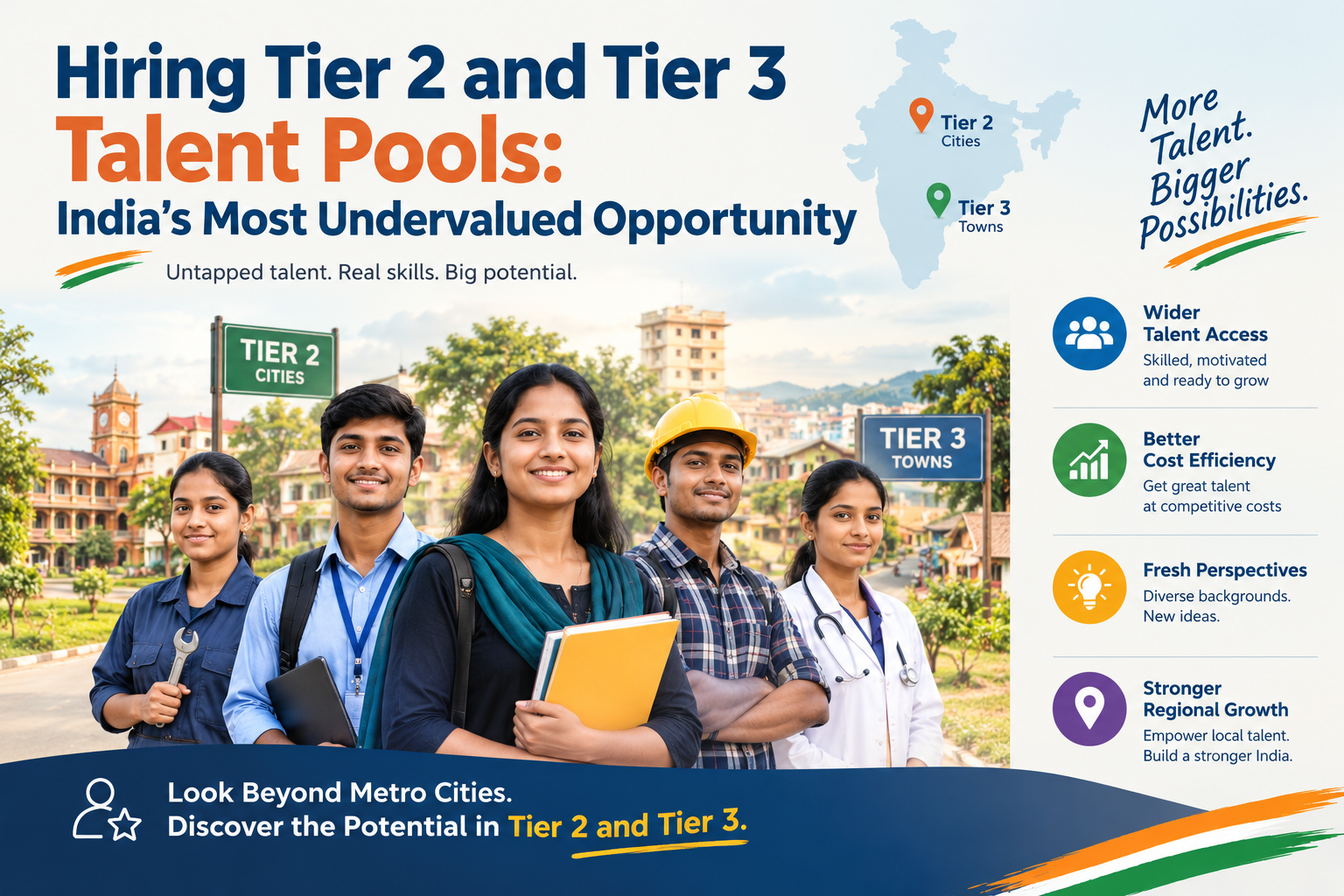
  • Hiring Tier 2 and Tier 3 Talent Pools: India’s Most Undervalued Opportunity

    Hiring Tier 2 and Tier 3 Talent Pools: India’s Most Undervalued Opportunity

    For years, India’s hiring conversation has revolved around the same major cities. Bengaluru for technology, Mumbai for finance, Delhi-NCR for corporate operations, and Hyderabad, Pune and Chennai for a wide range of industries.

    These cities continue to play an important role in the employment landscape. But there is another side to India’s talent story that deserves more attention.

    Across Tier 2 and Tier 3 cities, candidates are completing their education, developing practical skills, looking for their first jobs and building the experience employers need. Many are ready to work, yet they may not appear on the radar of companies that depend on familiar recruitment channels.

    The problem may not be a shortage of talent. It may be that businesses are looking for talent in too few places.

    For employers dealing with rising hiring needs, difficult-to-fill frontline positions or competition for entry-level candidates, smaller cities offer an opportunity to rethink how talent is discovered and recruited.

    Why Tier 2 and Tier 3 Cities Deserve More Attention

    The terms Tier 2 and Tier 3 are commonly used to describe cities outside India’s largest metropolitan centres, although there is no single classification applied consistently across every industry.

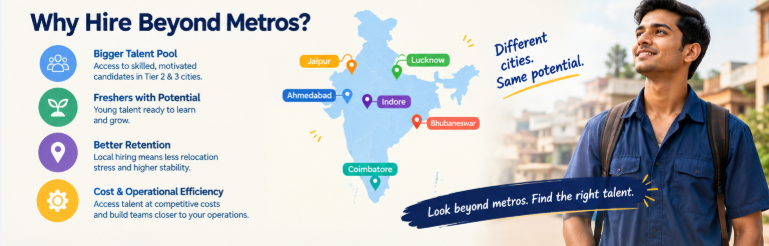
    Cities such as Jaipur, Indore, Lucknow, Coimbatore, Bhubaneswar, Nagpur, Kochi and many smaller regional centres are part of a changing employment landscape.

    Their importance is not simply about offering an alternative to metro hiring. It is about finding candidates whose skills, location and career goals align with actual business requirements.

    Several factors make these markets worth exploring.

    1. A Wider Pool of Emerging Talent

    A company’s existing recruitment database reflects the channels it has used in the past. It does not necessarily represent every suitable candidate available in the market.

    Smaller cities have students graduating from ITIs, polytechnic institutes, colleges and vocational training programmes. They also have candidates with practical work experience who want to move into better opportunities.

    For entry-level and frontline positions, this creates an opportunity to connect with people who may have the required educational background, basic skills or willingness to learn.

    Employers who expand their sourcing networks can discover candidates they might otherwise miss.

    2. Growing Demand for Local Employment

    Not every candidate wants to move to a major city for work.

    Relocation can involve additional expenses, accommodation challenges, unfamiliar surroundings and time away from family. For some job seekers, finding a suitable opportunity closer to home is a more practical choice.

    This creates a strong reason for businesses to consider location-based hiring.

    A retail chain opening new stores, a logistics company expanding warehouse operations or a service business building regional teams may find suitable candidates within the surrounding area.

    Local hiring is not always possible for every role, but where it works, it can align business needs with candidates’ preferences.

    3. Opportunity to Build Talent Before Demand Peaks

    Many companies begin searching for candidates only after a hiring requirement becomes urgent.

    This approach can work for small numbers of vacancies, but large-scale recruitment often requires more preparation.

    By developing relationships with local colleges, ITIs, skill centres and recruitment partners, employers can start building talent pipelines before the next hiring cycle.

    These relationships can help companies understand the local candidate market, identify relevant skills and communicate upcoming opportunities more effectively.

    Instead of asking, “Where can we find 100 candidates next week?”, recruitment teams can start asking, “Which locations and institutions can help us build a reliable pipeline for the next six months?”

    That change in approach can make recruitment more organised and less reactive.

    Hiring Beyond Metros

    The Opportunity Is Especially Strong in Frontline Hiring

    The value of regional talent pools extends across industries, but it is particularly relevant to businesses that recruit large numbers of frontline and entry-level employees.

    Consider the following examples:

    • Retail: Store associates, sales executives, cashiers and stock handlers.
    • Logistics and warehousing: Pickers, packers, warehouse associates and helpers.
    • Delivery and field operations: Delivery executives, field staff and local sales representatives.
    • Hospitality: Housekeeping staff, kitchen assistants and service employees.
    • Manufacturing: Production assistants, machine operators and shop-floor workers.
    • Customer support: Entry-level support executives and contact-centre employees.

    These roles often require candidates to work from a specific location, follow defined processes and meet practical job requirements.

    A candidate living near the workplace may be a more realistic match than someone who would need to relocate. Similarly, a fresher who meets the essential requirements and can be trained may be suitable for a role that does not genuinely require previous experience.

    The important question is not whether a candidate comes from a metro or a smaller city. It is whether that candidate can perform the job, meet its requirements and succeed in the working environment.

    Why Employers Still Miss These Talent Pools

    If the opportunity is so significant, why do many recruitment strategies remain concentrated in established hiring markets?

    Familiarity with Existing Channels

    Recruitment teams naturally return to the platforms, agencies and databases they already know. These channels offer convenience and established processes.

    However, familiarity can become a limitation when the same sources repeatedly produce insufficient or unsuitable candidates.

    The answer is not to discard existing channels. It is to add new ones and measure their performance.

    Limited Visibility of Suitable Candidates

    Candidates in smaller cities may not be visible through a company’s existing sourcing network. Some rely on local contacts, educational institutions or informal information about vacancies.

    Without an effective way to reach them, employers may conclude that a suitable talent pool does not exist.

    In reality, they may simply need a different route to discover it.

    Concerns About Readiness and Quality

    Employers may have questions about candidates’ communication skills, practical abilities, reliability or readiness for work.

    These are legitimate concerns, but city of origin is not a reliable substitute for assessing job fit.

    A consistent screening process, practical assessments where appropriate, reference checks and structured onboarding can help employers evaluate candidates on relevant criteria.

    The objective should be to maintain hiring standards while widening access to the opportunity.

    Fragmented Recruitment Processes

    Reaching candidates is only the beginning. Employers must still screen applications, schedule interviews, communicate decisions and support successful joining.

    If these processes are slow or unclear, candidates can drop out regardless of where they were sourced.

    Regional hiring therefore needs more than wider advertising. It needs a recruitment process that takes candidates from discovery to joining.

    How Companies Can Build a Stronger Regional Hiring Strategy

    Expanding into Tier 2 and Tier 3 markets works best when it is planned around business needs rather than treated as a one-time experiment.

    Start With the Role, Not the City

    Identify the positions that are suitable for regional hiring.

    Ask whether the role requires a specific qualification, prior experience, specialist skills or simply a defined level of readiness and trainability.

    Also consider workplace location, shift requirements, transport, compensation and the realistic commuting radius.

    Once these factors are clear, identify cities and districts where a relevant candidate pool may exist.

    Develop Local Partnerships

    Colleges, ITIs, polytechnic institutes, vocational training centres and community organisations can help employers reach candidates who may not be active on conventional job portals. Partnerships should be built around actual requirements. Share clear job descriptions, eligibility criteria, expected joining dates and selection processes.

    For recurring vacancies, maintaining a relationship with institutions can be more useful than contacting them only when hiring becomes urgent.

    Combine Local Reach With Digital Recruitment

    Offline outreach and digital recruitment can complement each other.

    Local partnerships provide access to communities and institutions. Digital platforms can help candidates discover openings, review job information and apply without necessarily travelling to a recruitment location just to learn about a vacancy.

    Employers can use both approaches to extend their reach while maintaining a consistent screening and selection process.

    The right combination depends on the role, location, candidate profile and hiring volume.

    Give Trainable Freshers a Fair Chance

    Some entry-level roles can be performed by candidates who have the right foundational skills and the ability to learn on the job.

    Employers should distinguish between requirements that are essential and those that are simply preferred.

    Where appropriate, practical assessments, role-specific training and structured onboarding can help identify candidates with potential.

    This can open opportunities for freshers and vocational graduates while helping businesses develop a workforce suited to their operating needs.

    Measure Outcomes, Not Just Applications

    A regional hiring strategy should be evaluated through clear recruitment metrics.

    Track:

    • Number of qualified candidates sourced by location
    • Application-to-interview conversion rate
    • Interview attendance
    • Offer acceptance rate
    • Joining rate
    • Time to fill a vacancy
    • Cost per successful joining
    • Early retention, where reliable data is available

    Compare results across sourcing channels and locations, taking role requirements and sample sizes into account.

    A city that generates many applications but few successful joiners may need a different approach from one that produces fewer, better-matched candidates.

    Over time, this information helps employers decide where to invest more effort and which sourcing partnerships to strengthen.

    Technology Can Help Make Regional Talent More Accessible

    Digital recruitment platforms are making it easier for employers and candidates to connect across geographical boundaries.

    For candidates, they can provide a more convenient way to discover openings, understand eligibility requirements and submit applications.

    For employers, they can create additional sourcing opportunities beyond established recruitment networks.

    However, technology is not a complete solution on its own. Job information must be clear, suitable candidates must be reached, and employers need reliable screening and communication processes.

    Platforms work best when they complement local knowledge and human follow-through.

    At Job Raahi, this is an important opportunity: helping employers reach frontline and entry-level candidates across India, including people from smaller cities and underserved talent markets.

    For companies, Job Raahi can serve as an additional channel to explore a wider candidate pool without requiring them to abandon their existing hiring methods.

    The larger objective is to make relevant opportunities easier to discover and help employers connect with candidates based on their actual workforce requirements.

    Looking Beyond the Traditional Hiring Map

    Tier 2 and Tier 3 cities should not be treated as a backup option when metropolitan hiring becomes difficult.

    They deserve to be considered as part of a deliberate, long-term talent strategy.

    That does not mean every smaller city will suit every role. Candidate availability, infrastructure, skills, compensation and workplace requirements differ from one location to another. Employers need to assess each market on its own merits.

    But companies that never explore these markets may miss candidates who could contribute to their growth.

    The next step is straightforward: identify suitable roles, map relevant locations, build local and digital sourcing channels, and measure the results.

    India’s talent opportunity is larger than the recruitment networks many companies currently use.

    The most valuable candidate may not be in the city everyone is hiring from. Sometimes, the opportunity begins when employers look beyond the usual map.

    Looking to expand your frontline hiring reach? Explore Job Raahi as an additional channel to connect with candidates for entry-level and frontline roles across India.

  • Hiring at the Last Mile: Reaching India’s Frontline Workforce

    Hiring at the Last Mile: Reaching India’s Frontline Workforce

    A job opening can be available. A company can be ready to hire. And thousands of people can be looking for work. Yet, somehow, the right candidate and the right employer never connect.

    This is one of the biggest challenges in frontline hiring.

    Across India, businesses need people to manage stores, operate warehouses, deliver products, support customers, work on production lines and keep daily operations running. At the same time, many job seekers in smaller cities, towns and rural areas struggle to discover suitable opportunities.

    The problem is not always a lack of jobs or a lack of candidates. Sometimes, the real challenge is reaching each other at the last mile.

    What Does Last-Mile Hiring Really Mean?

    Last-mile hiring is about reaching potential employees where traditional recruitment channels may not reach them effectively.

    It means moving beyond the usual databases, familiar locations and conventional hiring networks to connect with candidates who may be actively seeking work but remain difficult for employers to discover.

    These candidates may include:

    • Freshers looking for their first job
    • ITI, diploma and vocational training graduates
    • Candidates with six months to two years of experience
    • Workers living in smaller cities and semi-urban areas
    • Candidates looking for jobs closer to home
    • People with practical skills but limited access to formal recruitment channels

    For companies hiring at scale, reaching these candidates can make a meaningful difference.

    A business opening new stores, expanding warehouse operations or increasing its delivery network cannot rely only on candidates who happen to be present on familiar job portals. It needs a recruitment strategy that reaches a wider and more relevant workforce.

    Why Is Reaching Frontline Candidates Still Difficult?

    1. The Right Candidates Are Not Always Visible

    Traditional recruitment often depends on referrals, recruitment agencies, existing databases and established job platforms.

    These channels can be useful, but they may not reach every suitable candidate.

    Someone living in a smaller town might have the education and skills required for a warehouse, retail or customer support role but may not know where to find genuine openings.

    Similarly, a fresher may be ready to learn but have no professional network to help them enter the workforce.

    When employers repeatedly source candidates from the same channels, they risk overlooking people who could be a good fit.

    A wider talent pool starts with wider access to opportunities.

    2. Location Creates a Hiring Gap

    Frontline jobs are often location-dependent.

    A retail associate is needed at a particular store. A warehouse worker needs to reach a specific facility. A delivery executive must serve a defined area. A hospitality employee needs to work at a particular property.

    Yet, recruitment teams may be sourcing candidates from locations that are too far away or unsuitable for the role.

    This can create practical problems around commuting, relocation, joining and long-term retention.

    A location-aware recruitment strategy helps employers reach candidates who can realistically access the workplace.

    It also helps candidates find opportunities that fit their circumstances instead of applying blindly to jobs they may not be able to join.

    3. Complicated Application Processes Lose Candidates

    Frontline candidates often need a straightforward way to discover a job, understand the requirements and apply.

    Long forms, unclear instructions, repeated data entry and delayed responses can discourage candidates from completing the process.

    For someone applying through a mobile phone, every unnecessary step creates friction.

    Employers should make the journey as simple as possible:

    • Explain the job role clearly.
    • Mention the work location and salary or pay range.
    • State the eligibility criteria and experience required.
    • Keep the application process mobile-friendly.
    • Communicate the next steps promptly.
    • Make interview details and joining requirements easy to understand.

    A simpler process does not mean compromising on screening. It means removing barriers that do not help assess a candidate’s suitability.

    4. Urgent Hiring Can Lead to Narrow Sourcing

    When a company needs to fill 50, 100 or several hundred positions quickly, recruitment teams often return to the channels they already know.

    That is understandable. They have deadlines, operational targets and managers waiting for employees to join.

    However, repeatedly using the same sources can limit the available candidate pool.

    A better approach is to maintain multiple sourcing channels before the next urgent requirement arrives. Local institutions, skill centres, community networks, digital platforms and employee referrals can complement existing recruitment methods.

    The goal is not to abandon successful channels. It is to build additional routes to suitable candidates.

    Why Last-Mile Hiring Matters for Indian Businesses

    India’s workforce is spread across metropolitan cities, smaller urban centres, towns and rural communities. Employers who broaden their reach can discover candidates beyond their usual recruitment networks.

    The opportunity is particularly relevant for industries that depend on frontline teams, including:

    • Retail: Store associates, cashiers, sales executives and stock handlers
    • Logistics and warehousing: Pickers, packers, warehouse associates and helpers
    • Delivery and e-commerce: Delivery executives and field operations staff
    • Hospitality: Housekeeping staff, kitchen assistants and service teams
    • Customer support: Entry-level support executives and contact-centre staff
    • Manufacturing: Production operators, assistants and shop-floor workers
    • Field sales: Sales representatives and local market executives

    Each sector has different requirements, but the underlying challenge is similar: finding enough suitable people in the right locations and helping them move from application to joining.

    For growing businesses, effective last-mile hiring can support expansion while giving more candidates access to employment opportunities.

    Companies Hiring Last Mile Delivery executive

    Five Ways Employers Can Improve Last-Mile Hiring

    1. Expand Beyond Traditional Hiring Channels

    Do not depend on a single platform or sourcing method.

    Combine existing recruitment channels with local colleges, ITIs, polytechnic institutes, vocational training centres, community networks and digital job platforms.

    Different channels reach different types of candidates. A combination gives recruitment teams more flexibility when hiring requirements change.

    For example, a company hiring warehouse associates across multiple districts could build connections with local training institutions and digital recruitment partners before new facilities become operational.

    This creates a broader sourcing network rather than a last-minute search.

    2. Build Location-Based Talent Pipelines

    Instead of beginning every recruitment campaign from scratch, identify the locations from which candidates can realistically commute or relocate.

    Map hiring requirements by city, district, workplace and role. Then identify potential sourcing partners in those areas.

    A regional talent pipeline can help employers prepare for future openings, reduce dependence on emergency sourcing and maintain relationships with potential candidates.

    The key is to build these pipelines around actual workforce requirements, not simply collect large numbers of candidate profiles.

    3. Make Job Information Clear and Honest

    Candidates need enough information to decide whether a role is right for them.

    A job post should clearly communicate the responsibilities, location, pay, working hours, eligibility criteria and selection process wherever applicable.

    Avoid vague descriptions that create unrealistic expectations.

    When candidates understand the opportunity before applying, recruiters can spend less time clarifying basic details and more time assessing role fit.

    Transparency also builds trust, which is particularly important when reaching candidates who may be unfamiliar with a company or recruitment platform.

    4. Reduce the Time Between Application and Joining

    Finding candidates is only one part of recruitment. Employers must also help suitable candidates progress through the process.

    Delays in screening, interview scheduling, offer approval or joining communication can cause candidates to lose interest or accept another opportunity.

    Recruitment teams should track each stage of the hiring funnel:

    Application → Screening → Interview → Selection → Offer → Joining

    Measure how many candidates move from one stage to the next, where drop-offs occur and how long each stage takes.

    These insights can help identify whether the main problem is sourcing, eligibility, communication, interview attendance or joining readiness.

    The objective should be to improve the complete hiring journey, rather than focus only on the number of applications received.

    5. Use Digital Platforms to Extend Your Reach

    Digital recruitment platforms can help employers connect with candidates across locations without depending entirely on physical recruitment drives or existing databases.

    Candidates can discover relevant openings, review job details and apply through their phones. Employers can promote vacancies, reach wider talent pools and manage applications more efficiently, depending on the platform’s features.

    However, technology alone is not enough.

    A digital listing must still reach the right audience. Candidates need access to smartphones or other application channels, clear information and timely communication. Employers also need appropriate screening and verification processes.

    The strongest approach combines digital reach with local understanding and human follow-through.

    Hiring Freshers: An Opportunity Worth Exploring

    One way to expand the frontline talent pool is to reconsider how employers evaluate freshers.

    Not every entry-level role requires years of previous experience. Some positions can be filled by candidates who have the necessary basic skills, willingness to learn and ability to complete role-specific training.

    ITI graduates, diploma holders, vocational trainees and other early-career candidates may bring practical knowledge that is relevant to particular roles.

    Employers can identify which positions genuinely require prior experience and which could be suitable for trainable candidates.

    For suitable roles, structured onboarding, clear supervision and practical training can help new employees become productive.

    This approach can also open the door to candidates who have struggled to enter the workforce because most advertised positions ask for prior experience.

    The aim is not to lower hiring standards. It is to assess candidates against the actual requirements of the job.

    What Job Platforms Can Do to Bridge the Last-Mile Gap

    Recruitment platforms have an important role to play in connecting employers with candidates who are difficult to reach through conventional channels.

    They can make job opportunities more discoverable, provide a convenient way to apply and help employers extend recruitment beyond familiar locations.

    When combined with local outreach and skill-development networks, digital platforms can support a more accessible hiring ecosystem.

    At Job Raahi, this is the opportunity: helping companies connect with frontline and entry-level talent across India, including candidates from smaller cities and underserved communities.

    For employers, an additional sourcing channel can offer a way to explore new candidate pools without immediately replacing existing recruitment methods.

    For candidates, better access to job information can make it easier to discover opportunities, understand requirements and take the next step in their careers.

    The important measure of success is not simply how many people see a vacancy. It is whether suitable candidates are reached, apply, progress through selection and successfully join.

    The Future of Hiring Starts at the Last Mile

    Frontline workers are essential to the everyday functioning of businesses. They help products reach customers, stores operate smoothly, warehouses fulfil orders and service teams deliver reliable experiences.

    Yet, recruitment strategies can overlook the very people businesses need to reach.

    Closing this gap requires employers to think beyond familiar hiring channels, make applications simpler, communicate clearly and build talent pipelines closer to where candidates live.

    It also requires a more inclusive view of talent — one that considers skills, potential, location and role fit rather than relying only on experience or access to established networks.

    India’s frontline workforce is not limited to major cities or candidates already visible to recruiters.

    The opportunity is to reach further, build smarter sourcing networks and make genuine employment opportunities easier to access.

    Because successful hiring isn’t just about finding candidates. It’s about reaching the right people, wherever they are.

    Looking to expand your frontline talent reach? Explore Job Raahi as an additional channel for connecting with candidates for entry-level and frontline roles.

  • Vocational Training in India: Is the Current Model Built for the Jobs of Tomorrow?

    Vocational Training in India: Is the Current Model Built for the Jobs of Tomorrow?

    Imagine two candidates applying for the same job.
    One has completed a vocational course and holds a certificate. The other has received practical training, worked with industry-standard tools and understands what the job actually demands.

    Both have studied. Both are looking for an opportunity. But when the employer asks them to perform a real workplace task, their readiness may be very different.

    This raises an important question: Are we training people to complete courses, or preparing them to build careers?

    India has made significant efforts to expand vocational education through ITIs, polytechnics, skill development programmes, apprenticeships and training centres. These initiatives play an important role in preparing young people for employment.

    But the world of work is changing quickly. Technology is reshaping industries, businesses are adopting new processes, and employers increasingly need people who can combine practical knowledge with adaptability.

    So, is the current vocational training model ready for the jobs of tomorrow? The answer depends on how well training connects with real workplace needs.

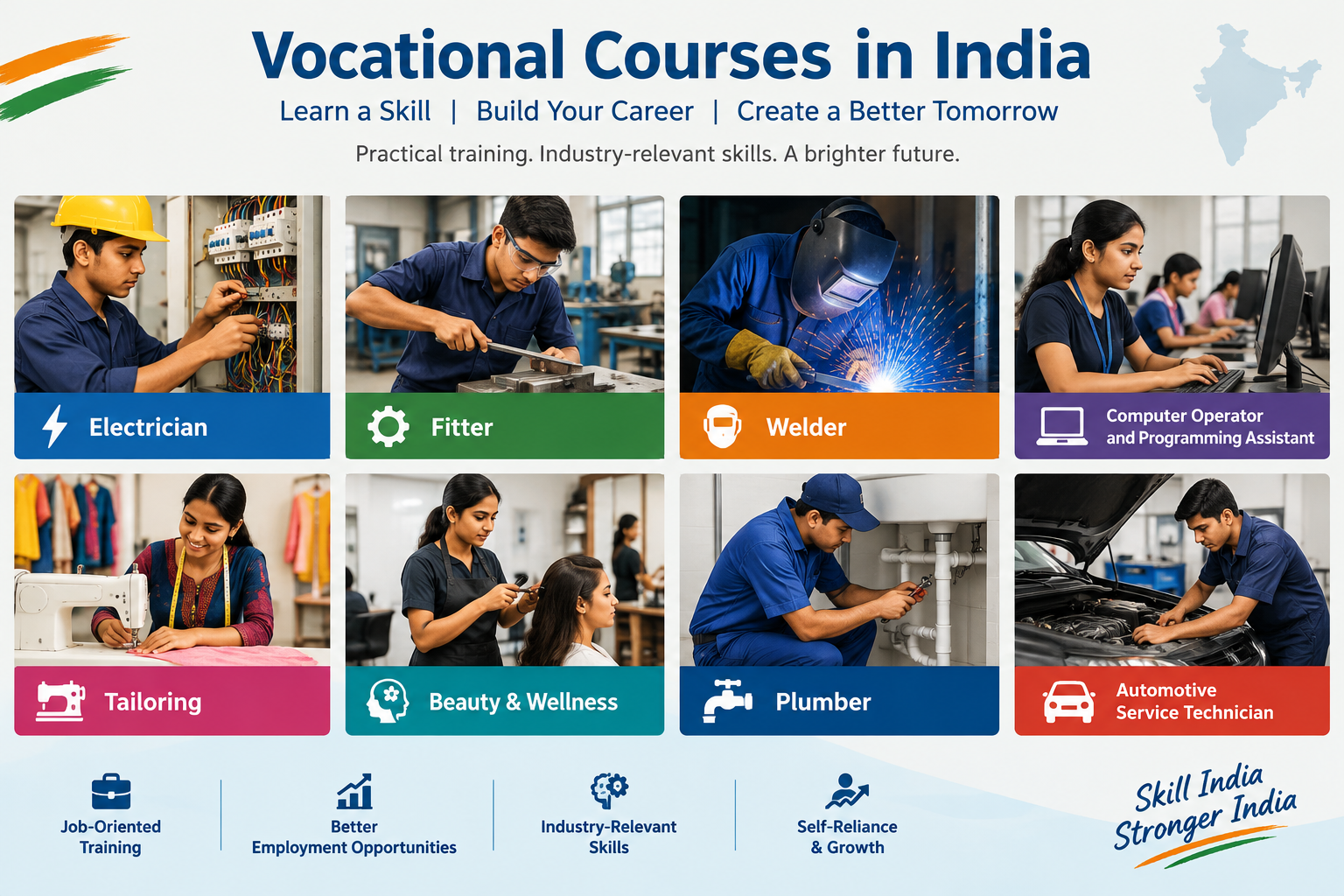
    Vocational courses in India

    1. India’s Job Market Is Changing. Is Training Keeping Up?

    Traditional vocational courses have helped learners develop practical skills for occupations across manufacturing, electrical work, automotive services, construction, retail and other industries.

    These skills remain valuable. However, many jobs are also changing.

    A warehouse employee may now need to use digital inventory systems. A retail associate may work with point-of-sale software and digital payments. A technician may need to understand automated equipment. A customer support executive may work with CRM tools and AI-assisted systems.

    New opportunities are also emerging in areas such as renewable energy, electric vehicles, robotics, data analytics and other technology-driven sectors.

    The challenge is not that traditional vocational skills are no longer useful. It is that those skills increasingly need to be combined with digital knowledge, problem-solving and the ability to learn new processes.

    Training programmes must evolve alongside the industries they serve.

    2. A Certificate Is a Starting Point, Not the Finish Line

    Vocational qualifications give learners a structured way to develop knowledge and demonstrate that they have completed a course.

    But employers also need to know what a candidate can actually do.

    Can the candidate operate the required equipment safely? Can they follow workplace instructions? Can they use the tools relevant to the role? Can they handle common problems without constant supervision?

    These are practical questions that a certificate alone may not answer.

    This does not mean qualifications are unimportant. It means that qualifications should be supported by practical assessments, demonstrations and workplace exposure.

    A stronger training model would combine classroom learning with hands-on exercises, realistic work simulations and assessments based on actual job tasks.

    The goal should be simple: when a learner finishes training, they should understand not just the theory behind the job but also what performing that job looks like in practice.

    3. Industry Must Become a More Active Partner

    One of the biggest opportunities for vocational training is stronger collaboration between training institutions and employers.

    Training institutes cannot always predict how job roles will change. Employers, on the other hand, see the skills they need today and the capabilities they expect to need in the coming years.

    Bringing these two sides together can help make training more relevant.

    Companies can contribute by:

    • Sharing the skills required for specific job roles.
    • Advising institutes on curriculum updates.
    • Providing equipment, demonstrations and practical learning opportunities.
    • Offering internships and apprenticeships.
    • Participating in assessments and candidate evaluations.
    • Giving feedback on the performance of newly hired trainees.

    For example, if a logistics company regularly hires warehouse associates, it can help training partners understand the actual requirements of warehouse work, including inventory handling, workplace safety, scanning systems and basic digital operations.

    This makes training more closely connected to employment.

    The government has also emphasised demand-driven skilling and industry alignment. The Ministry of Skill Development and Entrepreneurship’s initiatives include industry-linked training and on-the-job exposure through schemes such as the Dual System of Training.

    The next step is to make these connections meaningful, consistent and accessible across more sectors and locations.

    4. Practical Experience Should Be Part of the Learning Journey

    A learner can understand a process in theory and still struggle when they encounter it in a real workplace.

    That is why practical exposure matters.

    Apprenticeships, internships, supervised workplace training and simulated work environments can help bridge the gap between learning and employment.

    Consider someone training to become an electrician. Understanding electrical concepts is important, but so is learning to use tools correctly, follow safety procedures and troubleshoot common problems under supervision.

    Similarly, someone preparing for a retail role benefits from practising customer interactions, handling billing systems and learning how to manage everyday store operations.

    Practical exposure also helps learners understand whether a job suits their interests and expectations before they enter full-time employment.

    Training should therefore not treat practical work as an optional extra. It should make it a meaningful part of the learning process wherever the occupation requires it.

    5. Soft Skills Matter More Than Many Learners Realise

    Technical knowledge helps candidates qualify for a role. Workplace skills often determine how effectively they perform in it.

    Communication, punctuality, teamwork, problem-solving, adaptability and the ability to follow instructions are important across many occupations.

    For frontline roles, these skills can be especially relevant.

    A delivery executive needs to communicate with customers and follow delivery procedures. A retail associate must understand customer needs and coordinate with colleagues. A warehouse employee needs to follow instructions, maintain safety and work as part of a team.

    These abilities can be taught and practised.

    Training centres can introduce workplace scenarios, group activities, mock interviews, communication exercises and basic digital tasks into their programmes.

    The objective is not to turn every learner into an expert communicator overnight. It is to help them enter the workplace with greater confidence and a clearer understanding of professional expectations.

    6. Training Should Lead to Employment, Not Just Completion

    One of the most important questions for any vocational programme is what happens after the course ends.

    How many learners find jobs related to their training? How many successfully join? Are they still employed after a few months? Do they have opportunities to improve their skills and earn more over time?

    Course completion and certification are useful indicators, but they do not tell the whole story.

    Training providers should work towards tracking outcomes such as:

    • Employment after training.
    • Relevance of the job to the course.
    • Employer feedback on job readiness.
    • Successful joining rates.
    • Retention after three or six months.
    • Opportunities for career progression.
    • Learner satisfaction with the training.

    These measures can help institutions understand where their programmes are working and where changes are needed.

    For instance, if a course attracts many learners but employers repeatedly report the same practical skill gaps, the curriculum or training delivery may need to be reviewed.

    Likewise, if candidates receive offers but struggle to join because of unclear job conditions or unsuitable locations, better career guidance and employer coordination may help.

    The real measure of vocational training is not only how many people complete it, but how effectively it helps them move forward.

    7. Future-Ready Training Must Be Accessible Beyond Major Cities

    India’s talent is not limited to metropolitan areas.

    Across smaller cities, towns and districts, young people are pursuing ITI courses, diplomas, vocational qualifications and other forms of practical education.

    These learners can become an important source of talent for employers in logistics, retail, manufacturing, hospitality, customer support and many other sectors.

    However, access to quality training and employment connections can vary by location.

    Some learners may have limited access to modern equipment, experienced trainers, career counselling or employers who recruit from their region.

    A future-ready vocational system should therefore focus on both training quality and access to opportunity.

    This includes strengthening regional training centres, developing partnerships with local employers, providing digital learning resources and connecting candidates with relevant vacancies.

    Digital platforms can help learners discover opportunities beyond their immediate networks. But technology works best when combined with reliable information, practical training and real employer connections.

    The aim should be to ensure that a learner’s location does not unnecessarily limit their ability to develop skills or find suitable work.

    8. What Should the Vocational Training Model Look Like Tomorrow?

    There is no single solution for every occupation. A technician, a healthcare worker and a warehouse associate will need different training pathways.

    However, a more effective model can follow a common approach:

    Understand demand → Train for the role → Practise real tasks → Assess skills → Connect with employers → Track outcomes

    First, training providers identify the skills employers actually need.

    Next, learners receive relevant technical instruction and workplace skills training.

    They practise the tasks associated with their chosen roles and are assessed on what they can demonstrate.

    They then connect with employers through apprenticeships, placement partnerships, recruitment drives or digital platforms.

    Finally, training providers gather feedback on employment, retention and performance to improve future batches.

    This creates a continuous cycle in which training responds to the job market instead of remaining disconnected from it.

    It also allows employers to contribute to talent development rather than relying entirely on the external labour market to supply ready-made candidates.

    Final Thought: Build Skills for Real Opportunities

    India’s vocational training ecosystem has an important role to play in preparing the workforce for the future. But the future will require more than adding new courses or issuing more certificates.

    It will require practical learning, stronger industry partnerships, digital skills, workplace readiness and a clear connection between training and employment.

    It will also require recognising that people develop at different speeds. Some learners will be ready for employment immediately after training, while others may need additional practice, apprenticeships or on-the-job support.

    The answer is not to dismiss the current model. It is to keep improving it.

    Training institutions must understand industry needs. Employers must participate in building talent. Learners must have access to relevant skills and genuine job opportunities. And the entire system must pay closer attention to what happens after training ends.

    Because a vocational course should do more than prepare someone to pass an assessment. It should help them take the next step towards a livelihood, a career and a better future.

    The jobs of tomorrow will need people who can keep learning. Our training systems must be built to help them do exactly that.

  • Hiring Beyond Metros: Unlocking India’s Next Talent Pool

    Hiring Beyond Metros: Unlocking India’s Next Talent Pool

    For years, when companies thought about hiring at scale, the first names that came to mind were Bengaluru, Delhi NCR, Mumbai, Hyderabad, Chennai and Pune.

    These cities have strong talent pools, established businesses, universities and mature hiring ecosystems. They will continue to be important.

    But there is another side to India’s talent story.

    Across Tier 2 and Tier 3 cities, thousands of candidates are building skills, completing vocational courses, graduating from colleges and looking for opportunities closer to home.

    For employers, this creates an important question:

    Are you looking at the entire talent pool, or only the talent that is easiest to find?

    The Talent Market Is Moving Beyond Traditional Hubs

    Hiring is no longer restricted to a handful of large cities. Recent hiring data has shown continued momentum in emerging cities. In FY26, cities such as Coimbatore, Gandhinagar and Surat recorded strong hiring activity, while more recent data has highlighted cities including Jaipur, Coimbatore and Ahmedabad as growing hiring markets.

    The change is particularly interesting because companies are not only looking for highly specialised professionals. There is growing demand across sectors such as retail, logistics, hospitality, BPO, sales, customer support, manufacturing and e-commerce.

    These sectors require people who can perform practical, customer-facing and operational roles — and that talent can be found far beyond the major metros.

    Why Should Companies Look Beyond Metros?

    Hiring Beyond Metro cities

    1. A Larger Talent Pool

    The biggest advantage is simple: more people to hire from.

    When companies repeatedly recruit from the same few cities, they are competing for the same candidates.

    Expanding into smaller cities can open access to candidates who may have the right education, skills or potential but are not actively visible in traditional hiring channels.

    For frontline and entry-level roles, this becomes even more important.

    A warehouse associate, retail executive, field sales representative, customer support executive or delivery professional does not necessarily need to come from a major metropolitan city.

    They need the right skills, willingness to work and an opportunity.

    2. Freshers Can Become Long-Term Talent

    One of the biggest opportunities outside metros is the availability of young, early-career talent.

    Many candidates in smaller cities are entering the workforce for the first time.

    They may not have years of experience, but they can bring:

    • Willingness to learn
    • Local market understanding
    • Basic digital skills
    • Communication abilities
    • Educational qualifications
    • Practical training
    • Strong motivation to build a career

    Instead of treating lack of experience as an automatic rejection, companies can look at potential and trainability.

    Recent hiring data has also shown positive momentum in fresher hiring, including strong growth in several emerging cities.

    3. Local Talent Can Improve Workforce Stability

    Hiring locally can also have an important advantage: employees may not need to relocate to another city to find work.

    For many frontline employees, relocation can be a major challenge.

    Moving to a metro can mean higher rent, longer commutes, unfamiliar surroundings and greater living expenses.

    A suitable job closer to home can sometimes make employment more sustainable.

    This can matter for employers too.

    A workforce that lives closer to its workplace may be easier to build and retain, particularly for roles where attendance, punctuality and regular availability are critical.

    Of course, retention depends on many factors — compensation, management, work environment and career growth all matter. But location can be an important part of the equation.

    4. Smaller Cities Are Becoming More Connected

    The old perception of smaller cities is changing.

    Digital connectivity, smartphones, online education, digital payments and job platforms have made it easier for candidates to discover opportunities without physically visiting an employer’s office.

    At the same time, better infrastructure and expanding business ecosystems are making regional hiring more practical.

    Team Lease notes that Tier 2 and Tier 3 cities are increasingly becoming strategic hiring locations because of their talent availability, workforce stability and improving infrastructure.

    This means companies don’t necessarily have to choose between talent quality and geographic expansion.

    With the right hiring and training systems, they can build both.

    5. Frontline Hiring Especially Benefits From a Regional Approach

    Consider a company expanding its operations across multiple states.

    It may need hundreds of:

    • Retail associates
    • Sales executives
    • Warehouse associates
    • Pickers and packers
    • Delivery executives
    • Customer support executives
    • Field representatives
    • Hospitality staff
    • Store operations employees

    Hiring all of them from major cities would make little sense.

    These roles are often needed where the business operates.

    If a company opens stores in smaller cities, expands its warehouse network or enters new regional markets, the hiring strategy should move with the business.

    The closer your talent search is to your actual operations, the more relevant your talent pool can become.

    Why look beyond metros

    The Challenge: Finding This Talent

    Of course, hiring beyond metros is not as simple as posting a job and waiting for applications.

    Companies may face challenges such as:

    • Limited visibility into local talent
    • Fragmented recruitment channels
    • Difficulty reaching candidates at scale
    • Candidate verification
    • Skill mismatches
    • Communication gaps
    • Joining drop-offs
    • Lack of structured local recruitment networks

    This is where technology and local talent ecosystems can make a difference.

    A digital hiring platform can help companies reach candidates across different locations without depending entirely on traditional recruitment methods.

    Training institutions, colleges, skill centres and local employment networks can also become valuable sources of candidates.

    Build a Regional Talent Pipeline, Not Just a Regional Hiring Campaign

    There is an important difference between hiring from smaller cities and building a talent pipeline in smaller cities.

    A hiring campaign begins when a vacancy opens.

    A talent pipeline starts much earlier.

    Companies can work with local colleges, vocational institutes, training centres and digital platforms to identify potential candidates before urgent hiring requirements arise.

    For example:

    Identify → Train → Assess → Connect → Hire → Develop

    This creates a repeatable model instead of starting recruitment from zero every time a new requirement comes in.

    Technology Can Make Regional Hiring Easier

    Technology is changing how employers connect with candidates.

    Candidates no longer have to depend entirely on newspaper advertisements, local references or physically visiting recruitment offices.

    They can discover jobs, create profiles, apply digitally and track opportunities through their phones.

    For employers, digital platforms can make it easier to:

    • Reach candidates across locations
    • Filter candidates by skills and experience
    • Manage high-volume applications
    • Promote vacancies
    • Build candidate pipelines
    • Connect with fresher talent
    • Track recruitment activity

    The combination of digital reach + local talent can make regional hiring significantly more scalable.

    Don’t Ignore the Candidate’s Potential

    Perhaps the biggest mindset shift required is moving away from the idea that the best candidate is always the candidate with the longest resume.

    For many frontline and entry-level positions, employers need people who can learn, adapt and perform consistently.

    A candidate with six months of experience from a smaller city may be a better fit than an experienced candidate who is unwilling to relocate.

    A fresher with the right attitude and practical training may develop into a strong employee.

    The question should therefore move from:

    “Where does this candidate come from?”

    to:

    “Can this candidate perform, learn and grow in this role?”

    India’s Next Talent Pool May Already Be There

    India’s workforce is becoming increasingly distributed. Talent is not concentrated in a few large cities anymore.

    From Jaipur and Indore to Bhubaneswar, Coimbatore, Surat, Lucknow, Patna and many other emerging markets, companies have an opportunity to discover talent closer to where people actually live.

    For frontline hiring, this shift can be particularly powerful.

    The future of recruitment may not be about choosing between metros or smaller cities.

    It may be about building a hiring strategy that combines both.

    Use metros when specialised talent is needed.

    Look beyond metros when you need scale, local talent and broader workforce access.

    Build partnerships with institutions and local ecosystems.

    Use digital platforms to expand your reach.

    And most importantly, evaluate candidates based on skills, potential and role fit — not simply their pin code.

    Final Thought

    India’s next talent pool isn’t necessarily waiting in another large corporate office.

    It could be in a college classroom, a vocational training centre, a small city, a district headquarters or a candidate’s home town.

    The opportunity for employers is to look beyond the traditional hiring map.

    Because sometimes, the talent you’re looking for isn’t unavailable.

    You’re simply not looking far enough.

  • How to Scale a GCC from 100 to 1,000 Employees

    How to Scale a GCC from 100 to 1,000 Employees

    Growing a Global Capability Centre from 100 employees to 1,000 is not simply a matter of hiring 900 more people.

    At 100 employees, many things can still work through individual relationships, informal communication and a relatively small leadership team. But as the organisation grows, those same approaches can quickly become bottlenecks.

    Hiring takes longer. Teams become difficult to coordinate. Managers get stretched. New employees take more time to become productive. And if the organisation grows too quickly without the right systems, quality can suffer.

    The real challenge is not just how to hire 1,000 people.

    It is how to build an organisation that can successfully operate with 1,000 people.

    Here are some practical steps GCC leaders can consider when planning that journey.

    Start With a Clear Workforce Plan

    Before increasing headcount, understand exactly why the organisation needs to grow.

    A GCC should have a clear view of:

    • Which functions are expanding?
    • Which roles will be needed in the next 12, 24 and 36 months?
    • Which skills are available internally?
    • Which skills need to be hired from outside?
    • Which roles can be developed through training?
    • Which positions are business-critical?

    For example, growing from 100 to 1,000 employees may involve expansion across technology, finance, analytics, HR, customer operations, engineering, cybersecurity or other functions.

    The workforce plan should connect hiring with the actual business mandate.

    Headcount should be an outcome of business growth, not the target itself.

    Build Hiring Capacity Before You Need It

    One of the biggest mistakes companies make during rapid expansion is starting recruitment only after the requirement becomes urgent.

    If a GCC suddenly needs 200 employees in six months, the recruitment team can quickly become overloaded.

    Instead, build a scalable hiring engine early.

    This can include:

    • Multiple sourcing channels
    • Strong employer branding
    • Recruitment partners
    • Employee referrals
    • Campus and fresher hiring
    • Specialist talent networks
    • Digital recruitment platforms
    • Internal talent pipelines

    The objective is simple: don’t start looking for talent when you need it. Build access to talent before you need it.

    Don’t Hire Everyone for the Same Location

    A 100-person GCC may initially operate from one major city. But scaling to 1,000 employees does not necessarily mean making the same office ten times bigger.

    India’s GCC ecosystem is increasingly looking beyond traditional metropolitan hubs, with Tier-II cities becoming part of the expansion conversation. This can help companies access additional talent pools and create distributed delivery models.

    A GCC can evaluate locations based on:

    • Talent availability
    • Skill concentration
    • Operating costs
    • Employee retention
    • Infrastructure
    • Connectivity
    • Educational ecosystem
    • Long-term hiring potential

    The right question is not “Which city is cheapest?”

    It is “Which location gives us sustainable access to the talent we need?”

    GCC in Mumbai

    Create a Multi-Level Talent Pipeline

    Scaling from 100 to 1,000 employees requires more than experienced professionals.

    A healthy GCC workforce can have a mix of:

    Experienced professionals
    For leadership, specialised and critical roles.

    Mid-level talent
    For building functional strength and managing growing teams.

    Freshers and early-career professionals
    For creating a long-term talent pipeline.

    Internal talent
    For promotions, mobility and leadership development.

    This creates a more balanced workforce instead of making the organisation completely dependent on lateral hiring.

    The GCC industry is also seeing increasing attention toward entry-level talent and fresher opportunities, making early-career hiring an important part of long-term workforce planning.

    Build a Strong Internal Training System

    You cannot always hire every skill you need.

    Some capabilities may be difficult to find in the market, while others may become important only as the GCC expands.

    This is where internal learning becomes important.

    A scalable GCC should invest in:

    • Technical training
    • Functional training
    • Leadership development
    • Communication skills
    • Domain knowledge
    • Digital skills
    • Manager training
    • Cross-functional exposure

    A person hired for one role today could potentially become a team lead, specialist or manager tomorrow.

    Hiring brings people into the organisation. Development helps the organisation grow with them.

    Standardise the Employee Experience

    When a company has 100 employees, a new employee can often get support directly from a manager or colleague.

    At 1,000 employees, this becomes much harder.

    That is why processes need to become more structured as the organisation scales.

    The GCC should standardise areas such as:

    • Recruitment
    • Background verification
    • Onboarding
    • Training
    • Performance management
    • Internal mobility
    • Employee communication
    • Exit processes

    The goal is not to make the organisation bureaucratic.

    The goal is to make the employee experience consistent and predictable, even as the workforce becomes larger.

    Strengthen Managers Before Rapid Hiring

    One manager cannot effectively manage an endlessly growing team.

    If the organisation adds hundreds of employees but does not build its management layer, problems eventually appear.

    Managers become overloaded.

    Employees receive less feedback.

    Performance issues take longer to identify.

    New employees struggle to understand expectations.

    Therefore, manager development should happen alongside workforce growth.

    Future managers can be identified internally and trained in:

    • People management
    • Communication
    • Performance coaching
    • Conflict resolution
    • Delegation
    • Decision-making
    • Team development

    Scaling a GCC means scaling its leadership capacity, not just its employee count.

    Use Technology to Make Recruitment and Operations Scalable

    When hiring 50 people, manual processes may still be manageable.

    When hiring hundreds, they become expensive and slow.

    Technology can help GCCs manage:

    • Candidate sourcing
    • Application tracking
    • Interview scheduling
    • Assessments
    • Onboarding
    • Employee records
    • Learning
    • Workforce analytics
    • Internal mobility

    Recruitment technology should not simply be used to increase the number of applications.

    It should help recruitment teams identify the right candidates faster.

    Similarly, workforce analytics can help leadership understand hiring velocity, time-to-hire, attrition, productivity and skill gaps.

    GCC's

    Protect Culture While You Scale

    This is one of the hardest parts of moving from 100 to 1,000 employees.

    A small organisation often has a strong sense of identity because employees know each other and leadership is accessible.

    Rapid hiring can change that.

    New employees may not understand the organisation’s values or the purpose behind the GCC.

    That is why culture needs to be deliberately built into:

    • Onboarding
    • Leadership communication
    • Recognition
    • Career development
    • Employee engagement
    • Internal communication

    The objective is to make new employees feel that they are joining a growing organisation, not simply filling a vacancy.

    Measure the Right Numbers

    Headcount alone does not tell you whether the GCC is scaling successfully.

    Leadership should track metrics such as:

    • Time to hire
    • Cost per hire
    • Offer acceptance rate
    • New-hire productivity
    • Attrition
    • Employee retention
    • Internal mobility
    • Training completion
    • Hiring by skill
    • Hiring by location
    • Diversity
    • Manager span of control

    These numbers can reveal where growth is working and where the organisation is developing a bottleneck.

    For example, hiring 100 employees in a quarter may look impressive. But if 30% leave within a short period, the organisation has a retention problem rather than a successful scaling model.

    The 100-to-1,000 Journey Needs a Different Mindset

    The biggest difference between a 100-person GCC and a 1,000-person GCC is not the number of employees.

    It is the operating model.

    At 100 employees, the organisation can depend heavily on people.

    At 1,000 employees, it needs people plus processes, technology, leadership, training and systems.

    A successful scaling journey can therefore be thought of in five stages:

    Plan → Build → Hire → Develop → Scale

    Plan the workforce requirements.

    Build the talent pipeline.

    Hire through multiple channels.

    Develop people internally.

    Then scale the functions, locations and leadership structure as the business grows.

    India’s GCC ecosystem is continuing to move toward higher-value work across technology, data, engineering, finance, AI and other specialised functions. That makes talent strategy increasingly important to the success of GCC expansion.

    The organisations that scale successfully will not necessarily be the ones that hire the fastest.

    They will be the ones that can hire the right people, develop them, retain them and build the systems required to support them.

    And when the goal is to move from 100 employees to 1,000, that difference can determine whether growth becomes a competitive advantage or an operational challenge.

    Final Thought

    Scaling a GCC is ultimately a people-and-process challenge.

    Technology can accelerate the journey. Recruitment platforms can expand access to talent. Training can close skill gaps. But sustainable growth comes from bringing all these pieces together.

    The goal isn’t simply to reach 1,000 employees.

    The goal is to build a 1,000-person GCC that is ready for its next 1,000.

  • Frontline Workforce in India: 5 Valuable Career Skills Field Sales Jobs CanBuild

    Frontline Workforce in India: 5 Valuable Career Skills Field Sales Jobs CanBuild

    When people hear the word sales, they often imagine someone going door to door or sitting in an office and making phone calls. But the large part of Sales happens outside the office.

    How Frontline Sales can be build real career skills?

    A field sales executive might spend the day visiting customers, understanding their requirements, explaining a product, following up with the prospects and building relationship. That makes a field sales one of the many important frontline jobs in India. And while the field sales can be challenging, it can also teach skills that stay useful throughout a person’s career.

    Frontline workforce includes people who directly interacts with customers, operate business processes or deliver products and services. This can include:

    • Field Sales executives
    • Delivery Executives
    • Retail Employees
    • Warehouse Workers
    • Technicians
    • Drivers
    • Manufacturing Workers
    • Field Sales Professionals. 

    Recent workforce research describes frontline employees as the people working across areas such as retail, factories, warehouses and customer service — roles that keep day-to-day operations moving.

    Frontline Field Sales in India

    What Does a Field Sales Executive Actually Do?

    A sales professional job is not simply about selling something. A typical field sales executive may have to:

    • Find and contact potential customers
    • Visit customers
    • Understand their requirements
    • Explain products or services
    • Handle questions and objections
    • Negotiate with customers
    • Follow up regularly
    • Maintain customer information
    • Coordinate with internal teams
    • Work towards sales targets

    Every customer interaction is different.
    That means a sales executive gets practical experience that cannot always be learned from a classroom.

    The Skills You Build in Sales

    One of the biggest advantages of a frontline sales job is the range of skills you develop.

    • Communication

    You learn how to explain an idea clearly to different types of customers.

    • Customer Handling

    Not every customer will be interested. Learning how to listen, respond to objections and maintain a professional conversation is an important skill.

    • Negotiation

    Customers may question pricing, features or value. Handling these conversations teaches you how to negotiate and communicate value.

    • Time Management

    A customer facing executive may have several meetings or visits in one day. Planning the day properly becomes an important part of the job.

    • Problem Solving

    Customers don’t always give you a straightforward requirement. You often have to understand the actual problem and find a suitable solution.

    Field Sales Can Be a Starting Point, Not the Final Destination

    A person’s first job does not necessarily determine their entire career. Someone who starts as a field sales executive can gradually develop experience in areas such as:

    Field Sales → Senior Sales Executive → Business Development → Key Account Management

    Or, depending on their skills and interests:

    Frontline Sales → Sales Operations → CRM / Sales Coordination → Business Operations

    The actual career path depends on the person’s experience, performance, education, skills and the opportunities available to them.

    The important point is that frontline work can help build transferable skills.

    Field Sales In FMCG and Logistics

    Why Digital Job Discovery Matters

    Finding suitable frontline jobs can sometimes be difficult. Many workers traditionally depend on personal contacts, local references or word-of-mouth to discover opportunities.

    Digital job platforms are creating another way for workers to discover jobs and present their skills to potential employers.

    Find Frontline and Field Sales Opportunities with Job Raahi

    Job Raahi is a digital job portal specializing in blue collar, grey collar and frontline employment.

    The platform connects job seekers with employment opportunities across different frontline and skilled-work categories. For someone looking for a field sales job, sales executive job, logistics job, delivery job, manufacturing job or other frontline opportunity, having access to relevant vacancies can make the job search more organized.

    Your First Job Can Teach You More Than You Expect

    A frontline job can teach you how to communicate with people, handle pressure, solve problems and take responsibility. These skills can remain useful even when your career direction changes later.

    So, if you’re starting your career and considering a field sales job, don’t look at it only as a job title.

    Look at the skills you can build along the way. Every customer conversation, every visit and every problem you solve can become part of your professional experience.

  • Blue Collar Workers Career

    Blue Collar Workers Career

    Blue Collar Workers

    Blue Collar Workers are the backbone of India’s economy, and their career prospects are diverse and exciting. Furthermore, the Indian job market is witnessing a significant surge in demand for skilled and unskilled workers. Consequently, Blue Collar Workers have numerous opportunities to explore various sectors and industries. Additionally, with the right training and skills, they can secure better-paying jobs and improve their standard of living.

    Introduction to Blue Collar Workers Career

    Moreover, the Indian government has launched several initiatives to promote vocational training and skill development among Blue Collar Workers. For instance, the Ministry of Skill Development offers various programs to enhance the skills of Blue Collar Workers. Therefore, it is essential for Blue Collar Workers to stay updated about the latest trends and opportunities in the job market.

    Blue Collar Workers

    Blue Collar Workers Career Prospects

    However, Blue Collar Workers often face challenges in finding the right job opportunities. Consequently, they must be proactive in seeking out career prospects and exploring various sectors. Additionally, they can visit the Job Raahi Blog to stay informed about the latest job market trends and career advice. Some of the key sectors for Blue Collar Workers include:

    • Manufacturing and production
    • Construction and infrastructure
    • Logistics and transportation
    • Healthcare and hospitality
    • IT and technology

    Benefits of Blue Collar Workers Career

    Moreover, a career as a Blue Collar Worker offers numerous benefits, including job security, opportunities for advancement, and a sense of fulfillment. Furthermore, Blue Collar Workers can work in a variety of settings, from factories and warehouses to hospitals and hotels. Additionally, they can specialize in specific trades, such as electrical work, plumbing, or carpentry.

    Sectors and Industries for Blue Collar Workers

    However, the job market for Blue Collar Workers is constantly evolving, and new sectors and industries are emerging. Consequently, Blue Collar Workers must be adaptable and willing to learn new skills. For instance, the renewable energy sector is creating new job opportunities for Blue Collar Workers, including solar panel installation and wind turbine maintenance. Moreover, the National Career Service provides resources and support for Blue Collar Workers to explore these new opportunities.

    Types of Blue Collar Jobs

    Additionally, there are many types of Blue Collar jobs available, including:

    • Factory workers
    • Warehouse workers
    • Drivers
    • Electricians
    • Fitters
    • Welders
    • Machine operators

    Skills and Training for Blue Collar Workers

    Furthermore, Blue Collar Workers require specialized skills and training to succeed in their careers. Consequently, they must invest in vocational training and certification programs. For example, the Job Raahi platform offers resources and support for Blue Collar Workers to acquire new skills and improve their employability. Moreover, the following table highlights some of the key skills and training required for Blue Collar Workers:

    Skill Training Certification
    Electrical work Vocational training ITI certification
    Plumbing Apprenticeship Diploma certification
    Carpentry On-the-job training Certificate of completion
    Machine operation Factory training License to operate

    Importance of Vocational Training

    However, vocational training is essential for Blue Collar Workers to acquire the skills and knowledge required for their jobs. Consequently, they must prioritize vocational training and certification programs. Additionally, vocational training can help Blue Collar Workers to advance in their careers and increase their earning potential.

    Blue Collar Workers Job Opportunities

    Moreover, Blue Collar Workers can find job opportunities through various channels, including online job portals, recruitment agencies, and company websites. Furthermore, they can download Job Raahi app to search for jobs and receive job alerts. Additionally, the following are some tips for Blue Collar Workers to find job opportunities:

    • Update their resumes and profiles
    • Network with employers and recruiters
    • Practice their interview skills
    • Stay positive and motivated
    • Be open to new opportunities and challenges

    Conclusion

    In conclusion, Blue Collar Workers have numerous career prospects and opportunities in India. Furthermore, with the right skills and training, they can succeed in their careers and improve their standard of living. Therefore, Blue Collar Workers must stay informed about the latest job market trends and career advice. Additionally, they can visit the Job Raahi Blog to learn more about Blue Collar Workers career prospects and opportunities. Consequently, Blue Collar Workers can download Job Raahi app to search for jobs and receive job alerts.

    Sources and References

    The following are some sources and references used in this article: