Category: Uncategorized

  • Your First Job Is More Than a Starting Point: How to Turn Potential into Career Growth

    Your First Job Is More Than a Starting Point: How to Turn Potential into Career Growth

    Your first job can bring a mix of excitement, uncertainty and pressure. You may be eager to start earning, support your family or become financially independent. At the same time, you may wonder whether your qualifications are enough, whether you have the right skills or whether a company will hire you without experience.

    These concerns are common, especially when many job descriptions appear to ask for experience before giving candidates an opportunity to gain it.

    But here is an important thought: your first job is not just about getting hired. It is about building the foundation for what comes next.

    Whether you start as a retail associate, warehouse assistant, delivery executive, customer support representative, machine operator or sales trainee, the right opportunity can help you develop skills, understand workplace expectations and discover your strengths.

    The key is to approach your first job with a clear purpose: learn, contribute and grow.

    First job, new journey

    Why Your First Job Matters More Than You Think

    A first job introduces you to the realities of working life. You begin to understand how teams operate, how responsibilities are managed and how your work contributes to a larger business.

    For example, a warehouse associate may begin by learning inventory handling, order picking and packing. With experience and consistent performance, that employee may develop an understanding of stock management, quality checks and team coordination.

    Similarly, someone starting in retail can learn customer communication, billing, product knowledge and store operations. These skills can create a foundation for taking on greater responsibilities over time.

    Your first designation does not have to define your entire career. What matters is what you learn from the role and how you use that learning to move forward.
    Instead of asking only, “What is the salary?” consider asking, “What will I learn here, and where could this experience take me?”

    Salary, work hours, location, safety and working conditions still matter. Career growth should not mean accepting an unsuitable job. It means looking for a reasonable opportunity that supports both your present needs and future goals.

    Experience Is Built Somewhere

    One of the biggest challenges for freshers is the expectation that they should already have experience.

    But experience has to begin somewhere.

    Employers may need people who can follow instructions, communicate clearly, work responsibly and learn the tasks required for a role. These qualities can be demonstrated through training, practical assignments, internships, apprenticeships, college projects or previous responsibilities—not only through a long employment history.

    If you are a fresher, focus on what you can already offer.

    Have you completed an ITI course? Have you worked on machines during practical training? Have you helped manage a family business? Have you coordinated a college event, handled customers or learned to use basic computer tools?

    These experiences may demonstrate useful abilities when explained honestly and clearly. You do not need to pretend to have professional experience. Instead, show that you are prepared to learn and take responsibility.

    Employers also have a role to play. When a position can reasonably be performed by a trained fresher, requiring unnecessary years of experience may exclude candidates who could develop into capable employees. A better approach is to distinguish between skills a candidate must already possess and skills that can be taught after joining.

    How to Choose the Right First Job

    Your first opportunity deserves careful consideration. A job that looks attractive on paper may not be the right fit for your needs or abilities.

    Before applying, evaluate five things:

    Role clarity: Understand your actual responsibilities. Ask what a typical working day looks like and what performance expectations will be.

    Salary and benefits: Confirm the salary structure, payment frequency, deductions and any applicable benefits before accepting an offer.

    Location and commute: Consider travel time, transport availability and whether the job location is practical for you.

    Learning opportunities: Look for roles where you can develop useful skills, receive appropriate training and understand how performance is evaluated.

    Workplace conditions: Ask about shifts, weekly offs, safety arrangements and the support available to new employees.

    Do not choose a job only because it has an impressive title. A clearly defined role with supportive supervision and meaningful learning may be more valuable than a title that offers little development.

    At the same time, do not assume that every entry-level job automatically leads to promotion. Ask questions, understand the terms and make an informed decision.

    Five Skills That Can Help You Grow Faster

    You do not need to master everything before your first day. However, a few foundational skills can make the transition into employment easier.

    1. Communication

    Learn to explain a problem, ask for clarification and share updates. You do not need perfect English for every role. Clear communication in the language required by your workplace is what matters.

    2. Punctuality and reliability

    Arriving on time, following agreed schedules and informing your supervisor when an issue arises help build trust.

    3. Willingness to learn

    Listen carefully during training, take notes where useful and ask questions when instructions are unclear. Learning a task correctly is more important than pretending to know everything.

    4. Basic digital skills

    Depending on your role, you may need to use a smartphone application, scan barcodes, enter information, manage digital payments or communicate through workplace tools. Practising these skills can improve your readiness.

    5. Teamwork and problem-solving

    Most jobs involve working with other people. Learn how to coordinate, handle routine challenges and seek help when a problem is beyond your responsibility.

    These abilities are not limited to office jobs. They are valuable across retail, logistics, hospitality, manufacturing, customer support and many other sectors.

    Make Your First Job a Learning Experience

    Getting hired is an important milestone, but your development continues after joining. During your first few weeks, focus on understanding the job rather than comparing your progress with everyone else’s.

    Learn the correct process. Understand the quality and safety standards. Observe experienced colleagues. Ask your supervisor what good performance looks like.
    Once you become comfortable with your responsibilities, look for opportunities to improve. Can you complete a task more accurately? Can you communicate a customer issue more clearly? Can you learn another part of the operation?

    Keep a simple record of what you learn and the responsibilities you take on. This will help you explain your experience when applying for future opportunities.
    For instance, rather than writing only “worked in a warehouse” on your CV, describe the responsibilities you genuinely handled, such as order picking, packing, inventory updates or dispatch coordination.

    Never exaggerate your achievements. Specific, honest examples are more useful than impressive-sounding claims that you cannot support.
    You can also explore career guidance, job-search support and skill-development resources through the National Career Service portal.

    What Employers Can Do to Help New Employees Succeed

    Career growth is not solely the responsibility of the employee. Employers influence how easily a new hire adjusts, learns and contributes. A candidate who joins without previous work experience may still have the attitude, basic aptitude and willingness to learn needed for the role. Without proper onboarding, even a promising candidate can struggle to understand expectations.

    Employers can help by setting clear responsibilities, providing practical training, assigning an approachable supervisor and giving feedback during the early weeks.
    They can also make job descriptions more realistic by separating essential requirements from skills that can be taught.

    This creates a more meaningful way to evaluate candidates: not just by where they have worked before, but also by what they can do, what they can learn and how well they match the role.
    For businesses hiring at scale, this approach can expand the pool of potential candidates. For job seekers, it can make suitable entry-level opportunities easier to identify. The aim is not to overlook experience when it is genuinely necessary. It is to avoid treating experience as the only sign of capability.

    Your Career Starts with Your Next Step

    You do not need to have your entire career planned before applying for your first job.

    Start by understanding your strengths, identifying suitable roles and preparing an honest CV. Apply for opportunities that match your qualifications and practical abilities. Research employers, ask questions and understand the terms before accepting an offer.

    Once you begin working, keep learning. Build reliable habits, improve your skills and take responsibility for the work assigned to you. Your first job may not be your final destination. It can still be an important step towards greater confidence, better skills and new opportunities.

    You do not need years of experience to begin building your future. You need a suitable opportunity, the willingness to learn and the determination to make the most of each step.

    Find Your Next Opportunity with Job Raahi

    If you are looking for your first job or exploring your next career move, Job Raahi can help you discover opportunities across frontline and entry-level roles.

    Explore available vacancies, look for positions that match your skills and qualifications, and take the next step towards your career.
    Your journey does not have to begin with the perfect job. It can begin with the right opportunity to learn, contribute and grow.
  • How Employers Can Reduce High Attrition Rates in Frontline Roles: 9 Practical Strategies

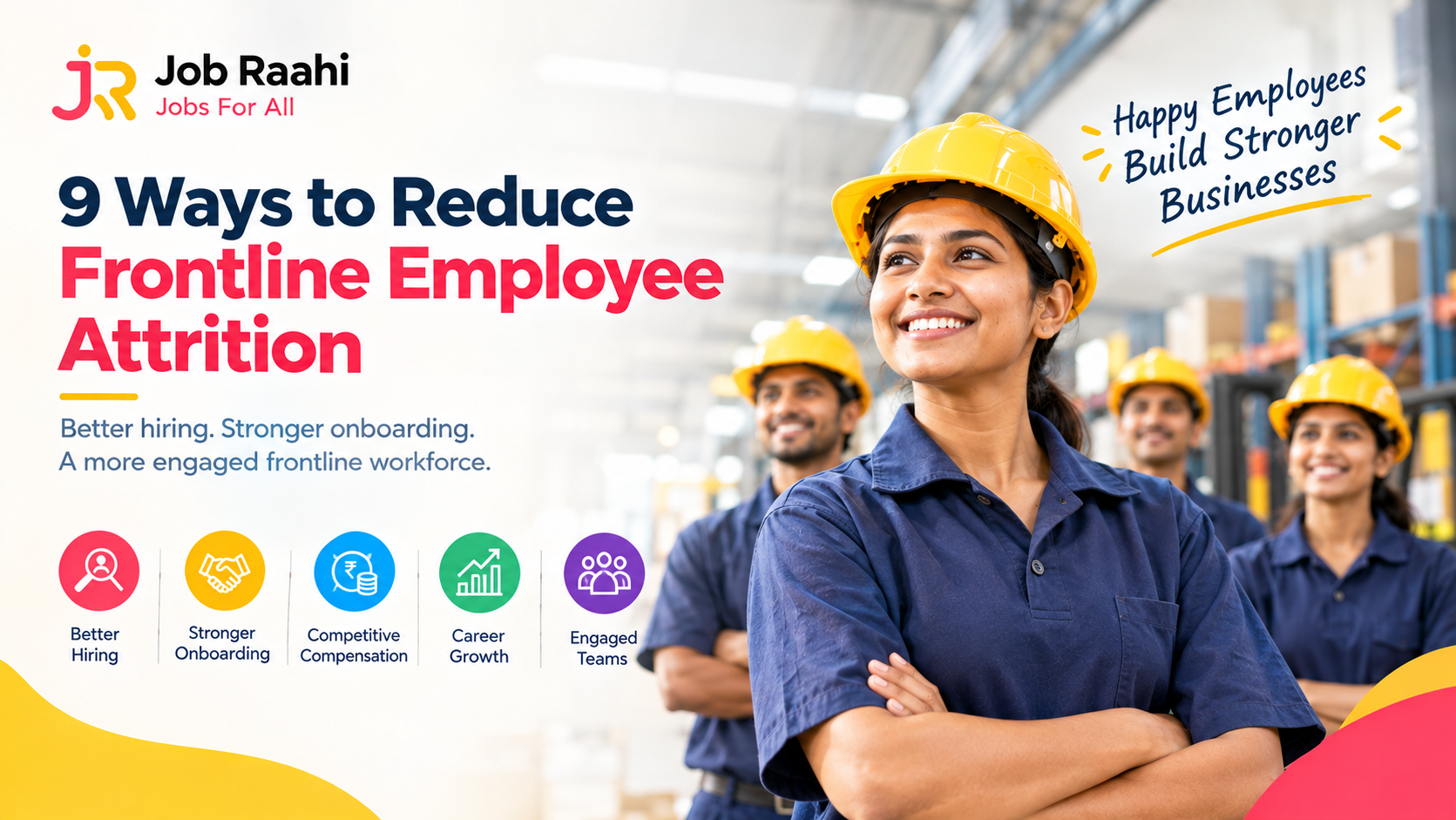
    How Employers Can Reduce High Attrition Rates in Frontline Roles: 9 Practical Strategies

    Frontline employees keep businesses running. From manufacturing operators and warehouse associates to retail staff, delivery teams, security personnel and facility management workers, these employees play a critical role in daily operations.

    Yet, many employers face a persistent challenge: high attrition rates in frontline roles.

    Frequent resignations, absenteeism, early exits and constant replacement hiring can disrupt operations, increase recruitment costs and put additional pressure on existing teams. Hiring more people may appear to be the obvious solution, but sustainable workforce management requires employers to look beyond recruitment numbers.

    The real question is: How can employers attract the right frontline candidates, retain them longer and reduce repeated hiring cycles?

    What Causes High Attrition in Frontline Jobs?

    Before implementing retention measures, employers need to understand why employees leave. Common reasons include:

    • Salary and benefits: Employees may leave for slightly better pay, more reliable incentives or improved benefits elsewhere.
    • Long commutes: Travel time and transportation costs can make a job financially or physically difficult to sustain.
    • Unclear job expectations: Candidates may discover after joining that the actual work, shift timings or responsibilities differ from what they were told.
    • Difficult working conditions: Physically demanding work, inadequate facilities, safety concerns and excessive workloads can affect retention.
    • Limited growth opportunities: Employees may leave when they cannot see a path toward higher pay, supervisory roles or skill development.
    • Poor supervisor relationships: Disrespectful communication, inconsistent instructions or unfair treatment can contribute to resignations.
    • Weak onboarding: Employees who receive little guidance during their first few days may feel overwhelmed and leave early.

    These causes vary across industries and locations. Employers should use exit interviews, attendance records, employee feedback and early-tenure data to identify their specific attrition drivers.

    9 Strategies to Reduce Attrition in Frontline Roles

    1. Hire for Job Fit, Not Just Immediate Availability

    When a large number of vacancies need to be filled quickly, employers may focus primarily on how soon a candidate can join. However, availability alone does not guarantee suitability.

    Recruiters should clearly explain the job responsibilities, salary structure, shift timings, weekly offs, work location, physical requirements and employment conditions before candidates accept an offer.

    This helps candidates make informed decisions and reduces the risk of early exits caused by mismatched expectations.

    Practical tip: Use a standard job briefing checklist so every candidate receives consistent and accurate information before joining.

    2. Recruit Closer to the Workplace

    For many frontline workers, the distance between home and the workplace can influence whether they accept a job and how long they stay.

    Long commutes may increase travel expenses, make shift changes difficult and reduce the attractiveness of an otherwise suitable opportunity.

    Employers can improve workforce stability by building candidate pipelines in nearby communities, industrial areas and residential clusters. For locations with limited public transport, company transport or travel support may also help.

    Hyperlocal recruitment can make it easier to reach candidates who are realistically able to commute to the workplace.

    3. Review Compensation and Incentives

    Employers should periodically compare their compensation with similar jobs in the surrounding area. Even when salaries are competitive, unclear incentives, delayed payments or unexpected deductions can damage employee trust.

    Consider reviewing:

    • Take-home pay after deductions.
    • Attendance and performance incentives.
    • Overtime calculations and payment timelines.
    • Transport, meal and accommodation support where relevant.
    • Pay progression for experienced employees.

    The objective is not necessarily to offer the highest salary in the market. It is to provide a transparent and dependable compensation structure that employees understand and value.

    4. Improve the First 30 Days of Employment

    The initial weeks can strongly influence whether a new frontline employee continues in the role. A worker who feels unsupported, confused or disconnected may leave before becoming comfortable with the job.

    A structured onboarding process should include:

    • A clear explanation of workplace rules and responsibilities.
    • Safety training and role-specific instructions.
    • Introduction to supervisors and team members.
    • Help with attendance systems, payroll processes and shift schedules.
    • Regular check-ins during the first week and first month.

    Assigning a buddy or experienced colleague can also help new employees settle in faster.

    Key metric to track: Early-tenure attrition, especially exits within the first 7, 30 and 90 days.

    5. Train Supervisors to Manage People Better

    Frontline employees often interact with their immediate supervisors more frequently than with HR. As a result, day-to-day management practices can have a major influence on the employee experience.

    Employers should train supervisors to communicate respectfully, explain expectations, resolve concerns fairly and recognise good performance. They should also provide employees with a clear channel to raise grievances without fear of retaliation.

    Regular employee feedback can help HR identify teams or shifts where management practices may be contributing to unusually high attrition.

    6. Make Work Schedules More Predictable

    Unpredictable shifts, last-minute schedule changes and excessive overtime can make it difficult for employees to manage their personal responsibilities.

    Where operationally possible, employers should publish schedules in advance, communicate changes promptly and distribute overtime fairly. They should also monitor excessive workloads and recurring absenteeism rather than treating every absence as an isolated incident.

    For round-the-clock operations, better workforce planning can help maintain staffing levels without placing disproportionate pressure on the same employees.

    7. Create Visible Career Progression

    Frontline jobs should not automatically be treated as short-term positions. Many employees are willing to build long-term careers when they can see a realistic opportunity to progress.

    Employers can create pathways from entry-level roles to senior operator, team leader, technician, quality checker or supervisor positions, depending on the industry.

    Short training programmes, skill certifications, internal promotions and pay increases linked to demonstrated skills can encourage employees to stay and develop within the organisation.

    8. Use Attrition Data to Identify Patterns

    A company-wide attrition percentage may not reveal the real problem. One plant, contractor, shift or job category may account for a disproportionate share of employee exits.

    HR teams should analyse attrition by:

    • Location and business unit.
    • Role and department.
    • Supervisor and shift.
    • Employment type or contractor.
    • Length of service.
    • Recruitment source.
    • Reason for leaving.

    For example, if most exits occur within the first two weeks at one location, the issue may relate to job expectations, onboarding or working conditions rather than the overall recruitment pipeline.

    Use the findings to test targeted improvements and measure whether they reduce exits over time.

    9. Build a More Reliable Recruitment Pipeline

    Retention should be the priority, but employers also need a dependable way to manage unavoidable vacancies. Resignations, seasonal demand and business expansion can still create urgent workforce requirements.

    Instead of restarting recruitment from scratch every time a vacancy opens, employers can maintain a pipeline of screened candidates, build relationships with local talent communities and use recruitment channels suited to frontline workers.

    A more organised pipeline can help employers fill vacancies faster while allowing recruiters to focus on candidate suitability instead of relying entirely on last-minute hiring.

    Digital hiring platforms can support this process by improving vacancy visibility and helping employers reach candidates across relevant locations and job categories.

    Which Attrition Metrics Should Employers Track?

    A practical frontline workforce dashboard should go beyond the total number of resignations.

    MetricWhat it helps employers understand
    Overall attrition rateThe proportion of the workforce leaving during a defined period
    Early-tenure attritionWhether new hires are leaving soon after joining
    Offer-to-joining ratioWhether candidates who accept offers actually join
    Absenteeism ratePatterns that may signal disengagement or operational difficulties
    Vacancy fill timeHow long it takes to replace employees
    30-day and 90-day retentionWhether new employees are staying beyond their initial period
    Exit reasonsThe most common reported reasons employees leave

    A common way to calculate attrition is:

    Attrition rate = (Employees who left during the period ÷ Average number of employees during the period) × 100

    For meaningful comparisons, employers should use a consistent reporting period and clearly define which exits are included. Voluntary resignations, contract completions, layoffs and other separations may need to be tracked separately.

    How Job Raahi Can Support Frontline Hiring

    Reducing attrition requires more than increasing the number of candidates available. Employers need to reach relevant jobseekers, communicate opportunities clearly and maintain a reliable recruitment pipeline.

    Job Raahi supports employers looking to connect with frontline and mass-hiring talent through a digital job platform designed for roles across relevant locations and candidate segments.

    Employers can use the platform to publish vacancies, improve job visibility through recruitment marketing campaigns and reach potential candidates through channels such as WhatsApp, RCS, SMS, email and AI-powered calling, subject to applicable permissions and campaign requirements.

    By combining targeted candidate reach with better job communication and a more organised hiring process, employers can work toward reducing avoidable hiring friction and filling frontline vacancies more efficiently.

    The important distinction: recruitment platforms can help employers reach and hire candidates, but long-term retention also depends on fair compensation, realistic job expectations, good supervision, safe working conditions and opportunities for growth.

    Frequently Asked Questions

    1. What is the main reason for high attrition in frontline jobs?

    There is no single reason across all industries. Compensation, long commutes, difficult working conditions, unpredictable shifts, supervisor relationships and mismatched job expectations can all contribute. Employers should analyse their own workforce data before choosing a solution.

    2. How can employers reduce attrition among new hires?

    Provide accurate job information before joining, simplify onboarding, explain workplace expectations clearly and check in with employees during their first 7, 30 and 90 days.

    3. Does increasing salary always reduce attrition?

    Not necessarily. Competitive and reliable pay matters, but employees may also leave because of commuting difficulties, poor management, unsafe conditions or limited career progression. Employers should address the reasons most relevant to their workforce.

    4. How does hyperlocal hiring help with frontline retention?

    Recruiting candidates who live closer to the workplace may reduce commuting time and travel costs. However, proximity alone does not guarantee retention; job fit, compensation and working conditions remain important.

    5. How can employers manage attrition without constantly increasing recruitment budgets?

    Focus on preventing avoidable exits, improving early-tenure retention, analysing why employees leave and building a reusable candidate pipeline. Reducing repeated replacement hiring can help control recruitment costs over time.

    Conclusion: Retention Starts Before the First Working Day

    High attrition in frontline roles is not simply a recruitment problem. It is a workforce management challenge that spans candidate expectations, compensation, commuting, onboarding, supervision and career development.

    Employers that measure attrition carefully and address its root causes can make better decisions about both retention and recruitment. The goal is not just to fill today’s vacancies, but to build a workforce that is more likely to join, perform and stay.

    Looking to strengthen your frontline hiring pipeline? Explore how Job Raahi can help your organisation reach relevant candidates and manage high-volume recruitment more effectively.

    Recommended External Links

    1. Employee Onboarding Best Practices – SHRM
      Link: https://www.shrm.org/en/topics-tools/topics/onboarding
      Anchor text: employee onboarding best practices
      Place in: Section 4 – Improve the First 30 Days of Employment.
    2. Employee Turnover and Retention Strategies – SHRM
      Link: https://www.shrm.org/topics-tools/news/talent-acquisition/how-to-reduce-employee-turnover-robust-retention-strategies
      Anchor text: strategies to reduce employee turnover
      Place in: Section 8 – Use Attrition Data to Identify Patterns, or the introduction to retention strategies.
    3. Decent Work Country Programme for India 2023–2027 – International Labour Organization (ILO)
      Link: https://www.ilo.org/publications/decent-work-country-programme-india-2023-2027
      Anchor text: improving working conditions and employment quality
      Place in: Section 5 – Train Supervisors to Manage People Better, or Section 6 – Make Work Schedules More Predictable.
    4. Indian Labour Statistics – Labour Bureau, Government of India
      Link: https://labourbureau.gov.in/indian-labour-statistics
      Anchor text: Indian labour-market statistics
      Place in: Section 8 – Use Attrition Data to Identify Patterns.
    5. Decent Work – International Labour Organization (ILO)
      Link: https://www.ilo.org/public/english/decent.htm
      Anchor text: decent work and fair employment practices
      Place in: Section 3 – Review Compensation and Incentives.
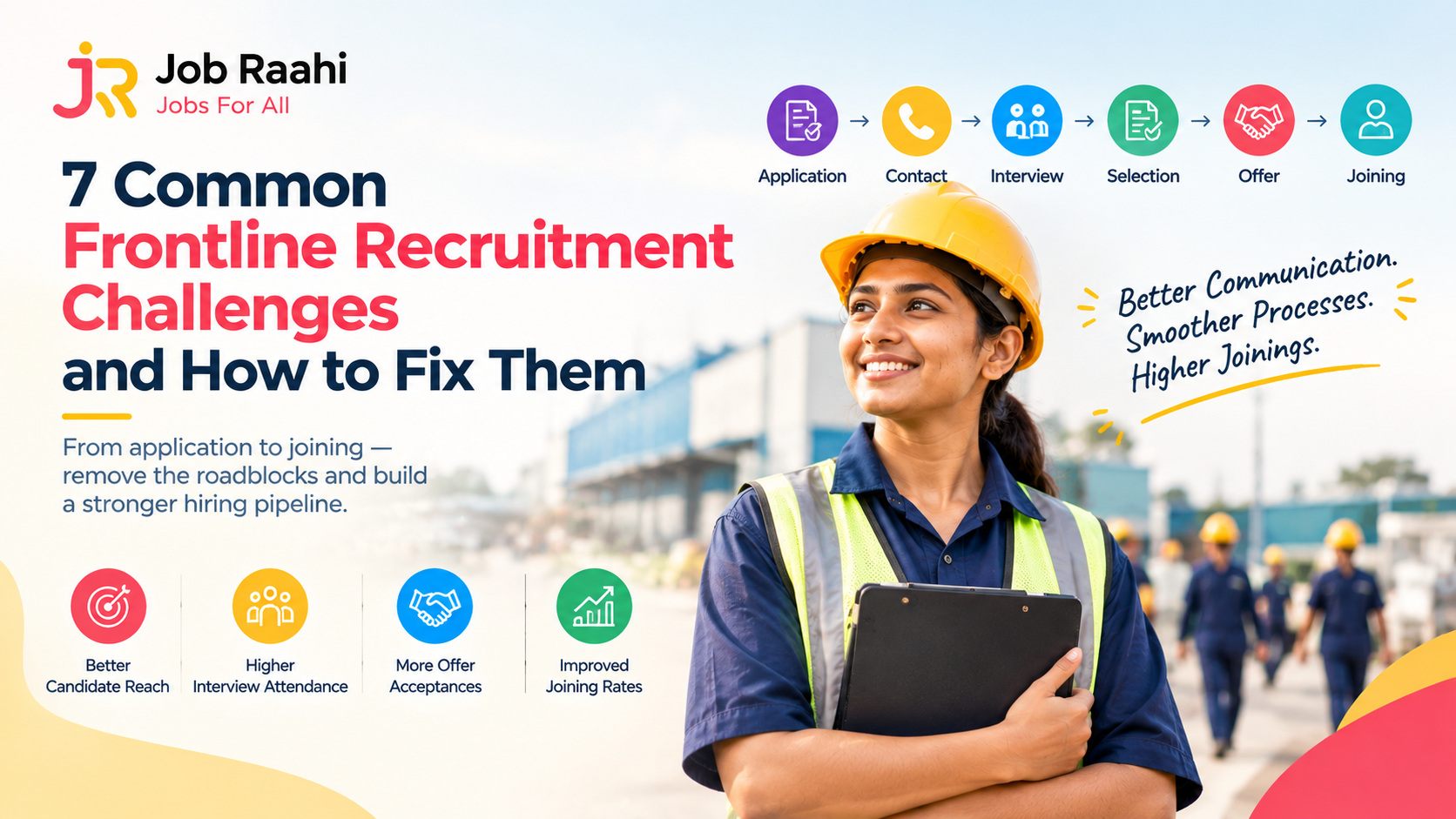
  • The Hiring Handoff Problem: Why Good Candidates Get Lost Between Application and Joining

    The Hiring Handoff Problem: Why Good Candidates Get Lost Between Application and Joining

    A candidate applies. A recruiter calls. An interview is scheduled. The candidate gets selected. And then… silence.

    For employers hiring frontline employees at scale, this situation can feel frustratingly familiar.

    The vacancy is live. Applications are coming in. Recruiters are making calls. Interviews are happening. Yet the final number of employees joining often falls short of the original target.

    Where are the candidates getting lost?

    The answer may not always be sourcing.

    Sometimes, the bigger problem is the handoff between one stage of recruitment and the next.

    At every step, a candidate has to move from interest to action. If that transition breaks down, even a strong sourcing campaign can struggle to deliver the required workforce.

    For frontline, industrial, field and high-volume hiring, understanding these handoffs can help employers build a more reliable recruitment process.

    Table of Contents

    1. What Is the Hiring Handoff Problem?
    2. Why Applications Don’t Automatically Become Hires
    3. The Five Handoffs Where Candidates Can Get Lost
    4. Why Frontline Hiring Needs a Different Approach
    5. Six Ways Employers Can Reduce Candidate Drop-Off
    6. Turn Recruitment Into a Connected Candidate Journey
    7. How Job Raahi Fits Into the Process
    8. Frequently Asked Questions
    9. Build a Stronger Frontline Hiring Pipeline

    1. What Is the Hiring Handoff Problem?

    Recruitment is often managed as a series of separate activities.

    One team attracts candidates. Another screens applications. Recruiters schedule interviews. Hiring managers conduct assessments. HR handles offers and joining formalities.

    Each activity may be working as intended, but the overall hiring process can still lose momentum.

    Consider this example:

    A company needs 200 production associates at a manufacturing facility.

    The job campaign generates applications. Recruiters contact candidates and schedule interviews. A proportion of candidates attend, some are selected, and offers are issued.

    However, several candidates may never attend interviews, some may decline offers, and others may accept but fail to join.

    The original target remains 200, but the recruitment team has to source additional candidates to fill the gap.

    This is the hiring handoff problem: the loss of candidate momentum as people move from discovery to application, screening, interview, selection and joining.

    The solution isn’t necessarily to generate more applications. It is to understand where the process loses candidates and improve those transitions.

    2. Why Applications Don’t Automatically Become Hires

    Application volume is an important metric, but it is only one part of recruitment performance.

    A high application count doesn’t automatically indicate that an employer has a strong hiring pipeline.

    Candidates may apply without fully understanding the role. Some may not meet the requirements. Others may be unreachable, unavailable for interviews or unable to commute to the workplace.

    Some may simply choose another opportunity.

    For frontline recruitment, these factors can become especially important when employers are hiring across multiple locations or filling large numbers of similar positions.

    A more useful way to view recruitment is:

    Candidate Reach → Application → Contact → Qualification → Interview → Selection → Offer → Joining

    Every stage has a conversion rate.

    If a large proportion of candidates disappear at one particular stage, that is where the employer should investigate first.

    3. The Five Handoffs Where Candidates Can Get Lost

    Handoff 1: Job Visibility to Application

    A candidate sees a vacancy but doesn’t apply.

    Possible reasons include unclear salary information, a vague job location, confusing eligibility requirements or an application process that feels too complicated.

    What employers can do: Communicate the role, location, salary range, shift requirements and application steps clearly wherever possible.

    Handoff 2: Application to Recruiter Contact

    A candidate applies, but the recruitment team cannot reach them.

    The candidate may have entered incorrect contact details, become unavailable or received calls at inconvenient times.

    What employers can do: Establish a consistent contact process, verify essential details and make it easy for candidates to respond or request a callback.

    Handoff 3: Contact to Interview

    The candidate is interested but doesn’t attend the interview.

    The location may be inconvenient, the timing may conflict with existing work, or the candidate may not understand what to expect.

    What employers can do: Share interview details early, confirm attendance, provide accurate directions and communicate the process in simple language.

    Handoff 4: Selection to Offer Acceptance

    A candidate is selected but declines the offer.

    Compensation, shift timing, benefits, location or a competing opportunity may influence the decision.

    What employers can do: Explain the complete employment proposition before selection whenever possible, and address important questions before issuing the offer.

    Handoff 5: Offer Acceptance to Joining

    The candidate accepts but doesn’t report on the joining date.

    This can happen when the joining process is unclear, documentation is delayed, communication stops after the offer or the candidate accepts another role.

    What employers can do: Maintain communication between offer acceptance and joining, provide a clear document checklist and confirm the reporting location, time and contact person.

    These are potential causes, not universal explanations. Employers should use their own recruitment data and candidate feedback to identify the actual reasons for drop-off.

    4. Why Frontline Hiring Needs a Different Approach

    For certain frontline roles, candidates may be choosing between multiple nearby opportunities with similar salary ranges.

    They may also need to consider practical factors such as:

    • Daily travel and transport availability
    • Shift schedules
    • Take-home pay
    • Joining timelines
    • Family or personal responsibilities
    • Documentation requirements
    • Reliability of the employer and job information

    A lengthy gap between application and recruiter contact can mean a candidate explores another opportunity. An unclear interview process can make attending feel less worthwhile. Uncertainty about the workplace can create hesitation before joining.

    This is why frontline recruitment requires more than a steady supply of applications.

    It requires clear communication, timely follow-up and a connected candidate journey.

    5. Six Ways Employers Can Reduce Candidate Drop-Off

    1. Treat Every Vacancy as a Complete Hiring Journey

    Before launching recruitment, define what happens after a candidate applies.

    Who contacts the candidate? How quickly should the first attempt happen? Who schedules interviews? Who follows up after selection?

    Clear ownership reduces the chances of candidates getting stuck between teams.

    2. Make Job Information Easy to Understand

    Candidates should be able to understand the essential details without chasing the recruiter for basic information.

    Include the job location, responsibilities, eligibility, compensation details, shift requirements and interview process wherever appropriate.

    Clear information can help candidates make better-informed decisions and improve the relevance of applications.

    3. Build a Consistent Follow-Up Process

    A candidate who doesn’t answer one call isn’t necessarily uninterested.

    Employers can establish reasonable follow-up procedures through appropriate channels, taking candidate consent and communication preferences into account.

    The aim is to make it easy for interested candidates to reconnect without overwhelming them with messages.

    4. Reduce Unnecessary Waiting

    Long gaps between application, screening, interview and offer can create opportunities for candidates to disengage.

    Review how long each stage takes and identify avoidable delays, such as repeated data entry, unclear approvals or limited interview scheduling options.

    A faster process is not about rushing decisions. It is about removing unnecessary friction.

    5. Keep Candidates Informed After Selection

    Communication should not end when the offer is accepted.

    Provide clear joining instructions, required documents, reporting details and a contact person who can resolve questions.

    For large hiring drives, standardised joining communication can help recruiters manage multiple candidates consistently.

    6. Measure Conversion at Every Stage

    Don’t track only the number of applications or vacancies filled.

    Measure the movement between stages:

    • Applications to successful contact
    • Contacted candidates to qualified candidates
    • Qualified candidates to interviews attended
    • Interviews to selections
    • Offers to accepted offers
    • Accepted offers to actual joinings

    Review the figures by role, location and recruitment source.

    This helps identify whether the main challenge is candidate reach, screening, interview attendance, offer acceptance or joining.

    6. Turn Recruitment Into a Connected Candidate Journey

    A recruitment process works best when each stage supports the next.

    Imagine a company hiring field technicians across several districts.

    Instead of running separate, disconnected activities, the employer creates one connected process:

    Step 1: Attract relevant candidates through job listings and targeted promotion.

    Step 2: Capture applications and essential candidate details.

    Step 3: Engage candidates through timely, appropriate communication.

    Step 4: Qualify candidates against the role and location requirements.

    Step 5: Coordinate interviews and assessments.

    Step 6: Convert selected candidates into accepted offers and confirmed joinings.

    Step 7: Learn from candidate drop-off and improve the next hiring cycle.

    The benefit is visibility. Recruitment teams can see not only how many candidates entered the pipeline but also where progress slowed down.

    7. How Job Raahi Fits Into the Process

    Job Raahi focuses on frontline, entry-level, blue-collar, grey-collar, industrial, contractual and high-volume hiring.

    For employers, reaching candidates is an important starting point. But candidate reach becomes more useful when it is connected to a clear recruitment process.

    Job Raahi’s approach combines job posting with job marketing and candidate outreach to help employers promote opportunities to relevant audiences.

    Depending on the campaign and available capabilities, this can include:

    • Job posting: Publish frontline and high-volume vacancies.
    • Candidate reach: Promote opportunities beyond passive job discovery.
    • Digital job marketing: Support vacancy visibility through relevant campaigns.
    • Multi-channel outreach: Use channels such as WhatsApp, RCS, SMS and email where appropriate.
    • Candidate pipeline development: Help employers work towards a more consistent supply of relevant applicants.

    These activities support the earlier stages of the hiring journey. Employers should also establish clear processes for screening, interviews, offer management and joining so that candidate interest can progress through the funnel.

    The underlying principle is simple:

    Generating candidate interest is one part of recruitment. Converting that interest into actual joinings requires a connected process.

    8. Frequently Asked Questions

    What is candidate drop-off in recruitment?

    Candidate drop-off occurs when candidates stop progressing through the recruitment process, such as abandoning an application, missing an interview, declining an offer or not joining after acceptance.

    Why do candidates drop out of frontline hiring processes?

    Potential reasons include unclear job details, inconvenient interview schedules, salary mismatches, transport challenges, competing offers and delayed communication. Employers should examine their own data and candidate feedback rather than assume one cause applies everywhere.

    How can employers improve interview attendance?

    Employers can communicate interview details clearly, confirm attendance, provide accurate directions, offer practical scheduling options where possible and make it easy for candidates to ask questions.

    What recruitment metrics should employers track?

    Useful metrics include successful contact rate, qualification rate, interview attendance, offer acceptance, joining rate and time taken at each recruitment stage.

    How can employers improve joining rates during bulk hiring?

    Start with clear job information, a structured recruitment process, timely follow-ups, transparent offer details and consistent pre-joining communication. Analyse results by role and location to identify the biggest sources of drop-off.

    9. Build a Stronger Frontline Hiring Pipeline

    A recruitment campaign can generate hundreds or thousands of applications and still fall short of its workforce target.

    The difference often lies in what happens after the candidate enters the pipeline.

    Employers need to understand where candidates disengage, reduce avoidable delays and connect sourcing, communication, interviews, offers and joining into one coherent process.

    At Job Raahi, we believe frontline hiring should move beyond simply publishing vacancies. Employers need practical ways to reach relevant candidates and build stronger hiring pipelines.

    We Don’t Just List Your Jobs. We Market Them.

    And the next step is making sure the right candidates can move from discovering an opportunity to taking it.


    External Resources

    For further reading on employment, workforce development and India’s labour market:

  • Your Job Vacancy Is Competing for Attention: Why Employers Need Job Marketing, Not Just Job Posting

    Your Job Vacancy Is Competing for Attention: Why Employers Need Job Marketing, Not Just Job Posting

    A job vacancy can be perfectly written.

    The salary can be competitive.

    The company can be well known.

    The role can have an immediate joining requirement.

    And yet, the right candidates may never apply.

    Why?

    Because a vacancy cannot hire someone if the candidate never sees it.

    This is one of the biggest challenges employers face in today’s competitive hiring environment, particularly when recruiting for frontline, blue-collar, grey-collar, industrial, field and high-volume roles.

    For years, recruitment has largely followed a simple model:

    Create Job → Post Job → Wait for Applications

    But candidate behaviour has changed.

    Today, a job vacancy is competing for attention with:

    • Other job vacancies
    • Social media content
    • WhatsApp messages
    • Recruiter calls
    • Local employment opportunities
    • Gig work
    • Referrals
    • Offline hiring campaigns
    • Multiple employers hiring for similar roles

    The question is no longer simply:

    “Where should we post the job?”

    The better question is:

    “How do we make sure the right candidates actually see, understand and consider this opportunity?”

    That is where job vacancy marketing comes in.


    What Is Job Vacancy Marketing?

    Job vacancy marketing is the process of actively promoting a job opportunity to relevant candidates instead of relying only on candidates discovering the vacancy on a job portal.

    Think about the difference between:

    Job Posting

    “We have a vacancy. Here it is.”

    and:

    Job Marketing

    “We have a vacancy, and we’re going to actively take this opportunity to the candidates who are most likely to be interested.”

    The second approach treats a job vacancy more like a candidate acquisition campaign.

    The objective is not simply to publish.

    The objective is to create:

    Awareness → Interest → Application → Engagement → Hiring


    Why Job Posting Alone Is No Longer Enough

    Posting a vacancy is important.

    But posting doesn’t guarantee visibility.

    Imagine a company publishes a job for:

    Production Operator — Noida

    At the same time, hundreds of other jobs may be available for:

    • Machine Operators
    • Warehouse Associates
    • Technicians
    • Delivery Executives
    • Sales Executives
    • Field Staff
    • Production Workers

    The candidate now has choices.

    Your vacancy isn’t competing only with other companies.

    It is competing for candidate attention.

    This is particularly important for employers recruiting at scale.

    When you need:

    10 people, passive applications may sometimes be enough.

    When you need:

    100, 500 or 1,000 people across locations, relying only on organic job discovery can become limiting.


    A Vacancy Has a Distribution Problem

    Recruiters often focus heavily on the quality of the job description.

    That’s important.

    But another question deserves equal attention:

    How far did the vacancy travel?

    Consider two employers.

    Employer A

    Posts a job on a platform and waits.

    Employer B

    Posts the job and actively promotes it through:

    • Candidate databases
    • WhatsApp
    • RCS
    • SMS
    • Email
    • Social media
    • Digital campaigns
    • Calling
    • Location-based targeting

    Both employers have a vacancy.

    But their candidate distribution strategy is completely different.

    This is the difference between:

    Job Publishing

    and

    Job Distribution.


    The Difference Between Job Posting and Job Marketing

    Job PostingJob Marketing
    Publish vacancyPromote vacancy
    Wait for discoveryActively create reach
    One primary channelMultiple channels
    Candidate comes to jobJob goes to candidate
    Focus on applicationsFocus on candidate acquisition
    Often reactiveCan be proactive
    Vacancy-centricCandidate-centric
    Limited campaign thinkingContinuous campaign approach

    Neither approach eliminates the need for the other.

    A strong recruitment strategy can use both.

    Posting creates the opportunity.

    Marketing creates visibility.


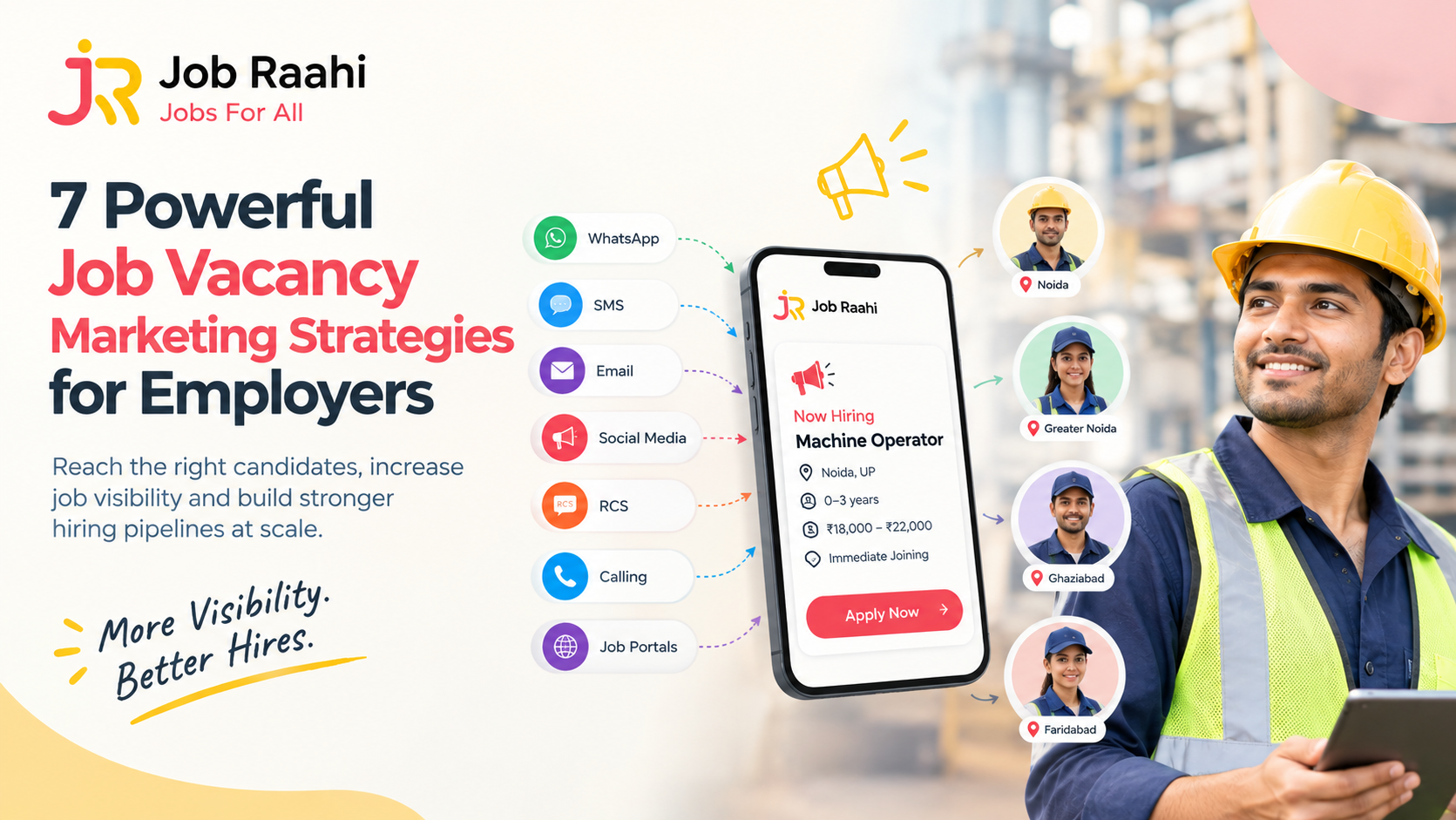
    7 Ways Employers Can Market Their Job Vacancies

    1. Reach the Right Candidate Segment

    More reach doesn’t necessarily mean better hiring.

    If a company needs:

    ITI Electricians in Haridwar

    reaching thousands of unrelated candidates doesn’t solve the problem.

    The employer needs relevant candidates based on:

    • Location
    • Qualification
    • Experience
    • Role
    • Availability
    • Salary expectations
    • Industry experience

    This is why candidate segmentation is becoming increasingly important in high-volume recruitment.

    The goal isn’t:

    Reach everyone.

    It’s:

    Reach more of the right people.


    2. Make the Job Discoverable

    A candidate cannot apply for a vacancy they never discover.

    Employers should therefore think about the different ways candidates can encounter a job opportunity.

    For example:

    Job Platform

    ↓

    WhatsApp

    ↓

    RCS

    ↓

    SMS

    ↓

    Social Media

    ↓

    Digital Campaign

    ↓

    Recruiter Outreach

    ↓

    Candidate Referral

    A multi-channel approach can increase the number of opportunities for relevant candidates to discover the vacancy.


    3. Localise the Recruitment Message

    A generic job advertisement may say:

    “Hiring Field Executives.”

    A more targeted message could say:

    Hiring Field Executives in Meerut — Immediate Joining

    Or:

    10 Technician Jobs Near Rudrapur — Apply Now

    The second message immediately answers an important candidate question:

    Where is the job?

    For frontline hiring, location can be one of the strongest elements of a recruitment message.

    That makes localised job marketing particularly useful.


    4. Repeat the Opportunity

    One social post doesn’t create a recruitment campaign.

    One SMS doesn’t create a recruitment campaign.

    One WhatsApp message doesn’t create a recruitment campaign.

    Candidates may miss messages.

    They may not be looking for a job that day.

    They may see the vacancy but not apply immediately.

    They may become available later.

    This means recruitment campaigns can benefit from consistent candidate communication, while respecting appropriate consent, frequency and communication practices.

    The objective is not to spam candidates.

    It is to ensure that relevant opportunities remain discoverable.


    5. Build Campaigns Around Hiring Requirements

    Instead of thinking:

    “We have 100 vacancies.”

    think:

    “We have a 30-day hiring campaign.”

    For example:

    Campaign

    Requirement: 100 Production Operators

    Location: Greater Noida

    Duration: 30 Days

    Target: Relevant frontline candidates

    Channels:

    • Job platform
    • WhatsApp
    • SMS
    • Social media
    • Candidate database
    • Recruiter outreach

    Goal:
    Build sufficient qualified candidates to achieve the joining target.

    This changes the recruitment mindset from vacancy management to candidate acquisition.


    6. Use Job Marketing for Difficult Locations

    Some recruitment markets are naturally more challenging.

    Examples include:

    • Remote industrial locations
    • Smaller cities
    • Tier 2 markets
    • Tier 3 markets
    • Hinterlands
    • New facility locations
    • Locations with limited candidate awareness

    In these markets, simply posting the job may not be enough.

    Employers may need to actively introduce the opportunity to the local talent market.

    This can involve:

    Local targeting + digital reach + candidate databases + direct engagement.


    7. Turn Hiring Data Into Better Campaigns

    Job marketing can also create useful recruitment intelligence.

    Suppose a company runs campaigns in three locations.

    Location A

    High reach → High applications → High interview conversion

    Location B

    High reach → High applications → Low joining

    Location C

    Low reach → Low applications → High joining conversion

    The recruitment team now has something valuable:

    Data about how different hiring markets behave.

    Over time, employers can use this information to improve:

    • Candidate targeting
    • Messaging
    • Channels
    • Hiring radius
    • Campaign timing
    • Recruitment budgets
    • Candidate engagement

    Turn Every Hiring Requirement Into a Recruitment Campaign

    A vacancy shouldn’t always be treated as an isolated event.

    Consider a company that regularly hires:

    Technicians

    Sales Executives

    Production Operators

    Customer Service Associates

    Instead of restarting the recruitment process every time, the employer can build ongoing candidate communities around these requirements.

    For example:

    Technician Talent Pool

    Location: North India

    Experience: 0–3 years

    Qualification: ITI / Diploma

    Availability: Actively looking

    Then every new technician requirement can potentially activate an existing candidate pipeline.

    This creates a more sustainable approach to high-volume hiring.


    How Job Raahi Approaches Employer Hiring

    Job Raahi is built around a simple idea:

    We Don’t Just List Your Jobs. We Market Them.

    For employers hiring frontline and high-volume workforces, Job Raahi combines job publishing with candidate reach and digital amplification.

    This can include:

    Unlimited Job Posting

    Employers can publish multiple frontline opportunities.

    Candidate Database

    Access relevant candidate pools for hiring requirements.

    Hyperlocal Candidate Reach

    Reach candidates around specific hiring markets.

    Social Media Promotion

    Promote relevant vacancies through targeted digital campaigns.

    WhatsApp

    Use WhatsApp-based candidate communication and outreach.

    RCS Business Messaging

    Deliver richer recruitment communication where appropriate.

    SMS

    Reach candidates through direct messaging.

    Email Campaigns

    Use email as another candidate acquisition channel.

    AI-Powered Calling

    Support candidate engagement and outreach at scale.

    The objective is not to add more complexity to recruitment.

    It is to create more ways for the right candidate to discover the opportunity.


    The Job Marketing Funnel

    A recruitment campaign can be viewed as a funnel:

    1. Reach

    How many relevant candidates can we reach?

    ↓

    2. Awareness

    How many candidates notice the opportunity?

    ↓

    3. Interest

    How many candidates consider the job?

    ↓

    4. Application

    How many apply?

    ↓

    5. Engagement

    How many respond or engage with the recruiter?

    ↓

    6. Interview

    How many attend?

    ↓

    7. Selection

    How many are selected?

    ↓

    8. Joining

    How many actually join?

    This creates a much broader view of recruitment performance.


    Why This Matters for High-Volume Hiring

    Imagine an employer needs:

    500 frontline employees.

    The traditional approach may be:

    Post 500 jobs → Wait → Screen applications → Repeat

    A recruitment marketing approach can be:

    Define requirement

    ↓

    Identify target markets

    ↓

    Create job campaigns

    ↓

    Reach relevant candidates

    ↓

    Capture applications

    ↓

    Engage candidates

    ↓

    Build candidate pipeline

    ↓

    Convert candidates into hires

    ↓

    Retarget the remaining talent pool for future requirements

    The second approach is designed around continuous candidate acquisition rather than one-time vacancy publishing.


    From Vacancy Posting to Candidate Acquisition

    This is the larger shift happening in recruitment.

    Employers are moving from:

    “Where can I post this vacancy?”

    towards:

    “How can I acquire the right candidates for this requirement?”

    That shift is particularly important for:

    • Frontline hiring
    • Blue-collar recruitment
    • Grey-collar hiring
    • Industrial hiring
    • Field workforce hiring
    • Bulk recruitment
    • High-volume hiring
    • Multi-location recruitment

    Because in these hiring environments, the challenge isn’t always the absence of jobs.

    Sometimes, the challenge is connecting the job with the right candidate at the right time.


    The Future of Recruitment Is Distribution

    The companies that build strong recruitment engines will not necessarily be the companies that post the most jobs.

    They may be the companies that become better at:

    Finding candidates

    Reaching candidates

    Engaging candidates

    Building candidate pools

    Reactivating talent

    Converting candidates into hires

    In other words:

    Recruitment is increasingly becoming a distribution problem.

    And solving distribution requires more than a job board.

    It requires a candidate acquisition strategy.


    Frequently Asked Questions

    What is job vacancy marketing?

    Job vacancy marketing is the active promotion of job opportunities to relevant candidates through multiple channels instead of relying only on passive job posting.

    How is job marketing different from job posting?

    Job posting publishes a vacancy. Job marketing actively promotes the vacancy to increase relevant candidate awareness, reach and engagement.

    Why is job marketing important for frontline hiring?

    Frontline employers often recruit large numbers of candidates across multiple locations. Active job marketing can help increase visibility and reach relevant candidate segments.

    What channels can employers use for job marketing?

    Depending on the recruitment strategy, employers can use job platforms, social media, WhatsApp, RCS, SMS, email, digital campaigns, candidate databases and recruiter outreach.

    Can job marketing support bulk hiring?

    Yes. Job marketing can be structured into campaigns around specific roles, locations, candidate segments and hiring timelines.

    How does Job Raahi market jobs?

    Job Raahi combines job posting with candidate reach, digital promotion, hyperlocal targeting, candidate databases and multi-channel outreach to help employers promote their hiring requirements.


    Your Vacancy Deserves More Than a Listing

    Your hiring team spends time creating the JD.

    Your business has a genuine requirement.

    The position is open.

    The salary is approved.

    The hiring manager is ready.

    But none of that matters if the right candidate never sees the opportunity.

    That’s why employers need to think beyond:

    “Where should I post this job?”

    and start thinking:

    “How should I market this job?”

    At Job Raahi, that’s exactly where we want to make a difference.

    We Don’t Just List Your Jobs. We Market Them.

    External Resources

    For additional insights into recruitment, employment trends, digital skills and India’s changing workforce landscape:

    • International Labour Organization (ILO) — Research and reports on employment, labour markets and workforce trends: International Labour Organization
    • India Employment Report 2024 — Insights into India’s youth employment, education and skills landscape: India Employment Report 2024
    • Ministry of Labour & Employment, Government of India — Employment policies, labour-market initiatives and workforce information: Ministry of Labour & Employment
    • Ministry of Statistics and Programme Implementation (MoSPI) — Employment and labour-force data through the Periodic Labour Force Survey: MoSPI – PLFS Data
    • Skill India Digital — Government platform focused on skills, training and employment opportunities: Skill India Digital
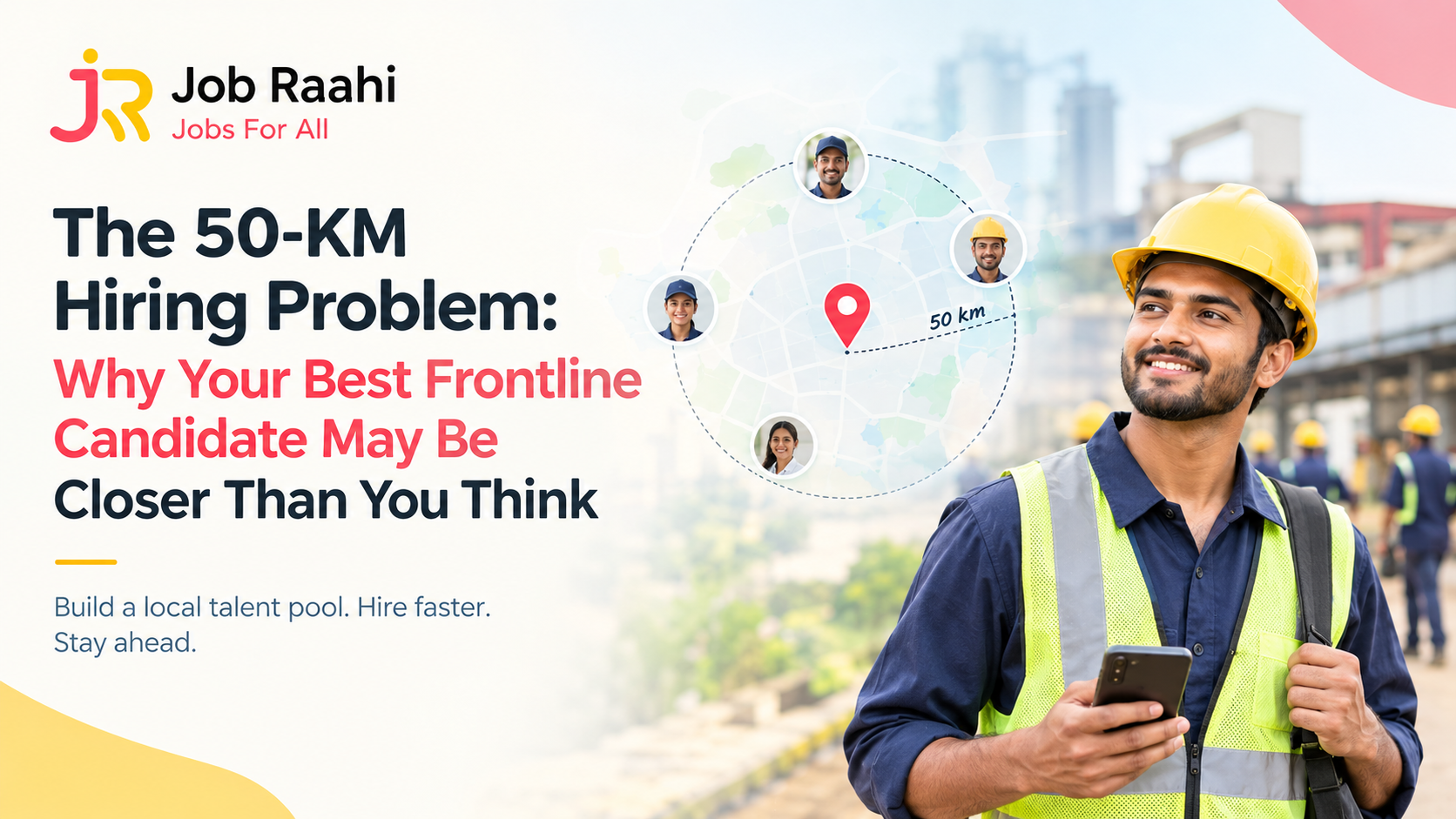
  • The 50-KM Hiring Problem: Why Your Best Frontline Candidate May Be Closer Than You Think

    The 50-KM Hiring Problem: Why Your Best Frontline Candidate May Be Closer Than You Think

    What if the problem with your frontline hiring isn’t a shortage of candidates?

    What if the problem is that you’re looking in the wrong places?

    A manufacturing company may have 100 open positions.

    A telecom company may need technicians across multiple districts.

    A retail chain may be opening stores in smaller cities.

    A logistics company may need warehouse workers around a new hub.

    The conventional response is often:

    Post the jobs. Increase the sourcing. Get more applications.

    But there is another question employers should be asking:

    Where are the candidates who can actually work at this location?

    For many frontline roles, geography isn’t just a recruitment parameter.

    Geography is part of the candidate profile.

    A candidate who lives 8 km from the workplace can sometimes be more relevant than a candidate with identical qualifications who lives 80 km away.

    This is the local talent pool problem.

    And solving it can change the way companies approach frontline hiring.


    What Is a Local Talent Pool?

    A local talent pool is a group of potential candidates who live within a practical geographic area around a job location and match the employer’s requirements.

    Instead of thinking:

    “We need 500 candidates for this role.”

    an employer can think:

    “We need 50 relevant candidates within the hiring radius of this location.”

    Then repeat the process across every location.

    For example:

    Requirement

    500 Field Technicians

    Instead of treating this as one national vacancy:

    500 Candidates → India

    the employer could structure it as:

    50 Candidates → Location A

    75 Candidates → Location B

    40 Candidates → Location C

    60 Candidates → Location D

    and so on.

    This creates a much more granular local hiring strategy.


    Why Distance Matters in Frontline Hiring

    For many corporate roles, relocation is relatively common.

    For frontline roles, it can be a completely different story.

    A candidate may consider:

    • Daily commute
    • Transportation costs
    • Shift timings
    • Family responsibilities
    • Local transportation availability
    • Workplace accessibility
    • Working hours
    • Take-home salary

    This means two candidates with identical qualifications may not have identical hiring relevance.

    Consider:

    Candidate A

    Lives 6 km from the workplace.

    Candidate B

    Lives 65 km from the workplace.

    Both have the same qualification.

    Both have similar experience.

    Both accept the salary.

    But Candidate A may have a significantly easier commute.

    This is why location-based recruitment deserves more attention in frontline hiring.


    The Hidden Cost of Hiring From Too Far Away

    Distance can create friction throughout the recruitment lifecycle.

    During sourcing

    The candidate may apply but later reject the location.

    During interviews

    The candidate may be less willing to travel for an interview.

    During joining

    The candidate may accept another nearby opportunity.

    After joining

    Long commutes can affect employee satisfaction and attendance.

    During replacement hiring

    The employer may have to restart the sourcing process.

    This doesn’t mean local candidates will always have better retention or joining rates.

    But it does mean location deserves to be considered much earlier in the recruitment funnel.


    The 50-KM Hiring Problem

    Let’s imagine a company opens a manufacturing facility.

    The HR team needs:

    100 machine operators.

    The company posts the jobs across a major job portal.

    Applications start coming in from:

    • Delhi
    • Noida
    • Ghaziabad
    • Meerut
    • Jaipur
    • Lucknow
    • Other states

    The application count looks impressive.

    But the plant is located in a specific industrial area.

    The real hiring market may be much smaller:

    People who are qualified + available + willing to commute to the plant.

    This is where the concept of a hiring radius becomes powerful.

    Instead of asking:

    “How many people applied?”

    ask:

    “How many relevant candidates are available within our practical hiring market?”

    That is a much more useful employer question.


    8 Smart Ways to Build a Local Talent Pool

    1. Map the Hiring Radius Before You Start Recruiting

    Before launching a high-volume recruitment campaign, define the geographic market.

    Consider:

    • Workplace location
    • Nearby towns
    • Nearby districts
    • Public transport
    • Employee transportation
    • Typical commuting patterns
    • Shift timings
    • Candidate availability

    A hiring radius doesn’t necessarily have to be a fixed number such as 50 km.

    For one role, 10 km may be appropriate.

    For another, 30 km may be practical.

    For specialized technicians, the radius could be much larger.

    The important thing is to make location part of the recruitment strategy from day one.


    2. Divide Large Requirements Into Local Markets

    Large recruitment requirements can become easier to manage when divided geographically.

    Imagine:

    1,000 frontline vacancies

    across

    20 locations.

    Instead of running one giant campaign, employers can create:

    20 local hiring campaigns.

    Each campaign can have its own:

    • Candidate pool
    • Hiring target
    • Recruitment message
    • Candidate outreach
    • Progress tracking
    • Joining target

    This provides greater visibility into where hiring is actually working.


    3. Segment Candidates Beyond Job Titles

    A candidate database shouldn’t only say:

    “Machine Operator.”

    The employer needs more context.

    A useful frontline candidate profile can include:

    Role

    Location

    Skill

    Experience

    Availability

    Salary expectation

    Preferred work location

    For example:

    ITI Machine Operator | 2 Years Experience | Rudrapur | Available in 15 Days | ₹18–22K

    This is significantly more actionable than:

    Machine Operator | 2 Years

    The more useful the segmentation, the easier it becomes to activate the right candidate pool.


    4. Market Jobs Where Candidates Actually Are

    A job vacancy has little value if the relevant candidates never see it.

    This is especially important in:

    • Tier 2 cities
    • Tier 3 cities
    • Industrial clusters
    • Smaller towns
    • District markets
    • Hinterlands

    Employers should think about candidate distribution, not just job distribution.

    That can include:

    • Job portals
    • WhatsApp
    • RCS
    • SMS
    • Email
    • Digital campaigns
    • Candidate databases
    • AI-powered calling

    The objective is simple:

    Put the opportunity in front of the right candidate segment.


    5. Build Talent Pools Before Vacancies Become Urgent

    This is where recruitment can shift from reactive to proactive.

    Suppose a telecom company knows it will regularly require field technicians across North India.

    It doesn’t need to start from zero every time.

    It can continuously build pools of:

    Technicians

    Installers

    Field Executives

    Sales Employees

    Customer Service Associates

    across relevant locations.

    Then, when a new requirement opens, the employer already has a starting point.

    This is the difference between:

    Sourcing after demand

    and

    Building supply before demand.


    6. Create a Reusable Local Candidate Pipeline

    A candidate who wasn’t selected today doesn’t necessarily become irrelevant forever.

    Maybe:

    • The candidate was unavailable.
    • The salary wasn’t suitable.
    • The role was filled.
    • The location wasn’t suitable.
    • The candidate was not selected for that particular position.

    Six months later, circumstances may change.

    A reusable local talent pool allows employers to maintain access to previously engaged candidates, subject to candidate preferences and applicable data practices.

    This can reduce the need to rebuild the entire pipeline every time a similar vacancy opens.


    7. Use Multiple Candidate-Reach Channels

    Different candidate segments respond differently to different channels.

    One candidate may discover a job through a job portal.

    Another may respond to WhatsApp.

    Another may notice a digital campaign.

    Another may respond to an SMS.

    Another may engage after a phone call.

    This is why multi-channel candidate outreach can be particularly valuable for high-volume frontline hiring.

    Job Raahi can help employers amplify opportunities through channels such as:

    WhatsApp

    RCS Business Messaging

    SMS

    Email

    Digital Campaigns

    AI-Powered Calling

    The objective isn’t simply to communicate more.

    It’s to reach relevant candidates through the channels where they are more likely to engage.


    8. Measure Your Hiring Market by Market

    One of the biggest advantages of a localized recruitment strategy is better visibility.

    Instead of looking at:

    Total Applications: 10,000

    employers can look at:

    LocationApplicationsInterviewsSelectionsJoining
    Location A1,2001807052
    Location B9001405541
    Location C6001104839
    Location D1,5001304021

    Suddenly, the recruitment problem becomes clearer.

    Location D may be generating lots of applications but fewer joiners.

    Location C may be generating fewer applications but better conversion.

    This is local talent intelligence.

    And it can help recruiters decide where to increase sourcing effort.


    How Job Raahi Can Help Employers

    Job Raahi is designed around the challenges of frontline, entry-level, blue-collar, grey-collar, industrial and high-volume hiring.

    The platform can support employers looking to build local talent pools across India’s diverse hiring markets.

    The approach combines:

    Hyperlocal Candidate Reach

    Reach relevant candidates around specific hiring locations.

    Candidate Segmentation

    Organize candidate pools based on role, skill, location and other relevant parameters.

    Job Marketing

    Don’t simply list the vacancy.

    Actively promote it to relevant candidate segments.

    Multi-Channel Outreach

    Use WhatsApp, RCS, SMS, email and other digital channels to amplify opportunities.

    AI-Powered Candidate Engagement

    Support candidate outreach and initial engagement at scale.

    Talent Pipeline Building

    Build candidate pools that can support both current and future requirements.


    The Local Talent Flywheel

    The real opportunity isn’t just building one candidate pool.

    It’s creating a local talent flywheel.

    Here’s how it works:

    Step 1

    Identify the hiring market.

    ↓

    Step 2

    Understand the local candidate profile.

    ↓

    Step 3

    Reach relevant candidates.

    ↓

    Step 4

    Build the candidate pool.

    ↓

    Step 5

    Hire from the pool.

    ↓

    Step 6

    Continue engaging the market.

    ↓

    Step 7

    Reuse and expand the pipeline for future hiring.

    ↓

    Step 8

    Build deeper talent access in that location.

    Over time, the employer becomes better positioned to hire in that market.

    The recruitment process gets smarter with every hiring cycle.


    Industries That Can Benefit From Local Talent Pools

    A local talent strategy can be useful across industries.

    Manufacturing

    • Machine operators
    • Production workers
    • Quality inspectors
    • Maintenance technicians
    • Assembly workers

    Telecom

    • Field technicians
    • Installation teams
    • Field executives
    • Sales representatives

    Retail

    • Store associates
    • Sales employees
    • Customer service associates

    Logistics

    • Warehouse workers
    • Delivery executives
    • Operations employees

    Infrastructure

    • Electricians
    • Technicians
    • Site employees
    • Field workers

    Healthcare

    • Support staff
    • Field workers
    • Operations employees

    Hospitality

    • Housekeeping
    • Service staff
    • Front office
    • Kitchen staff

    BFSI

    • Field executives
    • Sales officers
    • Customer-facing employees

    The roles vary.

    The recruitment principle remains the same:

    Build access to the right talent where the work happens.


    From National Hiring to Local Talent Intelligence

    India has a huge workforce.

    But employers don’t hire India.

    They hire people for:

    A location

    A role

    A shift

    A salary

    A skill requirement

    A joining timeline

    That means the real recruitment market is often much smaller than the national candidate pool.

    The future of frontline recruitment may therefore not be about having access to the largest possible database.

    It may be about having access to the most relevant candidate pool for each requirement.

    That’s a very different proposition.


    Why This Matters for Employers

    Imagine your recruitment team receives:

    5,000 applications.

    It sounds impressive.

    But imagine instead having:

    500 relevant candidates

    who match:

    • Location
    • Role
    • Skills
    • Experience
    • Availability

    The second number may actually be more valuable.

    Because recruitment isn’t a competition to collect applications.

    It’s a process of finding people who can actually join.


    The Job Raahi Approach

    At Job Raahi, we believe frontline hiring needs to move beyond:

    Post → Wait → Screen

    towards:

    Identify → Reach → Engage → Build → Hire → Reuse

    That’s why Job Raahi focuses on building a stronger connection between employers and frontline talent across India’s cities, towns, industrial clusters and hinterlands.

    We Don’t Just List Your Jobs. We Market Them.

    And increasingly, the question we’re helping employers solve is not:

    “Where can I post this job?”

    It’s:

    “Where is my next candidate likely to come from?”


    Frequently Asked Questions

    What is a local talent pool?

    A local talent pool is a group of potential candidates located within a practical geographic area around a job location and relevant to the employer’s hiring requirements.

    Why is a local talent pool important for frontline hiring?

    Many frontline jobs are location-dependent. Building a local candidate pool can help employers reach people who may be better positioned to commute and join the workplace.

    What is hyperlocal recruitment?

    Hyperlocal recruitment focuses on sourcing and engaging candidates within specific cities, towns, districts or geographic markets around a job location.

    How can companies build a local talent pool?

    Companies can map their hiring radius, segment candidates by location and skill, market jobs locally, use multiple outreach channels and continuously maintain candidate pipelines.

    Can local talent pools support bulk hiring?

    Yes. Large requirements can be divided into individual local hiring markets, allowing recruiters to build and activate candidate pools for each location.

    Can Job Raahi help companies build local talent pools?

    Job Raahi is designed to support frontline, blue-collar, grey-collar, industrial and high-volume hiring through job postings, candidate reach, digital job marketing, multi-channel outreach and talent pipeline building.


    Build Your Local Talent Pool With Job Raahi

    Your next great frontline candidate may not be thousands of kilometres away.

    They may be:

    15 km away.

    20 km away.

    In the next town.

    In the next district.

    The challenge is finding them, reaching them and building a relationship with that talent market before the next urgent vacancy arrives.

    That’s where local talent pools become powerful.

    Job Raahi helps employers move towards a more localized, scalable approach to frontline recruitment by combining:

    Hyperlocal candidate reach

    Candidate segmentation

    Digital job marketing

    Multi-channel outreach

    AI-powered engagement

    Talent pipeline building

    Because the future of frontline hiring isn’t necessarily about finding candidates everywhere.

    It’s about finding the right candidates where the work happens.

    Job Raahi — We Don’t Just List Your Jobs. We Market Them.

    External Resources

  • Learning Vocational Skills and Building careers.

    Learning Vocational Skills and Building careers.

    Starting a career can feel confusing, especially when you are a fresher.

    You may have completed your 10th or 12th, finished a course, or simply be looking for your first opportunity. You may also come across job descriptions asking for experience when you have barely had the chance to gain any.

    The good news is that a career does not have to begin with a big designation or a traditional office job.

    Sometimes, it starts with learning a practical skill, finding the right opportunity and getting your first real work experience.

    This is where vocational courses and blue-collar jobs can make a real difference.

    Skills Can Open the Door to Opportunity

    Education gives us knowledge, but practical skills help us understand how that knowledge can be used at work.

    That is the basic idea behind vocational training.

    Vocational courses are designed around specific skills and occupations. Instead of only focusing on theory, they give candidates an opportunity to learn things that are directly connected to the workplace.

    For example, someone interested in logistics can learn about warehouse operations, inventory handling, order processing and basic safety practices.

    Career in Logistics and warehousing Industry.

    Someone interested in retail can develop customer handling, billing, product management and store operation skills.

    Retail Training

    Similarly, candidates can explore vocational training related to hospitality, manufacturing, technical services, sales and several other industries.

    The important part is choosing a skill that matches both your interest and the demand in the job market.

    Blue-Collar Jobs Are More Than Just a First Job

    There is still a common perception that blue-collar jobs are only temporary jobs or something people take up when they cannot find other opportunities.

    That view is changing.

    Blue-collar and frontline workers are an essential part of almost every industry. Think about the people working in warehouses, stores, factories, hotels, delivery operations, service centres and field operations.

    Behind every product reaching a customer and every service being delivered, there are people doing important work on the ground.

    For many young candidates, these jobs can also become the starting point of a career.

    A person may begin as a warehouse associate and gradually take on more responsibilities. A retail associate can move into a senior role and eventually manage store operations. Someone starting in a technical or field role can build experience and develop specialised skills over time.

    Of course, growth looks different for everyone. But the first opportunity gives you something extremely valuable — real-world experience.

    Vocational Courses Can Make Candidates More Job-Ready

    One of the biggest advantages of vocational education is its practical approach.

    Imagine two candidates applying for an entry-level warehouse position. Both are freshers. But one has already received basic training in warehouse processes and understands how inventory and order handling work.

    That candidate may have a better understanding of what the job involves even before joining.

    This does not guarantee employment, of course. But being familiar with the basics can make the transition from learning to working much easier.

    Vocational training can help candidates build:

    • Practical, job-related skills
    • Basic industry knowledge
    • Workplace awareness
    • Communication skills
    • Problem-solving abilities
    • Confidence in performing tasks
    • Understanding of workplace discipline and safety

    And sometimes, that confidence matters more than we realise.

    There Are Many Career Options to Explore

    Another positive thing about vocational education is that candidates are not restricted to one type of career. Different industries need different kinds of skilled workers.

    Logistics and warehousing offer opportunities in warehouse operations, inventory, picking, packing and order fulfilment. Retail provides roles involving customers, store operations, sales and product management. Hospitality has opportunities across hotels, restaurants and other service businesses. Manufacturing needs people with practical and technical knowledge to support production and operations. Sales and field operations can be suitable for candidates who enjoy interacting with people and working outside a traditional office environment. Technical services can provide opportunities for people who prefer hands-on work and want to build specialised expertise.

    There is no single definition of a successful career.

    For one person, it may mean working in a store. For another, it could mean becoming a skilled technician. Someone else may want to grow in logistics and eventually manage a team.

    The important thing is finding a direction that works for you.

    Hospitality Training

    What Should You Look for in a Vocational Course?

    Choosing a vocational course should not be an impulsive decision. Before enrolling, take some time to ask a few simple questions:

    What will I actually learn?

    Look beyond the course name. Understand the practical skills and knowledge you will gain.

    Is there demand for this skill?

    A course becomes more useful when it prepares you for roles that companies are actually hiring for.

    Will I get practical exposure?

    Hands-on learning can make a big difference, particularly for operational and technical roles.

    What opportunities can I explore after completing it?

    Try to understand the types of jobs, industries and career paths connected to the course.

    Does the training also focus on soft skills?

    Communication, punctuality, teamwork and basic workplace behaviour are important in almost every job.

    A good vocational course should ideally help you become more confident about entering the workplace — not just help you collect a certificate.

    Your First Job Can Be the Beginning of Something Bigger

    There is a lot of pressure on young people to get the “perfect” first job. But the truth is, most careers do not follow a perfectly straight path. Your first job may teach you things you never learned in a classroom.

    You may learn how to communicate with customers. You may learn how to work with a team. You may understand how businesses actually operate. You may make mistakes, learn from them and gradually become better at what you do.

    That experience stays with you.

    A blue-collar or frontline job can therefore be more than just a source of income. It can help you understand your strengths, develop professional habits and discover what kind of work you enjoy. Once you have experience, your next opportunity can look very different from your first.

    Skills + Opportunity = A Stronger Start

    Vocational training and employment should not be looked at as two separate things. Training can help a candidate become better prepared.

    A job gives the candidate an opportunity to apply those skills. Experience then helps the candidate improve further.

    It becomes a cycle:

    Learn → Get an Opportunity → Gain Experience → Build Skills → Grow

    This is particularly important for freshers who are trying to enter the workforce for the first time.

    The journey may take time, and there may be challenges along the way. But every new skill and every experience can add something to the career you are building.

    The Future Belongs to Skilled Workers

    India’s workforce is changing, and practical skills are becoming increasingly important across industries. Companies need people who can do the work, understand their responsibilities and adapt to changing requirements.

    At the same time, young people need accessible pathways that help them move from education and training into employment. Vocational courses can be an important part of that journey.

    And blue-collar jobs can provide the real-world platform where those skills are put into action.

    A Career Starts with One Opportunity

    You don’t need to have your entire career figured out on day one. Sometimes, you just need the right skill, the right opportunity and the willingness to learn.

    A vocational course can help you build the skill. A blue-collar or frontline job can give you the opportunity to use it.

    And with experience, learning and consistency, that first opportunity can become the foundation for something much bigger.

    Your first job is not the destination. It can be the first step towards the career you want to build.

  • Blue Collar Jobs in India

    Blue Collar Jobs

    Blue Collar Jobs are in high demand in India, with thousands of verified job openings available for blue collar workers. Furthermore, the country is experiencing a significant surge in the growth of various industries, leading to an increase in Blue Collar Jobs. Additionally, the government is taking initiatives to promote Blue Collar Jobs in India, providing numerous opportunities for blue collar workers to find employment.

    What are Blue Collar Jobs

    Blue Collar Jobs refer to occupations that involve manual labor, technical skills, and often require vocational training or on-the-job experience. For instance, electricians, fitters, welders, and machine operators are all examples of blue collar workers. Moreover, these jobs are essential to the functioning of various industries, including manufacturing, construction, and logistics.

    Blue Collar Jobs

    Characteristics of Blue Collar Jobs

    Some common characteristics of Blue Collar Jobs include physical labor, technical skills, and a strong work ethic. Consequently, blue collar workers are in high demand, and their skills are highly valued by employers. Additionally, many Blue Collar Jobs offer opportunities for career advancement and professional growth.

    Benefits of Blue Collar Jobs

    There are several benefits to pursuing Blue Collar Jobs, including job security, competitive salaries, and opportunities for career growth. Furthermore, many blue collar workers take pride in their work, knowing that they are contributing to the development of their country. Moreover, Blue Collar Jobs can be highly rewarding, both financially and personally.

    Advantages of Blue Collar Employment

    Some advantages of Blue Collar Jobs include flexibility, variety, and autonomy. For example, many blue collar workers have the opportunity to work on different projects, travel to new locations, and develop new skills. Additionally, Blue Collar Jobs often offer a sense of camaraderie and teamwork, as workers collaborate to achieve common goals.

    Types of Blue Collar Jobs

    There are many types of Blue Collar Jobs available, including jobs in manufacturing, construction, logistics, and healthcare. Moreover, the National Career Service and the Ministry of Skill Development offer training and certification programs for blue collar workers. Additionally, the Job Raahi Blog provides information and resources on various Blue Collar Jobs.

    Examples of Blue Collar Jobs

    Some examples of Blue Collar Jobs include:

    • Factory workers
    • Warehouse workers
    • Drivers
    • Electricians
    • Fitters
    • Welders

    How to Find Blue Collar Jobs

    Finding Blue Collar Jobs can be challenging, but there are several resources available to help. For instance, the Job Raahi platform offers a wide range of verified job openings for blue collar workers. Moreover, the download Job Raahi app provides access to job listings, career advice, and training resources.

    Job Search Strategies

    Some effective job search strategies for Blue Collar Jobs include:

    1. Networking with other blue collar workers
    2. Utilizing online job boards and platforms
    3. Reaching out to recruitment agencies
    4. Attending job fairs and industry events
    5. Creating a strong resume and cover letter
    Job Title Industry Location Salary
    Machine Operator Manufacturing Mumbai 25000
    Electrician Construction Delhi 30000
    Warehouse Worker Logistics Bengaluru 20000
    Fitter Automotive Chennai 28000

    Blue Collar Jobs and Career Growth

    Blue Collar Jobs can offer opportunities for career growth and professional development. Furthermore, many blue collar workers can advance to supervisory or management positions with experience and training. Moreover, Blue Collar Jobs can provide a sense of job security and stability, as well as competitive salaries and benefits.

    Conclusion

    In conclusion, Blue Collar Jobs are in high demand in India, and there are many resources available to help blue collar workers find employment. Therefore, we encourage all blue collar job seekers to download Job Raahi app and start their job search today.

    Sources and References

    Some useful sources and references for Blue Collar Jobs include:

  • Streamlining Volume Hiring for Manufacturing Firms with Efficient Strategies

    Streamlining Volume Hiring for Manufacturing Firms with Efficient Strategies

    volume hiring

    Volume hiring is a crucial aspect of manufacturing recruitment, as it enables companies to fill multiple job openings quickly and efficiently. In the manufacturing sector, bulk hiring is often necessary to meet production demands, and an efficient hiring process can make all the difference in reducing costs and improving productivity. However, managing a large number of candidates and vacancies can be a daunting task, which is why it is essential to implement efficient strategies for volume hiring. In this article, we will explore the importance of streamlining volume hiring for manufacturing firms and provide tips on how to achieve it.

    Challenges in Volume Hiring

    Manufacturing recruitment involves a unique set of challenges, particularly when it comes to volume hiring. One of the main difficulties is the high volume of applications that need to be processed, which can be time-consuming and labor-intensive. Moreover, the hiring process for manufacturing jobs often requires a specific set of skills and qualifications, making it essential to have a well-structured recruitment strategy in place. The lack of efficient hiring processes can lead to delays, increased costs, and a negative impact on the overall productivity of the company. To overcome these challenges, manufacturing firms need to adopt efficient hiring solutions that can streamline the recruitment process and improve hiring efficiency.

    Importance of Efficient Hiring Processes

    Efficient hiring processes are critical in volume hiring, as they enable companies to quickly identify and select the best candidates for the job. A well-structured recruitment strategy can help manufacturing firms reduce the time-to-hire, lower recruitment costs, and improve the overall quality of hires. Moreover, efficient hiring processes can also enhance the candidate experience, which is essential for building a positive employer brand and attracting top talent in the industry. According to the International Labour Organization (ILO), efficient hiring processes can also contribute to improved job satisfaction and reduced employee turnover rates.

    Strategies for Streamlining Volume Hiring

    To streamline volume hiring, manufacturing firms can implement several strategies that can improve the efficiency of the recruitment process. Some of these strategies include:

    • Defining clear job requirements and qualifications to attract the right candidates
    • Utilizing digital recruitment channels, such as job portals and social media, to reach a wider audience
    • Implementing automated recruitment tools, such as applicant tracking systems (ATS), to streamline the application process
    • Developing a structured interview process to assess candidate skills and qualifications
    • Providing a positive candidate experience through timely communication and feedback

    These strategies can help manufacturing firms improve their hiring efficiency, reduce costs, and enhance the overall quality of hires. Additionally, companies can also leverage the expertise of recruitment agencies or job portals, such as Job Raahi, to streamline their volume hiring processes.

    Role of Technology in Volume Hiring

    Technology plays a vital role in streamlining volume hiring, as it enables companies to automate many aspects of the recruitment process. From applicant tracking systems to video interviewing tools, technology can help manufacturing firms reduce the time-to-hire, lower recruitment costs, and improve the overall efficiency of the hiring process. Moreover, technology can also provide valuable insights into the recruitment process, enabling companies to make data-driven decisions and optimize their recruitment strategies. According to the National Skill Development Corporation (NSDC), technology can also help address the skills gap in the manufacturing sector by providing access to online training and development programs.

    Best Practices for Manufacturing Recruitment

    To achieve efficient volume hiring, manufacturing firms should adopt best practices that can improve the recruitment process. Some of these best practices include:

    1. Developing a comprehensive recruitment strategy that aligns with business objectives
    2. Building a strong employer brand to attract top talent in the industry
    3. Utilizing data analytics to optimize recruitment processes and improve hiring efficiency
    4. Providing ongoing training and development opportunities to enhance employee skills and productivity
    5. Encouraging employee referrals and internal mobility to reduce recruitment costs and improve job satisfaction

    By adopting these best practices, manufacturing firms can improve their recruitment processes, reduce costs, and enhance the overall quality of hires. For more information on manufacturing recruitment and volume hiring, visit Job Raahi’s blog for expert insights and advice.

    Conclusion

    Streamlining volume hiring is essential for manufacturing firms to reduce costs, improve productivity, and enhance the overall quality of hires. By implementing efficient strategies, leveraging technology, and adopting best practices, companies can improve their recruitment processes and achieve their business objectives. To learn more about volume hiring and manufacturing recruitment, visit Job Raahi’s blog for expert insights and advice. You can also explore the Ministry of Skill Development and Entrepreneurship website for information on government initiatives and programs that support skills development and employment in the manufacturing sector.

    Sources and References

  • Exploring Career Options After ITI Courses in India 2026

    Exploring Career Options After ITI Courses in India 2026

    ITI Courses

    ITI Courses in India have been a cornerstone of technical education, providing students with the necessary skills and knowledge to pursue a wide range of career options. The Indian government has been actively promoting vocational training and industrial training through various initiatives, including the establishment of the Ministry of Skill Development and Entrepreneurship. As a result, the demand for skilled workers in various industries has increased, making ITI Courses an attractive option for students looking to enhance their job prospects.

    Introduction to ITI Courses

    ITI Courses in India are designed to provide students with practical skills and knowledge in a specific trade or vocation. These courses are typically one or two years in duration and are offered in a variety of fields, including engineering, electronics, and hospitality. The primary objective of ITI Courses is to equip students with the necessary skills and knowledge to secure employment in their chosen field. With the Indian government’s emphasis on skill development, ITI Courses have become an essential part of the country’s vocational training landscape.

    Benefits of ITI Courses

    There are several benefits to pursuing ITI Courses in India. Firstly, these courses provide students with hands-on experience and practical skills, making them more employable in their chosen field. Secondly, ITI Courses are typically shorter in duration than traditional degree programs, allowing students to enter the workforce sooner. Finally, ITI Courses are often more affordable than traditional degree programs, making them an attractive option for students from lower-income backgrounds. According to the National Skill Development Corporation (NSDC), ITI Courses have been successful in providing students with the necessary skills and knowledge to secure employment in various industries.

    Career Options after ITI Courses

    There are a wide range of career options available to students after completing ITI Courses in India. Some of the most popular career options include:

    • Technical jobs in industries such as manufacturing, construction, and automotive
    • Employment in the hospitality and tourism industry
    • Jobs in the electronics and telecommunications sector
    • Opportunities in the renewable energy sector
    • Career advancement opportunities in the government sector

    Students can also pursue further education and training after completing their ITI Course, including diploma and degree programs. For example, students who complete an ITI Course in engineering can pursue a diploma in engineering or a degree in engineering. According to the International Labour Organization (ILO), vocational training and technical education are essential for promoting employment and economic growth.

    Job Opportunities after ITI Courses

    The job opportunities available to students after completing ITI Courses in India are diverse and varied. Many companies, including leading Indian companies, recruit students who have completed ITI Courses. Students can also search for job openings on government job portals and private job portals. Additionally, many companies provide on-the-job training and apprenticeships to students who have completed ITI Courses, allowing them to gain practical experience and skills in their chosen field.

    Conclusion

    In conclusion, ITI Courses in India provide students with a wide range of career options and job opportunities. With the Indian government’s emphasis on skill development and vocational training, ITI Courses have become an essential part of the country’s education landscape. Students who are interested in pursuing ITI Courses can visit Job Raahi’s website for more information and resources on ITI Courses and career options after ITI. By pursuing ITI Courses, students can enhance their job prospects and contribute to the growth and development of the Indian economy. To learn more about ITI Courses and career options, visit https://blog.jobraahi.com/ today.

    Sources and References

    The following sources were used to research and write this article:

  • Exploring Career Options After ITI Courses in India 2026

    Exploring Career Options After ITI Courses in India 2026

    ITI courses

    ITI courses have become a popular choice among students in India, offering a range of vocational training and technical education options. With the increasing demand for skilled workers in various industries, ITI courses have emerged as a preferred pathway for students seeking career guidance and job opportunities. In this article, we will explore the various career options available to students after completing ITI courses in India.

    Introduction to ITI Courses

    ITI courses, also known as Industrial Training Institute courses, are designed to provide students with technical skills and knowledge in a specific trade or vocation. These courses are typically one or two years in duration and are offered in a range of fields, including engineering, electronics, and hospitality. The primary objective of ITI courses is to equip students with the necessary skills and training to secure blue-collar jobs in their chosen field.

    Benefits of ITI Courses

    ITI courses offer several benefits to students, including the opportunity to acquire technical skills and knowledge in a specific trade or vocation. These courses are also designed to provide students with practical experience and hands-on training, which is essential for securing job opportunities in the industry. Additionally, ITI courses are recognized by the National Council for Vocational Training (NCVT) and the State Council for Vocational Training (SCVT), which ensures that students receive a nationally recognized certification upon completion of their course.

    Career Options After ITI Courses

    There are numerous career options available to students after completing ITI courses in India. Some of the most popular career options include:

    • Electrician: ITI students who have completed a course in electrical engineering can pursue a career as an electrician, working on the installation, maintenance, and repair of electrical systems.
    • Fitter: Students who have completed a course in fitting can work as a fitter, responsible for the assembly and maintenance of machinery and equipment.
    • Welder: ITI students who have completed a course in welding can pursue a career as a welder, working on the fabrication and repair of metal components.
    • Automotive Technician: Students who have completed a course in automotive engineering can work as an automotive technician, responsible for the maintenance and repair of vehicles.

    These are just a few examples of the many career options available to ITI students. With the increasing demand for skilled workers in various industries, the job opportunities for ITI students are vast and varied.

    Grey-Collar Workers

    Grey-collar workers are a new and emerging category of workers who possess a combination of technical and administrative skills. ITI students who have completed courses in fields such as hospitality, tourism, and healthcare can pursue careers as grey-collar workers, working in roles such as customer service representatives, medical assistants, and hospitality managers. According to the International Labour Organization (ILO), grey-collar workers are in high demand globally, with many industries seeking workers who possess a combination of technical and administrative skills.

    Job Opportunities and Career Guidance

    ITI students can access a range of job opportunities and career guidance through various channels, including job portals, career counseling services, and industry associations. Job Raahi is a leading job portal for blue-collar workers in India, providing ITI students with access to a range of job opportunities and career guidance. The National Skill Development Corporation (NSDC) is another organization that provides career guidance and job opportunities to ITI students, working to promote skill development and vocational training in India.

    Government Initiatives

    The Indian government has launched several initiatives to promote vocational training and technical education in the country. The Ministry of Skill Development and Entrepreneurship is responsible for promoting skill development and vocational training in India, working to provide career guidance and job opportunities to ITI students. The government has also established the National Council for Vocational Training (NCVT), which is responsible for recognizing and certifying vocational training programs in India.

    Conclusion

    ITI courses offer a range of career options and job opportunities to students in India. With the increasing demand for skilled workers in various industries, ITI students can pursue careers in fields such as engineering, electronics, and hospitality. For more information on ITI courses and career options, visit https://blog.jobraahi.com and explore the various resources and job opportunities available. You can also read more about career guidance and job opportunities on our blog.

    Sources and References