Starting a career can feel confusing, especially when you are a fresher.
You may have completed your 10th or 12th, finished a course, or simply be looking for your first opportunity. You may also come across job descriptions asking for experience when you have barely had the chance to gain any.
The good news is that a career does not have to begin with a big designation or a traditional office job.
Sometimes, it starts with learning a practical skill, finding the right opportunity and getting your first real work experience.
This is where vocational courses and blue-collar jobs can make a real difference.
Skills Can Open the Door to Opportunity
Education gives us knowledge, but practical skills help us understand how that knowledge can be used at work.
That is the basic idea behind vocational training.
Vocational courses are designed around specific skills and occupations. Instead of only focusing on theory, they give candidates an opportunity to learn things that are directly connected to the workplace.
For example, someone interested in logistics can learn about warehouse operations, inventory handling, order processing and basic safety practices.

Someone interested in retail can develop customer handling, billing, product management and store operation skills.
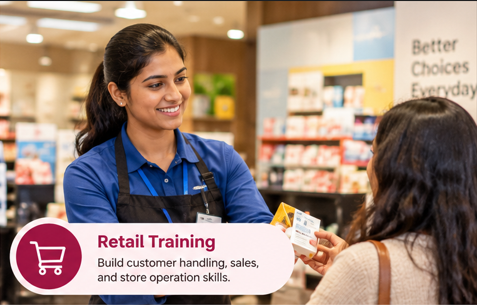
Similarly, candidates can explore vocational training related to hospitality, manufacturing, technical services, sales and several other industries.
The important part is choosing a skill that matches both your interest and the demand in the job market.
Blue-Collar Jobs Are More Than Just a First Job
There is still a common perception that blue-collar jobs are only temporary jobs or something people take up when they cannot find other opportunities.
That view is changing.
Blue-collar and frontline workers are an essential part of almost every industry. Think about the people working in warehouses, stores, factories, hotels, delivery operations, service centres and field operations.
Behind every product reaching a customer and every service being delivered, there are people doing important work on the ground.
For many young candidates, these jobs can also become the starting point of a career.
A person may begin as a warehouse associate and gradually take on more responsibilities. A retail associate can move into a senior role and eventually manage store operations. Someone starting in a technical or field role can build experience and develop specialised skills over time.
Of course, growth looks different for everyone. But the first opportunity gives you something extremely valuable — real-world experience.
Vocational Courses Can Make Candidates More Job-Ready
One of the biggest advantages of vocational education is its practical approach.
Imagine two candidates applying for an entry-level warehouse position. Both are freshers. But one has already received basic training in warehouse processes and understands how inventory and order handling work.
That candidate may have a better understanding of what the job involves even before joining.
This does not guarantee employment, of course. But being familiar with the basics can make the transition from learning to working much easier.
Vocational training can help candidates build:
- Practical, job-related skills
- Basic industry knowledge
- Workplace awareness
- Communication skills
- Problem-solving abilities
- Confidence in performing tasks
- Understanding of workplace discipline and safety
And sometimes, that confidence matters more than we realise.
There Are Many Career Options to Explore
Another positive thing about vocational education is that candidates are not restricted to one type of career. Different industries need different kinds of skilled workers.
Logistics and warehousing offer opportunities in warehouse operations, inventory, picking, packing and order fulfilment. Retail provides roles involving customers, store operations, sales and product management. Hospitality has opportunities across hotels, restaurants and other service businesses. Manufacturing needs people with practical and technical knowledge to support production and operations. Sales and field operations can be suitable for candidates who enjoy interacting with people and working outside a traditional office environment. Technical services can provide opportunities for people who prefer hands-on work and want to build specialised expertise.
There is no single definition of a successful career.
For one person, it may mean working in a store. For another, it could mean becoming a skilled technician. Someone else may want to grow in logistics and eventually manage a team.
The important thing is finding a direction that works for you.

What Should You Look for in a Vocational Course?
Choosing a vocational course should not be an impulsive decision. Before enrolling, take some time to ask a few simple questions:
What will I actually learn?
Look beyond the course name. Understand the practical skills and knowledge you will gain.
Is there demand for this skill?
A course becomes more useful when it prepares you for roles that companies are actually hiring for.
Will I get practical exposure?
Hands-on learning can make a big difference, particularly for operational and technical roles.
What opportunities can I explore after completing it?
Try to understand the types of jobs, industries and career paths connected to the course.
Does the training also focus on soft skills?
Communication, punctuality, teamwork and basic workplace behaviour are important in almost every job.
A good vocational course should ideally help you become more confident about entering the workplace — not just help you collect a certificate.
Your First Job Can Be the Beginning of Something Bigger
There is a lot of pressure on young people to get the “perfect” first job. But the truth is, most careers do not follow a perfectly straight path. Your first job may teach you things you never learned in a classroom.
You may learn how to communicate with customers. You may learn how to work with a team. You may understand how businesses actually operate. You may make mistakes, learn from them and gradually become better at what you do.
That experience stays with you.
A blue-collar or frontline job can therefore be more than just a source of income. It can help you understand your strengths, develop professional habits and discover what kind of work you enjoy. Once you have experience, your next opportunity can look very different from your first.
Skills + Opportunity = A Stronger Start
Vocational training and employment should not be looked at as two separate things. Training can help a candidate become better prepared.
A job gives the candidate an opportunity to apply those skills. Experience then helps the candidate improve further.
It becomes a cycle:
Learn → Get an Opportunity → Gain Experience → Build Skills → Grow
This is particularly important for freshers who are trying to enter the workforce for the first time.
The journey may take time, and there may be challenges along the way. But every new skill and every experience can add something to the career you are building.
The Future Belongs to Skilled Workers
India’s workforce is changing, and practical skills are becoming increasingly important across industries. Companies need people who can do the work, understand their responsibilities and adapt to changing requirements.
At the same time, young people need accessible pathways that help them move from education and training into employment. Vocational courses can be an important part of that journey.
And blue-collar jobs can provide the real-world platform where those skills are put into action.
A Career Starts with One Opportunity
You don’t need to have your entire career figured out on day one. Sometimes, you just need the right skill, the right opportunity and the willingness to learn.
A vocational course can help you build the skill. A blue-collar or frontline job can give you the opportunity to use it.
And with experience, learning and consistency, that first opportunity can become the foundation for something much bigger.
Your first job is not the destination. It can be the first step towards the career you want to build.