Imagine a company that needs to hire 100 employees this month. A few months later, its requirement increases to 300 employees across multiple locations.
Does the company need to increase its recruitment team threefold to manage this growth?
Not necessarily.
Traditional recruitment models often depend heavily on individual recruiters managing vacancies, sourcing candidates, conducting follow-ups and coordinating interviews. As hiring requirements increase, the workload grows, and organisations may respond by adding more recruiters.
But this approach has limitations. Increasing team size also increases coordination requirements, operational costs and management complexity.
Businesses today need a different way of thinking about recruitment: building the capacity to hire more people without increasing internal recruitment resources at the same rate.
This is particularly important for industries such as retail, logistics, warehousing, manufacturing, hospitality and customer support, where hiring requirements can change quickly and vacancies may need to be filled across multiple locations.
The solution lies in developing a more scalable talent acquisition operating model.
1. Why Traditional Recruitment Models Struggle to Scale
Recruitment is often managed through a relatively straightforward structure: a vacancy is assigned to a recruiter, the recruiter sources candidates, conducts initial screening, coordinates interviews and follows up until the position is filled.

A. Increasing Workload Per Recruiter
When the number of vacancies increases, recruiters have to manage more applications, calls, interviews and follow-ups.
Without efficient processes, important activities can get delayed, affecting the overall hiring timeline.
B. Repetitive Recruitment Activities
A significant amount of recruitment time is spent on recurring activities such as sharing job details, collecting candidate information, checking basic eligibility and coordinating interview schedules.
When these activities are handled manually for every vacancy, the recruitment process becomes difficult to scale.
C. Limited Sourcing Capacity
Depending on a small number of sourcing channels can restrict access to candidates.
This becomes particularly challenging when companies are hiring for different locations, educational backgrounds and experience levels.
D. Coordination Across Multiple Locations
High-volume hiring often involves multiple branches, warehouses, factories or retail outlets.
Recruitment teams must coordinate with local managers, understand location-specific requirements and ensure that candidates are available for the required positions.
E. Difficulty Tracking Hiring Performance
When recruitment activities are spread across different people and channels, it can become difficult to identify which sources are delivering relevant candidates and where candidates are dropping out.
These challenges show that recruitment capacity cannot depend only on the number of people working in the HR team.
2. What Does Scaling Hiring Without Scaling Teams Mean?
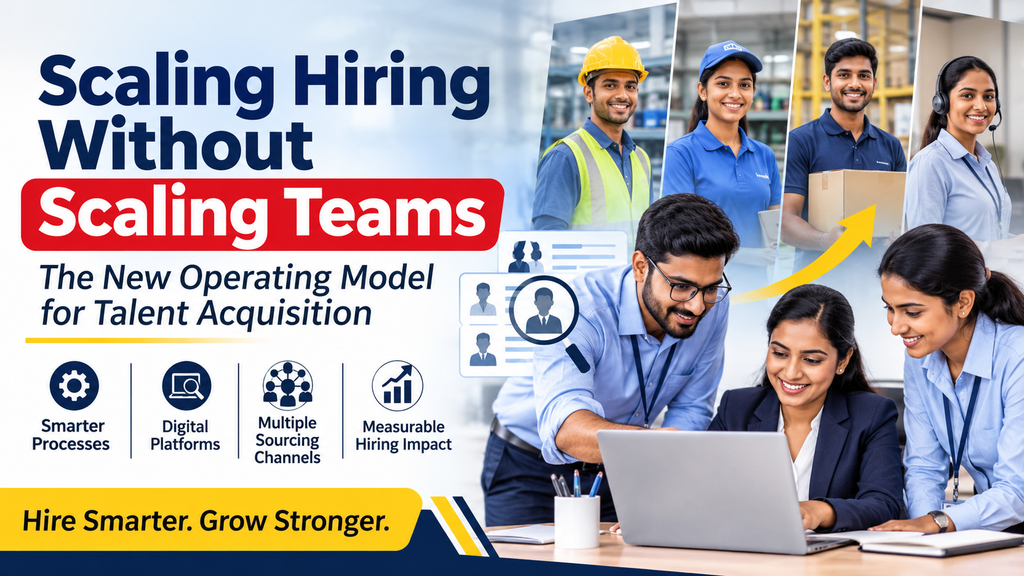
Scaling hiring without scaling teams means increasing recruitment output without increasing the internal recruitment workforce at the same rate.
It does not mean expecting recruiters to work longer hours or handle unlimited vacancies.
Instead, it involves redesigning the recruitment process so that repetitive activities are reduced, sourcing capacity improves and responsibilities are distributed more effectively.
For example, instead of assigning every activity to an internal recruiter, a company can:
- Standardise job descriptions and eligibility requirements.
- Build multiple candidate sourcing channels.
- Use digital job platforms to expand candidate reach.
- Create consistent screening and interview processes.
- Improve coordination between HR teams and hiring managers.
- Track recruitment performance through defined metrics.
The objective is to allow a relatively stable recruitment team to manage changing hiring volumes through better systems and processes.
3. The New Operating Model for Talent Acquisition
A scalable talent acquisition model requires more than adopting new recruitment software. It needs a clear structure that connects workforce planning, sourcing, screening, selection and joining.
Here are six important components.
A. Centralised Workforce Planning
Recruitment should begin with a clear understanding of business requirements.
Instead of handling every vacancy as an independent request, organisations should consolidate hiring needs across departments and locations.
For example, a logistics company planning to hire warehouse associates across five locations should identify:
- Total number of vacancies.
- Location-wise hiring requirements.
- Educational qualifications.
- Required experience, if any.
- Salary and shift details.
- Expected joining timelines.
This allows the recruitment team to plan sourcing activities in advance rather than responding to every requirement at the last moment.
B. Standardised Job Requirements
Repeatedly creating new job descriptions and screening criteria for similar positions wastes time.
Companies can develop standard job templates for frequently hired roles such as:
- Warehouse associates
- Pickers and packers
- Retail associates
- Delivery executives
- Production assistants
- Customer support executives
- Field sales executives
Standardisation helps recruiters understand the requirements quickly and communicate consistent information to candidates.
It also makes it easier to compare candidates against the same eligibility criteria.
C. Multiple Sourcing Channels
A scalable recruitment model should not depend entirely on one source of candidates.
Businesses can build a sourcing ecosystem that includes:
- Digital job portals.
- Employee referrals.
- ITI and vocational institutes.
- Campus and local hiring drives.
- Community-based outreach.
- Recruitment partners, where appropriate.
- Existing candidate databases.
Different channels can serve different hiring requirements.
The important thing is to understand which channels deliver relevant applicants and which are suitable for specific roles.
D. Clear Distribution of Responsibilities
One of the biggest opportunities to improve recruitment efficiency is to ensure that every activity has clear ownership.
A possible operating structure could look like this:
| Function | Primary Responsibility |
|---|---|
| HR / Talent Acquisition Lead | Workforce planning, hiring priorities and performance monitoring |
| Recruiters | Candidate screening, interviews and selection coordination |
| Hiring Managers | Role requirements, technical evaluation and final selection |
| Sourcing Channels | Expanding candidate reach and generating applications |
| Operations Teams | Joining coordination and initial workplace onboarding |
This structure helps prevent recruitment teams from becoming responsible for every activity in the hiring process.
E. Digital Recruitment Platforms
Digital platforms can support recruitment by making job opportunities accessible to a wider candidate base.
Instead of depending exclusively on manual outreach, employers can publish vacancies through online job platforms and allow interested candidates to discover and apply for relevant positions.
For frontline and mass hiring, this can be especially useful when companies need candidates with different educational backgrounds, experience levels and location preferences.
Job platforms can complement existing recruitment channels rather than necessarily replacing them.
F. Structured Follow-Up and Joining Coordination
Recruitment does not end when a candidate is selected.
Candidates may drop out between application, interview, selection and joining because of unclear communication, salary expectations, location issues or delays.
A scalable operating model should therefore include:
- Timely interview communication.
- Clear information about job responsibilities.
- Salary and shift transparency.
- Joining-date confirmation.
- Regular candidate follow-ups.
- Coordination with the hiring location.
A structured process can help recruiters manage larger candidate volumes without losing visibility over individual candidates.
4. The Role of Digital Platforms in Scalable Recruitment
Digital recruitment platforms are becoming an important part of the talent acquisition ecosystem.
For employers, they provide an additional way to communicate vacancies and reach candidates who may not be accessible through traditional sourcing methods.
For candidates, they make it easier to discover employment opportunities based on their qualifications, experience and location preferences.
This is particularly relevant in frontline recruitment.
A company hiring warehouse associates, production assistants or retail employees across different locations may need to reach candidates beyond its immediate network.
Digital job platforms can support this requirement by providing another channel for vacancy visibility and candidate applications.
Where Job Raahi Fits In
Job Raahi is a digital job platform focused on frontline and mass hiring opportunities. It connects companies with candidates across areas such as logistics, warehousing, retail, delivery, sales, customer support, hospitality and other frontline roles.
For employers, Job Raahi can serve as an additional sourcing channel when they want to publish vacancies and reach candidates, including freshers and individuals with limited work experience.
Rather than treating digital platforms as a replacement for existing hiring methods, businesses can consider them as part of a wider sourcing strategy.
The larger objective is to create a recruitment ecosystem in which employers can access candidates through multiple channels instead of depending entirely on the internal recruitment team’s individual sourcing efforts.
5. Why This Model Matters for Frontline and Mass Hiring
Frontline recruitment has some specific challenges that make scalability particularly important.
High Hiring Volumes
Businesses may need to recruit dozens or hundreds of employees for similar roles within a short period.
A standardised process can help reduce repetitive work.
Location-Specific Requirements
A vacancy in one city may have different requirements from a similar vacancy in another location.
Local sourcing channels and clear location-based planning can improve recruitment coordination.
Different Candidate Backgrounds
Frontline roles often include candidates from diverse educational and professional backgrounds.
Recruiters need to evaluate candidates according to the actual job requirements rather than applying unnecessarily restrictive experience criteria.
Joining and Retention Challenges
In high-volume recruitment, the number of selected candidates does not always translate into the same number of actual joiners.
Employers need to monitor the complete recruitment journey, including joining and early retention.
A scalable model must therefore focus on successful hiring outcomes, not simply the number of applications received.
6. Metrics That Help Measure Recruitment Efficiency
A recruitment operating model cannot improve without proper measurement.
Instead of focusing only on the number of vacancies filled, companies should track the performance of the entire hiring process.
Here are some useful metrics:
| Metric | What It Measures |
|---|---|
| Time to Fill | Time taken to fill an approved vacancy |
| Cost per Hire | Recruitment expenditure for each successful hire |
| Application-to-Interview Ratio | How effectively applications convert into interviews |
| Interview-to-Selection Ratio | How effectively interviews result in selections |
| Selection-to-Joining Ratio | How many selected candidates actually join |
| Source-wise Applications | Candidate applications generated by each sourcing channel |
| Source-wise Joining Rate | Successful joinings from different sourcing channels |
| Early Attrition | Employees leaving within an initial defined period |
For example, a sourcing channel may generate a high number of applications but very few successful joinings.
Another channel may generate fewer applications but deliver candidates who meet the requirements and actually join.
Understanding this difference helps employers make better sourcing decisions.
7. Common Challenges Businesses Should Prepare For
Although a scalable recruitment model offers several advantages, implementing it requires careful planning.
Poor-quality applications: Expanding candidate reach without clear eligibility requirements can increase screening workload. Employers should communicate job requirements accurately.
Inconsistent candidate information: Different sourcing channels may provide information in different formats. Standardised candidate records and screening criteria can improve consistency.
Lack of coordination: If responsibilities are not clearly defined, candidates may receive delayed responses or conflicting information.
Overdependence on technology: Digital platforms can support sourcing, but candidate evaluation, communication and final selection still require appropriate human involvement.
Ignoring retention: Filling vacancies quickly has limited value if employees leave soon after joining. Employers must also focus on realistic job expectations, onboarding and workplace conditions.
A successful operating model balances efficiency with candidate experience and hiring quality.
8. Building a Recruitment Model That Can Grow
Businesses do not need to redesign their entire recruitment function at once.
They can begin with a few practical changes:
- Identify frequently hired roles and standardise their job descriptions.
- Consolidate vacancy requirements across locations.
- Review existing sourcing channels and identify gaps.
- Introduce digital platforms as additional sourcing options.
- Define clear responsibilities between recruiters, hiring managers and operations teams.
- Track conversion rates from application to joining.
- Review sourcing performance regularly and improve the process.
Companies can also test the model with one high-volume job category before expanding it across other departments.
This approach allows the organisation to identify operational gaps, measure results and make improvements without creating unnecessary complexity.
9. Conclusion: Recruitment Needs a Better Operating Model, Not Just a Bigger Team
As businesses expand, their hiring requirements will continue to change. Some organisations may need to recruit across multiple cities, while others may experience sudden increases in frontline workforce demand.
In such situations, simply increasing the number of recruiters may not always be the most sustainable answer.
A better approach is to build a talent acquisition model supported by workforce planning, standardised processes, multiple sourcing channels, digital platforms and measurable outcomes.
For frontline and mass hiring in particular, expanding access to relevant candidates and improving coordination across the recruitment journey can help organisations manage growing requirements more effectively.
At Job Raahi, we focus on connecting employers with candidates for frontline and mass-hiring requirements. As an additional digital sourcing channel, Job Raahi can form part of a broader recruitment approach for companies looking to reach freshers and candidates across different experience levels.