
When customers place an order online, they usually think about the product, its price and how quickly it will arrive. The delivery executive bringing the package to their doorstep is often the most visible part of the process.
But have you ever wondered what happens before a package reaches the delivery partner?
Behind every successful e-commerce order is a network of people working in warehouses, fulfilment centres and sorting facilities. They receive products, organise inventory, prepare orders, check packaging and ensure that shipments move to the correct destinations.
These operations create employment opportunities across several job roles, many of which do not require candidates to begin their careers in delivery.
For freshers and individuals looking for practical, entry-level employment, the e-commerce ecosystem offers career possibilities worth exploring.
Understanding the Work Behind E-Commerce
E-commerce is not simply about selling products through websites or mobile applications. It also involves a large operational network that ensures orders are processed, packed and dispatched correctly.
When a customer places an order, several activities may take place:
- The order is received and processed by the system.
- The product is located in the warehouse.
- The item is picked from its storage location.
- The product is checked and packed.
- The package is sorted according to its destination.
- The shipment is handed over for transportation and delivery.
Each step requires people who understand the process and perform their responsibilities carefully.
India’s logistics and warehousing ecosystem has developed alongside the growth of online commerce. According to CBRE’s India Logistics Figures H2 2025, e-commerce accounted for 13% of overall logistics space take-up during the second half of 2025, compared with 10% in the same period of 2024. This reflects the growing importance of e-commerce within the logistics infrastructure.
What Happens Inside a Fulfilment Centre?
A fulfilment centre is a facility where products are stored and orders are prepared before dispatch. It connects online orders with the physical movement of goods.
Different teams work together to keep these facilities organised and efficient.
Receiving and storage: Products arriving from manufacturers, sellers or suppliers are received, checked and placed in designated storage areas.
Inventory management: Stock quantities and product locations are recorded and updated to help teams identify available items.
Picking and packing: Employees locate products against customer orders, check the items and pack them according to the required process.
Sorting and dispatch: Packages are organised according to delivery routes, locations or shipment categories before being handed over to transportation teams.
Returns processing: Returned products may be inspected, recorded and moved to the appropriate storage or processing area, depending on their condition and company procedures.
Every activity contributes to the customer receiving the correct product at the expected destination.
Career Opportunities Beyond Delivery Jobs
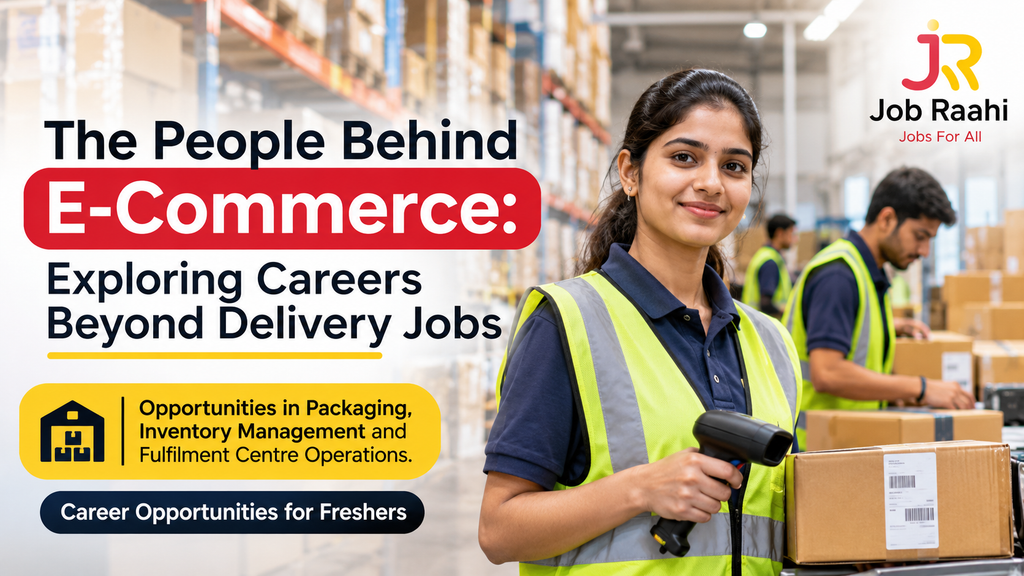
Here are some important job opportunities:
A. Warehouse Associate
Warehouse associates support everyday warehouse activities. Their responsibilities may include receiving goods, picking products, packing orders, labelling shipments and maintaining organised storage areas.
This can be a suitable entry-level opportunity for candidates who want to understand warehouse operations.
B. Sorting Associate
Sorting associates organise parcels according to their destinations, categories or dispatch requirements. They help ensure that shipments move to the correct processing or transportation section.
Accuracy, attention to detail and the ability to follow instructions are important for this role.
C. Packaging Associate
Packaging associates prepare products for shipment. Their work may include selecting appropriate packaging materials, checking product condition, sealing packages and attaching shipping labels.
Careful handling and consistency are important because packaging helps protect products during transportation.
D. Inventory Assistant
Inventory assistants help maintain records of products stored in a facility. They may count stock, update inventory details, check product locations and report differences between physical stock and recorded quantities.
Basic computer knowledge, numerical ability and attention to detail can be useful in this position.
E. Fulfilment Centre Executive
Fulfilment centre executives support different operational activities, such as order processing, coordination between teams, documentation and monitoring daily workflows.
Depending on the employer and level of responsibility, this role may require previous experience or stronger computer and communication skills.
F. Quality Check Associate
Quality check associates inspect products or packages to identify damage, incorrect items, missing labels or other issues before dispatch.
They help reduce errors and ensure that orders meet the organisation’s quality requirements.
Skills Required to Work in E-Commerce Operations
Many entry-level e-commerce operations roles focus on practical abilities, discipline and the willingness to learn.
Some useful skills include:
Attention to detail: Helps employees identify incorrect products, quantities, labels and packaging issues.
Basic digital literacy: Employees may need to use barcode scanners, mobile applications, inventory systems or warehouse software.
Time management: Orders often need to be processed within specific operational timelines.
Teamwork: Warehouse activities involve coordination between receiving, picking, packing, sorting and dispatch teams.
Physical readiness: Some roles involve standing, walking, lifting or moving goods. The physical requirements vary by position and workplace.
Safety awareness: Employees must follow workplace instructions, use required protective equipment and handle goods responsibly.
Candidates do not need to master every skill before applying. Many organisations provide role-specific instructions and training after selection.
How Freshers Can Prepare for These Jobs
Here are a few practical steps:
- Understand different job roles: Learn the difference between sorting, picking, packing, inventory and dispatch responsibilities.
- Improve basic computer skills: Become comfortable with smartphones, digital forms, basic data entry and simple applications.
- Develop workplace discipline: Build habits around punctuality, attendance, teamwork and following instructions.
- Understand safety practices: Learn about safe material handling, protective equipment and workplace procedures.
- Read job descriptions carefully: Check the location, shift timings, salary, eligibility, physical requirements and other employment conditions before applying.
- Prepare for interviews: Be ready to explain why you are interested in warehouse operations and how you can contribute to the team.
Students from ITI and vocational backgrounds can also explore relevant logistics and warehousing training pathways.
Career Growth in E-Commerce Operations
With experience, performance and additional training, employees may get opportunities to take on greater responsibilities.
A possible career progression could look like:
Warehouse Associate → Senior Associate → Team Leader → Warehouse Supervisor → Warehouse Manager
Similarly, employees working in inventory operations may develop towards inventory coordination, inventory supervision or specialised warehouse management roles.
Career progression is not automatic. It depends on the organisation, qualifications, experience, available openings and individual performance.
However, learning warehouse processes, using operational systems and developing coordination skills can help employees prepare for future responsibilities.
How Digital Job Platforms Can Help
Finding the right opportunity is an important part of starting a career. Candidates may know that e-commerce companies hire for warehouse operations, but they may not know which job titles to search for or where relevant vacancies are available.
For freshers, it is useful to explore opportunities based on location, education, experience and job responsibilities rather than searching only for familiar titles such as delivery executive.
Conclusion
Every successful online order involves the coordinated effort of people working behind the scenes. From receiving and sorting products to managing inventory, packaging orders and preparing shipments, each responsibility plays an important role in the e-commerce process.
Delivery may be the most visible part of online shopping, but it is only one part of a much larger employment ecosystem.
For freshers and individuals seeking practical career opportunities, e-commerce operations offer several roles worth considering. Understanding these job profiles, developing relevant skills and staying informed about available openings can help candidates take their first step into this growing field.