The traditional approach to job searching
For years, finding a job meant checking newspaper advertisements, visiting employment exchanges, asking friends and relatives, or physically approaching companies.
The process was often time-consuming. Candidates had limited information about available vacancies, while employers depended on local networks, referrals and manual recruitment methods to find suitable people.
With the arrival of online job portals, the process became more accessible. Candidates could browse multiple vacancies from one platform, upload their resumes and apply without visiting an employer’s office.
This was a major step forward. However, it mainly digitised the existing job search process rather than completely changing how candidates and employers connected.
How digital platforms changed recruitment
Candidates could:
- Search for jobs across different industries and locations.
- Apply to multiple vacancies from their phones or computers.
- Create digital profiles and upload resumes.
- Receive updates about new opportunities.
Employers also benefited from wider candidate reach, easier vacancy promotion and access to larger applicant pools.
But as the number of online vacancies and applications increased, a new challenge emerged: finding the right opportunity among hundreds of available options.
A candidate might apply to several jobs without receiving a response. At the same time, recruiters might receive a large number of applications, many of which do not match the actual job requirements.
This highlighted the need for a more relevant recruitment experience.
Why finding a job is not the same as finding the right job
A vacancy being available does not automatically make it suitable for every job seeker.
For example, a candidate looking for an entry-level warehouse position may come across vacancies requiring several years of experience. Another candidate may find a suitable role but discover that the workplace is too far from home.
Several factors influence whether a job is genuinely relevant:
- Skills: Does the candidate have the required practical or technical abilities?
- Experience: Is the role suitable for a fresher or someone with limited experience?
- Location: Can the candidate realistically travel to the workplace?
- Education: Does the candidate meet the basic educational requirements?
- Job expectations: Are the responsibilities and working conditions suitable?
When these factors are overlooked, candidates spend time applying for unsuitable jobs and employers spend time reviewing irrelevant applications.
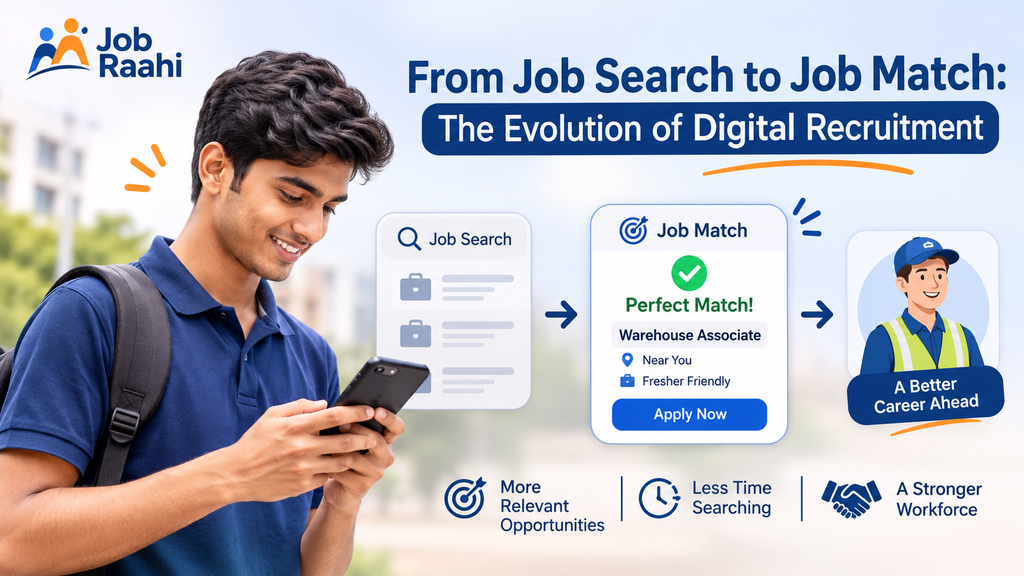
The shift from job search to job matching
The next stage of digital recruitment focuses on improving the connection between a candidate and a vacancy.
Instead of simply displaying a list of available jobs, job-matching platforms aim to make opportunities more relevant to individual candidates.
A job-matching approach considers information such as:
- Candidate education and qualifications.
- Skills and previous work experience.
- Preferred job location.
- Type of employment and role.
- Employer requirements.
For instance, consider a fresher who has completed an ITI course and is looking for an entry-level technician or machine operator position.
A basic job search may show hundreds of vacancies across unrelated industries. A more relevant matching process can help highlight opportunities that align with the candidate’s educational background, experience level and location.
The objective is not just to increase the number of applications. It is to improve the relevance of each application.
Technology’s role in smarter recruitment
Technology is becoming an important part of this transformation.
1. Data-driven candidate profiles
Digital profiles allow candidates to share their education, skills, experience and job preferences in one place. This information can help platforms identify more relevant vacancies.
2. AI-assisted recommendations
Artificial intelligence can analyse candidate profiles and job descriptions to suggest potentially suitable opportunities. However, recommendations depend on the quality of the available data and should not replace fair human evaluation.
3. Location-based discovery
For many frontline and entry-level roles, workplace location is an important consideration. Location-based discovery can help candidates find opportunities closer to where they live.
4. Mobile-first recruitment
Smartphones have made job discovery and applications more accessible. Candidates can explore vacancies, create profiles and apply without relying entirely on desktop computers.
5. Faster communication
Digital platforms can help candidates receive information about vacancies and application updates more conveniently, reducing dependence on lengthy manual communication.
Why better job matching matters for employers and candidates
The shift towards job matching can create value for both sides of the recruitment process.
| For job seekers | For employers |
|---|---|
| More relevant job opportunities | More suitable applications |
| Less time spent on unsuitable vacancies | Reduced effort in screening irrelevant profiles |
| Better visibility of local openings | Access to candidates across locations |
| Opportunities aligned with experience levels | Improved alignment between job requirements and candidate profiles |
For employers hiring at scale, especially in retail, logistics, warehousing, hospitality and customer support, relevance is particularly important. A large applicant pool is useful, but the ability to reach candidates who meet the basic requirements of a role can make recruitment more efficient.
Similarly, freshers and candidates with limited work experience benefit when platforms make entry-level opportunities easier to discover.
The future of digital recruitment
Digital recruitment is likely to become increasingly focused on relevance, accessibility and better connections between employers and job seekers.
The future will not be defined only by how many vacancies a platform displays or how many applications it receives. It will also depend on how effectively it helps candidates discover suitable opportunities and helps employers connect with relevant talent.
As recruitment technology develops, platforms may increasingly combine candidate profiles, skill information, location preferences and employer requirements to improve the matching process.
However, technology alone cannot solve every recruitment challenge. Accurate job descriptions, updated candidate information, transparent employer communication and a simple application experience will remain equally important.
How platforms like Job Raahi fit into this evolution
The move from job search to job matching is particularly relevant for India’s frontline and entry-level employment market.
Many candidates from smaller cities and hinterland regions are looking for their first job or an opportunity to build work experience. At the same time, employers across sectors need people for roles in logistics, warehousing, retail, delivery, sales, hospitality and other frontline functions.
Platforms like Job Raahi aim to bring these two sides closer through digital job discovery and access to employment opportunities.
By connecting candidates with employers and making job vacancies accessible through a digital platform, Job Raahi is part of the broader shift towards a more connected employment ecosystem.
The larger opportunity is to make job discovery more accessible and help candidates explore opportunities that align with their qualifications, skills and experience.
Conclusion
The evolution of digital recruitment is about more than moving job advertisements from newspapers to websites or mobile applications.
It represents a shift in how people discover employment and how organisations connect with talent.
Traditional job search focused on finding available vacancies. The next generation of digital recruitment is focused on making those opportunities more relevant to the people searching for them.
Because the future of recruitment is not simply about finding more jobs. It is about finding the right match.