Imagine two candidates applying for the same job.
One has completed a vocational course and holds a certificate. The other has received practical training, worked with industry-standard tools and understands what the job actually demands.
Both have studied. Both are looking for an opportunity. But when the employer asks them to perform a real workplace task, their readiness may be very different.
This raises an important question: Are we training people to complete courses, or preparing them to build careers?
India has made significant efforts to expand vocational education through ITIs, polytechnics, skill development programmes, apprenticeships and training centres. These initiatives play an important role in preparing young people for employment.
But the world of work is changing quickly. Technology is reshaping industries, businesses are adopting new processes, and employers increasingly need people who can combine practical knowledge with adaptability.
So, is the current vocational training model ready for the jobs of tomorrow? The answer depends on how well training connects with real workplace needs.
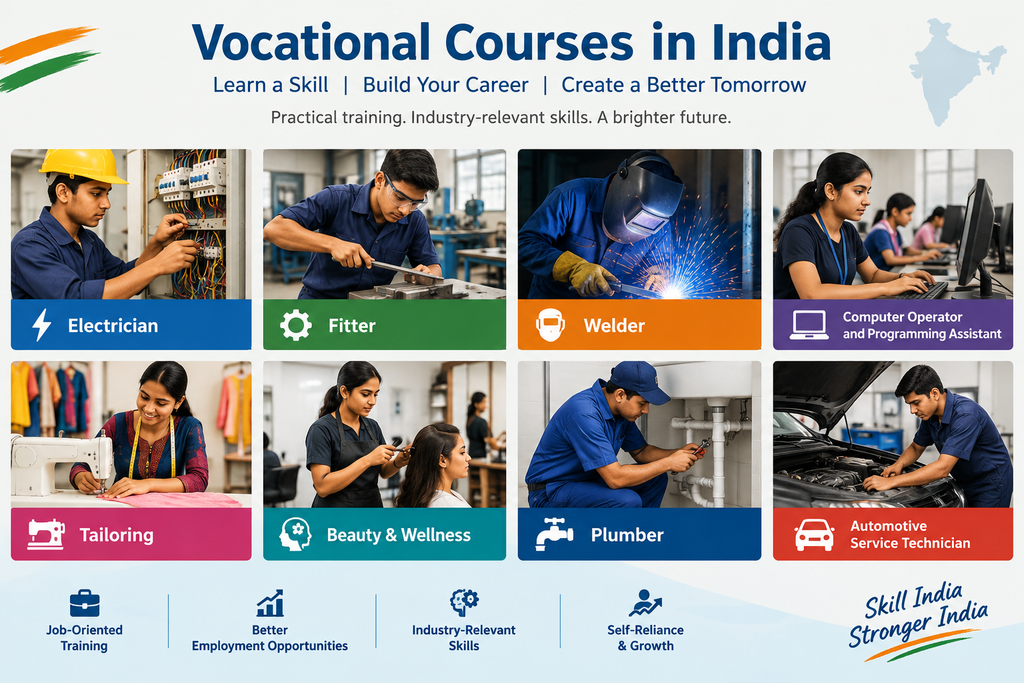
1. India’s Job Market Is Changing. Is Training Keeping Up?
Traditional vocational courses have helped learners develop practical skills for occupations across manufacturing, electrical work, automotive services, construction, retail and other industries.
These skills remain valuable. However, many jobs are also changing.
A warehouse employee may now need to use digital inventory systems. A retail associate may work with point-of-sale software and digital payments. A technician may need to understand automated equipment. A customer support executive may work with CRM tools and AI-assisted systems.
New opportunities are also emerging in areas such as renewable energy, electric vehicles, robotics, data analytics and other technology-driven sectors.
The challenge is not that traditional vocational skills are no longer useful. It is that those skills increasingly need to be combined with digital knowledge, problem-solving and the ability to learn new processes.
Training programmes must evolve alongside the industries they serve.
2. A Certificate Is a Starting Point, Not the Finish Line
Vocational qualifications give learners a structured way to develop knowledge and demonstrate that they have completed a course.
But employers also need to know what a candidate can actually do.
Can the candidate operate the required equipment safely? Can they follow workplace instructions? Can they use the tools relevant to the role? Can they handle common problems without constant supervision?
These are practical questions that a certificate alone may not answer.
This does not mean qualifications are unimportant. It means that qualifications should be supported by practical assessments, demonstrations and workplace exposure.
A stronger training model would combine classroom learning with hands-on exercises, realistic work simulations and assessments based on actual job tasks.
The goal should be simple: when a learner finishes training, they should understand not just the theory behind the job but also what performing that job looks like in practice.
3. Industry Must Become a More Active Partner
One of the biggest opportunities for vocational training is stronger collaboration between training institutions and employers.
Training institutes cannot always predict how job roles will change. Employers, on the other hand, see the skills they need today and the capabilities they expect to need in the coming years.
Bringing these two sides together can help make training more relevant.
Companies can contribute by:
- Sharing the skills required for specific job roles.
- Advising institutes on curriculum updates.
- Providing equipment, demonstrations and practical learning opportunities.
- Offering internships and apprenticeships.
- Participating in assessments and candidate evaluations.
- Giving feedback on the performance of newly hired trainees.
For example, if a logistics company regularly hires warehouse associates, it can help training partners understand the actual requirements of warehouse work, including inventory handling, workplace safety, scanning systems and basic digital operations.
This makes training more closely connected to employment.
The government has also emphasised demand-driven skilling and industry alignment. The Ministry of Skill Development and Entrepreneurship’s initiatives include industry-linked training and on-the-job exposure through schemes such as the Dual System of Training.
The next step is to make these connections meaningful, consistent and accessible across more sectors and locations.
4. Practical Experience Should Be Part of the Learning Journey
A learner can understand a process in theory and still struggle when they encounter it in a real workplace.
That is why practical exposure matters.
Apprenticeships, internships, supervised workplace training and simulated work environments can help bridge the gap between learning and employment.
Consider someone training to become an electrician. Understanding electrical concepts is important, but so is learning to use tools correctly, follow safety procedures and troubleshoot common problems under supervision.
Similarly, someone preparing for a retail role benefits from practising customer interactions, handling billing systems and learning how to manage everyday store operations.
Practical exposure also helps learners understand whether a job suits their interests and expectations before they enter full-time employment.
Training should therefore not treat practical work as an optional extra. It should make it a meaningful part of the learning process wherever the occupation requires it.
5. Soft Skills Matter More Than Many Learners Realise
Technical knowledge helps candidates qualify for a role. Workplace skills often determine how effectively they perform in it.
Communication, punctuality, teamwork, problem-solving, adaptability and the ability to follow instructions are important across many occupations.
For frontline roles, these skills can be especially relevant.
A delivery executive needs to communicate with customers and follow delivery procedures. A retail associate must understand customer needs and coordinate with colleagues. A warehouse employee needs to follow instructions, maintain safety and work as part of a team.
These abilities can be taught and practised.
Training centres can introduce workplace scenarios, group activities, mock interviews, communication exercises and basic digital tasks into their programmes.
The objective is not to turn every learner into an expert communicator overnight. It is to help them enter the workplace with greater confidence and a clearer understanding of professional expectations.
6. Training Should Lead to Employment, Not Just Completion
One of the most important questions for any vocational programme is what happens after the course ends.
How many learners find jobs related to their training? How many successfully join? Are they still employed after a few months? Do they have opportunities to improve their skills and earn more over time?
Course completion and certification are useful indicators, but they do not tell the whole story.
Training providers should work towards tracking outcomes such as:
- Employment after training.
- Relevance of the job to the course.
- Employer feedback on job readiness.
- Successful joining rates.
- Retention after three or six months.
- Opportunities for career progression.
- Learner satisfaction with the training.
These measures can help institutions understand where their programmes are working and where changes are needed.
For instance, if a course attracts many learners but employers repeatedly report the same practical skill gaps, the curriculum or training delivery may need to be reviewed.
Likewise, if candidates receive offers but struggle to join because of unclear job conditions or unsuitable locations, better career guidance and employer coordination may help.
The real measure of vocational training is not only how many people complete it, but how effectively it helps them move forward.
7. Future-Ready Training Must Be Accessible Beyond Major Cities
India’s talent is not limited to metropolitan areas.
Across smaller cities, towns and districts, young people are pursuing ITI courses, diplomas, vocational qualifications and other forms of practical education.
These learners can become an important source of talent for employers in logistics, retail, manufacturing, hospitality, customer support and many other sectors.
However, access to quality training and employment connections can vary by location.
Some learners may have limited access to modern equipment, experienced trainers, career counselling or employers who recruit from their region.
A future-ready vocational system should therefore focus on both training quality and access to opportunity.
This includes strengthening regional training centres, developing partnerships with local employers, providing digital learning resources and connecting candidates with relevant vacancies.
Digital platforms can help learners discover opportunities beyond their immediate networks. But technology works best when combined with reliable information, practical training and real employer connections.
The aim should be to ensure that a learner’s location does not unnecessarily limit their ability to develop skills or find suitable work.
8. What Should the Vocational Training Model Look Like Tomorrow?
There is no single solution for every occupation. A technician, a healthcare worker and a warehouse associate will need different training pathways.
However, a more effective model can follow a common approach:
Understand demand → Train for the role → Practise real tasks → Assess skills → Connect with employers → Track outcomes
First, training providers identify the skills employers actually need.
Next, learners receive relevant technical instruction and workplace skills training.
They practise the tasks associated with their chosen roles and are assessed on what they can demonstrate.
They then connect with employers through apprenticeships, placement partnerships, recruitment drives or digital platforms.
Finally, training providers gather feedback on employment, retention and performance to improve future batches.
This creates a continuous cycle in which training responds to the job market instead of remaining disconnected from it.
It also allows employers to contribute to talent development rather than relying entirely on the external labour market to supply ready-made candidates.
Final Thought: Build Skills for Real Opportunities
India’s vocational training ecosystem has an important role to play in preparing the workforce for the future. But the future will require more than adding new courses or issuing more certificates.
It will require practical learning, stronger industry partnerships, digital skills, workplace readiness and a clear connection between training and employment.
It will also require recognising that people develop at different speeds. Some learners will be ready for employment immediately after training, while others may need additional practice, apprenticeships or on-the-job support.
The answer is not to dismiss the current model. It is to keep improving it.
Training institutions must understand industry needs. Employers must participate in building talent. Learners must have access to relevant skills and genuine job opportunities. And the entire system must pay closer attention to what happens after training ends.
Because a vocational course should do more than prepare someone to pass an assessment. It should help them take the next step towards a livelihood, a career and a better future.
The jobs of tomorrow will need people who can keep learning. Our training systems must be built to help them do exactly that.