Getting a call for an interview or receiving a job offer can be an exciting moment. For a fresher, it may mean the beginning of a career. For someone already working, it could be a chance to earn more, learn new skills or find a better opportunity.
But excitement can sometimes make it easy to overlook important details.
What exactly will your job involve? Is the salary what you were promised? Where will you work? Is the recruiter genuinely representing the company?
These questions matter whether you are applying for a warehouse position, a retail job, a delivery role, a customer support position or your first job after completing an ITI, diploma or school education.
Here are seven things to check before accepting a job offer.
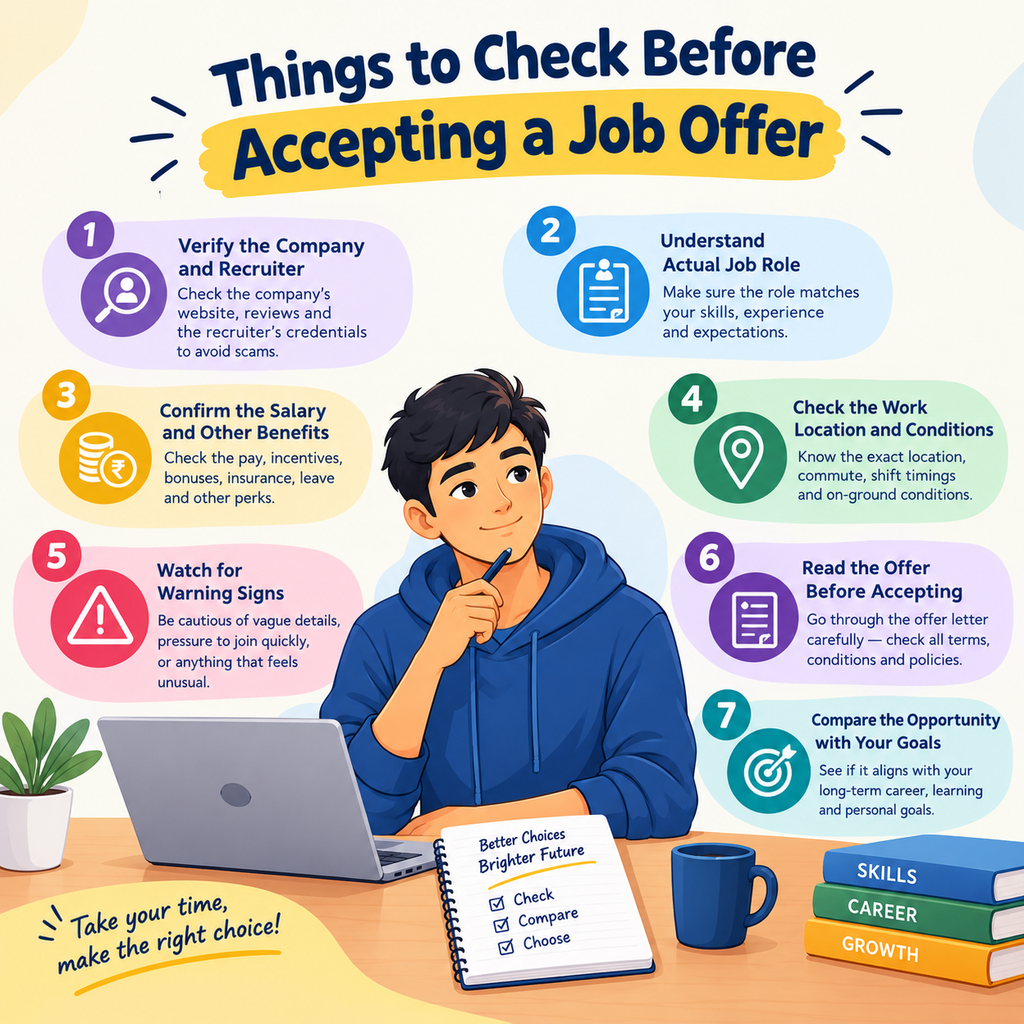
1. Verify the Company and Recruiter
Before sharing sensitive information or agreeing to join, take time to understand who is offering you the job. Start by checking the company’s official website, business details and publicly available contact information. If a recruiter contacts you, ask for their name, designation and the company they represent.
You can also look for the vacancy on the company’s official careers page or contact the company through independently verified contact details to confirm whether the opportunity is genuine.
Be cautious if someone refuses to identify the employer, uses inconsistent company names or pressures you to make a decision immediately.
Remember that a professional-looking website, an impressive logo or a social media profile does not, by itself, prove that a job offer is genuine. If anything feels unclear, ask questions and verify the details before proceeding.
2. Understand the Actual Job Role
A job title may sound attractive, but the responsibilities are what you will actually be expected to perform.
For example, a job advertised as a warehouse associate may involve picking and packing orders, handling inventory, scanning products or preparing dispatches. A retail associate may be responsible for customer assistance, billing, stock management or store operations.
Before accepting, ask:
- What will my daily responsibilities be?
- Will training be provided?
- What skills or qualifications are required?
- Who will I report to?
- How will my performance be evaluated?
These questions are particularly useful for freshers who may not have previous workplace experience.
A clear understanding of the role helps you assess whether the job matches your skills, physical requirements, interests and expectations. It also reduces the likelihood of joining and discovering that the actual work is very different from what you were told.
3. Confirm the Salary and Other Benefits
Never rely entirely on a verbal salary promise. Ask for the compensation details in writing before making your decision.
Understand the difference between the total salary package, gross salary and the amount you are likely to receive in your bank account after applicable deductions.
Clarify the following:
- Monthly salary and payment date
- Incentives, if any, and how they are calculated
- Applicable deductions and benefits
- Overtime arrangements, where relevant
- Any allowances for travel, meals or accommodation
- Whether the position is permanent, temporary, contractual or probationary
For example, an advertised salary may include incentives that depend on targets. If those incentives are not guaranteed, your actual monthly earnings could be different from what you initially expected.
Ask for an explanation rather than making assumptions.
Also be cautious when someone demands money to secure a job, guarantee selection or release an offer letter. The National Career Service explicitly warns job seekers that its services are free and advises them not to pay fees to employers. Verify any unusual payment request independently before proceeding.
4. Check the Work Location and Conditions
A job can appear suitable until you understand the practical details of getting to work and completing your shift.
Confirm the exact work location, reporting time, shift timings and weekly offs. If the job involves night shifts, travel, field visits or physically demanding tasks, ask what these responsibilities involve.
For roles in warehouses, manufacturing, hospitality and delivery, it is also sensible to understand the workplace safety arrangements, equipment provided and support available during your shift.
Consider your daily commute. Calculate the likely transport cost and travel time, especially if the salary is close to your current earnings or budget.
If accommodation is offered, confirm whether it is free or paid, what facilities are included and whether any deductions apply. A suitable job should make sense not just on paper but also in your everyday life.
5. Watch for Warning Signs
Not every unusual message is fraudulent, but certain warning signs deserve attention.
Be careful if someone:
- Promises selection without a reasonable assessment for a role that requires one.
- Demands an urgent payment for registration, training, an interview or a guaranteed appointment.
- Requests your OTP, banking password, PIN or other sensitive credentials.
- Sends an offer using an unrelated email address while claiming to represent a known company.
- Avoids explaining the job responsibilities, salary or employer identity.
- Pressures you to share identity documents before you can establish who is collecting them and why.
Do not share OTPs or banking credentials with recruiters. Share personal documents only when you understand who needs them, why they are required and how they will be handled.
If you suspect fraud, stop the process and seek verification. In India, suspected cybercrime can be reported through the official cybercrime reporting portal. The National Cyber Crime helpline is 1930.
Taking precautions does not mean distrusting every employer. It means protecting yourself while making a career decision.
6. Read the Offer Before Accepting
When you receive an offer letter, read it carefully instead of accepting it immediately out of excitement.
Check whether the employer’s name, job title, salary, work location, joining date and employment terms match what was discussed.
Pay attention to probation conditions, notice periods, contractual obligations and any clauses that you do not understand.
If a detail is missing or differs from the verbal promise, ask the recruiter to clarify it in writing. Keep copies of relevant communications and the final offer for your records.
You do not need to feel uncomfortable about asking reasonable questions. A genuine hiring process should allow candidates to understand the terms of employment.
If the employer changes important conditions at the last moment, take time to evaluate the revised offer before deciding.
7. Compare the Opportunity with Your Goals
The highest advertised salary is not always the best option for every candidate.
Consider what matters most to you right now. You may need immediate income, a job close to home, a predictable shift, practical training or an opportunity to enter a new industry.
A fresher might value structured training and the chance to gain relevant experience. Someone supporting a family might place greater importance on reliable pay and manageable travel costs.
Make a simple comparison of your options using salary, location, work hours, job responsibilities, employment terms and learning opportunities.
Do not assume that every entry-level position guarantees promotion. Instead, ask whether training is available, how performance is reviewed and what additional responsibilities employees may be able to take on over time.
Your decision should reflect your real circumstances, not only the excitement of receiving an offer.
How Employers Can Build Trust with Job Seekers
Trust is not created by a job advertisement alone. It develops through clear communication, realistic expectations and consistent hiring practices.
Employers can help candidates make informed decisions by providing accurate job descriptions, transparent salary details, clear location information and timely updates throughout the recruitment process.
They can also explain selection stages, identify the person candidates can contact with questions and ensure that the offer letter reflects the agreed terms.
These practices matter particularly when recruiting freshers and frontline workers, many of whom may be navigating formal recruitment processes for the first time.
For employers, transparency can help candidates understand whether a role suits them before joining. For job seekers, it makes comparing opportunities easier.
Recruitment works better when both sides know what to expect.
Make Your Next Career Move with Confidence
Finding a job is an important step, but choosing the right opportunity deserves equal attention.
Verify the employer, understand the role, confirm the salary, check the work conditions and read the offer carefully. If something is unclear, ask questions before making a commitment. You do not need to know everything about the world of work to make a good decision. You simply need to take the time to check the details that matter.
Find Opportunities with Job Raahi
Looking for your next opportunity? Job Raahi helps job seekers explore job openings across frontline and entry-level roles.
Explore vacancies that match your qualifications, location and interests. Review the available job details, ask questions when you need clarification and make informed decisions about your next step.
Your next opportunity should bring you closer to your goals—and confidence starts with knowing what you are applying for.