Imagine a company needs 50 warehouse associates to meet an upcoming business requirement. The recruitment team advertises the vacancies, screens applicants, conducts interviews and selects 50 candidates.
However, when the joining date arrives, only 32 candidates report to work.
The company is now short of 18 employees despite completing the selection process. The HR team must restart recruitment, supervisors need to adjust their workforce plans, and daily operations may face additional pressure.
This is the candidate no-show problem — a challenge that employers frequently encounter, particularly in frontline and high-volume recruitment.
Attracting applicants and selecting suitable candidates are important parts of recruitment. But the hiring process is not complete until selected candidates actually join the organisation.
What Is the Candidate No-Show Problem?
A candidate no-show occurs when a selected candidate fails to report for joining on the agreed date, sometimes without informing the employer or recruiter.
It can happen at different stages:
- A candidate confirms interview attendance but does not appear.
- A selected candidate accepts the job but later declines.
- A candidate agrees to a joining date but becomes unreachable.
- A candidate completes documentation but does not report on the first day.
Although these situations are related, they should be tracked separately. An interview no-show, an offer dropout and a first-day no-show represent different stages of the recruitment funnel.
Understanding where candidates drop out helps employers identify the actual problem instead of treating every unsuccessful joining as the same issue.
Why Do Selected Candidates Not Join?
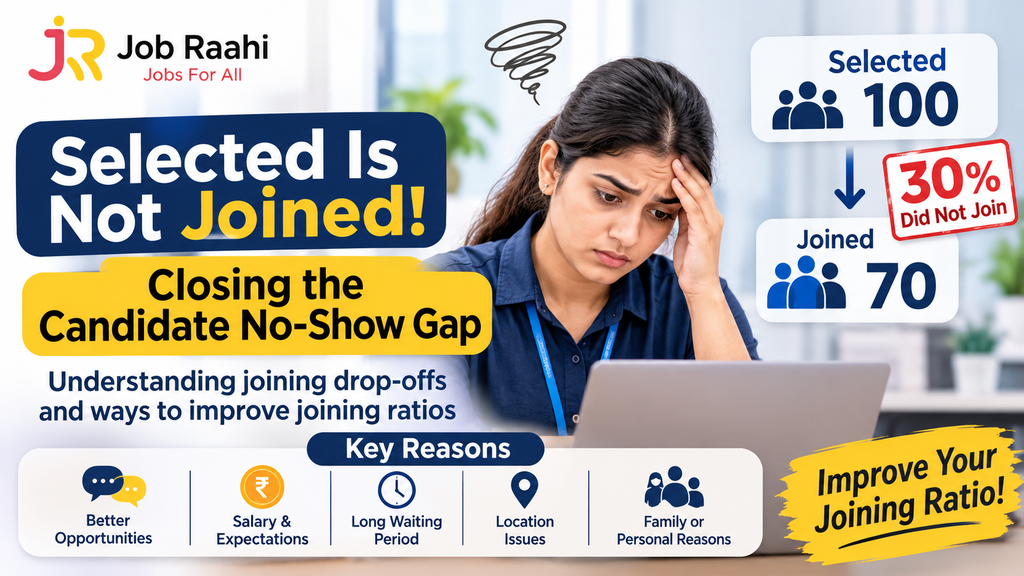
Candidate no-shows rarely have just one explanation. Several personal, financial and recruitment-related factors can influence a candidate’s final decision.
1. Better Job Opportunities
Candidates may receive another offer with a higher salary, better benefits, a preferred location or more suitable working hours.
This is especially possible when candidates are applying to multiple employers simultaneously.
2. Unclear Salary and Job Expectations
Sometimes candidates discover important details only after selection.
For example, the advertised salary may be different from the expected take-home amount, or the actual responsibilities may differ from what was explained during the interview.
Such misunderstandings can reduce confidence in the opportunity.
3. Long Waiting Periods
A long gap between selection and joining gives candidates more time to reconsider their decisions or explore other opportunities.
In the meantime, they may accept another offer or lose interest because they have not received updates from the employer.
4. Location and Transportation Problems
For frontline employees, the distance between home and workplace can significantly influence the decision to join.
Transport availability, commuting expenses, relocation requirements and shift timings may make an otherwise suitable job difficult to accept.
5. Family or Personal Reasons
Candidates may need approval or support from family members, particularly when a job involves relocation, night shifts or working in another city.
Personal responsibilities and unexpected circumstances can also change their availability.
6. Poor Communication from Recruiters
If candidates do not receive clear instructions about documentation, reporting time, workplace location or whom to contact, they may become uncertain about the joining process.
How Candidate No-Shows Affect Businesses
Candidate no-shows create challenges beyond an incomplete recruitment target.
Increased recruitment costs: Recruiters spend additional time sourcing, screening and interviewing replacement candidates.
Delayed workforce deployment: Departments may not receive the required number of employees on time.
Additional pressure on existing employees: Teams may need to manage increased workloads until vacancies are filled.
Disrupted business operations: Warehouses, retail outlets, delivery operations and production units may struggle to maintain planned staffing levels.
Reduced recruitment efficiency: Even when recruiters generate enough applications and complete selections, poor joining conversion can make the overall hiring process less effective.
For businesses hiring at scale, a small gap between selected candidates and actual joiners can create a significant workforce shortage.
Understanding the Selection-to-Joining Ratio
One of the most useful ways to understand this challenge is to measure how many selected candidates actually join.
A simple metric is the selection-to-joining ratio:
Selection-to-Joining Ratio = (Number of Candidates Joined ÷ Number of Candidates Selected) × 100
Consider this example:
| Recruitment Stage | Candidates |
|---|---|
| Candidates selected | 100 |
| Candidates confirmed for joining | 85 |
| Candidates who actually joined | 70 |
| Candidates who did not join | 30 |
The selection-to-joining ratio is:
70 ÷ 100 × 100 = 70%
This means that 70 out of every 100 selected candidates successfully joined.
Employers should also track offer acceptance and joining conversion separately:
- Offer acceptance rate: Offers accepted ÷ offers released × 100.
- Offer-to-joining ratio: Candidates joined ÷ offers released × 100.
- Selection-to-joining ratio: Candidates joined ÷ candidates selected × 100.
The organisation should define each metric consistently and compare results across locations, job roles, recruiters and sourcing channels.
This makes it easier to identify where the biggest drop-offs occur.
8 Practical Ways to Improve Candidate Joining Ratios
Improving joining ratios requires more than increasing the number of selected candidates. Employers need to build a reliable process between selection and the first working day.
1. Share Accurate Job Information
Explain the salary, take-home pay, working hours, shift arrangements, location, responsibilities and eligibility requirements before selection.
Candidates should know what they are agreeing to.
2. Reduce the Gap Between Selection and Joining
Avoid unnecessary delays in documentation, offer communication and joining formalities.
Where possible, plan interview and joining schedules in advance so candidates do not have to wait unnecessarily.
3. Maintain Regular Communication
Do not stop contacting candidates after they accept an offer.
A simple follow-up schedule can include:
- Immediately after selection: Confirm the offer and joining details.
- Two to three days before joining: Reconfirm availability and reporting instructions.
- One day before joining: Share a final reminder and contact details.
- On joining day: Check whether the candidate has reported successfully.
The frequency can be adjusted according to the time between selection and joining.
4. Understand Candidate Concerns
Recruiters should ask candidates whether they have concerns about salary, transport, shift timings, relocation or documentation.
Identifying these issues early gives employers an opportunity to address them before the joining date.
5. Make the Joining Process Simple
Provide a clear list of required documents, reporting time, workplace address and contact person.
Avoid asking candidates to complete unnecessary steps at the last moment.
6. Offer Location and Transport Clarity
For roles requiring physical attendance, candidates should know how to reach the workplace and whether transport facilities are available.
Where feasible, employers can explore transport support or accommodation assistance for candidates travelling from distant locations.
7. Keep Backup Candidates Ready
For high-volume hiring, employers should maintain a suitable backup pipeline until the required workforce has joined.
This does not mean selecting candidates carelessly. It means planning for predictable recruitment uncertainty.
8. Track Reasons for Drop-Offs
Recruiters should record why candidates did not join wherever the reason is available.
For example:
- Accepted another job.
- Salary expectations not met.
- Transport or location issue.
- Family or personal reasons.
- Shift timings unsuitable.
- Could not be contacted.
- Joining date postponed.
Reviewing these reasons every month can help employers identify recurring problems and improve future hiring decisions.
The Importance of Candidate Communication
Recruitment communication should not end when a candidate receives an offer.
The period between selection and joining is an important stage in building trust. Candidates should feel informed, supported and confident about their decision.
Research published in Criteria’s 2024 Candidate Experience Report found that 51% of surveyed candidates had abandoned a recruitment process because of poor communication from an employer or recruiter. The survey covered 2,516 candidates globally, so the figure should not be treated as an India-specific joining statistic. Nevertheless, it highlights how strongly communication can influence candidate decisions.
Employers can make a difference through simple practices:
- Use clear and respectful language.
- Respond to candidate questions promptly.
- Share updates when joining dates or processes change.
- Provide a recruiter or HR contact for assistance.
- Avoid making promises that the organisation cannot fulfil.
A candidate who understands the opportunity and knows what to expect is better positioned to make an informed joining decision.
How Digital Job Platforms Support Recruitment
However, generating applications is only one part of recruitment. Employers must still ensure that candidates are suitable, job details are accurate, selection is timely and joining instructions are communicated properly.
A stronger recruitment process combines effective sourcing with consistent candidate engagement and clear coordination.
How Job Raahi Fits into the Hiring Process
For employers managing frontline and mass recruitment, reaching relevant candidates across locations is an important part of building a dependable hiring pipeline.
Employers can use Job Raahi as an additional sourcing channel to promote vacancies and reach candidates, including freshers and individuals with limited work experience.
While sourcing platforms help employers connect with potential applicants, improving the final joining ratio also requires accurate job information, timely follow-ups and a well-organised joining process.
The objective is not simply to select more candidates. It is to build a recruitment process that helps suitable candidates move confidently from application to joining.
Conclusion
A successful recruitment process does not end when a candidate is selected or accepts an offer. It ends when the candidate actually joins and is ready to begin work.
Candidate no-shows can increase recruitment costs, delay workforce deployment and create additional pressure on business operations. However, many common causes can be addressed through better communication, transparent job information, simpler joining formalities and regular follow-ups.
For employers, improving the selection-to-joining ratio requires treating joining as an important part of recruitment rather than the final administrative step.
Hiring the right candidate is important. Making sure the candidate reaches the first working day is what completes the hiring process.