Two candidates apply for the same entry-level job.
The first has a polished resume, a recognised qualification and a year of experience. The second is a fresher who has skills, completed relevant training, understands the basics of the role and is eager to learn.
Which candidate should the employer choose?
The answer depends on the job. But if the employer automatically rejects the second candidate because they lack experience, they may never discover whether that person could perform the work well.
This is one of the central questions facing modern recruitment: are businesses identifying the right talent, or are they relying too heavily on familiar indicators of capability?
In India, where job seekers enter the workforce through different educational pathways and life experiences, the distinction matters.
A resume is useful evidence, but it is not the complete measure of a person’s ability or potential.
The Resume Is Only Part of the Story
A resume helps employers understand a candidate’s education, work history, qualifications and achievements. These details are important, particularly when a position requires specialised knowledge, professional licensing or substantial experience.
However, a resume cannot always show how someone performs a practical task, responds to feedback, handles a customer or learns a new process.
Consider a warehouse role. A candidate’s ability to follow safety procedures, identify products accurately and learn inventory systems may be more directly relevant than the prestige of their college.
For a retail position, communication, customer handling and reliability may be essential. For a technical role, employers may need to assess specific knowledge, practical competence and the ability to troubleshoot problems.
The right evaluation depends on the responsibilities of the job.
This does not mean qualifications should be ignored. It means employers should distinguish between requirements that are genuinely necessary and preferences that may unnecessarily narrow the candidate pool.
The goal is not to hire people with fewer qualifications. It is to identify people with the right qualifications and capabilities for the work.
Why Skills Matter More Than We Sometimes Realise
Recruitment has traditionally relied on familiar signals: degrees, previous employers, job titles and years of experience. These can help with shortlisting, but they do not always tell the full story.
Skills-based hiring adds another question: can the candidate demonstrate the abilities needed to perform the role, or learn them through appropriate training?
This approach is especially relevant for entry-level and frontline positions in sectors such as retail, logistics, hospitality, customer support and operations.
A candidate may have developed useful abilities through an ITI course, a diploma, an apprenticeship, practical training, a family business or previous informal work. Another may be entering the workforce for the first time but have the aptitude to learn the required tasks.
Employers should assess these experiences in context rather than assume that only conventional employment counts. The shift towards skills-based hiring is also reflected in India’s recruitment discussion.
Reporting on the 2026 State of College Hiring in India describes a market where skills-first approaches are gaining attention, while traditional academic indicators continue to influence many hiring decisions.
The important point is not that degrees no longer matter. It is that qualifications and demonstrated ability should be evaluated in a way that reflects the actual role.
The Barriers That Keep Capable Candidates Out
Even when employers want capable people, their recruitment processes can unintentionally exclude suitable candidates.
Unnecessary experience requirements
A job described as entry-level may still ask for one or two years of experience. When that experience is not essential, the requirement can discourage freshers who might otherwise be suitable.
Overly restrictive educational filters
A specific qualification is necessary for some jobs. For others, requiring a particular degree or institution may not meaningfully predict performance.
Resumes that favour presentation over ability
Candidates with stronger writing skills or more guidance may produce more impressive resumes, even when another applicant has comparable practical ability.
Limited opportunities to demonstrate skills
If selection depends entirely on resume screening and a short interview, employers may miss abilities that become apparent through a relevant practical exercise or structured assessment.
Assumptions about non-traditional backgrounds
Candidates returning to work, changing careers or coming from informal employment may have relevant skills that are not clearly represented by conventional job titles.
These barriers are not present in every recruitment process. But when they do exist, they can reduce the range of candidates an employer considers.
A better process makes it easier for relevant capability to become visible.
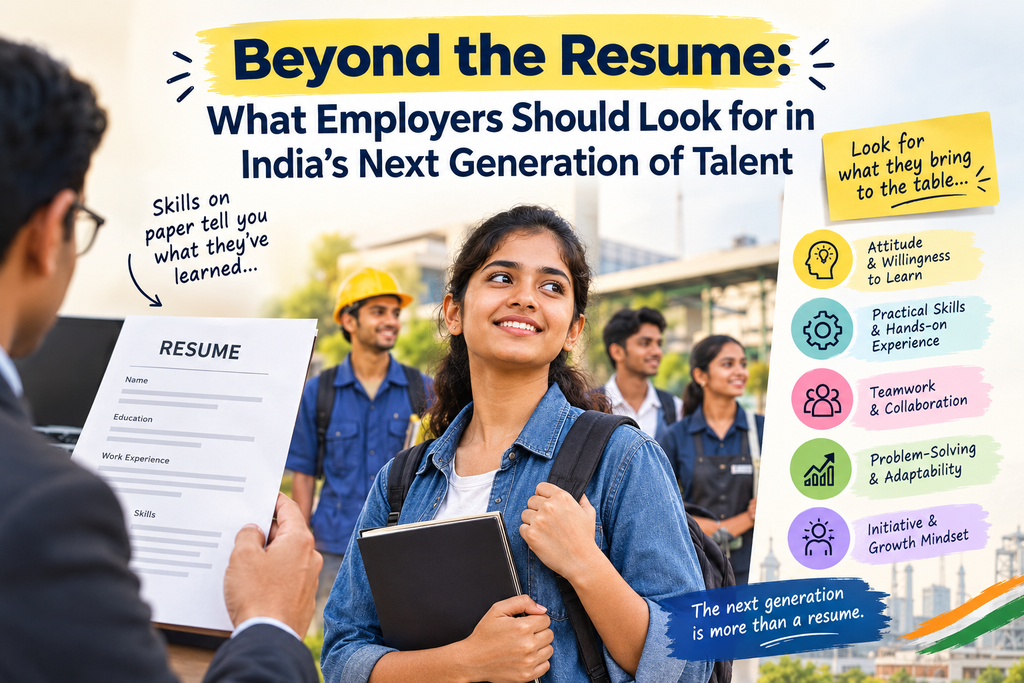
What Employers Should Look for Beyond Qualifications
Four areas deserve particular attention.
Practical Ability
Can the candidate perform the task, demonstrate the relevant knowledge or learn the required process?
For experienced candidates, this may involve reviewing work samples or previous achievements. For freshers, it may involve a practical exercise, a relevant qualification or evidence from training.
The assessment should match the actual job and should not demand unpaid work that provides little value to the candidate.
Willingness to Learn
Not every entry-level candidate will arrive fully prepared for every workplace process. Employers should consider whether the person can understand instructions, respond to feedback and develop the skills needed for the role.
A willingness to learn is not a substitute for essential competence. It is a useful indicator when the position includes appropriate training and development.
Communication and Reliability
Many jobs require candidates to communicate clearly, follow instructions, coordinate with colleagues and raise concerns when something goes wrong.
These abilities can be assessed through relevant interview questions and realistic scenarios rather than assumptions based on educational background or fluency in a language that the role does not require.
Reliability should also be assessed fairly, using relevant evidence instead of stereotypes about a candidate’s age, location or background.
Evidence of Potential
For a fresher, evidence of potential might include practical coursework, an apprenticeship, a project, a demonstration of relevant skills or the way the candidate approaches an unfamiliar task.
Employers should look for evidence, not simply rely on intuition. Structured questions and consistent scoring help compare candidates more fairly.
How Job Seekers Can Demonstrate Their Skills
Candidates also have a role in making their abilities visible.
If you are a fresher, do not assume that having limited work experience means you have nothing valuable to show.
Start by identifying the skills relevant to the jobs you want. These might include operating equipment, using spreadsheets, handling customers, communicating with a team, maintaining records or following safety procedures.
Then gather honest evidence of those abilities. You could include relevant coursework, practical training, apprenticeship experience, personal projects or responsibilities from previous work. Describe what you actually did rather than relying on broad claims such as “hard-working” or “quick learner.”
For example, instead of writing only “completed warehouse training,” explain the tasks you practised, such as inventory recording, order picking or packaging—provided these accurately reflect your experience.
Prepare examples that show how you learned something, solved a problem or handled responsibility.
You can also use career resources and employability guidance from the Government of India’s National Career Service portal to support your job search and profile development.
The objective is simple: help an employer understand what you can offer, even if your employment history is short.
Building a Better Skills-Based Hiring Process
Employers do not need to redesign their entire recruitment system overnight. They can begin with a few practical changes.
Write Clearer Job Descriptions
Separate essential requirements from preferred qualifications. Explain the actual responsibilities, required skills, location, salary range where possible and any training provided.
If experience is mandatory, explain why it matters for the position.
Assess Skills Relevant to the Role
Use structured interviews, practical demonstrations or work-related scenarios where appropriate. Ensure that assessments are accessible, consistent and proportionate to the job.
For a customer support position, a short role-play may reveal communication and problem-solving ability. For a warehouse role, a safety-focused scenario or relevant task demonstration may be more useful than an unrelated written test.
Give Suitable Freshers a Fair Chance
Where previous experience is not essential, consider candidates who have the required foundation and can develop through training.
Clear onboarding, realistic expectations and early feedback can help new employees understand the role and become productive.
Hiring freshers is not suitable for every position. Safety-critical, regulated or highly specialised roles may require specific qualifications or proven experience. The decision should reflect the real requirements of the work.
Measure Hiring Outcomes
Employers should track more than the number of resumes received.
Useful measures include assessment pass rates, time to fill, offer acceptance, joining rates, early retention, training progress and job performance.
Review these indicators by role and hiring channel. If a particular requirement repeatedly excludes candidates who later prove capable, it may be worth reassessing that requirement.
Skills-based hiring should be evaluated through results, not treated as a slogan.
A More Inclusive Future of Work
India’s workforce includes graduates, ITI-trained candidates, diploma holders, freshers, experienced workers and people whose abilities have developed through informal work.
No single hiring method will suit every role. Qualifications remain essential where the work demands them, and experience can provide valuable evidence of performance.
But neither a degree nor a job title tells the whole story.
Employers can make better decisions by identifying the skills the role requires, assessing those skills consistently and remaining open to candidates who can demonstrate relevant capability through different pathways.
For job seekers, this creates a stronger incentive to develop practical skills and explain their value clearly. For employers, it offers a way to reconsider unnecessary filters and reach candidates who may otherwise be overlooked.
The next generation of talent will not all arrive with identical resumes. The opportunity is to build recruitment processes that can recognise what makes each candidate suitable for the work.
The future of hiring should not be about choosing between qualifications and skills. It should be about understanding what the job requires—and finding the person best prepared to meet that need.
Find Your Next Opportunity with Job Raahi
Looking for a job that matches your skills, qualifications and experience?
Job Raahi helps job seekers explore opportunities across frontline and entry-level roles. Whether you are a fresher or have already gained practical experience, explore vacancies that match your profile and take the next step in your career.
For employers, a clearer understanding of role requirements can open the door to a wider range of suitable candidates. Consider adding Job Raahi as an additional channel to share vacancies and reach job seekers who may match your hiring needs.