Table of Contents
- Why Are Tier 2 and Tier 3 Cities Gaining Attention?
- What Makes These Cities Attractive for Business Growth?
- Industries Creating New Opportunities Beyond Metros
- The Biggest Opportunity: India’s Local Workforce
- Challenges That Still Need Attention
- How Businesses Can Unlock the Potential of Smaller Cities
- What This Growth Means for Job Seekers
- India’s Next Opportunity May Be Closer Than You Think
For years, India’s biggest metropolitan cities have attracted businesses, investments and job seekers. Cities such as Delhi, Mumbai, Bengaluru and Hyderabad have become familiar destinations for people looking to build their careers.
But India’s growth story is no longer limited to these major urban centres.
Look beyond the metros, and a different picture begins to emerge. Cities such as Indore, Coimbatore, Jaipur, Lucknow, Surat, Nagpur, Bhubaneswar and Guwahati are developing stronger business ecosystems, attracting investments and creating employment opportunities.
These cities are not simply alternatives to metropolitan areas. They are becoming important contributors to India’s economic development.
The real question is no longer whether smaller cities have potential. It is whether businesses and job seekers are ready to recognise and make use of it.
1. Why Are Tier 2 and Tier 3 Cities Gaining Attention?
India’s urban growth is becoming more geographically distributed.
Businesses are exploring locations beyond traditional metropolitan markets because smaller cities offer opportunities to expand operations, reach new customers and access local talent.
The Government of India’s Economic Survey 2025–26 highlights the expansion of manufacturing activity beyond metropolitan cities. It points to advantages such as affordable land, lower real estate and wage costs, and proximity to raw materials.
This shift matters because when businesses expand into a new city, they create demand beyond just a few specialised positions.
They need people for production, warehouse operations, transportation, retail, sales, customer support, maintenance and administration.
That means economic expansion can create opportunities for people with different educational qualifications and experience levels.
2. What Makes These Cities Attractive for Business Growth?
There is no single reason behind the growing interest in smaller cities. Several factors are working together.
A. More Accessible Operating Costs
Compared with many large metropolitan markets, some Tier 2 and Tier 3 locations offer more affordable commercial space, land and operating costs.
For businesses looking to establish warehouses, manufacturing units, service centres or retail operations, this can make expansion more practical.
B. Growing Infrastructure
Road connectivity, industrial corridors, logistics facilities, airports and digital infrastructure are improving across several smaller cities.
Better connectivity makes it easier for businesses to transport goods, serve customers and manage operations across different locations.
C. Expanding Local Markets
Smaller cities are also becoming important consumer markets.
As incomes, digital access and purchasing preferences change, demand for retail, e-commerce, financial services, healthcare and other services can grow.
Businesses that enter these markets can build stronger regional customer relationships.
D. Availability of Local Talent
Every city has people looking for employment, including fresh graduates, ITI students, diploma holders, semi-skilled workers and experienced frontline employees.
Hiring locally can help companies reach candidates who already understand the region, language and customer environment.
3. Industries Creating New Opportunities Beyond Metros
The potential of smaller cities becomes clearer when we look at the industries expanding across them.
Manufacturing and Industrial Operations
Manufacturing is one of the important drivers of employment beyond metros.
Industrial clusters and production facilities require machine operators, quality assistants, technicians, helpers, packaging staff and maintenance workers.
Cities such as Rajkot, Coimbatore, Belagavi and Vadodara have established or emerging manufacturing ecosystems.
Logistics and Warehousing
The growth of e-commerce, organised retail and regional distribution networks is increasing the importance of logistics infrastructure.
Warehouses, fulfilment centres and distribution facilities create demand for:
- Pickers and packers
- Warehouse associates
- Inventory assistants
- Dispatch coordinators
- Delivery executives
- Loading and unloading staff
As supply chains expand into smaller markets, these roles can become important sources of local employment.
Retail and Consumer Services
Growing consumer markets create opportunities for retail stores, supermarkets, electronics outlets, restaurants and service businesses.
This generates demand for store associates, sales executives, cashiers, customer support staff and store operations teams.
Local-language communication and familiarity with customer preferences can be valuable advantages in these roles.
Healthcare and Hospitality
Healthcare facilities, diagnostic centres, hotels, restaurants and other service businesses also support employment growth.
These industries require people across different functions, including facility operations, housekeeping, reception, food services, customer assistance and technical support.
Technology and Digital Services
Technology-related employment is also expanding beyond traditional IT hubs.
Coimbatore, Indore, Jaipur, Kochi and other cities are attracting attention for IT services, digital operations and business support functions.
The opportunity is not limited to software development. It can also include customer support, data operations, technical assistance and administrative roles.
4. The Biggest Opportunity: India’s Local Workforce
Infrastructure and investment are important, but people are what make economic growth sustainable.
Tier 2 and Tier 3 cities have large populations of young people who want to build careers without necessarily moving to a major metropolitan city.
Consider three examples:
An ITI graduate in a smaller city: A candidate with electrical training may find opportunities in manufacturing, maintenance, solar installation or technical services.
A Class 12 fresher: Someone who has recently completed school may explore retail, sales, customer support, delivery or warehouse operations.
An experienced frontline worker: A person with experience in logistics or retail may be able to find a new opportunity closer to home as local businesses expand.
These examples show why smaller cities should not be viewed only as sources of inexpensive labour.
They are talent markets with different skills, educational backgrounds, languages and work experiences.
For employers, recognising this diversity can create access to a much wider candidate base.
For job seekers, it can mean more opportunities to build a career without relocating immediately.
5. Challenges That Still Need Attention
Despite their potential, smaller cities face challenges that businesses and policymakers must address.
Skill-to-Job Mismatch
Candidates may have educational qualifications but lack the practical skills required for specific roles.
Industry-aligned training, apprenticeships and workplace learning can help bridge this gap.
Limited Awareness of Opportunities
Many job seekers do not know which companies are hiring in their own cities or what qualifications different roles require.
Better access to reliable job information can help candidates make informed decisions.
Infrastructure Gaps
Not every smaller city has the same level of transport, connectivity, industrial infrastructure or access to support services.
Companies must evaluate local conditions before expanding operations.
Recruitment Reach
Employers entering new markets may not have established recruitment networks or local hiring partners.
They need ways to connect with suitable candidates, communicate job requirements and manage applications efficiently.
Addressing these challenges is essential to converting potential into sustainable employment.
6. How Businesses Can Unlock the Potential of Smaller Cities
Companies that want to expand beyond major metros need to think beyond simply opening a new office or facility.
They should build a local employment strategy.
Here are five practical steps:
- Understand local demand: Identify which roles are required and whether hiring needs are seasonal, recurring or long-term.
- Explore local talent sources: Connect with ITIs, colleges, training institutes and relevant employment platforms.
- Design location-specific recruitment: Consider language, commute, shift timings and local candidate preferences.
- Invest in practical training: Provide role-specific training to help candidates meet workplace expectations.
- Build a wider hiring network: Use digital platforms and local outreach to reach candidates across different neighbourhoods and surrounding towns.
A local hiring strategy can help companies expand their reach while creating stronger connections with the communities in which they operate.
7. What This Growth Means for Job Seekers
For candidates living in smaller cities, this changing employment landscape is worth paying attention to.
You do not necessarily need to relocate to Delhi, Mumbai or Bengaluru to begin your professional journey.
Depending on your qualifications and interests, you can explore opportunities in:
- Manufacturing and production
- Retail and sales
- Logistics and warehousing
- Delivery and field operations
- Customer support
- Hospitality
- Technical services
- Digital and business support operations
Start by understanding what industries operate in and around your city.
Identify the skills required for their jobs, prepare your resume and explore relevant vacancies regularly.
If you are a fresher, do not ignore entry-level positions. Your first job can help you gain practical experience, understand workplace expectations and develop skills for future opportunities.
8. India’s Next Opportunity May Be Closer Than You Think
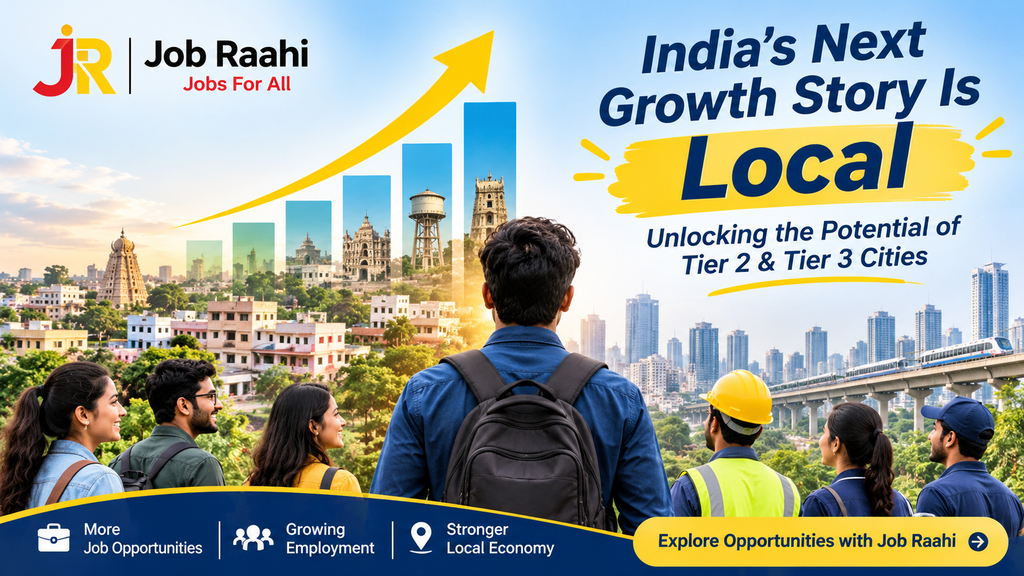
India’s Tier 2 and Tier 3 cities have the potential to become important centres of business activity and employment.
Their growth can benefit companies looking to expand, job seekers searching for opportunities and communities looking for stronger local economies.
However, this potential will only become meaningful when investment, infrastructure, skills and employment opportunities grow together.
At Job Raahi, we believe access to employment opportunities should not be limited by geography.
Our platform connects job seekers with employers across industries, helping freshers and frontline candidates discover relevant opportunities.
Whether you live in a major city or a smaller town, your next career opportunity deserves to be within reach.
Your city has potential. Your skills have value. Your journey can start right where you are.
Explore opportunities with Job Raahi and take your next step towards a better career.